
Control Towers Market Trends, Size & Growth by 2034
Coverage: By Type (Analytical, Operational); Application (Supply Chain, Transportation); End-user (Aerospace and Defense, Chemicals, Retail and Consumer Goods, Healthcare, Manufacturing, Others), and Geography (North America, Europe, Asia Pacific, and South and Central America)
- Status : Data Released
- Report Code : TIPRE00016144
- Category : Electronics and Semiconductor
- No. of Pages : 150
- Available Report Formats :


- Last update date : July 29, 2026


2025 Market Size
US$ 13.05 Bn
Base year value
2034 Forecast
US$ 77.97 Bn
Projected by 2034
CAGR 2026-2034
21.98 %
Growth rate
Addressable Market
US$ 360.56 Bn
(2026-2034)
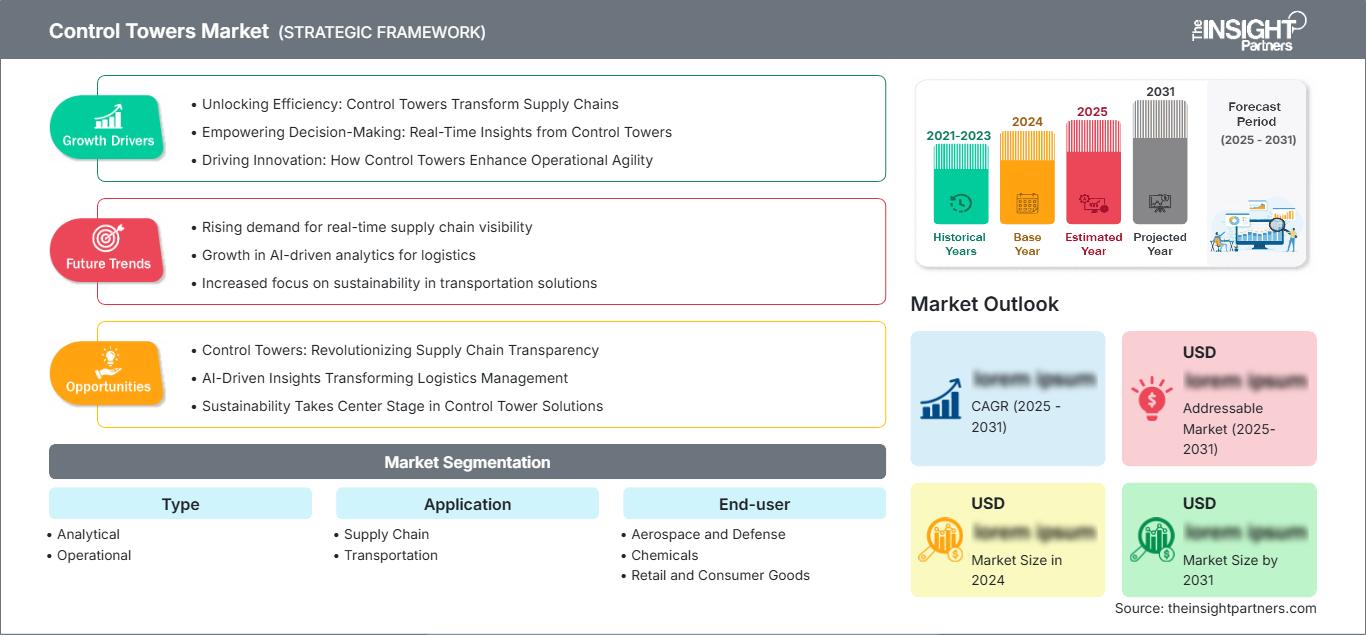
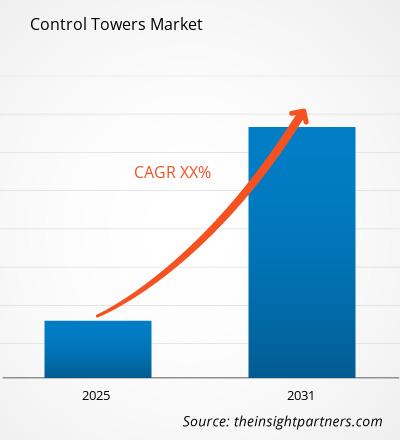
The Control Towers Market was sized at US$ 13.05 Billion in 2025 and is estimated to be worth US$ 77.97 Billion by 2034, marking a CAGR of 21.98% during the period 2026 to 2034. The market growth is driven as companies transition from isolated monitoring to real-time orchestration of their networks related to supply chain, transportation, inventories, manufacturing, and customer fulfillment.
The implementation rate of Control Towers across North America is estimated to increase at a CAGR of 20.8% to 22.2%. The major drivers of the Control Towers Market size include tariff volatility, workforce scarcity, e-commerce service demands, and need for integration of plans into organizations along with execution information of carriers, warehouses, suppliers, and distributors.
Control Towers Market Assessment and Insights
- North America held 35–39% share in 2025 and is growing at a CAGR of 20.8–22.2% during 2026–2034, supported by advanced logistics networks, retail omnichannel demand, and enterprise resilience investments.
- US represented 79–83% of North America in 2025 and is growing at a CAGR of 21.0–22.4%, led by large retailers, manufacturers, defense logistics, and 3PL modernization.
- Europe accounted for 24–28% share in 2025 and is advancing at a CAGR of 19.2–20.8%, with Germany, the UK, France, Italy, and Spain leading adoption.
- Asia Pacific captured 25–29% share in 2025 and is expanding at a CAGR of 23.0–24.6%, led by China, Japan, South Korea, India, and Australia.
- Largest Segment Operational control towers held 56–60% market share in 2025 and are growing at a CAGR of 21.2–22.6%, supported by execution visibility and exception management.
- High Growth Segment Analytical control towers held 40–44% market share in 2025 and are growing at a CAGR of 23.4–24.8%, driven by AI, digital twins, and scenario modeling.
- Key companies analyzed in detail: Accenture plc, Blue Yonder Group, Inc., DHL International GmbH, E2open, LLC, International Business Machines Corporation, Infor Inc., Kinaxis Inc., One Network Enterprises, Inc., SAP SE, and Viewlocity Technologies Pty Ltd.
Source: The Insight Partners' analysis based on proprietary research, government publications, company annual reports, investor presentations, industry databases, and expert interviews.
Control Tower Platforms have moved from being simple shipment visibility dashboards to becoming decisioning systems built around real-time data ingestion, predictive analytics, workflow automation, and collaboration with partners. The Control Towers Market is indicative of the move from passive visibility to action-based orchestration where planners can detect exceptions, simulate outcomes, and orchestrate response actions. The production processes become increasingly reliant on cloud infrastructure, APIs, data management, model accuracy of AI, and integration capabilities of ERP, TMS, WMS, supplier portals, and carriers.
Future demand will be driven by region-specific supply chains, resilient procurement, digital logistics, and requirements of regulatory bodies for traceability. New geographies will contribute through increased manufacturing and logistics infrastructure, whereas developed markets will focus on autonomous resolution of exceptions, sustainability, and control towers' integration with planning. The investments will be made in the platforms that allow reducing human interaction, decreasing disruption response time, and giving auditable and enterprise-wide visibility into decision processes.
Control Towers Market Report Scope
| Report Attribute | Details |
|---|---|
| Market size in 2025 | US$ 13.05 Billion |
| Market Size by 2034 | US$ 77.97 Billion |
| Global CAGR (2026 - 2034) | 21.98% |
| Historical Data | 2021-2024 |
| Forecast period | 2026-2034 |
Control Towers Market Analysis
Control Towers Market growth is spurred on account of fluctuations in the supply chain, greater need for higher service levels and the challenge of balancing cost, inventory, and delivery in real-time. The digitization initiative by the IATA shows that there is an inherent need for interoperable shipment information and the outlook for WTO/IMF trade highlights the risks associated with demand and policies. Companies look at control towers as critical execution tools.
The ecosystem consists of software providers, system integrators, logistics companies, cloud infrastructure companies, analytics providers, data exchange networks, and enterprise buyers. The supply is driven by deployment complexity, quality of master data, process reengineering needs, and pre-built connectors. The buying organization looks for platforms that integrate order, shipment, inventory, capacity, and risk information and facilitate decision-making based on role-based workflows internally and externally.
The Competition within Control Towers Market Report comprises suite providers, logistics providers, and those orchestration-focused players. The competitive landscape includes Blue Yonder Group, Inc., E2open, LLC, Infor Inc., Kinaxis Inc., One Network Enterprises, Inc., SAP SE, and International Business Machines Corporation which compete via planning, execution, and network visibility functions. Accenture plc offers services for transformation programs, DHL International GmbH uses control tower operational models in logistics services, and Viewlocity Technologies Pty Ltd. helps to solve the issue of multi-enterprise visibility.
The strategic differentiation is now driven by AI-driven exception management, time-to-value, industry templates, and connectivity. The providers invest in agentic workflows, natural language querying, digital twin technologies, and risk dashboard solutions which can integrate external data sources such as weather data, tariffs, supplier performances, and transportation issues. The customers move beyond the visibility initiatives towards the operational models involving process ownership, analytics, and improved service level results.
● REPORT CUSTOMIZATION
Tailor This Report To Align With Your Specific Business Requirements
This report can be customized to align precisely with your business objectives, scope, and target markets. Customization options include tailored segmentation, geography, competitive analysis, and strategic insights to support informed decision-making.
Customize This Report →WHAT YOU CAN ADJUST
- ● Segmentations
- ● Geography
- ● Competitive Analysis
- ● Language Preferences
Control Towers Market: Strategic Insights
Regional Insights
North America Control Towers Market
The North America region had a market share of 35–39% in 2025 and is expected to expand at a CAGR of 20.8–22.2% until 2034. Growth in the Control Towers Market shares is driven by large-scale retail networks, sophisticated 3PL activities, defense logistics, and manufacturing supply chain which demands exceptional real-time visibility. U.S. tariff fluctuations and carrier expenses increase the need for predictive visibility and rerouting decisions.
Market demand is focused on operational control towers for logistics execution as well as analytic control towers for modeling scenarios. Retailers use these control towers to manage their inventories, orders, and fulfill capabilities, whereas manufacturers use them for managing supplier risk and production. Integrating with ERP, TMS, WMS, and partner ecosystems is the key priority of customers since disconnected dashboards are not capable of driving action within complex North American logistics footprints.
U.S. Control Towers Market
U.S. constitutes 79–83% of North America in 2025 and is projected to have a CAGR of 21.0-22.4%. The adoption is driven by the intricacy of its distribution network, high expectations from e-commerce deliveries, reshoring projects, and military logistics transformation. Accenture plc, Blue Yonder Group, Inc., International Business Machines Corporation, Infor Inc., Kinaxis Inc., SAP SE, and E2open, LLC continue to retain their relevancy to enterprises.
The most sought-after applications are those of supply chain orchestration, transportation visibility, inventory management, and collaboration with suppliers. Retailers and manufacturers seek control towers for their omnichannel offerings, whereas aerospace, healthcare, and manufacturing industry users look for part availability, compliance, and continuity of operations. American organizations demand more capabilities of artificial intelligence in terms of workflow automation, cybersecurity measures, and expediting/priority shipments reduction.
Europe Control Towers Market
The region occupied 24–28% market share in 2025 and is expected to witness a CAGR of 19.2–20.8%. Leading country-wise implementation in Europe include Germany with automotive, chemicals, industrial manufacturing, and logistics exports; UK with retail, life sciences, and transport visibility initiatives; and France with aerospace, consumer goods, and public sector supply chain modernization.
The countries like Italy and Spain are also adopting the solution in manufacturing corridors, ports, retail distribution, and pharmaceutical logistics; however, procurement cycles continue to be dictated by data privacy concerns, localization, and integration complexities. The European buyers value traceability, sustainability reporting, risk assessment, and compliance requirements. It is ideal for platforms offering multi-country visibility and governance-driven data models & workflows.
APAC Control Towers Market
In the Asia-Pacific region, the market share stood at 25%-29% in 2025, and it is forecasted to have a CAGR of 23.0-24.6%. China takes the lead due to manufacturing, ports, and digital logistics infrastructure. Japan and South Korea will contribute due to electronics and automotive network services, whereas India and Australia will contribute through demand.
Industrial policies, increasing e-commerce activities, and regional production diversification boost adoption rates. APAC customers demand platforms able to address fragmentation of suppliers, multi-level logistics chains, localization of languages, and fast scalability of capacities. The control tower demand is highest where manufacturers and logistics companies need shipment tracking and coordination of inventory with suppliers.
Middle East & Africa Control Towers Market
Middle East & Africa is projected to grow at a CAGR of 18.4–19.8% as Saudi Arabia, the UAE, South Africa, and the rest of MEA invest in logistics hubs, ports, energy supply chains, and healthcare distribution. The UAE leads adoption through trade corridors, air cargo, and integrated logistics infrastructure.
Diversification of energy sources, creation of industrial zones, and food security initiatives generate a need for improved shipment management, inventory management, and supplier management visibility. South Africa helps in this regard through its logistics in retailing and mining, while Saudi Arabia has put effort into transportation and manufacturing ecosystems. Widespread adoption in MEA region requires efficient cloud implementation..
Segmentation Analysis
Type
Type is expected to grow at a CAGR of 22.0–23.4% from 2026 to 2034 as the Control Towers Market scope covers platforms designed for execution monitoring and advanced decision intelligence. Operational systems support live exception handling, while analytical platforms deliver forecasting, scenario testing, and risk modeling. Enterprises increasingly combine both layers to connect visibility with timely intervention and measurable operating outcomes.
- Analytical platforms support predictive risk assessment, scenario simulation, digital twins, and performance analytics. Demand is rising as enterprises seek earlier disruption signals and more informed planning decisions.
- Operational platforms provide live shipment, order, inventory, and capacity visibility. They remain essential for exception management, partner coordination, expedited response, and day-to-day execution reliability.
Application
Application is projected to grow at a CAGR of 21.4–22.8% during 2026–2034 as adoption expands across supply chain and transportation use cases. Supply chain applications focus on supplier coordination, inventory visibility, and fulfillment trade-offs, while transportation applications emphasize shipment tracking, carrier performance, routing, ETA accuracy, and disruption response across multimodal networks.
- Supply Chain applications lead demand because they connect procurement, production, inventory, orders, and customer service. Strategic value rises when platforms support multi-tier supplier visibility and allocation decisions.
- Transportation applications address carrier tracking, route exceptions, dock scheduling, freight cost control, and ETA accuracy. They are strategically important for shippers facing volatile capacity and service expectations.
End-user
End-user is expected to grow at a CAGR of 21.0–22.5% from 2026 to 2034 as regulated and asset-intensive sectors adopt control towers to improve resilience. Aerospace and defense prioritize parts availability, chemicals focus on compliance and safety, retail requires omnichannel responsiveness, healthcare needs traceability, and manufacturing uses control towers to align supplier capacity with production continuity.
- Aerospace and Defense relies on control towers for critical parts visibility, supplier risk monitoring, maintenance logistics, and secure fulfillment where delays can affect readiness and contractual performance.
- Chemicals uses these platforms to coordinate hazardous goods movement, inventory buffers, compliance documentation, and plant supply continuity across complex regional and global distribution networks.
- Retail and Consumer Goods applies control towers to improve inventory allocation, store replenishment, e-commerce fulfillment, returns visibility, and service reliability during demand spikes.
- Healthcare requires temperature-sensitive shipment visibility, product traceability, shortage response, and supplier coordination for pharmaceuticals, devices, hospital networks, and critical medical supplies.
- Manufacturing uses control towers to monitor supplier capacity, inbound materials, production constraints, shipment delays, and customer commitments across multi-tier industrial networks.
Opportunity Snapshot
| End-user | Revenue Contribution | Trend Tag | Adoption Stage |
| Aerospace and Defense | High | Parts Readiness | Scaling |
| Chemicals | Medium | Compliance Flow | Scaling |
| Retail and Consumer Goods | High | Omnichannel Flow | Mature |
| Healthcare | Medium | Cold Chain | Scaling |
| Manufacturing | High | Supplier Sync | Scaling |
Control Towers Market Growth Drivers and Impact Analysis
Real-Time Visibility Becomes an Execution Requirement
Global supply chains now operate with tighter delivery windows, fragmented supplier bases, and higher disruption frequency, making delayed reporting inadequate for service-critical decisions. Control towers aggregate orders, inventory, shipments, capacity, and partner updates into a shared operating view that helps teams identify exceptions earlier. The practical impact is lower manual expediting, faster escalation, and better coordination between planning and execution. Companies can prioritize constrained inventory, reroute shipments, and communicate service risks before failures reach customers. Vendors benefit when they provide prebuilt connectors, workflow automation, and role-specific dashboards that convert visibility into action. Adoption strengthens when buyers can quantify reduced premium freight, fewer stockouts, and improved on-time delivery.
AI-Enabled Orchestration Improves Disruption Response
Artificial intelligence is changing control towers from monitoring tools into decision-support platforms. AI agents can detect anomalies, summarize root causes, recommend corrective actions, and simulate trade-offs across cost, service, and inventory outcomes. This matters because supply chain teams often face too many exceptions for manual triage. The market impact is stronger demand for analytical platforms that can prioritize issues by financial or customer impact. Buyers will look for explainable recommendations, configurable approval rules, and integration with execution systems so decisions can be implemented quickly. Suppliers that combine predictive models with governance, audit trails, and human-in-the-loop workflows will capture larger transformation budgets across retail, manufacturing, healthcare, and logistics.
Regulated Industries Need Traceable Multi-Party Networks
Aerospace, defense, healthcare, chemicals, and food-related supply chains require traceability across suppliers, carriers, warehouses, and customers. Control towers help these sectors document chain of custody, monitor shipment conditions, detect supplier delays, and coordinate corrective actions. The real-world impact is improved compliance readiness and reduced operational risk when disruptions affect critical materials or regulated products. Healthcare users need product availability and cold-chain visibility, while chemicals users require safer transport coordination and documentation. Aerospace and defense buyers focus on parts readiness and supplier risk. Vendors that provide secure data exchange, permissioned partner collaboration, and auditable workflows can address these high-value use cases more effectively than generic dashboard providers.
Control Towers Market Future Trends
Agentic Planning and Execution Workflows Expand
Control Towers Market trends will increasingly favor agentic workflows that monitor conditions, generate recommended actions, and trigger approved responses across planning and execution systems. Future platforms will combine digital twins, natural-language interfaces, and autonomous exception triage to reduce planner workload. This shift will not eliminate human oversight, but it will change user roles toward governance, scenario approval, and outcome management. Vendors will compete on model transparency, configurable guardrails, and proof that automation improves service and cost performance without creating operational risk.
Industry-Specific Control Tower Templates Gain Adoption
Future deployments will rely more heavily on preconfigured workflows for sectors such as retail, healthcare, chemicals, aerospace, and manufacturing. Industry templates reduce implementation time by embedding relevant metrics, alerts, partner roles, compliance fields, and escalation paths. This trend will help mid-sized enterprises adopt control towers without lengthy custom development. Suppliers will differentiate through reusable data models, verticalized AI recommendations, and partner ecosystems. Buyers will expect faster time-to-value, clearer benchmarks, and upgrade paths that allow templates to expand from visibility into orchestration.
Control Towers Market Opportunities
Transportation Visibility Connected to Inventory Decisions
Control Towers Market Forecasts support investment in platforms that connect transportation visibility with inventory allocation, order promising, and fulfillment decisions. Many shippers already track shipments, but the higher-value opportunity is linking ETA changes to customer service, replenishment, and production priorities. Vendors can target retailers, manufacturers, and healthcare distributors that need to decide which orders to protect when delays occur. The investment case improves when control towers reduce premium freight, prevent stockouts, and improve promise accuracy. Partnerships with carriers, TMS providers, and inventory optimization platforms will be essential for scalable deployment.
Managed Control Tower Services for Complex Networks
Enterprises with limited internal analytics and integration capacity create an opportunity for managed control tower services. Logistics providers and consulting firms can combine technology, process governance, exception management, and continuous improvement into an operating model. This is attractive for companies that need rapid visibility but lack the staff to redesign workflows or maintain partner data quality. Managed services can support supplier onboarding, transport monitoring, KPI reporting, and disruption response playbooks. Providers should emphasize measurable outcomes, cybersecurity, multilingual operations, and industry expertise because buyers will evaluate service value against internal control tower build costs.
Recent Developments
- March 2026: Kinaxis Inc. advanced large-scale supply chain optimization with NVIDIA AI to strengthen decision orchestration and accelerate complex planning workloads. The initiative supports faster scenario evaluation and reinforces the role of AI-enabled control towers in managing volatility across global operations.
- September 2025: Blue Yonder Group, Inc. was named a leader in the 2025 control tower technology assessment, with its Command Center and network capabilities recognized for collaboration, orchestration, AI recommendations, and multi-enterprise supply chain visibility.
- October 2024: DHL International GmbH deployed generative AI applications at scale to enhance data management, customer support, and proposal accuracy across supply chain operations, strengthening the analytics foundation needed for orchestration-led logistics services.
Frequently Asked Questions

- Comprehensive Market Sizing and Forecast Analysis
- Detailed Segmentation Analysis
- In-Depth Market Dynamics Assessment
- Regional and Country-Level Insights
- Competitive Landscape and Company Benchmarking
- Strategic Business Intelligence
Recent Reports
Testimonials

The Insight Partners' SCADA System Market report is comprehensive, with valuable insights on current trends and future forecasts. The team was highly professional, responsive, and supportive throughout. We are very satisfied and highly recommend their services.
RAN KEDEM Partner, Reali Technologies LTDs
I requested a report on a very specific software market and the team produced the report in a few days. The information was very relevant and well presented. I then requested some changes and additions to the report. The team was again very responsive and I got the final report in less than a week.
JEAN-HERVE JENN Chairman, Future Analytica
We worked with The Insight Partners for an important market study and forecast. They gave us clear insights into opportunities and risks, which helped shape our plans. Their research was easy to use and based on solid data. It helped us make smart, confident decisions. We highly recommend them.
PIYUSH NAGPAL Sr. Vice President, High Beam Global
The Insight Partners delivered insightful, well-structured market research with strong domain expertise. Their team was professional and responsive throughout. The user-friendly website made accessing industry reports seamless. We highly recommend them for reliable, high-quality research services
YUKIHIKO ADACHI CEO, Deep Blue, LLC.
This is the first time I have purchased a market report from The Insight Partners.While I was unsure at first, I visited their web site and felt more comfortable to take the risk and purchase a market report.I am completely satisfied with the quality of the report and customer service. I had several questions and comments with the initial report, but after a couple of dialogs over email with their analyst I believe I have a report that I can use as input to our strategic planning process.Thank you so much for taking the extra time and making this a positive experience.I will definitely recommend your service to others and you will be my first call when we need further market data.
JOHN SUZUKI President and Chief Executive Officer, Board Director, BK Technologies
I wish to appreciate your support and the professionalism you displayed in the course of attending to my request for information regarding to infectious disease IVD market in Nigeria. I appreciate your patience, your guidance, and the fact that you were willing to offer a discount, which eventually made it possible for us to close a deal. I look forward to engaging The Insight Partners in the future, all thanks to the impression you have created in me as a result of this first encounter.
DR CHIJIOKE ONYIA MANAGING DIRECTOR, PineCrest Healthcare Ltd.Reason to Buy
- Informed Decision-Making
- Understanding Market Dynamics
- Competitive Analysis
- Identifying Emerging Markets
- Customer Insights
- Market Forecasts
- Risk Mitigation
- Boosting Operational Efficiency
- Strategic Planning
- Investment Justification
- Tracking Industry Innovations
- Aligning with Regulatory Trends





 Get Free Sample for