
Dark Fiber Networks Market Size, Share & Growth by 2034
Coverage: by Fiber Type (Single Mode, Multi-mode); Network Type (Metro, Long-haul); End-user (Internet Service Providers (ISPs) and Telecom, Oil and Gas, Hospitality and Retail, BFSI, Healthcare, Others) , and Geography (North America, Europe, Asia Pacific, and South and Central America)
- Status : Data Released
- Report Code : TIPRE00012447
- Category : Electronics and Semiconductor
- No. of Pages : 150
- Available Report Formats :


- Last update date : August 04, 2026


2025 Market Size
US$ 6.49 Bn
Base year value
2034 Forecast
US$ 12.02 Bn
Projected by 2034
CAGR 2026-2034
7.09 %
Growth rate
Addressable Market
US$ 83.56 Bn
(2026-2034)
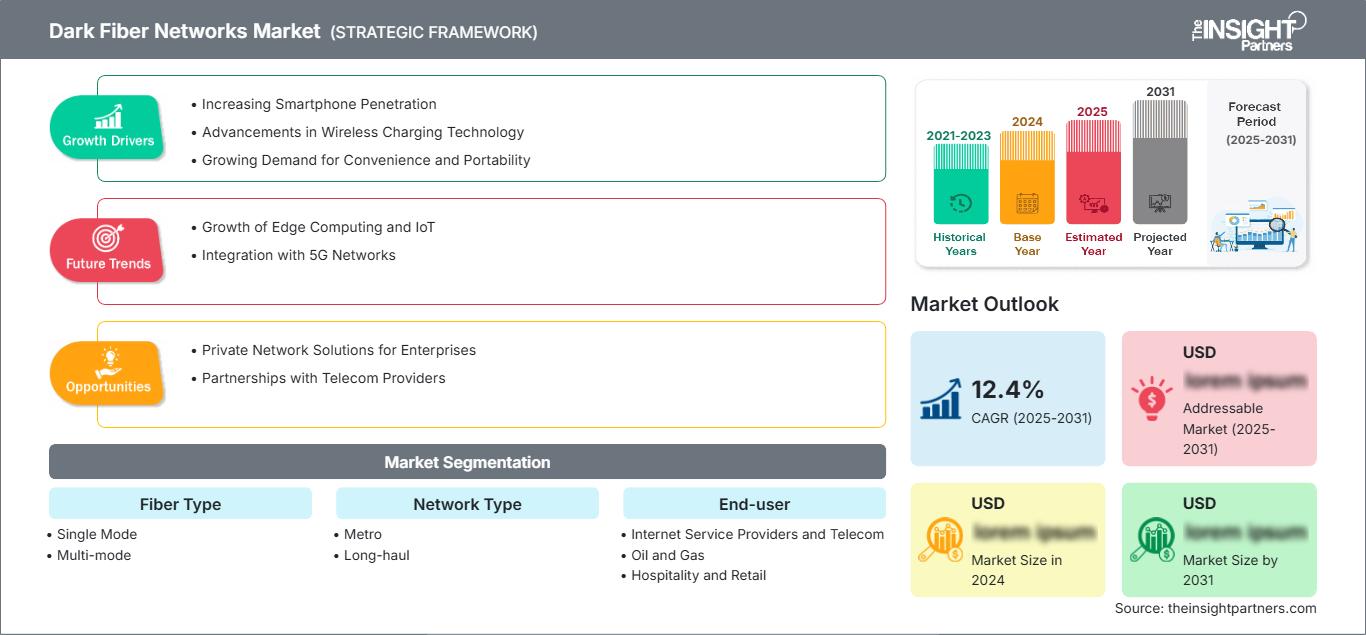
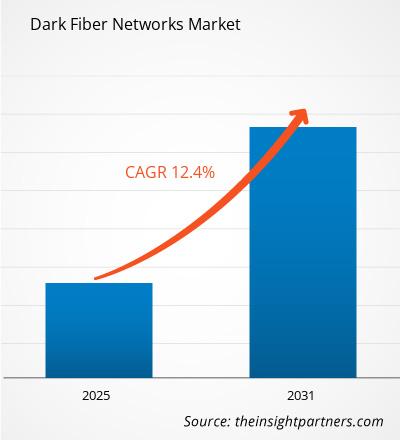
The global Dark Fiber Networks market was valued at US$ 6.49 billion in 2025 and is expected to reach US$ 12.02 billion by 2034; it is estimated to record a CAGR of 7.09% during 2026-2034.
Dark Fiber Networks Market Assessment and Insights
- North America held 36–39% share in 2025 and is growing at a CAGR of 7.4–8.0% during 2026–2034, led by U.S. broadband programs, data center interconnect demand, and metro route consolidation.
- US accounted for 82–86% of North America in 2025 and is growing at a CAGR of 7.5–8.1% during 2026–2034, supported by AI-ready fiber builds.
- Europe represented 25–28% share in 2025 and is growing at a CAGR of 7.0–7.7% during 2026–2034, with the UK, Germany, France, Spain, and Italy leading wholesale fiber modernization.
- Asia Pacific captured 22–25% share in 2025 and is growing at a CAGR of 8.6–9.4% during 2026–2034, led by China, India, Japan, South Korea, and Australia data center expansion.
- Largest Segment Single Mode held 76–80% Dark Fiber Networks market share in 2025, with a CAGR of 7.8–8.4% during 2026–2034 due to long-distance, high-bandwidth deployment suitability.
- High Growth Segment Healthcare held 7–10% market share in 2025, with a CAGR of 9.0–9.8% during 2026–2034 as secure imaging, telehealth, and hospital cloud connectivity rise.
- Key companies analyzed in detail: Lumen Technologies, Inc.; Colt Technology Services Group Limited; Comcast Corporation; Consolidated Communications Holdings, Inc.; Crown Castle Inc.; GTT Communications, Inc.; Ufinet Telecom, S.A.U.; Verizon Communications Inc.; Windstream Services, LLC; Zayo Group, LLC.
Source: The Insight Partners' analysis based on proprietary research, government publications, company annual reports, investor presentations, industry databases, and expert interviews.
Network economics are evolving away from a reliance on leased bandwidth toward optical infrastructure that can be controlled. Network providers are focusing on spare fiber, routing diversity, high density wavelength, and scalable backhaul in order to support cloud region connectivity, carrier neutral data centers, 5G backhaul, and enterprise redundancy. There is also growing manufacturing capacity for fiber cables and associated components in North America due to funding for broadband deployment and domestic procurement requirements.
Future demand for these services should diversify into corridors for emerging data centers, smart energy grids, healthcare campus environments, and digital government initiatives. Focus on broadband connectivity, infrastructure resiliency, and data sovereignty regulations make the case even stronger for dark fiber either through ownership or leasing.
Dark Fiber Networks Market Report Scope
| Report Attribute | Details |
|---|---|
| Market size in 2025 | US$ 6.49 Billion |
| Market Size by 2034 | US$ 12.02 Billion |
| Global CAGR (2026 - 2034) | 7.09% |
| Historical Data | 2021-2024 |
| Forecast period | 2026-2034 |
Dark Fiber Networks Market Analysis
Factors driving the Dark Fiber Networks Market include cloud migrations, workload distribution related to artificial intelligence, low-latency trading, 5G transport, and enterprise security needs. In contrast to lit offerings, dark fibers allow their customers the flexibility in terms of equipment, scalability of bandwidth, encryption levels, and network topology. Demand is high in places where traffic patterns are highly uncertain and longer term capacity planning points toward ownership-type economics.
The supply chain involves fiber owners, trenching service providers, rights-of-way providers, network equipment manufacturers, data center operators, telecommunication carriers, and enterprises as end-customers. Some limiting factors on the supply side include time required for permits, availability of labor, accessibility of conduits, and capital intensity. However, there have been efforts to optimize routes through purchase of brownfield fibers and network sharing arrangements.
According to Dark Fiber Networks Market analysis, the competition is now consolidating into operators who have complementing metro and long-haul coverage. Zayo Group, LLC, Lumen Technologies, Inc., Verizon Communications Inc., Comcast Corporation, and Crown Castle Inc. shape the U.S. availability landscape, while Colt Technology Services Group Limited and Ufinet Telecom, S.A.U. impact Europe and Latin America enterprise routes.
The competitive landscape is becoming ever more about proximity to hyperscale campuses, carrier-neutral facilities, subsea landing stations, and regulated enterprise campuses. GTT Communications, Inc., Windstream Services, LLC, and Consolidated Communications Holdings, Inc. compete by leveraging their regional strength and wholesale expertise, as well as enterprise tailoring. Investors prefer network operators that are capable of supporting AI inference, cloud peering, and route diversification without additional civil works.
● REPORT CUSTOMIZATION
Tailor This Report To Align With Your Specific Business Requirements
This report can be customized to align precisely with your business objectives, scope, and target markets. Customization options include tailored segmentation, geography, competitive analysis, and strategic insights to support informed decision-making.
Customize This Report →WHAT YOU CAN ADJUST
- ● Segmentations
- ● Geography
- ● Competitive Analysis
- ● Language Preferences
Dark Fiber Networks Market: Strategic Insights
Regional Insights
North America Dark Fiber Networks Market
North America accounted for 36-39% market share in 2025 and is forecast to grow with a CAGR of 7.4-8.0% from 2026 to 2034. The Dark Fiber Networks Market share is supported by the U.S. Broadband Equity, Access, and Deployment initiative, FCC Broadband Map, and growth in Fiber Serviceable Locations. Cloud regions, financial centers, and AI campuses are increasing the demand for privately operated optical paths.
Canada makes its contribution through metropolitan network extensions in Toronto, Montreal, Calgary, and Vancouver, whereas the U.S. network operators construct tight rings surrounding the data centers and business areas. Improvements in the availability of optical fibers are provided by investments in fiber manufacturing and incentives for local supply, but permit, pole access, and construction labor are still constraints.
U.S. Dark Fiber Networks Market
In 2025, the U.S. will represent 82–86% of Dark Fiber Networks market share in North America, and its CAGR rate is estimated to be 7.5–8.1%. The demand is mainly clustered in Northern Virginia, Dallas, Chicago, Phoenix, Atlanta, and Silicon Valley due to hyperscaler, finance, healthcare, and carrier ecosystems that need low-latency private capacity.
Zayo Group, LLC, Verizon Communications Inc., Comcast Corporation, Lumen Technologies, Inc., Windstream Services, LLC, and Consolidated Communications Holdings, Inc. have excellent route assets in the metro and long-haul routes. The applications comprise data center interconnection, 5G fronthaul/backhaul, hospitals network, municipal broadband, and enterprise disaster recovery services. AI use cases are forcing procurement towards scalable strand-level access.
Europe Dark Fiber Networks Market
Europe has had a share of 25–28% in 2025 and will continue to have a CAGR of 7.0–7.7% during 2026–2034. The UK is ahead of the pack due to data center density in and around London, Slough, Manchester, and regional cloud exchanges, while alternative networks provide wholesale connectivity and services.
Germany is seeing a surge because of industrial digitization, automotive cloud platforms, and deferred full-fiber rollouts resulting in the need for large capacity enterprise routes. Frankfurt continues to be the dominant exchange-based market, and permitting will be key to accelerated deployment. France, Spain, Italy, and the Nordics can capitalize on FTTH deployments and sub-sea gateways.
APAC Dark Fiber Networks Market
The APAC region had 22 to 25% Dark Fiber Networks market share in 2025 and is growing with a CAGR of 8.6 to 9.4 percent from 2026 to 2034. China has the largest network and India, Japan, South Korea, and Australia increase the demand via cloud region, 5G transport, and enterprise digitization.
Government initiatives on broadband, sovereign clouds, and hyperscale data center construction pipelines are boosting terrestrial and metropolitan fiber demand. Undersea cable investments also contribute to demand for landing station backhaul. Power limitations and route complexities require comprehensive planning by operators and infrastructure players.
Middle East & Africa Dark Fiber Networks Market
Middle East and Africa is growing at a CAGR of 8.2–9.0% during 2026–2034, with the UAE as the leading connectivity hub. Saudi Arabia, South Africa, and the Rest of MEA are adding fiber capacity for cloud zones, financial centers, smart cities, and energy operations.
Energy infrastructure, submarine landing points, and national digital strategies shape deployment priorities. Oil and gas operators require secure fiber for field automation, while governments invest in resilient broadband corridors. Financing remains uneven, but wholesale neutral-host models are improving route utilization and cross-border connectivity.
Segmentation Analysis
Fiber Type
Fiber Type is expected to grow at a CAGR of 7.7–8.5% during 2026–2034. The Dark Fiber Networks Market scope across this segment is shaped by distance, bandwidth, attenuation, and cost requirements. Single mode dominates long-haul, metro backbone, and data center interconnect routes, while multi-mode remains useful inside campuses, buildings, and shorter enterprise links.
- Single Mode supports long-distance, high-capacity transmission with lower signal loss, making it strategically important for telecom backbones, cloud connectivity, 5G transport, and wholesale carrier networks.
- Multi-mode serves short-reach enterprise, hospital, hospitality, and campus environments where lower installation complexity, shorter runs, and localized bandwidth demand justify deployment.
Network Type
Network Type is expected to grow at a CAGR of 7.6–8.8% during 2026–2034. Metro networks benefit from edge computing, enterprise districts, hospitals, financial exchanges, and data center clusters. Long-haul networks remain essential for intercity cloud routes, subsea cable backhaul, disaster recovery, and national wholesale transport.
- Metro networks show strong demand in dense urban corridors where enterprises, data centers, carriers, and public agencies need diverse routes, low latency, and scalable bandwidth.
- Long-haul networks connect cities, cloud regions, landing stations, and industrial corridors, supporting resilience, traffic redundancy, and national-scale bandwidth aggregation.
End-user
End-user is expected to grow at a CAGR of 7.9–8.9% during 2026–2034. Internet service providers and telecom operators remain the largest buyers because they require flexible transport capacity. BFSI, healthcare, oil and gas, hospitality, and retail increasingly lease dark fiber for security, low latency, uptime control, and cloud modernization.
- Internet Service Providers and Telecom drive backbone, middle-mile, and last-mile aggregation demand, using dark fiber to manage traffic growth, 5G transport, peering, and wholesale service differentiation.
- Oil and Gas uses dedicated fiber for field automation, pipeline monitoring, offshore connectivity, seismic data transfer, and secure communication across remote production assets.
- Hospitality and Retail adopts fiber for payment systems, guest connectivity, inventory platforms, video analytics, and multi-site cloud applications requiring reliable bandwidth.
- BFSI prioritizes low-latency routes, secure data replication, trading platforms, branch modernization, and compliance-grade disaster recovery between primary and secondary sites.
- Healthcare needs dedicated capacity for imaging files, telemedicine, hospital information systems, research data, and connected medical devices where security and uptime are critical.
Opportunity Snapshot
| End-user | Revenue Contribution | Trend Tag | Adoption Stage |
| Internet Service Providers and Telecom | High | 5G Backhaul | Mature |
| Oil and Gas | Medium | Field Automation | Scaling |
| Hospitality and Retail | Medium | Store Cloud | Scaling |
| BFSI | High | Low Latency | Mature |
| Healthcare | Medium | Medical Imaging | Scaling |
Dark Fiber Networks Market Growth Drivers and Impact Analysis
AI and Cloud Workloads Require Dedicated Optical Capacity
The growing need for AI training, inference, and cloud-based enterprise applications is generating more traffic in east-west connections between compute clusters, storage clusters, and edge sites. Fiber-optic connectivity allows customers to increase capacity simply by upgrading their hardware and not renegotiate their lit bandwidth. The effect on the market will be an increased demand for metro rings surrounding the data centers and long-haul circuits linking cloud regions. For operators that own some dark fiber, have diverse routing paths, and have access to carrier hotels, this will be an opportunity to monetize their assets sooner.
Public Broadband Funding Improves Fiber Availability
The deployment of government-sponsored broadband schemes is boosting fiber coverage across the middle mile and last mile, thus generating opportunities for the leasing of dark fiber assets. In the United States, federal mapping and BEAD initiatives focus on unserved and underserved regions, while in Europe, digital ambitions remain committed to the expansion of full-fiber networks. With better infrastructure being put in place through government funding, private providers can build wholesale and enterprise connections to secondary cities. The effect is more geographic presence, better economics of rural backhaul, and improved network design. But the implementation requires permits, compliance, workforce, and coordination among many stakeholders.
Enterprise Security and Latency Needs Favor Private Routes
Organizations in BFSI, healthcare, energy, and government increasingly require predictable performance, direct control, and stronger data protection. Dark fiber supports customer-managed encryption, dedicated routing, and traffic isolation, making it attractive for regulated data movement and disaster recovery. Low-latency requirements in trading, imaging, cloud replication, and industrial monitoring further strengthen adoption. The real-world impact is a shift from generic connectivity procurement to network architecture decisions tied to risk management. Providers that can offer diverse paths, service-level transparency, and scalable expansion options are better positioned to capture long-duration enterprise contracts.
Dark Fiber Networks Market Future Trends
AI Inference Will Reshape Metro Fiber Demand
Dark Fiber Networks Market trends will increasingly reflect AI inference moving closer to enterprises, hospitals, factories, and consumers. This shift will require lower-latency metro routes, distributed data center interconnects, and edge aggregation points rather than only large centralized training corridors. Operators are expected to prioritize dense rings around business districts, campuses, and cloud on-ramps. The result will be more granular leasing models, stronger demand for route diversity within cities, and higher utilization of previously underused fiber strands.
Neutral-Host Fiber Platforms Will Gain Importance
Neutral-host fiber models are expected to expand as municipalities, utilities, carriers, and infrastructure funds seek better asset utilization. Shared conduits and wholesale dark fiber can reduce duplicated civil works, improve rural project economics, and accelerate operator onboarding. This trend may be especially relevant in Europe and APAC, where permitting, dense urban construction, and sustainability targets pressure traditional build models. Buyers will prefer platforms that combine transparent access terms, documented route diversity, and scalable capacity for multiple service providers.
Dark Fiber Networks Market Opportunities
Secondary Data Center Corridors Create New Fiber Routes
Dark Fiber Networks Market Forecasts point to rising opportunity in secondary data center corridors where power availability, land costs, and latency requirements are shifting infrastructure away from saturated hubs. Investors can target routes connecting emerging campuses to cloud regions, carrier hotels, and subsea landing points. These builds may offer stronger long-term utilization because AI inference and enterprise cloud adoption require distributed connectivity. Success will depend on early rights-of-way acquisition, utility coordination, anchor tenant commitments, and designs that allow later strand monetization.
Healthcare and BFSI Offer Premium Enterprise Demand
Healthcare systems and financial institutions offer attractive opportunities because they value uptime, privacy, and deterministic performance more than lowest-cost bandwidth. Hospitals need imaging transfer, telehealth, research connectivity, and multi-site resilience, while BFSI buyers require low-latency trading, secure replication, and branch modernization. Providers can differentiate through diverse routes, rapid provisioning, and customer-managed equipment options. Targeted sales around compliance, continuity, and cyber resilience can convert dark fiber from a technical product into a strategic infrastructure decision.
Recent Developments
- July 2026: WhiteFiber announced the successful testing of its cross-data-center networking solution designed to connect geographically separated data centers into a unified distributed GPU supercluster for large-scale artificial intelligence workloads. The technology achieved 111.2 Tbps bandwidth across an 83 km dark fiber connection with round-trip latency of 0.9 milliseconds, demonstrating the potential to support AI computing environments that require massive processing capacity and high-speed data movement.
- June 2025: Lumen Technologies announced that it will provide dark fiber backhaul connectivity for the JUNO Trans-Pacific Cable System, a high-capacity subsea cable linking Japan and the United States. Lumen’s fiber network will connect the JUNO cable’s U.S. landing point in Grover Beach, California, to major network hubs in San Jose and Los Angeles, enabling faster and more reliable data transport between Asia and North America.
- May 2026: BIG Fiber secured $250 million in financing from Stonepeak and Caisse de dépôt et placement du Québec to expand its dark fiber network and increase connectivity capacity in response to rising demand from artificial intelligence infrastructure and large-scale data center deployments. The investment will support the development of new fiber routes and upgrades to existing network infrastructure across key markets, including the San Francisco Bay Area, Hillsboro, and Atlanta.
Frequently Asked Questions

- Comprehensive Market Sizing and Forecast Analysis
- Detailed Segmentation Analysis
- In-Depth Market Dynamics Assessment
- Regional and Country-Level Insights
- Competitive Landscape and Company Benchmarking
- Strategic Business Intelligence
Recent Reports
Testimonials

The Insight Partners provided valuable market intelligence that supported our global go-to-market strategy. Their team was professional, responsive, and attentive to our feedback, providing thoughtful analysis and helpful methodological clarifications throughout the project.
Junmo Kim Chief Financial Officer (CFO), Enertech Co., Ltd.
The Insight Partners' SCADA System Market report is comprehensive, with valuable insights on current trends and future forecasts. The team was highly professional, responsive, and supportive throughout. We are very satisfied and highly recommend their services.
RAN KEDEM Partner, Reali Technologies LTDs
I requested a report on a very specific software market and the team produced the report in a few days. The information was very relevant and well presented. I then requested some changes and additions to the report. The team was again very responsive and I got the final report in less than a week.
JEAN-HERVE JENN Chairman, Future Analytica
We worked with The Insight Partners for an important market study and forecast. They gave us clear insights into opportunities and risks, which helped shape our plans. Their research was easy to use and based on solid data. It helped us make smart, confident decisions. We highly recommend them.
PIYUSH NAGPAL Sr. Vice President, High Beam Global
The Insight Partners delivered insightful, well-structured market research with strong domain expertise. Their team was professional and responsive throughout. The user-friendly website made accessing industry reports seamless. We highly recommend them for reliable, high-quality research services
YUKIHIKO ADACHI CEO, Deep Blue, LLC.
This is the first time I have purchased a market report from The Insight Partners.While I was unsure at first, I visited their web site and felt more comfortable to take the risk and purchase a market report.I am completely satisfied with the quality of the report and customer service. I had several questions and comments with the initial report, but after a couple of dialogs over email with their analyst I believe I have a report that I can use as input to our strategic planning process.Thank you so much for taking the extra time and making this a positive experience.I will definitely recommend your service to others and you will be my first call when we need further market data.
JOHN SUZUKI President and Chief Executive Officer, Board Director, BK Technologies
I wish to appreciate your support and the professionalism you displayed in the course of attending to my request for information regarding to infectious disease IVD market in Nigeria. I appreciate your patience, your guidance, and the fact that you were willing to offer a discount, which eventually made it possible for us to close a deal. I look forward to engaging The Insight Partners in the future, all thanks to the impression you have created in me as a result of this first encounter.
DR CHIJIOKE ONYIA MANAGING DIRECTOR, PineCrest Healthcare Ltd.Reason to Buy
- Informed Decision-Making
- Understanding Market Dynamics
- Competitive Analysis
- Identifying Emerging Markets
- Customer Insights
- Market Forecasts
- Risk Mitigation
- Boosting Operational Efficiency
- Strategic Planning
- Investment Justification
- Tracking Industry Innovations
- Aligning with Regulatory Trends





 Get Free Sample for