
Data Center Rack Server Market Size, Share & Trends by 2034
Coverage: by Form Factor (1U, 2U, 4U, Others); Tier Type (Tier 1, Tier 2, Tier 3, Tier 4); Industry Vertical (BFSI, IT and Telecom, Healthcare and Life Sciences, Retail and E-commerce, Energy and Utilities, Others) , and Geography (North America, Europe, Asia Pacific, and South and Central America)
- Status : Data Released
- Report Code : TIPRE00008266
- Category : Electronics and Semiconductor
- No. of Pages : 150
- Available Report Formats :


- Last update date : July 27, 2026


2025 Market Size
US$ 116.62 Bn
Base year value
2034 Forecast
US$ 384.12 Bn
Projected by 2034
CAGR 2026-2034
14.16 %
Growth rate
Addressable Market
US$ 2,156.14 Bn
(2026-2034)
The Data Center Rack Server Market size stood at US$ 116.62 Billion in 2025 and forecast to rise to US$ 384.12 Billion by 2034 at a CAGR of 14.16% between 2026-2034. This market includes the increasing use of rack-based compute platforms in hyperscale data centers, colocation data centers, enterprises, telecommunications, and the edge environment as organizations scale up their artificial intelligence, cloud, analytics, virtualization, and HPC workloads.
North America is anticipated to progress at a CAGR of 13.2-14.0% between 2026-2034 driven by investments in AI data centers, growth in cloud regions, and replacement of old enterprise data center infrastructure. Drivers for the market include high rack power density, liquid cooling compatibility, hybrid IT security, and ongoing procurements from hyperscaler, colocation players, government organizations, and banks.
Data Center Rack Server Market Assessment and Insights
- North America held 35–39% Data Center Rack Server Market share in 2025 and is growing at a CAGR of 13.2–14.0% during 2026–2034, led by AI clusters, cloud regions, and high-density colocation capacity.
- US represented 82–86% of North American revenue in 2025 and is growing at a CAGR of 13.4–14.2% during 2026–2034, supported by hyperscale AI procurement.
- Europe accounted for 20–24% share in 2025 and is growing at a CAGR of 12.1–12.9% during 2026–2034, with Germany, the UK, France, Italy, and Spain leading upgrades.
- Asia Pacific held 28–32% share in 2025 and is growing at a CAGR of 15.0–15.8% during 2026–2034, led by China, Japan, South Korea, India, and Australia.
- Largest Segment Large Data Centers held 62–66% market share in 2025 and is growing at a CAGR of 14.3–15.1% during 2026–2034 due to hyperscale deployments.
- High Growth Segment 2U represented 34–38% market share in 2025 and is growing at a CAGR of 15.2–16.0% during 2026–2034, supported by accelerated computing.
- Key companies analyzed in detail: Cisco Systems, Inc.; Dell Technologies Inc.; Fujitsu Limited; Hewlett Packard Enterprise Development LP; Huawei Technologies Co., Ltd.; Lenovo Group Limited; NEC Corporation; Oracle Corporation; Quanta Computer Inc.; Rittal GmbH and Co. KG.
Source: The Insight Partners' analysis based on proprietary research, government publications, company annual reports, investor presentations, industry databases, and expert interviews.
From an infrastructure perspective, rack server design has moved away from standard x86 to accelerated, power-dense, serviceable solutions, offering GPU, CPU, memory, storage, networking, and security capabilities in rack-limited environments. The Data Center Rack Server Market will see changes, with vendors designing 1U, 2U, and 4U racks that can handle increased heat dissipation, faster connection speeds, direct liquid cooling, and automated management solutions. The manufacturing process is now influenced by the amount of processors, motherboards, power conversions, logistics, security of firmware, and rack testing in manufacturing.
The future demand will be driven by new cloud regions, AI infrastructure projects in various countries, data sovereignty regulations, and industry-specific modernization of enterprises. Investments in the Data Center Rack Server Market are expected to come from India, Southeast Asia, the Gulf states, and Latin America, while advanced economies will emphasize power savings, workload consolidation, and secure hybrid IT environment. The regulation will impact the specifications, procurement timing, and qualification of vendors.
Data Center Rack Server Market Report Scope
| Report Attribute | Details |
|---|---|
| Market size in 2025 | US$ 116.62 Billion |
| Market Size by 2034 | US$ 384.12 Billion |
| Global CAGR (2026 - 2034) | 14.16% |
| Historical Data | 2021-2024 |
| Forecast period | 2026-2034 |
Data Center Rack Server Market Analysis
The market growth stems from the shift from compute-centric platforms to those that support AI training, inference, analytics, cloud-native computing, and virtualized enterprise workloads. Servers contribute significantly to overall electricity consumption within modern data centers, thus making compute density, power efficiency, and cooling capability key considerations during purchases. The supply chain consists of processors, memory companies, storage providers, boards manufacturers, ODMs, OEMs, rack servers, software management solutions, distributors, hyperscale organizations, colocation providers, and enterprise IT.
The supply chain is influenced by the availability of GPUs, roadmaps for future CPUs, limitations of high-bandwidth memory, motherboard limitations, power supply delivery times, and the availability of liquid-cooling components. The buyers are emphasizing the lifecycle performance of products because, although dense systems consume less floor space, they have more complex power and cooling issues. The market demand is highest in situations where application growth is linked with compute capability growth, including cloud computing, financial modeling, cybersecurity, generative AI, digital twins, and simulations.
The Data Center Rack Server Market analysis indicates competition among global server OEMs, network companies, enterprise infrastructure players, and design and manufacturing collaborators. Competition in the market is among Dell Technologies Inc., Hewlett Packard Enterprise Development LP, Lenovo Group Limited, Cisco Systems, Inc., Huawei Technologies Co., Ltd., and Oracle Corporation based on integrated compute offerings, AI readiness, management solutions, security options, and enterprise channel coverage. Quanta Computer Inc. continues to be significant in hyperscale manufacturing, while Rittal GmbH and Co. KG offers rack level infrastructure integration.
Trends include investments in rack scale designs, factory built AI systems, open hardware specifications, serviceable liquid manifolds, and firmware-level security. Fujitsu Limited and NEC Corporation add value to the market by virtue of regional enterprise connections and government infrastructure initiatives. Positioning requires processor collaborations, thermal innovations, safe supply chain, configurability, and delivery of validated systems at scale. Providers that integrate servers, networking, storage, management solutions, and maintenance agreements will maintain better margins.
● REPORT CUSTOMIZATION
Tailor This Report To Align With Your Specific Business Requirements
This report can be customized to align precisely with your business objectives, scope, and target markets. Customization options include tailored segmentation, geography, competitive analysis, and strategic insights to support informed decision-making.
Customize This Report →WHAT YOU CAN ADJUST
- ● Segmentations
- ● Geography
- ● Competitive Analysis
- ● Language Preferences
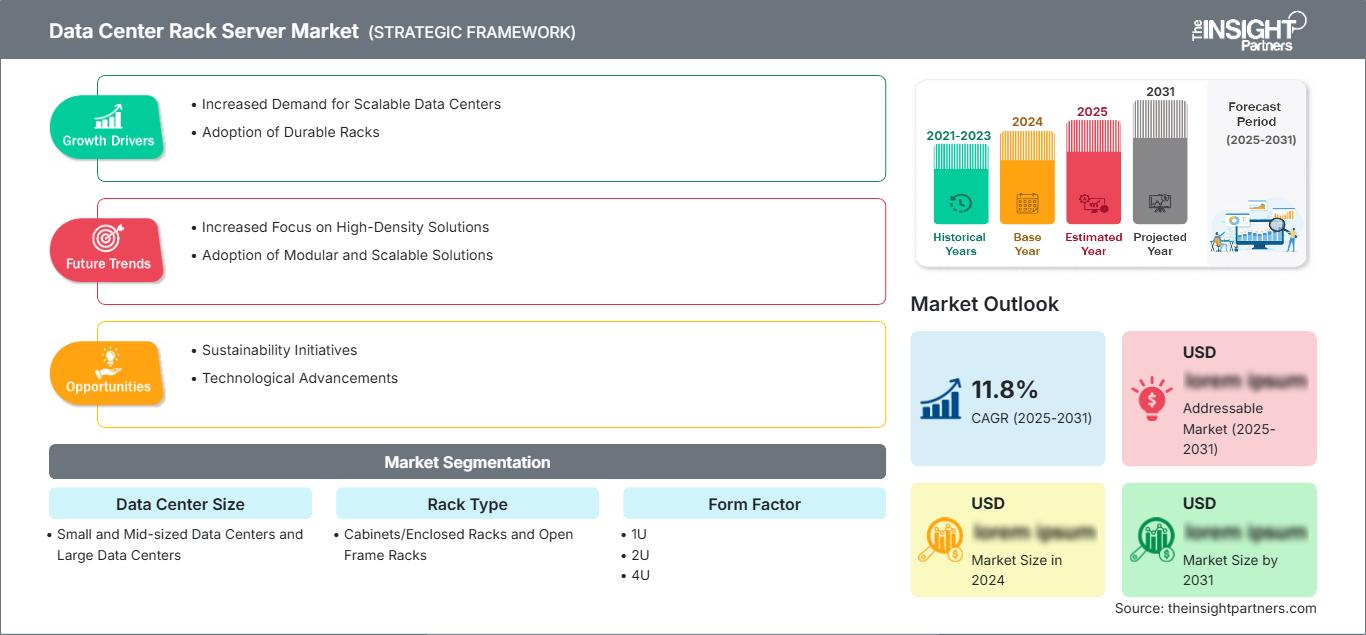
Data Center Rack Server Market: Strategic Insights
Regional Insights
North America Data Center Rack Server Market
North America captured a market share of 35–39% within Data Center Rack Server in 2025 and is expected to grow at a CAGR of 13.2–14.0% over 2026–2034. Growth drivers include demand for hyperscale AI campuses, cloud regions, colocation capacity additions, federal modernization, and enterprise refresh cycles. The availability of power, interconnection queues, and cooling strategies are now factors in selecting servers.
Regional users focus on server solutions tested for high GPU density, security through firmware, remote management, service continuity, and rack density. The increase in market shares of Data Center Rack Server is due to growth in financial services, healthcare, research, SaaS, telecommunication, and public clouds. The strength of OEMs and components will help to ensure supply, but transformers and energy permitting may delay deployment.
U.S. Data Center Rack Server Market Market
In 2025, the U.S. accounted for 82-86% of the total North American market revenue and is projected to experience a CAGR of 13.4-14.2% over 2026-2034. The country enjoys several factors including hyperscale clustering, AI models training, enterprise cloud migrations, defense computing systems, investment in semiconductor ecosystems, and denser colocation hubs located in Virginia, Texas, Arizona, Oregon, Ohio, Georgia, and Illinois.
Dell Technologies Inc., Hewlett Packard Enterprise Development LP, Cisco Systems, Inc., Oracle Corporation, and Lenovo Group Limited have established strong U.S. enterprise footprints via direct selling, partnerships, managed services, and certified AI stack solutions. In terms of applications, inference clusters, private cloud, cybersecurity analytics, digital engineering, healthcare imaging, financial risk modeling, and liquid-ready rack servers are favored.
Europe Data Center Rack Server Market Market
Europe held 20–24% share in 2025 and is projected to grow at a CAGR of 12.1–12.9% during 2026–2034. Germany is the leading country because automotive engineering, manufacturing, research computing, financial services, and sovereign cloud projects require secure, efficient, and serviceable server infrastructure. The UK contributes demand through financial technology, public cloud, defense, and life sciences computing.
France, Italy, and Spain add modernization demand through telecom networks, public services, digital healthcare, industrial automation, and regional colocation hubs. European procurement emphasizes data residency, energy efficiency, waste heat reuse, cybersecurity certification, and lifecycle serviceability. The Data Center Rack Server Market benefits when suppliers align rack design with EU reporting expectations, processor efficiency, and limited power availability.
APAC Data Center Rack Server Market Market
Asia Pacific held a 28-32% market share in 2025 and is expected to expand with a CAGR of 15.0-15.8% in the period between 2026-2034. China dominates the regional market due to its capabilities in cloud services, AI infrastructure, manufacturing, and digital government initiatives. Japan and South Korea provide growth from HPC, semiconductors, telecom, and enterprise transformation.
India and Australia drive growth through cloud regions, banking transformation, public sector digitization, and colocation investments. Policies promoting data localization, semiconductor ecosystem, and digital infrastructure will encourage adoption in the region. Power limitations, import regulations, local assembly, and need for affordable and scalable rack server platforms influence the Data Center Rack Server Market.
Middle East & Africa Data Center Rack Server Market Market
Middle East & Africa region will witness a CAGR of 13.8-14.6% from 2026 to 2034. Saudi Arabia emerges as the major demand driver with sovereign cloud, AI policy, smart city, energy vertical analytics, and public infrastructure digitization initiatives. The UAE emerges next with hyperscale collaborations, financials, logistics, aviation, and government clouds.
South Africa and Rest of MEA will depend on telecom upgrades, banking platforms, content delivery networks, and enterprise hosting. Availability of energy, resilient cooling, and service capabilities become key. The regional customers prefer rack servers capable of operating efficiently even in high ambient environments and compatible with cooling solutions and phased investment owing to data sovereignty policies.
Segmentation Analysis
Data Center Size
Data Center Size is projected to grow at a CAGR of 14.0–14.8% during 2026–2034. The Data Center Rack Server Market scope covers small and mid-sized sites as well as large facilities that prioritize rack density, power distribution, cooling compatibility, and management automation. Large data centers lead procurement because hyperscalers and colocation operators standardize validated server configurations across campuses.
- Small and Mid-sized Data Centers support enterprise, regional cloud, healthcare, education, and public sector workloads where flexible configurations, simplified management, and serviceability matter more than hyperscale standardization.
- Large Data Centers dominate purchasing through hyperscale cloud, AI factories, colocation campuses, and telecom core facilities that require repeatable rack designs and high-volume deployment discipline.
Rack Type
Rack Type is expected to grow at a CAGR of 13.7–14.5% during 2026–2034. Cabinets and enclosed racks remain preferred where security, airflow control, cable containment, and operational standardization are required. Open frame racks serve labs, test environments, telecom rooms, and cost-sensitive deployments that need fast access and flexible cabling.
- Cabinets/Enclosed Racks lead demand where controlled airflow, physical security, cable management, and standardized containment are critical for enterprise, colocation, and regulated environments.
- Open Frame Racks remain strategically relevant for labs, telecom facilities, staging rooms, and budget-sensitive installations that prioritize access, fast configuration changes, and simplified maintenance.
Form Factor
Form Factor is forecast to grow at a CAGR of 14.4–15.2% during 2026–2034. The segment reflects workload density, expansion slots, thermal budget, and maintenance priorities. 1U systems serve scale-out compute, 2U platforms balance accelerators and serviceability, while 4U designs support heavy GPU, storage, and high-memory configurations in AI and HPC clusters.
- 1U servers support dense general compute, web services, virtualization, and cloud-native workloads where rack space efficiency and standardized maintenance are major procurement considerations.
- 2U servers offer balanced expansion for GPUs, storage, networking, and memory, making them strategically important for AI inference, analytics, and enterprise consolidation.
- 4U systems serve accelerator-heavy AI training, HPC, storage-rich workloads, and specialized applications requiring greater thermal headroom, component access, and power delivery flexibility.
Tier Type
Tier Type is projected to grow at a CAGR of 13.9–14.7% during 2026–2034. Tier design influences redundancy, uptime expectations, server resilience, and procurement economics. Tier 3 and Tier 4 facilities generate stronger demand for rack servers with remote diagnostics, redundant power, validated firmware, and service contracts that protect mission-critical workloads.
- Tier 1 facilities serve basic enterprise and local hosting requirements where cost efficiency, standard configurations, and straightforward maintenance are more important than advanced redundancy.
- Tier 2 facilities improve availability through selected redundancy and suit organizations balancing reliability, budget control, and gradual modernization of server infrastructure.
- Tier 3 facilities represent a major demand pool because concurrent maintainability supports cloud, colocation, finance, healthcare, and public sector workloads.
- Tier 4 facilities require fault-tolerant infrastructure, making validated rack servers, redundant components, advanced monitoring, and lifecycle support central to procurement strategy.
Opportunity Snapshot
| Form Factor | Revenue Contribution | Trend Tag | Adoption Stage |
| 1U | High | Scale Compute | Mature |
| 2U | High | AI Inference | Scaling |
| 4U | Medium | GPU Density | Scaling |
Data Center Rack Server Market Growth Drivers and Impact Analysis
AI workloads raise rack-level compute density
Generative AI, computer vision, simulation, recommendation engines, and real-time analytics push companies to use servers with more accelerators, bandwidth, and networking capabilities. As a consequence, this demand driver shifts from unit cost to rack performance and power/cooling infrastructure. Hyperscale and colocation facilities experience the most significant impact from this trend, since they require platforms that are reproducible across multiple racks and do not compromise reliability. Vendors who offer validated GPUs, liquid cooling, and automation capabilities will benefit the most from this trend.
Hybrid cloud modernization accelerates replacement cycles
Firms are upgrading their older server systems to enable their private cloud, virtualization, containerization, security analysis, and data workloads that can’t be migrated to public clouds for regulatory or performance reasons. Modern rack servers offer greater processing efficiency, secure firmware, remote management, and workload consolidation compared to older server fleets. This trend is evident in the finance, healthcare, government, manufacturing, telecommunications, and education sectors, where upgrades are made based on regulatory requirements, latency considerations, costs, and data management.
Power and cooling constraints reshape server selection
Data centers experience increasing scarcity in power availability, lengthy timeframes for grid connections, and greater scrutiny into the use of power, thus creating an efficiency-driven procurement strategy. Server specifications include factors such as performance-per-watt efficiency, thermal characteristics, suitability for liquid cooling, air containment techniques, and remote workload management. Such a trend encourages the adoption of solutions that minimize stranded capacity in the racks and increase rack utilization without increasing the risk factor. Vendors that provide data center management software that incorporates all of these factors will be more competitive.
Data Center Rack Server Market Future Trends
Rack-scale AI systems move into mainstream procurement
Data Center Rack Server Market trends indicate that buyers will move from purchasing isolated servers toward rack-scale, factory-integrated AI systems with validated compute, networking, storage, cooling, and management. This shift will reduce deployment risk, shorten commissioning time, and improve operational predictability for training and inference clusters. Vendors will differentiate through reference architectures, thermal engineering, orchestration software, and lifecycle services. Colocation providers and enterprises will increasingly request modular designs that can scale by rack, pod, or hall while maintaining serviceability and energy visibility.
Secure firmware and lifecycle assurance gain priority
Security will become a differentiating feature as servers host regulated data, AI models, financial transactions, healthcare records, and government workloads. Future procurement will place greater weight on silicon root of trust, firmware validation, encrypted management, supply chain traceability, and secure decommissioning. The trend will strengthen suppliers that can document component provenance, automate patching, and provide auditable lifecycle controls. Buyers will also demand resilience against emerging cryptographic threats, making security certification and remote attestation part of server qualification.
Data Center Rack Server Market Opportunities
Validated AI-ready bundles for enterprise deployment
Data Center Rack Server Market Forecasts support investment in prevalidated enterprise AI bundles that combine rack servers, accelerators, storage, networking, management software, and services. Many organizations want AI capacity near controlled data but lack skills to design full infrastructure. Vendors can capture demand by offering reference architectures, financing, migration support, and outcome-based service packages. The opportunity is strongest in banking, healthcare, manufacturing, public sector, and professional services, where data sensitivity and latency support on-premises or colocation deployment.
Sovereign cloud and regional colocation expansion
Government data policies, national AI programs, and regional cloud investments create opportunities for suppliers that can deliver secure, locally supportable rack server platforms. Sovereign cloud projects need documented supply chains, firmware controls, service commitments, and compliance-ready architectures. Colocation operators also require standardized equipment that supports multiple tenants and power profiles. Vendors with regional integration partners, local assembly options, and strong support coverage can win infrastructure programs in India, the Gulf, Europe, Southeast Asia, and Africa.
Recent Developments
- June 2026: Vertiv (NYSE: VRT), a global leader in critical digital infrastructure, announced the Vertiv Rack Extreme, a next-generation rack designed for the increasing demands of high-performance computing and AI applications. This future-ready rack platform supports deep and heavy IT equipment required for next-generation deployments.
- June 2026: Qualcomm Technologies, Inc. (NASDAQ: QCOM) announced at its Investor Day, new data center solutions, including the Qualcomm Dragonfly C1000 CPU, Qualcomm High Bandwidth Compute (HBC), Qualcomm Dragonfly AI300 inference accelerator, and connectivity products, together with custom silicon solutions, all engineered to maximize performance per watt and token throughput at lower total cost of ownership. The new platforms highlight Qualcomm Technologies’ growing role in building full‑stack data center infrastructure optimized for AI, spanning agentic and data‑center‑class CPUs, AI inference accelerators, high‑performance connectivity, sand at scale custom silicon solutions. The Qualcomm Dragonfly AI300 joins the previously announced Qualcomm Dragonfly AI200 and AI250 in its data center solutions portfolio with an annual cadence AI accelerator roadmap.
- November 2025: Schneider Electric, the leader in the digital transformation of energy management and automation, announced new data center solutions specifically engineered to meet the intensive demands of next-generation AI cluster architectures. Evolving its EcoStruxure Data Center Solutions portfolio, Schneider Electric introduced a Prefabricated Modular EcoStruxure Pod Data Center solution that consolidates infrastructure for liquid cooling, high-power busway and high-density NetShelter Racks. In addition, EcoStruxure Rack Solutions incorporate detailed rack configurations and frameworks designed to accelerate High Performance Computing (HPC) and AI data center deployments. The new EcoStruxure Pod Data Center and EcoStruxure Rack Solutions are now available globally.
Frequently Asked Questions

- Comprehensive Market Sizing and Forecast Analysis
- Detailed Segmentation Analysis
- In-Depth Market Dynamics Assessment
- Regional and Country-Level Insights
- Competitive Landscape and Company Benchmarking
- Strategic Business Intelligence
Recent Reports
Testimonials

The Insight Partners' SCADA System Market report is comprehensive, with valuable insights on current trends and future forecasts. The team was highly professional, responsive, and supportive throughout. We are very satisfied and highly recommend their services.
RAN KEDEM Partner, Reali Technologies LTDs
I requested a report on a very specific software market and the team produced the report in a few days. The information was very relevant and well presented. I then requested some changes and additions to the report. The team was again very responsive and I got the final report in less than a week.
JEAN-HERVE JENN Chairman, Future Analytica
We worked with The Insight Partners for an important market study and forecast. They gave us clear insights into opportunities and risks, which helped shape our plans. Their research was easy to use and based on solid data. It helped us make smart, confident decisions. We highly recommend them.
PIYUSH NAGPAL Sr. Vice President, High Beam Global
The Insight Partners delivered insightful, well-structured market research with strong domain expertise. Their team was professional and responsive throughout. The user-friendly website made accessing industry reports seamless. We highly recommend them for reliable, high-quality research services
YUKIHIKO ADACHI CEO, Deep Blue, LLC.
This is the first time I have purchased a market report from The Insight Partners.While I was unsure at first, I visited their web site and felt more comfortable to take the risk and purchase a market report.I am completely satisfied with the quality of the report and customer service. I had several questions and comments with the initial report, but after a couple of dialogs over email with their analyst I believe I have a report that I can use as input to our strategic planning process.Thank you so much for taking the extra time and making this a positive experience.I will definitely recommend your service to others and you will be my first call when we need further market data.
JOHN SUZUKI President and Chief Executive Officer, Board Director, BK Technologies
I wish to appreciate your support and the professionalism you displayed in the course of attending to my request for information regarding to infectious disease IVD market in Nigeria. I appreciate your patience, your guidance, and the fact that you were willing to offer a discount, which eventually made it possible for us to close a deal. I look forward to engaging The Insight Partners in the future, all thanks to the impression you have created in me as a result of this first encounter.
DR CHIJIOKE ONYIA MANAGING DIRECTOR, PineCrest Healthcare Ltd.Reason to Buy
- Informed Decision-Making
- Understanding Market Dynamics
- Competitive Analysis
- Identifying Emerging Markets
- Customer Insights
- Market Forecasts
- Risk Mitigation
- Boosting Operational Efficiency
- Strategic Planning
- Investment Justification
- Tracking Industry Innovations
- Aligning with Regulatory Trends





 Get Free Sample for