
Delivery Controller Market Size, Share & Growth by 2034
Coverage: By Component (Software, Hardware); Enterprise Type (Small and Medium Enterprises, Large Enterprises); User Type (Retail, IT and Telecom, Banking and Financial Services, Healthcare, Government, Others) , and Geography (North America, Europe, Asia Pacific, and South and Central America)
- Status : Data Released
- Report Code : TIPRE00024666
- Category : Electronics and Semiconductor
- No. of Pages : 150
- Available Report Formats :


- Last update date : July 31, 2026


2025 Market Size
US$ 2.24 Bn
Base year value
2034 Forecast
US$ 3.48 Bn
Projected by 2034
CAGR 2026-2034
5.66 %
Growth rate
Addressable Market
US$ 26.82 Bn
(2026-2034)
The Delivery Controller Market was valued at US$ 2.24 Billion in 2025 and is projected to reach US$ 3.48 Billion by 2034, registering a CAGR of 5.66% during 2026–2034. Some factors influencing its market are enterprise migration to hybrid clouds, secure access to applications, load balancing, API traffic management, and reliable digital services delivery in retail, IT and telecommunications, BFSI, healthcare, and government domains.
In North America, the growth in terms of the CAGR for adoption is expected to occur between 5.9% to 6.4%, due to cloud-native application transformation and greater enterprise expenditure on application security. The North American Delivery Controller Market size is driven by the presence of dense data centers, robust BFSI technology upgrade cycles, and regulatory push for secure digital access.
Delivery Controller Market Assessment and Insights
- North America accounted for 34–37% share in 2025 and is growing at a CAGR of 5.9–6.4% between 2026–2034, led by hybrid multicloud deployments, API protection needs, and mature enterprise security budgets.
- US represented 78–82% of North America in 2025 and is growing at a CAGR of 5.8–6.3% between 2026–2034, supported by cloud platforms and application security modernization.
- Europe held 25–28% share in 2025 and is growing at a CAGR of 4.9–5.4% between 2026–2034, with the UK, Germany, and France leading regulated digital infrastructure adoption.
- Asia Pacific captured 22–25% share in 2025 and is growing at a CAGR of 6.7–7.4% between 2026–2034, led by China, India, Japan, South Korea, and Australia.
- Largest Segment Software held 58–62% market share in 2025 and is growing at a CAGR of 6.0–6.6% during 2026–2034 as virtualized deployment becomes default.
- High Growth Segment Small and Medium Enterprises held 38–42% market share in 2025 and is growing at a CAGR of 6.8–7.5% during 2026–2034.
- Key companies analyzed in detail: F5, Inc.; Fortinet, Inc.; Array Networks, Inc.; Cloud Software Group, Inc.; Broadcom Inc.; Progress Software Corporation; Sangfor Technologies Inc.; NGINX, Inc.; Radware Ltd.; Hewlett Packard Enterprise Company.
Source: The Insight Partners' analysis based on proprietary research, government publications, company annual reports, investor presentations, industry databases, and expert interviews.
Application Delivery has come a long way since the days of appliance-based load balancing; it now involves software-based control planes that are able to perform traffic steering, SSL offload, bot detection, API security and telemetry services. As the need for software subscriptions, virtualized ADCs and cloud markets becomes more pronounced, hardware is still important where latency matters in data centers. In light of this, the market is developing along with the industry towards programmability, operability and consistent performance.
During the forecast period, spend is set to go towards the growing digital economies, sovereign clouds, and regulated applications requiring audit-compliant access control. Enterprises will value the vendors providing application delivery and security as one solution, Kubernetes ingress, and AI-capable traffic inspection.
Delivery Controller Market Report Scope
| Report Attribute | Details |
|---|---|
| Market size in 2025 | US$ 2.24 Billion |
| Market Size by 2034 | US$ 3.48 Billion |
| Global CAGR (2026 - 2034) | 5.66% |
| Historical Data | 2021-2024 |
| Forecast period | 2026-2034 |
Delivery Controller Market Analysis
Enterprise Demand Drivers include application uptime, increasing encrypted traffic, exposure of API, and multi-cloud complexity. The market observes very fast growth in situations when there is a need for performance and security balance without extra operational stacks. For financial institutions, it is important to provide transaction availability, for telecom operators, it is latency-sensitive traffic, and for hospitals, it is access resiliency for patient's systems.
The Ecosystem is made up of software companies, hardware appliances, cloud companies, managed service providers, and systems integrators. As far as the dynamics on the supply side go, they consist of developments like virtualization, pay-per-use model, and API-based automation; but here again, the hardware appliances themselves matter in terms of high-throughput data centers. The trends in terms of procurement consist of the following:
Competition is dominated by vendors with combined strengths of large installed base, security expertise, and cloud integrations. F5, Inc. and Cloud Software Group, Inc. compete for enterprise customers with comprehensive offerings, while Fortinet, Inc., Radware Ltd., and Array Networks, Inc. win with security-driven strategy. Analysis of the Delivery Controller Market report reveals that competition shifts from throughput alone to policy consistency, automation, and operations visibility.
Trends in investments show growing demand for platforms that protect applications in artificial intelligence, microservices, and distributed APIs. Among solutions to this problem are Progress Software Corporation, Sangfor Technologies Inc., NGINX, Inc., Broadcom Inc., and Hewlett Packard Enterprise Company, which cater to certain preferences for deployment. Positioning becomes more and more focused on channel coverage and cloud marketplaces integration.
● REPORT CUSTOMIZATION
Tailor This Report To Align With Your Specific Business Requirements
This report can be customized to align precisely with your business objectives, scope, and target markets. Customization options include tailored segmentation, geography, competitive analysis, and strategic insights to support informed decision-making.
Customize This Report →WHAT YOU CAN ADJUST
- ● Segmentations
- ● Geography
- ● Competitive Analysis
- ● Language Preferences
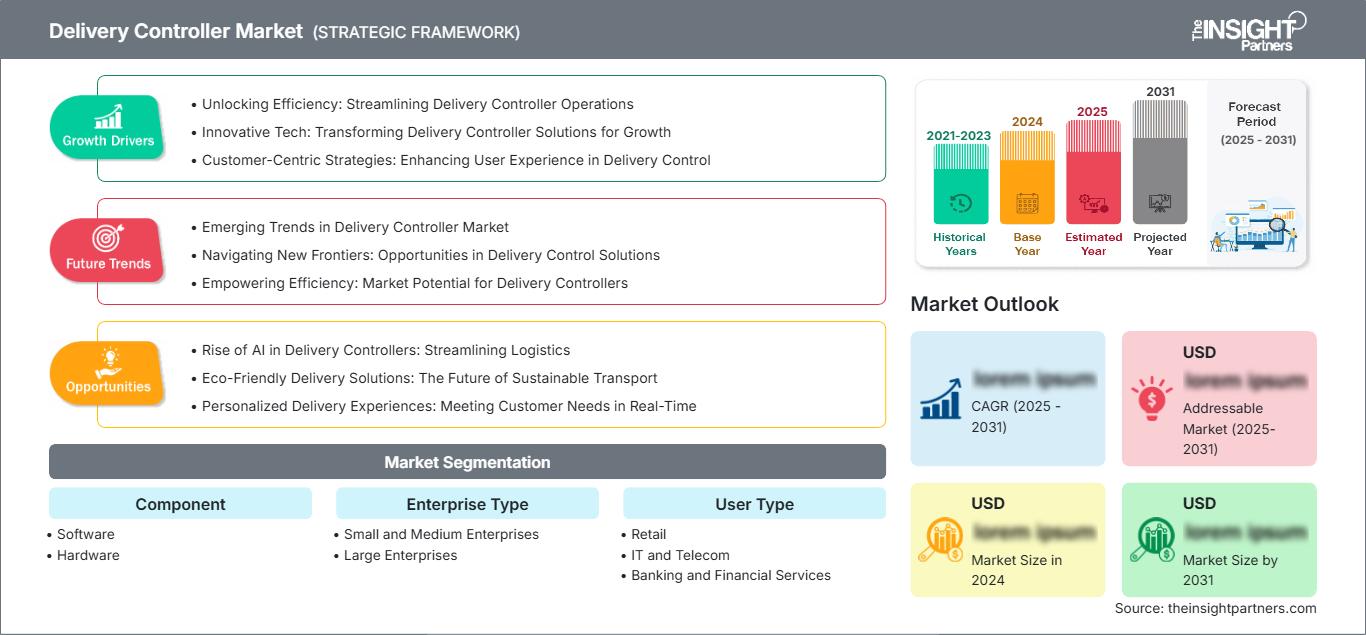
Delivery Controller Market: Strategic Insights
Regional Insights
North America Delivery Controller Market
The North American region accounted for 34–37% market share in 2025 and is expected to register 5.9–6.4% CAGR on the back of mature adoption of secure application delivery within financial services, telecommunication, healthcare, and government organizations. The Delivery Controller Market Share is driven by the presence of enterprise data center footprint, heavy investments in cloud, and early adoption of ADC and web application security platform.
Intrinsic demand comes from hybrid multicloud traffic, API, and high demand for uptime. Enterprise organizations value platforms which offer global server load balancing, SSL termination, bot mitigation, and analytics. The region is also well positioned because of the presence of vendors' headquarter, wide partner ecosystem, and regulatory industries which upgrade their infrastructure before there is any risk.
U.S. Delivery Controller Market
In 2025, the U.S. is estimated to hold 78-82% of North America and is expected to grow at a 5.8-6.3% CAGR. The adoption rate is largely seen among large banks, hyperscale-associated firms, government organizations, healthcare providers, and telecommunications companies, which need low latency and always-available connections for applications.
There is a substantial player presence, with F5, Inc., Fortinet, Inc., Radware Ltd., NGINX, Inc., and Progress Software Corporation competing in the market via direct sales and channels. Applications being seen are APIs gateways, Kubernetes ingresses, AI workload delivery, and app security. Investment in platforms that cut down on firewall, load balancer, and monitoring solutions has become common practice.
Europe Delivery Controller Market
Europe held 25–28% market share in 2025, and the region is predicted to register a 4.9–5.4% CAGR driven by high demand from the United Kingdom due to the usage of clouds in financial services, retail and public sector applications. The United Kingdom buyers' needs include reliable applications, data security, and secure access for distributed teams, driving the deployment of virtual and managed delivery controllers.
The second largest contributor to Europe market is Germany due to the need for deterministic operation of industrial digitalization solutions, automotive platforms, and manufacturing network requirements. There is also demand from France, Italy, and Spain owing to banking modernization, healthcare digitization, and public cloud migration. Vendors should consider data localization, multi-language requirements, and procurement models.
APAC Delivery Controller Market
APAC has 22-25% market share in 2025 and will have the highest regional CAGR of 6.7-7.4%. China is strongest on digital infrastructure scale, while Japan and South Korea focus on low-latency enterprise platforms; India builds cloud-native products; and Australia builds on regulated public sector and banking infrastructure.
Industries’ policies, 5G, growth in the e-commerce market, and sovereign cloud initiatives help accelerate adoption. Telecommunication sector reforms, enabling of fintech, and hospitals will benefit the Delivery Controller Market positively; however, buying decisions depend on the level of evolution in local channels. Editions of software are favored owing to quicker deployment and integration within the DevOps chain.
Middle East & Africa Delivery Controller Market
Middle East & Africa will show CAGR of 5.4%-6.0%, led by investments in Saudi Arabia driven by smart city, energy, and government applications. This is followed by UAE investments driven by cloud centers, finance sector modernization, and aviation industry digital solutions. Meanwhile, South Africa is the driver of enterprise demand for banking and telecom applications.
Energy sector companies, national infrastructure projects, and government services drive the requirement for traffic management that provides application-level resiliency. Rest of MEA will see selective investments that come from managed service providers and telecom companies. Buyers need a solution that provides high reliability and security to their portal systems exposed to traffic and application attacks.
Segmentation Analysis
Component
Component is expected to grow at a 5.8–6.4% CAGR during 2026–2034 as buyers rebalance spending between software flexibility and hardware performance. The Delivery Controller Market scope increasingly favors software for automation, cloud portability, and elastic scaling, while hardware remains relevant where throughput, deterministic latency, and physical control are critical.
- Software leads demand because virtual ADCs, containerized ingress, and subscription models support hybrid cloud operations, faster provisioning, centralized policy management, and lower dependency on appliance refresh cycles.
- Hardware remains strategically important for high-throughput data centers, telecom cores, and regulated environments where dedicated appliances deliver predictable performance, isolation, and operational control.
Enterprise Type
Enterprise Type is projected to grow at a 5.7–6.3% CAGR during 2026–2034. Large enterprises continue to anchor spending through complex application estates, while SMEs accelerate adoption through managed services and cloud marketplaces. Decision criteria include security consolidation, uptime assurance, deployment simplicity, and pricing models aligned with distributed workloads.
- Small and Medium Enterprises increasingly adopt virtual or managed solutions to secure customer portals, SaaS integrations, and e-commerce traffic without maintaining large in-house network engineering teams.
- Large Enterprises require advanced policy orchestration, global server load balancing, compliance reporting, and integration with security operations centers across multiple business units and geographies.
User Type
User Type is expected to grow at a 5.6–6.2% CAGR during 2026–2034, shaped by sector-specific uptime and security priorities. BFSI and IT and telecom show the deepest technical requirements, while healthcare and government increase adoption as digital services become mission critical. Retail demand rises during seasonal traffic peaks and omnichannel expansion.
- Retail uses delivery controllers to stabilize e-commerce traffic, protect checkout applications, and improve customer experience during promotions, holiday peaks, and omnichannel inventory updates.
- IT and Telecom prioritizes low latency, API traffic control, service availability, and scalable infrastructure for cloud hosting, managed security, mobile services, and enterprise connectivity platforms.
- Banking and Financial Services depends on secure transaction routing, fraud-resistant access, compliance reporting, and resilient digital banking channels where downtime directly affects customer trust.
- Healthcare adopts application delivery controls for patient portals, electronic health record access, telehealth platforms, and secure data exchange between hospitals, insurers, and public agencies.
- Government requires reliable citizen portals, identity-linked services, and resilient infrastructure that can withstand traffic surges, cyberattacks, and compliance scrutiny across agencies.
Opportunity Snapshot
| User Type | Revenue Contribution | Trend Tag | Adoption Stage |
| Retail | Medium | Checkout Resilience | Scaling |
| IT and Telecom | High | API Traffic | Mature |
| Banking and Financial Services | High | Secure Banking | Mature |
| Healthcare | Medium | Patient Access | Scaling |
| Government | Medium | Citizen Portals | Emerging |
Delivery Controller Market Growth Drivers and Impact Analysis
Hybrid Multicloud Application Delivery Complexity
Nowadays, businesses have deployed their applications in both private data centers, public clouds, edge facilities, and containers. It is hard to provide consistent traffic in such a distributed environment with only simple load balancing methods. Delivery controllers will address such challenges by centralizing policies, better failover support, and applying security controls closer to application traffic. Real-life benefits will include higher resiliency, more efficient cloud migration, and better user experience while moving workloads. In the regulated business sectors, the consistent policy enforcement will add up to auditability and resiliency planning.
Rising Application-Layer Security Requirements
Application layer attacks now attack APIs, log-in pages, payment workflows, and portal systems and no longer focus exclusively on the network perimeter. Delivery controllers become security control points because they already examine and route high-value application traffic. Web Application Firewall, bot protection, rate-limiting, TLS management, and DDoS capabilities integrated together minimize the need for disparate point solutions. The business effect is evident in combined purchases of performance and security budgets. Organizations also benefit from increased incident response times as telemetries, policy updates, and traffic control can all be managed through one delivery system.
Digital Service Uptime as a Business Metric
Customer-facing applications now influence revenue, compliance, reputation, and employee productivity, making uptime a board-level operating metric. Retailers cannot afford checkout disruption during peak campaigns, banks must protect transaction continuity, and healthcare providers need reliable access to clinical systems. Delivery controllers directly affect these outcomes through load balancing, health checks, session persistence, and disaster recovery routing. This driver increases willingness to invest in resilient architectures even when infrastructure budgets are constrained. Vendors that demonstrate measurable uptime improvement and simplified operations are positioned to capture renewal and modernization spending.
Delivery Controller Market Future Trends
AI-Aware Application Delivery Control
AI-enabled applications will create new traffic patterns, larger model interactions, and more sensitive API exchanges. Delivery Controller Market trends therefore point toward platforms that understand AI workload behavior, apply adaptive routing, and detect abnormal model access patterns. Future solutions are likely to combine traffic optimization with governance signals, helping enterprises control latency, cost, and exposure. Vendors with observability, API protection, and automation capabilities will be better positioned as AI moves from pilots into production application estates.
ADC-as-a-Service for Distributed Enterprises
Consumption-based delivery controller services will gain relevance as enterprises reduce appliance management and expand across smaller branches, edge nodes, and cloud regions. Managed ADC models can shorten deployment time, align spending with traffic volumes, and extend enterprise-grade capabilities to mid-market buyers. This trend will shift vendor competition toward service reliability, policy portability, support quality, and marketplace integration. It also creates opportunities for telecom operators and managed service providers to bundle secure application delivery with connectivity and cloud migration services.
Delivery Controller Market Opportunities
Security-Converged Modernization Programs
Enterprises replacing legacy load balancers offer a clear opportunity for vendors that can package application delivery, web application firewall, API protection, and analytics in one migration path. Buyers want fewer consoles, consistent policy, and faster security response without degrading performance. Delivery Controller Market Forecasts indicate that modernization will favor suppliers with migration tooling, flexible licensing, and reference architectures for hybrid environments. Channel partners can capture value by assessing existing appliances, mapping application dependencies, and designing phased upgrades that reduce downtime while improving visibility and control.
SME Cloud Marketplace Expansion
Small and medium enterprises represent an underpenetrated opportunity because many still rely on basic cloud load balancing or fragmented security tools. Vendors can expand adoption through simplified bundles, predictable pricing, guided configuration, and managed support. Cloud marketplaces reduce procurement friction and let SMEs activate delivery controller functions near existing workloads. The opportunity is strongest in retail, healthcare clinics, fintech platforms, and regional government services where digital traffic is growing but specialist infrastructure teams are limited. Ease of use will matter as much as technical depth.
Recent Developments
- February 2025: F5 introduced its Application Delivery and Security Platform, bringing application delivery, traffic management, API protection, and security services together in a single platform for hybrid and multicloud environments. The platform helps organizations simplify operations, strengthen application security, and support AI-driven workloads with unified management and consistent policy enforcement across distributed infrastructure
- June 2026: Lob recognized as Delivery Platform of the Year by SupplyTech Breakthrough for its direct mail automation and logistics platform. The platform uses routing intelligence, a distributed print network, and delivery optimization capabilities to help businesses improve delivery speed, reduce costs, and increase predictability across large-scale direct mail operations.
- April 2026: FarEye launched PILOT, an AI-powered logistics dispatcher designed to automate last-mile delivery operations by coordinating route planning, driver management, delivery recovery, and invoice reconciliation through specialized AI agents. The platform helps reduce manual dispatcher workload from around 10 hours to 60 minutes while improving operational efficiency, delivery visibility, and decision-making across logistics networks.
Frequently Asked Questions

- Comprehensive Market Sizing and Forecast Analysis
- Detailed Segmentation Analysis
- In-Depth Market Dynamics Assessment
- Regional and Country-Level Insights
- Competitive Landscape and Company Benchmarking
- Strategic Business Intelligence
Recent Reports
Testimonials

The Insight Partners' SCADA System Market report is comprehensive, with valuable insights on current trends and future forecasts. The team was highly professional, responsive, and supportive throughout. We are very satisfied and highly recommend their services.
RAN KEDEM Partner, Reali Technologies LTDs
I requested a report on a very specific software market and the team produced the report in a few days. The information was very relevant and well presented. I then requested some changes and additions to the report. The team was again very responsive and I got the final report in less than a week.
JEAN-HERVE JENN Chairman, Future Analytica
We worked with The Insight Partners for an important market study and forecast. They gave us clear insights into opportunities and risks, which helped shape our plans. Their research was easy to use and based on solid data. It helped us make smart, confident decisions. We highly recommend them.
PIYUSH NAGPAL Sr. Vice President, High Beam Global
The Insight Partners delivered insightful, well-structured market research with strong domain expertise. Their team was professional and responsive throughout. The user-friendly website made accessing industry reports seamless. We highly recommend them for reliable, high-quality research services
YUKIHIKO ADACHI CEO, Deep Blue, LLC.
This is the first time I have purchased a market report from The Insight Partners.While I was unsure at first, I visited their web site and felt more comfortable to take the risk and purchase a market report.I am completely satisfied with the quality of the report and customer service. I had several questions and comments with the initial report, but after a couple of dialogs over email with their analyst I believe I have a report that I can use as input to our strategic planning process.Thank you so much for taking the extra time and making this a positive experience.I will definitely recommend your service to others and you will be my first call when we need further market data.
JOHN SUZUKI President and Chief Executive Officer, Board Director, BK Technologies
I wish to appreciate your support and the professionalism you displayed in the course of attending to my request for information regarding to infectious disease IVD market in Nigeria. I appreciate your patience, your guidance, and the fact that you were willing to offer a discount, which eventually made it possible for us to close a deal. I look forward to engaging The Insight Partners in the future, all thanks to the impression you have created in me as a result of this first encounter.
DR CHIJIOKE ONYIA MANAGING DIRECTOR, PineCrest Healthcare Ltd.Reason to Buy
- Informed Decision-Making
- Understanding Market Dynamics
- Competitive Analysis
- Identifying Emerging Markets
- Customer Insights
- Market Forecasts
- Risk Mitigation
- Boosting Operational Efficiency
- Strategic Planning
- Investment Justification
- Tracking Industry Innovations
- Aligning with Regulatory Trends





 Get Free Sample for