
Digital Radar Market Growth, Demand & Size by 2034
Digital Radar Market Size and Forecasts (2021 - 2034), Global and Regional Share, Trends, and Growth Opportunity Analysis Report Coverage : By Type (Active and Passive), Dimension (2D, 3D and 4D), Application (Safety, Security and Surveillance), Vertical (Automotive, Aerospace, Military and Defense)
- Status : Data Released
- Report Code : TIPRE00039815
- Category : Electronics and Semiconductor
- No. of Pages : 150
- Available Report Formats :


- Last update date : August 05, 2026


2025 Market Size
US$ 7.61 Bn
Base year value
2034 Forecast
US$ 29.99 Bn
Projected by 2034
CAGR 2026-2034
16.47 %
Growth rate
Addressable Market
US$ 158.43 Bn
(2026-2034)
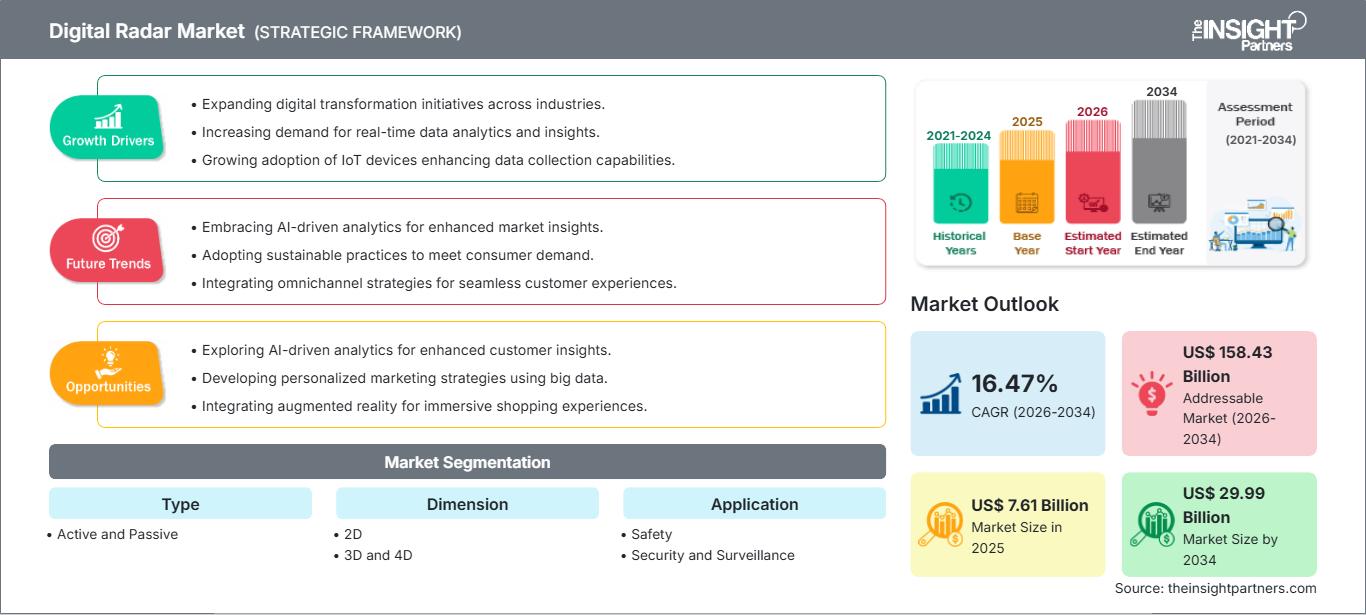
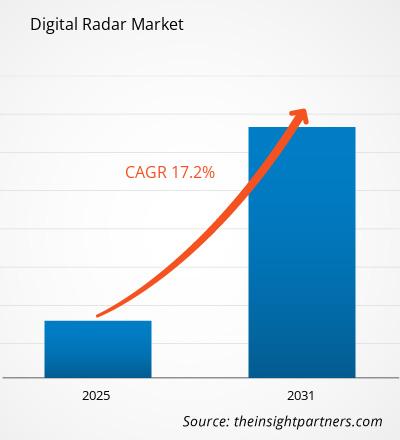
The Digital Radar Market has been valued at US$ 7.61 Billion in 2025 and is forecasted to be US$ 29.99 Billion in 2034, growing at a CAGR of 16.47% between 2026 and 2034. As the development of software-defined sensing, digital beamforming, 4D perception and advanced signal processing takes radar from hardware-only detection to intelligence-enabled safety, surveillance, and defense, the market will continue to flourish.
In North America, the growth rate of the Digital Radar Market size ranges between 15.2% and 16.4%, driven by defense modernization and vehicle safety needs, together with the domestic semiconductor industry capabilities. Growth is enabled by the need for upgrading air and missile defense systems, developing autonomous mobility projects, airport security requirements, and industrial surveillance systems that operate in inclement conditions.
Digital Radar Market Assessment and Insights
- North America held 34–37% share in 2025 and is growing at a CAGR range of 15.2–16.4% during 2026–2034, supported by missile defense, air surveillance, automotive radar, and domestic electronics capacity.
- US represented 80–84% of North America in 2025 and is growing at a CAGR range of 15.5–16.7%, led by defense programs and ADAS penetration.
- Europe accounted for 24–27% share in 2025 and is advancing at a CAGR range of 14.1–15.3%, with Germany, France, the UK, Italy, and Spain leading procurement and automotive integration.
- Asia Pacific captured 28–31% share in 2025 and is expanding at a CAGR range of 17.6–18.9%, led by China, Japan, South Korea, India, and Australia.
- Largest Segment Active radar held 76–80% market share in 2025 and is growing at a CAGR range of 15.8–16.8%, supported by automotive safety and defense surveillance.
- High Growth Segment 4D radar held 18–22% market share in 2025 and is growing at a CAGR range of 20.8–22.6%, driven by imaging radar and autonomous sensing.
- Key companies analyzed in detail: Lockheed Martin Corporation, Bharat Electronics Limited, NXP Semiconductors N.V., Thales S.A., Advanced Micro Devices, Inc., Saab AB, Uhnder, Inc., Israel Aerospace Industries Ltd., Leonardo S.p.A., and BAE Systems plc.
Source: The Insight Partners' analysis based on proprietary research, government publications, company annual reports, investor presentations, industry databases, and expert interviews.
The design of radars has moved away from being analog-based to a more digital transmit/receive path, software-defined processing, Gallium Nitride technology, machine learning, and multi-sensor fusion. There is also an evolution in manufacturing trends because the increasing production volumes of automotive radars drive down costs while military radars call for ruggedized, encrypted, electronically protected, and longer-life cycle solutions. This is evident in the market report, Digital Radar, as both trends are covered by the research scope.
Future demand will arise from emerging air defense capabilities of various nations, advanced ADAS in the automotive sector, and improved perimeter surveillance in infrastructure applications. Investment in intelligent mobility in Asia Pacific and defense refurbishments in Europe will drive orders outside of the current US-led radar market. There will be regulatory pressure on vehicle safety, drone detection, and infrastructure security driving growth in modularity, certification, and upgradability of radar solutions.
Digital Radar Market Report Scope
| Report Attribute | Details |
|---|---|
| Market size in 2025 | US$ 7.61 Billion |
| Market Size by 2034 | US$ 29.99 Billion |
| Global CAGR (2026 - 2034) | 16.47% |
| Historical Data | 2021-2024 |
| Forecast period | 2026-2034 |
Digital Radar Market Analysis
The growth drivers of the Digital Radar Market are the requirement for a resilient system when the cameras, optical sensors, and other forms of monitoring are hampered due to weather conditions, glares, dust, darkness, and clutters. The automotive OEMs employ radar for applications like adaptive cruise control, automatic emergency braking, blind-spot detection, and higher-level automation. For defense, the buyers focus on long-range surveillance, detection of drones, missile warning, maritime surveillance, and situational awareness that is immune to electronic warfare.
The value chain covers RF semiconductors, array antennas, digital processors, embedded software, system integration, testing and calibration, and sustaining. The companies involved in the compute/processing layer of the value chain include NXP Semiconductors N.V. and Advanced Micro Devices, Inc. On the other hand, Lockheed Martin Corporation, Thales S.A., Saab AB, Bharat Electronics Limited, Israel Aerospace Industries Ltd., Leonardo S.p.A., and BAE Systems plc. provide integration of complicated air, land, sea, and security systems.
Digital Radar Market analysis demonstrates that competition is tending towards modular architectures, software-defined capabilities, and domain specialization. Uhnder, Inc. represents the digital imaging automotive radar market segment, and the major defense contractors are differentiated by AESA radar architecture, sensor fusion, electronic protection, and installed base support. The procurement organizations are placing greater emphasis on evaluating the interoperability, cybersecurity, exportability, manufacturing robustness, and ability to update algorithms post deployment.
Investments are being made in 77-81 GHz automotive systems, 4D imaging radars, GaN AESA radar technology, GPU processing, and C-UAS surveillance. Strategy depends on the relationship between the chip manufacturer, Tier 1 automotive supplier, defense prime contractor, and government customer. Hardware validated products with software refresh capability enable product longevity along with safety, surveillance, and mission requirements.
● REPORT CUSTOMIZATION
Tailor This Report To Align With Your Specific Business Requirements
This report can be customized to align precisely with your business objectives, scope, and target markets. Customization options include tailored segmentation, geography, competitive analysis, and strategic insights to support informed decision-making.
Customize This Report →WHAT YOU CAN ADJUST
- ● Segmentations
- ● Geography
- ● Competitive Analysis
- ● Language Preferences
Digital Radar Market: Strategic Insights
Regional Insights
North America Digital Radar Market
North America held 34–37% share in 2025 and is projected to grow at a CAGR range of 15.2–16.4% through 2034. The Digital Radar Market share is supported by US air and missile defense programs, autonomous vehicle development, aerospace electronics, airport security, and border surveillance. Recent defense sources show Lockheed Martin Corporation delivered the first TPY-4 radar to the US Air Force in April 2025, reinforcing demand for digital AESA surveillance systems.
Commercial adoption is also strong because vehicle safety rules, insurance incentives, and consumer demand support radar-rich ADAS platforms. Canada contributes through aerospace, defense electronics, and Arctic surveillance needs, while Mexico benefits from automotive manufacturing integration. Regional growth is constrained by export controls, spectrum coordination, and skilled RF engineering shortages, but domestic defense budgets and semiconductor capacity keep North America structurally attractive.
U.S. Digital Radar Market
The US represented 80–84% of North America in 2025 and is forecast to grow at a CAGR range of 15.5–16.7%. Lockheed Martin Corporation, BAE Systems plc, Advanced Micro Devices, Inc., NXP Semiconductors N.V., and Uhnder, Inc. have relevant operating presence across defense systems, processing platforms, semiconductors, and automotive radar design. Applications span air surveillance, missile defense, vehicle safety, perimeter security, and unmanned system detection.
Demand is strengthened by the transition from mechanically scanned systems to software-defined AESA platforms and by broader radar integration in passenger vehicles. US buyers value domestic supply assurance, NATO interoperability, cybersecurity, and upgradeable mission software. Automotive use is shifting toward corner radar, front imaging radar, and sensor fusion, while defense programs emphasize smaller target detection, electronic protection, transportability, and long-range tracking.
Europe Digital Radar Market
The European market was recorded at 24-27% in 2025 and is anticipated to grow at a CAGR of 14.1%-15.3%. Germany dominates the segment due to automotive radar incorporation, industrial safety, and defense electronics owing to premium vehicle platforms and ADAS adoption. The UK has an influence through air defense radars, naval radars, and aerospace systems, while France gets the help of Thales S.A. and military modernization associated with airspace security and surveillance.
Italy and Spain provide additional demands due to Leonardo S.p.A., naval platforms, airports, and border surveillance. Procurement activities in Europe depend on NATO preparedness, energy infrastructure security, and vehicle safety legislation. The region has a slower rate compared to Asia Pacific in the units' growth but has a deep technological expertise, certifications discipline, and defense interoperability. Suppliers capable to comply with export, cyber security, and sustainability criteria would be rewarded with a sustainable position.
APAC Digital Radar Market
The Asia Pacific segment had the market share of 28-31% in 2025 and is projected to grow at a CAGR of 17.6-18.9%. China dominates the unit consumption in the Asia Pacific through intelligent vehicle solutions, border surveillance, and domestic electronic projects. Japan and South Korea include the automotive, maritime, and aerospace segments, while India focuses on defense radars through Bharat Electronics Limited.
Australia's contribution comes from maritime domain awareness systems, air defense systems, and infrastructure protection initiatives. Policy backing for ADAS, smart transportation, airport development, and self-reliance in defense helps drive the technology's penetration in the region. In the Digital Radar Market in APAC, the high rates of vehicle production, electronics manufacturing, and security investments contribute.
Middle East & Africa Digital Radar Market
Middle East & Africa is projected to grow at a CAGR range of 13.2–14.6% as Saudi Arabia, the UAE, South Africa, and the rest of MEA invest in air defense, airport security, oil and gas infrastructure protection, and coastal surveillance. The UAE leads premium security deployment, while Saudi Arabia expands defense and critical infrastructure monitoring.
Regional demand is linked to energy assets, transport hubs, smart cities, and defense modernization. Adoption depends on import approvals, integration skills, maintenance capability, and interoperability with existing command systems. Growth is smaller than Asia Pacific, but high-value defense programs and infrastructure security needs create opportunities for advanced radar suppliers and local system integrators.
Segmentation Analysis
Type
Type is expected to grow at a CAGR range of 15.6–16.8% from 2026 to 2034 as the Digital Radar Market scope covers active and passive architectures serving different mission requirements. Active systems dominate because they transmit controlled waveforms for precise detection, while passive systems attract interest where low-probability-of-intercept operation, spectrum efficiency, and covert surveillance matter.
- Active radar remains the largest type because automotive safety, air defense, maritime surveillance, and perimeter monitoring require controlled emissions, reliable range measurement, target tracking, and high refresh rates.
- Passive radar is strategically important for covert surveillance, spectrum-constrained environments, and electronic warfare-aware missions that use existing broadcast or communication signals to detect moving targets.
Dimension
Dimension is projected to grow at a CAGR range of 16.2–17.5% during 2026–2034 as radar evolves from basic range-bearing detection to richer elevation and velocity perception. The shift toward 4D imaging reflects demand for object classification, height estimation, and sensor fusion in vehicles, drones, airports, and defense surveillance systems.
- 2D radar supports cost-sensitive monitoring where range and azimuth are sufficient, including basic traffic sensing, perimeter alerting, legacy surveillance, and lower-complexity industrial safety applications.
- 3D radar adds elevation insight and remains central to air surveillance, naval systems, airport monitoring, and defense applications that require altitude discrimination and multi-target tracking.
- 4D radar adds velocity and high-resolution imaging capability, making it critical for autonomous driving, counter-drone detection, low-altitude surveillance, and complex object classification.
Application
Application is expected to grow at a CAGR range of 15.9–17.1% from 2026 to 2034 as radar supports both life-safety and threat-monitoring functions. Safety applications scale through vehicles and infrastructure, while security and surveillance remain anchored in defense, border, maritime, airport, and critical asset protection.
- Safety applications use radar to prevent collisions, monitor blind spots, detect vulnerable road users, support automated braking, and improve industrial or transport operations in poor visibility.
- Security applications prioritize perimeter protection, intrusion detection, counter-UAS monitoring, maritime awareness, and critical infrastructure defense where persistent sensing is needed despite weather or darkness.
- Surveillance applications require wide-area monitoring, airspace tracking, traffic management, battlefield awareness, and coastal observation where operators need continuous target detection and classification.
Vertical
Vertical is forecast to grow at a CAGR range of 16.0–17.3% from 2026 to 2034 as automotive, aerospace, military, and defense users adopt digital radar for different performance thresholds. Automotive emphasizes cost, compactness, and volume scale, whereas aerospace and defense prioritize range, reliability, electronic protection, and system integration.
- Automotive is expanding rapidly as OEMs increase radar content per vehicle for ADAS, automated driving, parking assistance, and all-weather sensing across premium and mass-market platforms.
- Aerospace uses digital radar for aircraft safety, weather awareness, terrain monitoring, airport surveillance, and air traffic applications where reliability and certification are essential.
- Military and Defense remains strategically important through air defense, missile warning, battlefield surveillance, naval tracking, counter-drone systems, and electronic warfare-resilient situational awareness.
Opportunity Snapshot
| Application | Revenue Contribution | Trend Tag | Adoption Stage |
| Safety | High | ADAS Mandates | Scaling |
| Security | High | Perimeter Defense | Scaling |
| Surveillance | High | Airspace Tracking | Mature |
Digital Radar Market Growth Drivers and Impact Analysis
ADAS Regulation Raises Radar Content per Vehicle
Vehicle safety regulation is increasing radar attachment rates because automatic emergency braking, adaptive cruise control, blind-spot monitoring, and lane assistance require reliable sensing in rain, fog, dust, darkness, and glare. Industry reporting cited 166 million automotive radar modules shipped globally in 2024, up 8% year on year, indicating that radar is already a volume automotive component rather than a niche premium feature. The market impact is broader adoption of 77–81 GHz platforms, more corner radar, and rising interest in imaging radar for higher automation. OEMs benefit from scalable safety architectures, while chip suppliers and radar specialists gain recurring design-win opportunities across vehicle platforms and model refresh cycles.
Defense Modernization Prioritizes Software-Defined AESA
Defense agencies are replacing legacy mechanically scanned systems with digital AESA radar because modern threats include low-observable aircraft, cruise missiles, hypersonic weapons, drones, and electronic attack. Software-defined systems can adapt waveforms, refresh algorithms, and support multiple missions without full hardware replacement. Lockheed Martin Corporation’s 2025 TPY-4 delivery and Saab AB’s work on GPU-accelerated radar processing illustrate how defense radar is becoming more computational and upgradeable. The impact is higher spending on digital beamforming, GaN transmit-receive modules, cybersecurity, and open architectures. Suppliers that can prove interoperability, transportability, and electronic protection will capture long-cycle programs across air, land, naval, and missile defense applications.
Critical Infrastructure Requires All-Weather Surveillance
Airports, ports, borders, energy facilities, data centers, and industrial sites increasingly need persistent detection of drones, intrusions, vehicles, vessels, and low-flying targets. Radar is valuable because it operates continuously without depending on daylight or cooperative signals, and it can trigger cameras, command systems, or response workflows. This driver expands the Digital Radar Market beyond traditional defense and automotive demand into infrastructure resilience. Operators can reduce blind spots, improve incident response, and monitor wide perimeters with fewer false alarms when radar is integrated with analytics. The commercial impact is growing demand for compact, networked, and lower-maintenance systems that can be deployed around high-value assets.
Digital Radar Market Future Trends
4D Imaging Radar Becomes a Baseline Perception Layer
Digital Radar Market trends will increasingly center on 4D imaging radar as vehicle, drone, and surveillance platforms require elevation, range, azimuth, and velocity in one perception layer. Industry sources indicate 4D radar represented nearly 40% of automotive radar shipments in 2024, showing rapid movement from optional feature to mainstream design path. Future systems will use denser virtual channels, improved calibration, and AI-based classification to distinguish pedestrians, debris, drones, and vehicles. This trend will strengthen radar’s role alongside cameras and LiDAR because it provides redundancy in adverse weather while improving object-level confidence for safety-critical decisions.
Edge AI and GPU Processing Improve Radar Intelligence
Radar processing will move closer to the sensor as edge AI, GPUs, and domain-specific accelerators reduce latency and support richer classification. Saab AB reported GPU-based radar signal processing tested up to ten times faster than CPU-based processing, indicating how parallel compute can improve resolution and target separation. Future radar platforms will not simply detect objects; they will classify movement patterns, assess threat likelihood, and feed command or vehicle systems with prioritized outputs. This will raise the value of software, data sets, validation, and cybersecurity across radar procurement decisions.
Digital Radar Market Opportunities
Automotive 4D Radar Platforms for Scalable Autonomy
Digital Radar Market Forecasts point to strong opportunity in automotive 4D radar platforms that can scale from premium vehicles to mid-market ADAS architectures. Suppliers can target OEMs seeking better height resolution, longer range, and object classification without relying solely on LiDAR cost curves. The investment case is strongest for chipsets, reference designs, software stacks, and validation services that reduce integration risk. Partnerships between semiconductor firms, radar specialists, and Tier 1 suppliers can accelerate platform reuse across models. Companies that demonstrate robust performance in rain, fog, tunnels, and complex urban scenes will be well placed for future vehicle programs.
Counter-UAS and Low-Altitude Airspace Monitoring
Small drones are creating a measurable surveillance gap around military bases, airports, prisons, public events, and energy assets. Digital radar suppliers can pursue opportunities in counter-UAS systems that combine compact AESA arrays, passive detection, electro-optical confirmation, and command software. Buyers need systems that distinguish birds, drones, helicopters, and ground clutter while minimizing false alarms. The opportunity is action-oriented because procurement is moving from demonstrations to layered operational networks. Vendors with proven detection performance, integration flexibility, and regulatory awareness can serve both government security and commercial infrastructure customers as low-altitude airspace becomes more contested.
Recent Developments
- May 2025: Saab AB the company disclosed radar signal-processing work with NVIDIA, reporting that GPU-based processing tested up to ten times faster than CPU-based methods and could improve resolution, small-drone detection, and target separation for future military radar systems.
- May 2025: Lockheed Martin Corporation the company highlighted SPY-7 as a software-defined digital radar family supporting US, Japan, Spain, and Canada programs, emphasizing common radar building blocks, upgradeability, and large-array long-range discrimination capability for air and missile defense.
- April 2025: Lockheed Martin Corporation the company delivered the first TPY-4 radar to the US Air Force after early phase testing, marking progress in the Three-Dimensional Expeditionary Long-Range Radar program and beginning government testing for a software-defined sensor architecture.
Frequently Asked Questions

- Comprehensive Market Sizing and Forecast Analysis
- Detailed Segmentation Analysis
- In-Depth Market Dynamics Assessment
- Regional and Country-Level Insights
- Competitive Landscape and Company Benchmarking
- Strategic Business Intelligence
Recent Reports
Testimonials

The Insight Partners' SCADA System Market report is comprehensive, with valuable insights on current trends and future forecasts. The team was highly professional, responsive, and supportive throughout. We are very satisfied and highly recommend their services.
RAN KEDEM Partner, Reali Technologies LTDs
I requested a report on a very specific software market and the team produced the report in a few days. The information was very relevant and well presented. I then requested some changes and additions to the report. The team was again very responsive and I got the final report in less than a week.
JEAN-HERVE JENN Chairman, Future Analytica
We worked with The Insight Partners for an important market study and forecast. They gave us clear insights into opportunities and risks, which helped shape our plans. Their research was easy to use and based on solid data. It helped us make smart, confident decisions. We highly recommend them.
PIYUSH NAGPAL Sr. Vice President, High Beam Global
The Insight Partners delivered insightful, well-structured market research with strong domain expertise. Their team was professional and responsive throughout. The user-friendly website made accessing industry reports seamless. We highly recommend them for reliable, high-quality research services
YUKIHIKO ADACHI CEO, Deep Blue, LLC.
This is the first time I have purchased a market report from The Insight Partners.While I was unsure at first, I visited their web site and felt more comfortable to take the risk and purchase a market report.I am completely satisfied with the quality of the report and customer service. I had several questions and comments with the initial report, but after a couple of dialogs over email with their analyst I believe I have a report that I can use as input to our strategic planning process.Thank you so much for taking the extra time and making this a positive experience.I will definitely recommend your service to others and you will be my first call when we need further market data.
JOHN SUZUKI President and Chief Executive Officer, Board Director, BK Technologies
I wish to appreciate your support and the professionalism you displayed in the course of attending to my request for information regarding to infectious disease IVD market in Nigeria. I appreciate your patience, your guidance, and the fact that you were willing to offer a discount, which eventually made it possible for us to close a deal. I look forward to engaging The Insight Partners in the future, all thanks to the impression you have created in me as a result of this first encounter.
DR CHIJIOKE ONYIA MANAGING DIRECTOR, PineCrest Healthcare Ltd.Reason to Buy
- Informed Decision-Making
- Understanding Market Dynamics
- Competitive Analysis
- Identifying Emerging Markets
- Customer Insights
- Market Forecasts
- Risk Mitigation
- Boosting Operational Efficiency
- Strategic Planning
- Investment Justification
- Tracking Industry Innovations
- Aligning with Regulatory Trends





 Get Free Sample for