
Durometer Market Strategies, Top Players, Growth, and Forecast by 2034
Coverage: by Product Type (Type A, Type B, Type C, Type D, Type M, Others); Application (Elastomers, Polymers, Acrylic Glass, Others); Operation (Digital Durometer, Mechanical Durometer); End-user (Industrial, Laboratory) , and Geography (North America, Europe, Asia Pacific, and South and Central America)
- Status : Data Released
- Report Code : TIPRE00007887
- Category : Electronics and Semiconductor
- No. of Pages : 150
- Available Report Formats :


- Last update date : August 26, 2026


2025 Market Size
US$ 1.28 Bn
Base year value
2034 Forecast
US$ 2.04 Bn
Projected by 2034
CAGR 2026-2034
5.32 %
Growth rate
Addressable Market
US$ 15.06 Bn
(2026-2034)
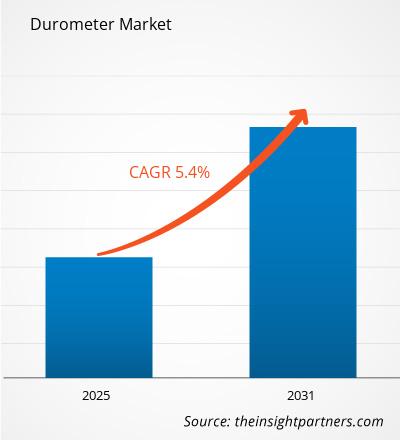
The global Durometer market was valued at US$ 1.28 billion in 2025 and is expected to reach US$ 2.04 billion by 2034; it is estimated to record a CAGR of 5.32% during 2026-2034.
Durometer Market Assessment and Insights
- North America: North America is estimated to hold a 29–33% Durometer Market share in 2025, expanding at a 5.1–5.7% CAGR between 2026–2034, supported by mature manufacturing, polymer testing, automotive production, and laboratory quality-control infrastructure.
- US: The US is estimated to represent 74–78% of North America in 2025, growing at a 5.0–5.6% CAGR between 2026–2034, supported by industrial testing and advanced materials laboratories.
- Europe: Europe is estimated at a 25–29% share in 2025, advancing at a 5.2–5.8% CAGR between 2026–2034, led by Germany, the UK, France, Italy, and Spain across automotive, polymers, and precision manufacturing.
- Asia Pacific: Asia Pacific is estimated to account for 27–31% share in 2025, growing at a 6.0–6.7% CAGR between 2026–2034, with China, Japan, South Korea, India, and Taiwan supporting manufacturing-led demand.
- Largest Segment: Type A is estimated to hold a 34–38% market share in 2025, with a 5.4–5.9% CAGR during 2026–2034, reflecting broad elastomer and rubber-testing applicability.
- High Growth Segment: Digital Durometer is estimated at a 52–56% market share in 2025, with a 6.1–6.7% CAGR during 2026–2034, driven by data capture and measurement repeatability.
- Key companies analyzed in detail: Buehler, Hildebrand, IMADA Incorporated, INSIZE, Mitutoyo Corporation, PCE Instruments, PTC Instruments, Rex Gauge Company, Inc., Shimadzu Corporation, TECLOCK Corporation.
Source: The Insight Partners' analysis based on proprietary research, government publications, company annual reports, investor presentations, industry databases, and expert interviews.
The Durometer Market has evolved from mechanical analog instruments to electronic, automated, and data-connected devices. New product development focuses on accuracy, peak detection, calibration management, smaller test pieces, and data transmission capability. The ASTM D2240 standard includes different types of durometers used to measure hardness of elastomers and thermoplastics, and ISO 48-4 provides Shore indentation hardness testing methods for certain rubber hardness scales. The standards underscore the significance of standardized force, indenter design, sample preparation, and testing process.
In the upcoming years, development is anticipated to focus on automated measurements, wireless communication, calibration traceability, and fixtures for certain applications. New manufacturing hubs in Asia Pacific will contribute to additional demand as production of rubber, plastics, automotive parts, electronics, and consumer goods grows. Meanwhile, more developed regions are expected to focus on replacing traditional instruments with electronic solutions that avoid transcription errors.
Durometer Market Report Scope
| Report Attribute | Details |
|---|---|
| Market size in 2025 | US$ 1.28 Billion |
| Market Size by 2034 | US$ 2.04 Billion |
| Global CAGR (2026 - 2034) | 5.32% |
| Historical Data | 2021-2024 |
| Forecast period | 2026-2034 |
Durometer Market Analysis
Durometer market Growth depends primarily on manufacturing quality requirements related to rubber, polymers, plastics, seals, gaskets, tubing, footwear, automobile parts, and consumer goods. The system comprises instrument makers, indenter and spring makers, calibration labs, block makers, distributors, materials labs, and industrial quality divisions. The market will benefit from the usage of hardness values as production release criteria or consistency proofs.
Supply tends to go towards those suppliers who are able to supply not only measuring instruments but also the whole measurement system. The system may include, apart from instruments, test stands, blocks, calibration certificates, software, USB or wireless communication, and spare parts. This is evident from TECLOCK's approach to automation and semi-automation of hardness measurements and provision of SmartTester series which focuses on repeatability and direct data exchange.
Positioning in the Durometer Market depends on the level of accuracy, compliance with standards, product range, application, calibration capabilities, and geography. TECLOCK focuses mainly on rubber and soft-material hardness measurement, whereas Mitutoyo offers durometer testing combined with other precision measurement solutions. Buehler adds to the competitive environment by offering materials testing capabilities, whereas Shimadzu offers advanced hardness testing equipment for material characterization. The rest of the players add value to the market with specialized, portable, laboratory, and industrial measurement devices.
Durometer Market trends indicate that investment involves digital transformation and automation of the inspection process. Mitutoyo's accreditation scope for 2025 comprises Type A and Type D durometer testing as well as test blocks based on the ASTM D2240, which shows that the need for traceability remains relevant. TECLOCK's Bluetooth-equipped durometer line proves the demand for connected factory-floor measurement. Shimadzu's current hardness portfolio expands to micro-scale and automated material testing.
● REPORT CUSTOMIZATION
Tailor This Report To Align With Your Specific Business Requirements
This report can be customized to align precisely with your business objectives, scope, and target markets. Customization options include tailored segmentation, geography, competitive analysis, and strategic insights to support informed decision-making.
Customize This Report →WHAT YOU CAN ADJUST
- ● Segmentations
- ● Geography
- ● Competitive Analysis
- ● Language Preferences
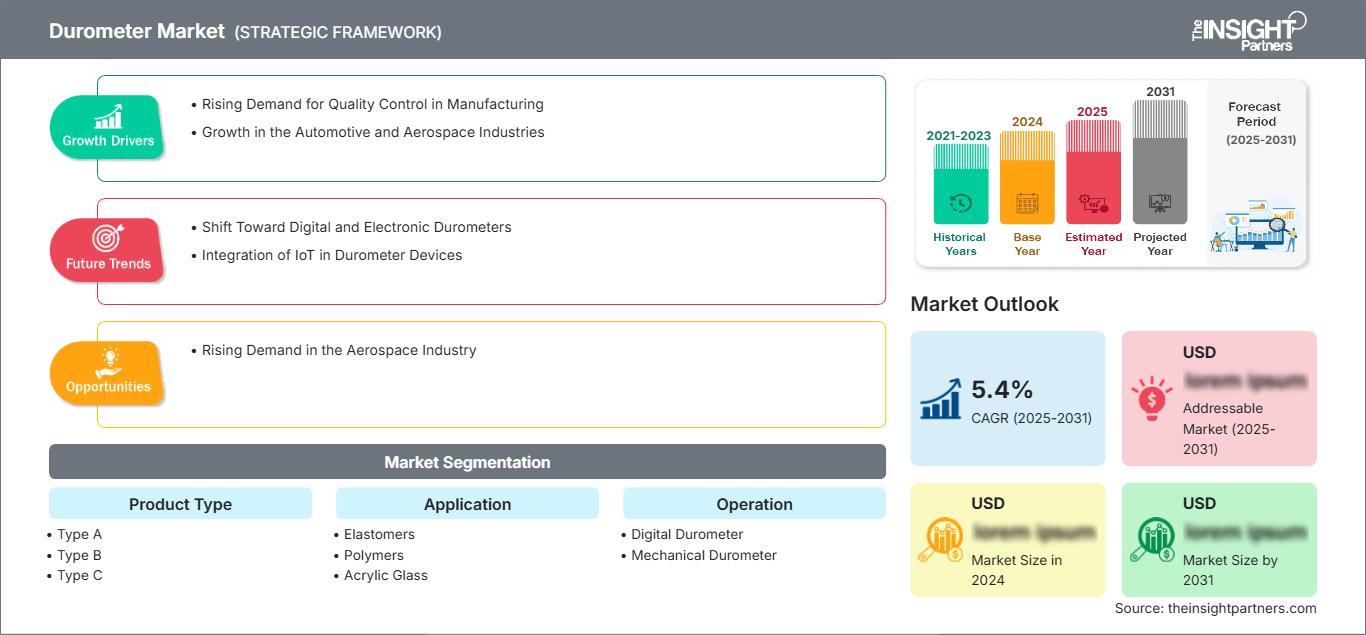
Durometer Market: Strategic Insights
Regional Insights
North America Durometer Market
North America is expected to hold 29-33% of the global market in 2025 and is predicted to expand at a CAGR of 5.1-5.7% until 2034. The US leads regional demand due to automotive components, industrial rubber, plastic, medical devices, aerospace materials, and laboratory testing needs. Canada contributes through automotive, mining equipment, and polymer applications, and Mexico has advantages because of its growing automotive and manufacturing supply chains. Quality control processes need repeatable hardness testing of incoming materials, molded parts, seals, hoses, and completed parts.
Increasing demands for the purchase include digital display options, peak hold functions, calibration traceability, test stand and data exporting capabilities. Industrial laboratories are also looking for the equipment which will allow for standardization of measurements between operators. ASTM D2240 is still an important reference standard for hardness testing of rubber products in the region and includes several devices along with the effect of indenter shape and applied force.
U.S. Durometer Market Market
The United States constitutes around 74-78% of the total North American market of 2025, and is anticipated to grow at a CAGR of 5.0-5.6% through 2034. Demand will be segmented into applications such as automotive, aerospace, medical devices, plastics, rubber products, electronics, and contract testing laboratories. Suppliers like Buehler, Mitutoyo Corporation, PTC Instruments, Rex Gauge Company, Inc., and PCE Instruments offer varying testing options ranging from hand-held gauges to laboratory-based systems. Applications include production verification and material uniformity.
There is also a strong calibration and metrology presence in the United States market. The accreditation documents for 2025 by Mitutoyo specifically relate to Type A and Type D durometer tests and test blocks in ASTM D2240, thus increasing demand for traceable measurements. Digital gauges are preferred where there is a need for digital records, while mechanical gauges are useful for simpler testing applications.
Europe Durometer Market
The Europe region holds a share of 25–29% in 2025 and is anticipated to register a CAGR of 5.2–5.8% during 2026-2034. The German market is expected to be the leading market, driven by the automotive industry, machinery manufacturing, polymers production, and precision engineering industry. The United Kingdom, France, Italy, and Spain are other regions driving growth from the production of components, laboratories, plastic processing, and quality assurance.
Germany shows significant demand for automated inspection and standardized material testing, while the United Kingdom continues to have uses for their laboratory testing equipment and specialized manufacturing sector. France, Italy, and Spain offer more demand from automotive, packaging, rubber goods, and industrial parts. ISO 48-4 offers standards for measuring Shore hardness of vulcanized and thermoplastic rubber.
APAC Durometer Market
APAC is expected to account for 27-31% market share in 2025 and is projected to grow at a 6.0-6.7% CAGR over 2034. The region’s key countries include China, Japan, South Korea, India, and Taiwan. Manufacturing growth, plastics molding, automotive production, electronics, footwear, and rubber products drive instrument demand. Precision measuring is strong in Japan, whereas volume potential is in China and India.
Supportive industrial policies in favor of local manufacturing and quality improvement will help maintain the demand for inspection devices. The example of Japanese TECLOCK demonstrates the region’s emphasis on standardization of rubber measuring, automation, thin section measuring, and connectivity of measurement data and process. The demand thus moves away from portable measuring tools toward more repeatable and connected solutions.
Middle East & Africa Durometer Market
Middle East & Africa is expected to record a 4.7–5.5% CAGR through 2034, with Saudi Arabia and the UAE leading regional demand and South Africa serving as an important industrial and laboratory center. Growth is linked to construction materials, oil and gas equipment, automotive components, plastics conversion, and manufacturing diversification. Saudi industrial development provides the largest regional opportunity.
The UAE benefits from manufacturing and logistics investments, while South Africa supports testing demand across mining equipment, rubber products, automotive components, and industrial laboratories. Rest of MEA remains fragmented, with procurement influenced by distributor availability, calibration services, and technical support. Increasing industrial localization should gradually strengthen demand for portable and digital inspection equipment.
Segmentation Analysis
Product Type
Product Type determines the measurement scale, indenter configuration, applied force, and material range that an instrument can address. Type A remains the broadest configuration for conventional rubber and elastomer applications, while Type D serves harder materials. Type B and Type C address intermediate or specialized materials, and Type M supports compact or thin-part applications. The segment is expected to expand at a 5.3–5.9% CAGR during 2026–2034.
- Type A: Type A remains the principal choice for medium-hardness rubber and elastomers, supporting routine quality checks across molded products, seals, hoses, footwear, and automotive components.
- Type B: Type B addresses materials requiring a different indentation response from conventional Type A testing, giving laboratories greater flexibility when hardness characteristics fall outside standard application ranges.
- Type C: Type C supports specialized hardness measurement for selected elastomeric materials, providing manufacturers with an additional scale where Type A or Type D configurations are unsuitable.
- Type D: Type D is strategically important for harder rubber and plastic materials, particularly where higher hardness requires a more suitable indenter geometry and measurement configuration.
- Type M: Type M supports measurement of smaller or thinner specimens, addressing components where conventional handheld durometers can be difficult to position consistently.
- Others: Other configurations serve specialized hardness applications and provide manufacturers with additional scale options for materials outside the most frequently tested hardness ranges.
Application
Application influences instrument configuration because elastomers require conventional Shore testing, polymers may demand different scales and fixtures, and acrylic glass can require controlled measurement procedures. The Application segment is projected to grow at a 5.1–5.7% CAGR during 2026–2034, supported by material diversification and production quality requirements.
- Elastomers: Elastomer testing represents a core application, covering rubber compounds, seals, gaskets, hoses, tires, and molded components where hardness directly supports formulation and quality-control decisions.
- Polymers: Polymer applications are expanding with plastics manufacturing and engineered materials, creating demand for versatile instruments capable of repeatable measurements across different hardness ranges and specimen geometries.
- Acrylic Glass: Acrylic glass testing requires controlled contact conditions and consistent measurement technique, making reliable instrument positioning and calibration particularly important for laboratories and manufacturers.
- Others: Other materials extend application breadth across soft and semi-rigid products, allowing manufacturers and laboratories to select specialized hardness scales according to material behavior and test requirements.
Operation
Operation divides instruments according to manual mechanical measurement or digitally enabled measurement. Digital systems increasingly appeal to users requiring electronic records, peak-value capture, statistical analysis, and integration with quality software. Mechanical instruments remain relevant for simple, portable, and cost-sensitive testing. The segment is forecast to grow at a 5.8–6.4% CAGR during 2026–2034.
- Digital Durometer: Digital durometers provide clear numerical displays, electronic data handling, and increasingly wireless connectivity, supporting standardized production records and reducing manual transcription.
- Mechanical Durometer: Mechanical durometers remain valued for portability, simplicity, durability, and straightforward visual readings, particularly in field inspections and basic shop-floor quality-control applications.
End-user
End-user requirements vary according to measurement frequency, documentation needs, operator skill, and testing environment. Industrial organizations typically prioritize throughput and repeatability, whereas laboratories require calibration control and measurement traceability. The segment is expected to expand at a 5.2–5.8% CAGR during 2026–2034.
- Industrial: Industrial users require fast, repeatable hardness checks across incoming materials, production batches, molded parts, and finished goods, making rugged construction and easy operation important purchasing criteria.
- Laboratory: Laboratory users emphasize controlled test conditions, calibration, repeatability, specimen preparation, and data documentation, supporting demand for stands, reference blocks, digital interfaces, and advanced analysis capabilities.
Opportunity Snapshot
| End-user | Revenue Contribution (High/Medium/Low) | Trend Tag (MAX 2 words) | Adoption Stage (Emerging/Scaling/Mature) |
| Industrial | High | Inline Inspection | Mature |
| Laboratory | Medium | Data Traceability | Scaling |
Durometer Market Growth Drivers and Impact Analysis
Rising Demand for Repeatable Material Quality Control
The requirement for consistency of material properties between batch-to-batch production is becoming increasingly necessary since variations in hardness will indicate any variations in the formulation, curing process, method of production, or even variations in the raw materials used. There is a continual need for measurement equipment that produces repeatable measurements using controllable force and contact criteria. According to ASTM D2240, indentation hardness is influenced by the shape of the indenter, force applied, and material characteristics. The commercial value is not only about selling measurement equipment but also providing calibration blocks, certification of the equipment, stands, spare parts, and training to operators. Hardness results are now becoming part of quality control data as production becomes more and more automated.
Expansion of Advanced Polymers and Elastomer Components
The increasing adoption of engineered polymers, thermoplastic elastomers, specific rubber formulations, and light-weight materials creates new opportunities for testing the hardness of additional types of components. Applications in automotive electrification, medical devices, electronics, and consumer goods include various material compositions, the hardness properties of which must comply with certain specifications. Various hardness tests are needed because no single type of durometer can characterize all materials. According to ASTM D2240, there are several different types of devices, while according to ISO 48-4, specific Shore hardness scales are utilized for testing rubber materials. The increased market need is represented by multi-scale instruments, interchangeable probes, application-specific fixturing, and testing equipment. Software is another opportunity for differentiation, helping to manage the test results according to material grades, lots, suppliers, and production steps.
Digitalization of Inspection and Metrology Workflows
Manufacturing organizations are moving measurement records from paper forms toward electronic quality systems, creating a direct opportunity for digital durometers. Electronic data capture reduces transcription errors and makes measurements easier to associate with operators, components, batches, and inspection dates. TECLOCK's SmartTester systems demonstrate this transition by supporting automated or semi-automated hardness measurement and external measurement-data output. Its broader Measurement DX strategy also connects measurement instruments with digital data management. The commercial effect is a gradual shift in purchasing criteria from basic readability toward connectivity, software compatibility, statistical reporting, and traceability. Vendors that integrate wireless communication, USB connectivity, automatic peak detection, and calibration reminders can command greater relevance in factories pursuing broader digital quality initiatives.
Durometer Market Future Trends
Bluetooth-Enabled Measurement and Paperless Inspection
Future meters will integrate hardness testing together with Bluetooth connectivity, mobile phones, desktop computers and central quality data bases. Such an approach will enable the user to record readings at the very point of production, with automatic registration of identity, time stamp and test conditions. Currently, TECLOCK sells Bluetooth durometers and places the digital hardness test as part of the factory floor revolution. The next stage of development should involve automatic checking and validation of readings, set acceptance criteria, wireless calibration history and integration into manufacturing execution systems. For laboratories, the wireless meter will make statistical analysis easier and eliminate unnecessary manual transcription. For factories, the true value of wireless meters will be in the information around the measurement rather than in the hardness itself.
Automation for Small and Difficult Specimens
Hardness measurement is increasingly moving toward automated systems capable of handling thin sheets, O-rings, small molded parts, and difficult geometries. Conventional handheld testing can produce operator-dependent variation when the specimen is too small or when consistent positioning is difficult. TECLOCK's automated systems address small and thin rubber components through IRHD M-method equipment, while its SmartTester portfolio provides controlled measurement speed and loading. Future systems should increasingly combine motorized loading, automated specimen positioning, programmable measurement sequences, and direct result storage. Such automation will be particularly relevant for automotive seals, electronic components, medical-device parts, and precision molded products. The trend should expand the addressable market for higher-value laboratory and production systems while reducing dependence on operator technique.
Durometer Market Opportunities
Connected Quality-Control Platforms
Manufacturers can capture new value by developing connected hardness platforms that combine instruments, calibration accessories, software, and reporting tools. Instead of selling a gauge as a standalone product, suppliers can provide a measurement ecosystem covering test execution, data storage, statistical review, calibration scheduling, and audit documentation. This model is attractive for companies operating multiple production lines or facilities because centralized information can improve comparability across locations. The opportunity is particularly strong in automotive, electronics, medical devices, and engineered polymers, where quality documentation is increasingly important. Suppliers should prioritize open communication protocols and compatibility with existing quality-management systems rather than proprietary data environments. Recurring software services, calibration programs, replacement probes, and verification blocks can create additional revenue while strengthening customer retention. Such offerings can support the Durometer Market Forecasts by increasing instrument value per installed customer.
Asia Pacific Manufacturing Localization
Asia Pacific provides an attractive expansion opportunity because manufacturers are increasing local production of automotive parts, electronics, rubber goods, plastics, medical products, and consumer components. China, Japan, South Korea, India, and Taiwan offer distinct customer bases with different requirements for precision, cost, automation, and technical support. Suppliers can expand by combining localized distribution with calibration services, application training, and region-specific fixtures. Japanese manufacturers already demonstrate strong emphasis on automated rubber measurement and digital data management, while rapidly industrializing markets provide opportunities for simpler portable instruments before customers progress toward automated systems. Local partnerships with testing laboratories, machine builders, and component manufacturers can shorten sales cycles and improve service responsiveness. The Durometer Market scope therefore extends beyond instrument sales into calibration, workflow software, accessories, and application engineering.
Recent Developments
- December 2025: Proceq launched motorized probes for micro-hardness testing, expanding its testing solutions with automated probe operation for material hardness measurements. The new probes are designed to improve testing consistency and reduce manual intervention during measurements, supporting more controlled inspection workflows. The development strengthens Proceq’s portfolio of digital and automated non-destructive testing technologies for industrial material assessment.
- November 2023: Inkbit introduced TEPU 50A, a thiol-ene polyurethane-based elastomer for 3D printing with a Shore 50A hardness, low compression set, UV stability, and chemical compatibility. The material was developed for applications requiring flexible, resilient components with precise details and surface quality, including prototyping and replacement of rubber, silicone, and molded TPU parts in automotive and industrial applications.
Frequently Asked Questions

- Comprehensive Market Sizing and Forecast Analysis
- Detailed Segmentation Analysis
- In-Depth Market Dynamics Assessment
- Regional and Country-Level Insights
- Competitive Landscape and Company Benchmarking
- Strategic Business Intelligence
Recent Reports
Testimonials

The Insight Partners' SCADA System Market report is comprehensive, with valuable insights on current trends and future forecasts. The team was highly professional, responsive, and supportive throughout. We are very satisfied and highly recommend their services.
RAN KEDEM Partner, Reali Technologies LTDs
I requested a report on a very specific software market and the team produced the report in a few days. The information was very relevant and well presented. I then requested some changes and additions to the report. The team was again very responsive and I got the final report in less than a week.
JEAN-HERVE JENN Chairman, Future Analytica
We worked with The Insight Partners for an important market study and forecast. They gave us clear insights into opportunities and risks, which helped shape our plans. Their research was easy to use and based on solid data. It helped us make smart, confident decisions. We highly recommend them.
PIYUSH NAGPAL Sr. Vice President, High Beam Global
The Insight Partners delivered insightful, well-structured market research with strong domain expertise. Their team was professional and responsive throughout. The user-friendly website made accessing industry reports seamless. We highly recommend them for reliable, high-quality research services
YUKIHIKO ADACHI CEO, Deep Blue, LLC.
This is the first time I have purchased a market report from The Insight Partners.While I was unsure at first, I visited their web site and felt more comfortable to take the risk and purchase a market report.I am completely satisfied with the quality of the report and customer service. I had several questions and comments with the initial report, but after a couple of dialogs over email with their analyst I believe I have a report that I can use as input to our strategic planning process.Thank you so much for taking the extra time and making this a positive experience.I will definitely recommend your service to others and you will be my first call when we need further market data.
JOHN SUZUKI President and Chief Executive Officer, Board Director, BK Technologies
I wish to appreciate your support and the professionalism you displayed in the course of attending to my request for information regarding to infectious disease IVD market in Nigeria. I appreciate your patience, your guidance, and the fact that you were willing to offer a discount, which eventually made it possible for us to close a deal. I look forward to engaging The Insight Partners in the future, all thanks to the impression you have created in me as a result of this first encounter.
DR CHIJIOKE ONYIA MANAGING DIRECTOR, PineCrest Healthcare Ltd.Reason to Buy
- Informed Decision-Making
- Understanding Market Dynamics
- Competitive Analysis
- Identifying Emerging Markets
- Customer Insights
- Market Forecasts
- Risk Mitigation
- Boosting Operational Efficiency
- Strategic Planning
- Investment Justification
- Tracking Industry Innovations
- Aligning with Regulatory Trends





 Get Free Sample for