
Electric Actuator Market Size, Share & Growth by 2034
Coverage: byType (Hydraulic, Pneumatic, Electric, Others); Motion (Rotary, Linear); Application (Power industry, Oil and Gas industry, Automotive, Aerospace and Defense, Others), and Geography (North America, Europe, Asia Pacific, and South and Central America)
- Status : Data Released
- Report Code : TIPRE00009884
- Category : Electronics and Semiconductor
- No. of Pages : 150
- Available Report Formats :


- Last update date : September 07, 2026


2025 Market Size
US$ 14.43 Bn
Base year value
2034 Forecast
US$ 26. Bn
Projected by 2034
CAGR 2026-2034
6.76 %
Growth rate
Addressable Market
US$ 182.70 Bn
(2026-2034)
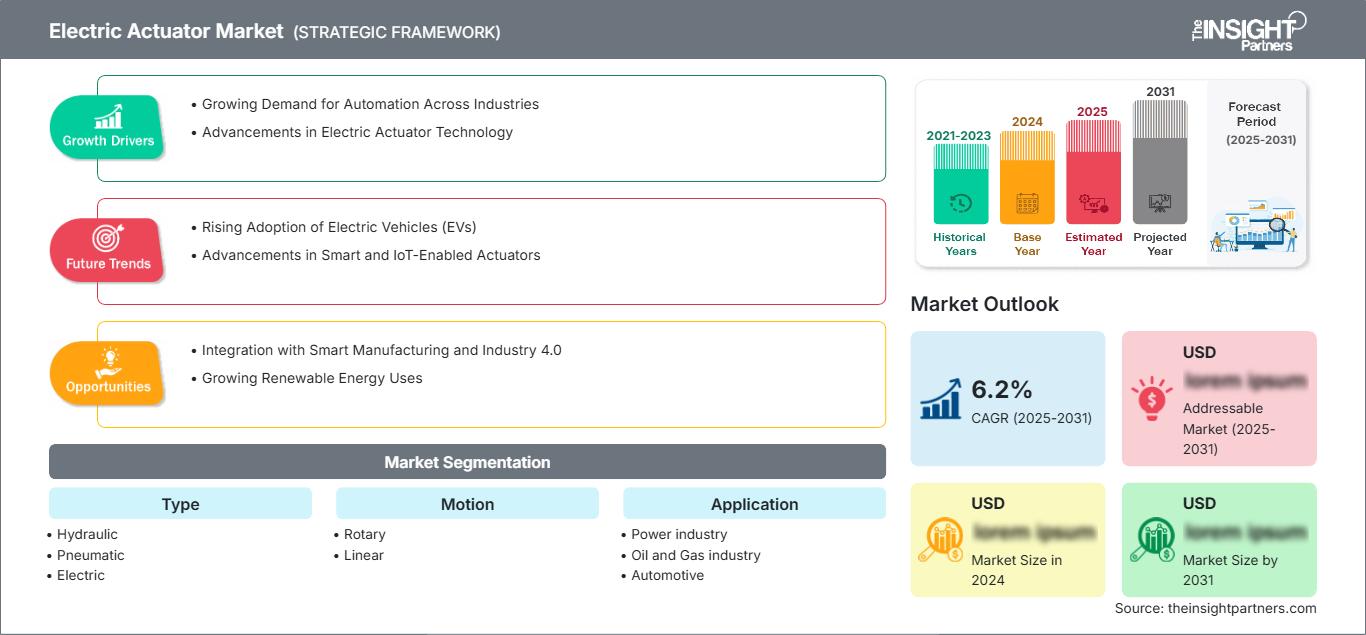
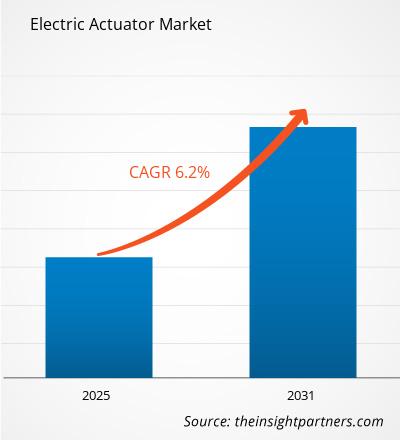
The Electric Actuator Market held a valuation of US$ 14.43 Billion in 2025 and will have an estimated worth of US$ 26 Billion in 2034, witnessing a CAGR of 6.76% from 2026 to 2034. The market is growing due to process automation, valve electrification, and motion control as industry users move from fluid power systems to electromechanical actuation.
North American Electric Actuator Market size will grow at a CAGR of 6.8% – 7.4% till 2034 backed by investments in shale oil infrastructure, power grid and manufacturing automation. Utility and manufacturers are focused on electric valve actuation to minimize losses and enable diagnostics in power generation, oil & gas, automotive, and aerospace industries.
Electric Actuator Market Assessment and Insights
- North America held 29–33% share in 2025 and is growing at a CAGR range of 6.8–7.4% during 2026–2034, supported by energy infrastructure renewal, domestic manufacturing automation, and strong valve automation demand.
- US represented 78–82% of North America in 2025 and is growing at a CAGR range of 6.9–7.5%, led by power generation, pipelines, aerospace, and automotive automation.
- Europe accounted for 23–27% share in 2025 and is advancing at a CAGR range of 6.0–6.6%, with Germany, the UK, France, Italy, and Spain leading process, water, and industrial upgrades.
- Asia Pacific captured 32–36% share in 2025 and is expanding at a CAGR range of 7.2–7.8%, led by China, Japan, India, and South Korea across manufacturing, energy, and automotive facilities.
- Largest Segment Electric held 43–47% market share in 2025 and is growing at a CAGR range of 7.0–7.6%, supported by precision control, lower maintenance, and industrial digitalization.
- High Growth Segment Automotive held 16–20% market share in 2025 and is growing at a CAGR range of 7.6–8.2%, driven by EV platforms, assembly automation, and active motion systems.
- Key companies analyzed in detail: Rotork plc, Parker-Hannifin Corporation, ABB Ltd, AUMA Riester GmbH & Co. KG, Bernard Controls SAS, DewertOkin GmbH, Emerson Electric Co., Flowserve Corporation, Tefulong (Shanghai) Technologies Co., Ltd., and TiMOTION Technology Co., Ltd.
Source: The Insight Partners' analysis based on proprietary research, government publications, company annual reports, investor presentations, industry databases, and expert interviews.
Market development is moving from simple open/close actuation into smarter devices that include a motor, gearbox, position feedback, diagnostics, fieldbus interface, and predictive maintenance features. Key drivers behind the market include the requirement for accurate valve actuation, reduced leak possibilities, and easy integration with distributed control systems. Manufacturing trends involve modularity, variable torque, rugged construction, and software installation assistance.
Looking into the future, the drivers will gain momentum as developing manufacturing markets become increasingly electrified and as regulators and operators update outdated valve assemblies in their networks. Investments in renewable energy generation facilities, hydrogen facilities, water treatment infrastructure, and LNG plants will encourage the use of electric actuators. Regulatory drivers such as energy efficiency, reduced emissions, and hazardous-area safety will encourage adoption of electric actuation systems.
Electric Actuator Market Report Scope
| Report Attribute | Details |
|---|---|
| Market size in 2025 | US$ 14.43 Billion |
| Market Size by 2034 | US$ 26. Billion |
| Global CAGR (2026 - 2034) | 6.76% |
| Historical Data | 2021-2024 |
| Forecast period | 2026-2034 |
Electric Actuator Market Analysis
Electric Actuator market growth can be attributed to the increasing electrification of industrial assets, increasing use of automated valves, and increasing need for accuracy in high-cycle applications. The value chain includes motor manufacturers, gearbox manufacturers, electronics manufacturers, actuator OEMs, valve manufacturers, system integrators, distributors, and plant operators. Increasing supply dynamics have been driven by the need for small size motors, embedded control, digital communication protocols, and certifications of designs suitable for energy, water, military and industrial applications.
Demand has been highest for applications where compressed air systems cause energy losses and hydraulic systems pose maintenance and contamination risks. Electric actuators lower auxiliary equipment needs, enable remote diagnostics, and increase repeatability in rotary and linear movement applications. The ecosystem also includes demand from retrofit applications since utilities and process plants favor replacement of old valve operators during maintenance shut downs.
In the Electric Actuator Market report, the competitive landscape is seen evolving in favor of flow control systems integration and service-driven differentiation. Rotork plc, AUMA Riester GmbH & Co. KG, Flowserve Corporation, Bernard Controls SAS, Emerson Electric Co., and ABB Ltd are competitors in process valve automation, whereas Parker-Hannifin Corporation, DewertOkin GmbH, Tefulong (Shanghai) Technologies Co., Ltd., and TiMOTION Technology Co., Ltd. target their offerings to specific applications.
Key investment trends include smart actuation capabilities, hazardous areas approval, plant connectivity, and service delivery that cuts down the commissioning and maintenance time cycle. The recent ABB Ltd offer to acquire Rotork plc in 2026 reveals the intention to combine field-device intelligence with automation offerings. Companies that have reliable products, diagnostics, and regional service network will be able to protect their margin as buyers evaluate total lifecycle cost.
● REPORT CUSTOMIZATION
Tailor This Report To Align With Your Specific Business Requirements
This report can be customized to align precisely with your business objectives, scope, and target markets. Customization options include tailored segmentation, geography, competitive analysis, and strategic insights to support informed decision-making.
Customize This Report →WHAT YOU CAN ADJUST
- ● Segmentations
- ● Geography
- ● Competitive Analysis
- ● Language Preferences
Electric Actuator Market: Strategic Insights
Regional Insights
North America Electric Actuator Market
North America held 29–33% share in 2025 and is projected to grow at a CAGR range of 6.8–7.4% through 2034. Electric Actuator Market share is supported by oil and gas midstream automation, power-plant valve modernization, water infrastructure funding, aerospace component production, and expanding advanced manufacturing. U.S. policy support for domestic manufacturing and grid reliability reinforces procurement of intelligent actuation systems.
Structural demand is also derived from the requirements to cut down methane emissions, enhance safety in dangerous environments, and preserve aged pipelines and utilities. Electric actuators are preferred when precise positioning and diagnostics along with lesser reliance on compressed air are required by the operator. Buyers from the region prefer localized service, cyber-safe controls, and certification for rigorous process, municipal, and military applications.
U.S. Electric Actuator Market
The US represented 78–82% of North America in 2025 and is forecast to grow at a CAGR range of 6.9–7.5%. Demand is anchored by LNG projects, refinery upgrades, power generation, water utilities, automotive assembly, and aerospace systems. Emerson Electric Co., Flowserve Corporation, Parker-Hannifin Corporation, ABB Ltd, and Rotork plc maintain strong commercial, service, or manufacturing footprints.
The current trend in applications is towards the automation of quarter-turn valves, linear actuation of manufacturing machinery, safety shut-off mechanisms, and intelligent actuators which are integrated into the plant network. The Market in the US is driven by investments in energy security, industrial reshoring, and automation initiatives that need repeatability in control.
Europe Electric Actuator Market
Europe has had 23–27% market share in 2025 and is forecasted to exhibit CAGR between 6.0–6.6%. The leader is Germany through automation in processes, automotive machinery and water infrastructure improvement. The UK helps through development of utilities, nuclear and offshore energy applications. France helps through aerospace, power and automation of industrial valves thanks to modernization of infrastructure.
There is progress in Italy and Spain through use of technology in manufacturing, water treatment, chemical and renewable-energy applications. Europe's market demand is slowed by reduced production of industries in some markets but there is creation of sustainable replacement cycles due to digitalization and energy efficiency requirements. Customers prefer smaller, low-voltage electric actuators that have fieldbus capability and suppliers include AUMA Riester GmbH & Co. KG and Bernard Controls SAS.
APAC Electric Actuator Market
Asia Pacific held 32-36% market share in 2025 and will be witnessing growth of 7.2-7.8% CAGR. China dominates the market on the back of energy, chemical, water, and automotive manufacturing applications, whereas Japan and South Korea dominate the market due to robotics, precision engineering, and shipbuilding sectors. India contributes to the growth due to power generation, refineries, infrastructure developments, and industrial automation.
Factors such as manufacturing localization, environment regulations, and adoption of smart factory technology drive the market. The Market benefits due to a number of suppliers and a number of projects. Buyers in Asia Pacific are looking for competitive and electronic actuators which are corrosion and digital friendly.
Middle East & Africa Electric Actuator Market
Middle East & Africa is projected to grow at a CAGR range of 5.8–6.4% as Saudi Arabia, the UAE, South Africa, and the rest of MEA invest in oil and gas, desalination, power, and transport infrastructure. Saudi Arabia leads demand through upstream, downstream, water, and industrial diversification projects.
In energy and infrastructure settings, electric actuator valves are suited for use in pipelines, storage tanks, refineries, desalination plants, port facilities, and district heating systems. The uptake is uneven due to cyclic purchasing of equipment, but there are increasing needs for resilience and remote monitoring. Growth requires certified equipment and local service provision.
Segmentation Analysis
Type
Type is projected to grow at a CAGR range of 6.5–7.1% during 2026–2034 as buyers compare hydraulic force density, pneumatic simplicity, and electric controllability. Electric Actuator Market scope covers legacy fluid-powered systems and increasingly preferred motor-driven solutions. Adoption depends on load profile, duty cycle, safety needs, maintenance tolerance, and integration with automation platforms.
- Hydraulic remains important where high force, rugged operation, and severe-duty positioning are required, particularly in heavy equipment, large valves, aerospace systems, and demanding industrial applications.
- Pneumatic is widely used in simple on-off actuation and fast cycling, especially where facilities already maintain compressed-air networks and prioritize low upfront device cost.
- Electric leads adoption where precise positioning, cleaner operation, digital diagnostics, and lower maintenance are valued across valves, machinery, medical equipment, and automation systems.
Motion
Motion is forecast to grow at a CAGR range of 6.4–7.0% during 2026–2034 as rotary and linear designs address different equipment architectures. Rotary motion dominates valve automation, dampers, and quarter-turn applications, while linear motion supports lifting, pushing, positioning, and machine-axis movement. Selection depends on stroke, torque, thrust, speed, enclosure, and control accuracy.
- Rotary supports quarter-turn valves, dampers, robotics joints, indexing systems, and industrial equipment where compact torque delivery and accurate angular positioning are strategic requirements.
- Linear serves push-pull movement in automotive systems, factory equipment, furniture, medical devices, aerospace mechanisms, and process controls needing controlled stroke and repeatable force.
Application
Application is expected to grow at a CAGR range of 6.6–7.2% during 2026–2034 as industries adopt actuation to improve control, safety, and automation depth. Power and oil and gas remain core process markets, while automotive and aerospace require compact, reliable motion systems. The segment outlook is tied to electrification, plant modernization, safety regulations, and demand for lower lifecycle costs.
- Power industry uses electric actuators for steam, cooling, fuel, damper, and balance-of-plant control where reliability, diagnostics, and precise valve movement support operating efficiency.
- Oil and Gas industry requires robust valve automation for pipelines, refineries, LNG, terminals, and well sites, with demand shaped by safety, remote operation, and emissions reduction.
- Automotive applies actuators in manufacturing cells, EV systems, seat and comfort functions, thermal control, active aerodynamics, and automated assembly needing repeatable movement.
- Aerospace and Defense demands lightweight, reliable actuation for flight systems, ground equipment, test rigs, and defense platforms where certification and dependable motion control matter.
Opportunity Snapshot
| Application | Revenue Contribution | Trend Tag | Adoption Stage |
| Power industry | High | Grid Valves | Mature |
| Oil and Gas industry | High | Remote Shutoff | Scaling |
| Automotive | Medium | EV Motion | Scaling |
| Aerospace and Defense | Medium | Certified Motion | Mature |
| Others | Low | Specialty Automation | Emerging |
Electric Actuator Market Growth Drivers and Impact Analysis
Industrial Electrification Replaces Fluid-Powered Actuation
The industrial sector is using electrically operated actuators in place of pneumatic and hydraulic actuators wherever there are advantages of saving energy, eliminating leaks, and improving maintenance. Operation of compressed air networks is expensive, and hydraulic fluid management poses both environmental problems and risks. Electrical actuators offer precise positioning, accurate torque and easier interfacing with electronic control systems. The implications for the industry include increased retrofits in water works, power plants, chemical and manufacturing operations where increased visibility of assets is required. Prospective buyers consider lifecycle costs, accessibility, and regulatory compliance along with initial costs. This trend favors vendors who offer modular lineups, hazardous area models, and staff to perform conversions.
Smart Infrastructure Expands Remote Valve Automation
Utility companies, pipeline operators, and industrial asset managers are turning to remote monitoring for their systems to increase resilience and decrease the need for field intervention by personnel. Electric actuators provide a solution for this purpose since they are able to incorporate position sensing, diagnostics, torque sensing, and communication in a supervisory control environment. When it comes to water systems, power plants, terminals, and district heating systems, the ability to remotely operate valves leads to faster response to system faults, weather events, and peak demand conditions. The market impact of this development lies in the change in customer demand for intelligent actuation rather than simple motor operators.
Automotive and Aerospace Demand Precision Motion
In the automotive and aerospace industries, small and compact motion systems are needed that provide solutions to the challenges posed by electrification, weight reduction, automation, and critical safety functions. Actuators that operate on an electric basis have applications in production equipment, test equipment, thermal management systems, seating systems, access systems, control systems, and auxiliary equipment where reliable motion and precise control are required. There is more demand for electric motion systems in the design of EVs since hydraulic and pneumatic systems do not integrate well with electric-based vehicles. The buyers in the aerospace and defense segment emphasize reliability and certification.
Electric Actuator Market Future Trends
Connected Actuators Become Standard in Process Automation
Electric Actuator Market trends will increasingly center on intelligent devices that transmit health, torque, position, and cycle data into plant asset systems. Over the next decade, field devices will be expected to support predictive maintenance rather than only execute movement commands. This will favor actuators with embedded diagnostics, Ethernet connectivity, secure configuration, and app-based commissioning. The shift will also change purchasing behavior because operators will compare data usefulness, serviceability, and integration cost. Suppliers that convert device-level information into actionable maintenance workflows will create differentiation beyond mechanical performance, particularly in water, energy, mining, and chemical facilities.
Low-Carbon Plants Favor Efficient Electric Motion
Future plants will be designed around lower energy intensity, fewer leaks, and easier monitoring of distributed assets. Electric actuators support this transition by avoiding continuous air compression, reducing hydraulic fluid handling, and enabling precise movement only when needed. Hydrogen, carbon capture, renewable power, and advanced water treatment projects will require reliable valve automation under strict safety and environmental expectations. This trend will increase demand for efficient motors, low-power standby modes, corrosion-resistant housings, and certified designs for hazardous or harsh settings. Vendors that document energy savings and lifecycle emissions benefits will improve acceptance in sustainability-focused capital projects.
Electric Actuator Market Opportunities
Retrofit Programs for Water, Power, and Process Plants
Retrofit programs offer a practical investment path because many plants operate aging manual, pneumatic, or earlier-generation electric valve systems. Electric Actuator Market Forecasts indicate that replacement demand will be reinforced by infrastructure spending, digital maintenance strategies, and operator shortages. Vendors can target installed bases with conversion kits, compatible mounting interfaces, and commissioning services that reduce shutdown time. Opportunity is strongest where asset owners need remote control, diagnostics, and longer equipment life without redesigning the full process. Companies that combine actuators, controls, service contracts, and spare-parts availability can build recurring revenue while helping customers modernize at manageable capital intensity.
Hazardous-Area and Safety-Certified Actuation
Energy, chemicals, mining, and defense facilities need actuation that performs safely in explosive, corrosive, or mission-critical environments. This creates opportunity for certified electric actuators with robust enclosures, functional safety ratings, secure communications, and dependable fail-safe behavior. Demand will expand as hydrogen infrastructure, LNG, offshore assets, and chemical plants add automated valves to improve safety and reduce manual exposure. Investment should focus on product qualification, documentation, and local technical support because buyers in these environments place high value on compliance evidence. Suppliers that can prove reliability through installed references and service capability will be positioned for higher-margin projects.
Recent Developments
- July 2026: ABB Ltd announced a recommended all-cash offer to acquire Rotork plc, a leading independent manufacturer of electric actuators, to strengthen ABB’s automation portfolio at the field-device layer and expand intelligent flow-control capabilities for infrastructure and industrial customers.
- March 2025: Rotork plc agreed to acquire Noah Actuation, a South Korean electric actuator manufacturer, for an enterprise value of £44 million, expanding its Asia Pacific coverage and electric actuator product range for water, power, chemical, process, industrial, and upstream electrification applications.
- March 2025: Flowserve Corporation released the Limitorque QX Series B quarter-turn smart electric actuator, featuring enhanced diagnostics, IP68-rated protection, improved display visibility, 0.1% positioning accuracy, and faster commissioning through connectivity with the Flowserve Flowsync App.
Frequently Asked Questions

- Comprehensive Market Sizing and Forecast Analysis
- Detailed Segmentation Analysis
- In-Depth Market Dynamics Assessment
- Regional and Country-Level Insights
- Competitive Landscape and Company Benchmarking
- Strategic Business Intelligence
Recent Reports
Testimonials

The Insight Partners provided valuable market intelligence that supported our global go-to-market strategy. Their team was professional, responsive, and attentive to our feedback, providing thoughtful analysis and helpful methodological clarifications throughout the project.
Junmo Kim Chief Financial Officer (CFO), Enertech Co., Ltd.
The Insight Partners' SCADA System Market report is comprehensive, with valuable insights on current trends and future forecasts. The team was highly professional, responsive, and supportive throughout. We are very satisfied and highly recommend their services.
RAN KEDEM Partner, Reali Technologies LTDs
I requested a report on a very specific software market and the team produced the report in a few days. The information was very relevant and well presented. I then requested some changes and additions to the report. The team was again very responsive and I got the final report in less than a week.
JEAN-HERVE JENN Chairman, Future Analytica
We worked with The Insight Partners for an important market study and forecast. They gave us clear insights into opportunities and risks, which helped shape our plans. Their research was easy to use and based on solid data. It helped us make smart, confident decisions. We highly recommend them.
PIYUSH NAGPAL Sr. Vice President, High Beam Global
The Insight Partners delivered insightful, well-structured market research with strong domain expertise. Their team was professional and responsive throughout. The user-friendly website made accessing industry reports seamless. We highly recommend them for reliable, high-quality research services
YUKIHIKO ADACHI CEO, Deep Blue, LLC.
This is the first time I have purchased a market report from The Insight Partners.While I was unsure at first, I visited their web site and felt more comfortable to take the risk and purchase a market report.I am completely satisfied with the quality of the report and customer service. I had several questions and comments with the initial report, but after a couple of dialogs over email with their analyst I believe I have a report that I can use as input to our strategic planning process.Thank you so much for taking the extra time and making this a positive experience.I will definitely recommend your service to others and you will be my first call when we need further market data.
JOHN SUZUKI President and Chief Executive Officer, Board Director, BK Technologies
I wish to appreciate your support and the professionalism you displayed in the course of attending to my request for information regarding to infectious disease IVD market in Nigeria. I appreciate your patience, your guidance, and the fact that you were willing to offer a discount, which eventually made it possible for us to close a deal. I look forward to engaging The Insight Partners in the future, all thanks to the impression you have created in me as a result of this first encounter.
DR CHIJIOKE ONYIA MANAGING DIRECTOR, PineCrest Healthcare Ltd.Reason to Buy
- Informed Decision-Making
- Understanding Market Dynamics
- Competitive Analysis
- Identifying Emerging Markets
- Customer Insights
- Market Forecasts
- Risk Mitigation
- Boosting Operational Efficiency
- Strategic Planning
- Investment Justification
- Tracking Industry Innovations
- Aligning with Regulatory Trends





 Get Free Sample for