
Electrical Room Thermostats Market Size, Trends & Growth by 2034
Coverage: By Product Type (Millivolt Thermostats, 24 Volt Thermostats, Line Voltage Thermostats, Others); Industry (Residential, Commercial), and Geography (North America, Europe, Asia Pacific, and South and Central America)
- Status : Data Released
- Report Code : TIPRE00014690
- Category : Electronics and Semiconductor
- No. of Pages : 150
- Available Report Formats :


- Last update date : August 12, 2026


2025 Market Size
US$ 3.01 Bn
Base year value
2034 Forecast
US$ 5.59 Bn
Projected by 2034
CAGR 2026-2034
7.11 %
Growth rate
Addressable Market
US$ 38.79 Bn
(2026-2034)
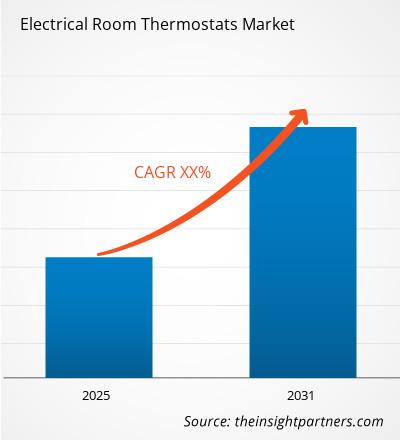
The Electrical Room Thermostats market size was worth US$ 3.01 Billion in 2025 and is estimated to grow to US$ 5.59 Billion by 2034 at a CAGR of 7.11%. Growing demand for exacting temperature regulation at room level within residential & commercial buildings has a lot to do with compatibility of the thermostats with existing HVAC systems, electric heating, smart controls, and energy management platforms.
North America will continue to be a significant revenue generation pool with CAGR ranging between 6.7% and 7.3% till 2034 as increasing electrification and utility incentives as well as the HVAC system replacement drive up control upgrade activity. The North America Electrical Room Thermostats market size will also be driven by 24-volt system configuration as well as the availability of connected products. This is because HVAC comprises nearly 50% of the household energy use.
Electrical Room Thermostats Market Assessment and Insights
- North America: Modeled Share in 2025 is 34–37%, with CAGR between 2026–2034 of 6.7–7.3%, supported by mature HVAC replacement, utility programs, and broad 24-volt controls adoption.
- US: The country represents 82–86% of North American demand in 2025 and records a modeled 6.8–7.4% CAGR through 2034.
- Europe: Modeled Share in 2025 is 28–31%, with CAGR between 2026–2034 of 6.4–7.0%; Germany leads, followed by the UK, France, Italy, and Spain.
- Asia Pacific: Modeled Share in 2025 is 24–27%, expanding at 8.0–8.8% CAGR through 2034 as China, Japan, India, and South Korea modernize building controls.
- Largest Segment: The 24 Volt Thermostats category holds a modeled 53–57% market share in 2025 and advances at 6.8–7.4% CAGR through 2034.
- High Growth Segment: Commercial applications hold a modeled 41–45% share in 2025 and register 7.6–8.3% CAGR through 2034 as building automation expands.
- Key companies analyzed in detail: ABB Ltd, Carrier Global Corporation, Danfoss A/S, Emerson Electric Co., Honeywell International Inc., Johnson Controls International plc, KMC Controls, Inc., Schneider Electric SE, Siemens AG, and Venstar Inc.
Source: The Insight Partners' analysis based on proprietary research, government publications, company annual reports, investor presentations, industry databases, and expert interviews.
Thermostats are no longer mere isolated electromechanical switches but intelligent digital controllers that can handle programming, occupancy sensing, remote troubleshooting, and interaction with equipment operating at variable speeds. The range of production includes millivolt, 24-volt, and line voltage types due to significant differences between installed systems in terms of geography and type of heating. Suppliers add to their offerings sensor precision, installation depth, smartphone app connectivity, and user-friendly connectors, while distributors continue providing reliable analog thermostats for replacements. This trend is consistent with the International Energy Agency’s focus on electrification, flexibility, and building efficiency via connected controls.
In the period until 2034, investments should be directed at increasing the area of cooled floors in Asia Pacific, renovations of buildings in Europe, and Gulf commercial constructions. Interoperable self-regulating controls will receive regulatory preference over stand-alone thermostat displays. Europe’s new directive on buildings aims at achieving a net-zero emission building stock by 2050, and efficiency programs at the national level and within utilities will ensure economic feasibility of building renovations. Manufacturers that can guarantee cybersecurity, work with heat pumps, and ease commissioning will take advantage of replacement cycles.
Electrical Room Thermostats Market Report Scope
| Report Attribute | Details |
|---|---|
| Market size in 2025 | US$ 3.01 Billion |
| Market Size by 2034 | US$ 5.59 Billion |
| Global CAGR (2026 - 2034) | 7.11% |
| Historical Data | 2021-2024 |
| Forecast period | 2026-2034 |
Electrical Room Thermostats Market Analysis
Electrical Room Thermostats Market drivers are HVAC replacement, heat-pump adoption, price sensitivity for energy, and building regulations providing incentives for controllability. Consumer focus areas include ease of installation, scheduling, and mobile capability, while commercial focus areas involve protocol compatibility, zoning, sensor reliability, and service throughout lifecycle. The ENERGY STAR defines connected thermostats as individually certified based on field data collection for ensuring savings.
Ecosystem participants are semiconductor and sensors manufacturers, controllers manufacturer, HVAC original equipment manufacturer, electrical wholesale distributors, mechanical installers, building systems integrators, utilities, and facility managers. Resilience of supply chain involves availability of electronics, relay switches, display, housing, and software support. Analog products are less vulnerable to silicon scarcity issues, while connected devices need higher software assurance and service demands.
The Electrical Room Thermostats market analysis shows that competition is highly fragmented, with a base of diverse automation companies and control experts. ABB Ltd, Schneider Electric SE, and Siemens AG utilize building platforms, while Carrier Global Corporation and Johnson Controls International plc link controls to HVAC systems and maintenance services. KMC Controls, Inc. and Venstar Inc. cater to integrators and contractors with specialized portfolios.
The investment trend is shifting towards algorithms, remote diagnostics, open interfaces, and faster installation. Honeywell International Inc., Danfoss A/S, and Emerson Electric Co. offer their competition based on familiarity with existing installations and channels. Competition is now becoming more dependent on backward compatibility, heat pump efficiency, cybersecurity, and aggregation of room data without compromising occupant privacy and contractor processes.
● REPORT CUSTOMIZATION
Tailor This Report To Align With Your Specific Business Requirements
This report can be customized to align precisely with your business objectives, scope, and target markets. Customization options include tailored segmentation, geography, competitive analysis, and strategic insights to support informed decision-making.
Customize This Report →WHAT YOU CAN ADJUST
- ● Segmentations
- ● Geography
- ● Competitive Analysis
- ● Language Preferences
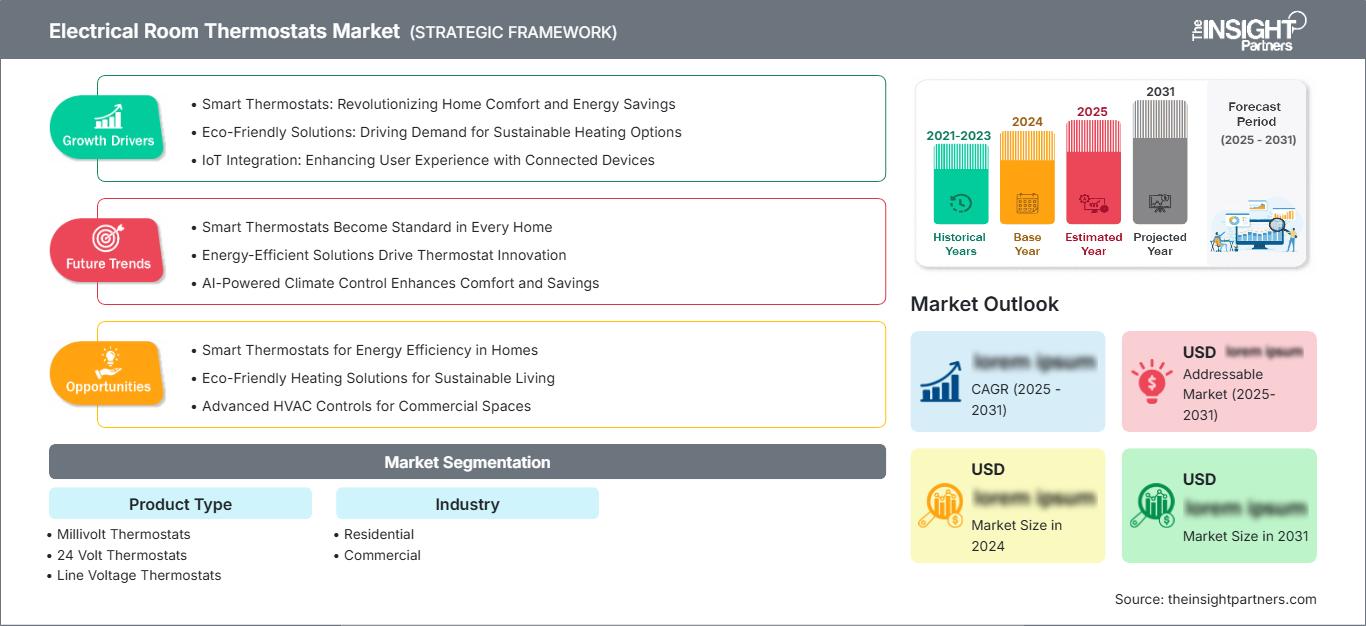
Electrical Room Thermostats Market: Strategic Insights
Regional Insights
North America Electrical Room Thermostats Market
North America represents a modeled 34–37% Electrical Room Thermostats Market share in 2025 and is forecast to grow at 6.7–7.3% CAGR until 2034. An existing inventory of forced-air systems, 24-volt wiring, and ongoing furnace/air-conditioner replacement drive installation. Utility incentives, time-of-use rates, and demand response programs motivate connected upgrades, while installers will need controllers that commission easily across varying-age equipment.
Commercial applications are spurred by education institutions, healthcare centers, office buildings, shopping centers, and multi-unit residences demanding zonal insight. The strong smart-home penetration rate in the region provides impetus to app-controlled devices, but cybersecurity, cloud availability, and compatibility with multi-speed heat pumps become more important selection criteria. Validation of performance is necessary because modern multi-speed HVAC equipment may behave differently depending on the setback program used. Manufacturers with a strong channel network, training of technicians, remote monitoring capabilities, and wide selection of accessories should retain pricing leverage in both retrofit and new constructions.
U.S. Electrical Room Thermostats Market
The U.S. Electrical Room Thermostats Market makes up the modeled 82-86% of North American demand in 2025 and grows at 6.8-7.4% CAGR until 2034. According to ENERGY STAR, almost 50% of household energy consumption goes into heating and cooling and estimates that certified smart thermostats may cut costs by approximately $100 per year in households that fit the requirements. The cost-saving logic behind these products justifies their installation in homes with high HVAC bills or which are unoccupied during work hours.
The list of companies that have relevant product or channel presence includes Carrier Global Corporation, Honeywell International Inc., Johnson Controls International plc, Emerson Electric Co., KMC Controls, Inc., and Venstar Inc. Applications of these devices become more diversified, transitioning from traditional single-stage thermostats to heat pumps, zoned HVAC, energy management solutions, and contractor remote diagnosis. Still, replacement opportunities are limited by the presence of a C-wire, equipment staging, landlord-tenant motivation, and installer experience.
Europe Electrical Room Thermostats Market
Europe’s Electrical Room Thermostats market share is projected at 28–31% in 2025, achieving 6.4–7.0% CAGR up to 2034, with Germany representing the lead. The updated Energy Performance of Buildings Directive became effective in May 2024 and is to be implemented in May 2026. This regulation’s framework for renovations and zero-emission buildings is favorable to self-regulating room controls and building automation and interoperability. The German hydronic heating base, transition to heat pumps, and renovation drive favor wired and networked thermostats.
In the UK, boiler controls and smart zoning, as well as landlord-oriented efficiency gains, prevail. France provides incentives for renovation, coupled with electrical and hydronic heating. Italy and Spain present increasing chances for heat pumps, fan coils, hospitality, and heating/cooling combinations, especially when summer cooling is needed. ABB Ltd, Danfoss A/S, Schneider Electric SE, Siemens AG, and Honeywell International Inc. leverage their channel reach; however, the variety of wiring conventions and heating types demands separate local portfolio in each country, not one pan-European one.
APAC Electrical Room Thermostats Market
Asia Pacific Electrical Room Thermostats Market represents a modeled 24–27% share in 2025 and grows at 8.0–8.8% CAGR through 2034, the fastest regional range. China leads through urban construction, local HVAC manufacturing, and smart-building investment. Japan and South Korea emphasize compact, efficient controls, while India’s rising commercial cooling load expands demand for affordable programmable units.
Australia contributes retrofit volume through residential heating and cooling upgrades. Across the region, hotter conditions, expanding floor area, electrification, and efficiency standards support control adoption. Fragmented protocols and price sensitivity favor modular products, localized interfaces, and distributor training.
Middle East & Africa Electrical Room Thermostats Market
Middle East and Africa Electrical Room Thermostats Market is modeled to advance at 6.5–7.3% CAGR through 2034. The UAE leads premium commercial adoption through hospitality, offices, and mixed-use developments, while Saudi Arabia’s construction pipeline and efficiency programs enlarge addressable demand. High cooling intensity makes room-level control economically important.
South Africa contributes replacement and commercial-building opportunities despite grid constraints. Rest of MEA demand is project-led and concentrated in major cities. Suppliers require durable electronics, multilingual interfaces, local integrators, and reliable service coverage to manage high ambient temperatures and uneven distribution.
Segmentation Analysis
Product Type
The Electrical Room Thermostats Market scope by product type spans millivolt, 24-volt, and line-voltage architectures, reflecting the installed diversity of fireplaces, furnaces, heat pumps, fan coils, baseboard heaters, and underfloor systems. The main segment is modeled to expand at 6.9–7.5% CAGR during 2026–2034. Product strategy must balance connected functionality with electrical compatibility, installer familiarity, and dependable switching performance.
- Millivolt Thermostats: These controls serve self-powered gas fireplaces, wall heaters, and legacy equipment, sustaining a defendable replacement niche where simple wiring, low cost, and offline reliability outweigh connectivity.
- 24 Volt Thermostats: The category anchors central HVAC control through broad furnace, air-conditioner, and heat-pump compatibility, making it strategically important for connected upgrades, zoning, accessories, and contractor-led replacement.
- Line Voltage Thermostats: Direct switching supports electric baseboards, convectors, and radiant systems, with demand concentrated in colder climates, multifamily dwellings, and rooms requiring independent control without low-voltage infrastructure.
Industry
Industry segmentation covers residential and commercial demand, with the main segment modeled at 7.0–7.7% CAGR during 2026–2034. Residential volume benefits from large replacement pools and consumer energy awareness, while commercial value is elevated by zoning, integration, commissioning, and service requirements. Procurement increasingly weighs lifecycle savings, protocol support, cybersecurity, and portfolio standardization across properties.
- Residential: Homes generate the larger unit base through HVAC replacement, renovation, and smart-home adoption, prioritizing affordability, intuitive scheduling, mobile access, accessory compatibility, and reliable operation during connectivity interruptions.
- Commercial: Offices, healthcare, education, retail, hospitality, and multifamily buildings require scalable zoning, occupancy response, integration, diagnostics, and portfolio oversight, creating higher specification complexity and service opportunity.
Opportunity Snapshot
| Industry Vertical | Revenue Contribution | Trend Tag | Adoption Stage |
| Residential | High | Heat Pumps | Mature |
| Commercial | Medium | Smart Zoning | Scaling |
Electrical Room Thermostats Market Growth Drivers and Impact Analysis
HVAC Electrification Expands Control Complexity
There is a change in the way thermostat control works due to the different features associated with heat pumps that need more advanced systems than single-stage systems used earlier. With building owners going for electric heat pumps, controls become necessary for ensuring comfort and avoiding energy losses in case of resistance heat backup. This increases the need for products compatible with 24 volt system, interface design specific for each type of equipment and commissioning tools for installers. The effect on the entire supply chain is that HVAC companies can include controls in packages, distributors need to increase the number of application specific products, and contractors need to be trained.
Building-Efficiency Regulation Accelerates Retrofits
The policy focuses more on efficiency of operations rather than efficiency of machinery. According to the European Commission, 40% of EU energy is consumed by buildings, whereas 75% of them have low energy efficiency, and only 1% of the buildings are renovated each year. The new directive ensures the provision of long-lasting flow of buildings to enable the use of self-regulating control and automation. Standards, rebates, and utilities in other places will help provide the return on investment for connected thermostats. The market effect will be maximum where the controls will be installed without the need for major rewiring, will be capable of measuring operation, and will work with boilers, heat pumps, or fan coil units.
Energy Costs Strengthen Room-Level Economics
Room thermostats control a substantial controllable load since space heating and cooling make up almost half of the energy consumption in American homes. Scheduling, occupancy setback, zoning, and remote calibration save unnecessary running time without substituting primary HVAC assets. Economically, the value proposition is even more interesting in cases of homes with expensive energy bills, often unused rooms, or variable rates, as well as portfolio buildings, where small savings will accumulate in many zones. This technology works equally well for connected devices as for traditional controls. But savings are contingent upon weather conditions, the structure of the building envelope, type of HVAC assets, and people’s habits.
Electrical Room Thermostats Market Future Trends
Grid-Interactive Thermostat Orchestration
Electrical Room Thermostats Market trends will increasingly connect room comfort with grid conditions. Thermostats will coordinate heat pumps, thermal storage, batteries, rooftop solar, and time-variable tariffs to preheat or precool buildings before peak periods. Carrier Global Corporation’s work on battery-enabled HVAC and weather-informed energy management illustrates the direction. Future differentiation will depend on reliable local fallback, utility-grade measurement, customer consent, and algorithms that protect comfort while shifting load. Commercial properties may aggregate hundreds of zones, whereas residential programs will favor simple enrollment and automated incentives. Interoperability and cybersecurity certification will determine whether flexible controls scale beyond proprietary ecosystems.
Adaptive Control for Variable-Capacity Equipment
Algorithm design will move beyond fixed setbacks as variable-speed heat pumps and multispeed HVAC systems become common. The U.S. Department of Energy notes that traditional runtime-based benchmarking can be less reliable when equipment has multiple efficiency and capacity points. Next-generation thermostats will combine indoor temperature, humidity, occupancy, weather forecasts, equipment telemetry, and thermal-response models to choose efficient operating states. Manufacturers will need evidence that algorithms save energy across equipment classes, not only single-speed systems. This creates opportunities for simulation-assisted certification, over-the-air optimization, and diagnostics that identify poor airflow, oversizing, or incorrect staging before comfort complaints become service calls.
Electrical Room Thermostats Market Opportunities
Retrofit Kits for Fragmented Installed Bases
Electrical Room Thermostats Market Forecasts indicate attractive investment potential in retrofit packages that solve wiring and compatibility barriers. Suppliers can combine adapters, relays, remote sensors, guided commissioning, and equipment databases into contractor-ready kits for older furnaces, boilers, electric heating, and mixed systems. A modular architecture lowers inventory complexity while retaining application coverage across millivolt, 24-volt, and line-voltage categories. Channel execution is critical: distributors need clear selection logic, installers need short training modules, and property owners need measurable post-installation performance. Vendors should prioritize regions with aging HVAC stocks, high energy costs, and active renovation incentives, then support products through long software-maintenance commitments.
Commercial Portfolio Analytics and Services
Commercial room controls can become recurring-service platforms rather than isolated hardware sales. Suppliers should develop portfolio dashboards that normalize zone temperatures, runtime, occupancy, faults, and comfort exceptions across schools, retail chains, hospitality groups, clinics, and multifamily assets. Integrators can use these data to tune schedules, detect simultaneous heating and cooling, and prioritize maintenance. The opportunity favors secure application programming interfaces, role-based access, edge processing, and exportable data because building owners resist closed ecosystems. Revenue models may combine devices, commissioning, analytics, and service agreements. Partnerships with energy-service companies and utilities can accelerate adoption where verified load reduction unlocks incentives or performance contracting.
Recent Developments
- February 2026: Eve, a leading provider of smart home devices and part of ABB, is expanding its Matter-over-Thread portfolio with the launch of Eve Thermostat, a sleek and intelligent smart thermostat designed for effortless, private climate control. Built with Thread connectivity and Matter compatibility, Eve Thermostat integrates seamlessly into the smart home while operating entirely without a cloud, subscriptions, or user accounts.
- June 2026: Automated Logic has introduced the TS2 Series of communicating and non-communicating thermostats, designed to provide flexible indoor climate control solutions for office buildings, hotels, dormitories, and other commercial spaces. Featuring an intuitive touch-key interface, the TS2 thermostats accurately monitor room temperatures while enabling precise control of fan speeds and operating modes. Available in multiple configurations to meet varying application requirements, equipment specifications, and ventilation strategies, the series delivers dependable performance for both single-zone and multi-zone building environments.
- June 2026: Automated Logic has introduced the new TS8 Wi-Fi communicating thermostat, designed to provide occupants with intuitive, in-room comfort control while enabling seamless BACnet integration with the WebCTRL building automation system (BAS). As part of Carrier Global Corporation (NYSE: CARR), a global provider of intelligent climate and energy solutions, Automated Logic continues to expand its portfolio of connected building technologies aimed at improving efficiency, comfort, and operational control.
Frequently Asked Questions

- Comprehensive Market Sizing and Forecast Analysis
- Detailed Segmentation Analysis
- In-Depth Market Dynamics Assessment
- Regional and Country-Level Insights
- Competitive Landscape and Company Benchmarking
- Strategic Business Intelligence
Recent Reports
Testimonials

The Insight Partners' SCADA System Market report is comprehensive, with valuable insights on current trends and future forecasts. The team was highly professional, responsive, and supportive throughout. We are very satisfied and highly recommend their services.
RAN KEDEM Partner, Reali Technologies LTDs
I requested a report on a very specific software market and the team produced the report in a few days. The information was very relevant and well presented. I then requested some changes and additions to the report. The team was again very responsive and I got the final report in less than a week.
JEAN-HERVE JENN Chairman, Future Analytica
We worked with The Insight Partners for an important market study and forecast. They gave us clear insights into opportunities and risks, which helped shape our plans. Their research was easy to use and based on solid data. It helped us make smart, confident decisions. We highly recommend them.
PIYUSH NAGPAL Sr. Vice President, High Beam Global
The Insight Partners delivered insightful, well-structured market research with strong domain expertise. Their team was professional and responsive throughout. The user-friendly website made accessing industry reports seamless. We highly recommend them for reliable, high-quality research services
YUKIHIKO ADACHI CEO, Deep Blue, LLC.
This is the first time I have purchased a market report from The Insight Partners.While I was unsure at first, I visited their web site and felt more comfortable to take the risk and purchase a market report.I am completely satisfied with the quality of the report and customer service. I had several questions and comments with the initial report, but after a couple of dialogs over email with their analyst I believe I have a report that I can use as input to our strategic planning process.Thank you so much for taking the extra time and making this a positive experience.I will definitely recommend your service to others and you will be my first call when we need further market data.
JOHN SUZUKI President and Chief Executive Officer, Board Director, BK Technologies
I wish to appreciate your support and the professionalism you displayed in the course of attending to my request for information regarding to infectious disease IVD market in Nigeria. I appreciate your patience, your guidance, and the fact that you were willing to offer a discount, which eventually made it possible for us to close a deal. I look forward to engaging The Insight Partners in the future, all thanks to the impression you have created in me as a result of this first encounter.
DR CHIJIOKE ONYIA MANAGING DIRECTOR, PineCrest Healthcare Ltd.Reason to Buy
- Informed Decision-Making
- Understanding Market Dynamics
- Competitive Analysis
- Identifying Emerging Markets
- Customer Insights
- Market Forecasts
- Risk Mitigation
- Boosting Operational Efficiency
- Strategic Planning
- Investment Justification
- Tracking Industry Innovations
- Aligning with Regulatory Trends





 Get Free Sample for