
Elevator Modernization Market Growth and Forecast by 2034
Coverage: By Type (Hydraulic and Traction); Component (Power Units, Cabin Enclosures, Controllers, Signalling Fixtures, Door Equipment and Others); and End User (Industrial, Residential Building, Institutional, Marine, Commercial and Others), and Geography
- Status : Data Released
- Report Code : TIPTE100000619
- Category : Electronics and Semiconductor
- No. of Pages : 150
- Available Report Formats :


- Last update date : August 27, 2026


2025 Market Size
US$ 14.66 Bn
Base year value
2034 Forecast
US$ 26.73 Bn
Projected by 2034
CAGR 2026-2034
6.9 %
Growth rate
Addressable Market
US$ 186.93 Bn
(2026-2034)
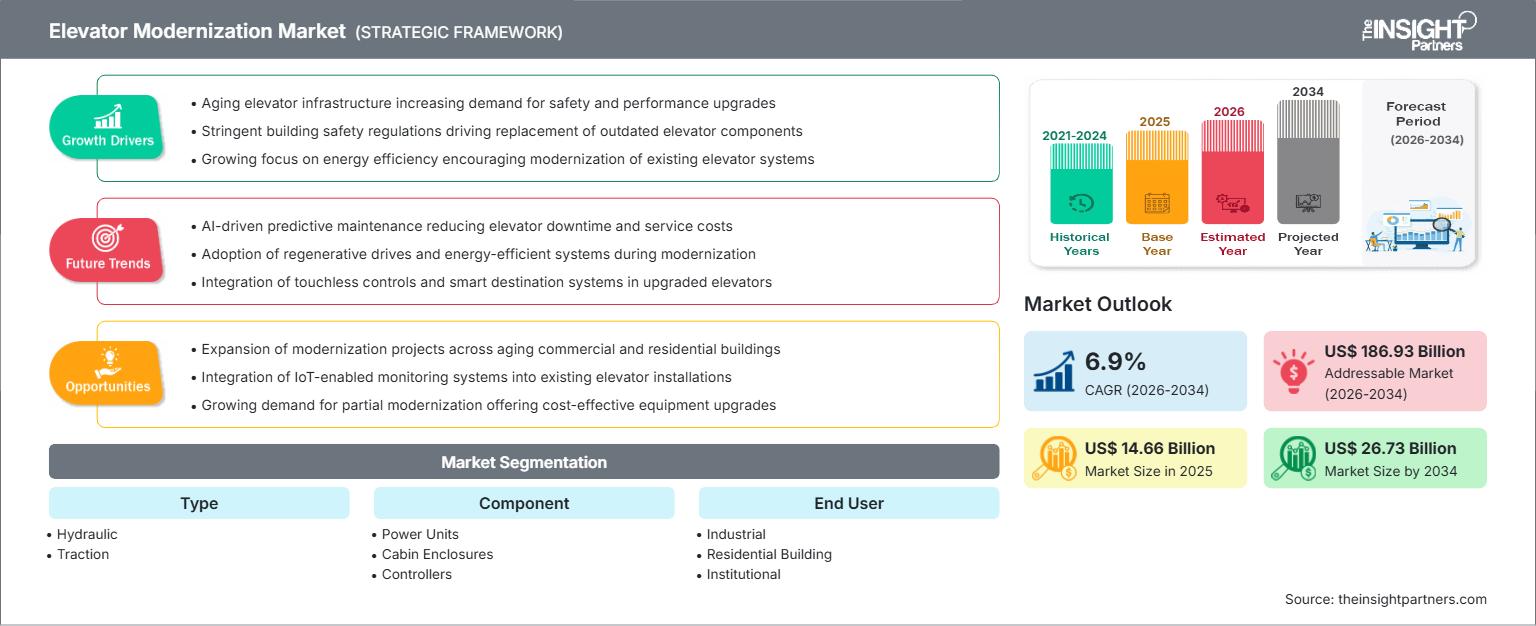
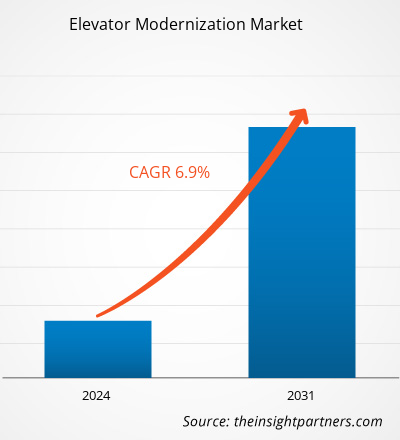
The Elevator Modernization market will be valued at US$ 14.66 Billion in 2025 and will reach US$ 26.73 Billion by 2034, growing at a CAGR of 6.9%. The market growth is primarily driven by high demand for the development of energy-efficient solutions, safety, and security compliance solutions, and integration with smart buildings.
North America continues to hold its importance in terms of the Elevator Modernization market size, with the region anticipated to record a CAGR growth of 6.2% to 6.8% during 2026-2034. Factors driving the growth of the regional market include aging infrastructure of elevators that have been in operation for more than 20-30 years, compliance requirements under ADA, and constant technology advancements within the property owner segment.
Elevator Modernization Market Assessment and Insights
- North America: The region commands approximately 28–32% share in 2025 and is growing at a CAGR range of 6.2–6.8% between 2026–2034, driven by stringent regulatory compliance requirements and extensive aging building stock supporting widespread modernization adoption across commercial and residential sectors.
- US: The United States accounts for 75–80% share in 2025 and is growing at a CAGR range of 6.0–6.6% between 2026–2034, reflecting mature market conditions with continuous safety-driven replacement cycles and IoT-enabled platform migration.
- Europe: The region holds approximately 24–28% share in 2025 and is growing at a CAGR range of 6.4–7.0% between 2026–2034, with the UK, Germany, and France leading adoption through energy efficiency directives and EN 81 safety standard compliance initiatives.
- Asia Pacific: The region represents approximately 28–32% share in 2025 and is growing at a CAGR range of 7.5–8.2% between 2026–2034, with China, India, Japan, and South Korea driving growth through urbanization and high-rise building modernization programs.
- Largest Segment: The Traction segment holds approximately 62–66% market share in 2025 and is growing at a CAGR range of 6.6–7.2% between 2026–2034, reflecting dominant adoption for mid-rise and high-rise building elevator modernization applications.
- High Growth Segment: The Controllers segment represents approximately 22–26% market share in 2025 and is growing at a CAGR range of 7.8–8.4% between 2026–2034, driven by IoT connectivity demand, predictive maintenance capabilities, and smart building integration requirements.
- Key companies analyzed in detail: KONE Corporation, United Elevator Corporation, Siemens AG, Schindler Holding Ltd., Mitsubishi Electric US, Inc., TK Elevator GmbH, Fujitec Co., Ltd., Hitachi, Ltd., Toshiba Corporation, and Hyundai Elevator Co., Ltd.
Source: The Insight Partners' analysis based on proprietary research, government publications, company annual reports, investor presentations, industry databases, and expert interviews.
The Elevator Modernization Market has undergone significant change from basic component replacements to complex upgrade programs that include regenerative drives, Internet-of-Things-based controllers, and artificial intelligence-powered predictive maintenance capabilities. Innovations in hardware have been focused on making machine systems more energy-efficient by utilizing gearless systems, whereas software innovations involve cloud computing and machine learning for optimal maintenance scheduling and minimizing downtime.
Future trends suggest growing regulations in developing economies of Asia-Pacific and Middle-East regions, along with growing investments in future-proofing solutions to meet the needs of smart cities and carbon-neutral buildings. Growing tailwinds from updates in the EU Energy Efficiency Directive and accessibility standards continue to encourage replacement and adoption of premium services.
Elevator Modernization Market Report Scope
| Report Attribute | Details |
|---|---|
| Market size in 2025 | US$ 14.66 Billion |
| Market Size by 2034 | US$ 26.73 Billion |
| Global CAGR (2026 - 2034) | 6.9% |
| Historical Data | 2021-2024 |
| Forecast period | 2026-2034 |
Elevator Modernization Market Analysis
The primary demand factors are aging elevator systems necessitating safety and performance improvements, energy efficiency regulations compelling buildings to reduce their carbon footprint, and the rising adoption of smart building concepts where elevators must be part of an interconnected system. The value chain involves component producers of controllers, doors, and power units, system integrators offering modernization solutions, and service firms delivering maintenance agreements and remote monitoring services.
The supply factors are improved access to semiconductors, wireless technology advancements ensuring efficient data transfer capabilities, and competitive pricing driven by the involvement of established suppliers and regional competitors. The distribution channels cover direct OEM cooperation with property management firms, dealership networks covering regional building owners, and online marketplaces that make it possible for small and medium-sized commercial buildings to deploy elevator solutions rapidly.
Integration with existing building management systems, facility management solutions, and third-party monitoring stations is becoming an important differentiator because customers want a comprehensive view of their building system and not just elevator components.
The competitive environment includes not only vertical transportation giants such as KONE Corporation and Schindler Holding Ltd but also specialists like TK Elevator GmbH and Mitsubishi Electric US, Inc. Each of these companies attempts to differentiate itself by using modernization, energy-saving technologies, and customer support services. It is also obvious that there is an increasing level of mergers and acquisitions aimed at expansion of IoT and cloud technologies and their applications to particular industries. The venture capital funds are also willing to invest in the development of next-generation technologies for smart buildings and urban mobility.
The strategic positioning of the market players takes into account not only pricing factors but also total cost of ownership, regulatory compliance certificates, and integration capability. In addition, the market leaders try to develop their services portfolio including predictive maintenance and monitoring services because they understand that the clients treat the modernization platform as a tool for achieving overall excellence.
● REPORT CUSTOMIZATION
Tailor This Report To Align With Your Specific Business Requirements
This report can be customized to align precisely with your business objectives, scope, and target markets. Customization options include tailored segmentation, geography, competitive analysis, and strategic insights to support informed decision-making.
Customize This Report →WHAT YOU CAN ADJUST
- ● Segmentations
- ● Geography
- ● Competitive Analysis
- ● Language Preferences
Elevator Modernization Market: Strategic Insights
Regional Insights
North America Elevator Modernization Market
North America has about 28-32% share of the Elevator Modernization market in 2025 and is expected to see a CAGR of 6.2-6.8% during the period of 2026-2034. North America is favored by stringent enforcement of regulations through the ADA accessibility requirements, aging buildings in the region, and increased property owner awareness of safety hazards and improvements in efficiency of integrated platforms.
The key structural growth drivers consist of ongoing upgrades of the regulation, which requires certified safety systems, replacement cycles for elevators above 25-30 years old and increasing integration requirements in connecting elevator platforms to the wider ecosystem of the buildings management. Larger property owners favor platforms that allow real-time monitoring and maintenance of elevators.
U.S. Elevator Modernization Market
The United States accounts for approximately 75–80% of North American Elevator Modernization share in 2025 and is growing at a CAGR range of 6.0–6.6% between 2026–2034. As the dominant market within the region, the US reflects mature adoption levels with continuous safety-driven replacement demand and ongoing technology upgrades among commercial and residential building operators of all sizes.
Company presence includes all major vertical transportation providers maintaining registered service networks, including KONE Corporation, Schindler Holding Ltd., TK Elevator GmbH, and Mitsubishi Electric US, Inc., each competing through modernization capabilities and customer support differentiation. Application trends indicate growing demand for IoT-enabled systems among large commercial properties, cloud-based solutions for residential buildings, and high-end service tiers featuring AI-driven predictive maintenance and energy optimization tools.
Europe Elevator Modernization Market
Europe has 24-28% of worldwide share of Elevator Modernization in 2025 and estimated growth rate is in CAGR range of 6.4-7.0% during 2026-2034. Europe has advantages related to EU Energy Efficiency Directive compliance, EN 81 standards and integration of modernization platform across EU members for cross border building management.
UK is responsible for 18-22% of total demand in Europe due to post-Brexit compliance requirements and well-developed commercial building infrastructure for foreign businesses. Germany is a leading country in Europe and its market share is equal to 24-28%. This is because of high number of commercial buildings in Germany and compliance requirements associated with energy efficiency and accessibility.
France, Italy, and Spain are responsible for 35-40% of total demand in Europe where France is leading through commercial building modernizations, Italy for accessibility upgrade of historical buildings and Spain for protection of tourism facilities and building compliance in coastal regions.
APAC Elevator Modernization Market
Asia Pacific represents approximately 28–32% of global Elevator Modernization share in 2025 and is growing at a CAGR range of 7.5–8.2% between 2026–2034, making it the fastest-growing regional market. China leads with 35–40% of APAC demand, followed by India, Japan, South Korea, and Australia, each pursuing urbanization and building modernization initiatives.
Industrial drivers include e-commerce logistics expansion, high-rise residential building upgrades, and intercity commercial development requiring enhanced vertical transportation performance and energy efficiency monitoring across distributed building networks. Policy drivers encompass emerging regulatory frameworks in India and Southeast Asia, infrastructure investment supporting smart city corridors, and government incentives promoting integrated modernization adoption for improved building safety and operational efficiency.
Middle East & Africa Elevator Modernization Market
Middle East & Africa is an example of the Elevator Modernization market that is considered an emerging market with a forecasted CAGR value between 8.0% and 8.8% during the period 2026-2034. The leading market in the region is Saudi Arabia due to the Vision 2030 infrastructure program and building corridor construction towards GCC and East Africa.
UAE is the hub market for the region, as the country has a well-developed building infrastructure as well as regulations for commercial facility compliance. South Africa is the most developed market on the continent, thanks to the modernization of commercial buildings, hospitality facilities and interprovincial transport monitoring.
Segmentation Analysis
Type
The Type segment is projected to grow at a CAGR range of 6.6–7.2% between 2026–2034. This segmentation reflects distinct technology requirements, deployment scenarios, and adoption patterns across different elevator modernization categories, with traction systems dominating demand due to comprehensive mid-rise and high-rise building vertical transportation applications.
- Hydraulic: Represents approximately 34–38% of type demand, driven by low-rise buildings, industrial facilities, and residential applications requiring cost-effective, reliable lifting solutions with simplified maintenance requirements and lower installation complexity compared to traction alternatives.
- Traction: Commands approximately 62–66% market share, reflecting dominant adoption for mid-rise and high-rise buildings, commercial properties, and institutional facilities where energy efficiency, speed, and passenger capacity deliver substantial operational value and long-term cost savings.
Component
The Component segment is projected to grow at a CAGR range of 6.8–7.4% between 2026–2034. This segmentation distinguishes between different elevator subsystems that require modernization, each with distinct technology requirements, replacement cycles, and integration complexity across building portfolios.
- Power Units: Represents approximately 18–22% of component demand, including motor replacements, gearless drive upgrades, and regenerative drive installations that improve energy efficiency by 25–40% compared to older systems while reducing operational costs and carbon footprints.
- Cabin Enclosures: Commands approximately 14–18% market share, encompassing interior renovations, lighting upgrades, flooring replacements, and aesthetic improvements that enhance passenger experience and building image while meeting modern accessibility and safety standards.
- Controllers: Accounts for approximately 22–26% of demand and is growing at a CAGR range of 7.8–8.4%, driven by IoT connectivity requirements, predictive maintenance capabilities, and smart building integration needs requiring advanced dispatch algorithms and remote monitoring features.
- Signalling Fixtures: Represents approximately 12–16% market share, including call buttons, position indicators, and communication systems that improve passenger experience, accessibility compliance, and emergency response capabilities across modernized elevator installations.
- Door Equipment: Accounts for approximately 18–22% of demand, including door operators, sensors, and safety interlocks that represent the most frequently serviced elevator component, making door modernization a high-priority upgrade for reducing service calls and improving reliability.
End User
The End User segment is projected to grow at a CAGR range of 6.6–7.2% between 2026–2034. This segmentation distinguishes between different building types and operational environments that deploy elevator modernization solutions, each with distinct regulatory requirements, usage patterns, and technology adoption priorities.
- Industrial: Represents approximately 12–16% of end user demand, including manufacturing facilities, warehouses, and distribution centers requiring heavy-duty elevator modernization to support freight movement, equipment transport, and worker safety compliance requirements.
- Residential Building: Commands approximately 38–42% market share, encompassing apartment complexes, condominiums, and multi-family housing requiring modernization to improve reliability, energy efficiency, and resident satisfaction while meeting accessibility and safety regulations.
- Institutional: Accounts for approximately 16–20% of demand, including hospitals, universities, government buildings, and public facilities requiring certified modernization solutions that meet stringent safety, accessibility, and performance standards for high-traffic public use.
- Marine: Represents approximately 6–10% market share, driven by cruise ships, offshore platforms, and maritime facilities requiring specialized marine-grade elevator modernization solutions that withstand harsh environmental conditions and meet maritime safety regulations.
- Commercial: Accounts for approximately 18–22% of demand and is growing at a CAGR range of 7.2–7.8%, including office buildings, shopping centers, and mixed-use developments requiring modernization to attract tenants, improve energy performance, and support smart building integration initiatives.
Opportunity Snapshot
| End User | Revenue Contribution | Trend Tag | Adoption Stage |
|---|---|---|---|
| Industrial | Medium | Heavy-Duty Upgrade | Mature |
| Residential Building | High | Aging Stock Replacement | Scaling |
| Institutional | High | Accessibility Compliance | Scaling |
| Marine | Low | Maritime Safety | Mature |
| Commercial | High | Smart Building Integration | Scaling |
Elevator Modernization Market Growth Drivers and Impact Analysis
Aging Infrastructure and Safety Compliance
Building infrastructure globally will keep focusing on elevator safety improvement and performance enhancement as essential needs until 2034. There is increasing demand for upgrading elevators beyond 20-30 years of operation period, as there are millions of elevators around the world that need updating of their components and safety systems.
Clear regulation of requirements of modernization certification, inspection and accessibility removes obstacles and creates market potential for providers of platforms that comply with regulations and are suitable for providing full range of building vertical transportation safety documentation needs.
Energy Efficiency and Sustainability Regulations
Strict energy efficiency standards set out by national and international regulatory authorities remain instrumental in driving the installation of mandatory elevator modernization, with the deadlines for adherence generating ongoing demand from constant updates to the standards. EU Energy Efficiency Directive amendments, alongside similar standards in North America and Asia Pacific, have provided favorable winds for the modernization process, where modern elevators use 25% to 40% less energy than outdated elevators.
In addition to regulatory compliance, property owners realize that modernizations are not only necessary but provide ROI through lower operating expenses, better energy efficiency of buildings, and higher property values. The development of emerging markets in Asia Pacific and the Middle East is expected to follow the same approach, with initiatives in India and sustainability standards in the GCC region.
Smart Building and IoT Integration
The shift to connected buildings increases the need for elevators that perform monitoring of performance, predictive maintenance, and integration into building automation systems. Modernization platforms needed by enterprises owned by commercial property operators and managed by facilities managers have to be equipped with IoT sensors, cloud computing, and mobile capabilities, which allow data-driven decisions to be made regarding maintenance, energy efficiency, and improved passenger experience.
Vendors of vertical transportation are developing solutions related to remote diagnostics, predictive maintenance notifications, and mobile interface for passengers that allow facilities managers to maximize their uptime and minimize cost of services. With the increase in smart buildings up to 2030, modernization platforms, which can seamlessly integrate IoT technology and connect with building management system, will enjoy disproportionate market share compared to other platforms with single architecture.
Elevator Modernization Market Future Trends
Predictive Maintenance and AI Analytics
In future, machine learning analysis on performance data in elevators will predict component malfunctions, manage maintenance activities, and make specific recommendations on how to take action before service disruptions happen. Currently, top manufacturers are using Internet of Things sensors, cloud computing, and automatic alerts that convert raw performance data into service information to enable proactive service management.
Elevator health profiles will be generated in future by combining data collected using computer vision from elevator camera footage, door activity logs, and ride quality sensors to enable personalized maintenance programs that enhance reliability and lower service costs. Predictive analytics will use data on wear and tear of components, usage intensity, and environmental factors to predict when components require replacing.
Regenerative Drive and Energy Recovery Systems
As elevator modernization becomes increasingly connected to building energy management systems, providers will evolve to offer integrated regenerative drive solutions that address energy recovery and carbon reduction objectives. Leading manufacturers are developing platforms that integrate regenerative drives with building energy management systems, capturing and redistributing energy generated during elevator braking and descent operations to reduce overall building energy consumption by 25–40%.
This evolution will require new energy standards, grid integration protocols, and incentive frameworks as elevator systems become critical components of building energy optimization architectures. Regulatory bodies are expected to mandate continuous monitoring of elevator energy performance and carbon emissions, creating opportunities for providers to develop specialized solutions serving this emerging market segment alongside traditional elevator modernization deployments.
Elevator Modernization Market Opportunities
Emerging Market Urbanization
Asia Pacific, Middle East, and Africa regions present substantial growth opportunities as governments implement building safety regulations and commercial facility operators modernize vertical transportation capabilities. India's proposed building modernization initiatives, GCC infrastructure development projects, and African commercial building growth create multi-billion-dollar addressable markets for providers offering localized solutions, regional support infrastructure, and regulatory compliance expertise.
Market entry strategies should prioritize partnerships with local building management companies, integration with regional facility management platforms, and device certification aligned with emerging regulatory frameworks. Early movers establishing brand recognition and customer relationships in these markets will benefit from switching costs and network effects as regulatory deadlines approach and building owners seek proven, compliant solutions rather than evaluating new vendors under time pressure.
Managed Service and Performance-Based Contracts
Building owners increasingly recognize the strategic value of predictive maintenance, remote monitoring, and performance-based modernization services beyond basic component replacement, creating opportunities for providers to migrate customers from project sales to recurring revenue service models. Margins on managed services substantially exceed hardware revenues, making service tier expansion a critical profitability driver for vertical transportation providers seeking sustainable competitive advantages.
Value-added offerings including 24/7 monitoring, performance optimization, energy management, and compliance reporting enable providers to differentiate on total value rather than project pricing alone. Successful migration strategies combine demonstrable ROI case studies, tiered pricing models that reward expanded adoption, and customer success programs ensuring clients realize maximum value from comprehensive modernization service capabilities.
Recent Developments
- June 2026: TK Elevator GmbH launched EOX Rebuild, a new full replacement solution within its EOX elevator family, offering comprehensive modernization capabilities for European building portfolios with enhanced energy efficiency and smart connectivity features.
- April 2026: KONE Corporation and TK Elevator GmbH announced plans for a transformative combination, creating one of the world's leading elevator and escalator companies with complementary geographical footprints and innovation capabilities for global modernization markets.
- September 2025: Schindler Holding Ltd. signed a Master Services and Supplies Agreement with Accor to provide elevator and escalator installation, modernization, maintenance, and servicing solutions across Accor hospitality properties globally.
Frequently Asked Questions

- Comprehensive Market Sizing and Forecast Analysis
- Detailed Segmentation Analysis
- In-Depth Market Dynamics Assessment
- Regional and Country-Level Insights
- Competitive Landscape and Company Benchmarking
- Strategic Business Intelligence
Recent Reports
Testimonials

The Insight Partners' SCADA System Market report is comprehensive, with valuable insights on current trends and future forecasts. The team was highly professional, responsive, and supportive throughout. We are very satisfied and highly recommend their services.
RAN KEDEM Partner, Reali Technologies LTDs
I requested a report on a very specific software market and the team produced the report in a few days. The information was very relevant and well presented. I then requested some changes and additions to the report. The team was again very responsive and I got the final report in less than a week.
JEAN-HERVE JENN Chairman, Future Analytica
We worked with The Insight Partners for an important market study and forecast. They gave us clear insights into opportunities and risks, which helped shape our plans. Their research was easy to use and based on solid data. It helped us make smart, confident decisions. We highly recommend them.
PIYUSH NAGPAL Sr. Vice President, High Beam Global
The Insight Partners delivered insightful, well-structured market research with strong domain expertise. Their team was professional and responsive throughout. The user-friendly website made accessing industry reports seamless. We highly recommend them for reliable, high-quality research services
YUKIHIKO ADACHI CEO, Deep Blue, LLC.
This is the first time I have purchased a market report from The Insight Partners.While I was unsure at first, I visited their web site and felt more comfortable to take the risk and purchase a market report.I am completely satisfied with the quality of the report and customer service. I had several questions and comments with the initial report, but after a couple of dialogs over email with their analyst I believe I have a report that I can use as input to our strategic planning process.Thank you so much for taking the extra time and making this a positive experience.I will definitely recommend your service to others and you will be my first call when we need further market data.
JOHN SUZUKI President and Chief Executive Officer, Board Director, BK Technologies
I wish to appreciate your support and the professionalism you displayed in the course of attending to my request for information regarding to infectious disease IVD market in Nigeria. I appreciate your patience, your guidance, and the fact that you were willing to offer a discount, which eventually made it possible for us to close a deal. I look forward to engaging The Insight Partners in the future, all thanks to the impression you have created in me as a result of this first encounter.
DR CHIJIOKE ONYIA MANAGING DIRECTOR, PineCrest Healthcare Ltd.Reason to Buy
- Informed Decision-Making
- Understanding Market Dynamics
- Competitive Analysis
- Identifying Emerging Markets
- Customer Insights
- Market Forecasts
- Risk Mitigation
- Boosting Operational Efficiency
- Strategic Planning
- Investment Justification
- Tracking Industry Innovations
- Aligning with Regulatory Trends





 Get Free Sample for