
Elevators and Escalators Market Growth Opportunities, Size & Forecast by 2034
Coverage: By Type (Elevators, Escalators, Moving Walkways); End User (Commercial, Residential) , and Geography (North America, Europe, Asia Pacific, and South and Central America)
- Status : Data Released
- Report Code : TIPRE00007309
- Category : Electronics and Semiconductor
- No. of Pages : 150
- Available Report Formats :


- Last update date : August 12, 2026


2025 Market Size
US$ 83.21 Bn
Base year value
2034 Forecast
US$ 149.11 Bn
Projected by 2034
CAGR 2026-2034
6.70 %
Growth rate
Addressable Market
US$ 1,050.29 Bn
(2026-2034)
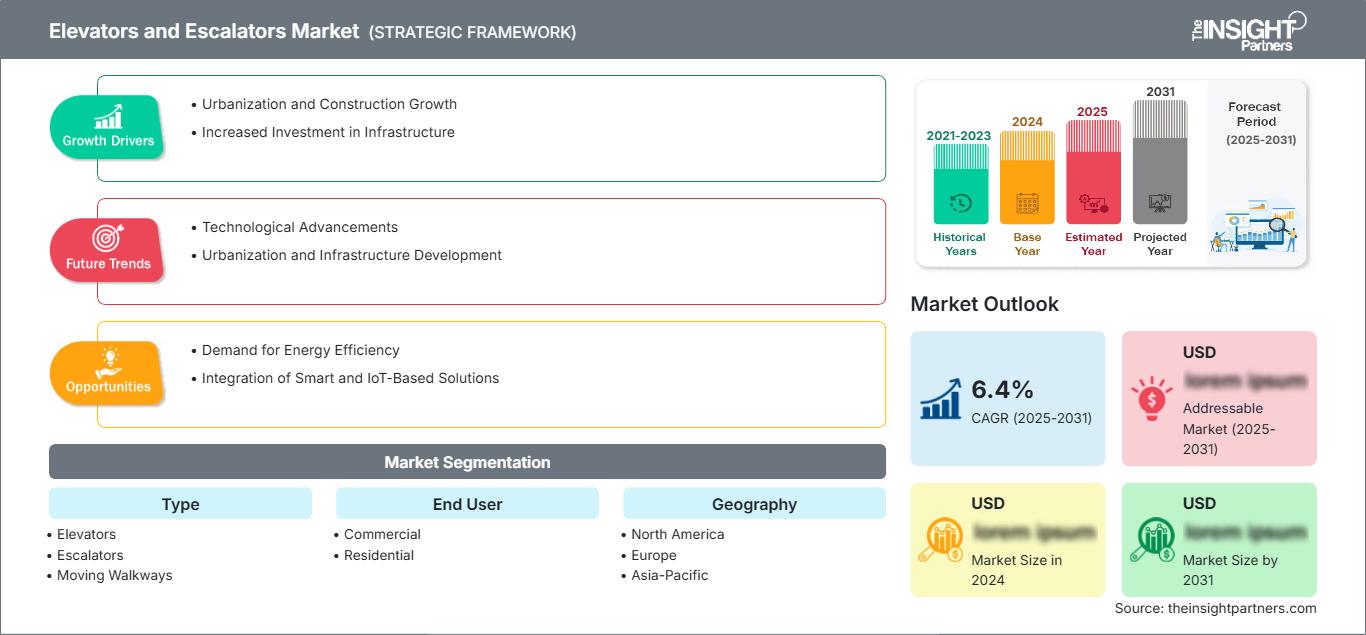
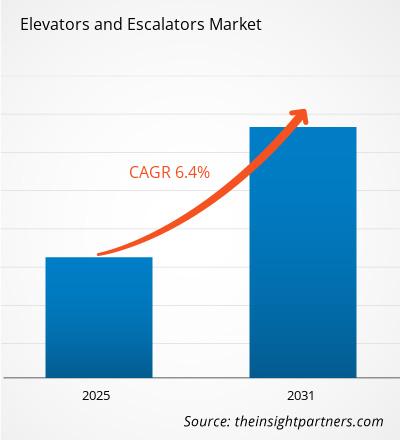
The Elevators and Escalators Market size was estimated at US$ 83.21 Billion in 2025 and is forecast to be US$ 149.11 Billion by 2034, growing at a CAGR of 6.70% between 2026 and 2034. Growing demand will arise due to the requirement for efficient vertical transportation within the dense urban environments of high-rise buildings. Modernizations, connected maintenance solutions, increased accessibility needs, and energy-efficient products are driving growing service revenue opportunities and increasing new product opportunities.
The growth rate of the Elevators and Escalators Market in North America is estimated at 5.8–6.4% CAGR through 2034. North America has benefited from an installed base that is moving into its modernization cycle as well as investments in mixed-use, health care, airport, and transit infrastructure. Improved accessibility and safety requirements are fueling modernizations of elevator controllers, drives, doors, and monitoring systems.
Elevators and Escalators Market Assessment and Insights
- North America: Held a 24–27% Elevators and Escalators Market share in 2025 and is forecast to grow at a 5.8–6.4% CAGR between 2026–2034, supported by modernization of aging equipment, code upgrades, urban infill, and resilient institutional construction.
- US: Accounted for 82–86% of North American revenue in 2025 and is projected to register a 5.9–6.5% CAGR between 2026–2034.
- Europe: Represented 22–25% in 2025 and should expand at a 5.4–6.0% CAGR between 2026–2034, led by Germany, the UK, France, Italy, and Spain as building renovation and energy performance rules stimulate modernization.
- Asia Pacific: Captured 43–47% in 2025 and is expected to post a 7.4–8.1% CAGR between 2026–2034. China leads installed demand, while India, Japan, South Korea, and Australia add transit, residential, and replacement opportunities.
- Largest Segment: Elevators held a 72–76% market share in 2025 and are forecast to expand at a 6.4–7.0% CAGR between 2026–2034, reflecting broad deployment across building types.
- High Growth Segment: Moving walkways represented a 5–8% market share in 2025 and should grow at a 7.2–7.9% CAGR between 2026–2034, driven by airports and large transit interchanges.
- Key companies analyzed in detail: Electra Ltd., Fujitec Co., Ltd., Hitachi, Ltd., Hyundai Elevator Co., Ltd., KONE Corporation, Mitsubishi Electric Corporation, Otis Worldwide Corporation, Schindler Holding Ltd., TK Elevator GmbH, and Toshiba Elevator and Building Systems Corporation.
Source: The Insight Partners' analysis based on proprietary research, government publications, company annual reports, investor presentations, industry databases, and expert interviews.
Vertical transport moved from being heavily mechanical to using machine room-less designs, gearless lifts, regenerative technology, destination dispatch, and cloud-based diagnostics. Vendors are now modularizing the controller, door, cabin, and drive components to expedite installation and retrofitting. The production process remains global yet locally tailored since there are differences in codes, elevator shafts, seismic activity, and labor practices. The economics of servicing now influence product design since the use of sensors, remote interventions, and component condition monitoring help reduce unanticipated servicing trips.
From 2019 to 2034, investments in the Elevators and Escalators Market will focus on Indian cities, Southeast Asian metropolises, Gulf mega projects, and maintenance-centric European markets. Growth of public transit systems, universal access legislation, and building energy codes will bring new procurement visibility outside the traditional property development cycle. Suppliers who provide standardized offerings yet locally engineered, financed and multi-branded servicing capabilities will have greater lifecycle value. Suppliers of cybersecurity governance and interoperability with the building management interface will be preferred purchasers.
Elevators and Escalators Market Report Scope
| Report Attribute | Details |
|---|---|
| Market size in 2025 | US$ 83.21 Billion |
| Market Size by 2034 | US$ 149.11 Billion |
| Global CAGR (2026 - 2034) | 6.70% |
| Historical Data | 2021-2024 |
| Forecast period | 2026-2034 |
Elevators and Escalators Market Analysis
Growth for Elevators and Escalators industry is dependent on urban population density, high rise construction, accessibility considerations, and replacement of aging equipment. In 2024, more than 7 million out of 21 million elevators in the world had been around for over 20 years, signifying an extensive modernization opportunity pipeline. Equipment procurement is conducted via consulting firms, general contractors, distributors and manufacturers, with installations and service relying on locally certified personnel. Material supplies such as steel, electronics, motors and semiconductors influence lead times, but platform standardization and regional sourcing mitigate that effect.
Increasingly, value shift is seen from single piece sale towards maintenance and repairs, modernization work, and subscriptions. Machine connectivity allows turning equipment data into scheduling priority, thus increasing uptime and efficiency of technicians. Instead of equipment pricing, property owners consider total lifecycle costs, parts availability, energy consumption, and regulatory compliance. Dense branch network allows suppliers to offer a portfolio service deal, while independent operators leverage multibrand service capability and geographical flexibility.
Elevators and Escalators market analysis reveals concentration of global leaders working alongside highly developed national specialists. Otis Worldwide Corporation, KONE Corporation, Schindler Holding Ltd., and TK Elevator GmbH utilize their wide servicing basis to finance their digital platforms and modernization packages. Mitsubishi Electric Corporation, Hitachi, Ltd., Fujitec Co., Ltd., Toshiba Elevator and Building Systems Corporation, and Hyundai Elevator Co., Ltd. preserve engineering depth in Asia, and Electra Ltd. relies on regional implementation and services.
The capital investment is aimed at connected service systems, maintenance portfolios acquisition, machine-room-less technologies, and high capacity solutions for infrastructures. The strategy positioning is different depending on geography: cost control and installed base modernization in China, modernization skills in Europe, ready-to-code solutions in North America, and reliable installation in developing countries. Hence, competitive advantage relies on the combination of global size of components and local technicians, regulatory issues, reaction time, and long-term customer relationships.
● REPORT CUSTOMIZATION
Tailor This Report To Align With Your Specific Business Requirements
This report can be customized to align precisely with your business objectives, scope, and target markets. Customization options include tailored segmentation, geography, competitive analysis, and strategic insights to support informed decision-making.
Customize This Report →WHAT YOU CAN ADJUST
- ● Segmentations
- ● Geography
- ● Competitive Analysis
- ● Language Preferences
Elevators and Escalators Market: Strategic Insights
Regional Insights
North America Elevators and Escalators Market
North America comprised 24-27% of the 2025 sales and will grow at a CAGR of 5.8-6.4% till 2034. Elevators & Escalators Market share is driven by a matured installed base, redevelopment of cities, growth of hospitals, airport renovations, and compliance-driven replacement. Aging hydraulics and traction elevators facilitate upgrades of controllers, doors, drives, and cabs, whereas labor shortages augment remote diagnostics and predictive maintenance.
Canadian contributions include demands from transportation and housing in Toronto, Vancouver, Montreal, and Calgary, and the Mexican contribution includes manufacturing, tourism, and mixed-use buildings. Increasing procurement trends include lifecycle services, cybersecurity, accessibility, and energy efficiency considerations. The regional suppliers have advantages of maintenance service income but permitting differences, technician availability, and financing of constructions can delay new equipment installation.
U.S. Elevators and Escalators Market
The share of North America in terms of income from the US was 82-86% in 2025, and the CAGR for this territory is expected to be 5.9-6.5%. The diversification of the range of facilities, which includes offices, apartments, hospitals, universities, hotels, data centers, and transit facilities, generates not only cyclic demands for installations but also protective revenue from services.
Such companies as Otis Worldwide Corporation, Schindler Holding Ltd., KONE Corporation, TK Elevator GmbH, and Mitsubishi Electric Corporation have significant operating facilities. The priorities of usage for each application vary: machine room-less systems are important for low and medium-rise facilities, the hospitals need a reliable dispatching system and large cars, and the transit facilities need robust escalators.
Europe Elevators and Escalators Market
The Europe region accounted for 22-25% Elevators and Escalators Market in 2025 and will witness a CAGR of 5.4-6.0% through 2034. Germany leads the market because of the huge installed base of elevators, high safety expectations, and renovations. The UK balances high-rise buildings in London and modernization across the whole country, whereas public estates generate demand from accessibility. France profits from commercial modernizations and transport infrastructure development in the Paris region. Italy and Spain provide substantial modernization opportunities because of the fragmentation of ownership in the region and small elevator shafts.
Energy efficiency legislation, old building stock, and the lack of skilled labor force stimulate diagnostics and modernization kits. The companies competing in the market are KONE Corporation, Schindler Holding Ltd., TK Elevator GmbH, Otis Worldwide Corporation, and regional competitors.
APAC Elevators and Escalators Market
APAC will record Elevators and Escalators market shares of 43%-47% in 2025 and is expected to grow at a CAGR of 7.4%-8.1% through 2034. China will continue to dominate among the countries owing to a large installed base and need for modernization, although with a slowdown in new construction. India will bring rapid urban rail, airport, office, and residential construction.
Replacement and earthquake-proofing, along with advanced controls, will drive Japan and South Korea, whereas Australia will benefit from transit and commercial renovations. Policy, manufacturing presence, urban density, and infrastructure programs are favorable factors driving demand. Competition will be intense, given the fact that the leading global players compete against well-established Asian manufacturers with a strong engineering base.
Middle East & Africa Elevators and Escalators Market
MEA is projected to grow at a 6.8–7.5% CAGR through 2034. Saudi Arabia leads through tourism, transit, mixed-use, and high-rise programs, while the UAE sustains premium commercial, hospitality, and airport demand.
South Africa concentrates replacement and maintenance opportunities in major cities; the Rest of MEA remains project-led and sensitive to financing. Energy-efficient drives, resilient service networks, and equipment suited to heat and dust improve lifecycle economics. Large infrastructure programs favor suppliers able to secure components and provide long-term technical support.
Segmentation Analysis
Type
The Type segment is projected to expand at a 6.5–7.1% CAGR during 2026–2034. Elevators and Escalators Market scope across this segment reflects differentiated traffic patterns: elevators serve vertical movement in nearly every multistory building, escalators handle continuous passenger flows, and moving walkways reduce walking distances in large transport facilities. Connected controls, regenerative drives, compact equipment, and durable components shape procurement across all three categories.
- Elevators: The largest product category serves residential, commercial, healthcare, hospitality, and institutional buildings. Its strategic importance rests on broad applicability, recurring maintenance needs, and substantial modernization demand across aging installed fleets.
- Escalators: Continuous-flow capacity supports metro stations, airports, malls, and mixed-use complexes. Buyers prioritize durability, passenger safety, energy-saving standby modes, and rapid maintenance response in high-footfall operating environments.
- Moving Walkways: Airports, exhibition centers, and major transit interchanges use moving walkways to improve passenger circulation over long horizontal distances, making reliability, modular refurbishment, and energy management central purchasing considerations.
End User
The End User segment is forecast to grow at a 6.3–6.9% CAGR during 2026–2034. Commercial projects generate technically complex specifications and intensive traffic, while residential demand benefits from apartment construction, accessibility retrofits, and modernization of mature buildings. Investment decisions increasingly compare uptime, speed, energy performance, cabin capacity, digital integration, and service response over the equipment lifecycle rather than focusing only on initial procurement cost.
- Commercial: Offices, hospitals, hotels, retail centers, airports, and transit facilities require high throughput, sophisticated dispatch, and dependable service. Modernization supports tenant experience, compliance, and asset competitiveness in intensively used buildings.
- Residential: Apartments and mixed-use towers provide high-volume elevator demand. Urban density, aging populations, barrier-free access, and replacement of obsolete systems sustain procurement across both new construction and existing housing stock.
Opportunity Snapshot
| End Users | Revenue Contribution | Trend Tag | Adoption Stage |
| Commercial | High | Smart Dispatch | Scaling |
| Residential | High | Access Retrofit | Mature |
Elevators and Escalators Market Growth Drivers and Impact Analysis
Modernization of Aging Installed Equipment
Aging equipment results in a multi-year replacement cycle that is not reliant on new construction activity. More than 7 million out of the 21 million elevators in the world have been over 20 years old as of 2024, and the number of such elevators will grow significantly. With obsolete control systems, lack of availability of spare parts, increase in callouts, and modern safety standards, the replacement of equipment becomes cost effective. Equipment manufacturers can plan the replacements of doors, controllers, drives, fixtures, and monitoring systems around the budgetary constraints of their owners, transforming irregular spending on repairs to a planned process.
Urban Density and High-Rise Construction
Population density in urban environments mandates that floorspace be provided upwards in situations where space is limited and access through transport is significant. Residential towers, mixed-use areas, hospitals, office buildings, and hotels all demand elevators when first occupied, while metros, airports, and retail facilities require escalators and moving walkways. Population expansion and infrastructure plans in India, Southeast Asia, and Gulf region cities fuel new installations while mature markets focus on replacements. It is the commercial consequence since every installed elevator becomes a maintenance opportunity for years into the future for manufacturers and contractors.
Digital Service and Predictive Maintenance Adoption
Connected sensors, cloud analytics, and remote intervention are changing service from scheduled inspection toward condition-based maintenance. Platforms monitor door cycles, vibration, fault codes, ride quality, and component performance, allowing technicians to arrive with appropriate parts and prioritize units at greatest risk. For owners, better uptime protects tenant satisfaction and passenger flow; for suppliers, digital tools increase route density, first-time fix rates, and service-contract retention. Adoption is strongest in portfolios where managers can compare performance across many buildings. As cyber requirements mature, secure interfaces with building management, access control, and visitor systems will become differentiators, rewarding vendors that combine equipment knowledge, software governance, and local technical response.
Elevators and Escalators Market Future Trends
Open Building Integration and Adaptive Dispatch
Elevators and Escalators Market trends will increasingly center on interoperable systems that exchange data with access control, visitor management, robotics, and facility platforms. Adaptive dispatch can combine destination, occupancy, security clearance, and real-time traffic information to reduce waiting and unnecessary stops. Open interfaces will let owners add tenant applications without replacing core controls, while cybersecurity certification will influence vendor selection. Digital twins may support commissioning and capacity planning before physical changes occur. The transition favors suppliers with secure developer ecosystems, upgradeable controllers, and governance for software updates across long equipment lifecycles, rather than closed systems designed around isolated elevator operation.
Circular Modernization and Component Reuse
Modernization strategies will move from complete replacement toward selective retention of structurally sound rails, machines, entrances, and cabins where codes permit. Lifecycle assessments and environmental product declarations will help owners compare embodied carbon, operating energy, and downtime across upgrade options. Modular controllers, drives, and fixtures can shorten closures and extend asset life, particularly in occupied housing, hospitals, and heritage buildings. Suppliers will develop take-back, remanufacturing, and parts-traceability programs to recover value from removed components. Procurement will therefore consider material circularity and maintainability alongside speed and aesthetics, encouraging designs that separate software, electronics, and mechanical assemblies for future upgrades.
Elevators and Escalators Market Opportunities
Service Portfolio Consolidation in Fragmented Markets
Investors and strategic buyers can consolidate independent maintenance providers that hold attractive recurring contracts but lack digital tools, purchasing scale, or succession plans. Elevators and Escalators Market Forecasts support a growing installed base, making route density and contract retention important value drivers. Acquirers can introduce remote monitoring, centralized call handling, technician scheduling, and standardized spare-parts procurement while preserving local customer relationships. The model is particularly relevant in North America and Europe, where mature equipment populations generate steady repair and modernization leads. Discipline is essential: due diligence should assess contract quality, technician retention, liability history, multibrand capability, and concentration before assigning synergies.
Localized Platforms for India and Gulf Infrastructure
India and Gulf markets offer actionable opportunities for suppliers that localize assembly, engineering, and service coverage around fast-growing urban corridors. Standardized elevator platforms can be configured for residential towers, hospitals, metros, airports, and mixed-use districts, while regionally stocked components reduce schedule risk. Partnerships with developers, transit contractors, and facility operators can secure equipment orders plus multiyear maintenance. Investment priorities include technician academies, code expertise, remote monitoring centers, and heat- or dust-resilient components. Companies should avoid competing solely on upfront price; stronger returns arise from specification influence, reliable commissioning, energy-efficient performance, and lifecycle agreements that convert project wins into durable service revenue.
Recent Developments
- April 2026: Otis Worldwide Corporation (NYSE: OTIS), the world leader in the manufacture, installation, service and modernization of elevators and escalators, today announced Otis Robust, a new heavy-duty elevator range engineered to meet the growing demand of multi-story data centers and other essential infrastructure, such as airports, hospitals and industrial plants, that operate around the clock under demanding conditions.
- April 2026: Mitsubishi Electric Corporation (TOKYO: 6503) announced today that it has agreed to wholly acquire the shares of Infinity Lifts Limited, an Irish elevator company based in Ennis, effective March 18. The transaction is expected to be completed in the first half of 2026, subject to the approval of the necessary regulatory authorities and the fulfillment of other customary closing conditions.
- May 2026: Otis Worldwide Corporation has introduced its new Otis Link MOD suite, a global portfolio of commercial escalator modernization solutions designed to help building owners upgrade aging escalator systems with improved safety, efficiency, and smart connectivity.
Frequently Asked Questions

- Comprehensive Market Sizing and Forecast Analysis
- Detailed Segmentation Analysis
- In-Depth Market Dynamics Assessment
- Regional and Country-Level Insights
- Competitive Landscape and Company Benchmarking
- Strategic Business Intelligence
Recent Reports
Testimonials

The Insight Partners' SCADA System Market report is comprehensive, with valuable insights on current trends and future forecasts. The team was highly professional, responsive, and supportive throughout. We are very satisfied and highly recommend their services.
RAN KEDEM Partner, Reali Technologies LTDs
I requested a report on a very specific software market and the team produced the report in a few days. The information was very relevant and well presented. I then requested some changes and additions to the report. The team was again very responsive and I got the final report in less than a week.
JEAN-HERVE JENN Chairman, Future Analytica
We worked with The Insight Partners for an important market study and forecast. They gave us clear insights into opportunities and risks, which helped shape our plans. Their research was easy to use and based on solid data. It helped us make smart, confident decisions. We highly recommend them.
PIYUSH NAGPAL Sr. Vice President, High Beam Global
The Insight Partners delivered insightful, well-structured market research with strong domain expertise. Their team was professional and responsive throughout. The user-friendly website made accessing industry reports seamless. We highly recommend them for reliable, high-quality research services
YUKIHIKO ADACHI CEO, Deep Blue, LLC.
This is the first time I have purchased a market report from The Insight Partners.While I was unsure at first, I visited their web site and felt more comfortable to take the risk and purchase a market report.I am completely satisfied with the quality of the report and customer service. I had several questions and comments with the initial report, but after a couple of dialogs over email with their analyst I believe I have a report that I can use as input to our strategic planning process.Thank you so much for taking the extra time and making this a positive experience.I will definitely recommend your service to others and you will be my first call when we need further market data.
JOHN SUZUKI President and Chief Executive Officer, Board Director, BK Technologies
I wish to appreciate your support and the professionalism you displayed in the course of attending to my request for information regarding to infectious disease IVD market in Nigeria. I appreciate your patience, your guidance, and the fact that you were willing to offer a discount, which eventually made it possible for us to close a deal. I look forward to engaging The Insight Partners in the future, all thanks to the impression you have created in me as a result of this first encounter.
DR CHIJIOKE ONYIA MANAGING DIRECTOR, PineCrest Healthcare Ltd.Reason to Buy
- Informed Decision-Making
- Understanding Market Dynamics
- Competitive Analysis
- Identifying Emerging Markets
- Customer Insights
- Market Forecasts
- Risk Mitigation
- Boosting Operational Efficiency
- Strategic Planning
- Investment Justification
- Tracking Industry Innovations
- Aligning with Regulatory Trends





 Get Free Sample for