
Emergency Lighting Market Share, Growth & Forecast by 2034
Coverage: by Battery Type (NI-CD, NI-MH, Lifepo4 and Lead-Acid); Light Source (LED, Fluorescent Lightning, Incandescent and Others); and Application (Residential, Commercial, Industrial), and Geography (North America, Europe, Asia Pacific, and South and Central America)
- Status : Data Released
- Report Code : TIPTE100000906
- Category : Electronics and Semiconductor
- No. of Pages : 150
- Available Report Formats :


- Last update date : August 14, 2026


2025 Market Size
US$ 8.32 Bn
Base year value
2034 Forecast
US$ 16.05 Bn
Projected by 2034
CAGR 2026-2034
7.57 %
Growth rate
Addressable Market
US$ 109.77 Bn
(2026-2034)
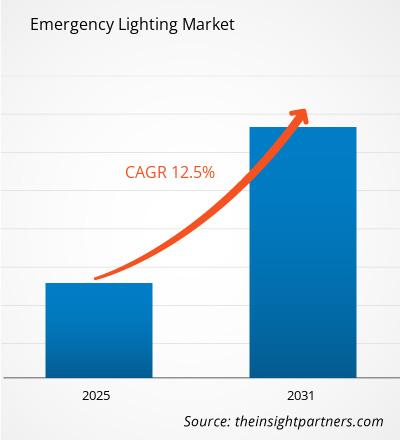
The Emergency Lighting Market was valued at US$ 8.32 Billion in 2025 and is projected to reach US$ 16.05 Billion by 2034, expanding at a CAGR of 7.57% from 2026 to 2034. This growth trajectory reflects increasing regulatory mandates for building safety, widespread LED technology adoption, and rising infrastructure investments across commercial and industrial sectors globally.
North America maintains its position as the largest regional market for emergency lighting solutions, with the region expected to grow at a CAGR range of 6.5–7.5% through 2034. Structural growth drivers include stringent NFPA 101 Life Safety Code enforcement, UL 924 equipment standards updates, and the Infrastructure Investment and Jobs Act accelerating retrofit activity across healthcare, transit, and commercial facilities.
Emergency Lighting Market Assessment and Insights
- North America: The region held 31–33% of global Emergency Lighting Market share in 2025, growing at a CAGR range of 6.5–7.5% between 2026–2034, driven by commercial building codes and infrastructure modernization initiatives.
- US: The United States accounted for 28–30% of North America in 2025, expanding at a CAGR range of 7.0–8.0% between 2026–2034, supported by NFPA and UL regulatory compliance.
- Europe: Europe captured 24–26% of global share in 2025, growing at a CAGR range of 5.5–6.5% between 2026–2034, with Germany, UK, and France leading adoption through Ecodesign regulations and BS 5266 standards.
- Asia Pacific: The region held 19–21% of global share in 2025, expanding at the fastest CAGR range of 8.5–9.5% between 2026–2034, propelled by China, India, Japan, and smart city development programs.
- Largest Segment: The LED light source segment dominated with 50–52% market share in 2025, growing at a CAGR range of 7.5–8.5% between 2026–2034, driven by energy efficiency mandates and superior operational lifespan.
- High Growth Segment: The LiFePO4 battery type segment demonstrated the highest growth potential with 18–20% market share in 2025, expanding at a CAGR range of 10.5–11.5% between 2026–2034, owing to longer cycle life and thermal stability advantages.
- Key companies analyzed in detail: Philips Lighting Holding B.V. (Signify), Daisalux, Cooper Industries Inc. (Eaton Corporation Inc.), Schneider Electric SE, Legrand S.A., Beghelli S.p.A., Fulham Co. Inc., Emerson Electric Co., Acuity Brands Lighting Inc., Zumtobel Group AG, Hubbell Incorporated, and ABB Ltd.
Source: The Insight Partners' analysis based on proprietary research, government publications, company annual reports, investor presentations, industry databases, and expert interviews.
There have been considerable changes in the development of the market from traditional standalone systems to smart safety solutions. Nowadays, LED lighting is characterized by efficiency over 180 lumens per watt, and lithium-iron-phosphate batteries allow operating over ten years, significantly lowering the total cost of ownership. Technologies, such as DALI-2, Zigbee 3.0, and Bluetooth Mesh, have helped reduce cabling costs in installing emergency lighting systems by up to 40–60%. Now facility managers can control thousands of cloud-connected devices from central dashboards and get automatic EN 50172 and NFPA 101 test logs and predict future failures.
Asia Pacific and Middle East & Africa represent high growth geographies due to national visions, like Saudi Vision 2030 or Smart Cities Mission in India, and substantial infrastructure investments made in recent years. Positive regulatory factors, like Ecodesign Regulation of the European Commission, which is going to eliminate the use of fluorescent tubes by 2027, are also pushing LED lights adoption.
Emergency Lighting Market Report Scope
| Report Attribute | Details |
|---|---|
| Market size in 2025 | US$ 8.32 Billion |
| Market Size by 2034 | US$ 16.05 Billion |
| Global CAGR (2026 - 2034) | 7.57% |
| Historical Data | 2021-2024 |
| Forecast period | 2026-2034 |
Emergency Lighting Market Analysis
High demand for products is driven by building safety regulations for commercial, industrial, and multi-dwelling buildings across the world. The value chain includes battery suppliers, LED component suppliers, fixture assemblers, and integrators with an increasing share of LiFePO4 batteries due to their higher efficiency than Ni-Cd and lead-acid batteries. The supply situation is stable; however, the prices for lithium and rare-earth phosphors as raw materials depend on the dynamics of the global commodity markets which makes suppliers expand their geographical sources.
The commercial market segment accounted for 40-42% of the revenues in 2025 with a share of users within public infrastructure and transportation sector growing at the rate of 13-15% per year through 2034. Major players in this market include global electric companies Eaton, Schneider Electric, and Legrand, along with special lighting companies like Signify, Acuity Brands, and Zumtobel. Competing products are increasingly oriented towards IoT-based self-test luminaires. Thus, Eaton launched a wirelessly connected cloud monitoring system while Signify expanded its portfolios of DALI-2 certified luminaires.
Investment trends favor connected emergency lighting networks that share occupancy and daylight data with HVAC, access control, and fire-alarm panels via open protocols like BACnet/IP. This interoperability transforms emergency lighting from a compliance-driven cost center into an active safety and operational asset within building management ecosystems.
● REPORT CUSTOMIZATION
Tailor This Report To Align With Your Specific Business Requirements
This report can be customized to align precisely with your business objectives, scope, and target markets. Customization options include tailored segmentation, geography, competitive analysis, and strategic insights to support informed decision-making.
Customize This Report →WHAT YOU CAN ADJUST
- ● Segmentations
- ● Geography
- ● Competitive Analysis
- ● Language Preferences
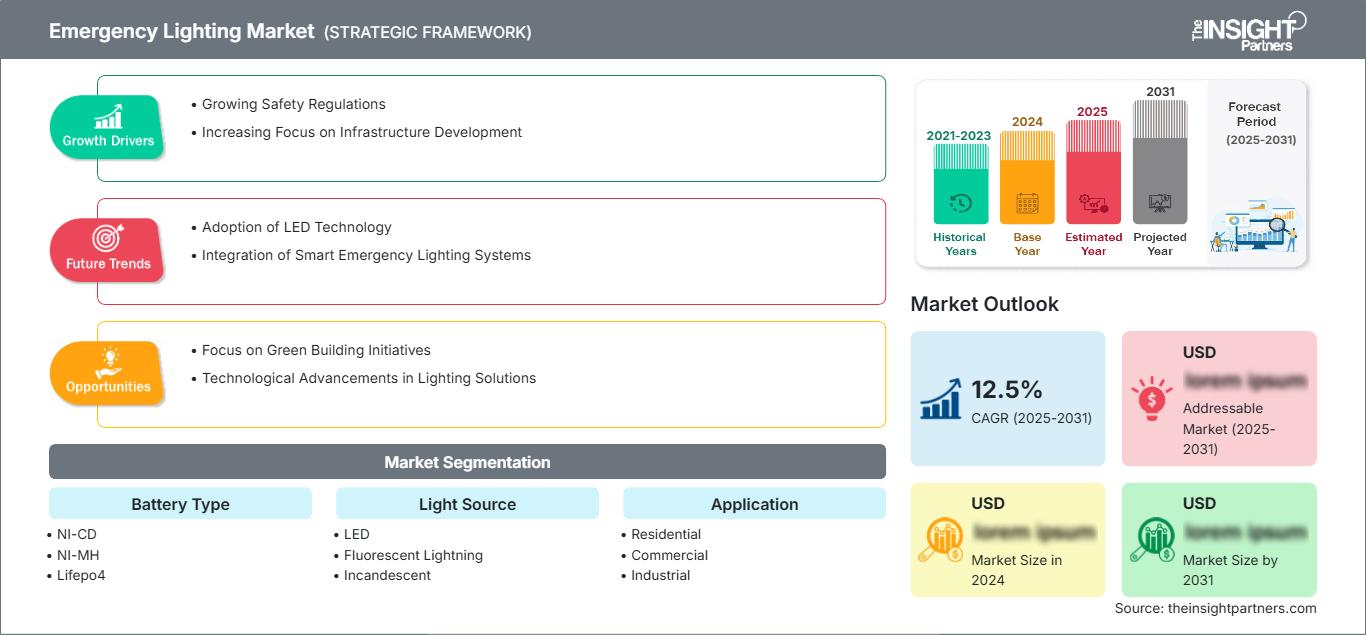
Emergency Lighting Market: Strategic Insights
Regional Insights
North America Emergency Lighting Market
North America maintained its position in 2025, accounting for 31–33% of global revenue. The region is projected to expand at a CAGR range of 6.5–7.5% between 2026 and 2034, supported by sustained commercial construction activity, healthcare facility modernization, and transit infrastructure upgrades. Enforcement continues to act as one of the major triggers, where NFPA 101 Life Safety Code, 2024 Edition requires centralized monitoring of healthcare occupancy buildings and monthly automated functional testing of assembly occupancies of more than 5,000 square feet.
The Infrastructure Investment and Jobs Act has been instrumental in facilitating retrofit projects on public buildings, while changes to the UL 924 standards scheduled for February 2027 increase performance demands on emergency lighting devices. Self-contained systems captured a 64%-66% share in the North American market in 2025 and would be the fastest growing segment with a 13%-14% CAGR until 2031 as building owners emphasize reliability during power loss situations and easy installations in difficult retrofits.
U.S. Emergency Lighting Market
The United States represented 28–30% of the North American share in 2025, with domestic valuations reaching approximately US$ 2.61 billion. The U.S. market is forecast to grow at a CAGR range of 7.0–8.0% through 2031, driven by revised UL 924 standards, ongoing LED price declines, and stricter NFPA 70/101 enforcement accelerating replacement cycles. Commercial facilities contributed 40–42% of U.S. emergency lighting revenue in 2025, while public infrastructure and transit venues emerged as the fastest-growing application segment at 14–15% CAGR.
Emergency Lighting Market report indicates that leading firms such as Acuity Brands, Eaton Corporation, Signify, Hubbell, and ABB have efficient distribution channels that are present in each and every one of the fifty states, especially in the healthcare, educational, and transportation industries. The residential market segment has become the biggest one in terms of application due to the need for safety in multi-residential buildings as well as subsidized housing projects through the government, which have expanded the need for emergency lighting beyond the traditional commercial scope.
Europe Emergency Lighting Market
Europe captured 24–26% of global share in 2025, valued at approximately US$ 2.08 billion, and is projected to grow at a CAGR range of 5.5–6.5% through 2034. The United Kingdom commands 18–20% of European regional revenue, with BS 5266-1:2025 code updates mandating monthly automated testing and centralized monitoring for premises exceeding specific occupancy thresholds. Germany follows closely with 22–24% share, driven by Ecodesign Regulation phasing out T5 and T8 fluorescent emergency tubes by September 2027, accelerating LED migration across industrial and commercial facilities.
The Emergency Lighting Market forecast indicates that France, Italy, and Spain constitute 28%-30% of European revenues, with France spearheading the smart cities movement in Paris and Lyon, Italy emphasizing the retrofitting of historic buildings via wireless DALI-2 technology, and Spain enjoying the boost in tourism through increased hotel and airport developments. The European Market is already mature, though stable, with growth driven by compliance issues, energy efficiency requirements, and the development of the Internet of Things (IoT)-enabled emergency luminaries that automate EN 50172 testing with 40-50% reduction in manpower costs.
APAC Emergency Lighting Market
Asia Pacific held 19–21% of global share in 2025, valued at approximately US$ 1.65 billion, and is projected to expand at the fastest CAGR range of 8.5–9.5% through 2034. China leads regional adoption with 35–37% of APAC revenue, driven by massive infrastructure development, smart city programs, and stringent GB building codes requiring emergency illumination in all public assemblies. Japan follows with 18–20% share, focusing on seismic-resilient systems and aging population safety in healthcare and residential facilities.
The three countries together account for 25% to 27% of the APAC emergency lighting market in terms of revenues, where India’s Smart Cities mission and Make in India campaigns boost local production and installations. South Korea focuses on IoT-enabled buildings, whereas Australia maintains stringent AS/NZS 2293 guidelines in mining, educational, and healthcare segments. The key industrial and policy factors that impact the APAC are government subsidies for LED usage, fast-paced urbanization, and heightened fire safety compliance due to fire accidents in buildings.
Middle East & Africa Emergency Lighting Market
The Middle East & Africa is projected to grow at a CAGR range of 11.5–12.5% through 2034, representing the highest regional growth rate globally. Saudi Arabia leads with Vision 2030 mega-projects including NEOM, Red Sea developments, and Qiddiya entertainment city, all requiring comprehensive fire and life safety solutions meeting international standards. The UAE follows with Dubai's Smart City program and updated Civil Defense Code 2024 mandating IoT-enabled emergency luminaires in buildings taller than 25 meters.
South Africa stands out as the biggest mature market in the sub-Saharan region owing to safety standards in the mining industry and office complexes in Johannesburg and Cape Town. RoMEA entails Egypt’s New Administrative Capital, Konza Technopolis in Kenya, and Lagos smart cities in Nigeria as examples of how country visions translate into mixed-use urban ecosystems that necessitate strong emergency lighting systems. The energy and infrastructure aspect encompasses plentiful solar energy resources allowing hybrid solar battery emergency lighting systems and lessening reliance on the grid in an unstable environment.
Segmentation Analysis
Battery Type
The Battery Type segment is projected to grow at a CAGR range of 7.0–8.0% between 2026 and 2034. LiFePO4 batteries are rapidly gaining preference due to their superior cycle life (2,000–5,000 charges), thermal stability up to 60C, and compact form factors enabling sleek fixture designs. Ni-Cd and lead-acid batteries remain prevalent in cost-sensitive applications and legacy installations, though their market share is declining as environmental regulations restrict cadmium content and total cost of ownership calculations favor lithium alternatives.
- Ni-Cd: Nickel-Cadmium batteries maintain 25–27% market presence in 2025, valued for wide temperature tolerance and established recycling infrastructure, though cadmium toxicity concerns drive gradual replacement in developed markets.
- Ni-MH: Nickel-Metal Hydride batteries hold 12–14% share in 2025, offering higher energy density than Ni-Cd without toxic heavy metals, gaining traction in residential and light commercial applications where affordability balances performance requirements.
- LiFePO4: Lithium Iron Phosphate batteries command 18–20% share in 2025 with fastest growth trajectory, favored for 10+ year service life, minimal maintenance, and compatibility with smart monitoring systems in premium commercial and industrial installations.
- Lead-Acid: Lead-acid batteries represent 28–30% of 2025 volume, dominant in central battery systems and cost-sensitive emerging markets, though weight, maintenance requirements, and shorter cycle life limit appeal in modern self-contained luminaires.
Light Source
The Light Source segment is expected to expand at a CAGR range of 7.5–8.5% from 2026 to 2034. LED technology dominates with superior efficacy exceeding 180 lm/W, 50,000–100,000 hour rated life, and instant-on capability critical for emergency egress illumination. Fluorescent systems face phase-out timelines under Ecodesign regulations, while incandescent sources are virtually obsolete outside niche heritage applications where aesthetic continuity outweighs efficiency considerations.
- LED: LED light sources held 50–52% market share in 2025, driven by energy efficiency mandates, superior lifespan reducing replacement frequency, and seamless integration with smart controls and occupancy sensors in connected building ecosystems.
- Fluorescent Lighting: Fluorescent emergency lighting maintains 28–30% share in 2025, primarily in legacy commercial installations and regions with slower regulatory enforcement, though T5/T8 tube bans by 2027 accelerate migration toward LED retrofit kits and replacement fixtures.
- Incandescent: Incandescent sources represent less than 5% of 2025 volume, confined to specialized exit signs requiring specific color temperature or historic building restorations where modern alternatives cannot replicate original aesthetic intent without compromising compliance.
Application
The Application segment is forecast to grow at a CAGR range of 7.0–8.0% between 2026 and 2034. Commercial buildings lead in absolute revenue contribution, while residential applications emerge as the fastest-growing category as building codes extend emergency lighting requirements to multi-unit dwellings and government-subsidized housing. Industrial facilities prioritize ruggedized, high-lumen fixtures for warehouses and manufacturing plants where continuous operation demands reliable backup illumination during power disruptions.
- Residential: Residential applications held 26–28% market share in 2025 with fastest growth outlook, propelled by safety awareness, smart home integration, and regulatory mandates extending emergency illumination requirements beyond single-family homes to apartments and condominiums.
- Commercial: Commercial buildings command 40–42% of 2025 Emergency Lighting Market revenue, encompassing offices, retail centers, hotels, and shopping malls where brand reputation and liability concerns drive premium system investments with remote monitoring and automated testing capabilities.
- Industrial: Industrial facilities represent 28–30% share in 2025, characterized by demanding environments requiring IP65+ rated fixtures, extended battery backup durations for shift work continuity, and integration with process control systems in manufacturing, warehousing, and logistics operations.
Opportunity Snapshot
| Application | Revenue Contribution | Trend Tag | Adoption Stage |
|---|---|---|---|
| Residential | Medium | Smart Home Integration | Scaling |
| Commercial | High | IoT Self-Testing | Mature |
| Industrial | High | Ruggedized LED | Mature |
Emergency Lighting Market Growth Drivers and Impact Analysis
Stringent Building Safety Regulations Worldwide
Emergency Lighting Market trends indicate that there are building codes and life safety regulations that mandate the installation of emergency lighting in commercial, industrial, and multi-family residential buildings in all parts of the world and thus ensuring continuous purchase of the same. The 2024 edition of NFPA 101 Life Safety Code states that there should be a minimum of 1 footcandle lighting at floor level on egress path with 10 seconds power transfer and battery backup for 90 minutes, and all this should be verified monthly and annually, respectively. Similarly, IEC 60598-2-22 is the international standard with similar requirements, whereas UL 924 is the North American listing standard. Failure to meet these requirements results in stiff penalties and liabilities.
LED Technology Cost-Performance Advancement
The LED emergency lighting fixtures can be more than 180 lumens per watt efficient, with a lifespan of 50,000 to 100,000 hours. This has made the LED lighting fixture very energy-efficient and reduces its cost of replacement due to its long lifespan when compared to its predecessor fluorescent and incandescent lightings. Total cost of ownership has been tilting towards the LED emergency lighting fixtures due to reductions in energy costs, replacement and installation labor over 10 to 15 years of useful service life.
Smart Building Integration and IoT Connectivity
The future of emergency lighting systems is not merely about installing lights that are compliant with the regulations; but the technology is moving towards more active systems that would be a part of building management systems with the help of IoT modules. Protocols such as DALI-2, Zigbee 3.0 and Bluetooth Mesh would cut down the cost of cables by 40%-60%, and provide for remote monitoring, automated fault alerts, and predictive maintenance schedules. The cloud connected dashboards will allow facility managers to monitor thousands of devices at different locations automatically document regulatory tests and save up to 50%-60% on manual inspections.
Emergency Lighting Market Future Trends
Wireless Self-Testing Luminaires Dominance
Wireless, self-testing emergency lighting units will account for 60-65% of all installations by 2030 due to mandatory regulations requiring automatic monthly tests being enforced worldwide. The cost of manual compliance is estimated at about US$ 3.50 per unit per month, which is more than the annual fee for smart lights for three years, thus presenting strong financial motivation to switch to wireless emergency lighting solutions. Such companies as Eaton and Signify have been implementing radio mesh networks that can be controlled from mobile applications, allowing to test remotely without any need to alter complicated wiring.
AI-Powered Predictive Maintenance Integration
The analysis of battery health, LED health, and environmental factors will be done by artificial intelligence and machine learning systems to determine future breakdowns proactively rather than reactively through the analysis of their impact on the functionality of the equipment. Emergency management software systems based on AI technology will compare the historical performance data and current sensors input data to determine the best test schedule and any patterns that indicate upcoming failures of components, thus generating compliance reports automatically.
Emergency Lighting Market Opportunities
Emerging Markets Infrastructure Expansion
Growth is also anticipated within Middle East & Africa and Asia Pacific due to the implementation of the vision of the country as well as the development of the infrastructure of the region. The vision 2030 of Saudi Arabia comprises of $1+ trillion in projects such as NEOM, Red Sea and Qiddiya which have the requirement for fire and life safety systems complying with international standards. The vision of India includes 100 smart cities project where the infrastructure will be upgraded whereas the urbanization in Africa happens at a rate of 3.5 percent per year in Lagos, Nairobi, and Cairo cities.
Hybrid Solar-Battery Emergency Systems
Solar-charging Lithium battery-stored hybrid emergency lighting systems are designed to resolve problems associated with power grid instability in developing countries while simultaneously meeting the sustainability goals in developed countries. Such lighting systems cut down on the cost of operation through electricity consumption by about 70-80% as opposed to their counterparts that are grid-charged; improve resilience to regional blackouts and at the same time meet companies' net-zero targets, which is becoming increasingly mandatory for investors and regulatory agencies. Companies that manufacture such modular and remotely monitored hybrid lighting systems would have an edge in off-grid rural and urban areas.
Recent Developments
- April 2026: HiViz Lighting Inc., the firefighter-founded company behind FireTech and Whirl-E-Bird, and trusted for high-performance emergency apparatus lighting, today announced the launch of Redline, a new line of emergency lighting built specifically for firefighters and public safety fleets operating light duty vehicles.
- June 2025: Signify N.V. (Philips Lighting) expanded its Interact Emergency portfolio with new DALI-2 certified self-testing luminaires featuring LiFePO4 batteries offering 10-year service life and reduced maintenance intervals. The launch targets European commercial customers facing 2027 fluorescent tube phase-out deadlines under Ecodesign regulations while seeking IoT-enabled centralized monitoring capabilities.
- December 2024: MIC Electronics Limited (MICEL) launched an Emergency Light Unit (ELU) designed to improve passenger safety in Indian Railways during power outages and emergency situations.
Frequently Asked Questions

- Comprehensive Market Sizing and Forecast Analysis
- Detailed Segmentation Analysis
- In-Depth Market Dynamics Assessment
- Regional and Country-Level Insights
- Competitive Landscape and Company Benchmarking
- Strategic Business Intelligence
Recent Reports
Testimonials

The Insight Partners' SCADA System Market report is comprehensive, with valuable insights on current trends and future forecasts. The team was highly professional, responsive, and supportive throughout. We are very satisfied and highly recommend their services.
RAN KEDEM Partner, Reali Technologies LTDs
I requested a report on a very specific software market and the team produced the report in a few days. The information was very relevant and well presented. I then requested some changes and additions to the report. The team was again very responsive and I got the final report in less than a week.
JEAN-HERVE JENN Chairman, Future Analytica
We worked with The Insight Partners for an important market study and forecast. They gave us clear insights into opportunities and risks, which helped shape our plans. Their research was easy to use and based on solid data. It helped us make smart, confident decisions. We highly recommend them.
PIYUSH NAGPAL Sr. Vice President, High Beam Global
The Insight Partners delivered insightful, well-structured market research with strong domain expertise. Their team was professional and responsive throughout. The user-friendly website made accessing industry reports seamless. We highly recommend them for reliable, high-quality research services
YUKIHIKO ADACHI CEO, Deep Blue, LLC.
This is the first time I have purchased a market report from The Insight Partners.While I was unsure at first, I visited their web site and felt more comfortable to take the risk and purchase a market report.I am completely satisfied with the quality of the report and customer service. I had several questions and comments with the initial report, but after a couple of dialogs over email with their analyst I believe I have a report that I can use as input to our strategic planning process.Thank you so much for taking the extra time and making this a positive experience.I will definitely recommend your service to others and you will be my first call when we need further market data.
JOHN SUZUKI President and Chief Executive Officer, Board Director, BK Technologies
I wish to appreciate your support and the professionalism you displayed in the course of attending to my request for information regarding to infectious disease IVD market in Nigeria. I appreciate your patience, your guidance, and the fact that you were willing to offer a discount, which eventually made it possible for us to close a deal. I look forward to engaging The Insight Partners in the future, all thanks to the impression you have created in me as a result of this first encounter.
DR CHIJIOKE ONYIA MANAGING DIRECTOR, PineCrest Healthcare Ltd.Reason to Buy
- Informed Decision-Making
- Understanding Market Dynamics
- Competitive Analysis
- Identifying Emerging Markets
- Customer Insights
- Market Forecasts
- Risk Mitigation
- Boosting Operational Efficiency
- Strategic Planning
- Investment Justification
- Tracking Industry Innovations
- Aligning with Regulatory Trends





 Get Free Sample for