
Enterprise Agile Planning Tools Market Demand, Trends & Forecast by 2034
Coverage: By Deployment (Cloud-based, On-premises); Application (0-100 Users, 100-500 Users, Above 500 Users) , and Geography (North America, Europe, Asia Pacific, and South and Central America)
- Status : Data Released
- Report Code : TIPRE00022416
- Category : Technology, Media and Telecommunications
- No. of Pages : 150
- Available Report Formats :


- Last update date : July 30, 2026


2025 Market Size
US$ 2.3 Bn
Base year value
2034 Forecast
US$ 15.83 Bn
Projected by 2034
CAGR 2026-2034
23.9 %
Growth rate
Addressable Market
US$ 70.12 Bn
(2026-2034)
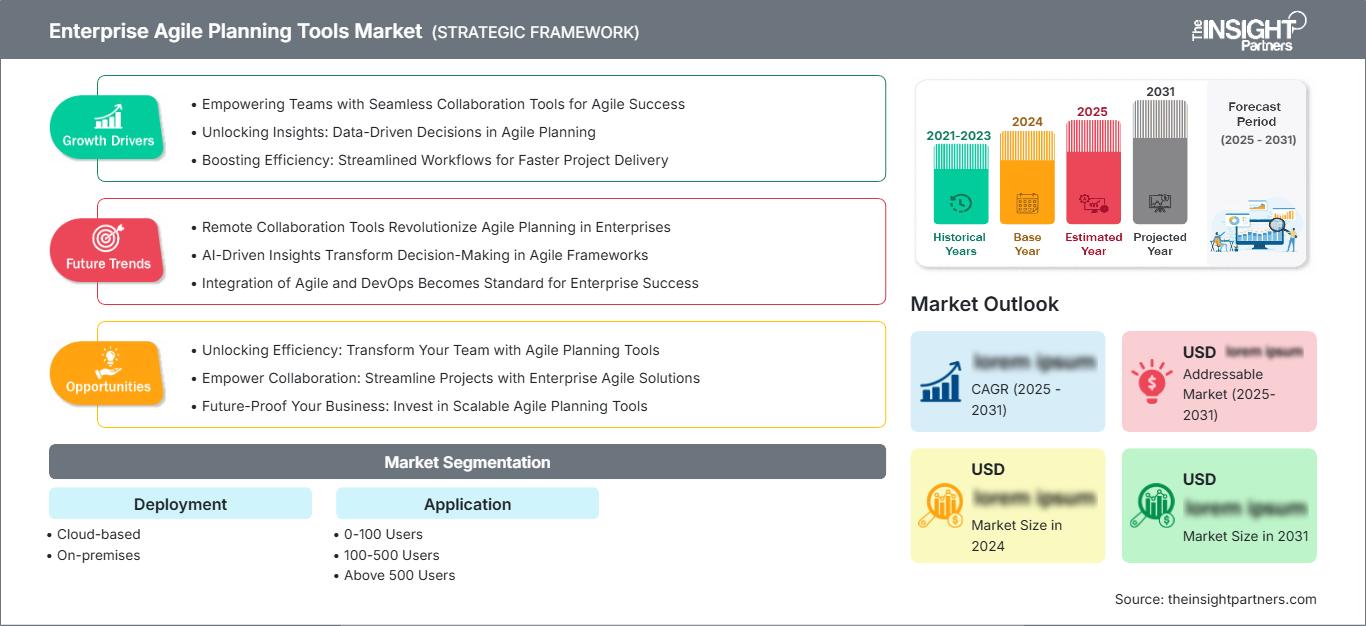
The Enterprise Agile Planning Tools market was valued at US$ 2.3 billion in 2025 and is expected to reach US$ 15.83 billion by 2034; it is estimated to record a CAGR of 23.9% during 2026-2034.
Enterprise Agile Planning Tools Market Assessment and Insights
- North America: Held an estimated 40-44% share of the enterprise agile planning tools market in 2025 and is projected to grow at a CAGR between 26-28% from 2026 to 2034, driven by mature DevOps ecosystems, dense software vendor concentration, and enterprise-wide scaled agile transformation programs across financial services and technology sectors.
- US: Accounted for roughly 84-88% of the North America enterprise agile planning tools market in 2025 and is expected to expand at a CAGR between 26-28% through 2034, underpinned by heavy R&D spending and dense enterprise software vendor presence.
- Europe: Captured an estimated 24-28% share in 2025 and is expected to grow at a CAGR of 25-27% between 2026 and 2034, with the United Kingdom, Germany, and France leading regional demand as manufacturing and financial institutions pursue digital operating-model transformation.
- Asia Pacific: Held an estimated 20-24% share in 2025 and is projected to expand at the fastest regional CAGR of 30-33% between 2026 and 2034, led by China, India, and Japan as enterprises scale IT modernization and offshore delivery center investment.
- Largest Segment: Cloud-based deployment held an estimated 68-72% share of the enterprise agile planning tools market in 2025 and is projected to grow at a CAGR of 29-31% through 2034, reflecting enterprise preference for elastic, subscription-based planning infrastructure.
- High Growth Segment: The 0-100 Users application tier held a smaller base in 2025 but is projected to expand at the fastest CAGR of 31-33% through 2034, as small and mid-sized enterprise teams adopt scaled agile practices.
- Key companies analyzed in detail: Atlassian Corporation, Microsoft Corporation, Digital.ai (VersionOne), Targetprocess, Planview Inc. (LeanKit), Fog Creek Software, IBM Corporation, Pivotal Software (VMware Tanzu), Blueprint Software Systems Inc., and Broadcom Inc. (AgileCraft/Rally Software).
Source: The Insight Partners' analysis based on proprietary research, government publications, company annual reports, investor presentations, industry databases, and expert interviews.
The enterprise agile planning tools market share has evolved considerably over the past decade, moving from spreadsheet-based sprint tracking and standalone Kanban boards toward integrated, cloud-native platforms capable of orchestrating portfolio-level delivery across hundreds of distributed teams. Early adopters came mainly from software and tech companies where the agile approach had its roots, but scaled approaches like SAFe and LeSS have since moved agile into other industries, including financial services, health care, telecommunications, and manufacturing. The vendors have gradually added features like dependency tracking, capacity planning, and live reports to the fundamental backlog management capability.
Looking ahead, the enterprise agile planning tools market expansion will increasingly draw from emerging geographies where digital-native enterprises are scaling engineering headcount without legacy process constraints. Regulatory tailwinds around data residency and cloud security certification are prompting vendors to expand regional hosting options, while private equity and strategic investment activity continue to consolidate point solutions into broader connected-work platforms spanning strategic planning, execution, and financial governance.
Enterprise Agile Planning Tools Market Report Scope
| Report Attribute | Details |
|---|---|
| Market size in 2025 | US$ 2.3 Billion |
| Market Size by 2034 | US$ 15.83 Billion |
| Global CAGR (2026 - 2034) | 23.9% |
| Historical Data | 2021-2024 |
| Forecast period | 2026-2034 |
Enterprise Agile Planning Tools Market Analysis
Demand for enterprise agile planning tools solutions is being shaped by the dual pressure of faster software release cycles and growing organizational complexity. Enterprises managing hundreds of concurrent workstreams require centralized visibility into dependencies, resource allocation, and delivery risk that spreadsheets and disconnected point tools cannot provide. Digital transformation mandates issued by CIOs and chief product officers have made portfolio-level agile tooling a board-level procurement priority rather than a departmental preference, supporting growth in the enterprise agile planning tools market forecast.
The market value chain is constituted by platform vendors, systems integrators, as well as a widening network of AI and automation partners who bring their expertise in integrating large language models into the sprint planning, estimation, and reporting processes. On the supply side, there is a preference for vendors with an open API ecosystem because companies are increasingly creating best-of-breed toolchains from their agile planning platforms all the way to source code, CI/CD, and ERP systems.
Competitive intensity in the enterprise agile planning tools market analysis reflects a bifurcated landscape between platform incumbents and specialist challengers. Atlassian Corporation and Microsoft Corporation are established in broad enterprise ecosystems via their Jira and Azure DevOps products, respectively, by building on existing relationships within collaboration platforms to upsell their planning solutions, while Planview Inc., IBM Corporation, and Broadcom Inc. differentiate themselves on strategic portfolio planning capabilities within large and highly-regulated enterprises. Digital.ai, Targetprocess, and Blueprint Software Systems Inc. stay relevant through their ability to build complex workflow modeling via configuration.
The key areas for investment for the competitive landscape have been AI native planning assistants, dependency intelligence, and agent-resource management as providers strive to incorporate their generative capabilities within the planning process. Positioning becomes more about an ecosystem play: for example, Atlassian Corporation and Planview Inc. are focusing on open integration protocols to maintain their position as the system of record, given the adoption of multi-vendor delivery platforms within software engineering, product management, and portfolio governance.
● REPORT CUSTOMIZATION
Tailor This Report To Align With Your Specific Business Requirements
This report can be customized to align precisely with your business objectives, scope, and target markets. Customization options include tailored segmentation, geography, competitive analysis, and strategic insights to support informed decision-making.
Customize This Report →WHAT YOU CAN ADJUST
- ● Segmentations
- ● Geography
- ● Competitive Analysis
- ● Language Preferences
Enterprise Agile Planning Tools Market: Strategic Insights
Regional Insights
North America Enterprise Agile Planning Tools Market
North America remains the largest contributor to the global enterprise agile planning tools market, supported by a dense concentration of enterprise software vendors, mature DevOps practices, and early institutional adoption of scaled agile frameworks. There is a strong presence of venture capital in the area, which has been funding AI-native start-ups while existing established technology and finance firms see agile governance at a portfolio level as a must-have for operations. The regional market is supported by cloud infrastructure and a mature system integrator ecosystem, enabling larger deployments.
Growth factors include growing use of AI among enterprises in planning processes, consolidation of point tools into work platforms, and increasing demand from regulated industries like banking and health care for an auditable, dependency-aware portfolio management solution. The regional market is expected to grow at a CAGR of 26-28% from 2026 through 2034. Growth will be centered around mid-sized companies using agile approaches beyond software development and engineering.
U.S. Enterprise Agile Planning Tools Market
The United States dominates the North America enterprise agile planning tools market, accounting for an estimated 84-88% regional share in 2025, reflecting concentrated enterprise software spending and the domestic headquarters presence of leading platform vendors including Atlassian Corporation, Microsoft Corporation, and Planview Inc. Financial services, technology, and healthcare enterprises represent the deepest adoption base, with large organizations increasingly standardizing on a single planning platform across hundreds of delivery teams to improve cross-functional visibility.
The application trends in the U.S. market favor the use of enterprise applications for companies with more than 500 users, in line with the size of technology and financial corporations in the country, although midsize companies with 100 to 500 users are increasingly using cloud-based solutions. The U.S. market is projected to register a CAGR of 26-28% up to 2034 on account of robust R&D, systems integrator strength, and the closeness of vendor headquarters, facilitating access to AI planning tools.
Europe Enterprise Agile Planning Tools Market
Europe held an estimated 24-28% share of the enterprise agile planning tools market in 2025, with adoption concentrated among manufacturing, automotive, and financial institutions pursuing coordinated digital operating-model transformation. Regional demand is shaped by data residency requirements under GDPR, prompting vendors to expand European hosting options, while public-sector digitization programs across the region continue to fund agile delivery capability building within government technology functions. The region is projected to grow at a CAGR of 25-27% between 2026 and 2034.
The UK dominates regional demand, fueled by the presence of a focused financial services and technology industry, as well as systems integrator expertise for larger rollouts. Germany ranks next, as manufacturers and auto companies move agile to engineering and software roles. Midmarket companies in France, Italy, and Spain comprise a rising base, as France moves on government digitization efforts and Italy and Spain expand their technology services industries.
APAC Enterprise Agile Planning Tools Market
Asia Pacific held an estimated 20-24% share of the enterprise agile planning tools market in 2025 and is projected to expand at the fastest regional CAGR of 30-33% between 2026 and 2034. China leads regional demand, supported by large domestic technology enterprises and government-backed digital industry initiatives, while Japan and South Korea contribute steady demand from established electronics and financial services sectors pursuing agile-at-scale transformation.
India represents the fastest-growing country market within the region, driven by its large offshore software delivery industry and expanding enterprise IT services sector, while Australia sustains demand through financial services and public-sector digitization programs. Industrial policy support for domestic software innovation across China and India, combined with rising enterprise cloud adoption, continues to reinforce regional growth momentum.
Middle East & Africa Enterprise Agile Planning Tools Market
The Middle East & Africa region represented a smaller but steadily expanding share of the enterprise agile planning tools market in 2025, projected to grow at a CAGR between 24-26% through 2034. Saudi Arabia leads regional demand, supported by national digital transformation programs and large-scale infrastructure and energy sector modernization initiatives that increasingly incorporate agile delivery practices into enterprise technology functions.
The United Arab Emirates follows closely, driven by its concentrated financial services and technology sector alongside government-led smart-city and digital government initiatives. South Africa and the Rest of MEA contribute incremental demand as regional enterprises in banking and telecommunications begin standardizing agile planning practices, with energy-sector digitization and infrastructure investment programs continuing to support gradual regional adoption through the forecast period.
Segmentation Analysis
Deployment
Cloud-based deployment is projected to grow at a CAGR between 29-31% from 2026 to 2034. Enterprises increasingly favor subscription-based, elastic infrastructure that reduces internal maintenance burden while enabling rapid feature delivery through continuous vendor updates. Cloud adoption has been reinforced by distributed and hybrid workforces requiring consistent, browser-based access to planning data across geographies, alongside vendor investment in AI-assisted capabilities that are typically released first, or exclusively, on cloud infrastructure. This scope of the enterprise agile planning tools market continues to expand as regulated industries gain confidence in cloud security certifications.
- Cloud-based: Preferred by fast-scaling technology and mid-market enterprises seeking rapid deployment, continuous feature updates, and reduced internal infrastructure ownership across distributed engineering teams.
- On-premises: Retained primarily by regulated financial institutions, government agencies, and defense-adjacent organizations requiring strict data sovereignty and internal infrastructure control.
Application
The Above 500 Users tier represents the largest application segment, projected to grow at a CAGR between 26-28% from 2026 to 2034. Large enterprises managing complex, multi-team portfolios require dependency mapping, capacity forecasting, and governance controls that smaller deployments do not demand, driving sustained platform investment. Adoption within this tier is increasingly influenced by the need to unify planning data across previously siloed business units following corporate consolidation and digital transformation mandates spanning engineering, product, and operations functions.
- 0-100 Users: Adopted by startups and small enterprise teams prioritizing lightweight setup, low licensing cost, and rapid onboarding without extensive administrative configuration.
- 100-500 Users: Serves mid-market enterprises scaling agile practices across multiple departments, balancing configurability with manageable administrative overhead.
- Above 500 Users: Deployed by large enterprises requiring portfolio-level governance, cross-team dependency visibility, and enterprise security and compliance controls.
Opportunity Snapshot
| Application | Revenue Contribution | Trend Tag | Adoption Stage |
| 0-100 Users | Medium | AI Onboarding | Scaling |
| 100-500 Users | High | Cross-Team Sync | Scaling |
| Above 500 Users | High | Portfolio Governance | Mature |
Enterprise Agile Planning Tools Market Growth Drivers and Impact Analysis
Enterprise-Wide Scaling of Agile Beyond Software Engineering
The agile methodology, which was traditionally used only by software development teams, is increasingly expanding into marketing, HR, finance, and operations teams as companies try to implement organization-wide responsiveness to changes on the market. Such an evolution has expanded the potential pool of buyers for enterprise agile planning tools from CTOs and engineering management to chief operating officers and heads of business units who need comprehensive portfolio visibility. In response, vendors have started to generalize terminologies and workflows from software-specific terms like sprints and story points to flexible workflows that can be applied in different business areas. This trend has significantly increased average enterprise contract size as platforms transition from department-level licensing to full organization-level adoption involving thousands of users. The trend is especially true for large financial firms and manufacturing companies undergoing digital operating model transformation, where agile planning tools have become a core component of portfolio management together with project execution, driving steady double-digit growth in the market forecast period.
AI-Native Planning Assistants Reducing Administrative Overhead
The use of generative AI features integrated into planning platforms is cutting down the administrative effort that traditionally came with backlogs, sprint estimation, and reporting. Enterprise customers are now considering vendors not only based on how advanced their planning features are, but also based on how much automation vendors are offering in terms of risk identification, dependency detection, and even report generation through natural language processing, among other things. The effort that enterprise program managers used to spend on manual reporting is now cut by this new trend and can be spent on making important portfolio decisions instead. Vendors such as Atlassian Corporation and Planview Inc. are focusing on developing AI agent functionality inside planning solutions as a way of differentiating themselves from their competitors in this market. Enterprise customers are now ready to pay extra for AI-powered solutions, which is driving average revenue per user.
Regulatory and Compliance Pressure Driving Governance-Grade Platforms
Organizations working in regulated industries like banking, healthcare, and government need agile planning systems that can provide audit trail capabilities, access control features, and compliance reports, along with the basic delivery tracking capability. The above requirement has made governance capabilities an important purchasing criterion among regulated enterprises instead of an afterthought. It is giving a competitive edge to those platform vendors that already have their security certifications against those who have just entered the market. The demand for data residency due to regulations like GDPR in Europe and the national data protection acts in the Asia Pacific is making vendors build infrastructure in their regions so that they can become viable for procurement by regulated enterprises.
Enterprise Agile Planning Tools Market Future Trends
Convergence of Strategic Portfolio Management and Execution-Level Planning
Enterprise agile planning tools market trends point toward growing convergence between strategic portfolio management, traditionally used for investment prioritization, and execution-level sprint planning historically confined to engineering teams. Vendors are increasingly building unified data models connecting high-level strategic objectives directly to team-level backlog items, enabling real-time visibility into how daily execution work ladders up to business outcomes. This convergence is reducing the historical divide between finance-driven portfolio governance and engineering-driven delivery tracking, allowing enterprises to reallocate investment dynamically based on execution signals rather than periodic planning cycles alone. Over the coming years, this trend is expected to reshape enterprise procurement patterns, favoring vendors capable of spanning both strategic and execution layers within a single connected platform rather than requiring separate specialized tools for each function.
Emergence of Agent-Resource Management Within Planning Platforms
As enterprises deploy increasing numbers of AI agents alongside human team members, planning platforms are beginning to treat agent capacity as a first-class resource requiring the same allocation, cost tracking, and accountability controls traditionally applied to human staffing. This emerging capability category, often termed agent-resource management, allows enterprise leaders to view combined human and AI agent workloads within a single portfolio view, ensuring every automated action remains traceable to an accountable decision-maker. Over the next several years, this trend is expected to become a standard platform capability rather than a differentiated feature, as enterprises scale agentic automation across software delivery, requiring planning platforms to evolve beyond human-centric work-item models toward hybrid human-agent capacity planning frameworks.
Enterprise Agile Planning Tools Market Opportunities
Mid-Market Expansion Through Simplified, AI-Guided Onboarding
A substantial enterprise agile planning tools market forecast opportunity exists among mid-market organizations that have historically avoided enterprise-grade planning platforms due to configuration complexity and lengthy implementation timelines. Vendors that invest in AI-guided onboarding, pre-built workflow templates, and simplified administrative interfaces stand to capture this underpenetrated segment, which represents a meaningfully larger population of organizations than the large-enterprise accounts most vendors have historically targeted. Reduced implementation timelines lower the total cost of adoption for mid-market buyers, directly expanding the addressable customer base. Vendors pursuing this opportunity should prioritize usage-based pricing models and self-service trial experiences over traditional enterprise sales-led motions, enabling faster customer acquisition velocity. Early movers capturing mid-market share now stand to benefit from long-term account expansion as these organizations scale headcount and require deeper portfolio governance capabilities over time, reinforcing durable recurring revenue growth.
Vertical-Specific Platform Configurations for Regulated Industries
A significant investment opportunity exists in developing vertical-specific platform configurations tailored to the compliance, terminology, and workflow requirements of regulated industries, including banking, healthcare, and government. Rather than offering generalized planning functionality requiring extensive customization, vendors that pre-build industry-specific templates, compliance reporting modules, and integration connectors for sector-specific systems can meaningfully reduce enterprise sales cycles and implementation risk. This approach allows vendors to command premium pricing relative to horizontal offerings while building defensible competitive moats through deep vertical domain expertise that generalist competitors cannot easily replicate. Enterprises within regulated sectors have consistently demonstrated willingness to pay higher licensing rates for platforms that reduce internal compliance engineering burden, making this an economically attractive avenue for vendors seeking to diversify beyond horizontal technology-sector customer bases toward higher-margin regulated industry accounts.
Frequently Asked Questions

- Comprehensive Market Sizing and Forecast Analysis
- Detailed Segmentation Analysis
- In-Depth Market Dynamics Assessment
- Regional and Country-Level Insights
- Competitive Landscape and Company Benchmarking
- Strategic Business Intelligence
Recent Reports
Testimonials

The Insight Partners' SCADA System Market report is comprehensive, with valuable insights on current trends and future forecasts. The team was highly professional, responsive, and supportive throughout. We are very satisfied and highly recommend their services.
RAN KEDEM Partner, Reali Technologies LTDs
I requested a report on a very specific software market and the team produced the report in a few days. The information was very relevant and well presented. I then requested some changes and additions to the report. The team was again very responsive and I got the final report in less than a week.
JEAN-HERVE JENN Chairman, Future Analytica
We worked with The Insight Partners for an important market study and forecast. They gave us clear insights into opportunities and risks, which helped shape our plans. Their research was easy to use and based on solid data. It helped us make smart, confident decisions. We highly recommend them.
PIYUSH NAGPAL Sr. Vice President, High Beam Global
The Insight Partners delivered insightful, well-structured market research with strong domain expertise. Their team was professional and responsive throughout. The user-friendly website made accessing industry reports seamless. We highly recommend them for reliable, high-quality research services
YUKIHIKO ADACHI CEO, Deep Blue, LLC.
This is the first time I have purchased a market report from The Insight Partners.While I was unsure at first, I visited their web site and felt more comfortable to take the risk and purchase a market report.I am completely satisfied with the quality of the report and customer service. I had several questions and comments with the initial report, but after a couple of dialogs over email with their analyst I believe I have a report that I can use as input to our strategic planning process.Thank you so much for taking the extra time and making this a positive experience.I will definitely recommend your service to others and you will be my first call when we need further market data.
JOHN SUZUKI President and Chief Executive Officer, Board Director, BK Technologies
I wish to appreciate your support and the professionalism you displayed in the course of attending to my request for information regarding to infectious disease IVD market in Nigeria. I appreciate your patience, your guidance, and the fact that you were willing to offer a discount, which eventually made it possible for us to close a deal. I look forward to engaging The Insight Partners in the future, all thanks to the impression you have created in me as a result of this first encounter.
DR CHIJIOKE ONYIA MANAGING DIRECTOR, PineCrest Healthcare Ltd.Reason to Buy
- Informed Decision-Making
- Understanding Market Dynamics
- Competitive Analysis
- Identifying Emerging Markets
- Customer Insights
- Market Forecasts
- Risk Mitigation
- Boosting Operational Efficiency
- Strategic Planning
- Investment Justification
- Tracking Industry Innovations
- Aligning with Regulatory Trends





 Get Free Sample for