
Ethernet Test Equipment Market Share, Growth & Forecast by 2034
Coverage: by Product Type (10 GbE, 1GbE, 40 GbE Above); End Users (Data Centers, Campuses, Enterprises, Households, Other) , and Geography (North America, Europe, Asia Pacific, and South and Central America)
- Status : Data Released
- Report Code : TIPRE00009728
- Category : Electronics and Semiconductor
- No. of Pages : 150
- Available Report Formats :


- Last update date : August 17, 2026


2025 Market Size
US$ 1.79 Bn
Base year value
2034 Forecast
US$ 3.37 Bn
Projected by 2034
CAGR 2026-2034
7.30 %
Growth rate
Addressable Market
US$ 23.29 Bn
(2026-2034)
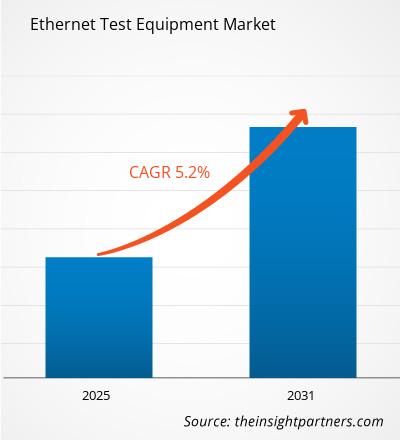
The Ethernet Test Equipment Market was valued at US$ 1.79 Billion in 2025 and is projected to reach US$ 3.37 Billion by 2034, expanding at a CAGR of 7.30% during 2026–2034. The market encompasses instruments, traffic generators, analyzers, and validation platforms used to assess Ethernet performance across telecommunications, data centers, automotive systems, manufacturing networks, and other connected environments.
North America remains a major development and deployment center, with the Ethernet Test Equipment Market size expected to expand at an estimated CAGR of 6.8–7.6%. Structural drivers include hyperscale data-center investment and rapid migration toward 400G, 800G, and emerging 1.6T interconnects. Telecommunications modernization, enterprise network upgrades, and software-defined vehicle testing also support regional demand.
Ethernet Test Equipment Market Assessment and Insights
- North America: North America is estimated to hold a 30–34% Ethernet Test Equipment Market share in 2025 and grow at a CAGR of 6.8–7.6% between 2026–2034, supported by data centers, telecom upgrades, semiconductor development, and advanced automotive networking.
- US: The US is projected to represent 78–83% of North American demand in 2025 and expand at a CAGR of 7.0–7.8% through 2034, led by cloud infrastructure and AI networking.
- Europe: Europe is estimated to account for 22–26% of global 2025 demand and grow at a CAGR of 6.2–7.0%, led by Germany, the UK, France, Italy, and the Netherlands.
- Asia Pacific: Asia Pacific is expected to capture 35–39% of 2025 demand and register a CAGR of 8.0–8.8%, with China, Japan, South Korea, Taiwan, and India driving network and electronics investment.
- Largest Segment: 10 GbE is estimated to hold a 43–47% market share in 2025 and expand at a CAGR of 5.8–6.6% between 2026–2034.
- High Growth Segment: 40 GbE Above is estimated to represent a 24–28% market share in 2025 and grow at a CAGR of 9.5–10.5% through 2034.
- Key companies analyzed in detail: Agilent Technologies, Inc., Anritsu Corporation, EXFO Inc., Fortive Corporation, Keysight Technologies, Inc., Spirent Communications plc, Teledyne Technologies Incorporated, VIAVI Solutions Inc., Xena Networks ApS, and Yokogawa Electric Corporation.
Source: The Insight Partners' analysis based on proprietary research, government publications, company annual reports, investor presentations, industry databases, and expert interviews.
According to the Ethernet Test Equipment Market report, the progression indicates a shift from simple link tests towards multi-layer, high-throughput, and automated test procedures. The earlier generations of devices were mainly concerned with throughput, packet loss, latency, and cable testing of 1GbE and 10GbE links. Newer test equipment is increasingly being capable of 40GbE, 100GbE, 400GbE, 800GbE testing, PAM4 signaling, optical modules, network disaggregation, and software-defined testing. There is a change in the production trends towards modular hardware design, programmable traffic generation, cloud-based analysis, and reusable test resources across lab, manufacturing, and field settings.
The Ethernet Test Equipment Market forecast indicates that future prospects are driven by AI infrastructure, the growth of 5G and optical networks, industrial automation, and Ethernet adoption in vehicles. The new sources of demand will most likely be India, Southeast Asia, the Middle East, and Latin America, where operators and vendors update their networks. The investments will focus on flexible systems that speed up testing process, fit into automated workflows, and provide flexibility for evolving standards. The work of IEEE and the Ethernet Alliance on interoperability and regulations should promote testing procedures.
Ethernet Test Equipment Market Report Scope
| Report Attribute | Details |
|---|---|
| Market size in 2025 | US$ 1.79 Billion |
| Market Size by 2034 | US$ 3.37 Billion |
| Global CAGR (2026 - 2034) | 7.30% |
| Historical Data | 2021-2024 |
| Forecast period | 2026-2034 |
Ethernet Test Equipment Market Analysis
The Ethernet Test Equipment market trends indicate that growth will be driven by testing for increased bandwidth, low latency, deterministic behavior, interoperability, and adherence to service level requirements. Telecom operators test access, metro, core, and transport networks, whereas cloud providers test switches, optical transceivers, cables, NICs and server interfaces. Automotive firms test Ethernet in vehicles for driver assist features, infotainment, zonal architecture, and software defined vehicles. Manufacturers use these instruments to test industrial Ethernet, time sensitive networking, and machine to machine communication.
Participants in the value chain include test instrument makers, semiconductor and optical component suppliers, network equipment makers, system integrators, labs, telecom operators, automotive firms, and automation firms. Development of product requires fast processors, FPGA technologies, optical transceivers, timing solutions, software, and protocol stacks. Users increasingly want a single platform that can handle multiple generations of Ethernet to avoid changing equipment. Supply factors affecting the industry include semiconductor availability, qualification of optical components, calibration needs, and support for evolving standards.
There is competition among diversified companies offering electronic measurement solutions, network test solutions providers, telecommunications test solution providers, and industrial instrumentation companies. Keysight Technologies, Inc., Spirent Communications plc, Anritsu Corporation, EXFO Inc., and VIAVI Solutions Inc. are highly competitive firms in terms of traffic generation, protocol analysis, service activation, and optical validation. Teledyne Technologies Incorporated, Fortive Corporation, Yokogawa Electric Corporation, Xena Networks ApS, and Agilent Technologies, Inc. bring competence in measurements, industrial systems, modular instruments, and network performance testing.
The investments are shifting from current technologies like 800G and 1.6T validation, artificial intelligence data centers, optical-electrical co-design, and automated production testing. The strategic positioning of vendors will increasingly depend on the breadth of software capabilities, port density, standards, interoperability databases, and integration with customer test systems. Modular architecture vendors will be able to serve a variety of applications while safeguarding the customers’ investments. Specialty vendors will be able to compete through fast adaptation of protocols, user interfaces, and technical support for telecommunication, automotive, and manufacturing accounts.
● REPORT CUSTOMIZATION
Tailor This Report To Align With Your Specific Business Requirements
This report can be customized to align precisely with your business objectives, scope, and target markets. Customization options include tailored segmentation, geography, competitive analysis, and strategic insights to support informed decision-making.
Customize This Report →WHAT YOU CAN ADJUST
- ● Segmentations
- ● Geography
- ● Competitive Analysis
- ● Language Preferences
Ethernet Test Equipment Market: Strategic Insights
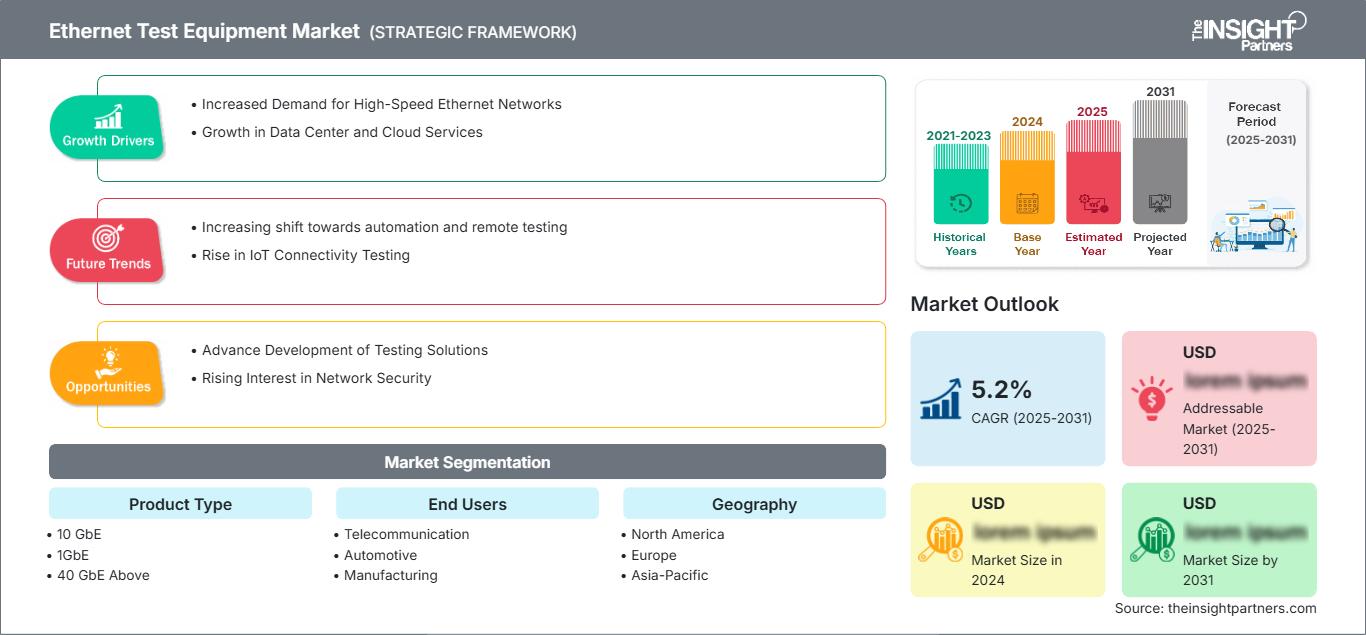
Regional Insights
North America Ethernet Test Equipment Market
North America is estimated to hold a 30–34% Ethernet Test Equipment Market share in 2025 and grow at a CAGR of 6.8–7.6% through 2034. The US is the region’s principal market because cloud providers, network-equipment manufacturers, semiconductor companies, telecom operators, and technology laboratories are concentrated there. Canada contributes through telecommunications, mining automation, aerospace, defense, and data-center projects.
The demand drivers of the Ethernet Test Equipment Market include the presence of AI clusters, high speed data center connectivity, 5G network densification, and migration to 800G and 1.6T from 400G. Automotive Ethernet testing is becoming increasingly popular for validation of cameras, sensors, zonal control and in-car networks. Companies with strong business or technical footprint include Keysight Technologies, Inc., Spirent Communications plc, VIAVI Solutions Inc., Anritsu Corporation, and Teledyne Technologies Incorporated.
U.S. Ethernet Test Equipment Market
The US is expected to represent 78–83% of North America’s 2025 demand and expand at a CAGR of 7.0–7.8% through 2034. Growth is supported by hyperscale data centers, AI computing, semiconductor research, defense communications, telecom upgrades, and enterprise network modernization. High-performance laboratories require instruments that combine traffic generation, protocol analysis, optical validation, and software automation.
Application areas in the Ethernet Test Equipment Market comprise 800G switch testing, optical transceiver testing, network security testing, private 5G, automotive Ethernet, and manufacturing testing. Test equipment manufacturers Keysight Technologies, Inc., Anritsu Corporation, Spirent Communications plc, VIAVI Solutions Inc., and Fortive Corporation deliver their products to customers directly and through distributors and engineering partnerships and software ecosystems. Federal research and advanced manufacturing investments and the growth of the semiconductor industry capacity domestically will drive test equipment sales, even as purchasing cycles depend on capital spending climates.
Europe Ethernet Test Equipment Market
Europe is estimated to account for 22–26% of global 2025 demand and grow at a CAGR of 6.2–7.0%. Germany is the leading country, supported by automotive engineering, industrial automation, factory networking, telecommunications, and electronics manufacturing. The region places strong emphasis on interoperability, safety, energy efficiency, and long equipment lifecycles.
UK involvement includes telecom carriers, cloud computing infrastructure, aerospace, defense, and research labs. German demand is created by car manufacturers, producers of industrial machinery, and vendors that develop time-critical and automotive Ethernet solutions. France sees the involvement of aerospace industry, rail, defense, telecoms, and public infrastructure. Italian and Dutch companies create demand in terms of industrial automation, semiconductor equipment, logistics, data centers, and high-tech manufacturing. Europeans tend to appreciate modularity, traceable calibration, protocols support, and local applications.
APAC Ethernet Test Equipment Market
APAC is projected to hold a 35–39% share in 2025 and grow at a CAGR of 8.0–8.8%, making it the fastest-growing region. China leads through telecom infrastructure, data centers, electronics manufacturing, and optical equipment. Japan and South Korea contribute through automotive, semiconductors, displays, and industrial systems, while Taiwan and India expand network and manufacturing demand.
Industrial policies, 5G rollouts, electronic exports, and semiconductor investments in the home country contribute to regional purchases. India is playing an increasingly important role in telecommunications, data centers, and assembly testing of electronics, and Australia has contributed in the areas of communications, mining, and infrastructure. There is price sensitivity in play, but testing of various Ethernet speeds justifies premium equipment.
Middle East & Africa Ethernet Test Equipment Market
Middle East and Africa demand is expected to grow at a CAGR of 7.2–8.2% through 2034. Saudi Arabia leads regional opportunity through smart-city programs, cloud infrastructure, telecom modernization, and industrial diversification. The UAE follows with data centers, aviation, logistics, financial services, and enterprise connectivity. South Africa remains the principal sub-Saharan market for telecom, mining, industrial automation, and public infrastructure.
MEA (excluding South Sudan) is impacted by submarine cables, broadband roll-outs, data center projects, and digitization of the energy industry. Ethernet testing is necessary for network acceptance, activation, problem-solving, and maintenance. Procurement still favors distributors; the requirements of the projects and operators determine the products that will be purchased. Growth is an appealing prospect, although it is contingent on funding schemes, imports, training, and calibration.
Segmentation Analysis
Product Type
Product Type includes 10 GbE, 1GbE, and 40 GbE Above. The segment is projected to expand at a CAGR of 7.0–7.8% during 2026–2034. Mature 1GbE and 10GbE networks continue generating replacement, troubleshooting, and manufacturing demand, while 40GbE Above records stronger growth as cloud, telecom, and AI infrastructure require higher throughput and more complex optical-electrical validation.
- 10 GbE: 10 GbE remains the largest product category because enterprise networks, telecom aggregation, industrial systems, and laboratory environments continue to require dependable validation, troubleshooting, and performance benchmarking.
- 1GbE: 1GbE serves installed-base maintenance, access networks, point-to-point links, industrial systems, and cost-sensitive environments where basic throughput, cable, latency, and packet-integrity testing remain strategically necessary.
- 40 GbE Above: 40 GbE Above is gaining importance in data centers, optical transport, telecom core networks, and AI infrastructure, requiring advanced traffic generation, PAM4 analysis, and transceiver interoperability testing.
End Users
End Users consist of Telecommunication, Automotive, Manufacturing, and Others. The segment is forecast to grow at a CAGR of 7.6–8.4% between 2026–2034. Telecommunication remains the broadest buyer group, while Automotive records high growth as Ethernet replaces or complements legacy vehicle networks. Manufacturing demand is strengthened by industrial automation, private networks, and connected production assets.
- Telecommunication: Telecommunication operators and equipment vendors use test platforms for network acceptance, service assurance, optical transport, 5G, fiber access, and capacity upgrades across multiple Ethernet generations.
- Automotive: Automotive users require deterministic, high-speed, and environmentally qualified validation for cameras, sensors, gateways, zonal controllers, infotainment, and software-defined vehicle architectures.
- Manufacturing: Manufacturing companies apply Ethernet testing to industrial networks, robotics, machine vision, time-sensitive networking, factory automation, and production-line quality assurance.
- Others: Other users include enterprises, research laboratories, utilities, government agencies, education, transportation, and defense organizations requiring network verification, troubleshooting, and compliance testing.
Opportunity Snapshot
| End Users | Revenue Contribution | Trend Tag | Adoption Stage |
|---|---|---|---|
| Telecommunication | High | 5G Backhaul | Mature |
| Automotive | High | Vehicle Ethernet | Scaling |
| Manufacturing | Medium | Factory Networking | Scaling |
| Others | Medium | Network Modernization | Emerging |
Ethernet Test Equipment Market Growth Drivers and Impact Analysis
AI Data Centers and Accelerating Network Speeds
The AI workload necessitates dense clustering, high throughput switching, and low latency connectivity, making there be an increased demand for validating optical modules, cables, switches, network interface cards, and data center fabrics as a whole. The transition from 400G to 800G and the upcoming 1.6T architecture increases the complexity of the measurements since engineers have to evaluate parameters such as signal integrity, forward error correction, latency, jitter, throughput, and compatibility all at once. As such, this trend drives investment in high port density systems, programmable traffic generators, and software solutions that automate repeatable testing procedures. This driver has increased the demands among cloud service providers, component vendors, and system integrators.
5G, Fiber Expansion, and Network Modernization
Telecommunications operators are upgrading access, aggregation, transport, and core networks to support higher traffic volumes, cloud services, private networks, and connected devices. Fiber rollout and 5G densification create testing requirements at installation, commissioning, service activation, and maintenance stages. Operators need portable instruments for field work alongside laboratory platforms for equipment qualification and interoperability. The resulting demand is broad because networks contain legacy 1GbE and 10GbE links as well as higher-speed backhaul and core connections. Service providers also place greater emphasis on automated reporting, remote collaboration, and assurance analytics. Suppliers with both handheld and high-capacity systems can address the full deployment lifecycle and reduce customer vendor fragmentation.
Automotive Ethernet and Software-Defined Vehicles
Automotive manufacturers are adopting Ethernet for cameras, radar, infotainment, advanced driver assistance, gateways, and centralized computing. This transition requires testing of bandwidth, latency, synchronization, electromagnetic performance, deterministic behavior, and interoperability among sensors, switches, controllers, and software. Vehicle programs also impose extended qualification cycles and demanding environmental conditions, making specialized validation essential. The driver encourages suppliers to develop automotive protocol libraries, hardware-in-the-loop integration, conformance testing, and production-line solutions. It creates additional demand beyond research laboratories because tier-one suppliers and vehicle plants need repeatable end-of-line verification. The impact should be strongest in high-speed vehicle networks and architectures using zonal controllers.
Ethernet Test Equipment Market Future Trends
Cloud-Native and AI-Assisted Test Automation
Future platforms will increasingly use cloud-native software, machine-readable results, programmable interfaces, and artificial intelligence to accelerate test planning and fault diagnosis. Engineers will be able to deploy standard test templates across laboratories, manufacturing lines, field teams, and customer acceptance environments. Automated anomaly detection may identify packet-loss patterns, optical degradation, timing instability, and interoperability failures before manual review. This approach can improve instrument utilization and reduce repetitive engineering work, particularly as link speeds and port counts rise. Vendors will compete on open APIs, workflow integration, data visualization, cybersecurity, and compatibility with DevOps tools. Customers may prefer subscription-based analytics while retaining capital equipment for high-performance traffic generation.
Unified Validation of Optical, Electrical, and Protocol Layers
The distinction between optical, electrical, and protocol testing will continue to weaken as network architectures become more integrated. A single validation workflow may need to correlate transmitter quality, receiver sensitivity, lane performance, FEC behavior, packet throughput, latency, and application-level service results. Instruments will therefore combine optical interfaces, electrical probing, traffic generation, protocol emulation, and advanced analytics. This trend is important for 800G and 1.6T systems, where failures can arise from interactions among transceivers, switch silicon, cables, connectors, and software. Vendors that offer unified platforms can reduce test handoffs and accelerate root-cause analysis. Modular architecture will remain essential for protecting customer investment.
Ethernet Test Equipment Market Opportunities
Regional Test Hubs for Emerging Manufacturing Centers
India, Vietnam, Malaysia, Indonesia, and selected Middle Eastern markets are developing electronics, telecom, automotive, and data-center ecosystems that require localized validation capability. Suppliers can invest in regional application laboratories, calibration centers, technical training, and demonstration facilities to shorten customer qualification cycles. Partnerships with contract manufacturers, telecom operators, universities, and system integrators can create demand before local production reaches full scale. Commercial success will depend on matching instrument complexity with local engineering capability and offering service packages that include maintenance, software updates, and training. Regional hubs can also improve inventory planning and support customers seeking alternatives to imported engineering services.
Managed Testing and Lifecycle Services
Many enterprises, manufacturers, and smaller operators cannot justify owning every instrument required for high-speed Ethernet qualification. This creates an opportunity for managed testing, equipment rental, remote laboratory access, calibration contracts, and engineering-as-a-service models. Providers can package hardware, software, test-plan development, data analysis, and compliance documentation around specific customer projects. Such services are particularly relevant for automotive suppliers, industrial manufacturers, and telecom operators entering higher-speed networking. Investment should focus on secure remote access, standardized reporting, equipment utilization, and specialist personnel. Service models can generate recurring revenue while helping customers manage technology transitions without purchasing a complete portfolio upfront.
Recent Developments
- September 2025: VIAVI Solutions Inc. launched all-in-one handheld tools for last-mile fiber service activation and testing, supporting Ethernet, Wi-Fi 7, DOCSIS, and multi-gigabit service validation up to 10 Gbps. The products target field technicians and operators seeking to simplify installation, commissioning, and troubleshooting across converged access networks.
- October 2025: Keysight Technologies, Inc. (NYSE: KEYS) introduced the AE6980T nGBASE-AU Optical Automotive Ethernet Transmitter Test Solution, the industry’s first platform to qualify next-generation optical automotive Ethernet PHYs in compliance with the IEEE 802.3cz standard. Keysight unveiled the solution at the 2025 IEEE SA Ethernet & IP Automotive Technology Day in Toulouse, France.
Frequently Asked Questions

- Comprehensive Market Sizing and Forecast Analysis
- Detailed Segmentation Analysis
- In-Depth Market Dynamics Assessment
- Regional and Country-Level Insights
- Competitive Landscape and Company Benchmarking
- Strategic Business Intelligence
Recent Reports
Testimonials

The Insight Partners' SCADA System Market report is comprehensive, with valuable insights on current trends and future forecasts. The team was highly professional, responsive, and supportive throughout. We are very satisfied and highly recommend their services.
RAN KEDEM Partner, Reali Technologies LTDs
I requested a report on a very specific software market and the team produced the report in a few days. The information was very relevant and well presented. I then requested some changes and additions to the report. The team was again very responsive and I got the final report in less than a week.
JEAN-HERVE JENN Chairman, Future Analytica
We worked with The Insight Partners for an important market study and forecast. They gave us clear insights into opportunities and risks, which helped shape our plans. Their research was easy to use and based on solid data. It helped us make smart, confident decisions. We highly recommend them.
PIYUSH NAGPAL Sr. Vice President, High Beam Global
The Insight Partners delivered insightful, well-structured market research with strong domain expertise. Their team was professional and responsive throughout. The user-friendly website made accessing industry reports seamless. We highly recommend them for reliable, high-quality research services
YUKIHIKO ADACHI CEO, Deep Blue, LLC.
This is the first time I have purchased a market report from The Insight Partners.While I was unsure at first, I visited their web site and felt more comfortable to take the risk and purchase a market report.I am completely satisfied with the quality of the report and customer service. I had several questions and comments with the initial report, but after a couple of dialogs over email with their analyst I believe I have a report that I can use as input to our strategic planning process.Thank you so much for taking the extra time and making this a positive experience.I will definitely recommend your service to others and you will be my first call when we need further market data.
JOHN SUZUKI President and Chief Executive Officer, Board Director, BK Technologies
I wish to appreciate your support and the professionalism you displayed in the course of attending to my request for information regarding to infectious disease IVD market in Nigeria. I appreciate your patience, your guidance, and the fact that you were willing to offer a discount, which eventually made it possible for us to close a deal. I look forward to engaging The Insight Partners in the future, all thanks to the impression you have created in me as a result of this first encounter.
DR CHIJIOKE ONYIA MANAGING DIRECTOR, PineCrest Healthcare Ltd.Reason to Buy
- Informed Decision-Making
- Understanding Market Dynamics
- Competitive Analysis
- Identifying Emerging Markets
- Customer Insights
- Market Forecasts
- Risk Mitigation
- Boosting Operational Efficiency
- Strategic Planning
- Investment Justification
- Tracking Industry Innovations
- Aligning with Regulatory Trends





 Get Free Sample for