
Fault Current Limiter Market Demand, Size & Forecast by 2034
Coverage: By Type (Superconducting, Non-Superconducting); Voltage Range (High, Medium, Low); End users (Power station, Oil and gas, Automotive, Steel and Aluminum, Paper mills and chemicals), and Geography (North America, Europe, Asia Pacific, and South and Central America)
- Status : Data Released
- Report Code : TIPRE00014528
- Category : Electronics and Semiconductor
- No. of Pages : 150
- Available Report Formats :


- Last update date : September 10, 2026


2025 Market Size
US$ 4.22 Bn
Base year value
2034 Forecast
US$ 5.82 Bn
Projected by 2034
CAGR 2026-2034
3.63 %
Growth rate
Addressable Market
US$ 45.58 Bn
(2026-2034)
The Fault Current Limiter Market was valued at US$ 4.22 Billion in 2025 and is projected to reach US$ 5.82 Billion by 2034, expanding at a CAGR of 3.63% during 2026–2034. Demand arises from the need to control short circuit currents without the necessity of disconnecting the power grid, protecting expensive transformers and switchgears, and ensuring the stability of the power grid, considering that there is increasing generation, interconnection, automation, and sensitivity of electrical loads within utilities and industries.
The Fault Current Limiter Market size in North America is forecasted to grow at a rate of 3.2-3.8% CAGR. Hardened grids, increased power requirements in data centers, interconnection of renewables, and the preference of targeted protection retrofits by utilities drive purchases. The United States accounts for the major demand, as aging substations and limited urban grids justify the cost-effectiveness of lowering prospective fault currents instead of replacing the entire fleet of switchgears.
Fault Current Limiter Market Assessment and Insights
- North America represented 24–28% Share in 2025 and is modelled to grow at a CAGR between 3.2–3.8% during 2026–2034, supported by grid hardening, data-center interconnections, and replacement deferral strategies.
- US accounted for 76–80% of North American demand in 2025 and is expected to expand at a CAGR between 3.3–3.9% during 2026–2034.
- Europe held 22–26% Share in 2025 and is forecast at a CAGR between 3.0–3.6% during 2026–2034, led by Germany, the UK, and France.
- Asia Pacific captured 38–42% Share in 2025 and is projected to grow at a CAGR between 3.8–4.4% during 2026–2034, led by China, Japan, India, and South Korea.
- Largest Segment Superconducting type secured 62–68% market share in 2025 and is modelled at a 3.5–4.1% CAGR during 2026–2034 as utilities prioritize rapid, low-impedance protection.
- High Growth Segment Medium voltage held 28–32% market share in 2025 and is projected at a 4.0–4.6% CAGR during 2026–2034, driven by distributed generation and industrial feeders.
- Key companies analyzed in detail: ABB Ltd.; Alstom SA; American Superconductor Corporation; Siemens AG; Applied Materials, Inc.; GridON Ltd.; SuperPower Inc.; Superconductor Technologies Inc.; Liaoning Rongxin Xingye Power Technology Co., Ltd.; Zenergy Power plc.
Source: The Insight Partners' analysis based on proprietary research, government publications, company annual reports, investor presentations, industry databases, and expert interviews.
The advance of technology has moved procurement from slow-reacting and network-splitting solutions to superconducting, saturable core, and power electronics-based systems that react fast but maintain their normal-load efficiencies. Economics of manufacture are increasingly based on supply chains for high-temperature superconductor tape, cryogenics, semiconductor switching capabilities, and specific engineering. The Fault Current Limiter Market is additionally positively affected by limitations in replacing equipment due to limited space and outage windows, since such a solution increases effective network capacity and decreases thermal and mechanical stresses on installed circuit breakers, transformers, cables, and bus bars.
The growth of procurement is forecasted in industrial corridors of Asia, Gulf region utilities, and high density urban substations with fault duty near the rating of equipment until 2034. The emphasis on resilience in regulation, renewables integration, and tariff-driven grid upgrading will assist in achieving financeability of projects. The companies that will not only provide equipment but also offer modeling, protection coordination, and lifecycle management services will be ahead of the component manufacturers, and the modular medium voltage platforms will enable quick qualifications and implementation of solutions.
Fault Current Limiter Market Report Scope
| Report Attribute | Details |
|---|---|
| Market size in 2025 | US$ 4.22 Billion |
| Market Size by 2034 | US$ 5.82 Billion |
| Global CAGR (2026 - 2034) | 3.63% |
| Historical Data | 2021-2024 |
| Forecast period | 2026-2034 |
Fault Current Limiter Market Analysis
Fault Current Limiter market growth is facilitated by an increase in probability of fault occurrence due to substation interconnection, distributed generation, converters, and high concentration of industry loads. This evaluation will take into consideration the performance of limiters compared to breakers, bus splitting, increased impedance, and delayed connections. The supply chain will include the production of superconducting tapes, magnetic cores, power semiconductors, cryogenics, protection relays, transformers, and testing laboratories.
Currently, supply depends on projects and not standardization. Qualification time, grid codes, and protection coordination limit scalability, while lead times influence deliveries. According to the International Energy Agency, the delivery of transmission projects ranges from one to seven years. This explains the importance of solutions that accelerate capacity utilization. The competition in this market is based on reaction time, recovery, temperature endurance, integration risks, and reduced reinforcement cost.
The Analysis of the Fault Current Limiter Market Report reveals that the competition is highly fragmented with electrification companies, superconductors, and power electronics competing. In such an instance, ABB Ltd., Siemens AG, and Alstom SA have the upper hand in providing system integration and installation base. However, American Superconductor Corporation, SuperPower Inc., GridON Ltd., and Superconductor Technologies Inc. are positioned in terms of material, cables, and limitation architecture.
The capital spending is mainly on modular fault current limiters, intelligent diagnosis, low loss superconducting conductor, and protection system making the installation easier. Applied Materials, Inc. leads in material technology and Liaoning Rongxin Xingye Power Technology Co., Ltd. meets high-power electronics requirement. The positioning strategy is based on having reference cases in utilities as well as production alliances. Zenergy Power plc is still an important reference case in terms of history technology due to current stiff competition.
● REPORT CUSTOMIZATION
Tailor This Report To Align With Your Specific Business Requirements
This report can be customized to align precisely with your business objectives, scope, and target markets. Customization options include tailored segmentation, geography, competitive analysis, and strategic insights to support informed decision-making.
Customize This Report →WHAT YOU CAN ADJUST
- ● Segmentations
- ● Geography
- ● Competitive Analysis
- ● Language Preferences
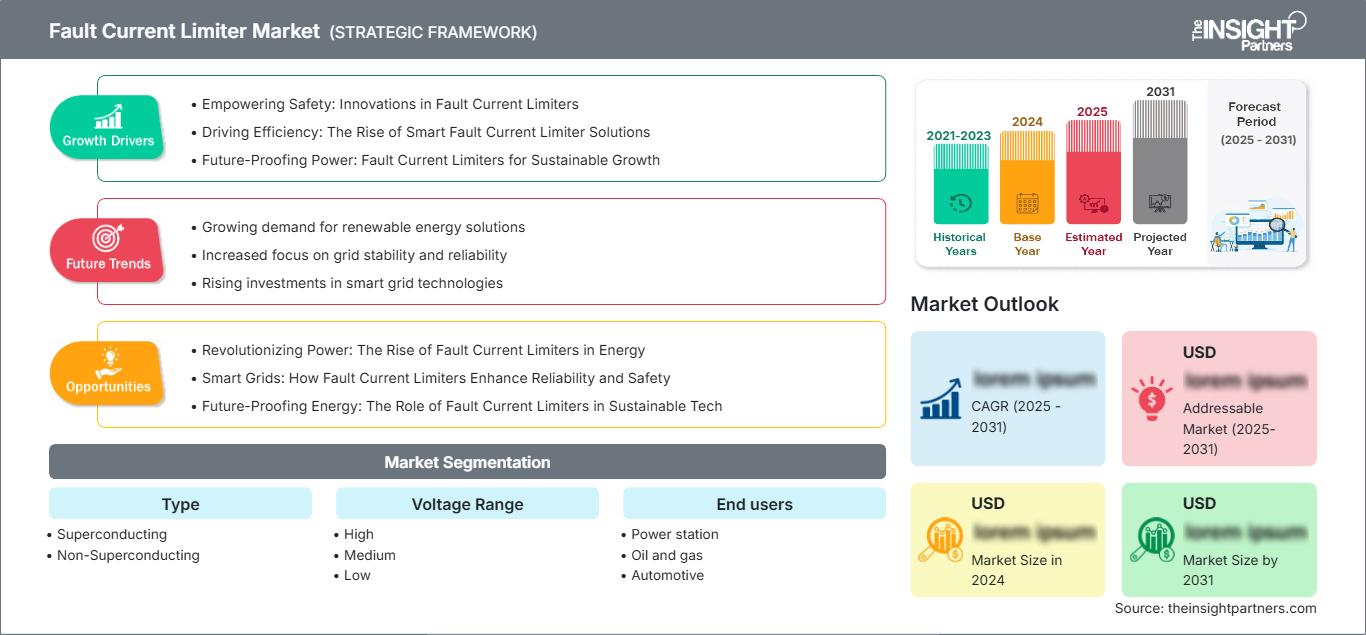
Fault Current Limiter Market: Strategic Insights
Regional Insights
North America Fault Current Limiter Market
North America represented 24%–28% modeled Fault Current Limiter Market share in 2025 and is projected to grow at a CAGR of 3.2% to 3.8% between 2025 and 2034. Aging substations, increased demands for data centers, renewables and storage integration, and extreme weather resilience initiatives are expanding potential fault duties. Utilities will be faced with limited locations where switchgear replacement or extension of bus ducts is too expensive and current limitation makes sense.
Utilities will favor technologies that fit into their existing protection systems and offer reliable fault clearing performance. Investments in protection equipment in the US, grid strengthening in Canada, and industrial electrification in Mexico expand the opportunity set. However, long qualification processes and unclear cost recovery might hinder adoption. Companies that will quantify the benefit of avoided breaker replacement, shorter outages, and on-shore commissioning will be more successful.
U.S. Fault Current Limiter Market
The US accounted for 76-80% of North American revenue in 2025 and is forecasted to grow at a CAGR of 3.3-3.9%. Urban network interconnections, hyperscale computing demands, semiconductors manufacturing, e-mobility, and utility wildfire resilience investments create security needs. The American Superconductor Corporation has created a domestic benchmark for grid interconnections fault limitation, while ABB Ltd. and Siemens AG offer compatible protection, control and switchgear systems.
Applications are concentrated in distribution substations, critical infrastructure, industrial parks, and data center facilities. Prospects of buyers assess the advantages of installing fault limiters versus breaker upgrade or substation reconstruction by means of downtime savings and land needs. Grid programs of the federal and state levels are positively affecting the market conditions; however, utility standards prolong sales cycle time. Successful players have to pass accredited testing, provide cybersecure monitoring, compatible relays, and multiterritory service coverage.
Europe Fault Current Limiter Market
The US accounted for 76-80% of North American revenue in 2025 and is forecasted to grow at a CAGR of 3.3-3.9%. Urban network interconnections, hyperscale computing demands, semiconductors manufacturing, e-mobility, and utility wildfire resilience investments create security needs. The American Superconductor Corporation has created a domestic benchmark for grid interconnections fault limitation, while ABB Ltd. and Siemens AG offer compatible protection, control and switchgear systems.
Applications are concentrated in distribution substations, critical infrastructure, industrial parks, and data center facilities. Prospects of buyers assess the advantages of installing fault limiters versus breaker upgrade or substation reconstruction by means of downtime savings and land needs. Grid programs of the federal and state levels are positively affecting the market conditions; however, utility standards prolong sales cycle time. Successful players have to pass accredited testing, provide cybersecure monitoring, compatible relays, and multiterritory service coverage.
APAC Fault Current Limiter Market
Asia Pacific started with a forecasted share of 38-42% in 2025, and this segment needs to experience growth by 3.8-4.4% CAGR. China drives via transmission development and industrial electrification; Japan and South Korea focus on compact and reliable grids; India is working on increasing substations and renewable corridors; Australia invests in grids for distributed generation and mining loads.
Support from policy, grid investments, urban power densities, local production of equipment, and growing short-circuit duties drive the demand in the region. Local serviceability of mid- and high-voltage platforms is preferred by buyers in this region; however, qualification and prices restrain their adoption. Cooperation with utilities, laboratories, and engineering companies is crucial in making demos turn into tendered products.
Middle East & Africa Fault Current Limiter Market
Middle East & Africa: The Middle East and Africa region is estimated at a CAGR of 3.4% - 4.0%. Generation, industry, and grid extension are driving growth in Saudi Arabia. In the UAE, the focus is on robust utility networks and critical infrastructure. System capacity constraints in South Africa drive retrofit opportunities; whereas the rest of MEA relies on project opportunities.
Opportunities in oil and gas installations, desalination, metal processing facilities, renewable energy plants, and transmission expansion projects represent areas where cost of outages justifies protection. However, procurement will depend on financing, technical expertise, and local maintenance.
Segmentation Analysis
Type
The type segment is forecast to expand at a modelled 3.4–4.0% CAGR during 2026–2034. The Fault Current Limiter Market scope covers superconducting and non-superconducting architectures selected according to response speed, continuous losses, footprint, recovery behavior, and maintenance capability. Superconducting designs suit space-constrained, high-duty networks, while magnetic and solid-state alternatives attract buyers seeking simpler thermal management or lower initial cost.
- Superconducting holds the leading position because near-zero normal-state impedance and rapid transition can protect dense grids without persistent voltage drop, although cryogenic systems elevate qualification and maintenance requirements.
- Non-Superconducting serves utilities and industrial users prioritizing mature magnetic or semiconductor components, easier servicing, and modular deployment, making it strategically important for medium-voltage feeders and cost-sensitive retrofit programs.
Voltage Range
The voltage range segment is modelled at a 3.6–4.2% CAGR during 2026–2034. High-voltage projects deliver substantial equipment-protection value but require extended testing and engineering. Medium-voltage installations scale faster across substations, renewables, data centers, and industrial feeders. Low-voltage demand remains application-specific, centered on critical facilities where arc-energy reduction, continuity, and compact protection justify additional capital.
- High voltage systems protect transmission assets and major generation interfaces, where avoided transformer, busbar, and breaker upgrades can offset complex engineering, insulation, and certification requirements.
- Medium voltage is strategically important for repeatable deployment across distribution substations, renewable interconnections, mines, factories, and data centers, combining meaningful fault reduction with manageable installation footprints.
- Low voltage solutions address power-dense critical facilities and industrial distribution, where selective coordination, arc-flash mitigation, and continuity requirements support demand despite competition from advanced circuit breakers.
End users
The end users segment is projected to post a modelled 3.3–3.9% CAGR during 2026–2034. Power stations dominate because generation additions and network interconnection increase available short-circuit current. Oil and gas, metals, chemical, and paper operations value reduced downtime and asset stress. Automotive demand rises with battery plants, electric drivetrains, charging infrastructure, and automated production lines requiring stable power quality.
- Power station is the principal user category, applying limiters at generator connections, bus couplers, and substations to protect high-value equipment while supporting added capacity and network flexibility.
- Oil and gas facilities require robust protection for compressors, pumps, offshore platforms, LNG infrastructure, and captive generation, where unplanned shutdowns can create substantial production and safety consequences.
- Automotive adoption centers on battery plants, stamping, welding, robotics, and high-power charging, where expanding electrical loads increase fault duty and strengthen continuity requirements.
- Steel and Aluminum operations use high-current furnaces, rolling mills, and drives, making fault limitation strategically valuable for reducing equipment stress and preventing production interruptions.
- Paper mills and chemicals demand coordinated protection for motors, process lines, and captive utilities, prioritizing stable operation, hazardous-area safety, and retrofit compatibility within continuously operating plants.
Opportunity Snapshot
| End Users | Revenue Contribution | Trend Tag | Adoption Stage |
| Power station | High | Grid Reinforcement | Scaling |
| Oil and gas | Medium | Asset Continuity | Mature |
| Automotive | Medium | Battery Plants | Scaling |
| Steel and Aluminum | Medium | Furnace Protection | Mature |
| Paper mills and chemicals | Low | Process Uptime | Emerging |
Fault Current Limiter Market Growth Drivers and Impact Analysis
Rising Short-Circuit Duty from Grid Interconnection
Renewable plants, storage systems, embedded generation, and substation interties improve capacity and flexibility but can raise prospective short-circuit current beyond installed equipment ratings. Network operators then face expensive breaker replacement, additional transformers, bus splitting, or delayed connections. A limiter offers an alternative by constraining the first current peak and reducing stress on downstream assets. The commercial impact is strongest where space, permitting, or outage windows restrict conventional reinforcement. Utilities can preserve existing switchgear, release connection capacity, and maintain network topology, while industrial operators avoid disruptive upgrades. This driver expands engineering studies and pilot deployments, particularly at medium-voltage nodes where distributed resources accumulate rapidly and repeatable designs can support portfolio-scale procurement.
Grid Resilience and Critical-Load Continuity
Data centers, hospitals, transport hubs, semiconductor facilities, and continuous-process plants place higher economic value on electrical continuity. Fault currents can damage transformers, cables, busbars, and breakers, extending restoration beyond the initiating event. Limiters reduce incident energy and mechanical stress while supporting selective isolation, making resilience benefits measurable through avoided downtime and deferred replacement. ABB’s 2025 US manufacturing investment targeted power-quality and protection products for data centers, manufacturing, and utilities, illustrating the strength of this demand signal. Procurement decisions increasingly combine protection studies with business-interruption scenarios, cybersecure monitoring, and recovery requirements. Vendors able to document response consistency, lifecycle availability, and service readiness gain an advantage in critical-load applications where reliability outweighs lowest initial price.
Economics of Deferred Network Reinforcement
Transmission and distribution projects require substantial capital and extended planning. The International Energy Agency estimates that adding one terawatt-hour of generation and grid capacity can require US$ 75–150 million in advanced economies and US$ 30–110 million in emerging economies. Where fault levels rather than thermal capacity block new connections, targeted current limitation can defer broader reinforcement. The economic case depends on avoided switchgear replacement, reduced civil works, released substation capacity, and shorter outages. This driver encourages utilities to evaluate total system cost rather than component price. It also favors modular products with repeatable study templates, because standardized engineering lowers transaction costs and improves regulatory justification across multiple substations.
Fault Current Limiter Market Future Trends
Software-Defined Protection Coordination
Fault Current Limiter Market trends will increasingly converge with virtualized relays, digital substations, synchronized measurements, and real-time network models. Limiters will be specified as controllable protection assets rather than isolated hardware, enabling operators to adapt settings as topology, generation, and load change. Siemens introduced a virtualized protection platform in 2026 that can consolidate up to 60 hardware devices, demonstrating the direction of substation architecture. Future products should expose secure diagnostics, event records, thermal status, and recovery readiness through interoperable interfaces. This shift can reduce commissioning time, support remote testing, and improve asset utilization, but it also raises cybersecurity, software-validation, and lifecycle-support requirements.
Modular Hybrid and Cryogenic Platforms
Manufacturers will combine superconducting, magnetic, and semiconductor elements to balance fast response, low normal-state losses, controllability, and recovery speed. Modular architecture can let utilities scale current-limiting capacity by feeder or phase, reducing the risk of one-off engineering. Advances in second-generation high-temperature superconductor tape, compact cryocoolers, silicon-carbide switches, and thermal monitoring should improve performance and maintainability. Standardized enclosures and factory-tested modules can shorten site work, while condition-based service can increase confidence in cryogenic availability. Hybrid designs are especially relevant where utilities need repeated medium-voltage deployments but cannot accept the operating losses, footprint, or maintenance profile of a single technology approach.
Fault Current Limiter Market Opportunities
Utility Portfolio Retrofits at Constrained Substations
Fault Current Limiter Market Forecasts support an investment case for standardized retrofit programs at substations where fault duty, rather than thermal capacity, limits growth. Suppliers can target utility portfolios by screening short-circuit studies, breaker margins, interconnection queues, and planned load additions. A repeatable offer should combine equipment, protection coordination, factory testing, installation, and performance guarantees. Financing can be structured against deferred breaker replacement and released connection capacity. Early emphasis should fall on urban networks, renewable-heavy feeders, and industrial corridors with limited land. Partnerships with engineering contractors and testing laboratories can reduce qualification friction, create reference designs, and convert isolated pilots into multi-site framework agreements.
Protection Packages for Power-Dense Industrial Campuses
Battery factories, semiconductor fabs, data centers, metals plants, and LNG facilities are adding high-current equipment behind constrained utility connections. Vendors can develop packaged studies and modular limiters for campus microgrids, bus ties, captive generation, and high-power charging. The value proposition should quantify avoided downtime, arc-energy reduction, equipment-life extension, and faster expansion. Industrial buyers often move faster than regulated utilities when interruption costs are explicit, providing a route to commercial scale. Channel partnerships with switchgear manufacturers, system integrators, and insurers can broaden access. Service contracts covering diagnostics, cryogenic maintenance, spares, and periodic protection validation can also create recurring revenue and strengthen long-term customer retention.
Recent Developments
- January 2025: Villeurbanne, France: SuperGrid Institute has achieved a significant milestone in high-voltage direct-current (HVDC) protection by successfully combining a resistive superconducting fault current limiter (RSFCL) with a mechanical DC circuit breaker in tests conducted at 50 kV DC. The demonstration represents what the institute describes as a world first for this type of high-voltage DC protection approach. During testing, the superconducting limiter reduced the prospective fault current by approximately 87%, bringing it down from 43 kA to 5.5 kA before the mechanical circuit breaker interrupted the remaining fault current.
- June 2024: Nexans and SNCF Réseau are collaborating on a new superconducting fault current limiter (SFCL) designed to improve the safety, reliability, and availability of railway electrical networks. Developed by Nexans and being deployed by SNCF Réseau, the system is described as a world first for the railway sector. It is designed to automatically limit excessive short-circuit currents, helping protect railway power infrastructure and reduce disruptions to train services
- July 2024: LS Cable & System and LS Electric have launched a superconducting power solution designed to provide high-capacity electricity to Internet data centers (IDCs) in densely populated urban areas. The companies say the solution combines superconducting cables with superconducting fault current limiters (SFCLs) to deliver large amounts of electrical power while reducing the need for new substations and helping address concerns about the environmental impact of conventional power infrastructure.
Frequently Asked Questions

- Comprehensive Market Sizing and Forecast Analysis
- Detailed Segmentation Analysis
- In-Depth Market Dynamics Assessment
- Regional and Country-Level Insights
- Competitive Landscape and Company Benchmarking
- Strategic Business Intelligence
Recent Reports
Testimonials

The Insight Partners' SCADA System Market report is comprehensive, with valuable insights on current trends and future forecasts. The team was highly professional, responsive, and supportive throughout. We are very satisfied and highly recommend their services.
RAN KEDEM Partner, Reali Technologies LTDs
I requested a report on a very specific software market and the team produced the report in a few days. The information was very relevant and well presented. I then requested some changes and additions to the report. The team was again very responsive and I got the final report in less than a week.
JEAN-HERVE JENN Chairman, Future Analytica
We worked with The Insight Partners for an important market study and forecast. They gave us clear insights into opportunities and risks, which helped shape our plans. Their research was easy to use and based on solid data. It helped us make smart, confident decisions. We highly recommend them.
PIYUSH NAGPAL Sr. Vice President, High Beam Global
The Insight Partners delivered insightful, well-structured market research with strong domain expertise. Their team was professional and responsive throughout. The user-friendly website made accessing industry reports seamless. We highly recommend them for reliable, high-quality research services
YUKIHIKO ADACHI CEO, Deep Blue, LLC.
This is the first time I have purchased a market report from The Insight Partners.While I was unsure at first, I visited their web site and felt more comfortable to take the risk and purchase a market report.I am completely satisfied with the quality of the report and customer service. I had several questions and comments with the initial report, but after a couple of dialogs over email with their analyst I believe I have a report that I can use as input to our strategic planning process.Thank you so much for taking the extra time and making this a positive experience.I will definitely recommend your service to others and you will be my first call when we need further market data.
JOHN SUZUKI President and Chief Executive Officer, Board Director, BK Technologies
I wish to appreciate your support and the professionalism you displayed in the course of attending to my request for information regarding to infectious disease IVD market in Nigeria. I appreciate your patience, your guidance, and the fact that you were willing to offer a discount, which eventually made it possible for us to close a deal. I look forward to engaging The Insight Partners in the future, all thanks to the impression you have created in me as a result of this first encounter.
DR CHIJIOKE ONYIA MANAGING DIRECTOR, PineCrest Healthcare Ltd.Reason to Buy
- Informed Decision-Making
- Understanding Market Dynamics
- Competitive Analysis
- Identifying Emerging Markets
- Customer Insights
- Market Forecasts
- Risk Mitigation
- Boosting Operational Efficiency
- Strategic Planning
- Investment Justification
- Tracking Industry Innovations
- Aligning with Regulatory Trends





 Get Free Sample for