
Fitness Equipment Market Share, Growth & Forecast by 2034
Coverage: by Type (Cardiovascular Training Equipment and Strength Training Equipment); and End-User (Home Consumer, Health Clubs, and Commercial Users), and Geography (North America, Europe, Asia Pacific, and South and Central America)
- Status : Data Released
- Report Code : TIPTE100001027
- Category : Electronics and Semiconductor
- No. of Pages : 150
- Available Report Formats :


- Last update date : September 09, 2026


2025 Market Size
US$ 18.61 Bn
Base year value
2034 Forecast
US$ 30.82 Bn
Projected by 2034
CAGR 2026-2034
5.77 %
Growth rate
Addressable Market
US$ 224.05 Bn
(2026-2034)
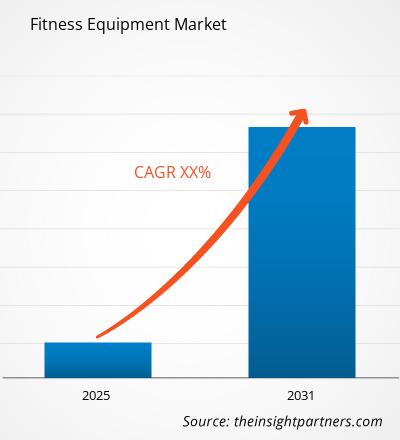
The Fitness Equipment Market is positioned for sustained expansion as consumers, health clubs, and commercial operators prioritize structured physical activity and equipment modernization. The market is valued at US$ 18.61 Billion in 2025 and is projected to reach US$ 30.82 Billion by 2034, advancing at a CAGR of 5.77% during 2026–2034. Demand is increasingly shaped by connected functionality, equipment durability, strength-focused programming, and broader integration of exercise into preventive wellness strategies.
Across North America, Fitness Equipment Market size is supported by mature health-club infrastructure, high household spending capacity, and strong adoption of digitally enabled workout systems. The regional market is estimated to expand at a 5.1–5.6% CAGR during 2026–2034, while replacement demand, commercial facility investment, and rising participation in organized fitness support equipment purchases across residential and institutional settings.
Fitness Equipment Market Assessment and Insights
- North America: North America represents a leading regional market, with a 34–38% share in 2025 and a 5.1–5.6% CAGR between 2026–2034. Mature fitness facilities, replacement cycles, and connected equipment adoption underpin steady expansion.
- US: The US accounts for 72–76% of North American demand in 2025, with a 4.9–5.4% CAGR between 2026–2034, supported by extensive club infrastructure and resilient consumer participation.
- Europe: Europe holds a 26–30% share in 2025 and is expected to grow at a 5.0–5.5% CAGR between 2026–2034. Germany, the UK, France, Italy, and Spain provide substantial demand through commercial fitness and wellness adoption.
- Asia Pacific: Asia Pacific represents a 22–26% share in 2025 and is projected to grow at a 6.3–6.9% CAGR between 2026–2034. China, Japan, South Korea, India, and Australia benefit from urbanization, expanding fitness awareness, and facility development.
- Largest Segment: Cardiovascular Training Equipment holds a 58–62% market share in 2025, with a 5.4–5.9% CAGR during 2026–2034, reflecting broad treadmill and cycling adoption.
- High Growth Segment: Home Consumer represents a 38–42% market share in 2025 and is estimated to grow at a 6.1–6.7% CAGR during 2026–2034, supported by convenient home workouts.
- Key companies analyzed in detail: iFIT Health & Fitness, Inc., Brunswick Corporation, Johnson Health Tech Co., Ltd., Nautilus, Inc., Core Health & Fitness, LLC, TRUE Fitness Technology, Inc., Technogym S.p.A., Amer Sports Corporation, Cybex International, Inc., Matrix Fitness.
Source: The Insight Partners' analysis based on proprietary research, government publications, company annual reports, investor presentations, industry databases, and expert interviews.
From being mechanical devices, machines have evolved into digitally enabled machines having displays, sensors, programming, connectivity, and tracking systems. The competitive advantage that the manufacturers now enjoy comes through superior biomechanics, quieter operations, compact design, superior resistance systems, and serviceability. In commercial buyers, the emphasis is on lifecycle costing, reliability, and effective utilization of the machine, thereby compelling the manufacturers to strike a balance between functionality and materials.
During the forecast period, capital will flow not only in the Western regions but also in the Asia-Pacific and some Middle Eastern countries. Residential development, hospitality developments, corporate wellness programs, and fitness facilities are potential avenues for capturing additional customers. The government focus on fitness and preventive health provides an enabling environment despite the challenges facing manufacturers in terms of import costs, availability of components, energy efficiency, and rising consumer expectations.
Fitness Equipment Market Report Scope
| Report Attribute | Details |
|---|---|
| Market size in 2025 | US$ 18.61 Billion |
| Market Size by 2034 | US$ 30.82 Billion |
| Global CAGR (2026 - 2034) | 5.77% |
| Historical Data | 2021-2024 |
| Forecast period | 2026-2034 |
Fitness Equipment Market Analysis
Factors affecting demand will be reinforced by the ongoing requirement to combat sedentary behavior and provide access to exercise facilities. The Growth Prospects for the Fitness Equipment Market are driven by purchases by households, health club upgrades, hotel and residential fitness centers, and institutional wellness programs. According to the World Health Organization, 31% of the adult population worldwide were not active enough in 2022, showing a considerable behavioral gap that justifies the long-term investments into fitness infrastructure.
The value chain involves components manufacturers, equipment manufacturers, software companies, distributors, fitness centers, personal trainers, and end-users. Changes in supply trends are reinforcing the importance of equipment manufacturers which can integrate motors, electronics, frames, displays, sensors, and software, keeping stable production schedules. The purchasing process is gradually shifting from acquisition cost towards total cost of ownership, especially in case of commercial buyers of equipment en masse.
Competitive positioning depends on the extent of product specialization, geographical location, strength of brands, technology competence, and geographical scope. According to the Fitness Equipment Market report, companies with diverse offerings can cater to both residential and commercial needs, whereas specialists can position themselves using the concepts of biomechanics, connectivity, and strength products. Johnson Health Tech and Matrix Fitness are positioned for commercial equipment, while Technogym is positioned as a premium company offering equipment, digital fitness, and wellness ecosystem services.
The focus of strategic investments is moving from hardware to product personalization, data-enabled training and facility solutions. Revenue of Technogym was more than €1 billion in 2025, proving the level of success that is possible by offering integrated fitness and wellness portfolio. iFIT Health & Fitness, Brunswick Corporation, Nautilus, Core Health & Fitness, TRUE Fitness Technology, Cybex International, and Matrix Fitness offer products for specific equipment category. Amer Sports Corporation offers products in the sporting goods category.
● REPORT CUSTOMIZATION
Tailor This Report To Align With Your Specific Business Requirements
This report can be customized to align precisely with your business objectives, scope, and target markets. Customization options include tailored segmentation, geography, competitive analysis, and strategic insights to support informed decision-making.
Customize This Report →WHAT YOU CAN ADJUST
- ● Segmentations
- ● Geography
- ● Competitive Analysis
- ● Language Preferences
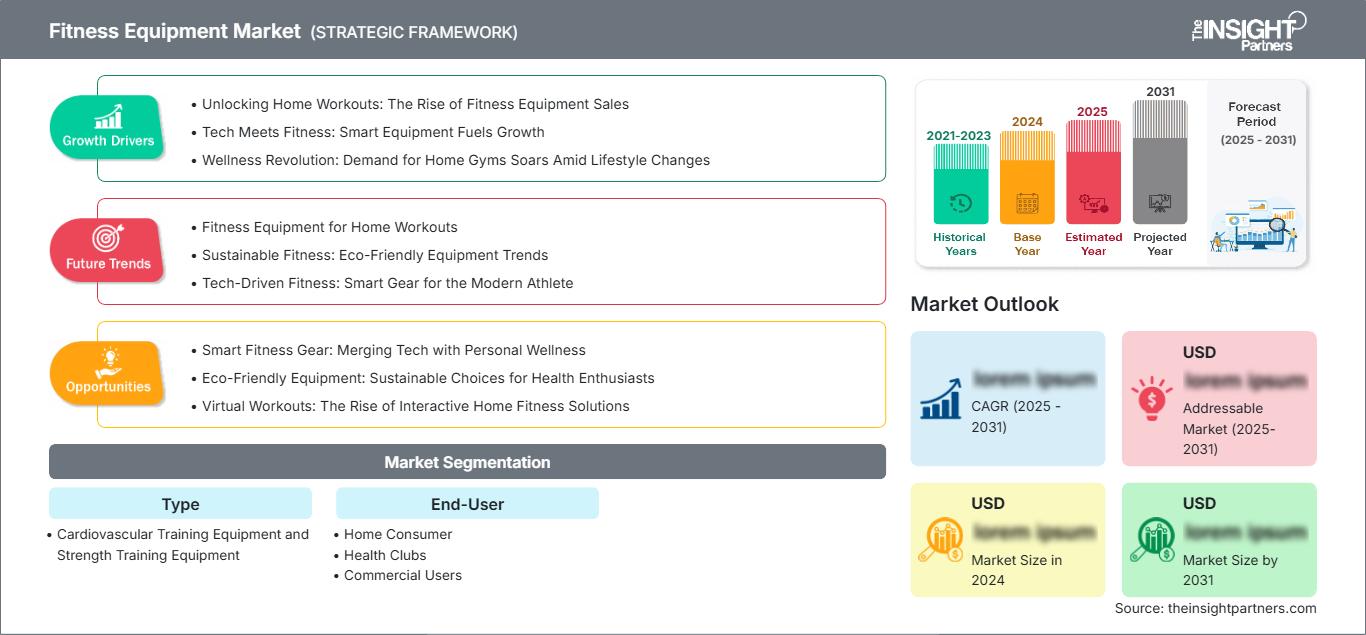
Fitness Equipment Market: Strategic Insights
Regional Insights
North America Fitness Equipment Market
The Fitness Equipment Market Share in North America is projected to command a 34-38% share in 2025 and is expected to grow at a 5.1-5.6% CAGR from 2025 to 2034. The existence of matured commercial facilities, established distribution networks, and need for replacement provides a stable base. Customers want equipment which is convenient and provides tangible workout results.
The ecosystem in the region is also boosted by good club memberships and investments in good facilities. The number of visits at US fitness clubs was above 184,000 per facility in 2025, while the total membership across all the facilities stood at 81 million. This ensures future equipment usage and replacement needs.
U.S. Fitness Equipment Market
US constitutes around 72-76% share of North America’s demand by 2025, and is expected to grow at a CAGR of 4.9-5.4% till 2034. Dense memberships of health clubs, purchasing power of its residents, and development of commercial structure ensure regular change over of equipment. Operators of fitness are now focusing on strength, cardio fitness, user comfort, and connectivity.
Leading brands offer a high level of market penetration through commercial and residential distribution channels. These brands have wide application in such venues as health clubs, hotels, universities, corporate facilities, and even private homes. HFA statistics show that there were 81 million Americans who visited fitness facilities in 2025, which is a 5.2% increase since 2024.
Europe Fitness Equipment Market
Europe is estimated to hold a 26–30% share of the Fitness Equipment Market in 2025 and is forecast to expand at a 5.0–5.5% CAGR through 2034. Germany is the leading country, followed by the UK, France, Italy, and Spain. Demand is shaped by commercial fitness modernization, wellness tourism, residential development, and growing attention to healthy aging.
UK fitness club industry is well-developed with demand for gyms at all levels, from budgetary to high-end studios. Germany is a country that enjoys good physical activities among its citizens and well-established networks of gyms with demands for replacements. French, Italian and Spanish market offers further possibilities with the help of health clubs, hospitality services and urban wellness centers. Europeans are now more concerned about durability, energy consumption and digitization in their equipment choices.
APAC Fitness Equipment Market
APAC is estimated to represent a 22–26% share of the Fitness Equipment Market in 2025 and is expected to record a 6.3–6.9% CAGR through 2034. China is the leading country, with Japan, South Korea, India, and Australia contributing through different demand structures.
China takes advantage of manufacturing depth and increasing fitness equipment, whereas Japan focuses on portable and elderly-friendly equipment. South Korea has high digital fitness equipment adoption, while India has the benefit of urbanization and increasing wellness consciousness. Australia is an advanced commercial fitness market. Physical activity campaigns and investments in gyms, hotels, residential complexes, and corporate health clubs are some of the key factors for equipment growth.
Middle East & Africa Fitness Equipment Market
Middle East and Africa demand will grow at a CAGR of 5.8-6.4% through 2034, with Saudi Arabia being a key market. Hospitality spending, high-end residences and wellness spending by the UAE drives equipment demand, whereas South Africa is an already developed market for commercial fitness.
While Saudi Arabia enjoys diversification programs and lifestyle infrastructure developments, the UAE focuses on tourism, hospitality and wellness. South Africa, on the other hand, features an extensive installation base of gyms and training centers. Other Middle East and Africa will have a more dispersed demand landscape, although it will develop along with urbanization, hotels and energy sector communities offering fitness facilities.
Segmentation Analysis
Type
Type segmentation demonstrates continued demand for both cardiovascular and strength-oriented equipment. The category is expected to expand at a 5.4–5.9% CAGR during 2026–2034. Cardiovascular systems retain broad applicability across homes and facilities, while strength equipment benefits from changing training preferences and greater emphasis on resistance-based exercise.
- Cardiovascular Training Equipment: Treadmills, elliptical systems, stationary cycles, and related machines remain central to facility floors and home workouts. Their familiarity, measurable performance metrics, and broad user suitability maintain strong procurement relevance.
- Strength Training Equipment: Selectorized machines, racks, benches, and resistance systems benefit from increasing emphasis on strength, functional training, muscle development, and structured programming across commercial and residential environments.
End-User
End-User demand is projected to grow at a 5.9–6.4% CAGR during 2026–2034. Home Consumer demand is increasingly influenced by convenience and space-efficient equipment, while health clubs and commercial users prioritize utilization, durability, serviceability, and differentiated member experiences. The Fitness Equipment Market scope therefore spans several purchasing models with distinct replacement cycles.
- Home Consumer: Residential users favor compact, connected, easy-to-maintain equipment supporting flexible exercise schedules. Product selection increasingly reflects available space, digital guidance, financing options, and the ability to perform multiple workout modes.
- Health Clubs: Clubs prioritize high-throughput equipment, durability, ergonomics, and reliable service support. Procurement decisions increasingly incorporate member expectations, floor utilization, equipment aesthetics, and integration with digital engagement platforms.
- Commercial Users: Hotels, corporations, universities, hospitals, sports facilities, and residential developments require equipment suited to diverse users. Buyers emphasize lifecycle economics, standardized fleets, maintenance coverage, and space-efficient deployment.
Opportunity Snapshot
| Segment Name | Revenue Contribution (High/Medium/Low) | Trend Tag | Adoption Stage |
|---|---|---|---|
| Home Consumer | High | Home Training | Scaling |
| Health Clubs | High | Club Refresh | Mature |
| Commercial Users | Medium | Wellness Amenities | Scaling |
Fitness Equipment Market Growth Drivers and Impact Analysis
Rising Fitness Participation and Preventive Wellness Spending
Increasing attention to preventive health is expanding the economic rationale for exercise equipment beyond traditional gyms. WHO identifies physical inactivity as a major public-health concern and estimates that inadequate physical activity could create about US$300 billion in healthcare costs between 2020 and 2030 if reductions are not achieved. This creates opportunities for equipment manufacturers to address consumers, employers, healthcare-linked wellness programs, and community facilities. The market impact extends beyond unit sales because purchasers increasingly seek equipment that supports measurable adherence and repeat engagement. Commercial operators can justify refurbishment when improved equipment contributes to member retention, while residential buyers increasingly treat exercise machines as long-term wellness assets rather than discretionary recreation products.
Expansion of Commercial Fitness Infrastructure
The commercial fitness ecosystem is generating a sustained replacement and capacity-expansion cycle for manufacturers. US facility visitation increased 4.2% in 2025, with the industry maintaining a record sequence of quarterly traffic growth. Higher utilization increases wear on treadmills, bikes, resistance machines, flooring interfaces, displays, and mechanical components, creating recurring replacement requirements. Operators also use equipment refreshes to differentiate facilities and respond to changing training preferences. The resulting demand favors suppliers capable of delivering complete equipment packages, installation support, spare parts, service contracts, and software integration. Internationally, new clubs, hospitality fitness centers, residential developments, and corporate wellness spaces broaden the addressable customer base, particularly where organized exercise participation remains below mature-market levels.
Technological Integration Raises Equipment Value Per Installation
Connected consoles, sensors, digital programming, biometric interfaces, and software platforms are increasing the functional value of individual machines. Rather than competing solely on mechanical specifications, manufacturers can use technology to improve personalization, tracking, coaching, asset management, and user engagement. This transition changes procurement criteria because operators can assess equipment through utilization data and service performance as well as physical durability. For consumers, digital guidance can reduce the knowledge barrier associated with independent training. For commercial buyers, connected fleets can provide visibility into usage and maintenance requirements. The resulting shift supports premiumization in selected categories while also creating opportunities for modular equipment that can receive software upgrades without full hardware replacement.
Fitness Equipment Market Future Trends
Connected Training Will Move Toward Outcome-Based Personalization
Fitness Equipment Market trends are likely to progress from basic connectivity toward systems that translate user data into adaptive training recommendations. Future platforms may combine workout history, heart-rate information, body-composition measurements, movement quality, and equipment utilization to personalize sessions. The commercial value will depend less on the number of sensors and more on whether insights produce understandable actions for users and trainers. Equipment makers can strengthen differentiation through interoperable platforms rather than closed ecosystems, allowing operators to preserve existing hardware while adding new digital capabilities. Partnerships between equipment manufacturers, measurement specialists, wellness providers, and software companies are therefore likely to increase. The resulting model could make equipment a recurring service interface, supporting subscriptions, analytics, remote support, and individualized programming without changing the underlying machine frequently.
Strength Training Will Influence Product Mix Across User Groups
Strength-focused programming is likely to reshape equipment portfolios across homes, clubs, hotels, and institutional facilities. Consumers increasingly recognize resistance training as complementary to cardiovascular exercise, while operators use strength zones to accommodate varied goals ranging from muscle development to functional fitness. Manufacturers can respond by expanding selectorized systems, plate-loaded stations, adjustable equipment, racks, and compact multi-function solutions. Design priorities will increasingly include biomechanics, intuitive adjustment, safety, storage efficiency, and accessibility for different experience levels. Commercial facilities may allocate more floor space to flexible strength configurations, while residential products can combine multiple movements within smaller footprints. This shift should benefit suppliers capable of balancing professional-grade durability with approachable interfaces, creating a broader customer base without relying exclusively on traditional gym formats.
Fitness Equipment Market Opportunities
Integrated Wellness Solutions for Hospitality and Residential Projects
Developers of hotels, serviced residences, apartments, senior-living communities, and mixed-use properties represent an attractive opportunity for equipment suppliers seeking larger project-based contracts. Fitness rooms are increasingly positioned as amenities that influence tenant and guest experience, creating demand for visually coordinated, compact, and reliable equipment packages. Suppliers can capture additional value by offering design consultation, installation, maintenance, digital programming, and replacement planning as a bundled service. The opportunity is particularly relevant in fast-growing urban centers where developers compete through wellness-oriented amenities. Fitness Equipment Market Forecasts should therefore consider project-based procurement alongside conventional retail and club replacement demand. Manufacturers with international distribution networks and standardized product platforms can potentially reduce deployment complexity while adapting equipment mixes to property size, user demographics, and expected utilization.
Data-Enabled Equipment Services and Lifecycle Management
Manufacturers can expand revenue opportunities by developing services around equipment monitoring, maintenance, utilization analysis, and replacement planning. Connected machines provide information that can help operators identify underused assets, anticipate servicing requirements, and evaluate floor productivity. This creates potential for subscription-based analytics, remote diagnostics, software upgrades, and predictive maintenance contracts. Suppliers can also use aggregated operational data to refine product design and identify demand differences between facility formats. For large operators, lifecycle services can reduce downtime and simplify equipment fleet management, strengthening the case for standardized procurement. Smaller facilities may benefit from outsourced maintenance and performance reporting that previously required dedicated technical resources. Investment in secure data architecture and interoperable systems will be important as manufacturers seek to build durable relationships beyond the initial hardware transaction.
Recent Developments
- April 2026: Technogym S.p.A. published its Q1 2026 revenue materials, continuing its reporting cycle following 2025, when consolidated revenue exceeded €1 billion. The disclosure reinforces Technogym’s ongoing emphasis on integrated wellness, international operations, and technology-supported fitness solutions as part of its product and service strategy.
- February 2026: Johnson Health Tech Co., Ltd. / Matrix Fitness announced a strategic partnership with seca to develop an integrated solution combining medical-grade body-composition measurement with AI-driven training programming. The companies planned to showcase the solution at major industry events in 2026, reflecting increasing convergence between fitness equipment, measurement, personalization, and health-oriented training.
- March 2026: Amer Sports Corporation published its fiscal 2025 annual report, outlining progress across its sporting-goods portfolio and reporting continued strategic execution following its first full year as a public company. The company highlighted direct-to-consumer expansion and sustainability initiatives, relevant indicators of broader channel and product strategy across sports-related categories.
Frequently Asked Questions

- Comprehensive Market Sizing and Forecast Analysis
- Detailed Segmentation Analysis
- In-Depth Market Dynamics Assessment
- Regional and Country-Level Insights
- Competitive Landscape and Company Benchmarking
- Strategic Business Intelligence
Recent Reports
Testimonials

The Insight Partners' SCADA System Market report is comprehensive, with valuable insights on current trends and future forecasts. The team was highly professional, responsive, and supportive throughout. We are very satisfied and highly recommend their services.
RAN KEDEM Partner, Reali Technologies LTDs
I requested a report on a very specific software market and the team produced the report in a few days. The information was very relevant and well presented. I then requested some changes and additions to the report. The team was again very responsive and I got the final report in less than a week.
JEAN-HERVE JENN Chairman, Future Analytica
We worked with The Insight Partners for an important market study and forecast. They gave us clear insights into opportunities and risks, which helped shape our plans. Their research was easy to use and based on solid data. It helped us make smart, confident decisions. We highly recommend them.
PIYUSH NAGPAL Sr. Vice President, High Beam Global
The Insight Partners delivered insightful, well-structured market research with strong domain expertise. Their team was professional and responsive throughout. The user-friendly website made accessing industry reports seamless. We highly recommend them for reliable, high-quality research services
YUKIHIKO ADACHI CEO, Deep Blue, LLC.
This is the first time I have purchased a market report from The Insight Partners.While I was unsure at first, I visited their web site and felt more comfortable to take the risk and purchase a market report.I am completely satisfied with the quality of the report and customer service. I had several questions and comments with the initial report, but after a couple of dialogs over email with their analyst I believe I have a report that I can use as input to our strategic planning process.Thank you so much for taking the extra time and making this a positive experience.I will definitely recommend your service to others and you will be my first call when we need further market data.
JOHN SUZUKI President and Chief Executive Officer, Board Director, BK Technologies
I wish to appreciate your support and the professionalism you displayed in the course of attending to my request for information regarding to infectious disease IVD market in Nigeria. I appreciate your patience, your guidance, and the fact that you were willing to offer a discount, which eventually made it possible for us to close a deal. I look forward to engaging The Insight Partners in the future, all thanks to the impression you have created in me as a result of this first encounter.
DR CHIJIOKE ONYIA MANAGING DIRECTOR, PineCrest Healthcare Ltd.Reason to Buy
- Informed Decision-Making
- Understanding Market Dynamics
- Competitive Analysis
- Identifying Emerging Markets
- Customer Insights
- Market Forecasts
- Risk Mitigation
- Boosting Operational Efficiency
- Strategic Planning
- Investment Justification
- Tracking Industry Innovations
- Aligning with Regulatory Trends





 Get Free Sample for