
Food and Beverage Packaging Robots Market Size, Growth & Trends by 2034
Coverage: by Food Products (Bakery, Confectionery, Snacks, Beverages, Others); Application (Primary Packaging, Secondary Packaging, Paletizing-Depalletizing, Others) , and Geography (North America, Europe, Asia Pacific, and South and Central America)
- Status : Data Released
- Report Code : TIPRE00005605
- Category : Electronics and Semiconductor
- No. of Pages : 150
- Available Report Formats :


- Last update date : September 10, 2026


2025 Market Size
US$ 133.24 Mn
Base year value
2034 Forecast
US$ 183.08 Mn
Projected by 2034
CAGR 2026-2034
3.59 %
Growth rate
Addressable Market
US$ 1,436.37 Mn
(2026-2034)
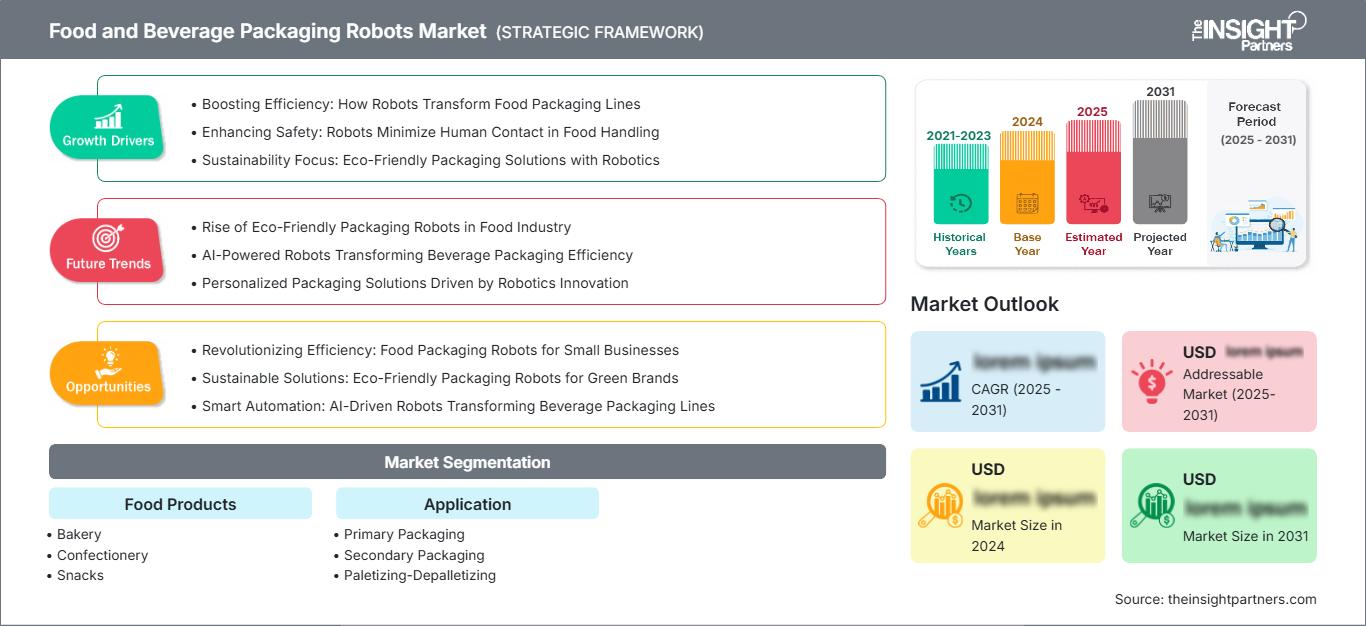
The global Food and Beverage Packaging Robots market was valued at US$ 133.24 million in 2025 and is expected to reach US$ 183.08 million by 2034; it is estimated to record a CAGR of 3.59% during 2026-2034.
Food and Beverage Packaging Robots Market Assessment and Insights
- North America: Accounted for 31–34% share in 2025 and is modeled to grow at a 3.8–4.3% CAGR between 2026–2034, supported by line modernization, labor availability pressures, and established integrator networks.
- US: Represented 79–82% of North American revenue in 2025, with a modeled 3.9–4.4% CAGR between 2026–2034 as producers automate mixed-SKU packaging.
- Europe: Held 27–30% share in 2025 and is modeled at 3.5–4.0% CAGR between 2026–2034, led by Germany, the UK, France, Italy, and Spain.
- Asia Pacific: Captured 29–32% share in 2025 and is modeled at 4.7–5.2% CAGR between 2026–2034, with China, Japan, India, and South Korea driving capacity additions.
- Largest Segment: Palletizing-Depalletizing held 38–42% market share in 2025 and is modeled to expand at 3.6–4.1% CAGR during 2026–2034.
- High Growth Segment: Primary Packaging represented 28–32% market share in 2025 and is modeled to grow at 4.6–5.1% CAGR during 2026–2034.
- Key companies analyzed in detail: ABB Ltd., Brenton Engineering Company, FANUC Corporation, Kawasaki Heavy Industries, Ltd., KUKA AG, Remtec Automation, LLC, Robert Bosch GmbH, Soft Robotics Inc., Universal Robots A/S, and Yaskawa America, Inc.
Source: The Insight Partners' analysis based on proprietary research, government publications, company annual reports, investor presentations, industry databases, and expert interviews.
The evolution of robotic packaging technology has been towards connected platforms with machine vision, hygienic components, adaptive gripping, digital twin technologies, and easy programming. The food companies have now started demanding flexibility in systems, which would be able to change among different packs without losing the speed of the process and keeping traceability. Delta robots continue playing an important role in picking products quickly and using articulating robots for handling cases; collaborative robots allow for automation of limited space brownfield facilities.
Until 2034, investments will not only continue in North America, Europe, and Japan but will expand into China, India, Southeast Asia, and some Gulf countries processing centers. These investments will be made into modular cells, allowing less time for engineering and providing a way for the expansion of the facility in a step-by-step manner. The demands from consumers regarding food safety, mechanical safety of machinery, packaging waste regulations, and shelf-ready products demanded by retailers will further drive adoption, while finance discipline will help to stick to tangible results.
Food and Beverage Packaging Robots Market Report Scope
| Report Attribute | Details |
|---|---|
| Market size in 2025 | US$ 133.24 Million |
| Market Size by 2034 | US$ 183.08 Million |
| Global CAGR (2026 - 2034) | 3.59% |
| Historical Data | 2021-2024 |
| Forecast period | 2026-2034 |
Food and Beverage Packaging Robots Market Analysis
Some of the elements that contribute towards growth of F Food and Beverage Packaging Robots Market comprise labor shortage, stringent hygiene, SKU proliferation, and need for balanced production rate during more than one shift. The value chain participants consist of robot manufacturers, EOAT, vision system players, control system suppliers, integrators, packaging equipment suppliers, processors, and service providers. The demand for robots is highly visible in scenarios where repetitive picking up and placing operations cause ergonomic problems.
Increasing supply side efficiencies include use of standard palletizing stations, food safe cobots, modular grippers and simulation software, which are lowering the need for application engineering. Nevertheless, integrator capacity, validation efforts, need for washdown, and qualified maintenance personnel limit the use of robotics in packaging. Buying decisions include considerations of total cell availability, changeover times, availability of replacement parts, energy consumption and suitability with conveyor systems, wrapping equipment, case packers, warehouse and enterprise software.
The Food and Beverage Packaging Robots Market Report reflects a fragmented competition across global robot platforms and specialized cell engineering. ABB Ltd., FANUC Corporation, Kawasaki Heavy Industries, Ltd., KUKA AG, Universal Robots A/S, and Yaskawa America, Inc. offer competition in terms of platform breadth, controllers, safety features, payloads, and service network. Brenton Engineering Company and Remtec Automation, LLC rely on their application engineering and packaged robots cells for competition.
Investment is shifting towards software-based flexibility and not arm changeover. Robert Bosch GmbH offers packaging and automation capability. Meanwhile, Soft Robotics Inc. focuses on handling irregular and delicate foods with adaptive tooling. Effective positioning has become critical with validation of hygienic designs, remote diagnostics, digital commissioning and collaboration with packaging original equipment manufacturers (OEMs). Those vendors which can speed up commissioning process and provide documentation of performance will gain the budget of midsize processors.
● REPORT CUSTOMIZATION
Tailor This Report To Align With Your Specific Business Requirements
This report can be customized to align precisely with your business objectives, scope, and target markets. Customization options include tailored segmentation, geography, competitive analysis, and strategic insights to support informed decision-making.
Customize This Report →WHAT YOU CAN ADJUST
- ● Segmentations
- ● Geography
- ● Competitive Analysis
- ● Language Preferences
Food and Beverage Packaging Robots Market: Strategic Insights
Regional Insights
North America Food and Beverage Packaging Robots Market
North America occupied an estimated 31–34% Food and Beverage Packaging Robots Market share in 2025 and is projected to grow at 3.8–4.3% CAGR between 2026 and 2034. The adoption drivers include the advanced packaging of food and beverages, the extensive integration of warehouses and the need to get employees out of manual loading of products. The 21% growth in food and beverage robot installations in 2024 recorded by the US underlines the region’s potential.
Canadian companies dealing with the packaging of beverages, bakery products and proteins drive the demand for flexible palletizing and secondary packaging while Mexican businesses leverage export manufacturing and nearshoring. Customers prefer modular systems that work with conveyor and case packer equipment. Service density in the region, locally made robots and machine makers reduce implementation risks although capital budgeting depends on payback and uptime guarantees.
U.S. Food and Beverage Packaging Robots Market
The US captured 79-82% of North American revenue in 2025 and is projected to increase with a CAGR of 3.9-4.4% from 2025 through 2034. Beverage bottlers, snack manufacturers, bakery and contract packers deploy robots to help standardize production despite the frequent change of formats. Applications include primary picking, cartoning, case packing, palletizing and depalletizing, while collaborative robotics cells continue to be deployed in cases of space constraints.
Leading companies such as ABB Ltd., FANUC Corporation, KUKA AG, Universal Robots A/S, and Yaskawa America, Inc. enjoy extensive commercial presence, augmented by integrators like Brenton Engineering Company and Remtec Automation, LLC. Domestic demand focuses on vision guidance and operator-friendly interfaces in addition to increased emphasis on product traceability. An increasing installation base creates more opportunities for replacement of tooling components, software updates, preventive maintenance and redeployment of robotic cells for different products.
Europe Food and Beverage Packaging Robots Market
Europe was accounted for a modeled 27–30% share in 2025, and it is projected to show a CAGR of 3.5–4.0% during 2026-2034. Germany dominates due to its excellence in machinery engineering, integrators and automated machinery intensiveness. The United Kingdom invests in labor-saving cells at end-of-line in bakery, beverages, prepared foods, and fulfillment processes due to flexibility in pack programming.
France is a combination of big food groups and regional processors that employ hygienic picking and case packing processes. Italy gains advantage due to its packaging machinery expertise, along with export-oriented system builders. Spain is known for beverage, fresh produce, and snacks operations that have a seasonal automation process. Packaging waste legislation in Europe boosts equipment that can work with light and redesigned packaging.
APAC Food and Beverage Packaging Robots Market
The Asia Pacific had a projected market share of 29–32% in 2025 and is expected to expand at 4.7–5.2% CAGR from 2026 to 2034. The leadership of Asia Pacific will be dominated by China because of manufacturing and increase in packaging of food products; Japan and South Korea bring advanced robotics technology; and India brings greenfield investments in food processing and beverages.
The higher labor cost in Australia makes palletizing and collaborative cells more favorable. In general, regional trends like industrialization projects, export demands, increased demand for convenient foods, and denser cold chains will drive growth in adoption.
Middle East & Africa Food and Beverage Packaging Robots Market
The Middle East and Africa region is expected to grow at 3.3%-3.8% CAGR in 2026-2034. Saudi Arabia takes the lead due to food security initiatives and diversification efforts into industries where local processing is encouraged, while the UAE is known for its advanced infrastructure for beverages, dairy, logistics, and re-export activities.
South Africa has the most entrenched manufacturing capabilities for food within the region, while Rest of MEA presents a select few project opportunities around bottling and staples. Availability of energy sources, equipment prices, expertise, and services are critical criteria here, hence making end-of-line systems available as opposed to packaging lines.
Segmentation Analysis
Food Products
The Food Products segment is modeled to expand at 3.9–4.4% CAGR during 2026–2034. The Food and Beverage Packaging Robots Market scope spans high-speed confectionery picking, delicate bakery handling, variable snack packs, and beverage case movement. Adoption depends on product fragility, sanitation, line rate, pack geometry, temperature, and changeover frequency. Flexible vision and gripping increasingly determine whether one cell can serve multiple products.
- Bakery: Delicate surfaces and variable dimensions favor soft gripping, vision-guided placement, and rapid recipe changes, positioning bakery lines as important proving grounds for flexible primary and secondary packaging.
- Confectionery: High throughput, precise orientation, and seasonal assortment changes support delta robots and integrated inspection, helping manufacturers protect product appearance while reconfiguring formats efficiently.
- Snacks: Fast bagging lines generate sustained demand for case packing and palletizing, with robots valued for continuous operation, mixed case patterns, and reduced ergonomic exposure.
- Beverages: Heavy repetitive cases, trays, bottles, and multipacks make beverage operations strategically significant for palletizing, depalletizing, and secondary handling integrated with warehouse flows.
Application
The Application segment is modeled to grow at 4.1–4.6% CAGR during 2026–2034. Deployment economics differ by proximity to exposed product, required speed, payload, hygiene, and line complexity. Primary packaging offers faster technical innovation, secondary packaging balances flexibility and throughput, and palletizing-depalletizing provides the broadest established return case. Modular cells increasingly allow processors to automate one bottleneck before expanding across the packaging chain.
- Primary Packaging: Direct or near-product handling requires hygienic design, food-compatible materials, precise vision, and gentle gripping, making qualification demanding but strategically important for flexible, high-mix production.
- Secondary Packaging: Cartoning, tray loading, and case packing support repeatable quality and shelf-ready formats, with strong demand for systems that absorb SKU changes without lengthy mechanical adjustment.
- Paletizing-Depalletizing: End-of-line load handling remains the largest application because clear ergonomics, standardized cases, and measurable labor savings support investment across both large and mid-sized plants.
Opportunity Snapshot
| Application | Revenue Contribution | Trend Tag | Adoption Stage |
| Primary Packaging | Medium | Hygienic Picking | Scaling |
| Secondary Packaging | Medium | Format Flexibility | Scaling |
| Paletizing-Depalletizing | High | End-Line | Mature |
Food and Beverage Packaging Robots Market Growth Drivers and Impact Analysis
Persistent Labor Constraints and Ergonomic Risk
Packaging lines depend on repetitive picking, case lifting, stacking, and unloading, tasks that are difficult to staff consistently across shifts. Robotic cells convert these constraints into an investment case based on stable cycle time, reduced injury exposure, and better allocation of skilled operators. The strongest impact occurs in palletizing, where load geometry is predictable and ergonomic benefits are easily measured. Collaborative cells extend the addressable base to smaller plants because they can fit constrained layouts and simplify redeployment. Evidence that US food and beverage robot installations increased 21% in 2024 indicates that labor and productivity pressures are already translating into purchasing. Suppliers that quantify uptime, staffing changes, and payback earn faster approvals.
SKU Proliferation Requires Flexible Packaging Lines
Food and beverage portfolios continue to fragment across pack sizes, flavors, promotional bundles, private labels, and channel-specific formats. Fixed automation can become a bottleneck when mechanical changeovers consume production time or require specialist intervention. Robots combined with machine vision, recipe-based controls, and interchangeable grippers allow plants to accommodate variation with less hardware. The market impact extends beyond faster changeover: processors can schedule shorter runs, reduce work-in-process, and respond to retailer orders without dedicating a line to each format. Vendors are consequently redesigning offerings around reusable software libraries, digital commissioning, and parameterized pallet patterns. Systems that preserve throughput while switching products will command priority in high-mix bakery, confectionery, snack, and beverage facilities.
Hygiene, Traceability, and Consistency Requirements
Food-safety programs reward equipment that delivers repeatable handling, cleanable surfaces, controlled contact, and documented process parameters. Food-grade lubricants, corrosion-resistant finishes, sealed joints, and washdown ratings broaden robotic use near unpackaged products. FANUC’s 2025 LR Mate/10-11A Food/Clean launch, for example, combined food-grade lubricant, IP67 protection, and a hygienic surface design, illustrating how suppliers translate compliance needs into product architecture. Integration with vision and plant data also supports inspection, reject tracking, and batch traceability. The market impact is a shift from evaluating robot speed alone toward validating the complete cell, including tooling, cables, guarding, cleaning access, and software. Vendors with documented hygienic design and application testing reduce qualification risk.
Food and Beverage Packaging Robots Market Future Trends
AI-Enabled Vision and Adaptive Handling
Food and Beverage Packaging Robots Market trends will increasingly center on vision models that identify orientation, defects, overlap, and variable shapes in real time. Adaptive grippers will complement these systems by handling fragile bakery items, confectionery, produce, and flexible packs without dedicated tooling for every SKU. Future cells should combine perception, motion planning, and quality data to adjust picks automatically rather than stopping for manual retuning. This direction can reduce product damage, improve yield, and broaden automation where incoming items are irregular. Commercial success will depend on validated performance, explainable rejection logic, cybersecurity, and operator interfaces that convert advanced algorithms into maintainable plant-floor workflows.
Convergence of Robotics and Autonomous Intralogistics
Packaging robots will connect more closely with autonomous mobile robots, warehouse management systems, and production scheduling. Instead of ending at a fixed pallet station, future cells can coordinate empty-pallet delivery, finished-load removal, stretch wrapping, labeling, and storage assignment. ABB already positions autonomous mobile robots for food and beverage flows from packaging to storage, signaling platform convergence. For processors, the value lies in reducing forklift traffic, queueing, and production interruptions while improving load traceability. Adoption will begin in greenfield and high-volume facilities, then migrate to brownfield plants through modular interfaces. Shared fleet orchestration and safety standards will become important purchasing criteria.
Food and Beverage Packaging Robots Market Opportunities
Standardized Cells for Mid-Sized Processors
Mid-sized producers often have suitable applications but lack internal robotics engineers and cannot absorb long custom-integration cycles. Suppliers can address this gap with pre-engineered palletizing, case-packing, and pick-and-place cells configured through selectable payloads, grippers, guarding, and software templates. Investment should focus on remote commissioning, simulation-based acceptance, operator training, and transparent service packages. Leasing or outcome-linked financing could further lower adoption barriers where capital budgets are constrained. The opportunity is commercially attractive because standardized architectures shorten sales-to-installation time and create recurring revenue through spare parts, preventive maintenance, upgrades, and redeployment. Integrator partnerships remain essential for local application validation and after-sales response.
Brownfield Modernization and Lifecycle Services
Most packaging capacity through 2034 will remain in existing plants, creating a sizeable opportunity to retrofit robots around installed conveyors, wrappers, fillers, and case packers. Vendors should develop compact cells, offline programming, standardized communications, and phased shutdown plans that limit production disruption. Lifecycle offerings can include robot health monitoring, gripper refurbishment, safety updates, software migration, and pallet-pattern changes. The Food and Beverage Packaging Robots Market Forecast opportunity extends beyond new equipment because aging controls and discontinued components increase obsolescence risk. Providers that map interfaces before installation and guarantee critical spares can differentiate on operational continuity. Partnerships with packaging-machine OEMs can produce validated retrofit kits for common line architectures and accelerate repeat deployments.
Recent Developments
- April 2026: Chef Robotics has introduced a new application that uses its physical AI-powered robots to automate the packing of fresh produce. The technology is designed to assemble trays and packages containing items such as oranges, apples, pears and kiwis, while also handling scoopable foods such as corn and peas.
- November 2025: Tetra Pak has launched Tetra Pak Factory OS, a new automation and digitalisation platform designed to help food and beverage manufacturers build smarter, more connected and AI-ready factories. The company unveiled the platform on November 4, 2025, at Gulfood Manufacturing in Dubai. Factory OS combines factory automation, data integration and digital applications to provide manufacturers with a unified, real-time view of their operations.
- December 2025: LeafyPack is expanding its cannabis packaging automation portfolio with new robotics, artificial intelligence and machine-vision technologies. The company says the new systems are designed to reduce dependence on manual labor while improving speed, consistency and quality throughout packaging operations.
Frequently Asked Questions

- Comprehensive Market Sizing and Forecast Analysis
- Detailed Segmentation Analysis
- In-Depth Market Dynamics Assessment
- Regional and Country-Level Insights
- Competitive Landscape and Company Benchmarking
- Strategic Business Intelligence
Recent Reports
Testimonials

The Insight Partners' SCADA System Market report is comprehensive, with valuable insights on current trends and future forecasts. The team was highly professional, responsive, and supportive throughout. We are very satisfied and highly recommend their services.
RAN KEDEM Partner, Reali Technologies LTDs
I requested a report on a very specific software market and the team produced the report in a few days. The information was very relevant and well presented. I then requested some changes and additions to the report. The team was again very responsive and I got the final report in less than a week.
JEAN-HERVE JENN Chairman, Future Analytica
We worked with The Insight Partners for an important market study and forecast. They gave us clear insights into opportunities and risks, which helped shape our plans. Their research was easy to use and based on solid data. It helped us make smart, confident decisions. We highly recommend them.
PIYUSH NAGPAL Sr. Vice President, High Beam Global
The Insight Partners delivered insightful, well-structured market research with strong domain expertise. Their team was professional and responsive throughout. The user-friendly website made accessing industry reports seamless. We highly recommend them for reliable, high-quality research services
YUKIHIKO ADACHI CEO, Deep Blue, LLC.
This is the first time I have purchased a market report from The Insight Partners.While I was unsure at first, I visited their web site and felt more comfortable to take the risk and purchase a market report.I am completely satisfied with the quality of the report and customer service. I had several questions and comments with the initial report, but after a couple of dialogs over email with their analyst I believe I have a report that I can use as input to our strategic planning process.Thank you so much for taking the extra time and making this a positive experience.I will definitely recommend your service to others and you will be my first call when we need further market data.
JOHN SUZUKI President and Chief Executive Officer, Board Director, BK Technologies
I wish to appreciate your support and the professionalism you displayed in the course of attending to my request for information regarding to infectious disease IVD market in Nigeria. I appreciate your patience, your guidance, and the fact that you were willing to offer a discount, which eventually made it possible for us to close a deal. I look forward to engaging The Insight Partners in the future, all thanks to the impression you have created in me as a result of this first encounter.
DR CHIJIOKE ONYIA MANAGING DIRECTOR, PineCrest Healthcare Ltd.Reason to Buy
- Informed Decision-Making
- Understanding Market Dynamics
- Competitive Analysis
- Identifying Emerging Markets
- Customer Insights
- Market Forecasts
- Risk Mitigation
- Boosting Operational Efficiency
- Strategic Planning
- Investment Justification
- Tracking Industry Innovations
- Aligning with Regulatory Trends





 Get Free Sample for