
FRAM Market Trends, Size & Forecast by 2034
Coverage: By Product Type (4K, 6.18K, 16K, 32K, 64K, 128K, 256K, 512K, Others); Interface (Serial, Parallel); Application (Metering/Measurement, Enterprise Storage, Automotive, Factory Automation, Telecommunication, Medical, Others), and Geography (North America, Europe, Asia Pacific, and South and Central America)
- Status : Data Released
- Report Code : TIPRE00017725
- Category : Electronics and Semiconductor
- No. of Pages : 150
- Available Report Formats :


- Last update date : August 17, 2026


2025 Market Size
US$ 539.00 Mn
Base year value
2034 Forecast
US$ 1,377.00 Mn
Projected by 2034
CAGR 2026-2034
10.98 %
Growth rate
Addressable Market
US$ 8,465.49 Mn
(2026-2034)
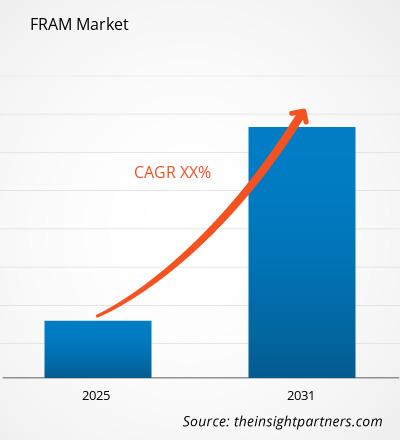
The FRAM market revenue is projected to advance from US$ 539.00 Million in 2025 to US$ 1,377.00 Million by 2034, representing a CAGR of 10.98% during 2026–2034. The increase can be attributed to growing use of nonvolatile ferroelectric memories in applications that need fast writing speed, low power usage, endurance capability, and data retention capabilities in industrial, automotive, metering, telecom, enterprise storage, and medical settings.
Projected growth rate for the North American FRAM market size is estimated to grow at a modeled 10.4% to 11.0% CAGR up to 2034. Underlying drivers for the market include smart metering, automotive electronics, industrial controls, and medical devices, where frequent writes and fail-safe power are key. Existing semiconductor design infrastructure, automotive qualification, and upgrading of electrical and manufacturing infrastructure facilitate continued switch from EEPROM and SRAM.
FRAM Market Assessment and Insights
- North America: Modelled share in 2025 is 32–35%, with CAGR between 2026–2034 at 10.4–11.0%, supported by automotive qualification, advanced metering infrastructure, industrial automation, and a concentrated embedded-system design base.
- US: The country represents 78–82% of North American demand in 2025 and is growing at a 10.5–11.1% CAGR through 2034.
- Europe: Modelled share in 2025 is 24–27%, with CAGR between 2026–2034 at 9.6–10.2%; Germany leads, while the UK, France, Italy, and Spain sustain industrial and metering demand.
- Asia Pacific: Modelled share in 2025 is 34–38%, with CAGR between 2026–2034 at 11.8–12.6%; China leads volume, while Japan and South Korea contribute advanced semiconductor and automotive capability.
- Largest Segment: Serial interfaces hold a modelled 68–72% market share in 2025 and expand at a 10.6–11.2% CAGR through 2034.
- High Growth Segment: Automotive applications hold a modelled 18–22% market share in 2025 and expand at a 12.4–13.2% CAGR through 2034.
- Key companies analyzed in detail: Infineon Technologies AG, Everspin Technologies, Inc., Fujitsu Limited, Future Electronics Inc., ROHM Co., Ltd., Symetrix Corporation, Texas Instruments Incorporated, Toshiba Corporation, LAPIS Technology Co., Ltd., and Cypress Semiconductor Corporation.
Source: The Insight Partners' analysis based on proprietary research, government publications, company annual reports, investor presentations, industry databases, and expert interviews.
Commercial FRAM has moved on from kilobit stand-alone devices to embedded and denser devices designed specifically for deterministic persistence. Advances have included process integration, small packaging and serial busses which made design easier, wafer fabrication that allowed better yields for special ferroelectric layers, along with suppliers offering memory, microcontroller products, reference designs and qualification assistance. Design and production concentration is required as the use of ferroelectric materials, endurance qualification, and automotive qualifications require specific knowledge. Distribution is the driver for increased availability for industrial and medical design companies.
Up through 2034, there will be investment in edge devices, software-defined cars, smart grids and resilient infrastructure. There should be additional manufacturing in Asia Pacific but the design centers will remain in North America and Europe. Rules for energy efficiency, grid digitalization and functional safety will make the case for low power persistent memory more obvious. Suppliers with qualified capacity, lifecycle and firmware ecosystem advantages will have preferred supplier status due to costly redesign cycles.
FRAM Market Report Scope
| Report Attribute | Details |
|---|---|
| Market size in 2025 | US$ 539.00 Million |
| Market Size by 2034 | US$ 1,377.00 Million |
| Global CAGR (2026 - 2034) | 10.98% |
| Historical Data | 2021-2024 |
| Forecast period | 2026-2034 |
FRAM Market Analysis
The FRAM market growth is being fueled by devices which continuously record data but cannot allow for erase delay of flash, high write energy consumption, or low endurance levels. Smart meters, programmable controls, battery-operated sensors, and vehicle control modules gain advantages from fast and byte-level writes as well as power-loss retention. The industry includes ferroelectric materials, specialty foundries, memory designers, microcontroller makers, distribution firms, firmware makers, and OEMs.
The supply dynamics stay very specialized and not commoditized. Qualified ferroelectric manufacturing process, long endurance testing, and special temperature requirements prevent any fast scaling of capacity. Serial devices prevail since SPI-compatible architectures are much simpler to integrate on the board while parallel ones work in latency-sensitive legacy systems. The long lifetime of products and second-sourcing considerations affect the purchasing behavior especially in factory automation, medical equipment, and metering programs which are used for over ten years.
Fram market report shows that the competition is driven by qualification level, integration of controllers, density roadmaps, and reliable supply in addition to pricing. Infineon Technologies AG and Texas Instruments Incorporated enjoy large portfolios of embedded solutions, whereas Fujitsu Limited, ROHM Co., Ltd., LAPIS Technology Co., Ltd., and Toshiba Corporation provide memory, semiconductors, and automotive solutions. Future Electronics Inc. contributes to design reach via distribution.
The strategic investments include processes' long-term viability, automotive products, low-power microcontrollers, and reference platforms for reducing validation times. Everspin Technologies, Inc. offers adjacent capabilities in persistent memory solutions; however, it has mainly MRAM solutions, and Symetrix Corporation offers ferroelectric IP. The inclusion of Cypress Semiconductor Corporation is due to the need to continue association with the legacy entity responsible for producing the product line now owned by Infineon.
● REPORT CUSTOMIZATION
Tailor This Report To Align With Your Specific Business Requirements
This report can be customized to align precisely with your business objectives, scope, and target markets. Customization options include tailored segmentation, geography, competitive analysis, and strategic insights to support informed decision-making.
Customize This Report →WHAT YOU CAN ADJUST
- ● Segmentations
- ● Geography
- ● Competitive Analysis
- ● Language Preferences
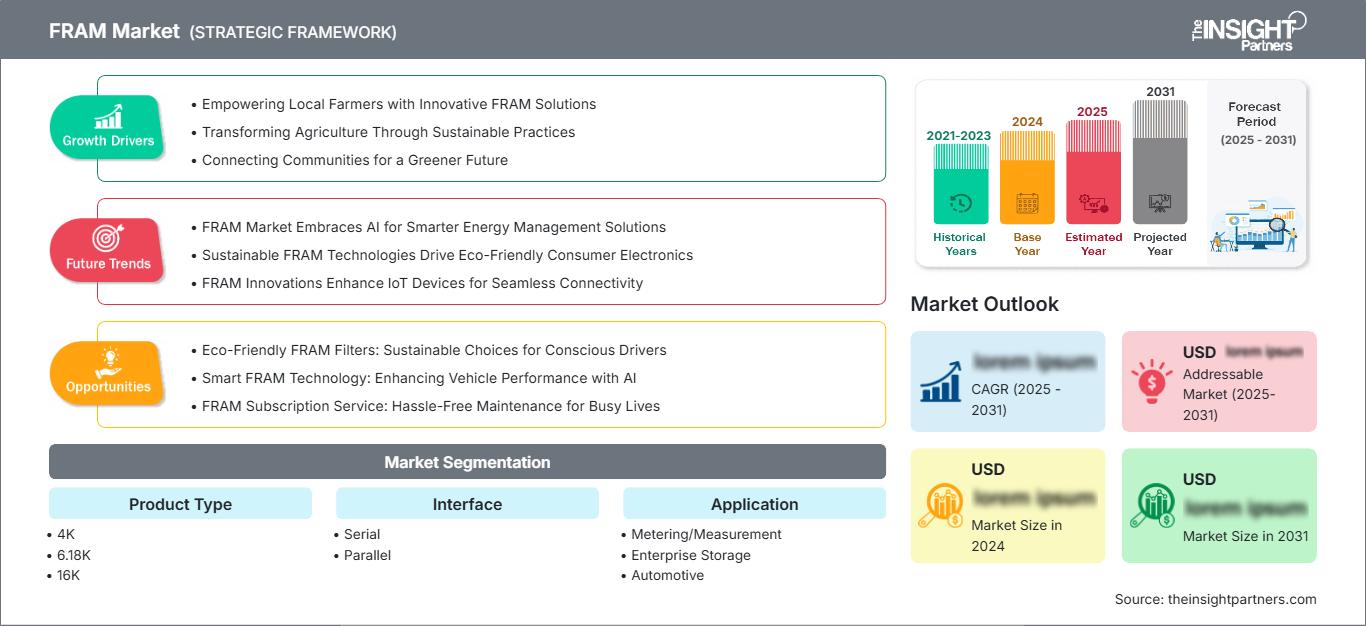
FRAM Market: Strategic Insights
Regional Insights
North America FRAM market
North America is forecasted to grow with 32–35% FRAM market share in 2025 and 10.4–11.0% CAGR until 2034. The demand for non-volatile memories with high endurance is sustained by the following applications: smart-grid upgrade, advanced metering, factory automation, aerospace electronics, and medical instrumentation. Qualified designs and testing centers facilitate the early adoption; however, specific production processes and long validation period of customers limit supply flexibility.
The electrification of the automobile sector results in more control units, logs for diagnostics, and calibration which should survive the sudden power shutdown. Utilities also require frequent low-power write operations in meters used over a long time period. Hence, the North American market requires qualified products under AEC-Q100 standard, wide temperature range, traceability, reliable sources, and the guarantee of product life-time.
U.S. FRAM market
The U.S. accounts for a modelled 78–82% of North American revenue in 2025 and advances at a 10.5–11.1% CAGR through 2034. Its position reflects semiconductor design capability, utility-meter programs, industrial automation investment, and demanding aerospace and defense electronics. Texas Instruments Incorporated, Infineon Technologies AG, Everspin Technologies, Inc., and Future Electronics Inc. maintain product, engineering, manufacturing, or channel presence that supports customer evaluation.
Requirements have moved from static settings to real-time event logging, predictive maintenance, and recovery when the power is lost. The meters need write efficiency, control systems need determinism on reset, medical equipment needs traceability, and the cars need thermal resilience. The purchasing requirements have shifted from cost per bit to assurance and resilience of the supply chain.
Europe FRAM market
Europe features a modeled 24–27% share in 2025 and shows CAGR of 9.6–10.2% up to 2034. Germany is dominant due to automotive electronics, machinery, and automation. The suppliers emphasize functional safety, longevity, high heat resistance, and use of certified parts for control modules, smart manufacturing equipment, and energy systems, ensuring constant demand due to strict validation cycles.
The UK has an advantage due to smart infrastructure, medical electronics, and design of specialized electronics. France has metering, transport, aerospace, and industrial sectors. Italy and Spain have additional factory equipment, energy management, and distributed renewable segments. In all these segments, regulatory requirements related to energy savings, cybersecurity, and longevity of the equipment ensure constant demand for persistent memory, and fragmented purchase process ensures application-specific approach of the suppliers.
APAC FRAM market
Asia-Pacific commands a modeled 34-38% market share in 2025 and grows at a rate of 11.8-12.6% CAGR till 2034. China dominates volumes with smart meters, industrial machinery, and other connective devices. Japan benefits from its skills in both automobiles and semiconductors. South Korea brings electronics manufacturing capabilities.
With India’s digitized grid, along with the electronics manufacturing push, there is room for development, while the Australian economy reaps the advantage from usage in utilities and infrastructure. Positive policies regarding localization, automation, electric vehicles, and energy management application facilitate development in the region, despite the fact that qualifications and availability of ferroelectric process are important.
Middle East & Africa FRAM market
8.7 to 9.5% compound annual growth rate through 2034 for MEA. Saudi Arabia makes progress through industrial diversification, grid modernization, and automation of infrastructure. UAE includes smart building, transport, and utility projects, whereas South Africa facilitates projects involving metering and energy management.
In other parts of MEA, the technology has been selective in nature and project oriented. The operational environment calls for memory technology that is durable and has low energy consumption capacity; however, due to lack of distribution system, certification, and dependency on imports, the technology remains untapped. Energy and remote sensing have become major deployment areas.
Segmentation Analysis
Product Type
The product-type segment is modelled to expand at a 10.7–11.3% CAGR during 2026–2034. The FRAM market scope spans compact capacities for configuration storage through 512K devices supporting larger event logs. Demand rises as designers balance density, endurance, package size, qualification, and unit economics. Lower capacities remain embedded in mature industrial designs, while higher capacities gain relevance where controllers capture more operational data locally.
- 4K: Serves compact configuration, identification, and calibration functions where minimal density, low standby power, and rapid writes outweigh the economics of using larger commodity memory.
- 6.18K: Addresses specialized legacy and application-specific designs requiring an exact memory footprint, reliable retention, and continuity of supply rather than broad platform standardization.
- 16K: Maintains demand in meters, sensors, and controllers that store parameters and short logs, offering a practical balance between package cost and endurance.
- 32K: Supports moderate logging and configuration workloads in industrial and medical equipment, where deterministic writes and long product lifecycles improve system reliability.
- 64K: Occupies a widely usable capacity tier for smart meters and embedded controllers, enabling event histories, calibration records, and frequent nonvolatile updates.
- 128K: Gains strategic relevance in connected equipment requiring larger local datasets, firmware variables, and maintenance records without flash-management overhead.
- 256K: Targets advanced automation, automotive modules, and medical systems that require deeper logs, higher update frequency, and reliable recovery after power interruption.
- 512K: Represents the highest listed density, supporting richer edge data, diagnostics, and persistent state while reducing reliance on external storage architectures.
Interface
The interface segment is modelled to grow at a 10.5–11.1% CAGR during 2026–2034. Serial connectivity dominates new embedded designs because it reduces pin count, board area, and integration complexity, while parallel devices remain important where deterministic low-latency access or legacy architectures prevail. Supplier roadmaps increasingly emphasize SPI-compatible families, broad voltage support, and packages suited to space-constrained industrial, automotive, and metering equipment.
- Serial: Holds the broadest design appeal because SPI-based connectivity simplifies controller integration, lowers pin count, and supports compact boards across metering, automotive, medical, and industrial systems.
- Parallel: Retains strategic importance in latency-sensitive and legacy equipment, where direct bus access, predictable timing, and redesign avoidance justify higher pin count and board complexity.
Application
The application segment is modelled to expand at an 11.0–11.6% CAGR during 2026–2034. Adoption concentrates where data changes frequently, power can fail unexpectedly, and maintenance costs exceed component premiums. Metering and factory automation provide durable installed bases, while automotive and medical systems introduce stringent qualification. Telecommunications and enterprise storage create selective opportunities for persistent metadata, configuration, and fault-recovery functions.
- Metering/Measurement: Remains a core demand center as electricity, gas, and water meters require low-energy writes, tamper records, calibration retention, and reliable operation over long deployments.
- Enterprise Storage: Uses FRAM selectively for metadata, configuration, and power-fail protection, where deterministic persistence and write endurance improve recovery rather than bulk storage capacity.
- Automotive: Expands with electronic control units, diagnostics, calibration, and event logging, where temperature resilience, endurance, and instant retention support lifetime vehicle requirements.
- Factory Automation: Benefits from programmable controllers, robotics, and predictive maintenance systems that continuously update operating states and must restart predictably after power interruption.
- Telecommunication: Applies persistent memory to configuration, network timing, alarms, and remote infrastructure, prioritizing low power, high availability, and dependable field operation.
- Medical: Values rapid, durable writes for device settings, usage records, and calibration data, while qualification, traceability, and long product lifecycles govern supplier selection.
Opportunity Snapshot
| Application | Revenue Contribution | Trend Tag | Adoption Stage |
| Metering/Measurement | High | Smart Metering | Mature |
| Enterprise Storage | Low | Persistent Metadata | Emerging |
| Automotive | High | Vehicle Logging | Scaling |
| Factory Automation | High | Deterministic Restart | Scaling |
| Telecommunication | Medium | Network Resilience | Scaling |
| Medical | Medium | Device Traceability | Scaling |
FRAM Market Growth Drivers and Impact Analysis
Continuous logging in smart meters and industrial controllers
The smart meters, the controllers, and the edge sensors make multiple readings of the consumption, events, calibration readings, and status. Unlike the flash memory technology that requires erasing prior to writing and wear management, FRAM does not have these limitations and can be used to help engineers store the data even in case of power failure while saving the energy. In terms of the commercial implications, one can see how FRAM extends service intervals, makes firmware less complicated, and reduces backup parts. Both utilities and factories require deterministic restart as otherwise lost data can affect the process of billing, maintenance, or process control.
Vehicle electrification expands persistent data requirements
Electric and software-defined vehicles have more electronic control units, sensors, diagnostics, and calibration parameters, thus creating more data that needs to survive an unexpected reboot. FRAM is capable of performing fast and energy-efficient writes under extreme temperature conditions and allows for simplification of the wear-leveling scheme. The effect of FRAM is most visible in applications that frequently write data but only save small amounts of information, such as powertrain parameters, faults, mileage, and event logs. Qualification is critical: suppliers need to prove automotive-grade reliability, availability, and trackability of production. Successful companies will win design wins for years because car makers do not change qualified memory chips during a platform's lifetime.
Low-power edge systems require instant persistence
Battery-operated medical systems, remote telecommunication systems, and industrial Internet of Things (IoT) nodes are rapidly becoming systems that will analyze data on-site. Such systems need a type of memory that does not require high programming voltage and can write to its cells fast enough, but they have to keep information stored during brownout situations and downtimes for servicing. FRAM provides the capability to checkpoint frequently, configure and restore a system state without using batteries or large capacitors, which helps to save space on a board and make designs simpler in case of power failures.
FRAM Market Future Trends
Embedded FRAM moves closer to edge intelligence
FRAM market trends increasingly point toward tighter integration of persistent memory with microcontrollers, sensor interfaces, and security functions. Edge systems will checkpoint models, calibration states, and event histories more frequently as local analytics expands. Embedded architectures can reduce component count, latency, and standby energy while simplifying firmware compared with external flash. Adoption will depend on process scalability, available density, toolchain maturity, and the ability to qualify integrated devices across automotive, industrial, and medical environments. Suppliers that combine memory technology with software libraries and reference designs should be positioned to capture design wins earlier in development cycles.
Higher densities broaden persistent-data use cases
Density advancement will gradually shift FRAM from parameter storage toward richer local histories, secure audit trails, and larger recovery checkpoints. The transition will not make the technology a bulk-storage substitute; instead, it will expand the size of high-value datasets that benefit from frequent writes and instant persistence. Serial bandwidth, package thermal performance, and cost per bit will influence adoption. Suppliers may differentiate through scalable families that let customers migrate capacity without board redesign. Higher-density offerings also strengthen opportunities in automotive diagnostics, advanced metering, medical monitoring, and resilient communications equipment.
FRAM Market Opportunities
Build qualified platforms for automotive and industrial buyers
Suppliers can increase design-win probability by packaging memory, reference schematics, drivers, functional-safety documentation, and lifecycle commitments into qualification-ready platforms. Automotive and industrial customers evaluate more than device specifications; they assess temperature performance, traceability, failure analysis, cybersecurity compatibility, and supply continuity. Investment should therefore target AEC-Q100 grades, industrial temperature ranges, pin-compatible density options, and engineering support in major design hubs. Partnerships with microcontroller vendors and distributors can accelerate evaluation. The opportunity rewards vendors able to convert technical endurance into lower system cost through fewer backup components, reduced firmware complexity, and predictable restart behavior.
Localize application engineering in high-growth Asian markets
China, India, Japan, and South Korea present different routes to expansion: volume metering, grid digitization, automotive quality, and advanced electronics manufacturing. Vendors should invest in regional laboratories, language-specific firmware support, distributor training, and relationships with local original equipment manufacturers. Capacity alone will not secure adoption because customers need rapid failure analysis and design assistance. A localized approach can also identify density and package requirements before global roadmaps are fixed. The strongest returns should come from co-design programs in metering, electric vehicles, robotics, and energy management, where qualification creates durable revenue and switching barriers.
Recent Developments
- June 2026: CEA-Leti announced scaling of Ferroelectric RAM (FeRAM) to the 22 nm node using a 3D capacitor architecture with hafnium zirconium oxide (HZO) ferroelectric materials. The technology targets edge AI, aerospace, IoT, and high-efficiency computing.
- June 2025: Infineon announced a radiation-tolerant memory portfolio for NewSpace applications, including low-power radiation-tolerant F-RAM devices for LEO satellite systems. The F-RAM devices support high endurance, low power operation, and harsh-environment reliability.
- March 2026: Fraunhofer IPMS and CEA-Leti successfully completed the first exchange of ferroelectric memory wafers within the FAMES Pilot Line, marking an important step toward advancing next-generation FRAM technologies. The collaboration validated wafer processing and characterization methods for hafnium-zirconium oxide (HZO)-based ferroelectric memory materials using 300 mm CMOS facilities. The achievement demonstrates reliable cross-site manufacturing capabilities and supports the development of low-power, high-performance embedded non-volatile memory solutions for future semiconductor applications.
Frequently Asked Questions

- Comprehensive Market Sizing and Forecast Analysis
- Detailed Segmentation Analysis
- In-Depth Market Dynamics Assessment
- Regional and Country-Level Insights
- Competitive Landscape and Company Benchmarking
- Strategic Business Intelligence
Recent Reports
Testimonials

The Insight Partners' SCADA System Market report is comprehensive, with valuable insights on current trends and future forecasts. The team was highly professional, responsive, and supportive throughout. We are very satisfied and highly recommend their services.
RAN KEDEM Partner, Reali Technologies LTDs
I requested a report on a very specific software market and the team produced the report in a few days. The information was very relevant and well presented. I then requested some changes and additions to the report. The team was again very responsive and I got the final report in less than a week.
JEAN-HERVE JENN Chairman, Future Analytica
We worked with The Insight Partners for an important market study and forecast. They gave us clear insights into opportunities and risks, which helped shape our plans. Their research was easy to use and based on solid data. It helped us make smart, confident decisions. We highly recommend them.
PIYUSH NAGPAL Sr. Vice President, High Beam Global
The Insight Partners delivered insightful, well-structured market research with strong domain expertise. Their team was professional and responsive throughout. The user-friendly website made accessing industry reports seamless. We highly recommend them for reliable, high-quality research services
YUKIHIKO ADACHI CEO, Deep Blue, LLC.
This is the first time I have purchased a market report from The Insight Partners.While I was unsure at first, I visited their web site and felt more comfortable to take the risk and purchase a market report.I am completely satisfied with the quality of the report and customer service. I had several questions and comments with the initial report, but after a couple of dialogs over email with their analyst I believe I have a report that I can use as input to our strategic planning process.Thank you so much for taking the extra time and making this a positive experience.I will definitely recommend your service to others and you will be my first call when we need further market data.
JOHN SUZUKI President and Chief Executive Officer, Board Director, BK Technologies
I wish to appreciate your support and the professionalism you displayed in the course of attending to my request for information regarding to infectious disease IVD market in Nigeria. I appreciate your patience, your guidance, and the fact that you were willing to offer a discount, which eventually made it possible for us to close a deal. I look forward to engaging The Insight Partners in the future, all thanks to the impression you have created in me as a result of this first encounter.
DR CHIJIOKE ONYIA MANAGING DIRECTOR, PineCrest Healthcare Ltd.Reason to Buy
- Informed Decision-Making
- Understanding Market Dynamics
- Competitive Analysis
- Identifying Emerging Markets
- Customer Insights
- Market Forecasts
- Risk Mitigation
- Boosting Operational Efficiency
- Strategic Planning
- Investment Justification
- Tracking Industry Innovations
- Aligning with Regulatory Trends





 Get Free Sample for