
Gaming Hardware Market Size, Trends & Growth by 2034
Coverage: By Product (Consoles, Accessories); Distribution Channel (Offline, Online); End-user (Commercial, Residential), and Geography (North America, Europe, Asia Pacific, and South and Central America)
- Status : Data Released
- Report Code : TIPRE00017504
- Category : Electronics and Semiconductor
- No. of Pages : 150
- Available Report Formats :


- Last update date : September 17, 2026


2025 Market Size
US$ 44.37 Bn
Base year value
2034 Forecast
US$ 81.44 Bn
Projected by 2034
CAGR 2026-2034
6.98 %
Growth rate
Addressable Market
US$ 568.09 Bn
(2026-2034)
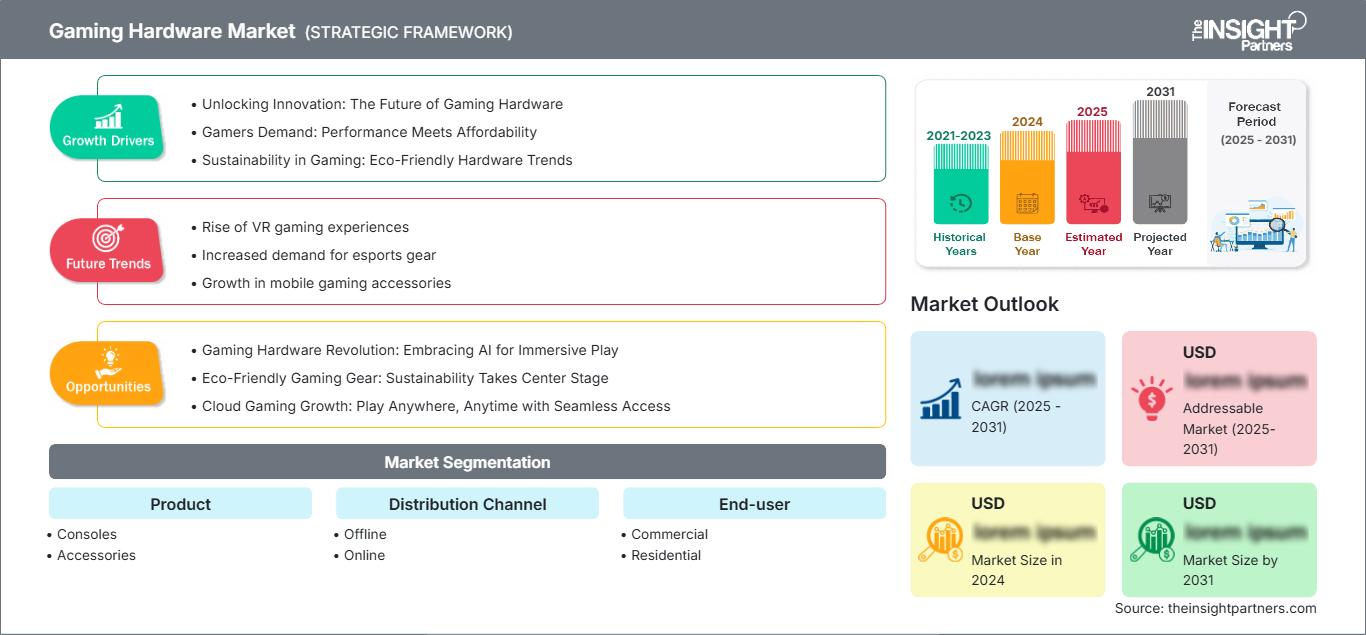
The Gaming Hardware Market was valued at US$ 44.37 Billion in 2025 and is projected to reach US$ 81.44 Billion by 2034, expanding at a CAGR of 6.98% during 2026–2034. The market covers consoles and accessories sold through offline and online channels to commercial and residential users, reflecting sustained demand for dedicated play systems, precision input devices, headsets, racing equipment, and other performance-focused hardware.
North America remains a strategically important demand center as the Gaming Hardware Market size benefits from a large installed base, mature retail infrastructure, esports participation, and frequent replacement cycles. The region is estimated to expand at a 6.3–6.9% CAGR during 2026–2034. In 2025, US hardware and console spending increased 9% to US$ 5.4 billion, while more than 205 million Americans played video games, supporting durable household and specialist-peripheral demand.
Gaming Hardware Market Assessment and Insights
- North America held 32–35% Gaming Hardware Market share in 2025 and is growing at a CAGR of 6.3–6.9% during 2026–2034, supported by established console ecosystems, organized esports, high household spending, and broad omnichannel retail coverage.
- US represented 82–86% of North America in 2025 and is growing at a CAGR of 6.4–7.0% during 2026–2034, driven by replacement consoles and premium peripherals.
- Europe held 25–28% share in 2025 and is growing at a CAGR of 6.0–6.6% during 2026–2034, with the UK, Germany, France, Italy, and Spain leading console, PC accessory, and esports-oriented demand.
- Asia Pacific captured 30–34% share in 2025 and is growing at a CAGR of 7.6–8.3% during 2026–2034, led by China, Japan, South Korea, India, and Australia across console production, gaming cafés, and online retail.
- Largest Segment Consoles held 58–62% market share in 2025 and are growing at a CAGR of 6.1–6.7% during 2026–2034, supported by platform ecosystems and generational upgrades.
- High Growth Segment Online distribution held 43–47% market share in 2025 and is growing at a CAGR of 8.1–8.8% during 2026–2034, supported by assortment, reviews, and direct delivery.
- Key companies analyzed in detail: A4TECH Co., Ltd.; HORI (U.S.A.), Inc.; Hyperkin, Inc.; Logitech International S.A.; Mad Catz Global Limited; Microsoft Corporation; Nintendo Co., Ltd.; Razer Inc.; Scuf Gaming International, LLC; Sony Corporation
Source: The Insight Partners' analysis based on proprietary research, government publications, company annual reports, investor presentations, industry databases, and expert interviews.
Product architecture in the Gaming Hardware Market has moved from isolated consoles and basic controllers toward connected, customizable ecosystems spanning handheld play, cross-platform audio, haptics, programmable inputs, and companion software. Console manufacturing remains scale-intensive because semiconductor sourcing, thermal engineering, assembly yields, and launch inventories shape availability. Accessories are more fragmented, allowing specialists to compete through ergonomics, latency, durability, licensed designs, and rapid category refreshes. This evolution aligns the Gaming Hardware Market with longer platform cycles but faster peripheral innovation.
According to the Gaming Hardware Market forecast, through 2034, investment will favor Asia Pacific manufacturing depth, Indian and Southeast Asian assembly, direct-to-consumer commerce, and commercial gaming venues in emerging cities. Accessibility labeling, right-to-repair discussion, wireless-spectrum compliance, and energy-efficiency requirements will influence product design and documentation. Companies able to localize price points while maintaining cross-platform compatibility should capture incremental demand without relying solely on flagship launches, broadening the addressable market across households, esports facilities, and gaming cafés.
Gaming Hardware Market Report Scope
| Report Attribute | Details |
|---|---|
| Market size in 2025 | US$ 44.37 Billion |
| Market Size by 2034 | US$ 81.44 Billion |
| Global CAGR (2026 - 2034) | 6.98% |
| Historical Data | 2021-2024 |
| Forecast period | 2026-2034 |
Gaming Hardware Market Analysis
Gaming Hardware Market growth is fueled by strong communities of players, generational replacement of consoles, e-sports, and lower latency interaction. The ecosystem includes semiconductor producers, contract manufacturers, platform owners, peripherals makers, distributors, retailers, e-sports organizers, and content publishers. Console companies leverage exclusive software, subscription services, backward compatibility, and social tools to enhance hardware loyalty. Peripheral makers benefit from the sale of installed base of products on various platforms.
The supply situation is conditioned by the chip supply, plastic, sensors, battery, acoustics production, and transportation capacity. Scale economics help platform owners; accessories allow shorter development times and diversification of the sourcing process. Inventories need to be managed carefully during holidays and product launches due to high risks associated with forecasting mistakes that could lead to shortages or discounts. Standardized wireless communication protocol and USB connection reduce adoption barriers but the proprietary license controls access to specific console functions.
Gaming Hardware Market trends reveal competitive landscape between ecosystem-based manufactures and dedicated peripheral producers. The leaders in console market are Microsoft Corporation, Nintendo Co., Ltd., and Sony Corporation. Logitech International S.A., Razer Inc., Scuf Gaming International, LLC, and Mad Catz Global Limited focus on performance, customization, e-sports credibility, and software tuning of controllers, mice, keyboards, headsets, and racing systems.
HORI (U.S.A.), Inc. and Hyperkin, Inc. compete through licensed, retro compatible, and affordable products, whereas A4TECH Co., Ltd. caters for general demand for input devices. Investments are being made in haptic controls, modular racing systems, low-latency wireless headphones, easy-to-repair products, and accessibility. Strategic positioning involves certification by the platform owner, partnership with creators, discipline of distribution channel, and capability of serving both premium enthusiasts and budget-conscious residential customers.
● REPORT CUSTOMIZATION
Tailor This Report To Align With Your Specific Business Requirements
This report can be customized to align precisely with your business objectives, scope, and target markets. Customization options include tailored segmentation, geography, competitive analysis, and strategic insights to support informed decision-making.
Customize This Report →WHAT YOU CAN ADJUST
- ● Segmentations
- ● Geography
- ● Competitive Analysis
- ● Language Preferences
Gaming Hardware Market: Strategic Insights
Regional Insights
North America Gaming Hardware Market
North America represented 32–35% of global revenue in 2025 and is expected to expand at a 6.3–6.9% CAGR through 2034. Market share for Gaming Hardware is supported by the prevalence of mature console ownership, broadband penetration, esports organization, specialist retailing, and effective direct to consumer distribution. Frequent peripheral replacements are another factor that favors the region as far as PC, console, simulation, and streaming users are concerned.
Market infrastructure revolves around the US market, with Canada making its contribution via wealthier households, collegiate esports, and cross-border business activities. Introduction of platforms results in focused demands, whereas headsets, controllers, keyboards, mice, and racing kits generate sustained replenishments. Business applications come from arenas, gaming lounges, schools, and event organizers. Increasingly buyers emphasize low latency, platform compatibility, ergonomics, and warranty services offered by vendors.
U.S. Gaming Hardware Market
The US accounted for 82–86% of North American revenue in 2025 and is projected to grow at a 6.4–7.0% CAGR during 2026–2034. According to industry information, the expenditure on 2025 hardware and console increased by 9% to $ 5.4 billion, and accessories amounted to $ 2.95 billion. Over 205 million people in the USA are playing video games, creating a strong replacement market.
Microsoft Corporation, Sony Corporation, Nintendo Co., Ltd., Logitech International S.A., Razer Inc., Hyperkin, Inc., and Scuf Gaming International, LLC have substantial retail, online or ecosystem presence. Application developments include hybrid handheld gaming, gaming controllers, wireless headsets, sim racing, streaming input devices, and user-friendly interfaces. Home users will form the bulk of sales, with educational institutions, esports venues, studios, and gaming cafes supplementing high-turnover commercial sales.
Europe Gaming Hardware Market
Europe held 25–28% share in 2025 and is forecast to grow at a 6.0–6.6% CAGR through 2034, with the UK leading through console engagement, digital retail, and a mature development ecosystem. The British customer exhibits an early adoption pattern for controllers, headsets, and simulation devices, while competitive gaming and content creators promote premium accessories.
Germany’s combination of high disposable income, PC gaming culture, specialty retailing, and simulation creates the right market for keyboards, mice, wheels, and audio devices. France enjoys the advantage of console gaming involvement along with electronics distribution channels. Italy and Spain also have price-conscious household buyers, esport tournaments locally, and growing e-commerce. Consumer safety, wireless compatibility, and recycling regulations in Europe raise documentation costs but help quality producers.
APAC Gaming Hardware Market
APAC accounted for 30–34% share in 2025 and is projected to expand at a 7.6–8.3% CAGR during 2026–2034. China leads through manufacturing scale, online retail, PC peripherals, and gaming cafés, while Japan anchors console innovation. South Korea adds esports and gaming-venue demand.
India's expanding digital consumer base and electronics incentives support online accessory sales and future assembly. Australia contributes affluent residential demand and organized events. Policy support for electronics manufacturing, export capability, and digital infrastructure strengthens regional supply depth and market access.
Middle East & Africa Gaming Hardware Market
Middle East and Africa is expected to grow at a 7.0–7.8% CAGR during 2026–2034, with Saudi Arabia leading through entertainment investment, esports events, youth engagement, and modern retail. The UAE supports premium imports, gaming venues, creator activity, and regional distribution.
South Africa contributes established console communities and e-commerce, while Rest of MEA growth remains concentrated in major cities. Data-center investment, improving broadband, shopping infrastructure, and reliable electricity access shape adoption. Import duties and currency volatility continue to influence affordability and inventory planning.
Segmentation Analysis
Product
The Product segment is expected to grow at a 6.5–7.2% CAGR during 2026–2034. Gaming Hardware Market scope across product categories reflects two connected cycles: infrequent console upgrades and faster accessory replacement. Platform launches create large revenue steps, while controllers, headsets, keyboards, mice, and racing systems broaden lifetime spending through personalization, wear replacement, competitive performance, and cross-device use.
- Consoles remain the largest product category because integrated hardware, exclusive game libraries, backward compatibility, social features, and simplified setup attract households seeking dependable performance without component-level configuration.
- Accessories provide recurring demand through controllers, headsets, keyboards, mice, racing equipment, charging systems, and specialized inputs, enabling differentiation by latency, ergonomics, customization, durability, and platform certification.
Distribution Channel
The Distribution Channel segment is expected to grow at a 7.0–7.7% CAGR during 2026–2034. Channel economics vary by product complexity and purchase urgency. Physical stores remain relevant for demonstrations, launches, trade-ins, and immediate availability, whereas digital storefronts offer wider assortment, price comparison, reviews, direct fulfillment, and efficient access to specialist brands or replacement components.
- Offline channels retain strategic value for console launches, demonstrations, bundled offers, trade-ins, and immediate collection, while specialist retailers help customers compare fit, sound, control feel, and compatibility.
- Online channels are scaling faster through broad assortment, competitive pricing, verified reviews, creator-led discovery, direct-to-consumer releases, and convenient delivery for repeat accessory purchases and hard-to-find configurations.
End-user
The End-user segment is expected to grow at a 6.7–7.4% CAGR during 2026–2034. Residential users generate the majority of units through household entertainment and personal upgrades. Commercial operators purchase fewer but more intensively used systems, creating demand for durability, serviceability, fleet consistency, reduced downtime, and peripherals designed for tournaments, education, hospitality, simulation, or content production.
- Commercial users include esports arenas, gaming cafés, universities, event organizers, hospitality venues, and studios that prioritize durability, standardized configurations, fast replacement, centralized support, and measurable utilization.
- Residential users dominate unit demand through household consoles and personal peripherals, with purchasing influenced by game compatibility, comfort, social play, streaming, aesthetics, gifting, and multi-device connectivity.
Opportunity Snapshot
| End-user | Revenue Contribution | Trend Tag | Adoption Stage |
| Commercial | Medium | Venue Fleets | Scaling |
| Residential | High | Home Ecosystems | Mature |
Gaming Hardware Market Growth Drivers and Impact Analysis
Generational Console Upgrades Reactivate Household Spending
The launches of major consoles lead to resetting of performance standards and creating chances to purchase peripheral accessories for controllers, memory cards, speakers, power supplies, and display compatible equipment. The launch of Nintendo Switch 2 was in June 2025 with a larger display size, magnetic Joy-Con 2 controllers, mouse functions, improved processing ability, and social media functions, thus highlighting the impact of change in platforms on the creation of substitution demand and additional demand. The market effects of this event transcend first party consoles as each new release adds to the potential customer pool for controllers, protective gear, headsets, racing wheels, and connectivity accessories. Retailers also benefit from focused traffic through bundling and trade-in initiatives.
Esports and Creator Workflows Raise Peripheral Requirements
The factors of competitiveness and live content creation raise the importance of accuracy, latency, sound quality, comfort, and configuration software. Gamers no longer review a mouse, keyboard, controller, or headset as an input peripheral but take into account consistency, actuation, reliability of connection in a wireless mode, microphone performance, customization options, and tournament approval. The accessories offered by Logitech International S.A. for the year 2025 included sim-racing gear, haptic mice, gaming mice, analog keyboards, headphones, and live content creation gear. The presence of market influence is evident in the increased rate of accessory change instead of console change, more premium pricing range, and the growing demand for software to allow settings persistence on other devices.
Omnichannel Access Broadens Specialist Brand Reach
Online marketplaces, brand stores, specialist retailers, and social commerce enable smaller hardware retailers to connect with consumers without needing the same shelf space available in their respective platforms. Product review, product compatibility, product demo by creators, and online community make technical products less ambiguous, while direct delivery caters to the niche design, colors, and licensed versions of the products. Physical retail remains relevant during console releases and when fit and feel of the product is required. The hybrid approach assists hardware vendors to effectively launch their premium products, long tail range of products, and promotions on local level. Market effects can be seen through quicker discovery of specialist controllers, vintage hardware, race controllers, and ergonomic devices, apart from increased price transparency.
Gaming Hardware Market Future Trends
Adaptive, Haptic, and Software-Defined Inputs
Gaming Hardware trends would focus more on input devices that would be capable of modifying behavior through software, profiles, modularity, haptic and actuation features. Competitive gamers would seek precision control, whereas ordinary consumers would look for easy-to-use personalization and accessibility. Future input devices such as controllers, keyboards, mice, and racing peripherals will incorporate onboard memory, calibration through sensors, feedback and platform-specific settings. Those vendors who provide customizable features without making things complicated for the consumer will be able to create an edge based not only on hardware aesthetics but also on software.
Hybrid Play Blurs Console, Handheld, and PC Categories
Portability, remote play, cloud connectivity, cross-progression, and multi-platform accessories will weaken boundaries between devices from now until 2034. The customer will demand headsets, controllers, and audio equipment that is interchangeable among consoles, PCs, handhelds, and mobile units with little change in configuration. Manufacturers will meet this need with multi-mode wireless connectivity, design for portability, integrated software and charging technology for on-the-go or at-home usage. Hybrid play increases the opportunities where specialized hardware becomes important, yet it also increases the demands for compatibility. Vendors who clearly inform consumers about platform compatibility, latency, battery life, and configuration processes will minimize returns. Multi-platform accessories may be increasingly important as more gaming platforms exist in the average household.
Gaming Hardware Market Opportunities
Commercial Fleet Solutions for Venues and Education
The gaming cafe, esports facility, university, hospitality, training, and events sectors present tangible opportunities to capitalize on the power of standardized hardware fleets. Justification for the need for gaming hardware can be made using forecasts for the Gaming Hardware Market. This justification would cover the need for tough controllers, headsets, keyboards, mice, and racing rigs with wearables, profile unification, asset management, and warranty handling. The hardware provider can sell its product as part of a bundle that includes advice on how to implement, spare parts, sanitization instructions, and service level agreements. The channel partner can help with installation, maintenance, and tournament needs. These clients are less concerned about dazzle and variety than availability, and that is differentiation.
Localized Online Portfolios for Emerging Consumer Markets
India, Southeast Asia, the Middle East, Africa, and Latin America present regions of growth where digital demographics are expanding but the importation of top-tier hardware is prohibitively costly. Companies could take action through the development of targeted pricing ladders, smaller packaging, multilingual offerings, regional payment methods, and certified reconditioned devices. Internet-only launches would help keep down the cost of the distribution channel, whereas select offline partners would aid in product demonstrations and warranty coverage. Device mixes should focus on robust entry controllers, headsets, and keyboards before including more sophisticated racing and creation products. Manufacturing and assembly could be done locally for those situations that call for it.
Recent Developments
- August 2026: Samsung Electronics is set to showcase its latest gaming technologies and products at Gamescom 2026, taking place from August 26 to 30 at Koelnmesse in Cologne, Germany. The company plans to demonstrate an integrated gaming ecosystem spanning mobile devices, PCs and consoles.
- May 2026: NVIDIA and Microsoft are teaming up to redefine the Windows PC around personal AI agents, introducing a new computing platform designed to run advanced AI workloads locally rather than relying entirely on cloud services. At the centre of the initiative is NVIDIA RTX Spark, a compact AI-focused platform that combines high-performance computing, graphics and NVIDIA's AI software stack. NVIDIA says the system can deliver up to 1 petaflop of AI performance and support as much as 128GB of unified memory.
- July 2026: Indian gaming hardware startup ARC has officially entered the market with a goal of making premium gaming experiences more accessible to consumers in India. Founded by lifelong gamers Jobin Joseph and Kaustubh K. Jadhav, the company is developing handheld gaming hardware aimed at helping players move beyond smartphone gaming and experience more console-like gameplay.
Frequently Asked Questions

- Comprehensive Market Sizing and Forecast Analysis
- Detailed Segmentation Analysis
- In-Depth Market Dynamics Assessment
- Regional and Country-Level Insights
- Competitive Landscape and Company Benchmarking
- Strategic Business Intelligence
Recent Reports
Testimonials

The Insight Partners provided valuable market intelligence that supported our global go-to-market strategy. Their team was professional, responsive, and attentive to our feedback, providing thoughtful analysis and helpful methodological clarifications throughout the project.
Junmo Kim Chief Financial Officer (CFO), Enertech Co., Ltd.
The Insight Partners' SCADA System Market report is comprehensive, with valuable insights on current trends and future forecasts. The team was highly professional, responsive, and supportive throughout. We are very satisfied and highly recommend their services.
RAN KEDEM Partner, Reali Technologies LTDs
I requested a report on a very specific software market and the team produced the report in a few days. The information was very relevant and well presented. I then requested some changes and additions to the report. The team was again very responsive and I got the final report in less than a week.
JEAN-HERVE JENN Chairman, Future Analytica
We worked with The Insight Partners for an important market study and forecast. They gave us clear insights into opportunities and risks, which helped shape our plans. Their research was easy to use and based on solid data. It helped us make smart, confident decisions. We highly recommend them.
PIYUSH NAGPAL Sr. Vice President, High Beam Global
The Insight Partners delivered insightful, well-structured market research with strong domain expertise. Their team was professional and responsive throughout. The user-friendly website made accessing industry reports seamless. We highly recommend them for reliable, high-quality research services
YUKIHIKO ADACHI CEO, Deep Blue, LLC.
This is the first time I have purchased a market report from The Insight Partners.While I was unsure at first, I visited their web site and felt more comfortable to take the risk and purchase a market report.I am completely satisfied with the quality of the report and customer service. I had several questions and comments with the initial report, but after a couple of dialogs over email with their analyst I believe I have a report that I can use as input to our strategic planning process.Thank you so much for taking the extra time and making this a positive experience.I will definitely recommend your service to others and you will be my first call when we need further market data.
JOHN SUZUKI President and Chief Executive Officer, Board Director, BK Technologies
I wish to appreciate your support and the professionalism you displayed in the course of attending to my request for information regarding to infectious disease IVD market in Nigeria. I appreciate your patience, your guidance, and the fact that you were willing to offer a discount, which eventually made it possible for us to close a deal. I look forward to engaging The Insight Partners in the future, all thanks to the impression you have created in me as a result of this first encounter.
DR CHIJIOKE ONYIA MANAGING DIRECTOR, PineCrest Healthcare Ltd.Reason to Buy
- Informed Decision-Making
- Understanding Market Dynamics
- Competitive Analysis
- Identifying Emerging Markets
- Customer Insights
- Market Forecasts
- Risk Mitigation
- Boosting Operational Efficiency
- Strategic Planning
- Investment Justification
- Tracking Industry Innovations
- Aligning with Regulatory Trends





 Get Free Sample for