
Gas Laser Market Share, Growth & Demand by 2034
Coverage: By Type (Pulse Gas Lasers, Continuous Gas Lasers, Others); Application (Industrial, Medical, Scientific Research, Others) , and Geography (North America, Europe, Asia Pacific, and South and Central America)
- Status : Data Released
- Report Code : TIPRE00027280
- Category : Electronics and Semiconductor
- No. of Pages : 150
- Available Report Formats :


- Last update date : August 17, 2026


2025 Market Size
US$ 786.06 Mn
Base year value
2034 Forecast
US$ 1,591.83 Mn
Projected by 2034
CAGR 2026-2034
9.22 %
Growth rate
Addressable Market
US$ 11,282.62 Mn
(2026-2034)
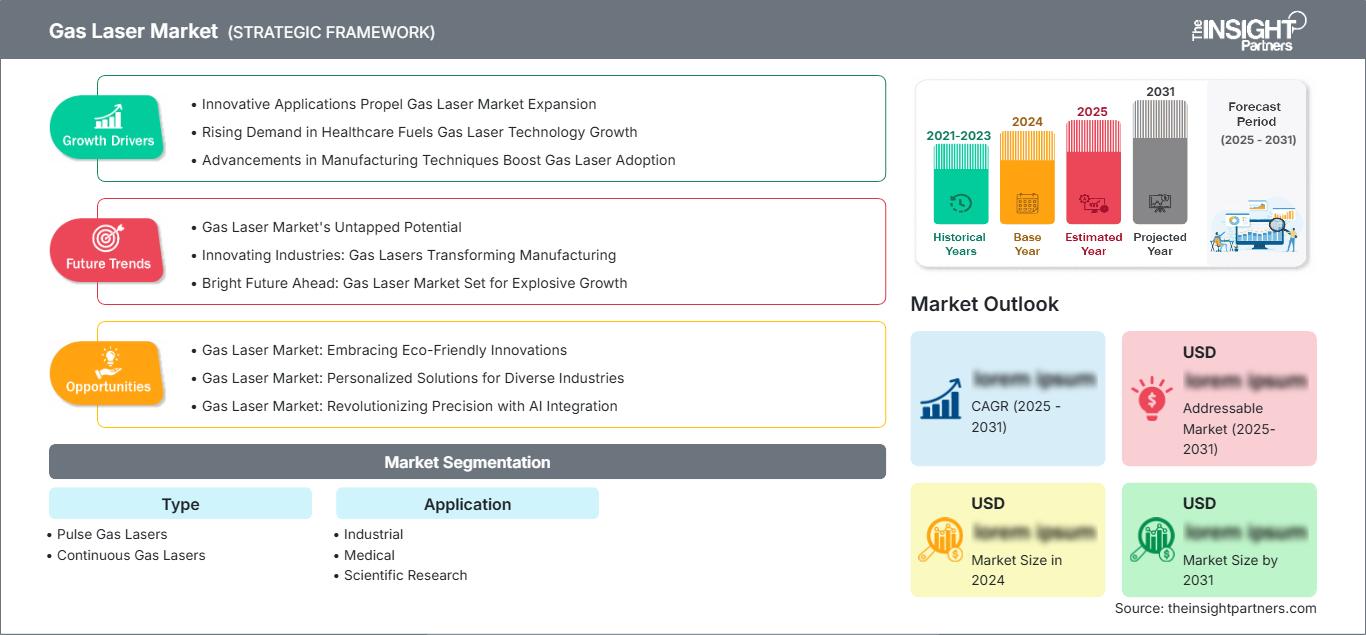
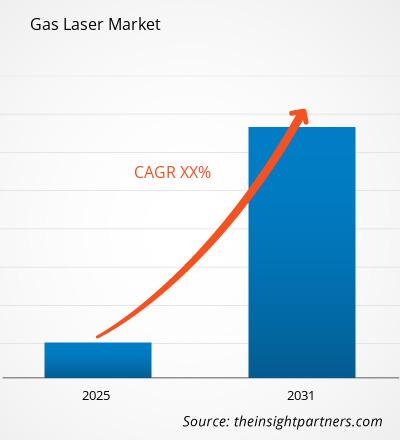
The Gas Laser Market was valued at US$ 786.06 Million in 2025 and is projected to reach US$ 1,591.83 Million by 2034, registering a compound annual growth rate (CAGR) of 9.22% from 2026 to 2034. This growth path can be attributed to the continued need for gas laser systems in applications related to industry manufacturing processes, medical treatments, and scientific research. The market derives the benefit of several strengths of gas lasers that include high beam quality, wavelength range, and continuous wave output capacity that are essential for various applications.
North America is expected to constitute around 36-40% share of the total Global Gas Laser Market Size in 2025, growing at a CAGR of 8-10%. The leadership position of North America in this regard is largely due to its strong manufacturing base, high investment in healthcare sector, and heavy research and development expenditure in the defense sector. The US is the major growth contributor in the region owing to the high level of industrial automation and semiconductors manufacturing in the region.
Gas Laser Market Assessment and Insights
- North America: North America held a significant share of 36–40% in 2025, driven by robust industrial manufacturing and healthcare infrastructure. The region is projected to grow at a CAGR of 8–10% from 2026 to 2034, supported by strong defense and semiconductor sectors.
- US: The US accounts for approximately 85–90% of the Market in 2025, growing at a CAGR of 8–10% through 2034, driven by advanced manufacturing, medical device production, and defense research activities.
- Europe: Europe holds a market share of 26–30% in 2025, with Germany, the UK, and France leading adoption. The region is projected to grow at a CAGR of 8–10% from 2026 to 2034, supported by strong automotive manufacturing and industrial automation sectors.
- Asia Pacific: Asia Pacific accounts for 28–32% of the Market in 2025, growing at a CAGR of 10–12% through 2034. China, Japan, South Korea, and India are leading the regional expansion, driven by manufacturing growth and technological investments.
- Largest Segment (Industrial): Industrial represents the largest application segment in 2025 with a market share of 48–52%, driven by gas laser adoption in cutting, welding, marking, and drilling operations across manufacturing sectors.
- High Growth Segment (Medical): Medical is the fastest-growing application segment in 2025 with a market share of 18–22%, projected to grow at a CAGR of 10–12% through 2034, driven by minimally invasive surgical procedures and ophthalmic treatments.
- Key companies analyzed in detail: Coherent Corp., DS4 Laser Technology, GAM LASER, Inc., Linde plc, MS Technologies AG, PaR Systems (Pty) Ltd, ROFIN-SINAR Laser GmbH, Sacher Lasertechnik GmbH, SÜSS MicroTec SE, Yokogawa Electric Corporation.
Source: The Insight Partners' analysis based on proprietary research, government publications, company annual reports, investor presentations, industry databases, and expert interviews.
The Gas Laser Market has seen significant development since its inception from crude lab machines into technologically advanced industrial and medical devices. Improvements in technology for gas discharge stabilization, optical cavity design, and heat management have helped in the improvement of power generation, beam quality, and lifespan of the products. The introduction of enclosed CO2 laser tubes and excimer lasers has been helpful in widening the usage applications of gas lasers, where the gas laser can take over the role of solid-state or fiber lasers in some precise applications. At the same time, advances in gas formulation and energy source technology have been helpful in ensuring that the gas laser system becomes an economical choice for industrial use.
In the next few years, there is expected to be considerable growth in the Market due to investments made by developing nations in establishing modern manufacturing and healthcare infrastructure. There are regulatory policies that support energy efficiency and environmental sustainability in gas laser development.
Gas Laser Market Report Scope
| Report Attribute | Details |
|---|---|
| Market size in 2025 | US$ 786.06 Million |
| Market Size by 2034 | US$ 1,591.83 Million |
| Global CAGR (2026 - 2034) | 9.22% |
| Historical Data | 2021-2024 |
| Forecast period | 2026-2034 |
Gas Laser Market Analysis
The Growth Drivers of the Gas Lasers Market are variously interdependent drivers of demand that influence the market's direction of growth. The ongoing changes in the global manufacturing sector in line with the Industry 4.0 agenda have made gas lasers indispensable devices used in cutting, welding, marking, and drilling. Automotive companies use CO2 lasers to cut non-metallic materials like polymers, textiles, and composites, while the semiconductor manufacturing industry uses excimer lasers in photolithography processes important for chip production. The healthcare segment has a significant role to play in the growth of the gas lasers market since the devices are widely employed in ophthalmology for procedures such as LASIK, dermatology treatment, and oncology ablation. This variety of demand streams in different application verticals gives the gas lasers market several independently operating engines of growth.
Competitive Landscape of the Gas Laser Market Report includes existing players in the field of manufacturing of lasers, specific providers of gas laser technologies, as well as companies which manufacture the vertical-integrated industrial equipment. Some examples of such companies would be Coherent Corp., ROFIN-SINAR Laser GmbH and Linde plc, each one possessing additional competencies in manufacturing of laser systems, gas supply and application engineering, correspondingly. Partnerships and acquisitions are becoming more and more common among the participants, since they try to integrate their technologies into the overall solution which will be used by their end customers. Growing investment activity in this market shows the increasing trust in its future potential, and existing companies develop their production capacities and networks. There is a trend of growing consolidation in the market through strategic acquisitions. Competitiveness in this market grows through specialization on specific applications.
● REPORT CUSTOMIZATION
Tailor This Report To Align With Your Specific Business Requirements
This report can be customized to align precisely with your business objectives, scope, and target markets. Customization options include tailored segmentation, geography, competitive analysis, and strategic insights to support informed decision-making.
Customize This Report →WHAT YOU CAN ADJUST
- ● Segmentations
- ● Geography
- ● Competitive Analysis
- ● Language Preferences
Gas Laser Market: Strategic Insights
Regional Insights
North America Gas Laser Market
The Gas Laser Market share of North America is considered as an important market share of the which is forecast to grow at a CAGR of 8-10% between 2026 to 2034, contributing 36-40% of the market share in 2025. The US is the key driver of the regional demand, owing to its highly developed manufacturing sector, well-established healthcare industry, and considerable investment in defense research. A well-established semiconductor industry is the key strength for the region, where the use of excimer laser in the process of photolithography is considered critical for the production of logic and memory chips. Aerospace & Defense is another key application in terms of demand, where gas lasers find application in material processing, LIDAR and directed energy studies.
U.S. Gas Laser Market
The U.S. Market accounts for approximately 85–90% of the North American regional total in 2025, with the country projected to grow at a CAGR of 8–10% through 2034. The U.S. market benefits from the presence of leading laser manufacturers, defense contractors, and medical device companies that drive technology adoption and innovation. The trends of application show an increase in the use of semiconductors in production, where the excimer lasers are used for patterning in sub-nanometer resolution. Gas lasers are still in use in the medical field in eye and skin treatments, and the automotive industry uses CO2 lasers for processing non-metallic materials. The current emphasis of the U.S. government in semiconductors manufacturing and modernizing its defense makes the environment conducive for manufacturing of gas lasers.
Europe Gas Laser Market
Europe holds a market share of 26–30% of the global Market in 2025, growing at a CAGR of 8–10% from 2026 to 2034. Germany leads the European market, driven by its strong automotive industry and industrial automation sector, where CO2 lasers are extensively deployed for cutting and welding applications. Next comes the United Kingdom, where notable developments have been made in the field of aerospace and defense electronics as well as in the production of medical devices. In addition to making contributions from its aerospace and defense industries, France is being supplemented by Italy and Spain, which are developing into new growth markets due to their industrial and renewable energy uses.
APAC Gas Laser Market
Asia Pacific accounts for 28–32% of the global market in 2025, growing at a CAGR of 10–12% through 2034, making it the fastest-growing regional market. The APAC region is dominated by China because it is the largest manufacturer of electronics in the world, and it is also a very large manufacturer. In addition to this, Japan offers support due to its semiconductor industry and precision manufacturing capabilities, while South Korea is the catalyst due to its electronics manufacturing capabilities and display manufacturing facilities. India provides the fastest-growing market because of the initiatives being taken in manufacturing and healthcare infrastructure. Australia has the market because of research and industrial applications in this region.
Middle East & Africa Gas Laser Market
The Middle East and Africa market has become an important growth market for gas lasers, with Saudi Arabia and the United Arab Emirates leading in adoption via diversification of industries and infrastructural development efforts. South Africa has become a part of this market through its mining and industrial activities, whereas the Rest of MEA market has become a strong growth market through telecoms and military. The Middle East and Africa market is expected to grow at a CAGR of 7–9% during the period 2026–2034 due to investments in manufacturing, healthcare, and research.
Segmentation Analysis
Type
The Type segment encompasses Pulse Gas Lasers and Continuous Gas Lasers, with the overall segment projected to grow at a CAGR of 9–11% from 2026 to 2034. Type selection significantly influences application suitability, with pulse lasers excelling in precision material processing and continuous wave lasers preferred for cutting and welding operations. The industry is witnessing growing demand for both types as manufacturing and medical applications diversify.
- Pulse Gas Lasers: Pulse Gas Lasers deliver high-energy pulses for precision material processing, marking, and medical applications. This type is widely utilized in semiconductor fabrication, dermatological treatments, and scientific research requiring controlled energy delivery.
- Continuous Gas Lasers: Continuous Gas Lasers provide steady output for cutting, welding, and industrial processing applications. This format is commonly deployed in automotive manufacturing, metal fabrication, and large-scale industrial operations requiring sustained power delivery.
Application
The Application segment includes Industrial, Medical, and Scientific Research, with the overall segment projected to grow at a CAGR of 9–11% from 2026 to 2034. Each application vertical presents distinct requirements and adoption drivers, collectively contributing to the market's diversified growth profile.
- Industrial: The Industrial application represents the largest segment of the Market, driven by demand for precision cutting, welding, marking, and drilling operations. CO2 lasers dominate industrial applications, processing metals, polymers, textiles, and composites with micron-level precision.
- Medical: The Medical application is experiencing rapid growth, driven by increasing adoption of minimally invasive surgical procedures and ophthalmic treatments. Gas lasers are extensively used in LASIK, dermatology, and oncological ablation therapies.
- Scientific Research: The Scientific Research application represents a significant market for gas lasers, with applications in spectroscopy, microscopy, and fundamental physics research. The technology's wavelength versatility and high beam quality drive adoption in academic and government research institutions.
Opportunity Snapshot
| Application | Revenue Contribution | Trend Tag | Adoption Stage |
|---|---|---|---|
| Industrial | High | Precision Cutting | Mature |
| Medical | High | Laser Surgery | Scaling |
| Scientific Research | Medium | Spectroscopy | Mature |
Gas Laser Market Growth Drivers and Impact Analysis
Industry 4.0 Transformation Driving Manufacturing Automation
The accelerating adoption of Industry 4.0 principles across global manufacturing sectors represents a primary growth driver for the market. Manufacturers in automotive, aerospace, electronics, and metal fabrication are retrofitting facilities with advanced laser-based cutting, welding, and marking systems to achieve higher precision, faster throughput, and improved automation. CO2 lasers, operating at the highly efficient 10.6 micrometer wavelength, are widely deployed for cutting non-metallic materials including polymers, textiles, wood, and composites with micron-level precision. The automotive sector alone is projected to account for a significant share of incremental demand as electric vehicle battery manufacturing scales globally and requires precise laser-based processes for cell assembly and electrode structuring.
Expanding Medical Applications for Gas Laser Systems
The medical sector represents a rapidly growing application area for gas laser systems, driven by increasing demand for minimally invasive surgical procedures and precision treatments. Gas lasers are extensively used in ophthalmic procedures such as LASIK and photorefractive keratectomy, dermatology treatments including skin resurfacing and tattoo removal, and oncological ablation therapies. The expanding medical device and surgical equipment segment is fueling demand for precisely controlled gas lasers that offer superior beam quality and tissue interaction characteristics. As healthcare systems worldwide invest in advanced surgical technologies and outpatient procedure capabilities, the addressable market for medical gas lasers continues to expand.
Semiconductor Manufacturing Demand for Excimer Lasers
The semiconductor fabrication industry increasingly relies on excimer lasers for photolithography processes critical to advanced chip production. ArF and KrF excimer laser systems enable sub-nanometer patterning essential for advanced logic and memory chip manufacturing. As chipmakers push toward higher numerical aperture extreme ultraviolet processes, excimer laser light sources remain a critical bridge technology for mature node production. The growing complexity of semiconductor devices and the expansion of global chip manufacturing capacity create sustained demand for excimer laser systems, providing a stable growth foundation for the market.
Gas Laser Market Future Trends
Integration of Gas Lasers with AI-Driven Process Control
The Gas Laser Market Trend is increasing the integration of artificial intelligence and machine learning capabilities into laser system control and monitoring. AI-driven process optimization enables real-time adjustment of laser parameters based on material characteristics, environmental conditions, and desired output quality. This trend is expected to enhance manufacturing efficiency, reduce waste, and improve product consistency across industrial applications. Manufacturers are developing smart laser systems that can self-calibrate, predict maintenance requirements, and optimize performance dynamically, positioning gas lasers as intelligent components within the broader Industry 4.0 ecosystem.
Development of High-Power Gas Laser Systems for Emerging Applications
The gas laser industry is experiencing a trend toward higher power systems capable of addressing emerging applications in defense, aerospace, and energy sectors. Research and development efforts are focused on scaling output power while maintaining beam quality and operational efficiency. High-power CO2 and excimer laser systems are being developed for directed energy applications, advanced materials processing, and large-scale manufacturing operations. This trend is supported by government research funding and defense modernization programs, particularly in North America and Europe, where high-energy laser technologies are being explored for both tactical and strategic applications.
Gas Laser Market Opportunities
Expansion into Emerging Manufacturing Economies
The industrialization of emerging economies presents substantial growth opportunities for gas laser technology providers. Countries in Southeast Asia, Latin America, and Eastern Europe are investing in manufacturing modernization, creating new demand for precision material processing tools. Gas laser manufacturers can capitalize on this trend by establishing local service networks, developing cost-optimized systems for price-sensitive markets, and forming partnerships with regional industrial equipment distributors. The growing electronics manufacturing sector in Vietnam, Thailand, and Malaysia, coupled with automotive production expansion in Mexico and Eastern Europe, represents significant addressable market potential.
Development of Specialized Medical Gas Laser Systems
The medical sector offers opportunities for gas laser manufacturers to develop specialized systems for emerging therapeutic applications. Advances in laser-tissue interaction understanding are enabling new treatment modalities in dermatology, ophthalmology, and oncology in the Gas Laser Market Forecast. Manufacturers can differentiate through application-specific system design, developing compact, user-friendly systems for outpatient procedures and specialty clinics. The growing demand for aesthetic treatments and minimally invasive surgical options in Asia Pacific and Latin America presents particularly attractive growth opportunities, with rising disposable incomes and healthcare spending driving adoption of advanced laser-based medical technologies.
Recent Developments
- January 2026: Defence Research and Development Organisation (DRDO) advanced development of a 300 kW-class high-energy laser system using hybrid gas laser technology. The directed-energy platform is being developed for precision engagement of aerial threats, with key optical and laser subsystems undergoing validation for future defence applications.
- October 2024: Eagle Lasers introduced the FlowIN automated sorting system and the 40kW iNspire 2.0 fiber laser cutting machine at EuroBLECH 2024. The innovations focused on high-speed metal processing, automated part handling, improved material utilization, and enhanced productivity for industrial laser cutting operations.
- February 2026: Atlas Copco launched its LC N₂ nitrogen generation range for laser cutting applications, providing on-site high-purity nitrogen supply for modern fiber laser systems. The solution targets improved cutting quality, reduced operating costs, and greater control over gas availability in fabrication environments..
Frequently Asked Questions

- Comprehensive Market Sizing and Forecast Analysis
- Detailed Segmentation Analysis
- In-Depth Market Dynamics Assessment
- Regional and Country-Level Insights
- Competitive Landscape and Company Benchmarking
- Strategic Business Intelligence
Recent Reports
Testimonials

The Insight Partners' SCADA System Market report is comprehensive, with valuable insights on current trends and future forecasts. The team was highly professional, responsive, and supportive throughout. We are very satisfied and highly recommend their services.
RAN KEDEM Partner, Reali Technologies LTDs
I requested a report on a very specific software market and the team produced the report in a few days. The information was very relevant and well presented. I then requested some changes and additions to the report. The team was again very responsive and I got the final report in less than a week.
JEAN-HERVE JENN Chairman, Future Analytica
We worked with The Insight Partners for an important market study and forecast. They gave us clear insights into opportunities and risks, which helped shape our plans. Their research was easy to use and based on solid data. It helped us make smart, confident decisions. We highly recommend them.
PIYUSH NAGPAL Sr. Vice President, High Beam Global
The Insight Partners delivered insightful, well-structured market research with strong domain expertise. Their team was professional and responsive throughout. The user-friendly website made accessing industry reports seamless. We highly recommend them for reliable, high-quality research services
YUKIHIKO ADACHI CEO, Deep Blue, LLC.
This is the first time I have purchased a market report from The Insight Partners.While I was unsure at first, I visited their web site and felt more comfortable to take the risk and purchase a market report.I am completely satisfied with the quality of the report and customer service. I had several questions and comments with the initial report, but after a couple of dialogs over email with their analyst I believe I have a report that I can use as input to our strategic planning process.Thank you so much for taking the extra time and making this a positive experience.I will definitely recommend your service to others and you will be my first call when we need further market data.
JOHN SUZUKI President and Chief Executive Officer, Board Director, BK Technologies
I wish to appreciate your support and the professionalism you displayed in the course of attending to my request for information regarding to infectious disease IVD market in Nigeria. I appreciate your patience, your guidance, and the fact that you were willing to offer a discount, which eventually made it possible for us to close a deal. I look forward to engaging The Insight Partners in the future, all thanks to the impression you have created in me as a result of this first encounter.
DR CHIJIOKE ONYIA MANAGING DIRECTOR, PineCrest Healthcare Ltd.Reason to Buy
- Informed Decision-Making
- Understanding Market Dynamics
- Competitive Analysis
- Identifying Emerging Markets
- Customer Insights
- Market Forecasts
- Risk Mitigation
- Boosting Operational Efficiency
- Strategic Planning
- Investment Justification
- Tracking Industry Innovations
- Aligning with Regulatory Trends





 Get Free Sample for