
Gas Purifier Market Size, Demand & Growth by 2034
Coverage: by Gas Type (Hydrogen, Nitrogen, Clean Dry Air (Cda), Helium, Carbon Dioxide, Oxygen and Others); Product Type (Bulk Gas Purifiers and Point-Of-Use Purifiers); Application (Semiconductor, LED, Flat Panel Display, Industrial and Others), and Geography (North America, Europe, Asia Pacific, and South and Central America)
- Status : Data Released
- Report Code : TIPEL00002424
- Category : Electronics and Semiconductor
- No. of Pages : 150
- Available Report Formats :


- Last update date : August 19, 2026


2025 Market Size
US$ 505.06 Mn
Base year value
2034 Forecast
US$ 898.31 Mn
Projected by 2034
CAGR 2026-2034
6.61 %
Growth rate
Addressable Market
US$ 6,345.85 Mn
(2026-2034)
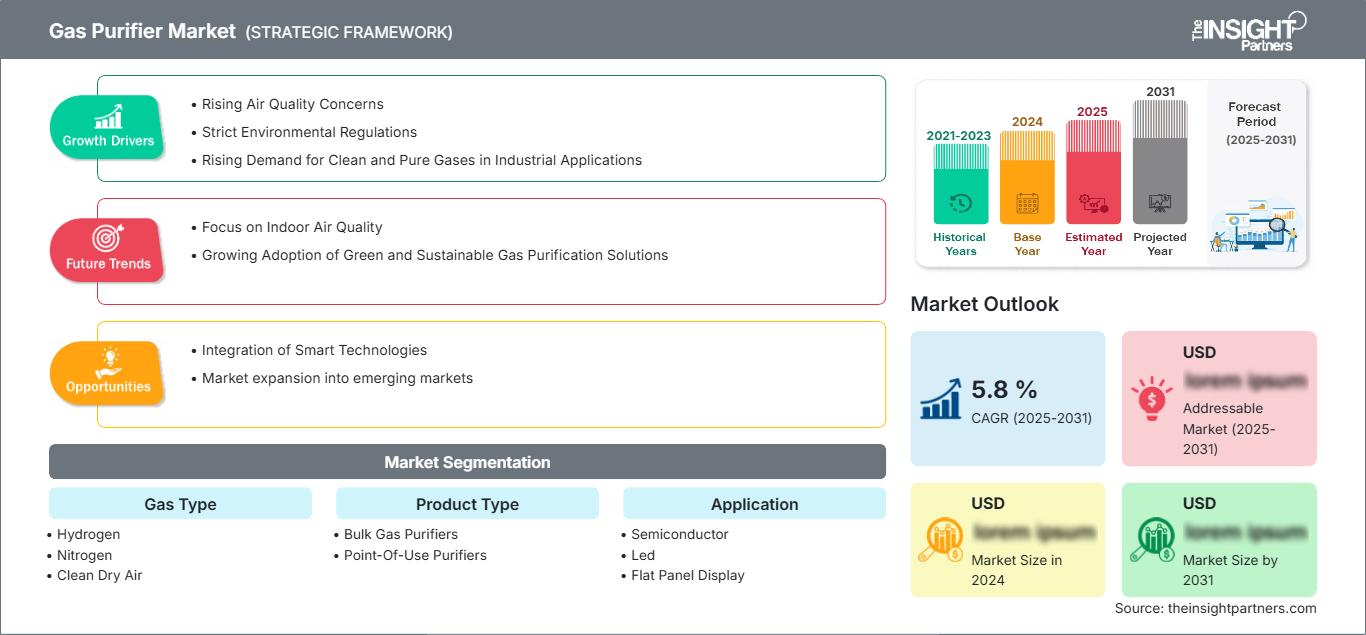
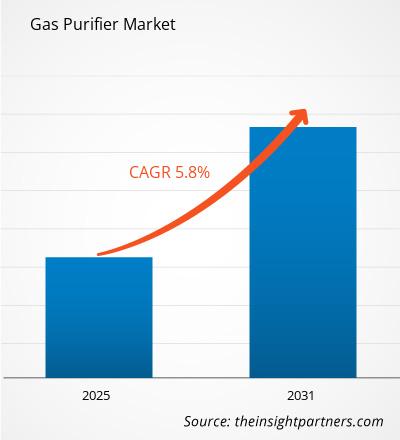
The Gas Purifier Market was valued at US$ 505.06 Million in 2025 and is projected to reach US$ 898.31 Million by 2034, registering a CAGR of 6.61% during 2026–2034. The demand is driven by requirements for contamination control in semiconductor, LED, flat-panel display, and industrial processes where trace moisture, oxygen, hydrocarbons, and particulate contamination could adversely affect yields, tool performance, and product quality. Bulk and on-site systems are critical infrastructure for high purity gas delivery.
The Gas Purifier Market Size in North America is projected to witness growth at a CAGR of 5.8% to 6.4% till 2034. Growth in Semiconductor capacity, increasing use of ultra-high purity process gases, and robust domestic supply chain initiatives will drive new installations. The replacement demand is bolstered by the adoption of regenerable media, on-line monitoring, and low-pressure drop purifiers.
Gas Purifier Market Assessment and Insights
- North America held 29–31% share in 2025 and is projected to grow at a 5.8–6.4% CAGR during 2026–2034, supported by semiconductor investment, analytical laboratories, and localized specialty-gas infrastructure.
- US represented 80–84% of North American revenue in 2025 and should expand at a 5.9–6.5% CAGR through 2034.
- Europe accounted for 24–26% share in 2025 and is expected to record a 5.3–5.9% CAGR, led by Germany, the UK, and France.
- Asia Pacific captured 35–38% share in 2025 and should advance at a 7.5–8.1% CAGR, led by China, Japan, South Korea, and India.
- Largest Segment Semiconductor held 49–53% market share in 2025 and is projected to post a 7.0–7.6% CAGR during 2026–2034.
- High Growth Segment Point-Of-Use Purifiers represented 42–46% market share in 2025 and are expected to grow at a 7.4–8.0% CAGR during 2026–2034.
- Key companies analyzed in detail: Entegris, Inc.; MATHESON TRI-GAS, INC.; Agilent Technologies, Inc.; Thermo Fisher Scientific Inc.; L’Air Liquide S.A.; Merck KGaA; Parker-Hannifin Corporation; Linde plc; Japan Pionics Co., Ltd.; and SAES Getters S.p.A.
Source: The Insight Partners' analysis based on proprietary research, government publications, company annual reports, investor presentations, industry databases, and expert interviews.
The development of gas purification has been towards more integrated cabinets which combine getter materials, catalysts, valves, detectors and changeover systems. There is a growing trend towards using modular platforms that can work with several flow rates and contamination levels without any need for redesigning. More regeneration activities are increasing the lifespan of the media, and better metrology ensures performance even at reduced levels of impurities. Such developments will bring the Gas Purifier market in alignment with continuous production lines, higher consumption of gases, and greater consideration of lifecycle costs.
Until 2034, the investments will be made in Asian semiconductor regions, US and Europe localization projects, as well as new electronics fabrication sites in India and South-East Asia. The environmental goals will drive development towards regenerable cylinders, energy efficient mass production of gases, and less material wastes. The increased attention to specialty gas availability will be beneficial for suppliers with regional service sites, media traceability and remote monitoring which helps scheduling maintenance before breakthrough.
Gas Purifier Market Report Scope
| Report Attribute | Details |
|---|---|
| Market size in 2025 | US$ 505.06 Million |
| Market Size by 2034 | US$ 898.31 Million |
| Global CAGR (2026 - 2034) | 6.61% |
| Historical Data | 2021-2024 |
| Forecast period | 2026-2034 |
Gas Purifier Market Analysis
The expansion of Gas Purifier Market stems from stringent contamination budgeting requirements for deposition, etching, epitaxy, lithography support, display fabrication, and precision industry applications. Gas purifier companies fall in the midst of industrial gases producers, media producers, valve and sensor makers, system integrators, and end customers. The performance of the purifier depends on flow rate, pressure, target contamination types, and gas chemistry, since a media formulation appropriate for nitrogen may not be so for reactive hydrogen or oxygen.
Vendor dynamics are in favor of companies that have the ability to qualify components, maintain spares, and facilitate exchange programs. Bulk systems make up engineering projects' sales, while point-of-use products help in maintaining service and replacement needs. The dual sourcing trend by customers for critical components notwithstanding, qualifications and compatibilities still secure incumbent positions.
The Gas Purifier Market Report shows the competition of comprehensive material experts and application-based players. Entegris, Inc. has expertise in filtration, purification, storage, and delivery. MATHESON TRI-GAS, INC., L’Air Liquide S.A., and Linde plc have a combination of purification and industrial-gas supplies. Agilent Technologies, Inc. and Thermo Fisher Scientific Inc. provide solutions for analytical process while Parker-Hannifin Corporation provides solutions through filtration and gas-handling engineering.
Differentiation includes validation of removal of impurities, vessel life expectancy, local regeneration, and field service reactivity. Specialized knowledge of materials comes from Merck KGaA, Japan Pionics Co., Ltd., and SAES Getters S.p.A. The investments include digital monitoring systems, lower pressure drop media, and application labs that speed up qualification process. Portfolio diversity is important, but performance data and installed base are key in case of contamination events stopping production.
● REPORT CUSTOMIZATION
Tailor This Report To Align With Your Specific Business Requirements
This report can be customized to align precisely with your business objectives, scope, and target markets. Customization options include tailored segmentation, geography, competitive analysis, and strategic insights to support informed decision-making.
Customize This Report →WHAT YOU CAN ADJUST
- ● Segmentations
- ● Geography
- ● Competitive Analysis
- ● Language Preferences
Gas Purifier Market: Strategic Insights
Regional Insights
North America Gas Purifier Market
North America accounted for a 29–31% of the Global Gas Purifier market Share in 2025 and is expected to record a CAGR of 5.8–6.4% over the forecast period (2024-2034). Semiconductor manufacturing, specialty gas manufacturing, analytical instrument, and advanced materials manufacturing applications are fueling demand. Fabrication facility construction creates demand for bulk nitrogen, hydrogen, and clean dry air purification systems, whereas existing facilities provide recurring revenue via purifier vessel replacement, regeneration, and contamination monitoring.
Safety certifications, responsive customer service, and performance verification are key considerations for regional procurement due to the risks associated with gas supply disruption or impurities entering the system. The United States drives consumption, with Canada adding through research, electronic, and industrial manufacturing applications. Mexico’s growing electronics manufacturing applications will drive limited adoption in certain point-of-use applications. Local stock, technical resources, and qualification labs favor supplier success.
U.S. Gas Purifier Market
The US accounted for 80-84% of North American market revenue in 2025 and will register a growth rate of 5.9-6.5% CAGR over 2026-2034. Big semiconductor projects, federal research centers, aerospace manufacturing industry, and traditional analytical instruments procurement support purchasing decisions. Leading players include Entegris, Inc., MATHESON TRI-GAS, INC., Agilent Technologies, Inc., Thermo Fisher Scientific Inc., and Parker-Hannifin Corporation, which have a solid presence in the market.
Applications are upgraded to high flow bulk systems for fab utilities along with small purification devices placed next to critical pieces of equipment. Customers look for automatic switching capabilities, minimal dead volume, certification of the media capacity, and fast exchange capabilities. Government promotion of semiconductor manufacturing inside the country is encouraging equipment certification; however, long construction and ramp-up periods mean that the purchase of purification devices will take place over several years.
Europe Gas Purifier Market
Europe generated 24–26% of world revenues in 2025 and will grow by 5.3–5.9% CAGR until 2034. Germany dominates with its semiconductor equipment, automotive electronics, research, and industrial gases. The UK is active in compound semiconductors and analytical labs, and France offers microelectronics, aerospace, specialty chemicals, and gas infrastructure with reliable deliveries of high-purity gases.
Italy and Spain provide demands from industrial manufacturing, universities, display-related research, and energy projects. Europeans start to look at energy consumption, media disposal, and regeneration together with efficiency of removals. Semiconductors investments in Europe promote large-scale deliveries, yet regulatory approvals and prolonged construction periods can hold up revenue generation. Suppliers that have EU service facilities and paperwork matching pressure equipment and chemical handling demands will be in the advantageous position.
APAC Gas Purifier Market
Asia Pacific has a share of 35-38% in 2025 and is expected to witness the fastest growth of 7.5-8.1% CAGR in the coming years. In electronics manufacturing, China has the highest share, whereas Japan and South Korea have the advanced semiconductor, display, and specialty gases ecosystem.
India with its fabs plans and electronics localization, along with Australia's support in research and industrial application makes the market scope larger. Policies and wafer fabrication capacity increase the need for purifiers, while the customers are interested in local services with impurity removal capabilities.
Middle East & Africa Gas Purifier Market
Middle East and Africa should register a 5.5–6.1% CAGR through 2034. Saudi Arabia leads through industrial diversification, hydrogen, refining, and advanced manufacturing, while the UAE develops specialty-gas, research, and electronics capabilities.
Contributions by South Africa include mining, laboratory services, gas distribution and industry processing whereas other countries under MEA rely on projects. For new investments in hydrogen and infrastructure, there is need for purification, but lack of local service capability may hinder such investments. Training, remote diagnostics and local stocking can help lower lifecycle risks.
Segmentation Analysis
Gas Type
The Gas Type segment is projected to grow at a 6.4–7.0% CAGR during 2026–2034. Gas Purifier Market scope encompasses hydrogen, nitrogen, clean dry air, helium, carbon dioxide, and oxygen, each requiring media and hardware compatible with distinct reactivity, moisture loads, flow rates, and purity thresholds. Adoption rises as users standardize validated gas trains and monitor breakthrough more closely.
- Hydrogen purification is strategically important for semiconductor processing, heat treatment, and emerging low-carbon supply chains, where oxygen, moisture, and hydrocarbons can affect safety and process stability.
- Nitrogen represents broad demand across inerting, purging, electronics, and laboratories, with bulk availability and high consumption supporting both central purification and distributed polishing systems.
- Clean Dry Air serves cleanrooms, pneumatic controls, and manufacturing utilities, where dependable dew point and particle control protect equipment and sensitive production environments.
- Helium requires conservation-focused purification for leak detection, analytical instruments, cooling, and research, making recovery compatibility and low pressure loss commercially significant.
- Carbon Dioxide purification supports electronics, food-related testing, laboratories, and specialty processes that require control of moisture, hydrocarbons, sulfur compounds, and particulates.
- Oxygen systems demand compatible materials and careful contaminant management, serving industrial, laboratory, and electronics processes where cleanliness, ignition risk, and reliability are critical.
Product Type
The Product Type segment should expand at a 6.5–7.1% CAGR through 2034. Bulk systems protect central distribution infrastructure and high-volume utilities, while point-of-use units provide final polishing close to sensitive tools. Digital monitoring, redundant vessels, and regeneration services improve uptime. Selection depends on facility scale, contaminant risk, acceptable pressure drop, and the cost of qualifying changes.
- Bulk Gas Purifiers hold a strong position in high-volume semiconductor and industrial sites, where centralized control, redundancy, and service planning deliver consistent quality across multiple process tools.
- Point-Of-Use Purifiers gain strategic importance by intercepting contamination near equipment, enabling application-specific polishing, shorter gas paths, and targeted upgrades without replacing entire facility systems.
Application
The Application segment is expected to register a 6.7–7.3% CAGR during 2026–2034. Semiconductor manufacturing leads because increasingly complex process flows multiply exposure to molecular contamination. LED and flat panel display production require stable high-purity gases for deposition and etching, while industrial users balance purity with throughput, safety, and operating cost.
- Semiconductor is the largest application, driven by advanced logic, memory, power devices, and compound semiconductors that require tightly controlled process gases to protect yield.
- LED manufacturing uses purified carrier and process gases to support epitaxial growth, deposition uniformity, device efficiency, and repeatable color and performance characteristics.
- Flat Panel Display demand reflects large-area deposition and etch processes, where stable gas quality helps control film properties, defect rates, and production consistency.
- Industrial applications span heat treatment, chemicals, laboratories, energy, and precision manufacturing, creating diverse requirements for ruggedness, maintainability, and application-specific contaminant removal.
Opportunity Snapshot
| Application | Revenue Contribution | Trend Tag | Adoption Stage |
| Semiconductor | High | Fab Purity | Scaling |
| LED | Medium | Epitaxy Control | Mature |
| Flat Panel Display | Medium | Large-Area Deposition | Mature |
| Industrial | Medium | Process Reliability | Scaling |
Gas Purifier Market Growth Drivers and Impact Analysis
Advanced Semiconductor Nodes Tighten Contamination Budgets
Advanced logic, memory, and compound semiconductor processes have more stages of fabrication and interactions between gases than the prior generations of device fabrication. With each new process, there is an additional chance that moisture, oxygen, particles, or hydrocarbons could affect the properties of the film and yield. Hence, purifiers become essential elements of manufacturing rather than additional units. While bulk purifiers take care of gas supply lines throughout the fab, point-of-use units polish gases at the end before their arrival to critical chambers. Commercial opportunities arise because increased consumption means increased demand for media replacement services.
Global Fab Expansion Broadens the Installed Base
The semiconductor capacity programs within the US, Europe, China, South Korea, Japan, India, and Southeast Asia increase the potential customer base for high purity gas systems. The purification orders start from the facility’s engineering phase, go on during the installation phase of the tools, and repeat in the ramp-up and maintenance phases. The localization strategy also makes regional manufacturing and servicing capacity of gases more common, offering benefits that go beyond equipment sales. This benefit applies especially to suppliers who are capable of working with the gases, facilities, and process tool companies.
Lifecycle Cost and Circularity Reshape Purchasing
Users are evaluating purifier economics across media life, pressure loss, energy use, service labor, waste handling, and downtime rather than relying on initial price. Regeneration can extend asset utilization and reduce replacement expenditure when performance is restored and documented. Dual-vessel cabinets enable service without interrupting gas delivery, making circular models operationally practical. This changes vendor incentives toward monitoring, return logistics, and certified refurbishment. Providers that combine lifecycle prediction with regional regeneration capacity can build recurring revenue while supporting customer sustainability targets. The result is stronger demand for serviceable systems and more scrutiny of disposable products.
Gas Purifier Market Future Trends
Predictive Breakthrough Monitoring
Gas Purifier Market trends will increasingly center on sensors, flow histories, and software models that estimate remaining media capacity before contaminants break through. Facilities will connect purifiers to maintenance systems, using actual duty cycles rather than fixed replacement intervals. Predictive monitoring can reduce premature changeouts, protect uptime, and help users compare media performance across tools and gases. Suppliers will differentiate through validated algorithms, secure data interfaces, and diagnostics that work without exposing sensitive process information. Over time, digital evidence of purifier health should become a procurement requirement for high-value semiconductor and industrial installations.
Application-Specific Regenerable Media
Future purifier platforms will use media engineered for narrower contaminant profiles, lower pressure drop, and repeated regeneration. Instead of treating all impurities uniformly, suppliers will optimize getter, catalyst, and adsorbent combinations for specific gases and process conditions. Modular vessels will permit targeted replacement while preserving cabinets, controls, and piping. This approach can improve total cost and reduce material waste, but it requires rigorous validation after each regeneration cycle. Companies with materials science, metrology, and local service capabilities will be best placed to scale these platforms across semiconductor, display, hydrogen, analytical, and specialty industrial applications.
Gas Purifier Market Opportunities
Regional Regeneration and Exchange Networks
Gas Purifier Market Forecasts support investment in regional centers that inspect, regenerate, certify, and exchange purifier vessels near semiconductor and industrial clusters. Shorter logistics cycles reduce spare inventory and improve response when capacity is exhausted unexpectedly. Investors should prioritize standardized vessels, documented chain of custody, and analytical metrology capable of verifying restored performance. Partnerships with gas suppliers and facility-service companies can aggregate demand and improve utilization. The model creates recurring revenue, strengthens customer retention, and lowers lifecycle waste, while avoiding the capital intensity of semiconductor fabrication. Success depends on safety compliance, process segregation, and reliable turnaround commitments.
Purification Infrastructure for Emerging Hydrogen Hubs
New hydrogen production, transport, and industrial-use projects create demand for purification that addresses moisture, oxygen, nitrogen compounds, carbon species, and particulates. Suppliers can target electrolyzer output polishing, ammonia-cracking streams, storage interfaces, fuel applications, and specialty manufacturing. Investment should focus on scalable skids, compatible materials, online quality monitoring, and service agreements suited to continuous operation. Partnerships with engineering contractors can embed purification early in plant design. Although specifications vary by end use, vendors that demonstrate flexible contaminant removal and predictable maintenance can establish reference projects before procurement practices standardize.
Recent Developments
- November 2025: Dyson has launched two new Hot+Cool air purification products in India, combining air-cleaning technology with heating and cooling functions. The new devices are designed to provide year-round indoor comfort while helping households manage rising concerns over indoor air pollution during the winter months. The products use advanced filtration technology to capture airborne pollutants and allergens, while intelligent sensors continuously monitor indoor air quality. The systems can automatically adjust their operation based on detected pollution levels, helping maintain cleaner indoor air.
- August 2026: Xiaomi has introduced a new smart home appliance that combines air purification and humidification in a single device. Called the Mijia Smart Air Purifier with Humidification Pro, the product is designed to improve indoor air quality while maintaining comfortable humidity levels. The appliance measures 32 × 32 × 81 cm and includes a quiet Sleep Mode that operates at just 14.6 dBA, making it suitable for bedrooms and other noise-sensitive spaces. It also incorporates a UV sterilisation system intended to help prevent bacteria from developing in the water used for humidification.
- November 2025: Dutch air-cleaning technology company Static Air, in partnership with Mumbai-based Klenviron Technologies, has launched a pilot project to test an outdoor air purification system in Jaipur. The initiative, approved by the Jaipur Municipal Corporation (JMC), began at Rambagh Circle on November 10 under a corporate social responsibility (CSR) programme.
Frequently Asked Questions

- Comprehensive Market Sizing and Forecast Analysis
- Detailed Segmentation Analysis
- In-Depth Market Dynamics Assessment
- Regional and Country-Level Insights
- Competitive Landscape and Company Benchmarking
- Strategic Business Intelligence
Recent Reports
Testimonials

The Insight Partners' SCADA System Market report is comprehensive, with valuable insights on current trends and future forecasts. The team was highly professional, responsive, and supportive throughout. We are very satisfied and highly recommend their services.
RAN KEDEM Partner, Reali Technologies LTDs
I requested a report on a very specific software market and the team produced the report in a few days. The information was very relevant and well presented. I then requested some changes and additions to the report. The team was again very responsive and I got the final report in less than a week.
JEAN-HERVE JENN Chairman, Future Analytica
We worked with The Insight Partners for an important market study and forecast. They gave us clear insights into opportunities and risks, which helped shape our plans. Their research was easy to use and based on solid data. It helped us make smart, confident decisions. We highly recommend them.
PIYUSH NAGPAL Sr. Vice President, High Beam Global
The Insight Partners delivered insightful, well-structured market research with strong domain expertise. Their team was professional and responsive throughout. The user-friendly website made accessing industry reports seamless. We highly recommend them for reliable, high-quality research services
YUKIHIKO ADACHI CEO, Deep Blue, LLC.
This is the first time I have purchased a market report from The Insight Partners.While I was unsure at first, I visited their web site and felt more comfortable to take the risk and purchase a market report.I am completely satisfied with the quality of the report and customer service. I had several questions and comments with the initial report, but after a couple of dialogs over email with their analyst I believe I have a report that I can use as input to our strategic planning process.Thank you so much for taking the extra time and making this a positive experience.I will definitely recommend your service to others and you will be my first call when we need further market data.
JOHN SUZUKI President and Chief Executive Officer, Board Director, BK Technologies
I wish to appreciate your support and the professionalism you displayed in the course of attending to my request for information regarding to infectious disease IVD market in Nigeria. I appreciate your patience, your guidance, and the fact that you were willing to offer a discount, which eventually made it possible for us to close a deal. I look forward to engaging The Insight Partners in the future, all thanks to the impression you have created in me as a result of this first encounter.
DR CHIJIOKE ONYIA MANAGING DIRECTOR, PineCrest Healthcare Ltd.Reason to Buy
- Informed Decision-Making
- Understanding Market Dynamics
- Competitive Analysis
- Identifying Emerging Markets
- Customer Insights
- Market Forecasts
- Risk Mitigation
- Boosting Operational Efficiency
- Strategic Planning
- Investment Justification
- Tracking Industry Innovations
- Aligning with Regulatory Trends





 Get Free Sample for