
GigE Camera Market Share, Growth & Forecast by 2034
Coverage: by Technology (Charge Coupled Device (CCD), Complementary Metal- Oxide - Semiconductor (CMOS)); Type (Line Scan, Area Scan); End User (Healthcare and Pharmaceutical, Military and Defense, Industrial, Traffic Security and Surveillance, Others) , and Geography (North America, Europe, Asia Pacific, and South and Central America)
- Status : Data Released
- Report Code : TIPRE00006249
- Category : Electronics and Semiconductor
- No. of Pages : 150
- Available Report Formats :


- Last update date : August 18, 2026


2025 Market Size
US$ 1.46 Bn
Base year value
2034 Forecast
US$ 2.67 Bn
Projected by 2034
CAGR 2026-2034
6.94 %
Growth rate
Addressable Market
US$ 18.65 Bn
(2026-2034)
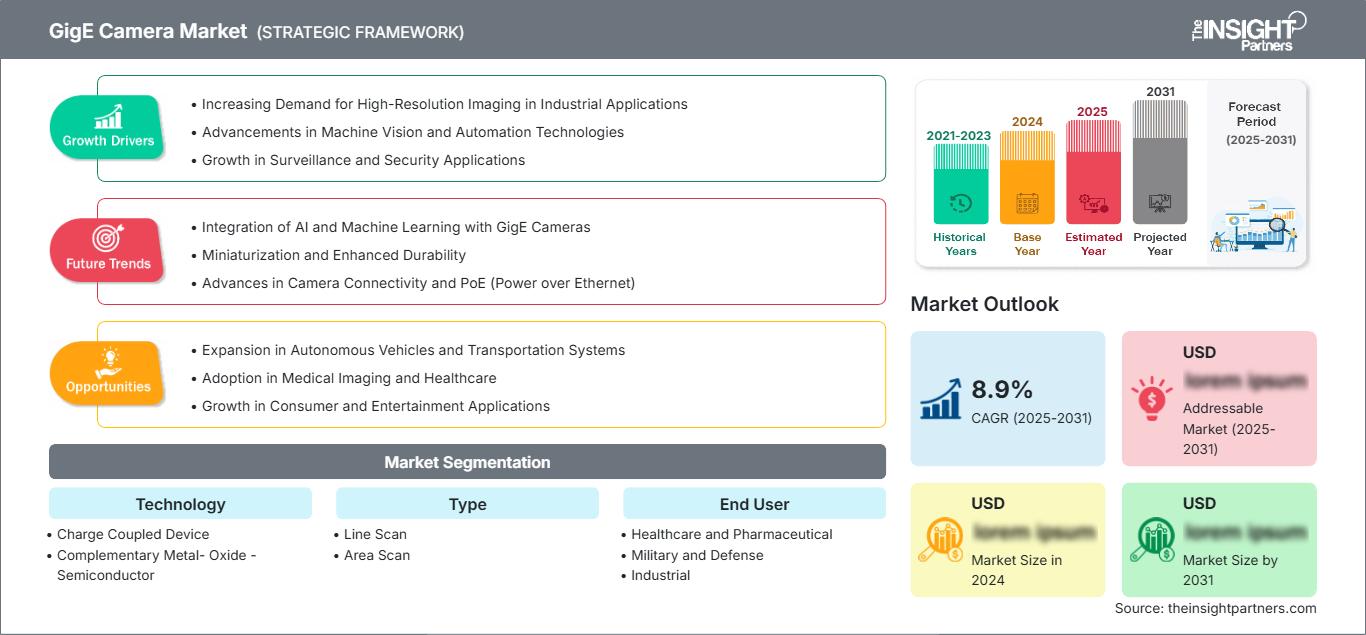
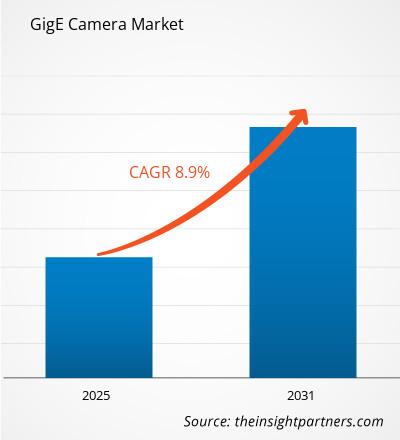
The global GigE Camera market was valued at US$ 1.46 billion in 2025 and is expected to reach US$ 2.67 billion by 2034; it is estimated to record a CAGR of 6.94% during 2026-2034.
GigE Camera Market Assessment and Insights
- North America accounted for 31–34% share in 2025 and is projected to grow at a CAGR of 6.2–6.9% during 2026–2034, supported by automated inspection, logistics vision, and defense modernization.
- US represented 79–83% of North America in 2025 and is expected to grow at a CAGR of 6.4–7.1% during 2026–2034, led by semiconductor, aerospace, and traffic applications.
- Europe held 25–28% share in 2025 and is forecast to expand at a CAGR of 5.9–6.6% during 2026–2034, with Germany, the UK, France, Italy, and Spain leading adoption.
- Asia Pacific captured 30–33% share in 2025 and is expected to grow at a CAGR of 8.2–9.1% during 2026–2034, driven by China, Japan, South Korea, India, and Australia.
- Largest Segment Complementary Metal-Oxide-Semiconductor held 63–67% market share in 2025 and is projected to grow at a CAGR of 7.6–8.4% during 2026–2034.
- High Growth Segment Line Scan held 33–37% market share in 2025 and is estimated to grow at a CAGR of 8.4–9.3% during 2026–2034.
- Key companies analyzed in detail: Allied Vision Technologies GmbH; Basler AG; Baumer Holding AG; Teledyne FLIR LLC; IMPERX, Inc.; JAI A/S; Sensor Technologies America, Inc.; Sony Group Corporation; Teledyne DALSA, Inc.; TOSHIBA TELI CORPORATION.
Source: The Insight Partners' analysis based on proprietary research, government publications, company annual reports, investor presentations, industry databases, and expert interviews.
GigE imaging has developed from standard factory vision into synchronized systems of multiple cameras being used in the fields of electronics, packaging, logistics, life sciences, and defense test ranges. Vendors are beginning to focus on producing cameras with CMOS sensors, smaller housing sizes, PoE interfaces, and increased band width products like 2.5GigE, 5GigE, 10GigE, and upcoming GigE Vision 3.0 platforms. This transition is simplifying the process of integration and maintaining the ability of GigE cameras to use long cables.
The future outlook for this market will see the increasing investment of money in manufacturing in Asia Pacific region, reshoring in North America, and automation in Europe, as well as expanding the potential pool of buyers. The regulatory requirements for product traceability in pharmaceuticals, road traffic safety, medical devices quality, and smart infrastructures are expected to facilitate the adoption of cameras.
GigE Camera Market Report Scope
| Report Attribute | Details |
|---|---|
| Market size in 2025 | US$ 1.46 Billion |
| Market Size by 2034 | US$ 2.67 Billion |
| Global CAGR (2026 - 2034) | 6.94% |
| Historical Data | 2021-2024 |
| Forecast period | 2026-2034 |
GigE Camera Market Analysis
The market growth drivers lie in the requirement of a dependable and standardized solution for capturing images on the manufacturing line, where any defect needs to be spotted to avoid costs at a later stage of production. The GigE interface continues to have a strong appeal due to the ability of Ethernet cabling to span up to 100 meters, enabling distributed inspection stations without the use of any specialized frame grabbers. The demand is greatest where high resolution, moderate to high frame rates and predictability in integration are valued over just bandwidth.
Supply factors include availability of the sensor, optic compatibility, advanced firmware, and compliance to the GigE Vision and GenICam ecosystem. The camera vendors have started offering an end-to-end solution with lenses, cables, illumination systems, software development kits, and validation services as well in order to reduce the commissioning time period.
From the Gige Camera Market report, there is high competition between Basler AG, Allied Vision Technologies GmbH, Teledyne DALSA, Inc., Baumer Holding AG, JAI A/S, Teledyne FLIR LLC, Sony Group Corporation, TOSHIBA TELI CORPORATION, IMPERX, Inc., and Sensor Technologies America, Inc. Their competitive advantage is derived from their products' bandwidths, sensors, ruggedness, software support, and regional application engineering. Strategic positioning has become increasingly reliant on vision platform solutions rather than just camera specifications.
The market is witnessing increasing investments in edge-based inspection systems, faster Ethernet protocols, SWIR technology, and smaller line scan solutions, especially for applications in electronics, battery, textiles, printing, and web inspections. Those companies having established product roadmaps and extensive channel coverage have an advantage in securing design-ins. The market favors those suppliers capable of offering lead-time stability and lifecycle protection for up to seven to ten years.
● REPORT CUSTOMIZATION
Tailor This Report To Align With Your Specific Business Requirements
This report can be customized to align precisely with your business objectives, scope, and target markets. Customization options include tailored segmentation, geography, competitive analysis, and strategic insights to support informed decision-making.
Customize This Report →WHAT YOU CAN ADJUST
- ● Segmentations
- ● Geography
- ● Competitive Analysis
- ● Language Preferences
GigE Camera Market: Strategic Insights
Regional Insights
North America Gige Camera Market
North America held 31–34% of the Gige Camera Market share in 2025 and is forecast to grow at a CAGR of 6.2–6.9% during 2026–2034. Adoption is concentrated in automated distribution centers, semiconductor fabrication, life sciences manufacturing, aerospace inspection, and traffic enforcement. The region benefits from experienced system integrators, strong machine vision standards adoption, and sustained replacement of analog and proprietary camera interfaces.
U.S. Gige Camera Market
The U.S. is estimated to be 79–83% of the total share of North America in 2025 and expected to grow at a CAGR of 6.4-7.1% over 2026-2034. The strong need for rugged area scan and line scan cameras arises from domestic electronics, aerospace, pharma, automotive, and defense projects. Suppliers will benefit from the presence in the U.S. market via sales and application engineering.
Europe Gige Camera Market
The share of Europe was estimated to be around 25-28% in 2025, with expected growth in the CAGR of 5.9-6.6% between 2026 and 2034. The country which is dominant in terms of demand includes Germany, which has a high need for automation in automotive, industrial machinery, inspection of electronics, and packaging. Other major countries which have high demand include the UK, France, Italy, and Spain.
APAC Gige Camera Market
APAC held a market share of 30–33% in 2025 and will witness an estimated CAGR of 8.2–9.1% over 2026-2034, providing the fastest-growing regional opportunity for the segment. China remains dominant due to the use of LIDAR in electronics, batteries, logistics, and surveillance applications. Japan and South Korea drive precision manufacturing, India boosts automation and road safety initiatives, and Australia drives mining and transport imaging.
Middle East & Africa Gige Camera Market
Demand from Middle East and Africa region is forecasted to rise at a CAGR of 5.5-6.3% for the period of 2026-2034, mainly driven by UAE and Saudi Arabia. Energy plants, ports, airports, smart city surveillance, and critical infrastructure surveillance drive demand. South Africa sees mining and industrial inspection applications, whereas the rest of the region sees project-based demand.
Segmentation Analysis
Technology
Technology is projected to grow at a CAGR of 7.0–7.8% during 2026–2034. The scope across technology is defined by the transition from legacy CCD platforms to CMOS architectures offering lower power use, higher frame rates, improved dynamic range, and stronger sensor availability. CCD remains relevant in niche scientific and high-uniformity imaging applications.
- Charge Coupled Device cameras retain demand in specialized imaging tasks requiring low noise, high uniformity, and stable image response, especially where installed systems value proven performance over new sensor economics.
- Complementary Metal-Oxide-Semiconductor cameras dominate new deployments because they support faster readout, compact designs, lower power consumption, and broader pricing flexibility for industrial, medical, and surveillance applications.
Type
Type is expected to grow at a CAGR of 7.2–8.0% during 2026–2034. Area scan cameras remain widely used across general inspection, microscopy, robotics, and traffic imaging, while line scan adoption is accelerating in continuous web, print, textile, battery, and electronics inspection. Selection depends on object motion, illumination, resolution, and total system architecture.
- Line Scan cameras are strategically important where moving materials require continuous inspection, including films, wafers, fabrics, labels, food streams, and battery components requiring high spatial consistency.
- Area Scan cameras remain the practical default for discrete part inspection, robot guidance, medical imaging, and security applications where two-dimensional image capture supports flexible object positioning.
End User
End User is forecast to grow at a CAGR of 7.1–7.9% during 2026–2034. Industrial users remain the largest adoption base due to inspection density across factories, while healthcare, pharmaceutical, defense, and traffic applications provide higher specification demand. Buyers evaluate reliability, software compatibility, timing precision, sensor performance, and supplier support before scaling deployments.
- Healthcare and Pharmaceutical users adopt cameras for laboratory automation, diagnostic instruments, vial inspection, packaging verification, and traceability systems requiring consistent imaging, compact form factors, and validated integration environments.
- Military and Defense applications emphasize ruggedized imaging for test ranges, surveillance, unmanned systems, target tracking, and situational awareness where long cable reach and synchronized capture improve operational flexibility.
- Industrial users represent broad demand across electronics, automotive, packaging, print, food, logistics, and battery production, where defect detection and process control directly reduce scrap and rework.
- Traffic Security and Surveillance deployments use GigE cameras for tolling, automatic number plate recognition, intersection monitoring, perimeter security, and smart city systems requiring networked imaging over longer distances.
Opportunity Snapshot
| End User | Revenue Contribution | Trend Tag | Adoption Stage |
| Healthcare and Pharmaceutical | Medium | Lab Vision | Scaling |
| Military and Defense | Medium | Rugged Imaging | Scaling |
| Industrial | High | Factory Inspection | Mature |
| Traffic Security and Surveillance | Medium | Smart Roads | Scaling |
| Others | Low | Research Imaging | Emerging |
GigE Camera Market Growth Drivers and Impact Analysis
Factory automation and quality inspection scale-up
As tolerances become tighter and the cost of rework increases, manufacturers are installing more automation inspection points. GigE cameras are an ideal combination of resolution, cable length, cost of the system and software integration. They have the biggest impact on the electronics industry, packaging, auto parts, food and battery manufacturing industries, in which it is necessary to capture visual defects on a moving line. With the growing digitalization of inspection records, standardized image capture is a useful tool for traceability and analysis. Advanced machine vision algorithms further enhance defect detection accuracy, enabling real-time quality control and reducing production downtime. These systems support predictive maintenance, process optimization, and regulatory compliance while providing valuable data for continuous improvement initiatives. High-speed imaging combined with AI-driven analytics helps manufacturers achieve greater efficiency, consistency, product reliability, and overall operational excellence.
Shift toward CMOS and higher-speed Ethernet variants
Enhancements in the CMOS sensor technology have increased frame rate, dynamic range, and sensitivity of the sensors and reduced the power requirements and costs of manufacturing. When used with 2.5 GigE, 5 GigE, 10 GigE and even future-proof communication protocols, these sensors enable users to increase the performance of their systems without having to move away from Ethernet-based infrastructure. The driver increases applications of line scan and area scan with high resolution and compact embedded systems. These advancements support demanding machine vision applications such as automated inspection, robotics guidance, semiconductor manufacturing, and intelligent transportation systems. Improved image quality and faster data transmission enable accurate detection of fine defects, higher throughput, and seamless integration with Industry 4.0 environments, delivering scalable and cost-effective solutions for modern industrial automation.
Expansion of smart infrastructure and regulated imaging
Effective traffic management, drug tracking, medical device testing, and critical infrastructure protection increasingly need network imaging systems that perform reliably. GigE cameras are suited to these applications as they have the capability to transmit video over greater lengths and use standard Ethernet networks. This results in a market effect of having customers in areas outside of industrial automation. Public works projects, traffic safety programs, and regulated manufacturing environments generate demand for imaging hardware and related services. In addition, the scalability of GigE camera networks allows easy deployment across distributed sites while maintaining centralized monitoring and data management. High-resolution imaging, low-latency transmission, and compatibility with advanced analytics software improve situational awareness, support regulatory compliance, enhance operational efficiency, and enable informed decision-making in mission-critical applications across diverse sectors.
GigE Camera Market Future Trends
Edge AI integration into networked vision systems
Gige Camera Market trends are moving toward cameras that operate as part of edge-enabled inspection cells rather than passive image capture devices. Processing will increasingly shift closer to the camera through embedded modules, smart triggers, and optimized data pipelines. This will reduce bandwidth pressure, accelerate defect decisions, and allow plants to deploy more inspection points without proportional increases in central computing. Vendors that pair cameras with software, AI tooling, and validated Ethernet components should gain stronger lifecycle relevance. In addition, edge-based architectures enhance system reliability by enabling localized decision-making and reducing dependence on centralized servers. Advanced onboard processing supports real-time analytics, anomaly detection, and adaptive inspection workflows. These capabilities improve manufacturing agility, minimize network congestion, strengthen data security, and enable scalable deployment of intelligent vision systems across diverse industrial automation environments.
GigE Vision 3.0 and scalable bandwidth adoption
The next technology shift will center on higher-speed Ethernet with reduced CPU load and better support for large image streams. GigE Vision 3.0 concepts, including remote direct memory access, are expected to help high-resolution cameras transmit data more efficiently across 10 Gbps, 25 Gbps, and future networks. This trend matters for semiconductor inspection, advanced materials, logistics automation, and scientific imaging, where bandwidth constraints can limit deployment density and inspection speed. Enhanced data transfer efficiency will enable real-time processing of high-volume imaging workloads, supporting greater scalability in complex machine vision systems. The adoption of faster Ethernet standards will also facilitate edge computing, cloud connectivity, and AI-based analytics. These capabilities can improve inspection accuracy, reduce latency, optimize resource utilization, and support the growing demand for high-performance imaging applications across industrial and research environments.
GigE Camera Market Opportunities
Line scan upgrades in batteries and electronics
Gige Camera Market Forecasts indicate that line scan upgrades offer strong investment potential in battery electrodes, printed circuit boards, displays, textiles, labels, and high-speed packaging. These environments require continuous imaging, uniform illumination, and precise synchronization with conveyor or web motion. Suppliers can capture value by offering compact cameras, validated optics, lighting, software tools, and integration support. The opportunity is action-oriented because buyers are replacing manual sampling with automated, full-surface inspection. Growing quality requirements, higher production speeds, and stricter regulatory standards are accelerating adoption across these industries. Advanced line scan systems enable early defect detection, reduce material waste, improve production yields, and support data-driven process optimization. Integration with artificial intelligence and machine learning further enhances inspection accuracy, operational efficiency, and long-term return on investment for manufacturers.
Regional application engineering and lifecycle services
Regional engineering coverage is becoming a differentiator as machine builders demand faster prototyping, local troubleshooting, and predictable lifecycle support. Suppliers can convert this requirement into recurring revenue by packaging camera selection, optics matching, lighting validation, firmware updates, and application-specific training. The opportunity is strongest in India, Southeast Asia, Mexico, Eastern Europe, and the Gulf, where automation projects are expanding but vision engineering resources remain uneven. Localized service models can reduce commissioning risk and improve long-term customer retention. Furthermore, the establishment of regional technical centers and certified partner networks enables faster response times and improved customer engagement. Access to local expertise helps manufacturers optimize system performance, accelerate deployment schedules, and minimize operational disruptions. As industrial automation adoption grows, comprehensive support services will become a key factor influencing purchasing decisions and fostering sustainable market growth.
Recent Developments
- August 2026: IDS Imaging Development Systems GmbH — introduced the next-generation uEye FA GigE Vision rugged industrial cameras with IP69K protection for factory automation. The cameras combine advanced imaging performance with durable construction for reliable operation in harsh industrial environments, including washdown, dusty, and high-vibration applications.
- July 2025: Vadzo Imaging — launched the Innova-544CRE embedded camera featuring Sony's IMX544 image sensor. The new camera delivers high-resolution imaging, enhanced low-light performance, and HDR capabilities for AI vision, robotics, industrial automation, and OEM machine vision applications.
- June 2026: Allied Vision Technologies GmbH — launched a GigE Vision 3.0 Device IP Core supporting 10 and 25 Gbps implementation with reduced receiver CPU load through remote DMA capabilities. The release targets developers building higher-throughput machine vision products and shortens time-to-market for compliant high-speed Ethernet imaging systems.
Frequently Asked Questions

- Comprehensive Market Sizing and Forecast Analysis
- Detailed Segmentation Analysis
- In-Depth Market Dynamics Assessment
- Regional and Country-Level Insights
- Competitive Landscape and Company Benchmarking
- Strategic Business Intelligence
Recent Reports
Testimonials

The Insight Partners' SCADA System Market report is comprehensive, with valuable insights on current trends and future forecasts. The team was highly professional, responsive, and supportive throughout. We are very satisfied and highly recommend their services.
RAN KEDEM Partner, Reali Technologies LTDs
I requested a report on a very specific software market and the team produced the report in a few days. The information was very relevant and well presented. I then requested some changes and additions to the report. The team was again very responsive and I got the final report in less than a week.
JEAN-HERVE JENN Chairman, Future Analytica
We worked with The Insight Partners for an important market study and forecast. They gave us clear insights into opportunities and risks, which helped shape our plans. Their research was easy to use and based on solid data. It helped us make smart, confident decisions. We highly recommend them.
PIYUSH NAGPAL Sr. Vice President, High Beam Global
The Insight Partners delivered insightful, well-structured market research with strong domain expertise. Their team was professional and responsive throughout. The user-friendly website made accessing industry reports seamless. We highly recommend them for reliable, high-quality research services
YUKIHIKO ADACHI CEO, Deep Blue, LLC.
This is the first time I have purchased a market report from The Insight Partners.While I was unsure at first, I visited their web site and felt more comfortable to take the risk and purchase a market report.I am completely satisfied with the quality of the report and customer service. I had several questions and comments with the initial report, but after a couple of dialogs over email with their analyst I believe I have a report that I can use as input to our strategic planning process.Thank you so much for taking the extra time and making this a positive experience.I will definitely recommend your service to others and you will be my first call when we need further market data.
JOHN SUZUKI President and Chief Executive Officer, Board Director, BK Technologies
I wish to appreciate your support and the professionalism you displayed in the course of attending to my request for information regarding to infectious disease IVD market in Nigeria. I appreciate your patience, your guidance, and the fact that you were willing to offer a discount, which eventually made it possible for us to close a deal. I look forward to engaging The Insight Partners in the future, all thanks to the impression you have created in me as a result of this first encounter.
DR CHIJIOKE ONYIA MANAGING DIRECTOR, PineCrest Healthcare Ltd.Reason to Buy
- Informed Decision-Making
- Understanding Market Dynamics
- Competitive Analysis
- Identifying Emerging Markets
- Customer Insights
- Market Forecasts
- Risk Mitigation
- Boosting Operational Efficiency
- Strategic Planning
- Investment Justification
- Tracking Industry Innovations
- Aligning with Regulatory Trends





 Get Free Sample for