
Hardware-based Full Disk Encryption Market Trends, Size & Growth by 2034
Coverage: By Product Type (External HDD, Internal HDD, Solid-state Drive); Application (Consumer electronics, IT and Telecom, Healthcare, Aerospace and Defense, Transportation, Others) , and Geography (North America, Europe, Asia Pacific, and South and Central America)
- Status : Data Released
- Report Code : TIPRE00021274
- Category : Electronics and Semiconductor
- No. of Pages : 150
- Available Report Formats :


- Last update date : August 25, 2026


2025 Market Size
US$ 55.42 Bn
Base year value
2034 Forecast
US$ 389.06 Bn
Projected by 2034
CAGR 2026-2034
24.18 %
Growth rate
Addressable Market
US$ 1,713.99 Bn
(2026-2034)
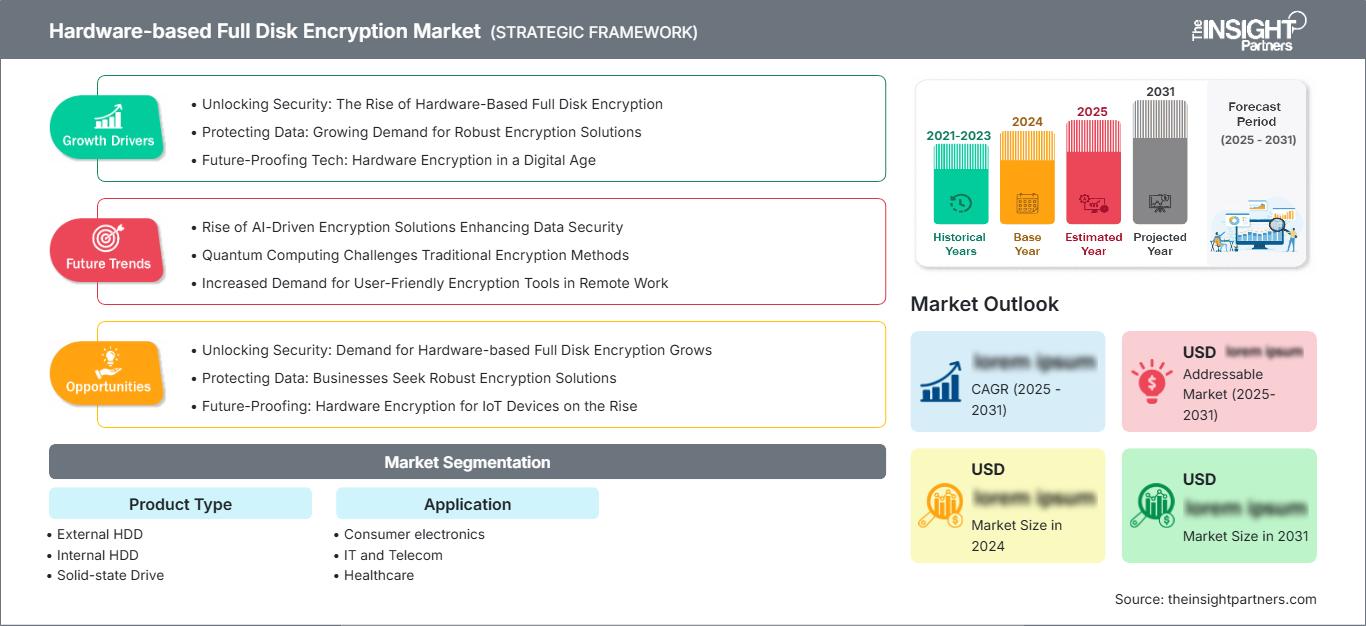
The Hardware-Based Full Disk Encryption Market size is estimated to be US$ 55.42 Billion in 2025 and will further be growing at a CAGR of 24.18%, to reach US$ 389.06 Billion by 2034. The Hardware-based encryption technology offers automatic encryption of entire storage media with the help of controllers and keys that are separate from the host processor, making sure of data-at-rest protection in external HDDs, internal HDDs, solid-state drives, consumer products, enterprise, healthcare, defense, and transportation segments.
In the region of North America, it is anticipated that the growth rate of the Hardware-Based Full Disk Encryption Market would be around 22.8-24.0% in the period of 2034. Enterprise zero-trust security programs, regulations related to data retention, and endpoint device refresh cycles will aid in the adoption of this technology. Self-encrypting drives also help in reducing the load on the host-processor and quick cryptographic erasure when redeploying the asset.
Hardware-based Full Disk Encryption Market Assessment and Insights
- North America held 28–31% share in 2025 and is projected to grow at a 22.8–24.0% CAGR during 2026–2034, supported by regulated workloads, enterprise endpoint refreshes, and hyperscale storage investment.
- US represented 82–86% of North American revenue in 2025 and should expand at a 23.0–24.2% CAGR through 2034.
- Europe accounted for 21–24% share in 2025 and is expected to record a 22.0–23.4% CAGR, led by Germany, the UK, and France.
- Asia Pacific captured 35–39% share in 2025 and should advance at a 25.5–27.0% CAGR, led by China, South Korea, Japan, and India.
- Largest Segment Solid-state Drive held 46–50% market share in 2025 and is projected to post a 25.5–27.0% CAGR during 2026–2034.
- High Growth Segment IT and Telecom represented 30–34% market share in 2025 and is expected to grow at a 25.8–27.4% CAGR during 2026–2034.
- Key companies analyzed in detail: Western Digital Corporation; Samsung Electronics Co., Ltd.; Micron Technology, Inc.; NetApp, Inc.; Kingston Technology Company, Inc.; Seagate Technology Holdings plc; Kioxia Corporation; Kanguru Solutions; Intel Corporation; and Analog Devices, Inc.
Source: The Insight Partners' analysis based on proprietary research, government publications, company annual reports, investor presentations, industry databases, and expert interviews.
The security of storage is evolving from software-driven encryption to architectures that have encryption performed at the level of the controller and which encrypt every sector of the drive all the time, authentication and key management separate from the operating system. The dynamics of production will continue to favor solid-state drives (SSDs), comprised of NAND, controllers, firmware, and standards-based management. Internal hard disk drives will stay relevant in arrays where the density of capacity is important, while encrypted external drives will be used by portable processes.
Until 2034, investments must be targeted towards Asian electronics clusters, North American clouds, regulated sectors in Europe, and emerging markets in digital services. Data protection and secure disposal will become key regulatory elements and thus increase the demand. Suppliers who can demonstrate secure firmware and lifecycle management of keys and administration based on standards will be preferred.
Hardware-based Full Disk Encryption Market Report Scope
| Report Attribute | Details |
|---|---|
| Market size in 2025 | US$ 55.42 Billion |
| Market Size by 2034 | US$ 389.06 Billion |
| Global CAGR (2026 - 2034) | 24.18% |
| Historical Data | 2021-2024 |
| Forecast period | 2026-2034 |
Hardware-based Full Disk Encryption Market Analysis
The market for Hardware-Based Full Disk Encryption is driven by growing risk exposure to data at rest in laptops, servers, storage systems, medical devices, avionics equipment, and automobiles. The supply chain includes NAND and disk media suppliers, controller suppliers, firmware suppliers, drive manufacturers, systems builders, security managers, and regulated users. Increasing value creation includes trusted keys, transparent encryption, boot security, policy enforcement, and media sanitization.
There are differences in the supply chain per product type. Solid-state drives (SSDs) have NAND supply cycles and controller qualification considerations. Enterprise hard disk drives (HDDs) have extensive platform validation and predictable capacity roadmap needs. Encrypted external drives need an enclosure as well as authentication and tampering considerations. Customers increasingly prefer standards-based self-encrypting drives but proper credential management and host system compatibility matter.
Hardware-Based Full Disk Encryption Market analysis reveals competition at the level of components, devices, and systems. The companies competing at the level of storage include Western Digital Corporation, Seagate Technology Holdings plc, Samsung Electronics Co., Ltd., Micron Technology, Inc., Kioxia Corporation, and Kingston Technology Company, Inc. At the array level, NetApp, Inc. provides the solution while Kanguru Solutions concentrates on portable storage.
The competitive strategy includes certification of cryptography, firmware, capacity, interface performance, and centralization of management. Intel Corporation supports platform security technology and the company, Analog Devices, Inc., acquired Maxim Integrated Products, Inc. is providing technologies in terms of trusted hardware. Investments are being made in preparation for quantum computing, supply chain attestation, and lifecycle control in order to transform encryption from a drive technology to an enterprise service.
● REPORT CUSTOMIZATION
Tailor This Report To Align With Your Specific Business Requirements
This report can be customized to align precisely with your business objectives, scope, and target markets. Customization options include tailored segmentation, geography, competitive analysis, and strategic insights to support informed decision-making.
Customize This Report →WHAT YOU CAN ADJUST
- ● Segmentations
- ● Geography
- ● Competitive Analysis
- ● Language Preferences
Hardware-based Full Disk Encryption Market: Strategic Insights
Regional Insights
North America Hardware-Based Full Disk Encryption Market
The North American region will account for 28-31% of the Hardware-Based Full Disk Encryption Market share in 2025 and is expected to register a CAGR of 22.8-24.0% during 2025-2034. The market growth is driven by factors such as enterprise endpoint replacement, cloud data centers, and strict regulations for health care, defense, financial, and public sector information. Hardware-based disk encryption decreases performance overheads and provides fast crypto erase when hard disks are repurposed or retired.
North American purchases focus on FIPS-certified solutions, reliable firmware, central key management, and interoperability with current storage controllers. The United States dominates in terms of consumption, whereas Canada and Mexico offer enterprise and regulated research needs and electronics & automotive manufacturing, respectively. Suppliers who have local qualification capabilities and logistics and return solutions stand out to capitalize on refresh demand since consumers consider the protection throughout installation, use, and decommissioning.
U.S. Hardware-Based Full Disk Encryption Market Market
The US represented 82–86% of North American revenue in 2025 and is expected to grow at a 23.0–24.2% CAGR during 2026–2034. Large cloud operators, federal agencies, defense contractors, healthcare networks, and telecom carriers create broad demand. Western Digital Corporation, Seagate Technology Holdings plc, Micron Technology, Inc., NetApp, Inc., Kingston Technology Company, Inc., Intel Corporation, and Analog Devices, Inc. maintain substantial commercial presence.
Application patterns are shifting toward encrypted NVMe SSDs in high-performance endpoints and servers, complemented by high-capacity SED HDDs in storage tiers. Healthcare buyers prioritize patient-data confidentiality, defense programs require certified controls, and transportation operators secure diagnostic and operational records at the edge. Procurement increasingly links drive selection with identity systems, recovery procedures, telemetry, and end-of-life sanitization.
Europe Hardware-Based Full Disk Encryption Market Market
The region represented 21-24% of global revenues in 2025 and is projected to grow at a CAGR of 22.0-23.4% through 2034. Leading in Europe due to its focus on industrial digitization, automotive electronics, cloud infrastructure, and strong governance of enterprises. The UK contributes with finance, defense, and data center demand, while France helps with aerospace, health care, telecommunications, and sovereign cloud needs, which require encryption and key management.
Italy and Spain are helping by providing public administration, transportation, health care modernization, and digital infrastructure expansion. European buyers see encryption not only as a means of control but as a part of larger governance aligned with GDPR, where separation of access, incident management, and proper disposal are key factors. Suppliers who can deliver audited firmware, multi-language capabilities, regional assistance, and standards compatibility would thrive when organizations update their diverse legacy fleet to centrally governed encrypted storage.
APAC Hardware-Based Full Disk Encryption Market Market
Asia Pacific held 35–39% share in 2025 and is forecast to grow at a 25.5–27.0% CAGR, the fastest regional pace. China leads through electronics production and cloud capacity, while South Korea and Japan contribute advanced NAND, SSD, and system manufacturing.
India’s digital-services expansion and local manufacturing widen demand, while Australia supports regulated enterprise and defense adoption. Data-localization policies, mobile work, AI infrastructure, and regional supply chains increase encrypted-drive deployment. Buyers balance cost with certification, manageability, and dependable firmware support.
Middle East & Africa Hardware-Based Full Disk Encryption Market Market
Middle East and Africa should register a 21.0–22.6% CAGR through 2034. Saudi Arabia leads through digital government, cloud investment, defense modernization, and industrial diversification, while the UAE develops regional data-center, aviation, finance, and smart-infrastructure capabilities.
South Africa contributes banking, telecom, healthcare, and public-sector demand; the rest of MEA remains project-driven. Energy and infrastructure operators need secure edge storage across dispersed assets, but limited integration capability can constrain adoption. Managed key services, channel training, and durable external drives can lower deployment risk.
Segmentation Analysis
Product Type
The Product Type segment is projected to grow at a 24.2–25.6% CAGR during 2026–2034. Hardware-Based Full Disk Encryption Market scope covers external HDDs, internal HDDs, and solid-state drives, each balancing capacity, mobility, interface performance, security certification, and lifecycle cost. SSD adoption accelerates with endpoint and server modernization, while encrypted HDDs retain strategic roles in portable backup and capacity-oriented enterprise storage.
- External HDD demand comes from portable backup, field operations, small businesses, and regulated users requiring physical mobility, password-controlled access, and hardware isolation without host-dependent software.
- Internal HDD remains important for high-capacity servers, NAS, archival tiers, and surveillance infrastructure where self-encryption supports secure redeployment, warranty return, and retirement at favorable cost per terabyte.
- Solid-state Drive leads adoption across laptops, workstations, edge systems, and data centers because encrypted NVMe and SATA platforms combine low latency, compact form factors, and transparent security.
Application
The Application segment should expand at a 24.5–25.9% CAGR through 2034. Adoption varies with data sensitivity, device mobility, operational continuity, certification requirements, and administrative maturity. IT and telecom deploy encrypted storage at scale, while healthcare, aerospace and defense, and transportation prioritize confidentiality under physical-loss scenarios. Consumer electronics benefits as security becomes embedded and increasingly transparent.
- Consumer electronics adoption centers on laptops, personal storage, gaming systems, and premium portable drives, where automatic encryption must remain simple, power-efficient, and compatible with familiar recovery workflows.
- IT and Telecom represents the largest opportunity through servers, employee endpoints, edge nodes, and storage arrays, with centralized policy, cryptographic erase, and fleet-scale manageability shaping procurement.
- Healthcare demand reflects protected health information on mobile workstations, diagnostic equipment, and departmental servers, making transparent encryption, auditability, and reliable credential recovery strategically important.
- Aerospace and Defense requires rugged, certified, and tamper-resistant storage for mission systems, engineering data, field devices, and maintenance records where physical capture or loss is material.
- Transportation uses encrypted drives in connected vehicles, aviation, rail, logistics, and roadside infrastructure, protecting operational, passenger, mapping, and diagnostic data across distributed assets.
Opportunity Snapshot
| Application | Revenue Contribution | Trend Tag | Adoption Stage |
| Consumer electronics | Medium | Embedded Security | Scaling |
| IT and Telecom | High | Fleet Encryption | Mature |
| Healthcare | Medium | Clinical Endpoints | Scaling |
| Aerospace and Defense | High | Mission Data | Mature |
| Transportation | Medium | Edge Mobility | Emerging |
Hardware-based Full Disk Encryption Market Growth Drivers and Impact Analysis
Regulation Makes Data-at-Rest Protection a Default Control
In terms of privacy, healthcare, governmental, military and critical infrastructure regulation, data at rest is required in addition to data in transit. By performing cryptographic functions within the disk drive itself, hardware encryption provides tighter controls by limiting reliance on the integrity of the operating system. The market effects go well beyond purchasing of additional hardware since compliance officers will review backup, logging, disposition of media and even recovery. Suppliers offering validation of the cryptographic module, standards-based management, firmware signing and proper audit documentation can help buyers move through their qualification processes faster. Buyers benefit especially in situations where mobile devices or removable storage can be lost and the use of cryptographic erase enables reuse of the device.
Cloud, AI, and Edge Infrastructure Expand Secure Storage Fleets
Training of AI systems, cloud computing operations, telecommunications infrastructure, and edge deployment within industries are driving an increase in storage devices with critical information. Self-Encrypting SSD and HDD devices ensure protection of data constantly without requiring any additional efforts on the host system, especially when it comes to performance-driven applications. Moreover, having large numbers of drives creates challenges concerning drive returns, segregation of tenants, and fast repurposing. All these tasks could be performed faster using cryptographic erase as it invalidates encryption keys instead of erasing every single sector. For manufacturers, encryption being pre-qualified on servers and storage arrays is very helpful for marketing purposes.
Device Mobility Raises the Cost of Physical Data Loss
In remote work scenarios, field services, portable diagnostic tests, aircraft maintenance, and connected transportation, the secure storage environment is no longer confined within the controlled facility. Data can be compromised even if the network defenses stay intact by the theft of a laptop or disconnection of the drive. Full disk hardware encryption technology is ideally suited to tackle this issue because data remains encrypted as long as the media is disconnected from the original computer. The business case is strongest in applications involving external drives, mobile computers, ruggedized computers, and departmental servers where there is little or no security support staff.
Hardware-based Full Disk Encryption Market Future Trends
Post-Quantum and Attested Storage Security
Hardware-Based Full Disk Encryption Market trends will increasingly include post-quantum-ready authentication, signed firmware, device identity, and platform attestation. Encryption engines will remain optimized for data throughput, while surrounding trust mechanisms evolve to resist supply-chain compromise and future cryptographic threats. Enterprise buyers will seek evidence that drives boot approved code, expose trustworthy health data, and integrate with confidential-computing architectures. Standards bodies and certification programs will influence adoption pace because premature proprietary implementations create interoperability risk. Over time, secure storage will be measured not only by encryption strength but also by provable device provenance, update integrity, and controlled communication with host platforms.
Policy Automation Across Mixed Storage Fleets
Future deployments will treat encrypted drives as managed identities within zero-trust infrastructure rather than isolated components. Administration tools will discover capable devices, verify firmware, enforce authentication, rotate credentials, and record cryptographic erase events across laptops, servers, arrays, and edge systems. Automation will reduce configuration gaps that currently weaken otherwise strong hardware. Vendors will expose interoperable interfaces while protecting sensitive keys within trusted boundaries. Analytics may identify devices that drift from policy or approach retirement. This transition favors suppliers able to connect storage hardware with enterprise identity, asset-management, and security operations platforms without creating a single, fragile control point.
Hardware-based Full Disk Encryption Market Opportunities
Managed Encryption for Midmarket and Regulated Operators
Hardware-Based Full Disk Encryption Market Forecasts support investment in managed services that bundle preconfigured drives, credential escrow, policy monitoring, replacement logistics, and certified cryptographic erase. Midmarket healthcare providers, regional telecom operators, transportation fleets, and engineering firms often need strong controls but lack dedicated storage-security teams. Channel partners can create recurring revenue by integrating hardware with identity systems and asset registers. Service design should preserve customer ownership of keys, define emergency recovery, and document every administrative action. Vendors that standardize onboarding across mixed endpoints and servers can lower deployment friction while extending enterprise-grade protection beyond organizations able to operate complex key-management infrastructure independently.
Secure Edge Storage for Transportation and Defense
Connected vehicles, aircraft, rail systems, drones, and remote defense platforms generate operational data in physically exposed environments. Suppliers can target rugged encrypted SSDs, removable mission modules, secure logging appliances, and controlled depot workflows. Investment should prioritize shock resistance, low power use, deterministic performance, tamper evidence, and authentication that remains practical during field operations. Partnerships with system integrators can embed encryption early in platform design, avoiding retrofits. Lifecycle services are equally important because failed or retired media may contain sensitive routes, diagnostics, imagery, or maintenance records. Reference deployments with auditable erase and recovery procedures can establish credibility before broader fleet standardization.
Recent Developments
- July 2026: Apricorn has introduced a new 4TB version of its Aegis Secure Key 3 (ASK3), expanding high-capacity secure storage in a compact USB drive form factor. The company says the device offers substantially more capacity than comparable hardware-encrypted USB flash drives while maintaining a pocket-sized design. The new drive uses a mini solid-state drive architecture and provides hardware-based encryption with software-free authentication. Apricorn says the device has been designed to meet or exceed FIPS 140-3 Level 3 requirements and has been submitted for validation through the U.S. National Institute of Standards and Technology's Cryptographic Module Validation Program.
- December 2022: Microsoft is rolling out hardware-accelerated BitLocker for supported Windows 11 and Windows Server 2025 systems, aiming to reduce the performance impact of full-drive encryption on modern high-speed NVMe SSDs. Traditional BitLocker encryption relies heavily on the CPU to handle encryption and decryption. As SSD speeds have increased, this processing can become a bottleneck. Microsoft’s new approach shifts much of the cryptographic workload to hardware capabilities built into newer processors and system-on-chip platforms, freeing CPU resources for other tasks.
- January 2026: Microsoft is introducing hardware-accelerated BitLocker support in Windows 11, with Intel Core Ultra Series 3 “Panther Lake” processors among the first platforms to support the technology. The move is designed to improve storage performance while maintaining strong data protection. Traditional BitLocker encryption can place additional workloads on the CPU, an issue that has become more noticeable as high-performance NVMe SSDs deliver increasingly faster read and write speeds. Microsoft’s new approach moves much of the cryptographic processing to dedicated security capabilities within supported system-on-chip platforms.
Frequently Asked Questions

- Comprehensive Market Sizing and Forecast Analysis
- Detailed Segmentation Analysis
- In-Depth Market Dynamics Assessment
- Regional and Country-Level Insights
- Competitive Landscape and Company Benchmarking
- Strategic Business Intelligence
Recent Reports
Testimonials

The Insight Partners' SCADA System Market report is comprehensive, with valuable insights on current trends and future forecasts. The team was highly professional, responsive, and supportive throughout. We are very satisfied and highly recommend their services.
RAN KEDEM Partner, Reali Technologies LTDs
I requested a report on a very specific software market and the team produced the report in a few days. The information was very relevant and well presented. I then requested some changes and additions to the report. The team was again very responsive and I got the final report in less than a week.
JEAN-HERVE JENN Chairman, Future Analytica
We worked with The Insight Partners for an important market study and forecast. They gave us clear insights into opportunities and risks, which helped shape our plans. Their research was easy to use and based on solid data. It helped us make smart, confident decisions. We highly recommend them.
PIYUSH NAGPAL Sr. Vice President, High Beam Global
The Insight Partners delivered insightful, well-structured market research with strong domain expertise. Their team was professional and responsive throughout. The user-friendly website made accessing industry reports seamless. We highly recommend them for reliable, high-quality research services
YUKIHIKO ADACHI CEO, Deep Blue, LLC.
This is the first time I have purchased a market report from The Insight Partners.While I was unsure at first, I visited their web site and felt more comfortable to take the risk and purchase a market report.I am completely satisfied with the quality of the report and customer service. I had several questions and comments with the initial report, but after a couple of dialogs over email with their analyst I believe I have a report that I can use as input to our strategic planning process.Thank you so much for taking the extra time and making this a positive experience.I will definitely recommend your service to others and you will be my first call when we need further market data.
JOHN SUZUKI President and Chief Executive Officer, Board Director, BK Technologies
I wish to appreciate your support and the professionalism you displayed in the course of attending to my request for information regarding to infectious disease IVD market in Nigeria. I appreciate your patience, your guidance, and the fact that you were willing to offer a discount, which eventually made it possible for us to close a deal. I look forward to engaging The Insight Partners in the future, all thanks to the impression you have created in me as a result of this first encounter.
DR CHIJIOKE ONYIA MANAGING DIRECTOR, PineCrest Healthcare Ltd.Reason to Buy
- Informed Decision-Making
- Understanding Market Dynamics
- Competitive Analysis
- Identifying Emerging Markets
- Customer Insights
- Market Forecasts
- Risk Mitigation
- Boosting Operational Efficiency
- Strategic Planning
- Investment Justification
- Tracking Industry Innovations
- Aligning with Regulatory Trends





 Get Free Sample for