
Harvesting Robot Market Demand, Share & Growth by 2034
Coverage: By Type (Unmanned Aerial Vehicles (UAVs), Milking Robots, Driverless Tractors, Automated Harvesting Systems, Other Robots); Farm Produce (Fruits and Vegetables, Field Crops, Livestock, Others); Application (Harvest Management, Field Farming, Dairy and Livestock Management, Irrigation Management, Others) , and Geography (North America, Europe, Asia Pacific, and South and Central America)
- Status : Data Released
- Report Code : TIPRE00026021
- Category : Electronics and Semiconductor
- No. of Pages : 150
- Available Report Formats :


- Last update date : August 19, 2026


2025 Market Size
US$ 2.59 Bn
Base year value
2034 Forecast
US$ 13.78 Bn
Projected by 2034
CAGR 2026-2034
20.41 %
Growth rate
Addressable Market
US$ 66.02 Bn
(2026-2034)
The Harvesting Robot Market is projected to grow from US$ 2.59 Billion in 2025 to US$ 13.78 Billion by 2034, registering a CAGR of 20.14% during 2026–2034. Adoption continues to rise as farmers adopt automation for labor-intensive crop harvesting, field monitoring, dairy farming, and harvest management tasks on premium farms and field-crop farms along with livestock farms that are becoming increasingly dependent on data.
In North America, Harvesting Robot Market size growth is driven by continuing labor challenges on farms, the mechanization of specialty crops, and increased machine vision capabilities with self-driving machines. It is anticipated that the region will grow at a CAGR of 19.5-20.5% in 2026-2034, while U.S. farmers emphasize robotic picking, automatic harvesting setup, UAVs, and livestock automation.
Harvesting Robot Market Assessment and Insights
- North America held 37–39% share in 2025 and is growing at a CAGR range of 19.5–20.5% during 2026–2034, supported by labor scarcity, large mechanized farms, and rapid autonomy integration.
- US represented 78–82% of North America in 2025 and is growing at a CAGR range of 19.8–20.8% during 2026–2034 through specialty crop and combine automation.
- Europe accounted for 27–29% share in 2025 and is growing at a CAGR range of 18.6–19.6% during 2026–2034, led by Germany, France, the UK, Italy, and Spain.
- Asia Pacific captured 22–24% share in 2025 and is growing at a CAGR range of 21.2–22.2% during 2026–2034, with China, Japan, South Korea, India, and Australia leading adoption.
- Largest Segment Automated Harvesting Systems held 35–38% market share in 2025 and is growing at a CAGR range of 19.7–20.7% during 2026–2034.
- High Growth Segment Harvest Management held 29–32% market share in 2025 and is growing at a CAGR range of 21.4–22.4% during 2026–2034.
- Key companies analyzed in detail: AgEagle Aerial Systems Inc.; AgJunction LLC; BouMatic LLC; CNH Industrial N.V.; Deepfield Robotics; Harvest Automation Inc.; Deere & Company; Naïo Technologies SAS; Harvest CROO, LLC; Trimble Inc.; YANMAR HOLDINGS CO., LTD.
Source: The Insight Partners' analysis based on proprietary research, government publications, company annual reports, investor presentations, industry databases, and expert interviews.
Technology innovation has led to the maturing of the Harvesting Robot from prototyping to interconnected systems with computer vision, LiDAR, GPS, edge computing, and robotic end effectors. The manufacturing trends have been moving from just selling the robot itself to selling a combination of autonomy, analytics subscription, and services. This innovation has increased efficiency in harvesting robots and decreased payback periods while giving farmers a chance to combine harvesting, scouting, routing of the fleet, and quality control into a single process.
The future demand growth will expand further than early adopters due to mechanization programs in Asia Pacific, sustainability regulations in Europe, and labor regulations in North America supporting investments in automation. Investors' interest in specialty crops, autonomous tractors, and dairy robotics is driven by the ability of these applications to turn apparent barriers into tangible increases in productivity. Tailwinds in the market will come from the farms which need reliable harvest quality, minimal downtime, decreased crop losses, and data collection.
Harvesting Robot Market Report Scope
| Report Attribute | Details |
|---|---|
| Market size in 2025 | US$ 2.59 Billion |
| Market Size by 2034 | US$ 13.78 Billion |
| Global CAGR (2026 - 2034) | 20.41% |
| Historical Data | 2021-2024 |
| Forecast period | 2026-2034 |
Harvesting Robot Market Analysis
Robotics for Harvesting Machines Growth is driven by farms experiencing labor shortage issues, wage pressures, and strict quality standards for their crops. Highest demand is observed in those segments where harvesting speeds influence revenues such as fruit, vegetable, dairy farming and large acreage field crops. Robotics enables precision agriculture by gathering crop condition information at the same time as performing practical tasks.
The supply chain comprises machine manufacturers, autonomous software providers, sensor manufacturers, equipment dealers, agronomy platforms and farmers. Standardization in cameras, processors and navigational equipment is developing in supply chain dynamics. However, commercialization requires robust robotics, specific gripping for different crops, access to finance and servicing networks in the fields for the harvest period.
Competitive positioning in the Harvesting Robot Market Report involves companies that combine machinery knowledge and software. For instance, companies such as Deere & Company, CNH Industrial N.V., Trimble Inc., and YANMAR HOLDINGS CO., LTD. have benefited from their well-established networks of dealers. On the other hand, Harvest CROO, LLC, Naïo Technologies SAS, Deepfield Robotics, and Harvest Automation Inc. rely on unique crop and task automation strategies.
The trend for investment in the industry is going towards systems where the operators need not be dependent upon them and which will help them gather data from the fields using technology. This is done by companies like AgEagle Aerial Systems Inc., Trimble Inc. and BouMatic LLC, whereas AgEagle Aerial Systems Inc. and Trimble Inc. concentrate on remote sensing and guiding systems and BouMatic LLC on dairy automation.
● REPORT CUSTOMIZATION
Tailor This Report To Align With Your Specific Business Requirements
This report can be customized to align precisely with your business objectives, scope, and target markets. Customization options include tailored segmentation, geography, competitive analysis, and strategic insights to support informed decision-making.
Customize This Report →WHAT YOU CAN ADJUST
- ● Segmentations
- ● Geography
- ● Competitive Analysis
- ● Language Preferences
Harvesting Robot Market: Strategic Insights
Regional Insights
North America Harvesting Robot Market
North America accounted for 37–39% share in 2025 and will grow at a CAGR of 19.5–20.5% during 2026–2034. The Harvesting Robot Market Share is driven by the existence of specialty crop acreage, increased labor wages on farms, robust machinery dealer networks, and the early adoption of precision guidance systems in large farms.
The regional adoption is extending from the use of autonomous tractors and UAV scouting to include orchard spraying, harvesting robots, and dairy farm automation. There is a heightened public awareness about the issue of food security and availability of labor, thus making farmers more willing to automate repetitive tasks.
U.S. Harvesting Robot Market
The United States contributed 78%-82% share to North America in 2025, with a forecasted CAGR of 19.8%-20.8% in the period 2026-2034. Strongest use case is witnessed in California, Washington, Florida and Midwest farms due to labor availability in crops, field size and harvest time to make automation viable.
Deere & Company, Trimble Inc., AgEagle Aerial Systems Inc., Harvest CROO, LLC and Harvest Automation Inc. enable the application growth with autonomy kits, guidance system, aerial imaging, strawberry harvesting and logistics robots respectively. Robotic systems are being evaluated by growers on the basis of uptime, serviceability, data continuity and integration with the farm management software.
Europe Harvesting Robot Market
The European market share was estimated to be 27–29%, growing at an annual growth rate of 18.6–19.6% from 2026 to 2034. Germany is a leader in its market due to machinery engineering, autonomous field trials, and precision agriculture implementation, while the UK is making progress in robotics in horticulture, efficient protected cropping, and valuable fruit cultivation.
France and Italy are crucial for the segment due to vineyards, orchards, and specialty vegetable cultivation providing a basis for small autonomous robots such as weeding and vineyard straddle robots. In Spain, the demand comes from labor-intensive fruit and vegetable cultivation.
APAC Harvesting Robot Market
The Asia Pacific region held a share of 22–24% in 2025 and will witness a growth of 21.2–22.2% CAGR in 2026–2034. The dominant country in the region is China, owing to increased farm consolidation, smart farming initiatives, and local manufacture of robotic machinery.
Japan and South Korea are making contributions due to issues with aging farmers and high automation readiness levels, while countries such as India and Australia are contributing due to their presence in the field of agriculture of crops, irrigation, and livestock farming.
Middle East & Africa Harvesting Robot Market
The Middle East & Africa is forecasted to experience 17.4-18.4% CAGR from 2026 to 2034. Controlled environment agriculture, irrigation monitoring, and food security investments by Saudi Arabia and UAE are driving forces for automation, whereas South Africa is contributing to slow adoption in fruits, field crops, and livestock.
Farming that is energy-intensive, lack of water sources, and agricultural projects that rely on infrastructure are areas where automation is highly relevant, considering the fact that crop uniformity and resource efficiency are strategic factors. Adoption will be determined by import prices, services, operator training, and adaptation of robotics.
Segmentation Analysis
Type
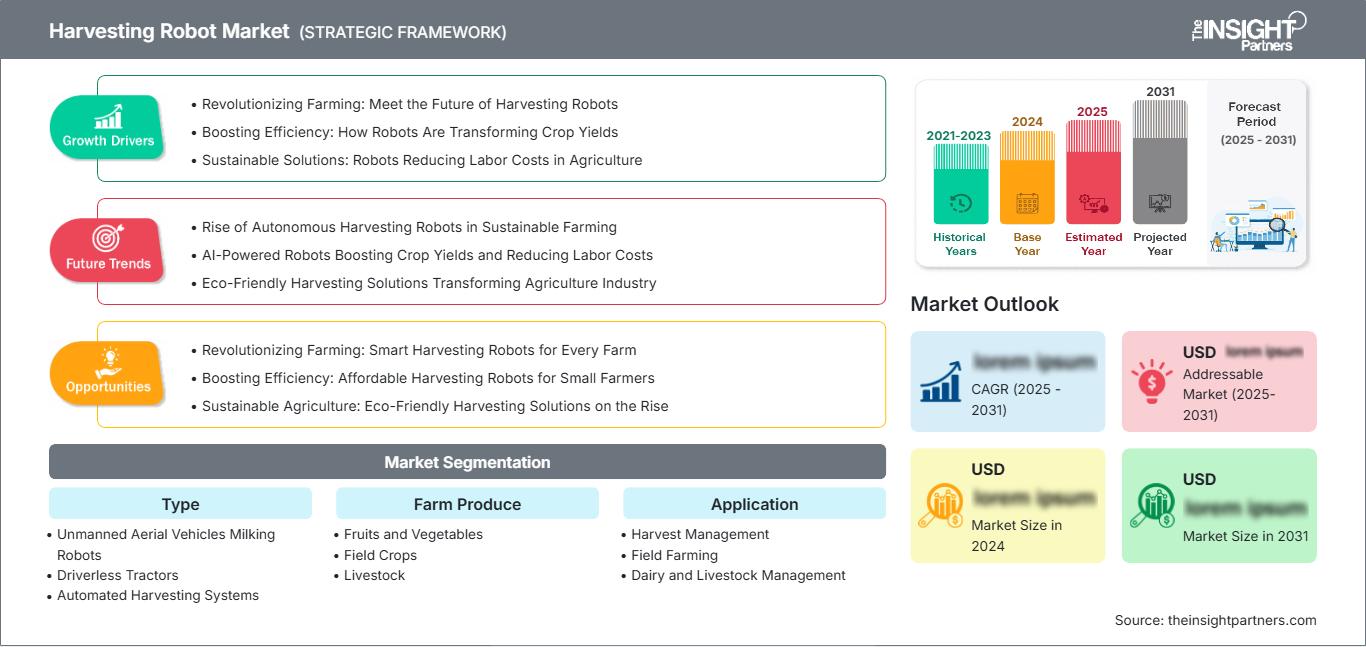
Type is expected to grow at a 19.8–20.8% CAGR during 2026–2034 as farms adopt task-specific machines rather than general automation alone. The Market scope across this segment includes aerial monitoring, autonomous traction, automated picking, and dairy robotics, each improving labor productivity while supporting higher consistency in field and barn operations.
- Unmanned Aerial Vehicles Milking Robots support monitoring, spraying, herd data capture, and dairy process automation, making them strategically important where labor shortages coincide with rising demand for verified farm productivity data.
- Driverless Tractors are gaining attention among broad-acre farms because they automate repetitive field operations, reduce operator fatigue, and work effectively with GPS guidance, implements, and farm management platforms.
- Automated Harvesting Systems remain the largest type because robotic picking, sorting, and crop handling directly address time-sensitive harvest economics, especially in fruits, vegetables, and other labor-intensive produce categories.
Farm Produce
Farm Produce is projected to grow at a 19.2–20.2% CAGR during 2026–2034 as robotics shifts from experimental crop trials to commercially relevant produce categories. Fruits and vegetables show the clearest near-term automation case, while field crops and livestock create scale opportunities through repetitive operations, monitoring, and standardized production environments.
- Fruits and Vegetables lead demand because harvesting depends heavily on skilled seasonal labor, product handling quality, rapid packhouse flow, and minimizing crop losses during narrow picking windows.
- Field Crops offer strong deployment potential through autonomous tractors, UAV scouting, and precision harvesting systems that improve field efficiency across large acreage and standardized crop cycles.
- Livestock adoption is driven by milking robots, feeding assistance, barn monitoring, and health-data integration, helping producers stabilize labor needs while strengthening animal management consistency.
Application
Application is expected to grow at a 20.6–21.6% CAGR during 2026–2034 as farms prioritize measurable use cases that protect yield, lower labor reliance, and improve operating visibility. Harvest management is the fastest scaling application, while field farming, dairy and livestock management, and irrigation management extend automation benefits across the farm production cycle.
- Harvest Management delivers high strategic value because robotics supports picking schedules, crop maturity assessment, labor planning, produce handling, and harvest data visibility across time-sensitive specialty crops.
- Field Farming benefits from autonomous tractors, UAVs, and sensor-guided equipment that automate repetitive operations, reduce fuel and labor inefficiencies, and strengthen precision agriculture workflows.
- Dairy and Livestock Management is supported by robotic milking, feeding, barn monitoring, and data-led herd management, making automation relevant beyond crop harvesting applications.
- Irrigation Management uses sensors, aerial monitoring, and automated controls to improve water-use efficiency, which is increasingly important in drought-prone and resource-constrained farming regions.
Opportunity Snapshot
| Application | Revenue Contribution | Trend Tag | Adoption Stage |
| Harvest Management | High | Robotic Picking | Scaling |
| Field Farming | High | Autonomous Traction | Scaling |
| Dairy and Livestock Management | Medium | Herd Automation | Mature |
| Irrigation Management | Medium | Water Precision | Emerging |
Harvesting Robot Market Growth Drivers and Impact Analysis
Labor scarcity accelerates automation purchasing
Labor availability remains the most direct purchasing catalyst because manual harvesting, crop handling, and dairy operations require dependable workers during narrow production windows. When farms cannot secure enough seasonal labor, harvest losses rise and crop quality declines quickly. Robots reduce this exposure by extending operating hours, standardizing repetitive tasks, and giving managers better control over scheduling. The impact is strongest in high-value fruits and vegetables, where a delayed harvest can reduce packable yield. For equipment suppliers, labor pressure supports recurring demand for service contracts, operator training, and modular upgrades that keep systems productive over multiple seasons.
Precision farming platforms improve return on automation
Robotic harvesting is becoming more attractive as precision agriculture platforms capture field maps, crop health indicators, moisture data, machine location, and yield information in one workflow. Farms can justify automation more easily when robots perform the physical task while collecting data that improves future decisions. This combined value case shifts procurement from simple labor replacement to operational intelligence. Dealers and OEMs also gain stronger customer engagement because software updates, connected diagnostics, and analytics subscriptions deepen the installed base. As integration improves, the Market becomes more resilient to short-term capital spending cycles.
Food security and resource efficiency support deployment
Governments and producers are placing greater emphasis on domestic food resilience, water efficiency, and stable supply chains. Robotics supports these priorities by reducing waste, improving harvest timing, and enabling more precise use of inputs. In regions exposed to drought, aging rural workforces, or import dependency, technology adoption is increasingly evaluated through productivity and risk-management lenses. Automated harvesting systems can also help farms maintain output without expanding acreage, which aligns with sustainability commitments. This driver strengthens demand in both mature mechanized markets and emerging regions building modern agricultural infrastructure.
Harvesting Robot Market Future Trends
AI-led crop recognition moves toward commercial standardization
Harvesting Robot Market trends will increasingly center on artificial intelligence models trained to identify crop maturity, defect levels, canopy density, and picking points under variable lighting and field conditions. As algorithms improve, robots will require fewer manual adjustments between crop varieties and regions. This will lower deployment friction for growers that operate mixed acreage or supply multiple buyers. Commercial standardization will also benefit equipment makers because validated recognition libraries can be reused across product lines. The trend points toward machines that learn from each season and deliver more consistent harvest quality over time.
Robotics-as-a-service expands access for mid-sized farms
Robotics-as-a-service models are expected to gain traction as growers seek automation without committing to full machine ownership. This approach can bundle equipment, maintenance, operators, software, and seasonal support into usage-based contracts aligned with harvest windows. Mid-sized farms may benefit most because they often face the same labor risks as large producers but have tighter capital budgets. Service models can also accelerate learning across crop conditions because providers operate fleets across multiple farms. Over time, these models may become an important route for scaling advanced automation in fragmented agricultural markets.
Harvesting Robot Market Opportunities
Specialty crop automation creates premium deployment potential
Specialty crops offer one of the strongest investment opportunities because berries, apples, citrus, tomatoes, and leafy vegetables combine high labor intensity with strict quality requirements. Harvesting Robot Market Forecasts indicate that suppliers able to adapt end effectors, vision systems, and mobility platforms to specific crop geometries can command stronger margins than broad-purpose automation providers. Commercial success will depend on field validation, grower training, and service response during harvest peaks. Companies that combine hardware, crop analytics, and flexible leasing can address growers seeking measurable payback without large upfront risk.
Integrated farm data ecosystems open recurring revenue channels
Robots that collect field, animal, machine, and irrigation data can support recurring revenue beyond equipment sales. Suppliers have an opportunity to develop dashboards, predictive maintenance, crop-quality analytics, and compliance reporting tools that turn automation into a farm operating system. This is strategically important as growers require traceability, sustainability documentation, and yield visibility for buyers and lenders. Partnerships with agronomy software providers, insurers, and financing platforms can expand value capture. The opportunity favors companies that design interoperable systems rather than closed machines with limited data portability.
Recent Developments
- May 2026: Egrobots — the Egyptian startup unveiled an AI-powered autonomous harvesting robot developed entirely by Egyptian engineers, combining computer vision, AI, and autonomous navigation to identify and harvest ripe crops with minimal human intervention.
- June 2026: Japanese Agri-Tech Startup — the startup moved its suction-type cherry tomato harvesting robot into routine production use after approximately three years of development and testing, demonstrating commercial harvesting performance and consistent produce quality.
- March 2026: Eternal.ag — the German startup launched its first fully autonomous harvesting robot for tomato greenhouses, designed to address labor shortages through AI-powered harvesting and extended operation of up to 22 hours per day.
Frequently Asked Questions

- Comprehensive Market Sizing and Forecast Analysis
- Detailed Segmentation Analysis
- In-Depth Market Dynamics Assessment
- Regional and Country-Level Insights
- Competitive Landscape and Company Benchmarking
- Strategic Business Intelligence
Recent Reports
Testimonials

The Insight Partners' SCADA System Market report is comprehensive, with valuable insights on current trends and future forecasts. The team was highly professional, responsive, and supportive throughout. We are very satisfied and highly recommend their services.
RAN KEDEM Partner, Reali Technologies LTDs
I requested a report on a very specific software market and the team produced the report in a few days. The information was very relevant and well presented. I then requested some changes and additions to the report. The team was again very responsive and I got the final report in less than a week.
JEAN-HERVE JENN Chairman, Future Analytica
We worked with The Insight Partners for an important market study and forecast. They gave us clear insights into opportunities and risks, which helped shape our plans. Their research was easy to use and based on solid data. It helped us make smart, confident decisions. We highly recommend them.
PIYUSH NAGPAL Sr. Vice President, High Beam Global
The Insight Partners delivered insightful, well-structured market research with strong domain expertise. Their team was professional and responsive throughout. The user-friendly website made accessing industry reports seamless. We highly recommend them for reliable, high-quality research services
YUKIHIKO ADACHI CEO, Deep Blue, LLC.
This is the first time I have purchased a market report from The Insight Partners.While I was unsure at first, I visited their web site and felt more comfortable to take the risk and purchase a market report.I am completely satisfied with the quality of the report and customer service. I had several questions and comments with the initial report, but after a couple of dialogs over email with their analyst I believe I have a report that I can use as input to our strategic planning process.Thank you so much for taking the extra time and making this a positive experience.I will definitely recommend your service to others and you will be my first call when we need further market data.
JOHN SUZUKI President and Chief Executive Officer, Board Director, BK Technologies
I wish to appreciate your support and the professionalism you displayed in the course of attending to my request for information regarding to infectious disease IVD market in Nigeria. I appreciate your patience, your guidance, and the fact that you were willing to offer a discount, which eventually made it possible for us to close a deal. I look forward to engaging The Insight Partners in the future, all thanks to the impression you have created in me as a result of this first encounter.
DR CHIJIOKE ONYIA MANAGING DIRECTOR, PineCrest Healthcare Ltd.Reason to Buy
- Informed Decision-Making
- Understanding Market Dynamics
- Competitive Analysis
- Identifying Emerging Markets
- Customer Insights
- Market Forecasts
- Risk Mitigation
- Boosting Operational Efficiency
- Strategic Planning
- Investment Justification
- Tracking Industry Innovations
- Aligning with Regulatory Trends





 Get Free Sample for