
Heat Meter Market Growth, Size & Forecast by 2034
Coverage: by Type (Mechanical Heat Meter, Static Heat Meter); Connectivity (Wired, Wireless); End User (Residential, Commercial, Industrial) , and Geography (North America, Europe, Asia Pacific, and South and Central America)
- Status : Data Released
- Report Code : TIPRE00009136
- Category : Electronics and Semiconductor
- No. of Pages : 150
- Available Report Formats :


- Last update date : September 10, 2026


2025 Market Size
US$ 1.28 Bn
Base year value
2034 Forecast
US$ 2.86 Bn
Projected by 2034
CAGR 2026-2034
9.36 %
Growth rate
Addressable Market
US$ 18.50 Bn
(2026-2034)
The Heat Meter Market was valued at US$ 1.28 Billion in 2025 and is projected to reach US$ 2.86 Billion by 2034, expanding at a CAGR of 9.36% during 2026–2034. This demand stems from the increasing requirement for proper accounting of thermal energy, better records of consumption and operation in district heating, multi-residential buildings, commercial facilities, and industrial heating systems around the world.
The Heat Meter Market Size in North America is forecast to progress at a CAGR of 8.4% – 9.1% for the period of 2026 – 2034. Growth is driven by campus energy upgrades, hydronic sub-metering, regulations on building performance and interest from utilities in interval data. Increased use of low-carbon district heating and cooling systems also benefits wireless ultrasonic meters.
Heat Meter Market Assessment and Insights
- North America held 19–22% share in 2025 and is growing at an 8.4–9.1% CAGR during 2026–2034, supported by campus district energy, hydronic submetering, and building-performance mandates.
- US represented 81–84% of North America in 2025 and is growing at an 8.5–9.2% CAGR during 2026–2034 through retrofit-led wireless metering.
- Europe accounted for 38–42% share in 2025 and is growing at an 8.8–9.5% CAGR during 2026–2034, led by Germany, Denmark, the UK, France, and Poland.
- Asia Pacific captured 29–33% share in 2025 and is growing at a 10.2–11.0% CAGR during 2026–2034, led by China, Japan, South Korea, India, and Australia.
- Largest Segment Static heat meters held 61–65% market share in 2025 and are growing at a 10.0–10.8% CAGR during 2026–2034 as utilities prioritize accuracy.
- High Growth Segment Wireless connectivity held 44–48% market share in 2025 and is growing at an 11.2–12.0% CAGR during 2026–2034 through remote-reading mandates.
- Key companies analyzed in detail: Danfoss A/S; Diehl Stiftung & Co. KG; Engelmann Sensor GmbH; ista SE; Itron, Inc.; Kamstrup A/S; Landis+Gyr AG; Resideo Technologies, Inc.; Siemens AG; Wasion Holdings Limited
Source: The Insight Partners' analysis based on proprietary research, government publications, company annual reports, investor presentations, industry databases, and expert interviews.
Metering architectures have progressed from mechanical impeller assemblies and manual reads toward ultrasonic static measurement, modular communications, and meter-data platforms. Production priorities now emphasize broad dynamic range, low pressure loss, long battery life, tamper evidence, and standardized interfaces. Open protocols such as wired M-Bus, wireless M-Bus, LoRaWAN, and NB-IoT are reducing integration friction, while embedded diagnostics allow utilities to identify reverse flow, air, temperature-sensor faults, and abnormal consumption remotely.
Investment is moving toward Central and Eastern Europe, China, and dense urban developments where district energy can serve buildings efficiently. The International Energy Agency reports that district heating serves more than 600 million people and networks exceed one million kilometers, providing a substantial installed base for meter replacement. European efficiency rules and remotely readable billing requirements strengthen the outlook for interoperable devices, analytics, and lifecycle services.
Heat Meter Market Report Scope
| Report Attribute | Details |
|---|---|
| Market size in 2025 | US$ 1.28 Billion |
| Market Size by 2034 | US$ 2.86 Billion |
| Global CAGR (2026 - 2034) | 9.36% |
| Historical Data | 2021-2024 |
| Forecast period | 2026-2034 |
Heat Meter Market Analysis
Heat meter market development relies on usage-based charging, district heating systems development, and carbon-neutral buildings. Utility companies acquire flow sensors, associated temperature sensors, calculators, gateways, head end software, installation services, and verification. Correct interval data provides an opportunity to calculate costs, identify low differential temperature, and fine-tune return temperature.
Supply chain includes ultrasonic transducers, microcontrollers, lithium batteries, brass and composite materials flow bodies, certified temperature sensors, and radio communication module. Manufacturers tend to utilize common enclosures and plug-and-play communications for product differentiation. Certification process according to Measuring Instruments Directive and EN 1434, certification of components, calibration facilities and cyber security concerns affect the delivery period and set the bar for newcomers.
Analysis of Heat meter market report reveals competition among diversified automation suppliers and manufacturers of heat meters. Danfoss A/S, Siemens AG, Landis+Gyr AG, and Itron, Inc. use their ties with utilities and system integration capabilities. Kamstrup A/S, Diehl Stiftung & Co. KG, Engelmann Sensor GmbH, and ista SE use metrological, billing, and network solutions as unique features while Resideo Technologies, Inc. and Wasion Holdings Limited extend their building and Asian networks.
Innovation drivers would be ultrasonic metering technology, open-protocol gateways, secure device management solutions, and analytics delivering information on networks using data from meters. Competitive strengths will be longevity, coverage, compatibility, and replacement of existing fleet of mechanical meters without disrupting the billing process. Firms providing both meters, communication technology, cloud applications, installation, and testing would benefit from periodic payments.
● REPORT CUSTOMIZATION
Tailor This Report To Align With Your Specific Business Requirements
This report can be customized to align precisely with your business objectives, scope, and target markets. Customization options include tailored segmentation, geography, competitive analysis, and strategic insights to support informed decision-making.
Customize This Report →WHAT YOU CAN ADJUST
- ● Segmentations
- ● Geography
- ● Competitive Analysis
- ● Language Preferences
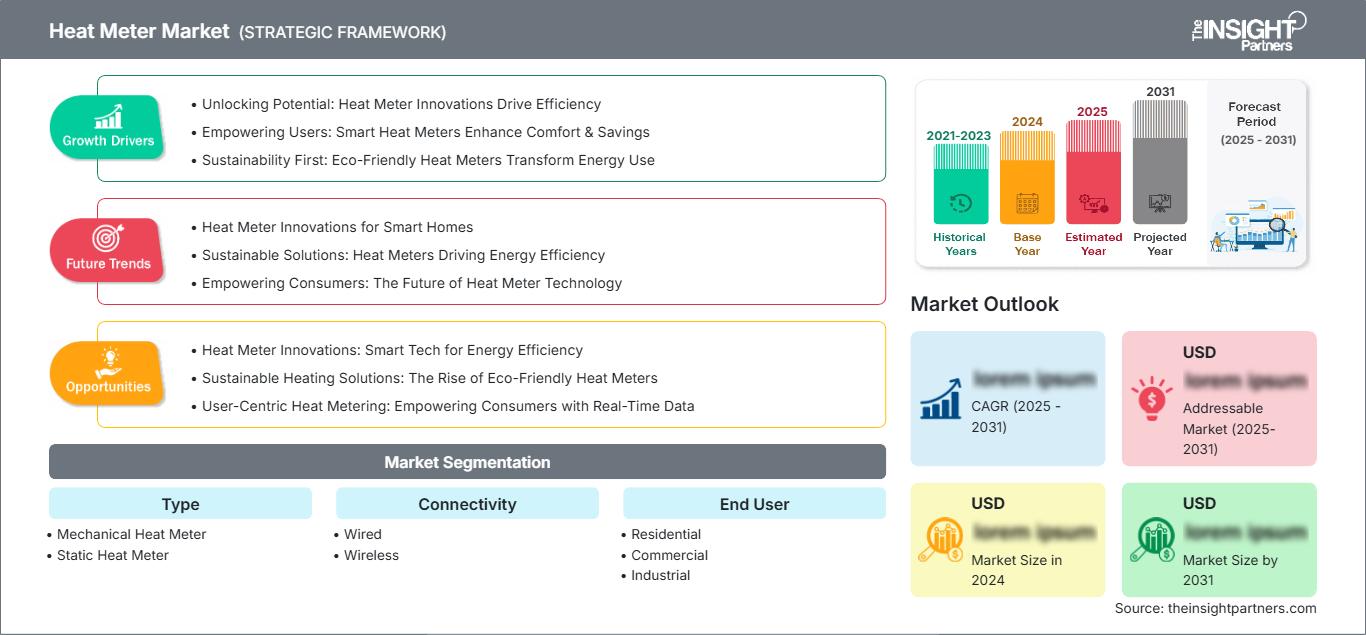
Heat Meter Market: Strategic Insights
Regional Insights
North America Heat Meter Market
The North America market accounted for 19-22% of the market share in 2025 and is estimated to grow with an 8.4-9.1% CAGR up to 2034. The factors driving the Heat Meter Market share include university and hospital energy systems, multifamily building hydronic submeters, thermal-energy services, and district heating/cooling of cities. The need for detailed consumption records for tenant metering, benchmarking, fault detection, and retrofits has grown among building owners.
Wireless retrofits are common where there is an issue with the cost of cabling whereas wired M-bus still plays a role in new commercial constructions. In Canada, there are contributions from campus systems, municipal energy systems, and cold climate hydronic heatings. In Mexico, there are contributions from industrial park and mixed use developments. In the region, there is emphasis on certified ultrasonic meters, open API, and partners for meter commissioning and installation.
U.S. Heat Meter Market
The U.S. accounted for 81–84% of North American revenue in 2025 and is projected to exhibit an 8.5–9.2% CAGR from 2026 through 2034. End users include campus districts, hospitals, educational institutions, military installations, multi-family housing, airports, and city core thermal grids. Building owners rely on interval data for cost allocation, confirmation of energy service savings, optimized chilled water and hot water loops, and detection of fouling or low differential temperatures.
Vendors with relevant utility or building channel partners include Itron, Inc., Siemens AG, Danfoss A/S, Landis+Gyr AG, and Resideo Technologies, Inc. Technical trends include energy calculators using the BACnet interface, clamp on diagnostic tests during audits, and wireless upgrades in occupied buildings. There is a highly fragmented procurement environment since thermal metering is subject to state, municipal, contractual, and utility mandates but not one overarching national mandate.
Europe Heat Meter Market
Europe held a market share of 38-42% in 2025 and is forecast to register a CAGR of 8.8-9.5% through 2034. Germany will be driven by large-scale district heating networks, multifamily billing regulations, and adoption of remote reading technology. Denmark has matured heat utilities with low-temperature network optimization capabilities. UK is creating a demand on the back of communal heating regulations preparation, social housing, universities, and commercial real estate projects.
France will be fueled by urban heat concessions, renovation, and development of renewable heat. The apartment segment in Italy and district energy projects in Spain are favorable towards the adoption of wireless submeters. Poland’s legacy infrastructure will create the market opportunity for replacement. Europe needs more efficient metering and higher consumer awareness. Remotely read meters will benefit ultrasonic meters, automated billing systems, and secure platform deployment. Suppliers need to cater to national testing windows and radio protocols.
APAC Heat Meter Market
Asia Pacific was dominant with 29-33% share in 2025 and will be expanding at a CAGR of 10.2-11.0% from 2026 to 2034. This is led by China, which uses northern district heating, urban revitalization, and smart city acquisitions.
India is driven by campus, hospital, industrial park, and district cooling projects. Australia provides precinct energy and commercial submetering projects. The focus on effective building and digital utility management by policy makers supports static meters, wireless communication, and localized generation.
Middle East & Africa Heat Meter Market
The Middle East and Africa market is expected to grow at a CAGR of 7.5%-8.3% between 2026-2034, with the UAE being the main driver. Buildings such as district cooling, mixed-use development, airports, and hotels have to be metered for billing and optimization of the plant operation. South Africa also contributes to giga-project and utility-scale cooling installations.
Commercial campuses and private utility installations are part of what South Africa has to offer. The rest of MEA has project-driven growth. Key considerations for buyers include thermal durability, remote commissioning, anti-tampering capabilities, and integration with district cooling billing systems.
Segmentation Analysis
Type
The Type segment is expected to grow at a 9.2–9.9% CAGR during 2026–2034. Heat Meter Market scope by type reflects trade-offs among acquisition cost, flow range, water quality, pressure loss, and service life. Static ultrasonic meters gain preference for stable accuracy and diagnostics, while mechanical units retain value in cost-sensitive, standardized residential installations with established maintenance practices.
- Mechanical Heat Meter products remain established in budget-sensitive residential portfolios, where familiar installation, straightforward verification, and broad installer knowledge outweigh wear risk and lower sensitivity at small flows.
- Static Heat Meter products lead procurement for district heating and modern buildings because ultrasonic measurement offers wide dynamic range, low pressure loss, stable accuracy, diagnostics, and limited moving-part maintenance.
Connectivity
The Connectivity segment is anticipated to advance at a 10.1–10.9% CAGR during 2026–2034. Communication choice depends on building topology, reading frequency, battery budget, cybersecurity, and installed cabling. Wireless options accelerate retrofit programs and portfolio visibility, whereas wired networks offer deterministic performance in new construction, plant rooms, and high-density installations where power and communication infrastructure are planned together.
- Wired connectivity remains strategically important in new buildings and utility substations, where M-Bus or automation cabling provides reliable power, predictable reads, and straightforward integration with central controls.
- Wireless connectivity enables rapid retrofits across occupied properties, reducing cable installation while supporting frequent remote reads, portfolio analytics, and regulatory consumer information through wM-Bus, LoRaWAN, or cellular networks.
End User
The End User segment is projected to grow at an 8.9–9.7% CAGR during 2026–2034. Residential demand benefits from fair billing and remote-read mandates, commercial properties use data for tenant allocation and building optimization, and industrial facilities meter process heat, steam conversion, and internal utilities. Cross-segment adoption increasingly favors meter-data services alongside certified devices.
- Residential installations generate high unit volumes in multifamily housing and district-heated apartments, where compact design, long battery life, fair cost allocation, and unattended reading define supplier competitiveness.
- Commercial users prioritize interoperability across offices, hospitals, hotels, campuses, and retail assets, using thermal data to validate bills, benchmark buildings, diagnose equipment, and support performance contracts.
- Industrial applications require broad flow ranges, rugged sensors, and integration with plant systems to allocate process heat, monitor heat recovery, identify losses, and improve utility accounting.
Opportunity Snapshot
| End User | Revenue Contribution | Trend Tag | Adoption Stage |
| Residential | High | Remote Billing | Mature |
| Commercial | Medium | Building Analytics | Scaling |
| Industrial | Medium | Heat Recovery | Scaling |
Heat Meter Market Growth Drivers and Impact Analysis
Remote-Read Billing and Consumer Transparency Rules
European efficiency policy is converting manual meter portfolios into remotely readable infrastructure. The transition gives utilities and submetering companies a clear reason to replace aging mechanical instruments with static meters, radio modules, gateways, and billing software. More frequent consumption information improves dispute resolution and enables households to react to abnormal use. For suppliers, the impact extends beyond hardware because secure data transmission, device enrollment, tenant portals, and lifecycle support become part of the tender. The shift also rewards open standards that allow mixed meter fleets to communicate without proprietary lock-in. Installers benefit from large portfolio programs, while property owners reduce site visits and estimated bills. Compliance timing therefore compresses replacement cycles and creates visible multi-year demand.
District Heating Expansion and Network Decarbonization
District energy supplies around 10% of global final energy consumption for heat, according to the International Energy Agency, and delivered heat has risen by about 35% since 2010. Expansion and decarbonization create meter demand at customer interfaces, substations, heat pumps, waste-heat sources, and thermal storage assets. Accurate flow and temperature data are essential for settlement, hydraulic balancing, and return-temperature control. As networks integrate lower-temperature renewable heat, measurement at small differentials becomes more valuable and technically demanding. Utilities consequently favor ultrasonic devices with broad dynamic range and diagnostics. New connections add installations, while modernization programs replace meters that cannot support interval data. The operational benefit is lower network loss, better plant dispatch, and clearer verification of renewable-heat contribution.
Performance-Based Building and Industrial Energy Management
Building owners and industrial operators increasingly need auditable thermal data to prove savings from insulation, controls, heat pumps, heat recovery, and energy-service contracts. Electricity meters alone cannot reveal whether a hydronic system is delivering expected thermal output. Heat meters close that evidence gap by combining flow and temperature difference into billable energy. Portfolio managers use interval data to benchmark assets and identify simultaneous heating and cooling, fouled heat exchangers, or excessive return temperatures. Industrial sites apply the same information to internal utility accounting and process optimization. The market impact is higher specification of connected meters during retrofit design, stronger demand for analytics, and recurring verification work after commissioning. Vendors that translate readings into corrective actions gain influence with consultants and facility teams.
Heat Meter Market Future Trends
Analytics-Led Low-Temperature Network Optimization
Heat Meter Market trends will increasingly focus on using meter data to operate lower-temperature networks rather than merely produce invoices. Algorithms will compare flow, supply temperature, return temperature, and customer load to identify oversized substations, failing controls, and poor heat-exchanger performance. Utilities can then target interventions that reduce return temperatures and improve renewable-source integration. Digital twins will combine weather, building characteristics, and interval records to forecast demand and optimize pumps. This transition elevates data quality, clock synchronization, and secure interfaces as purchasing criteria. Manufacturers able to provide validated analytics and open exports will gain strategic relevance, while basic stand-alone meters face greater price competition.
Multi-Network Communications and Edge Intelligence
Future meters will support adaptable communications through replaceable modules, dual-radio designs, or software-selectable protocols. This flexibility protects utilities when network strategies shift between wireless M-Bus, LoRaWAN, cellular IoT, and shared smart-city infrastructure. Edge processing will flag reverse flow, sensor drift, leakage signatures, or abnormal temperature spread before transmitting compact events, extending battery life and reducing data volume. Secure provisioning and firmware management will become necessary as thermal devices join critical infrastructure networks. The trend favors modular product families that can remain installed through multiple communication generations. It also enables utilities to consolidate electricity, water, gas, and heat data without forcing identical access technologies everywhere.
Heat Meter Market Opportunities
Mechanical Fleet Conversion as a Managed Service
Large property and utility portfolios often contain mixed meter ages, protocols, and verification dates, making one-time replacement difficult. Suppliers can offer phased conversion programs that bundle surveys, meter sizing, installation, gateway deployment, data migration, verification, and tenant communication. Financing through per-meter or per-read fees can reduce initial capital barriers and align vendor revenue with service continuity. Investment should prioritize automated device onboarding, exception handling, and field workflows that minimize apartment access. Partnerships with billing companies and energy-service contractors can improve route-to-market. The opportunity is strongest where remote-reading deadlines coincide with aging mechanical inventories, because customers need both compliant hardware and operational capacity to execute thousands of coordinated replacements.
Metering Packages for District Cooling and Mixed-Use Precincts
District cooling and mixed-use developments in the Middle East, Asia, and North America require accurate tenant allocation across offices, hotels, retail, residences, and data centers. Suppliers can assemble packages combining heating and cooling meters, temperature sensors, communications, billing interfaces, commissioning, and plant analytics. Early engagement with developers and engineering consultants improves specification influence before pipework and meter chambers are fixed. Investment should focus on high ambient-temperature performance, condensation-resistant electronics, multilingual portals, and integration with building-management systems. Reference projects demonstrating billing accuracy and reduced chilled-water return temperatures can accelerate adoption. The resulting contracts offer attractive scale because one central plant can require meters across hundreds or thousands of customer connections.
Recent Developments
- May 2026: The Zentrum fuer Waermemanagement (hereinafter referred to as “ZFW”) has launched worldwide sales of a new High Temperature Heat Flow Meter to test thermal and mechanical properties of insulation materials at temperatures up to 850 °C. C-Therm Technologies is the exclusive distributor of ZFW’s TIM-Tester in North America and is excited to support the distribution of the new Guarded Heat Flow Meter (GHFM). The instrument is capable of measuring thermal conductivity, thermal resistance, force, and compression with high accuracy and reproducibility.
- November 2024: Kamstrup A/S launched factory-mounted LoRaWAN modules for MULTICAL 403, 603, and 803 meters. The open-protocol option supplies timestamped billing and analytical data while reducing external hardware and commissioning effort.
- August 2026: Sontex Group has announced that DELTAMESS DWWF GmbH, an established German metering company, has joined the Sontex Group. The move is expected to strengthen Sontex’s position in Germany while expanding its access to new customers and distribution channels in the water and heat metering markets.
Frequently Asked Questions

- Comprehensive Market Sizing and Forecast Analysis
- Detailed Segmentation Analysis
- In-Depth Market Dynamics Assessment
- Regional and Country-Level Insights
- Competitive Landscape and Company Benchmarking
- Strategic Business Intelligence
Recent Reports
Testimonials

The Insight Partners provided valuable market intelligence that supported our global go-to-market strategy. Their team was professional, responsive, and attentive to our feedback, providing thoughtful analysis and helpful methodological clarifications throughout the project.
Junmo Kim Chief Financial Officer (CFO), Enertech Co., Ltd.
The Insight Partners' SCADA System Market report is comprehensive, with valuable insights on current trends and future forecasts. The team was highly professional, responsive, and supportive throughout. We are very satisfied and highly recommend their services.
RAN KEDEM Partner, Reali Technologies LTDs
I requested a report on a very specific software market and the team produced the report in a few days. The information was very relevant and well presented. I then requested some changes and additions to the report. The team was again very responsive and I got the final report in less than a week.
JEAN-HERVE JENN Chairman, Future Analytica
We worked with The Insight Partners for an important market study and forecast. They gave us clear insights into opportunities and risks, which helped shape our plans. Their research was easy to use and based on solid data. It helped us make smart, confident decisions. We highly recommend them.
PIYUSH NAGPAL Sr. Vice President, High Beam Global
The Insight Partners delivered insightful, well-structured market research with strong domain expertise. Their team was professional and responsive throughout. The user-friendly website made accessing industry reports seamless. We highly recommend them for reliable, high-quality research services
YUKIHIKO ADACHI CEO, Deep Blue, LLC.
This is the first time I have purchased a market report from The Insight Partners.While I was unsure at first, I visited their web site and felt more comfortable to take the risk and purchase a market report.I am completely satisfied with the quality of the report and customer service. I had several questions and comments with the initial report, but after a couple of dialogs over email with their analyst I believe I have a report that I can use as input to our strategic planning process.Thank you so much for taking the extra time and making this a positive experience.I will definitely recommend your service to others and you will be my first call when we need further market data.
JOHN SUZUKI President and Chief Executive Officer, Board Director, BK Technologies
I wish to appreciate your support and the professionalism you displayed in the course of attending to my request for information regarding to infectious disease IVD market in Nigeria. I appreciate your patience, your guidance, and the fact that you were willing to offer a discount, which eventually made it possible for us to close a deal. I look forward to engaging The Insight Partners in the future, all thanks to the impression you have created in me as a result of this first encounter.
DR CHIJIOKE ONYIA MANAGING DIRECTOR, PineCrest Healthcare Ltd.Reason to Buy
- Informed Decision-Making
- Understanding Market Dynamics
- Competitive Analysis
- Identifying Emerging Markets
- Customer Insights
- Market Forecasts
- Risk Mitigation
- Boosting Operational Efficiency
- Strategic Planning
- Investment Justification
- Tracking Industry Innovations
- Aligning with Regulatory Trends





 Get Free Sample for