
High Performance Computing Chipset Market Share, Growth & Demand by 2034
Coverage: By Type (Central Processing Unit, Graphic Processing Unit, Field Programmable Gate Array, Application Specific Integrated Circuit); Application (Information Technology, Telecommunication, Banking, Others) , and Geography (North America, Europe, Asia Pacific, and South and Central America)
- Status : Data Released
- Report Code : TIPRE00025984
- Category : Electronics and Semiconductor
- No. of Pages : 150
- Available Report Formats :


- Last update date : August 19, 2026


2025 Market Size
US$ 11.31 Bn
Base year value
2034 Forecast
US$ 23.05 Bn
Projected by 2034
CAGR 2026-2034
9.31 %
Growth rate
Addressable Market
US$ 163.09 Bn
(2026-2034)
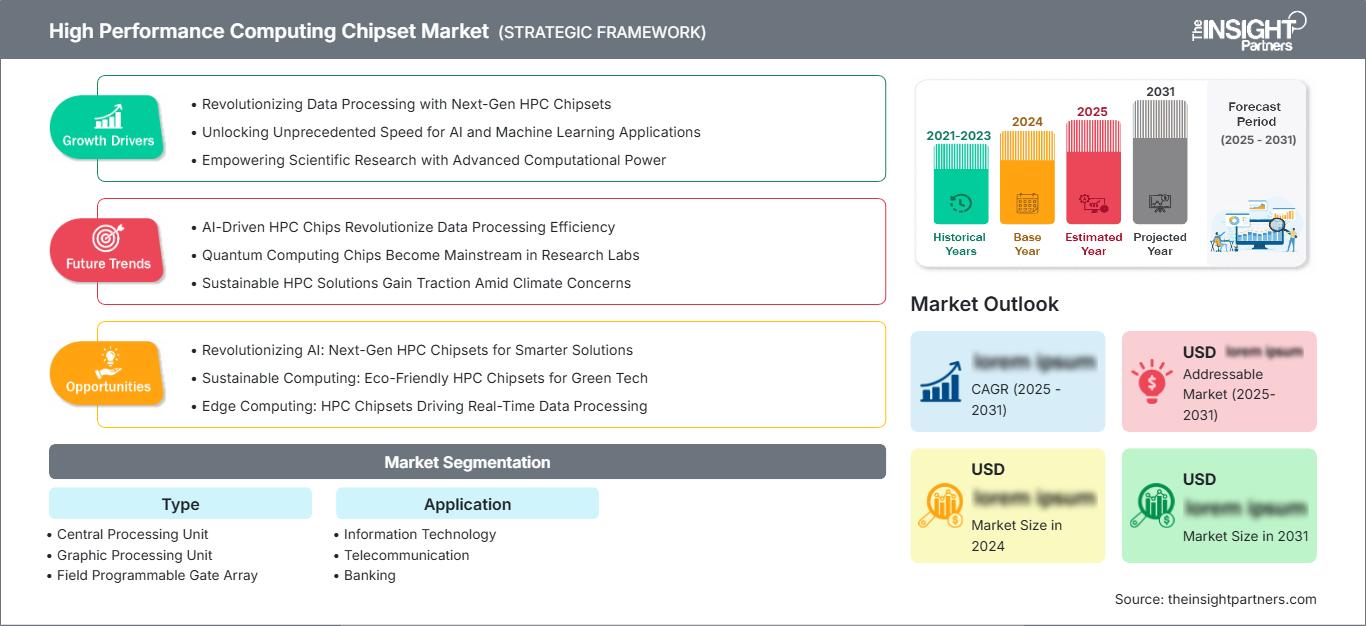
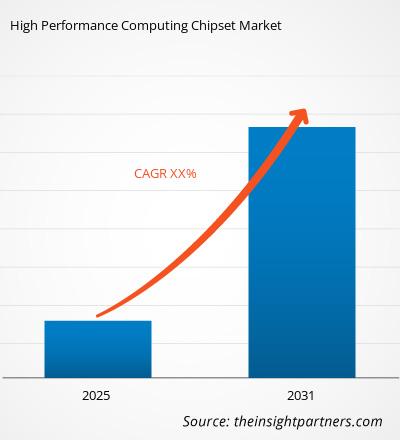
The High Performance Computing Chipset Market was valued at US$ 11.31 Billion in 2025 and is projected to reach US$ 23.05 Billion by 2034, registering a CAGR of 9.31% from 2026 to 2034. Demand is being shaped by accelerated computing, AI model training, scientific simulation, network virtualization, financial analytics, and enterprise cloud modernization across processor, accelerator, and programmable silicon categories.
North America remains a central demand hub, with regional growth estimated at 8.8–9.4% through 2034 as hyperscale data centers, federal research labs, AI cloud providers, and advanced telecommunication networks expand compute density. The High Performance Computing Chipset Market size in the region is supported by semiconductor design leadership, liquid-cooled server adoption, and sustained procurement of GPUs, CPUs, FPGAs, and ASICs for data-intensive workloads.
High Performance Computing Chipset Market Assessment and Insights
- North America accounted for 36–39% share in 2025 and is growing at a CAGR of 8.8–9.4% during 2026–2034, led by AI factories, national laboratories, GPU clusters, and advanced networking upgrades.
- US represented 78–82% of North America in 2025 and is growing at a CAGR of 8.9–9.5% during 2026–2034 through hyperscale and defense computing demand.
- Europe held 21–24% share in 2025 and is growing at a CAGR of 8.1–8.8% during 2026–2034, led by Germany, the UK, France, Italy, and Spain.
- Asia Pacific captured 28–32% share in 2025 and is growing at a CAGR of 10.2–10.9% during 2026–2034, supported by China, Japan, South Korea, India, and Australia.
- Largest Segment Graphic Processing Unit held 42–46% market share in 2025 and is growing at a CAGR of 10.0–10.8% during 2026–2034 due to accelerated AI and simulation workloads.
- High Growth Segment Application Specific Integrated Circuit held 17–20% market share in 2025 and is growing at a CAGR of 11.4–12.2% during 2026–2034 as custom AI silicon scales.
- Key companies analyzed in detail: Advanced Micro Devices, Inc.; Intel Corporation; International Business Machines Corporation; Cisco Systems, Inc.; Hewlett Packard Enterprise Development LP; NVIDIA Corporation; MediaTek Inc.; Achronix Semiconductor Corporation; Alphabet Inc.; Lattice Semiconductor Corporation.
Source: The Insight Partners' analysis based on proprietary research, government publications, company annual reports, investor presentations, industry databases, and expert interviews.
The design and architecture of today’s processors are moving away from scalability to heterogeneity among CPUs, GPUs, FPGAs, ASICs, memories, interconnects, and server architecture as well as thermal management. The development and advancement of the High Performance Computing Chipset Market are therefore motivated by energy efficiency, parallelism, software stack compatibility, and supply chain assurance. The recent technology trends revolve around advanced packaging, high bandwidth memory, wafer volumes, and reference platforms that minimize integration risk for both corporate and research clients.
Looking ahead into the forecast period, the purchasing trend is expected to extend beyond North America and Western Europe because of the emergence of AI sovereignty, supercomputers, and telecommunication infrastructures. The foundry capacity in Asia Pacific and government-backed projects in compute infrastructures will enhance supply chain as well as deployment channels, whereas efficiency regulations will drive the adoption of liquid cooling and workload-specific accelerators. These trends all contribute to growing market demands for high-end chipsets irrespective of hyperscale cloud cycles.
High Performance Computing Chipset Market Report Scope
| Report Attribute | Details |
|---|---|
| Market size in 2025 | US$ 11.31 Billion |
| Market Size by 2034 | US$ 23.05 Billion |
| Global CAGR (2026 - 2034) | 9.31% |
| Historical Data | 2021-2024 |
| Forecast period | 2026-2034 |
High Performance Computing Chipset Market Analysis
Enterprise and governmental requirements continue to grow with AI inference, weather simulation, drug discovery, seismic data processing, and fraud detection needing more memory bandwidth and higher parallel processing speeds. Growth of High Performance Computing Chipset Market is further spurred by the virtualization of 5G core and RAN networks by telecom operators, lower risk-model latency for banks, and consolidation of workloads on accelerated servers by IT organizations.
There are multiple supply chain players like silicon designers, EDA vendors, foundries, advanced packaging companies, memory manufacturers, interconnect providers, server OEMs, cloud providers, and software stacks. Dynamics in the supply side are still influenced by HBM availability, CoWoS-type package capacity, export restrictions, and lengthy validation processes. Customers now make purchasing decisions based on compute platforms as opposed to individual processors.
Competition will revolve mainly around firms having control of accelerator roadmaps, server integration, and software ecosystems. The NVIDIA Corporation continues to lead in GPU accelerators, whereas Advanced Micro Devices, Inc. reinforces its open platform strategy using Instinct GPUs and EPYC CPUs. Intel Corporation still plays an important role in HPC and telecoms with its CPUs, whereas Hewlett Packard Enterprise Development LP translates chipset demand into liquid cooled supercomputer deployments.
High Performance Computing Chipset Market Report highlights the factors that make them unique in terms of memory size, interconnection latency, development kits, and rack-scale performance. Some of the key players in this space include International Business Machines Corporation, Cisco Systems, Inc., MediaTek Inc., Achronix Semiconductor Corporation, Alphabet Inc., and Lattice Semiconductor Corporation.
● REPORT CUSTOMIZATION
Tailor This Report To Align With Your Specific Business Requirements
This report can be customized to align precisely with your business objectives, scope, and target markets. Customization options include tailored segmentation, geography, competitive analysis, and strategic insights to support informed decision-making.
Customize This Report →WHAT YOU CAN ADJUST
- ● Segmentations
- ● Geography
- ● Competitive Analysis
- ● Language Preferences
High Performance Computing Chipset Market: Strategic Insights
Regional Insights
North America High Performance Computing Chipset Market
North America held 36–39% share in 2025 and is projected to grow at a CAGR of 8.8–9.4% through 2034. The regional High Performance Computing Chipset Market share is anchored by hyperscale AI clusters, Department of Energy supercomputing programs, enterprise cloud migration, and dense telecom infrastructure. Strong chip design capability and advanced server integration shorten adoption cycles for accelerators.
Procurement has become increasingly performance-per-watt-, interconnect scalability-, and liquid-cooled system-ready-focused. Laboratories, cloud vendors, defense agencies, and financial firms in the United States have been making GPU and CPU/GPU hybrid systems for simulation, risk analysis, language models, and cyber defenses. Canada, on its part, provides through its AI research hubs, quantum computing-related efforts, and secure compute investments.
U.S. High Performance Computing Chipset Market
In 2025, the United States constituted 78–82% of North America and is forecast to expand with a CAGR of 8.9–9.5% over the period 2026–2034. The drivers include cloud AI factories, national labs, aerospace simulation, defense analysis, banking risk engines, and university supercomputing facilities. The presence in the domestic market of Advanced Micro Devices, Inc., Intel Corporation, NVIDIA Corporation, Cisco Systems, Inc., and Alphabet Inc. enables swift platform validation.
There is a trend towards a move from standalone HPC clusters to a collaborative architecture that serves applications in IT, telecom, and banking. The enterprises prefer chipsets which have well-developed software libraries, reliable supply chain, and robust security features. GPU acceleration is popular among applications in AI and digital twins, whereas CPU is important for orchestration and databases. FPGAs and ASICs are getting more attention due to low latency inference pipelines.
Europe High Performance Computing Chipset Market
In 2025, Europe held a 21-24% share and will continue to experience CAGR growth at 8.1-8.8% until 2034. The country has a strong leadership position due to its national supercomputing centers, automotive simulation, industrial artificial intelligence, and direct liquid-cooled HPE systems. UK is developing AI computational resources for life science, climate studies, finance, and secured cloud services, which creates an environment for GPU and CPU platforms.
The country can be characterized by its strong aerospace sector, nuclear, research, and sovereign clouds. Italy and Spain have increased investments in digital infrastructure, banking analysis, and academic HPC access, which creates demand for efficient systems. European users prioritize energy efficiency, procurement transparency, and interoperability; therefore, they favor systems that consist of open source software, high network bandwidth, and long lifecycles.
APAC High Performance Computing Chipset Market
Asia Pacific held 28–32% share in 2025 and is advancing at a CAGR of 10.2–10.9% during 2026–2034. China remains the largest regional country, while Japan, South Korea, India, and Australia invest in AI supercomputing, semiconductor capacity, and digital public infrastructure.
Policies, capacity for electronics manufacturing, and strong cloud adoption encourage chipset demand in the region. Korea and Japan strengthen their memory and packaging ecosystem, while India provides better access to computing services in the country, and Australia uses HPC for mining, climatology, and defense. The HPC Chipset Market is still highly linked to data sovereignty and AI policies.
Middle East & Africa High Performance Computing Chipset Market
MEA & Africa will experience a CAGR of 9.0%-9.7% from 2026-2034, with Saudi Arabia taking the lead for regional deployments. The UAE is focused on the construction of AI data centers and sovereign clouds, whereas South Africa will drive the market through research computing, banking analytics, and telecom upgrades.
Modeling solutions for the energy sector, smart cities, and diversification strategies will anchor demand. The adoption of RoMEA will be focused on university clusters, telecom providers, and government digital transformation initiatives. Regional consumers will prefer solutions that are durable, power-efficient, and backed by the provider due to differences in the regional infrastructure landscape.
Segmentation Analysis
Type
Type is expected to grow at a CAGR of 9.0–9.8% during 2026–2034 as buyers optimize processor mixes for workload economics. The High Performance Computing Chipset Market scope spans general-purpose CPUs, parallel GPUs, reconfigurable FPGAs, and workload-specific ASICs, with platform selection increasingly guided by memory bandwidth, software maturity, energy consumption, and model deployment patterns.
- Central Processing Unit remains central for orchestration, database execution, virtualization, and control-plane workloads, particularly where software compatibility, security, and balanced performance matter more than maximum parallel throughput.
- Graphic Processing Unit dominates accelerated computing because dense parallel cores, mature libraries, and high-bandwidth memory support AI training, inference, simulation, rendering, and scientific workloads at scale.
- Field Programmable Gate Array serves latency-sensitive workloads in telecommunication, banking, and edge systems, offering reconfigurable acceleration where deterministic performance and post-deployment flexibility are strategically valuable.
- Application Specific Integrated Circuit is gaining priority for hyperscale inference and dedicated AI services, where custom silicon can improve energy efficiency, throughput, and long-term operating economics.
Application
Application is projected to expand at a CAGR of 9.2–10.0% from 2026 to 2034 as IT, telecommunication, and banking users shift compute-intensive workloads toward accelerated infrastructure. Adoption differs by latency tolerance, data sensitivity, and infrastructure lifecycle, but all three areas are using chipsets to improve analytics speed, automation quality, and service continuity.
- Information Technology leads demand through cloud AI, enterprise analytics, cybersecurity automation, data engineering, and software development environments that require scalable GPUs, CPUs, and high-speed networking.
- Telecommunication adoption is rising as operators virtualize network functions, prepare AI-native 6G architectures, optimize RAN workloads, and deploy accelerated edge infrastructure for low-latency services.
- Banking uses high-performance chipsets for fraud detection, risk modeling, algorithmic trading, customer analytics, and regulatory stress testing where faster computation improves decision precision.
Opportunity Snapshot
| Application | Revenue Contribution | Trend Tag | Adoption Stage |
| Information Technology | High | AI Cloud | Scaling |
| Telecommunication | Medium | AI RAN | Scaling |
| Banking | Medium | Risk Engines | Mature |
High Performance Computing Chipset Market Growth Drivers and Impact Analysis
AI Workloads Are Raising Accelerator Density Requirements
AI training, reasoning inference, and synthetic data generation are changing infrastructure purchasing from server refresh cycles to capacity planning for token throughput and model responsiveness. The impact on the High Performance Computing Chipset is direct because GPUs, ASICs, and high-bandwidth CPU hosts determine how many users, simulations, and automated workflows can run simultaneously. Enterprises are also asking vendors for complete reference designs, networking, and software validation to reduce deployment risk.
Telecommunication Modernization Is Expanding Edge Compute Demand
Virtualized RAN, 5G core modernization, and early 6G planning are increasing demand for processors that combine throughput, deterministic latency, and power efficiency. Telecom operators need chipsets that support AI-assisted network optimization, media processing, and distributed edge services without requiring excessive hardware layers. This driver supports CPUs with embedded accelerators, FPGAs for programmable pipelines, and networking silicon that can preserve service quality while lowering operating costs.
Energy Efficiency Is Becoming a Purchase Criterion
Power availability and cooling constraints increasingly determine whether organizations can expand accelerated computing facilities. Data center operators compare chipsets on performance per watt, rack density, thermal design, and cooling compatibility because electricity and infrastructure costs influence total ownership economics. This is pushing vendors toward advanced packaging, liquid-ready modules, energy-aware orchestration, and workload-specific silicon. The result is a market where efficiency metrics now affect both procurement qualification and long-term vendor selection.
High Performance Computing Chipset Market Future Trends
Rack-Scale AI Factories Will Redefine System Design
High Performance Computing Chipset Market trends indicate a shift from component-level performance claims toward rack-scale outcomes measured by memory sharing, interconnect efficiency, cooling density, and inference throughput. Vendors are designing CPUs, GPUs, networking, and management software as integrated systems rather than independent products. This trend will favor suppliers that can validate full-stack performance across AI, simulation, and analytics workloads while helping buyers deploy dense systems faster and with fewer integration bottlenecks.
Custom Silicon Will Move Deeper Into Enterprise Infrastructure
ASIC adoption is expected to move from hyperscale-only projects into broader enterprise clouds, financial platforms, and telecom edge systems as repeatable AI workloads become better defined. Custom accelerators can reduce power draw and improve throughput when algorithms are stable and deployment volumes justify design costs. This transition will not replace GPUs, but it will create hybrid architectures where programmable and fixed-function silicon operate together.
High Performance Computing Chipset Market Opportunities
Sovereign AI Infrastructure Creates New Procurement Windows
Governments are funding national compute capacity to support language models, research security, healthcare analytics, and industrial competitiveness. High Performance Computing Chipset Market Forecasts point to opportunities for vendors that can combine secure supply, local integration partners, energy-efficient clusters, and long-term support. Winning suppliers will need transparent roadmaps, compliance readiness, and flexible financing models because public-sector projects often balance technical performance with resilience, data sovereignty, and national capability building.
Banking Analytics Modernization Opens Specialized Demand
Banks are upgrading risk, fraud, liquidity, and customer analytics platforms as volatile markets and real-time digital payments increase computational requirements. This creates an opportunity for chipset suppliers that can deliver low-latency inference, strong encryption support, and predictable performance under regulated workloads. Bundled solutions with validated financial-services software, high availability, and explainable AI tooling can help institutions modernize without compromising resilience or compliance obligations.
Recent Developments
- May 2026: NVIDIA Corporation — unveiled the NVIDIA RTX Spark superchip for Windows PCs, delivering up to 1 petaflop of AI performance, up to 128GB of unified memory, and support for locally running 120B-parameter LLMs with up to 1 million-token context, alongside Windows-native AI agents and NVIDIA OpenShell for secure agent execution.
- May 2026: Advanced Micro Devices, Inc. — previewed the AMD Instinct MI430X GPU for HPC and AI-for-science workloads, projecting more than 200 TFLOPs of native FP64 performance and more than 6x the FP64 performance of NVIDIA’s next-generation Rubin architecture, with deployments planned for future supercomputers including Discovery and Alice Recoque.
- July 2026: Rambus Inc. — launched its DDR5 9600 Server RDIMM chipset, built around the sixth-generation RCD06 and enabling memory speeds of up to 9600 MT/s with 20% higher bandwidth than the prior generation, targeting agentic AI, HPC and data-intensive data-center workloads.
Frequently Asked Questions

- Comprehensive Market Sizing and Forecast Analysis
- Detailed Segmentation Analysis
- In-Depth Market Dynamics Assessment
- Regional and Country-Level Insights
- Competitive Landscape and Company Benchmarking
- Strategic Business Intelligence
Recent Reports
Testimonials

The Insight Partners' SCADA System Market report is comprehensive, with valuable insights on current trends and future forecasts. The team was highly professional, responsive, and supportive throughout. We are very satisfied and highly recommend their services.
RAN KEDEM Partner, Reali Technologies LTDs
I requested a report on a very specific software market and the team produced the report in a few days. The information was very relevant and well presented. I then requested some changes and additions to the report. The team was again very responsive and I got the final report in less than a week.
JEAN-HERVE JENN Chairman, Future Analytica
We worked with The Insight Partners for an important market study and forecast. They gave us clear insights into opportunities and risks, which helped shape our plans. Their research was easy to use and based on solid data. It helped us make smart, confident decisions. We highly recommend them.
PIYUSH NAGPAL Sr. Vice President, High Beam Global
The Insight Partners delivered insightful, well-structured market research with strong domain expertise. Their team was professional and responsive throughout. The user-friendly website made accessing industry reports seamless. We highly recommend them for reliable, high-quality research services
YUKIHIKO ADACHI CEO, Deep Blue, LLC.
This is the first time I have purchased a market report from The Insight Partners.While I was unsure at first, I visited their web site and felt more comfortable to take the risk and purchase a market report.I am completely satisfied with the quality of the report and customer service. I had several questions and comments with the initial report, but after a couple of dialogs over email with their analyst I believe I have a report that I can use as input to our strategic planning process.Thank you so much for taking the extra time and making this a positive experience.I will definitely recommend your service to others and you will be my first call when we need further market data.
JOHN SUZUKI President and Chief Executive Officer, Board Director, BK Technologies
I wish to appreciate your support and the professionalism you displayed in the course of attending to my request for information regarding to infectious disease IVD market in Nigeria. I appreciate your patience, your guidance, and the fact that you were willing to offer a discount, which eventually made it possible for us to close a deal. I look forward to engaging The Insight Partners in the future, all thanks to the impression you have created in me as a result of this first encounter.
DR CHIJIOKE ONYIA MANAGING DIRECTOR, PineCrest Healthcare Ltd.Reason to Buy
- Informed Decision-Making
- Understanding Market Dynamics
- Competitive Analysis
- Identifying Emerging Markets
- Customer Insights
- Market Forecasts
- Risk Mitigation
- Boosting Operational Efficiency
- Strategic Planning
- Investment Justification
- Tracking Industry Innovations
- Aligning with Regulatory Trends





 Get Free Sample for