
Hub Motor Market Size, Demand & Growth by 2034
Coverage: by Type of Installation (Rear Hub Motor and Front Hub Motor); Motor Type (Geared Hub Motor and Gearless Hub Motor); Vehicle Type (Mopeds, E-Motorcycles and E-bikes); Sales Channel (OEMs and Aftermarket); , and Geography (North America, Europe, Asia Pacific, and South and Central America)
- Status : Data Released
- Report Code : TIPEL00002420
- Category : Electronics and Semiconductor
- No. of Pages : 150
- Available Report Formats :


- Last update date : September 17, 2026


2025 Market Size
US$ 10,441.02 Mn
Base year value
2034 Forecast
US$ 15,721 Mn
Projected by 2034
CAGR 2026-2034
4.65 %
Growth rate
Addressable Market
US$ 118,759.39 Mn
(2026-2034)
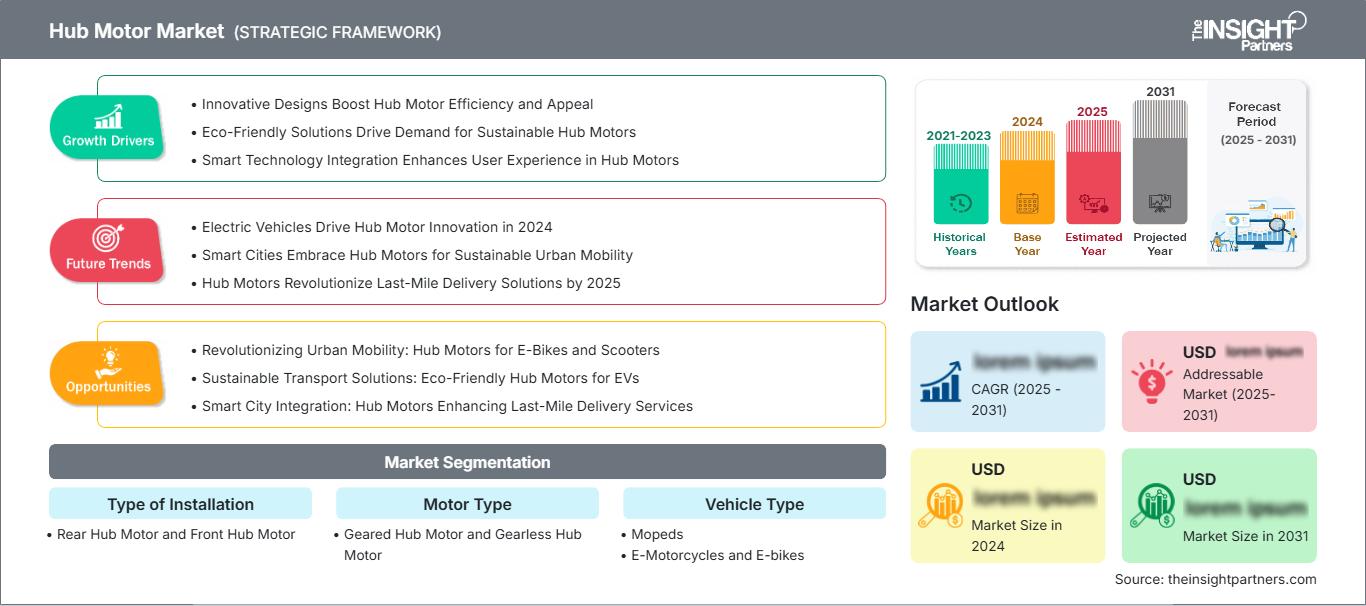
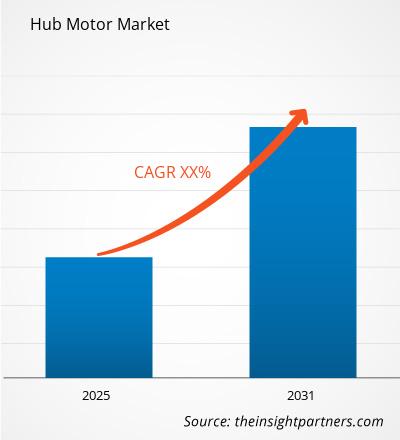
The Hub Motor Market was valued at US$ 10,441.02 Million in 2025 and is projected to reach US$ 15,721 Million by 2034, registering a CAGR of 4.65% during 2026–2034. The rear and front hub designs cater to mopeds, E-Motorcycles, and E-bikes in geared and gearless designs, whereas the OEM and aftermarket distribution channels facilitate factory installations, replacements, and conversions to electric mobility.
In North America, Hub Motor Market size will grow at a modeled 4.1%-4.5% CAGR till 2034. E-bike usage, growth in serviced fleets, and the demand for propulsion units in urban delivery vehicles drive the acquisition. The choice of products is towards low-maintenance rear wheel designs, torque sensing, connectivity features, and serviceability, with classifications and city investments influencing product specifications by countries/states.
Hub Motor Market Assessment and Insights
- North America: Represents 22–24% share in 2025 and grows at a 4.1–4.5% CAGR during 2026–2034, supported by commuter E-bikes, delivery fleets, dealer service networks, and connected urban-mobility products.
- US: Accounts for 80–82% of North America in 2025 and advances at a 4.2–4.6% CAGR as brands broaden affordable hub-driven commuter and utility models.
- Europe: Holds 25–27% share in 2025 and grows at a 4.0–4.4% CAGR, led by Germany, France, the Netherlands, Italy, and the UK through cycling infrastructure and fleet electrification.
- Asia Pacific: Captures 43–45% share in 2025 and expands at a 5.2–5.6% CAGR, with China, India, Japan, and South Korea anchoring two-wheeler production, component supply, and domestic adoption.
- Largest Segment: E-bikes hold 56–60% market share in 2025 and grow at a 4.8–5.2% CAGR through 2034, reflecting high unit volumes and broad commuter applicability.
- High Growth Segment: E-Motorcycles represent 18–22% market share in 2025 and advance at a 6.0–6.4% CAGR through 2034 as higher-output platforms commercialize.
- Key companies analyzed in detail: Compagnie Générale des Établissements Michelin SCA; Elaphe Propulsion Technologies Ltd.; Schaeffler AG; Tajima Motor Corporation; Robert Bosch GmbH; TDCM Corporation Limited; Polaris Industries Inc.; EnerTrac Corporation; GO SwissDrive AG; Trek Bicycle Corporation.
Source: The Insight Partners' analysis based on proprietary research, government publications, company annual reports, investor presentations, industry databases, and expert interviews.
As the product continues to evolve, hub motors have evolved from being mere externally controlled bicycle motors to becoming a complete propulsion system, which includes sensing, control, thermal management, regenerative features, and communication. The rear-wheel models have been more favored owing to reasons of traction and frame space concerns; however, the front-wheel models remain very handy for effective conversions. Gear motors have increased torque without adding any extra weight to the bike while gearless motors have remained robust and silent. The present day manufacture involves magnets, winding, sealing, wheel attachment, firmware, and testing.
Until 2034, investments will shift towards assembling electric two-wheelers in India, Southeast Asia, Latin America, and certain African cities. According to the IEA, 10 million electric two- and three-wheelers have been sold in 2024, with China, India, and Southeast Asia accounting for about 80% of all two-wheeler sales worldwide. Factors such as localization efforts, battery swapping facilities, deliveries, and urban air quality regulation will lead to increased OEM sourcing, whereas the selection of suppliers will pay attention to waterproofing, heat removal, braking compatibility, and maintenance services.
Hub Motor Market Report Scope
| Report Attribute | Details |
|---|---|
| Market size in 2025 | US$ 10,441.02 Million |
| Market Size by 2034 | US$ 15,721 Million |
| Global CAGR (2026 - 2034) | 4.65% |
| Historical Data | 2021-2024 |
| Forecast period | 2026-2034 |
Hub Motor Market Analysis
Hub Motor Market growth factors include electrification of commute, last-mile deliveries, and the quest among the companies to develop smaller drivetrain units with fewer mechanical transmission components. Two-wheeled and three-wheeled electric vehicles were the most electrified mode of road transportation in 2024, crossing 9% of the total fleet size in the world. Hub motor technologies convert the demand into a scaleable assembly comprising the motor, controller, sensors, wheel, battery connection, and software components.
Upstream value creation involves electrical steel, copper, permanent magnets, bearings, gears, aluminum housings, power electronics, and sealants. The midstream players specialize in winding, rotor balancing, gear development, thermal management, and validation activities, while the downstream original equipment manufacturers assemble brake and suspension systems and battery management systems along with controls. The price fluctuation of permanent magnets and certification periods may hamper product launches.
Hub motor market report reveals that there is competition from high-volume light-mobility producers and sophisticated in-wheel drive developers. Robert Bosch GmbH has come up with a hub motor that falls under the connected urban category, whereas TDCM Corporation Limited and GO SwissDrive AG have come up with custom-made bike applications. Elaphe Propulsion Technologies Ltd. and Schaeffler AG concentrate on integration into vehicles, torque management, and packagability.
Investment strategy includes automation in winding, small-size power electronics, built-in sensors, and application software for OEMs. Vehicle design expertise is provided by Compagnie Générale des Établissements Michelin SCA and Tajima Motor Corporation, bicycle distribution channel knowledge is possessed by Trek Bicycle Corporation, and high-output conversions are handled by EnerTrac Corporation. Polaris Industries Inc. has a place in the industry via its Victory electric-motorcycle legacy and service.
● REPORT CUSTOMIZATION
Tailor This Report To Align With Your Specific Business Requirements
This report can be customized to align precisely with your business objectives, scope, and target markets. Customization options include tailored segmentation, geography, competitive analysis, and strategic insights to support informed decision-making.
Customize This Report →WHAT YOU CAN ADJUST
- ● Segmentations
- ● Geography
- ● Competitive Analysis
- ● Language Preferences
Hub Motor Market: Strategic Insights
Regional Insights
North America Hub Motor Market
North America was estimated to have been generating revenues of 22-24% of the total global market in 2025 and is expected to experience a CAGR of 4.1-4.5% during 2026-2034. The Hub Motor Market share is indicative of mature recreational cycling needs, rising commuter E-bike uptake, and increasing utility fleet growth. Rear-hub technology fits approachable city bikes since they maintain traditional frame structure, enable easy power delivery, and allow competitive retail pricing.
The United States is the regional leader in terms of market value, Canada offers commuting and trail market, and Mexico offers manufacturing opportunity. Purchasing considerations include diagnostic ability of dealers, replaceability of the bike, theft resistance, and compatibility with different power and speed standards. Fleet operators prefer a sealed engine and maintenance capability. Premium manufacturers set themselves apart by using sensors and integrating software, whereas aftermarket brands provide conversion kits and replacement wheels. Growth within the region is moderate and not rapid because mid-drive technology is working well with performance bikes, although hub motors are more advantageous than simplicity, affordability, and lower drivetrain wear.
U.S. Hub Motor Market
The United States comprised 80% – 82% of the North American market revenue in 2025 and is projected to grow at a CAGR of 4.2% - 4.6% until 2034. Consumer demand is focused on commuter E-bikes, bikes compatible with throttle controls, delivery bikes, and recreation bikes. Differing state and municipal classifications affect power rating, assisted speed, and the control architecture, making configurable platforms desirable as these can be adapted by manufacturers without altering the entire bike.
Connected Hub Line of Robert Bosch GmbH will boost the competition in the premium sector; Trek Bicycle Corporation will emphasize dealers and replacements for hub drive bicycles, and TDCM Corporation Limited and specialized distributors will focus on OEMs’ customization needs. There is more likelihood that there will be use of sensors for torque, integration with apps, locational awareness, and easy-to-maintain electronics. Fleet buyers will focus on ingress protection, wheel durability, heat-induced derating of performance and availability of components because of the effect of downtimes on cost savings realized during procurement. Rear mounting will be dominant in general purchases while front mounting will dominate retrofits.
Europe Hub Motor Market
Share of Europe was 25–27% in 2025 and expected to increase at 4.0–4.4% CAGR. Germany takes the lead due to extensive bicycle retail market, engineering capabilities, and need for compliant pedelecs with 3.9–4.3% modeled CAGR. UK will advance at 4.1–4.5% as cycle-to-work buying behavior and urban deliveries drive adoption of reliable rear-hub systems, although some performance cyclists prefer mid-drive systems.
France, Italy, and Spain all have commuting, recreational, and mobility demands. France will see 4.2-4.6% growth because of the urban biking networks in the cities with the help of E-bikes; Italy will see 4.0-4.4% growth with the help of its well-established bicycle manufacturing industry and urban mobility; Spain will see 4.3-4.7% growth due to tourism, delivery, and metropolitan mobility. The Netherlands is important for high-end connected bicycles. European regulations will require proven speed restrictions, electromagnetic compatibility, battery safety, and repair manuals, which will help suppliers who can certify the integrated systems in multiple brands of bicycles.
APAC Hub Motor Market
The APAC region held a market share of 43-45% in 2025 and will continue growing at a 5.2-5.6% CAGR. The Chinese advantage lies in scale for motors, batteries, controllers, and electric two wheelers. India provides the growth impetus in terms of increasing demand for mopeds and motorcycles. The Japanese and Koreans focus on small size and reliability.
Industrial policies, local content mandates, tight supplier clusters, and battery swapping investments help with production in the region. Demand ranges from the cost-conscious fleets to premium OEMs, thus making demands for both simple geared systems to liquid cooled in-wheel motors.
Middle East & Africa Hub Motor Market
MEA is projected to grow at a CAGR of 4.6% – 5.0% until 2034. The UAE is leading premium micromobility and logistics pilots, whereas the urban development projects in Saudi Arabia open selective fleet opportunities. South Africa offers the most developed retail network for cycling products in the region and demand for replacement parts.
The Rest-of-MEA segment continues to rely on projects and be impacted by import tariffs, heat, dust, and service availability. Investments in energy and transport infrastructure can help build charging and delivery networks, however, motors will need strong protection from heat and dust.
Segmentation Analysis
Type of Installation
Type of Installation is projected to expand at a 4.5–4.9% CAGR during 2026–2034. The Hub Motor Market scope reflects traction, steering feel, frame compatibility, brake integration, and service requirements. Rear installations dominate OEM applications because propulsion loads remain separated from steering, while front units offer economical conversion and uncomplicated drivetrain compatibility for lower-power urban bicycles.
- Rear Hub Motor: Positioned as the mainstream configuration, rear systems deliver favorable traction, preserve conventional steering, and suit commuter E-bikes, mopeds, and higher-output motorcycles.
- Front Hub Motor: Front installations remain strategically important for economical conversions and simple bicycle architectures, offering straightforward fitment while requiring careful traction and fork-load management.
Motor Type
Motor Type is modeled to grow at a 4.6–5.0% CAGR through 2034. Geared architectures gain from compact dimensions and strong low-speed torque, particularly in lightweight bicycles. Gearless motors emphasize quietness, regenerative capability, and fewer wear components, supporting heavier vehicles and demanding duty cycles. Selection balances efficiency maps, thermal limits, mass, wheel diameter, and expected maintenance.
- Geared Hub Motor: Compact planetary gearing raises wheel torque from a smaller motor, supporting lightweight commuter designs, responsive starts, and efficient operation across moderate gradients.
- Gearless Hub Motor: Direct-drive systems offer quiet operation, mechanical simplicity, and regenerative potential, making them important for durable fleets, high-power conversions, and heavier electric two-wheelers.
Vehicle Type
Vehicle Type is expected to record a 5.0–5.4% CAGR during 2026–2034. E-bikes provide the largest unit base, mopeds support daily commuting and delivery, and E-Motorcycles create the strongest performance upside. Platform requirements widen sharply by vehicle mass and speed, shifting design priorities from low weight and natural pedaling toward liquid cooling, torque control, reinforced wheels, and braking coordination.
- Mopeds: Urban commuting and commercial delivery sustain demand for sealed, efficient motors with strong launch torque, standardized wheels, and serviceable controllers suited to intensive daily use.
- E-Motorcycles: Higher-voltage platforms require robust thermal management, wheel engineering, and precise torque control, creating premium opportunities as direct-drive systems progress toward OEM validation.
- E-bikes: The largest volume category spans economical commuters, shared fleets, leisure models, and utility cycles, rewarding lightweight motors, smooth sensing, quiet operation, and extensive dealer support.
Sales Channel
Sales Channel is projected to grow at a 4.4–4.8% CAGR through 2034. OEM procurement leads value through design integration, calibration, certification, and recurring production contracts. The aftermarket remains strategically significant for replacement wheels, controller upgrades, conversions, and legacy fleet service. Suppliers increasingly differentiate through application engineering, diagnostic tools, documentation, and assured spare-part availability.
- OEMs: Factory programs generate stable volumes and deeper integration, requiring validated performance, software calibration, quality systems, certification support, and dependable production ramp-up across vehicle platforms.
- Aftermarket: Replacement and conversion demand broadens lifecycle revenue, favoring compatible wheel formats, clear installation guidance, stocked controllers, and service networks capable of troubleshooting mixed-component systems.
Opportunity Snapshot
| Vehicle Type | Revenue Contribution | Trend Tag | Adoption Stage |
| Mopeds | Medium | Fleet Utility | Scaling |
| E-Motorcycles | Medium | Torque Vectoring | Emerging |
| E-bikes | High | Connected Commuting | Mature |
Hub Motor Market Growth Drivers and Impact Analysis
Electric Two-Wheeler Scale Expands Addressable Demand
Electric two- and three-wheelers provide the clearest volume foundation for hub drives. The IEA recorded 10 million electric models sold in 2024, representing around 15% of global two- and three-wheeler sales. China alone sold about 7 million electric two-wheelers, while India and Southeast Asia remained major mobility markets. Hub motors align with these applications because they reduce transmission complexity, fit compact platforms, and can be configured across commuter bicycles, mopeds, and delivery vehicles. Market impact extends through magnets, controllers, wheels, brakes, batteries, and service parts. Suppliers able to localize winding, housings, and electronics near assembly clusters can shorten lead times and meet domestic-content rules, while dependable quality systems help convert high unit demand into repeat OEM programs.
Last-Mile Fleets Reward Low-Maintenance Propulsion
Delivery fleets, shared mobility operators, and institutional users evaluate propulsion through uptime rather than recreational performance. Hub motors protect chains and sprockets from motor torque, simplify wheel-level replacement, and can reduce scheduled drivetrain maintenance. Direct-drive variants add regenerative braking opportunities, while geared units provide efficient launch torque for stop-start routes. Real-world impact appears in procurement specifications for sealing, spoke strength, thermal derating, diagnostic access, and stocked spares. Fleet customers also create recurring aftermarket revenue from wheels, controllers, sensors, and cables. Vendors that combine remote fault data with modular repair can shorten service events and improve residual value. However, commercial adoption depends on demonstrating total operating cost under payload, gradient, weather, and duty-cycle conditions rather than relying on nominal power alone.
Integrated Electronics Improve Ride Quality and Differentiation
Modern systems increasingly combine torque, cadence, speed, temperature, and motion sensing with compact controllers and over-the-air software. Fast sensor fusion can make assistance feel natural, manage wheel slip, protect hardware, and adapt output to battery state or riding mode. Connected functions also support theft deterrence, location services, maintenance alerts, and dealer diagnostics. This integration changes competition because motor efficiency alone no longer determines the user experience. OEMs favor suppliers that validate hardware, firmware, battery communication, and controls as one system, reducing launch risk. The impact is visible in premium commuter E-bikes and emerging in-wheel vehicles, where independent wheel control can improve maneuverability and torque allocation. Suppliers lacking software, cybersecurity, and service capabilities risk being confined to price-sensitive component business.
Hub Motor Market Future Trends
Software-Defined Wheel Modules Move Toward Production
Hub Motor Market trends will increasingly center on software-defined wheel modules that combine propulsion, sensing, braking coordination, diagnostics, and independent torque control. Vehicle developers can use wheel-level actuation to simplify mechanical layouts and create more cabin or cargo space, while software calibrates traction and stability by application. Progress depends on reducing unsprung mass, protecting electronics from impact and water, and proving durability over automotive lifecycles. Standardized interfaces between motor, inverter, brake, suspension, and vehicle controller will become strategically important. Early commercialization is likely in low-speed urban platforms, specialty vehicles, and premium demonstrations before broader passenger-vehicle adoption establishes scale.
Repairable Connected Systems Reshape Lifecycle Economics
Future hub-drive platforms will be designed for component-level service rather than complete assembly disposal. Replaceable electronics, accessible seals, modular connectors, diagnostic histories, and certified remanufacturing can reduce ownership cost and support circularity requirements. Connectivity will allow dealers and fleets to identify overheating, sensor drift, bearing wear, or communication faults before failure. Manufacturers will need secure firmware management and long-term parts governance because electric bicycles and light vehicles often remain in service well beyond consumer-electronics support cycles. The strongest systems will pair compact design with practical repair pathways, enabling brands to offer warranties, second-life programs, and fleet service agreements without absorbing excessive replacement costs.
Hub Motor Market Opportunities
Localized Systems for Asian Two-Wheeler Platforms
Hub Motor Market Forecasts support targeted investment in localized systems for India and Southeast Asia, where two-wheelers are essential passenger and commercial transport. Suppliers should combine regionally sourced housings, wheels, cables, controllers, and final assembly with common electromagnetic cores to balance cost and scale. Application laboratories can validate motors against high ambient temperatures, monsoon exposure, payload, rough roads, and battery-swapping duty cycles. Joint development with moped and motorcycle OEMs offers access to recurring volumes and earlier design influence. Success requires more than inexpensive hardware: providers need production traceability, homologation support, field diagnostics, and regional spares. Licensing or manufacturing partnerships can accelerate market entry while limiting capital intensity and tariff exposure.
Fleet Retrofit and Lifecycle Service Platforms
Installed delivery, rental, and shared-mobility fleets create an opportunity for standardized replacement wheels, controllers, sensors, and diagnostic subscriptions. Suppliers can audit existing platforms, identify failure modes, and offer sealed upgrade kits matched to wheel size, voltage, connector, and braking requirements. Service partners should receive training, test equipment, and stocked modules so repairs occur locally. Performance-based contracts tied to vehicle availability can differentiate capable vendors from component traders. Aggregated field data also informs improved thermal protection and predictive maintenance. The commercial model expands revenue beyond initial motor sales while helping operators extend asset life, manage mixed fleets, and plan replacement according to duty-cycle evidence rather than fixed schedules.
Recent Developments
- June 2026: Bosch eBike Systems has introduced its first-ever hub motor, marking the company's expansion beyond its traditional mid-drive motor technology. Called the Hub Line, the new drive unit has been specifically developed for urban eBikes, with an emphasis on lightweight construction, smooth assistance and minimalist design. The Hub Line delivers 45 Nm of torque and uses intelligent sensor technology to provide responsive and controlled assistance. This is particularly useful when starting from traffic lights or riding up moderate inclines.
- March 2025: TAILG has introduced its V6 flat-wire hub motor, bringing motor technology commonly associated with high-end electric vehicles into the electric two-wheeler market. The company says the new motor is designed to improve power output, efficiency, riding range and overall performance. The V6 motor uses an advanced flat-wire design with optimized slot structures, wiring and winding configurations.
- June 2026: Bosch eBike Systems is expanding its product portfolio for the 2027 eBike season with several new technologies, most notably its first-ever rear-wheel hub motor. The new Hub Line marks a significant shift for Bosch, which has traditionally focused on mid-drive motors. The new system is primarily aimed at lightweight urban, commuter and lifestyle eBikes.
Frequently Asked Questions

- Comprehensive Market Sizing and Forecast Analysis
- Detailed Segmentation Analysis
- In-Depth Market Dynamics Assessment
- Regional and Country-Level Insights
- Competitive Landscape and Company Benchmarking
- Strategic Business Intelligence
Recent Reports
Testimonials

The Insight Partners' SCADA System Market report is comprehensive, with valuable insights on current trends and future forecasts. The team was highly professional, responsive, and supportive throughout. We are very satisfied and highly recommend their services.
RAN KEDEM Partner, Reali Technologies LTDs
I requested a report on a very specific software market and the team produced the report in a few days. The information was very relevant and well presented. I then requested some changes and additions to the report. The team was again very responsive and I got the final report in less than a week.
JEAN-HERVE JENN Chairman, Future Analytica
We worked with The Insight Partners for an important market study and forecast. They gave us clear insights into opportunities and risks, which helped shape our plans. Their research was easy to use and based on solid data. It helped us make smart, confident decisions. We highly recommend them.
PIYUSH NAGPAL Sr. Vice President, High Beam Global
The Insight Partners delivered insightful, well-structured market research with strong domain expertise. Their team was professional and responsive throughout. The user-friendly website made accessing industry reports seamless. We highly recommend them for reliable, high-quality research services
YUKIHIKO ADACHI CEO, Deep Blue, LLC.
This is the first time I have purchased a market report from The Insight Partners.While I was unsure at first, I visited their web site and felt more comfortable to take the risk and purchase a market report.I am completely satisfied with the quality of the report and customer service. I had several questions and comments with the initial report, but after a couple of dialogs over email with their analyst I believe I have a report that I can use as input to our strategic planning process.Thank you so much for taking the extra time and making this a positive experience.I will definitely recommend your service to others and you will be my first call when we need further market data.
JOHN SUZUKI President and Chief Executive Officer, Board Director, BK Technologies
I wish to appreciate your support and the professionalism you displayed in the course of attending to my request for information regarding to infectious disease IVD market in Nigeria. I appreciate your patience, your guidance, and the fact that you were willing to offer a discount, which eventually made it possible for us to close a deal. I look forward to engaging The Insight Partners in the future, all thanks to the impression you have created in me as a result of this first encounter.
DR CHIJIOKE ONYIA MANAGING DIRECTOR, PineCrest Healthcare Ltd.Reason to Buy
- Informed Decision-Making
- Understanding Market Dynamics
- Competitive Analysis
- Identifying Emerging Markets
- Customer Insights
- Market Forecasts
- Risk Mitigation
- Boosting Operational Efficiency
- Strategic Planning
- Investment Justification
- Tracking Industry Innovations
- Aligning with Regulatory Trends





 Get Free Sample for