
HUD Helmet Market Share, Growth & Forecast by 2034
Coverage: by Connectivity (Tethered, Embedded); Component (Hardware, Software); Display (OLED, LCOS, LCD and LED); and Geography (North America, Europe, Asia Pacific, and South and Central America)
- Status : Data Released
- Report Code : TIPRE00007966
- Category : Electronics and Semiconductor
- No. of Pages : 150
- Available Report Formats :


- Last update date : September 17, 2026


2025 Market Size
US$ 4.44 Bn
Base year value
2034 Forecast
US$ 8.70 Bn
Projected by 2034
CAGR 2026-2034
7.76 %
Growth rate
Addressable Market
US$ 59.15 Bn
(2026-2034)
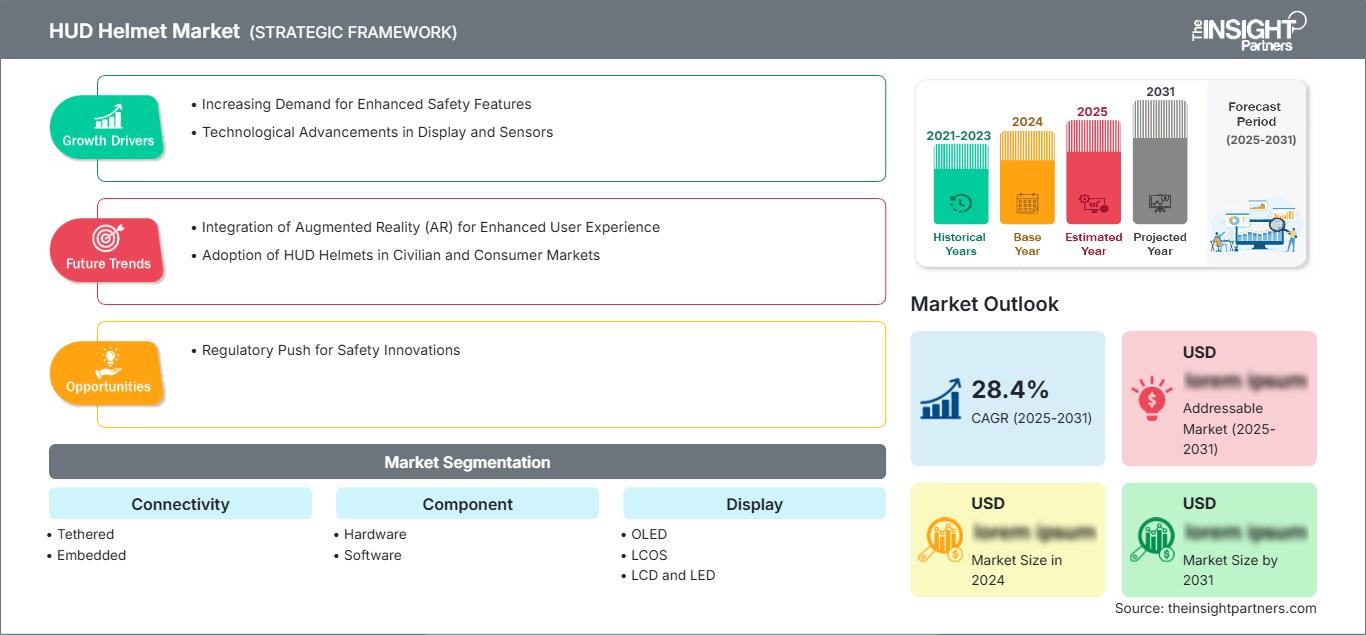
The HUD Helmet Market is valued at US$ 4.44 Billion in 2025 and is projected to reach US$ 8.70 Billion by 2034, expanding at a CAGR of 7.76% from 2026 to 2034. The Market is defined by head protection along with integrated digital technology that brings navigation, communication, and rider data into the line of sight. Market growth will be driven by the increasing use of connectivity, small size optical technologies, and assistance through software.
There are opportunities for the adoption of this market in North America due to the increased use of premium motorcycles, smart cars, and hand-free navigation system. The growth rate of the HUD Helmet Market Size is estimated to be 8.8%–10.2% CAGR due to incorporation of smartphone technology and user knowledge about the augmented reality system.
HUD Helmet Market Assessment and Insights
- North America: North America should retain a leading position, with a 2025 share of 32–36% and a CAGR of 8.8–10.2% between 2026–2034, supported by premium motorcycles, technology-oriented riders, and established aftermarket channels.
- US: The US represents the principal regional market, accounting for 72–76% of North American revenue in 2025 and expanding at an 8.6–10.0% CAGR through 2034.
- Europe: Europe holds a 24–28% share in 2025 and is projected to grow at 7.5–8.8%, led by Germany, the UK, France, Italy, and Spain, where premium helmet standards and motorcycle touring support technology adoption.
- Asia Pacific: Asia Pacific accounts for 28–32% in 2025 and should record a 9.8–11.5% CAGR, led by China, Japan, India, South Korea, and Australia as motorcycle volumes and digital mobility ecosystems deepen.
- Largest Segment: Connectivity is the largest segment, with a 55–60% market share in 2025 and an 8.5–10.5% CAGR, reflecting the central role of connected rider interfaces.
- High Growth Segment: Embedded connectivity represents a high-growth opportunity, holding a 30–35% share in 2025 and expanding at an 11.0–13.0% CAGR as integration improves.
- Key companies analyzed in detail: BIKESYSTEMS, BMW Motorrad, DigiLens Inc., Intelligent Cranium Helmets LLC, Japan Display Inc., JARVISH Inc., NUVIZ, Inc., REYEDR, SHOEI CO., LTD., SKULLY Technologies.
Source: The Insight Partners' analysis based on proprietary research, government publications, company annual reports, investor presentations, industry databases, and expert interviews.
In the HUD Helmet Market, there is a development from communication devices into computing devices that include optics, connectivity, sensors, battery life, and software that works specifically for helmets. There is a need for collaboration among helmet makers, display companies, optic component makers, semiconductor companies, and software developers. Lighter waveguides, smaller projectors, and better power management are needed since the electronics need not interfere with fit, weight, ventilation, and protection from impacts.
The future growth of this market will depend on new motorcycle markets where there is an ongoing development of connected vehicles along with increased premiumization. The focus of regulation on the safety of powered two-wheelers, especially those regions which have stringent helmet certification and enforcement, can be leveraged when the electronics do not interfere with the certified protective structure. There is also more investment in modular structures that will enable the software and optics to be updated without having to redesign the entire helmet platform.
HUD Helmet Market Report Scope
| Report Attribute | Details |
|---|---|
| Market size in 2025 | US$ 4.44 Billion |
| Market Size by 2034 | US$ 8.70 Billion |
| Global CAGR (2026 - 2034) | 7.76% |
| Historical Data | 2021-2024 |
| Forecast period | 2026-2034 |
HUD Helmet Market Analysis
The demand side will be determined by the market growth of connected riding, luxurious motorcycles, and customer expectations related to navigational and communication needs. The industry encompasses helmets, optical engines, waveguides, displays, batteries, sensors, Bluetooth technology, mobile applications, and cloud-based services. Component suppliers affect the performance of the device via its brightness, weight, heat dissipation, and power consumption, whereas helmet manufacturers affect performance by means of fit, safety, and ergonomics of use.
Supply conditions will still be difficult from a technical standpoint due to more complex manufacturing processes compared to traditional helmets. It is exemplified by such companies as DigiLens Inc. in terms of scalable waveguide manufacturing and Japan Display Inc. in terms of its experience in display technology application. SHOEI CO., LTD. shows that suppliers need safety engineering as well as digital technology expertise.
Competitive positioning analysis in HUD Helmet Market Report highlights different integration strategies. While BMW Motorrad is focused on integrating connected rider ecosystems, SHOEI CO., LTD. integrates premium helmet knowledge with HUD innovation and DigiLens Inc. is working on optical waveguides. JARVISH Inc., Intelligent Cranium Helmets LLC, REYEDR and SKULLY Technologies are specialized solutions, while NUVIZ, Inc. should not be ignored since it was an early reference in smart-helmet technology.
Investments will be mainly devoted to technologies like optical miniaturization, software differentiation, battery efficiency and cooperation with motorcycle manufacturers. BIKESYSTEMS can be included into the technology-related suppliers group, while Japan Display Inc. can provide display components for future architectures. Competitive advantage will no longer be achieved by integration of single features but by reliable provision of information without distracting a rider, reasonable weight and certification compliance.
● REPORT CUSTOMIZATION
Tailor This Report To Align With Your Specific Business Requirements
This report can be customized to align precisely with your business objectives, scope, and target markets. Customization options include tailored segmentation, geography, competitive analysis, and strategic insights to support informed decision-making.
Customize This Report →WHAT YOU CAN ADJUST
- ● Segmentations
- ● Geography
- ● Competitive Analysis
- ● Language Preferences
HUD Helmet Market: Strategic Insights
Regional Insights
North America HUD Helmet Market
North America represented 32–36% of the HUD Helmet Market Share in 2025 and is expected to expand at an 8.8–10.2% CAGR through 2034. The region benefits from premium touring motorcycles, technologically receptive consumers, established powersports distribution, and strong smartphone penetration. Demand is concentrated around navigation, communication, and situational information rather than entertainment.
US continues to be the major contributor in the region, while Canada caters to specific premium demand. Designers are more inclined towards designing products which can work without hands, which will have a display system that works under the sun, and will also be compatible with the motorcycle’s electrical system. Certification requirements will further motivate the manufacturers to design systems separate from impact structures. Growth in North America will favor such systems.
U.S. HUD Helmet Market
The US accounted for 72–76% of North American HUD Helmet Market revenue in 2025 and should expand at an 8.6–10.0% CAGR through 2034. Large premium motorcycle communities, long-distance touring, and established technology retail channels provide favorable conditions for connected helmet adoption.
The companies that manufacture products for BMW Motorrad, SHOEI CO., LTD., DigiLens Inc., and specialized developers are susceptible to US tech-focused motorcyclists. In applications of these helmets, navigation, communication, rear visibility, and ride-related information are higher priorities than entertainment applications. Modularity is still key because riders frequently change helmets separately from buying motorcycles.
Europe HUD Helmet Market
In 2025, Europe accounted for 24–28% of the market and was expected to record an annual CAGR of 7.5–8.8%. In Germany, the market benefits from a high-quality motorcycle industry and tech-oriented rider wearables. The UK sustains its market due to touring and high-performance motorcycling needs, while the French and Italian markets benefit from developed industries of helmets and motorcycles. Spain drives growth via growth in recreational and urban two-wheelers.
The relevance of Germany is in its ability to develop and integrate the use of helmets with navigation and connected cars thanks to the ecosystem of motorcycle OEMs. In the case of the UK market, there is a focus on luxury accessories and touring capabilities, while both France and Italy have a mixture of motorcycling culture and digitization. Spain emerges as an important market for helmet adoption owing to urban and recreational riding.
APAC HUD Helmet Market
APAC represented 28–32% of the market in 2025 and is expected to grow at a 9.8–11.5% CAGR, making it the fastest major regional market. China leads regional demand, followed by Japan, India, South Korea, and Australia.
High numbers of motorcycles, growing premium categories, domestic production of electronics, and digital mobility policy aid the adoption of HMDs. In terms of HMDs, Japan has advanced technology of helmets and display engineering, India is responsible for high demand of two-wheelers, China has large-scale production of electronics along with manufacturing scale.
Middle East & Africa HUD Helmet Market
MEA and Africa will experience growth in the range of 8.5%-10.2% CAGR due to factors such as premium mobility, development of infrastructure, and increased awareness regarding safety among motorcycle users. Leading markets in the Gulf include Saudi Arabia and UAE, while in Sub-Saharan Africa, it is South Africa.
Smart mobility and advanced transportation infrastructure investments drive opportunities in Saudi Arabia and UAE, while a more comprehensive ecosystem exists in South Africa. Road safety policies, backed by UNECE, have brought about increased focus on motorcycles, creating opportunities in the future as affordable and distributed connected helmets will emerge as solutions.

Segmentation Analysis
Connectivity
Connectivity remains the core architectural segment, with an 8.5–10.5% CAGR from 2026–2034. Tethered systems offer simpler power and data arrangements, while embedded architectures improve ergonomics and integration. The HUD Helmet Market scope increasingly favors embedded connectivity because it reduces external components and supports cleaner interaction with smartphones, motorcycles, navigation platforms, and future vehicle-to-device services.
- Tethered: Tethered configurations retain relevance where affordability, serviceability, and straightforward smartphone integration matter. External connections can simplify hardware design, although cables and accessory dependence limit ergonomic advantages during longer rides.
- Embedded: Embedded connectivity strengthens integrated product design by placing communication hardware, antennas, and controls inside the helmet. It supports cleaner interfaces and creates greater potential for OEM-linked navigation and software services.
Component
Component is projected to expand at a 9.0–11.0% CAGR during 2026–2034 as manufacturers balance hardware miniaturization with software functionality. Hardware remains essential for optics, computing, sensing, and power management, while software increasingly determines interface quality, navigation behavior, update capability, and application interoperability. Component-level optimization can materially improve weight, battery endurance, and user experience.
- Hardware: Hardware remains strategically important because displays, processors, batteries, sensors, and optical engines determine performance, durability, and helmet balance. Supplier innovation increasingly targets smaller components with higher efficiency.
- Software: Software supports navigation, communications, alerts, personalization, and over-the-air improvements. Its strategic importance is increasing because differentiated user interfaces can extend product relevance without requiring frequent physical redesigns.
Display
Display is forecast to grow at an 8.8–10.8% CAGR from 2026–2034. OLED, LCOS, LCD and LED architectures offer different combinations of brightness, resolution, efficiency, cost, and optical integration. Selection depends on whether manufacturers prioritize compactness, sunlight readability, power consumption, or manufacturing scalability. Waveguide compatibility will remain a decisive design consideration.
- OLED: OLED displays offer high contrast, compact construction, and strong visual performance, making them relevant for premium helmets. Their adoption depends on thermal management, outdoor readability, lifetime, and integration costs.
- LCOS: LCOS supports compact projection architectures and can provide detailed imagery. It remains relevant where optical efficiency and resolution need to be balanced against system complexity and component availability.
- LCD and LED: LCD and LED architectures retain relevance where brightness, cost, and mature supply chains are priorities. Their strategic role is strongest in products seeking dependable performance across broader price tiers.
Opportunity Snapshot
| Connectivity | Revenue Contribution (High/Medium/Low) | Trend Tag | Adoption Stage |
|---|---|---|---|
| Tethered | Medium | Accessory Link | Scaling |
| Embedded | High | Integrated HUD | Scaling |
HUD Helmet Market Growth Drivers and Impact Analysis
Rising demand for distraction-reduced rider information
Connected motorcycles increasingly generate navigation, speed, route, communication, and vehicle-status information that riders want to access without repeatedly viewing a conventional display. HUD interfaces can place selected information closer to the rider's line of sight, creating a potential ergonomic advantage when designed with restrained information density. The commercial impact is strongest in touring, premium commuting, and technology-oriented motorcycle categories, where customers already pay for connected features. Manufacturers can therefore justify higher system complexity when HUD functions are integrated with existing motorcycle applications rather than sold as isolated electronics. This driver also increases the value of software compatibility, voice interaction, and configurable alerts. Over time, purchasing decisions should increasingly evaluate information quality and distraction management alongside optical specifications, encouraging vendors to develop rider-centered interfaces rather than feature-heavy displays.
Miniaturization of optical and electronic components
Progress in compact projectors, waveguides, processors, sensors, and batteries is reducing the physical penalty associated with adding digital functionality to protective headgear. Smaller optical engines can create greater freedom for helmet designers to preserve shell geometry, ventilation, balance, and peripheral vision. Improvements in power efficiency similarly reduce the need for oversized battery packs, although operating endurance remains a central engineering constraint. The commercial effect is significant because weight and comfort are fundamental helmet purchase criteria, particularly during extended rides. Component miniaturization also supports modular architectures in which optical, communication, and computing functions can be upgraded independently. Suppliers that achieve better brightness, thermal performance, and energy efficiency can improve system economics while widening the addressable premium segment. This trend encourages deeper collaboration between optical specialists, electronics companies, and established helmet manufacturers.
Expansion of connected motorcycle ecosystems
Motorcycle manufacturers are increasingly linking instrument clusters, smartphones, navigation applications, communication systems, and rider accessories into broader digital ecosystems. This creates an opportunity for HUD helmets to function as another interface rather than as standalone consumer electronics. The market impact is potentially substantial because ecosystem integration can improve data consistency, simplify setup, and reduce duplicated hardware. OEM-linked systems can also support controlled software experiences and recurring service relationships, while aftermarket products can compete through broader motorcycle compatibility. The resulting competitive environment rewards companies that understand both vehicle communication protocols and helmet ergonomics. Integration with navigation and communication applications is particularly valuable because these functions already have clear rider utility. As motorcycles become more digitally connected, helmets that can receive authenticated information from the vehicle may gain an advantage over products relying solely on generic smartphone connectivity.
HUD Helmet Market Future Trends
AI-assisted contextual information
The next generation of interfaces is likely to use AI to filter rider information according to speed, route, traffic conditions, weather, and riding context. Instead of displaying every available data point, software could prioritize only information considered immediately relevant, reducing visual clutter and unnecessary alerts. This approach can transform the HUD from a passive screen into a contextual assistance layer. AI-enabled voice interaction may further reduce dependence on physical controls, particularly when gloves or adverse weather make buttons difficult to operate. The HUD Helmet Market trends will therefore increasingly emphasize information prioritization, personalization, and context awareness rather than simply increasing display resolution. Vendors that build transparent safety controls and predictable alert behavior will be better positioned as regulators and consumers scrutinize distraction risks. Data processing will also increasingly move toward edge architectures to reduce latency and protect sensitive rider information.
Modular architectures and serviceable electronics
Future products are likely to separate the helmet's certified protective structure from upgradeable digital modules wherever engineering and certification requirements permit. Modular optics, communication units, batteries, and computing components could allow manufacturers to extend product life while reducing the frequency of complete helmet replacement. Such architectures can also improve after-sales economics because individual modules may be repaired or upgraded instead of replacing the entire product. Software updates would become a more important mechanism for improving navigation, compatibility, and interface performance after purchase. Manufacturers may consequently develop tiered product families sharing common electronic platforms but differing in display capability or connectivity. This approach can lower development costs while enabling broader price segmentation. Long-term adoption will depend on maintaining weather resistance, impact protection, electromagnetic compatibility, and reliable attachment mechanisms as electronics become increasingly integrated into wearable protective equipment.
HUD Helmet Market Opportunities
OEM-integrated premium motorcycle platforms
Motorcycle OEM partnerships offer a strong route to scale because they can combine helmet hardware with vehicle electronics, navigation software, communication systems, and dealer distribution. Investors and suppliers can target programs where the helmet becomes an approved accessory within a connected motorcycle ecosystem rather than an isolated aftermarket device. This approach can improve customer confidence, simplify compatibility, and create opportunities for bundled financing or accessory packages. The HUD Helmet Market Forecasts should therefore consider OEM integration as a strategic channel alongside direct consumer sales. Companies with optical, display, or software capabilities can seek licensing arrangements with established helmet and motorcycle manufacturers. The most attractive programs will likely emphasize premium motorcycles, touring models, and technology-focused product lines where customers already accept connected accessories and higher equipment prices.
Waveguide platforms for scalable multi-device deployment
Waveguide technology creates an opportunity to develop optical platforms that can serve helmets, smart glasses, industrial headsets, and other wearable devices. A common optical architecture can spread engineering investment across multiple applications, potentially improving utilization of manufacturing capacity and reducing development risk. Suppliers can pursue licensing, joint development, or component partnerships rather than attempting to manufacture complete helmets themselves. The opportunity is especially relevant for companies with expertise in holographic optics, light engines, and display integration. Scaling across applications can also encourage greater standardization in optical modules and testing procedures. Strategic investors should prioritize platforms offering high transparency, low weight, efficient light transmission, and compatibility with multiple projector technologies. Such characteristics can support broader adoption while reducing dependence on a single helmet manufacturer or motorcycle brand.
Recent Developments
- June 2026: Canyon unveiled the prototype Stingr Smart helmet, featuring a retractable heads-up display (HUD) integrated into the visor, AI-powered safety information from the Canyon Predict system, peripheral-vision alerts for road hazards and other road users, customizable haptic and visual warnings, voice commands, audio navigation, group messaging and hands-free calling, while also supporting performance metrics such as speed, cadence, power and elevation.
- November 2025: TVS Motor Company and Aegis Rider unveiled the Aegis Rider Vision augmented-reality (AR) HUD helmet at EICMA 2025, featuring a spatially anchored display for real-time speed, navigation and safety alerts, along with hazard warnings, incoming-call information and hands-free communication, housed in a carbon-fiber shell.
- November 2025: TVS Motor unveiled a technology-packed heads-up display (HUD) helmet developed with Swiss startup Aegis Rider and Qualcomm, featuring motorcycle data such as speed, RPM, fuel level and gear position alongside smartphone functions including maps, turn-by-turn navigation, calls and messages, plus speakers, music, an integrated communication system and an action camera, with a reported battery life of around four hours.
Frequently Asked Questions

- Comprehensive Market Sizing and Forecast Analysis
- Detailed Segmentation Analysis
- In-Depth Market Dynamics Assessment
- Regional and Country-Level Insights
- Competitive Landscape and Company Benchmarking
- Strategic Business Intelligence
Recent Reports
Testimonials

The Insight Partners provided valuable market intelligence that supported our global go-to-market strategy. Their team was professional, responsive, and attentive to our feedback, providing thoughtful analysis and helpful methodological clarifications throughout the project.
Junmo Kim Chief Financial Officer (CFO), Enertech Co., Ltd.
The Insight Partners' SCADA System Market report is comprehensive, with valuable insights on current trends and future forecasts. The team was highly professional, responsive, and supportive throughout. We are very satisfied and highly recommend their services.
RAN KEDEM Partner, Reali Technologies LTDs
I requested a report on a very specific software market and the team produced the report in a few days. The information was very relevant and well presented. I then requested some changes and additions to the report. The team was again very responsive and I got the final report in less than a week.
JEAN-HERVE JENN Chairman, Future Analytica
We worked with The Insight Partners for an important market study and forecast. They gave us clear insights into opportunities and risks, which helped shape our plans. Their research was easy to use and based on solid data. It helped us make smart, confident decisions. We highly recommend them.
PIYUSH NAGPAL Sr. Vice President, High Beam Global
The Insight Partners delivered insightful, well-structured market research with strong domain expertise. Their team was professional and responsive throughout. The user-friendly website made accessing industry reports seamless. We highly recommend them for reliable, high-quality research services
YUKIHIKO ADACHI CEO, Deep Blue, LLC.
This is the first time I have purchased a market report from The Insight Partners.While I was unsure at first, I visited their web site and felt more comfortable to take the risk and purchase a market report.I am completely satisfied with the quality of the report and customer service. I had several questions and comments with the initial report, but after a couple of dialogs over email with their analyst I believe I have a report that I can use as input to our strategic planning process.Thank you so much for taking the extra time and making this a positive experience.I will definitely recommend your service to others and you will be my first call when we need further market data.
JOHN SUZUKI President and Chief Executive Officer, Board Director, BK Technologies
I wish to appreciate your support and the professionalism you displayed in the course of attending to my request for information regarding to infectious disease IVD market in Nigeria. I appreciate your patience, your guidance, and the fact that you were willing to offer a discount, which eventually made it possible for us to close a deal. I look forward to engaging The Insight Partners in the future, all thanks to the impression you have created in me as a result of this first encounter.
DR CHIJIOKE ONYIA MANAGING DIRECTOR, PineCrest Healthcare Ltd.Reason to Buy
- Informed Decision-Making
- Understanding Market Dynamics
- Competitive Analysis
- Identifying Emerging Markets
- Customer Insights
- Market Forecasts
- Risk Mitigation
- Boosting Operational Efficiency
- Strategic Planning
- Investment Justification
- Tracking Industry Innovations
- Aligning with Regulatory Trends





 Get Free Sample for