
Hyperspectral Imaging in Agriculture Market Size, Growth & Demand by 2034
Coverage: By Application (Vegetation Mapping, Crop Disease Monitoring, Stress Detection, Yield Estimation, Impurity Detection, Others); Product (Camera, Artificial Light Source, Image Processor, Others) , and Geography (North America, Europe, Asia Pacific, and South and Central America)
- Status : Data Released
- Report Code : TIPRE00026892
- Category : Electronics and Semiconductor
- No. of Pages : 150
- Available Report Formats :


- Last update date : September 15, 2026


2025 Market Size
US$ 56.39 Mn
Base year value
2034 Forecast
US$ 182 Mn
Projected by 2034
CAGR 2026-2034
13.9 %
Growth rate
Addressable Market
US$ 1,028.74 Mn
(2026-2034)
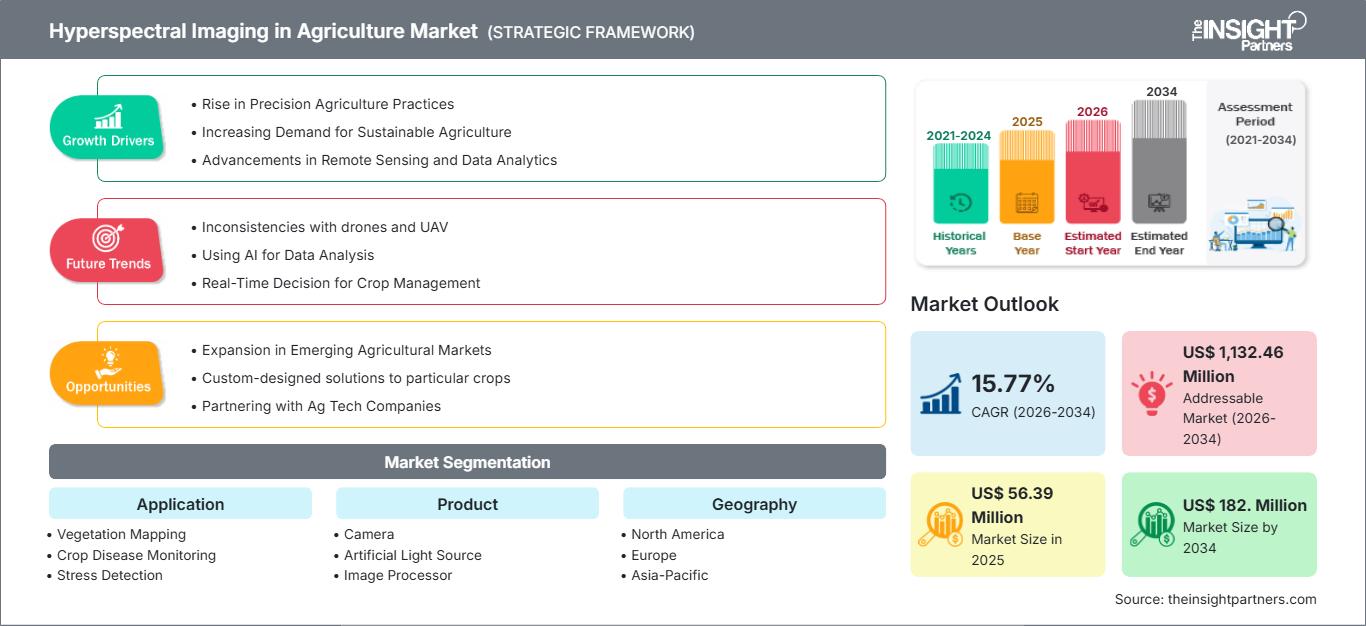
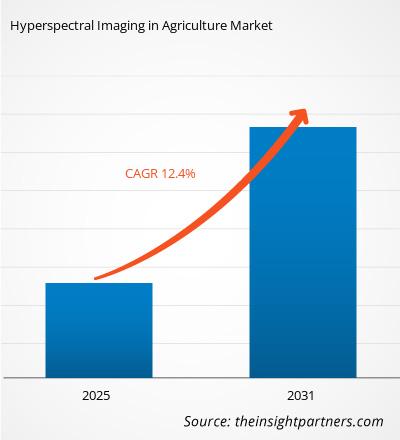
The Hyperspectral Imaging in Agriculture market was valued at US$ 56.39 million in 2025 and is expected to reach US$ 182 million by 2034; it is estimated to record a CAGR of 13.9% during 2026-2034.
Hyperspectral Imaging in Agriculture Market Assessment and Insights
- North America: Holds 34–36% share in 2025 and grows at a 14.8–15.4% CAGR during 2026–2034, supported by commercial-scale farms, drone service providers, public geospatial datasets, and advanced agronomy software.
- US: Accounts for 82–84% of North America in 2025 and advances at a 15.0–15.6% CAGR as growers prioritize early stress diagnosis and variable-rate decision support.
- Europe: Represents 27–29% share in 2025 and grows at a 14.4–15.0% CAGR, led by Germany, France, the UK, Italy, and Spain through digital-agriculture programs and research infrastructure.
- Asia Pacific: Captures 24–26% share in 2025 and expands at a 17.4–18.0% CAGR, with China, Japan, India, South Korea, and Australia scaling precision-farming trials and sensor manufacturing.
- Largest Segment: Cameras hold 44–48% market share in 2025 and grow at a 14.6–15.2% CAGR through 2034 because image acquisition remains the essential system layer.
- High Growth Segment: Stress Detection represents 17–21% market share in 2025 and advances at a 17.8–18.4% CAGR through 2034 as water and nutrient pressures intensify.
- Key companies analyzed in detail: Analytik Ltd; BaySpec, Inc.; Corning Incorporated; Cubert GmbH; Gamaya SA; HAIP Solutions GmbH; imec; ImpactVision, Inc.; inno-spec GmbH; FluroSat Pty Ltd.
Source: The Insight Partners' analysis based on proprietary research, government publications, company annual reports, investor presentations, industry databases, and expert interviews.
The design of the system has evolved from laboratory push-broom sensors to field-deployed snapshot, line-scan, aerial, and drone-based systems. Optics have shrunk in size, detectors have become more sensitive, there is onboard calibration capability, and processing using GPUs has reduced the time gap between sensing and agronomic intervention. The nature of production is such that it involves a growing collaboration between manufacturers of cameras, providers of light sources, image processors, drone operators, crop scientists, and modelers of the data.
For the period up until 2034, efforts to invest in this domain will need to be concentrated on moving forward from the deployment of research-driven programs in North America and Europe to Asia Pacific-centered agricultural production, specialist crops, breeding of seeds, and food inspection. Efforts undertaken by the EU in relation to spectral sensors as well as those related to digital farming in different countries serve as tailwinds to the growth in regulation and research.
Hyperspectral Imaging in Agriculture Market Report Scope
| Report Attribute | Details |
|---|---|
| Market size in 2025 | US$ 56.39 Million |
| Market Size by 2034 | US$ 182 Million |
| Global CAGR (2026 - 2034) | 13.9% |
| Historical Data | 2021-2024 |
| Forecast period | 2026-2034 |
Hyperspectral Imaging in Agriculture Market Analysis
Hyperspectral Imaging in Agriculture Market drivers include the need to identify physiological changes before symptoms emerge to apply targeted treatment instead of broad-based treatment. The value chain includes detectors, gratings, optics, illuminations, computing, calibration targets, and software, followed by drone operators, agronomists, research institutions, food processing, and farm management.
Supply is hindered by high cost of sensors, spectral calibration, atmospheric correction, voluminous data, and few agronomy training data. Vendors are countering by providing lighter weight cameras, standard APIs, cloud processing pipelines, and application specific models. Public data on crops and vegetation simplify the development process, while field testing is necessary since cultivar, soil, sunlight, plant maturity, and canopy architecture affect spectral properties.
Hyperspectral Imaging in Agriculture Market Report of hyperspectral imaging for agriculture shows a fragmented environment including component experts and solution providers offering vertical integration. The leading companies include BaySpec, Inc., Cubert GmbH (compact imagers), imec (semiconductor spectral sensing), Analytik Ltd (instrumentation, and application deployment), HAIP Solutions GmbH, inno-spec GmbH (integrated imaging solutions).
For the period up until 2034, efforts to invest in this domain will need to be concentrated on moving forward from the deployment of research-driven programs in North America and Europe to Asia Pacific-centered agricultural production, specialist crops, breeding of seeds, and food inspection. Efforts undertaken by the EU in relation to spectral sensors as well as those related to digital farming in different countries serve as tailwinds to the growth in regulation and research.
● REPORT CUSTOMIZATION
Tailor This Report To Align With Your Specific Business Requirements
This report can be customized to align precisely with your business objectives, scope, and target markets. Customization options include tailored segmentation, geography, competitive analysis, and strategic insights to support informed decision-making.
Customize This Report →WHAT YOU CAN ADJUST
- ● Segmentations
- ● Geography
- ● Competitive Analysis
- ● Language Preferences
Hyperspectral Imaging in Agriculture Market: Strategic Insights
Regional Insights
North America Hyperspectral Imaging in Agriculture Market
North America accounted for 34–36% of total revenue in 2025 and is expected to see a CAGR of 14.8–15.4% from 2026 to 2034. Hyperspectral Imaging in Agriculture Market Share is driven by sophisticated remote sensing infrastructure, premium specialty crops, extensive commercial farms, and robust collaboration between universities and industry. Public services of vegetation, croplands, and soil moisture also serve as reference layers to validate private data.
The U.S. is a clear leader in terms of demand for this product in the region, Canada takes part in broad-acre crops research, while Mexico possesses opportunities in horticulture and quality control of exported products. Providers of drone services and agronomy solutions have begun to offer hyperspectral imaging as a service that lowers capital costs. It is highly adopted in areas where such issues as diseases, irrigation, fertilization, or harvesting are economically important.
U.S. Hyperspectral Imaging in Agriculture Market
The US represents 82-84% of North American revenues in 2025, and growth rates of 15.0-15.6% are predicted between 2025 and 2034. Requirements include crop disease analysis, water stress analysis, phenotyping, vegetation classification, and produce inspections. Geospatial data from the government and extension programs at universities aid researchers to correlate their spectral analyses with ground truthing related to crop condition, acres, and soil moisture measurements.
US firms BaySpec, Inc., ImpactVision, Inc., and technology integrators enhance capabilities domestically, whereas foreign manufacturers of cameras can get into research facilities and drone service providers. Hyperspectral information is combined with thermal imagery, weather, and predictive analytics more and more often. Commercial agriculture needs rapid data processing, repeatable calibration, and integration with scouting and variable rate applications. Specialty crops, seed companies, and greenhouse agriculture provide an opportunity since variations in quality have an economic impact.
Europe Hyperspectral Imaging in Agriculture Market
Share of Europe was 27-29% in 2025 and growth rate in this region is expected at CAGR 14.4-15.0%. German lead comes from their expertise in photonics engineering, agriculture, and companies Cubert GmbH and inno-spec GmbH. UK enjoys instrumental support from Analytik Ltd as well as crop-science institutes. Advancements in France come from vineyards, cereals, and food quality use cases.
Vineyards, olives, horticulture, and drought detection have shown very strong application cases in Italy and Spain, and the EU is funding its research into universal spectral-imaging technology and excellence in remote sensing. Drivers for adoption of the technology include sustainable practices, efficient use of inputs, and a need for transparency of agricultural data. Vendors must adhere to privacy regulations, drone regulation, calibration, and standards for interoperability. Scalable solutions should leverage field imaging integrated with existing advisory services and not burden farmers with interpreting high dimensional spectral images.
APAC Hyperspectral Imaging in Agriculture Market
The APAC segment accounted for a 24% to 26% market share in 2025 and is estimated to grow with a CAGR of 17.4% to 18.0%. China drives growth via sensors production, drone solutions, and massive farm modernization projects. The focus in Japan and South Korea is on miniaturized optics and automation, India introduces crop-diversity and water-stressed applications, while Australia provides high-quality broad-acre precision farming.
There is industrial policy, local electronics competence, and government-led digital agriculture initiatives facilitating adoption. Local training of models is required to enter the market due to differences in cropping methods, field size, atmospheric conditions, and farmer economics.
Middle East & Africa Hyperspectral Imaging in Agriculture Market
Growth rate of MEA is expected to be between 15.8% and 16.4% CAGR till 2034. United Arab Emirates is leading the way in terms of controlled environment agriculture and food security trials, whereas Saudi Arabia is helping with efficient farming with water utilization projects. Commercial horticulture and vineyards are available in South Africa along with remote sensing capabilities.
With water shortages, the need to detect the stress becomes essential; nevertheless, the cost of machines, constraints on field research, and lack of labeled datasets create problems in this regard. Partnership with universities, agronomic consultants, and drone manufacturers can be beneficial in this regard.
Segmentation Analysis
Application
Application is projected to expand at a 16.0–16.6% CAGR during 2026–2034. The Hyperspectral Imaging in Agriculture Market scope spans crop characterization, physiological diagnosis, production forecasting, and quality assurance. Adoption rises where spectral outputs trigger a specific field action, while validation complexity differs by crop, growth stage, disease pressure, and imaging platform.
- Vegetation Mapping: Provides the broadest spatial foundation for crop classification, canopy assessment, stand uniformity, and field zoning, supporting scouting priorities and seasonal comparisons across large production areas.
- Crop Disease Monitoring: Enables pre-symptomatic detection by identifying biochemical and structural changes, making it strategically important for high-value crops where delayed treatment sharply increases losses.
- Stress Detection: Addresses water, nutrient, heat, and chemical pressures before severe visual decline, supporting targeted irrigation, fertilization, and field verification under climate variability.
- Yield Estimation: Combines spectral indicators with crop models and weather data to improve harvest planning, storage allocation, procurement, and production-risk assessment across seasons.
- Impurity Detection: Supports food and seed inspection by distinguishing foreign material, defects, contamination, or composition differences without destructive sampling, strengthening downstream quality control.
Product
Product is modeled to grow at a 15.2–15.8% CAGR through 2034. Cameras remain the system’s acquisition core, while illumination and image processing determine repeatability and speed in controlled settings. Competitive differentiation increasingly depends on spectral range, spatial resolution, signal-to-noise performance, weight, calibration stability, SDK access, and compatibility with drones or inspection lines.
- Camera: Commands the largest revenue contribution because detector, optics, spectral dispersion, and calibration directly determine data quality, platform weight, operating range, and application flexibility.
- Artificial Light Source: Provides controlled illumination for laboratories, greenhouses, sorting lines, and nighttime inspection, reducing ambient-light variability and improving repeatability for classification models.
- Image Processor: Converts large spectral cubes into usable indices, classifications, and alerts, making edge computing and optimized pipelines essential for near-real-time agricultural decisions.
Opportunity Snapshot
| Application | Revenue Contribution | Trend Tag | Adoption Stage |
| Vegetation Mapping | High | Field Zoning | Mature |
| Crop Disease Monitoring | High | Early Diagnosis | Scaling |
| Stress Detection | High | Water Stress | Scaling |
| Yield Estimation | Medium | Harvest Forecasting | Scaling |
| Impurity Detection | Medium | Quality Sorting | Mature |
| Others | Low | Custom Analytics | Emerging |
Hyperspectral Imaging in Agriculture Market Growth Drivers and Impact Analysis
Earlier Detection Improves Crop-Protection Economics
Hyperspectral systems identify subtle changes in pigments, water content, cellular structure, and chemistry that can precede visible symptoms. This timing advantage matters in high-value crops, seed production, and controlled environments, where delayed diagnosis can spread disease or reduce grade. The commercial impact appears when imagery directs scouts to specific zones, confirms treatment priorities, or separates healthy from compromised plants. Research increasingly combines spectral data with machine learning to improve classification, but field deployment requires disease-specific libraries and validation across cultivars and growth stages. Vendors that package cameras, calibration, analytics, and agronomic interpretation can reduce user complexity. Their strongest value proposition is not more bands; it is a verified reduction in detection time, unnecessary treatment, and avoidable crop loss.
Water and Nutrient Constraints Reward Precision Intervention
Climate variability, irrigation pressure, and input costs strengthen demand for tools that distinguish water stress, nutrient deficiency, disease, and normal canopy variation. Conventional vegetation indices can flag change, but hyperspectral measurements provide narrower diagnostic signatures that improve cause identification. Real-world impact depends on integrating imagery with soil, weather, irrigation, and field-history data so managers can prescribe action rather than simply observe anomalies. Drought-prone regions, orchards, vineyards, and greenhouse operations offer attractive economics because water allocation and crop quality are tightly linked. Suppliers must validate performance under changing sunlight, canopy geometry, and soil background. Solutions that deliver zone-level recommendations through familiar farm software can convert spectral precision into lower input waste and more resilient production.
Smaller Sensors and Faster Processing Expand Deployment
Advances in detectors, optics, snapshot acquisition, embedded processors, and compression are reducing payload weight and analysis latency. Lighter systems fit commercially available drones, while edge processing can screen data before cloud transfer and return priority maps soon after flight. These improvements broaden use beyond specialist laboratories toward agronomy services, breeding programs, and recurring farm monitoring. Market impact extends through lower deployment cost, more frequent imaging, and better integration with thermal or RGB sensors. However, miniaturization must preserve signal-to-noise performance, radiometric stability, and spectral calibration. Vendors that provide robust SDKs, automated correction, and standardized outputs simplify integration for drone operators and software partners, creating scalable channels without requiring every grower to become a spectroscopy expert.
Hyperspectral Imaging in Agriculture Market Future Trends
Foundation Models for Spectral Agronomy
Hyperspectral Imaging in Agriculture Market trends will increasingly center on reusable spectral foundation models trained across crops, sensors, seasons, and geographies. Instead of building every classifier from a small project dataset, developers will adapt broader representations to disease, nutrient, moisture, or quality tasks with fewer labels. Multimodal learning will combine hyperspectral cubes with weather, soil, thermal, and management records. Commercial progress depends on transparent validation, uncertainty reporting, and mechanisms for handling sensor drift or regional bias. Providers with access to diverse, well-annotated field libraries will hold an advantage, while partnerships with universities and growers will become strategic data-acquisition channels.
Spaceborne Data Joins Field-Scale Workflows
New-generation satellite sensors will extend hyperspectral coverage from experimental campaigns toward recurring regional observation. Spaceborne imagery will not replace drone or ground systems; it will identify broad anomalies, guide targeted flights, and provide context across seasons. Research using DESIS and PRISMA already demonstrates crop classification and biochemical assessment workflows, while future missions should improve availability. The emerging architecture will fuse satellite screening, drone diagnosis, and ground verification within one decision pipeline. Commercial services will differentiate through atmospheric correction, resolution matching, revisit management, and model transfer. This tiered approach can lower monitoring costs while reserving high-resolution acquisition for fields requiring precise intervention.
Hyperspectral Imaging in Agriculture Market Opportunities
Outcome-Based Agronomy Services
Hyperspectral Imaging in Agriculture Market Forecasts support investment in service models that bundle imaging, calibration, analytics, scouting support, and seasonal reporting. Such offerings reduce capital barriers and align supplier revenue with recurring hectares rather than one-time hardware sales. Providers should begin with crops where disease, water, or quality decisions have clear economic thresholds, then document avoided loss, input savings, or grading improvement. Partnerships with drone operators and crop advisers can accelerate distribution, while standardized data capture improves model performance over time. Contracts should specify revisit frequency, actionable turnaround, confidence levels, and ownership of field data. Outcome-based pricing can differentiate credible platforms from vendors selling undigested spectral imagery.
Integrated Quality Inspection from Field to Processor
Investment opportunities extend beyond crop monitoring into post-harvest grading, impurity detection, and composition assessment. Processors, seed companies, and packhouses operate in controlled illumination, making classification more repeatable than open-field imaging. Vendors can connect field observations with incoming-lot inspection to trace quality variation back to cultivar, location, stress history, or harvest timing. Artificial light sources, line-scan cameras, and image processors therefore form a compelling integrated system. Commercial programs should target defects or contaminants that materially affect price, safety, or waste. Pilot designs need representative product variability and independent validation. Successful systems create recurring software, calibration, and maintenance revenue alongside equipment sales.
Recent Developments
- August 2025: Agricultural researchers in Australia are gaining access to advanced drone-based sensing capabilities through a collaboration between GRYFN and the Australian Plant Phenomics Network (APPN). The deployment uses Headwall hyperspectral imaging technology to provide detailed insights into crop health, environmental conditions and plant responses.
- September 2024: Finland’s VTT Technical Research Centre and space technology company Kuva Space are taking advanced hyperspectral imaging technology into low Earth orbit, opening new possibilities for monitoring agriculture, forests, environmental conditions and climate-related changes. The companies are deploying the technology through Kuva Space’s Hyperfield satellite missions.
- May 2026: Bengaluru-based space-tech startup GalaxEye has marked a major milestone for India’s growing private space industry with the successful launch of Mission Drishti, an Earth-observation satellite designed to combine synthetic aperture radar (SAR) and multispectral imaging on a single platform. The satellite was launched aboard a SpaceX Falcon 9 rocket from California on May 3, 2026.
Frequently Asked Questions

- Comprehensive Market Sizing and Forecast Analysis
- Detailed Segmentation Analysis
- In-Depth Market Dynamics Assessment
- Regional and Country-Level Insights
- Competitive Landscape and Company Benchmarking
- Strategic Business Intelligence
Recent Reports
Testimonials

The Insight Partners' SCADA System Market report is comprehensive, with valuable insights on current trends and future forecasts. The team was highly professional, responsive, and supportive throughout. We are very satisfied and highly recommend their services.
RAN KEDEM Partner, Reali Technologies LTDs
I requested a report on a very specific software market and the team produced the report in a few days. The information was very relevant and well presented. I then requested some changes and additions to the report. The team was again very responsive and I got the final report in less than a week.
JEAN-HERVE JENN Chairman, Future Analytica
We worked with The Insight Partners for an important market study and forecast. They gave us clear insights into opportunities and risks, which helped shape our plans. Their research was easy to use and based on solid data. It helped us make smart, confident decisions. We highly recommend them.
PIYUSH NAGPAL Sr. Vice President, High Beam Global
The Insight Partners delivered insightful, well-structured market research with strong domain expertise. Their team was professional and responsive throughout. The user-friendly website made accessing industry reports seamless. We highly recommend them for reliable, high-quality research services
YUKIHIKO ADACHI CEO, Deep Blue, LLC.
This is the first time I have purchased a market report from The Insight Partners.While I was unsure at first, I visited their web site and felt more comfortable to take the risk and purchase a market report.I am completely satisfied with the quality of the report and customer service. I had several questions and comments with the initial report, but after a couple of dialogs over email with their analyst I believe I have a report that I can use as input to our strategic planning process.Thank you so much for taking the extra time and making this a positive experience.I will definitely recommend your service to others and you will be my first call when we need further market data.
JOHN SUZUKI President and Chief Executive Officer, Board Director, BK Technologies
I wish to appreciate your support and the professionalism you displayed in the course of attending to my request for information regarding to infectious disease IVD market in Nigeria. I appreciate your patience, your guidance, and the fact that you were willing to offer a discount, which eventually made it possible for us to close a deal. I look forward to engaging The Insight Partners in the future, all thanks to the impression you have created in me as a result of this first encounter.
DR CHIJIOKE ONYIA MANAGING DIRECTOR, PineCrest Healthcare Ltd.Reason to Buy
- Informed Decision-Making
- Understanding Market Dynamics
- Competitive Analysis
- Identifying Emerging Markets
- Customer Insights
- Market Forecasts
- Risk Mitigation
- Boosting Operational Efficiency
- Strategic Planning
- Investment Justification
- Tracking Industry Innovations
- Aligning with Regulatory Trends





 Get Free Sample for