
Image Intensifier Market Size, Share & Forecast by 2034
Coverage: Application (Cameras, Scopes, Goggles, X-Ray Detectors); Industry Vertical (Medical, Defense and Surveillance, Industrial, Others); , and Geography (North America, Europe, Asia Pacific, and South and Central America)
- Status : Data Released
- Report Code : TIPRE00003865
- Category : Electronics and Semiconductor
- No. of Pages : 150
- Available Report Formats :


- Last update date : September 15, 2026


2025 Market Size
US$ 1.69 Bn
Base year value
2034 Forecast
US$ 2.29 Bn
Projected by 2034
CAGR 2026-2034
3.43 %
Growth rate
Addressable Market
US$ 18.07 Bn
(2026-2034)
The global Image Intensifier market was valued at US$ 1.69 billion in 2025 and is expected to reach US$ 2.29 billion by 2034; it is estimated to record a CAGR of 3.43% during 2026-2034.
Image Intensifier Market Assessment and Insights
- North America: North America is estimated to represent a 40–44% Image Intensifier Market share in 2025 and is projected to grow at a 4.0–4.5% CAGR between 2026–2034. Defense procurement, medical imaging replacement cycles, and established optical manufacturing support regional resilience.
- US: The US is estimated to account for 82–86% of North American demand in 2025, with a 4.1–4.6% CAGR during 2026–2034, supported by defense modernization and clinical imaging.
- Europe: Europe is estimated to hold a 24–27% share in 2025 and is expected to grow at a 4.2–4.7% CAGR during 2026–2034. Germany, the UK, France, Italy, and Spain provide demand through defense procurement and healthcare modernization.
- Asia Pacific: Asia Pacific is estimated to capture a 23–26% share in 2025 and record a 4.5–5.0% CAGR during 2026–2034. China, Japan, India, and South Korea lead regional adoption, supported by manufacturing and healthcare expansion.
- Largest Segment: Goggles represent the largest application segment, with a modeled 36–40% market share in 2025 and a 3.9–4.3% CAGR during 2026–2034, reflecting defense and surveillance demand.
- High Growth Segment: X-Ray Detectors are positioned as the high-growth application, with a 15–19% market share in 2025 and a 4.8–5.3% CAGR during 2026–2034, supported by dynamic medical imaging.
- Key companies analyzed in detail: Argus Imaging, Canon Medical Systems Corporation, Teledyne FLIR LLC, JSC Katod, L3Harris Technologies, Inc., Photek Limited, PHOTONIS, Siemens Healthineers AG, Thales S.A., Exosens, and Hamamatsu Photonics K.K.
Source: The Insight Partners' analysis based on proprietary research, government publications, company annual reports, investor presentations, industry databases, and expert interviews.
The technological advances in the Image Intensifier Market have moved away from fundamental light amplification and towards smaller, more robust, and higher sensitivity tube construction and imaging systems. The focus on manufacturing will continue to be directed towards efficient photocathodes, microchannel plates, optics coupling, robustness, and controlled yield. In the medical application field, the use of image intensifiers will continue to have utility in the fluoroscopy and C-arm configuration where real-time imaging, field coverage, and established ecosystem equipment make it relevant next to digital detectors.
The trends into the future suggest that diversity in procurement and localization of manufacturing will impact production locations. Europe’s defense initiatives will increase local production of night vision tubes, while the Asia Pacific will expand imaging and manufacture capabilities. Compliance with regulations, supply chain resilience, and interoperability requirements will drive supplier selection. Hence, the industry outlook suggests that suppliers capable of bringing tube design, system integration, and long-term production capabilities will succeed.
Image Intensifier Market Report Scope
| Report Attribute | Details |
|---|---|
| Market size in 2025 | US$ 1.69 Billion |
| Market Size by 2034 | US$ 2.29 Billion |
| Global CAGR (2026 - 2034) | 3.43% |
| Historical Data | 2021-2024 |
| Forecast period | 2026-2034 |
Image Intensifier Market Analysis
The demand basis in the Image Intensifier Market lies on two separate ecosystems. Buyers from defense and surveillance sectors look at low light sensitivity, robustness, weight, field reliability, and compatibility with the current goggles and scopes. Medical buyers value high image quality, dose effectiveness, mechanical compatibility, and maintenance in fluoroscopy and intervention applications. The industrial sector occupies a smaller niche but with more varied technology, such as inspection and scientific imaging where advanced low light sensitivity might warrant expensive materials.
There is a long value chain including specialty glass, materials for photocathode and phosphor, micro-channel plates, vacuum processes, electronics, optics, assembly, testing, and integration. As a result, supply side is affected by special manufacturing competencies and qualification. Slow manufacturing cycles and demanding performance testing tend to benefit established suppliers. At the same time, localized manufacturing becomes increasingly important for the defense buyers seeking assured availability and avoiding export restrictions.
According to the Image Intensifier Market report, competition includes vertical integration of defense imaging providers, medical imaging equipment makers, specialists in tubes, and diversified photonics companies. L3Harris Technologies, Inc. is well-placed in the military night vision business, while PHOTONIS and Exosens focus on highly advanced amplifiers technology. The major players in the medical imaging systems ecosystems include Canon Medical Systems Corporation and Siemens Healthineers AG, while Thales S.A., Teledyne FLIR LLC, Photek Limited, and JSC Katod serve specialized imaging needs.
Increasing investment is targeted at performance enhancement, resilience of manufacturing, and system integration more so than just expansion of the capacity. Exosens' success highlights the value of the development of high-performance tubes and defense contracts, while Hamamatsu Photonics K.K. brings photonics capabilities to the specialized imaging business. Argus Imaging and other specialists compete based on application-specific engineering and low-volume needs.
● REPORT CUSTOMIZATION
Tailor This Report To Align With Your Specific Business Requirements
This report can be customized to align precisely with your business objectives, scope, and target markets. Customization options include tailored segmentation, geography, competitive analysis, and strategic insights to support informed decision-making.
Customize This Report →WHAT YOU CAN ADJUST
- ● Segmentations
- ● Geography
- ● Competitive Analysis
- ● Language Preferences
Image Intensifier Market: Strategic Insights
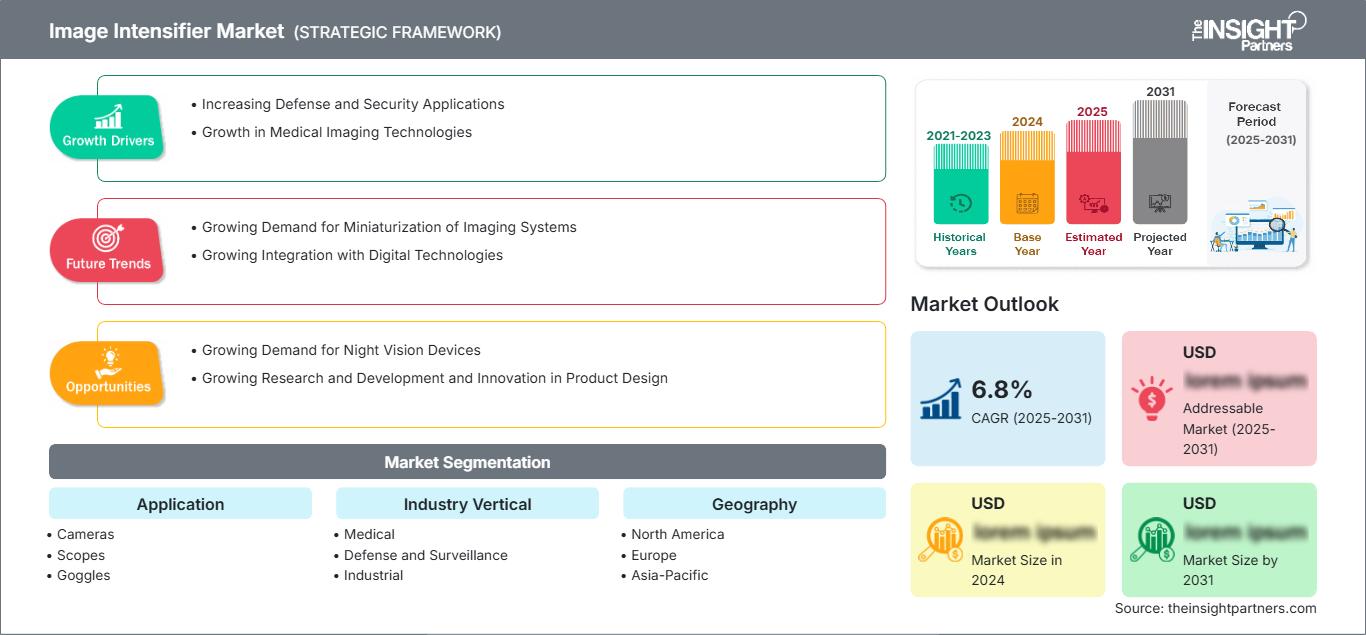
Regional Insights
North America Image Intensifier Market
North America is estimated to hold a 40–44% share of the global market in 2025 and is modeled to expand at a 4.0–4.5% CAGR through 2034. The U.S. generates regional demand by way of night vision, surveillance, law enforcement, and medical imaging projects. The ability to produce at home helps maintain the ability to procure.
Canada participates via defense, aerospace, science, and medical uses, while Mexico offers a more limited manufacturing and healthcare demand base. Regional use is aided by qualification processes already in place and by the sophistication of optical supply chains. Upgrading legacy systems to better, lighter-weight systems is expected to keep the demand going for goggles, scopes, and cameras.
U.S. Image Intensifier Market
According to the Image Intensifier Market forecast, the U.S. represents an estimated 82–86% of North American revenue in 2025 and is modeled to grow at a 4.1–4.6% CAGR through 2034. Defense procurement remains central, supported by tactical night vision, surveillance, and soldier modernization requirements.
L3Harris Technologies, Inc. has established domestic tube and system capabilities, while Canon Medical Systems Corporation and Siemens Healthineers AG participate in broader medical imaging ecosystems. Application demand spans goggles, scopes, cameras, and X-Ray Detectors, with procurement increasingly emphasizing fused sensing, compactness, durability, and lifecycle support. Federal and allied procurement standards also create barriers to entry that favor qualified suppliers with established production and testing capabilities.
Europe Image Intensifier Market
Europe is estimated to account for 24–27% of global demand in 2025 and is modeled at a 4.2–4.7% CAGR through 2034. The top national markets are Germany, followed by the UK, France, Italy, and Spain, through defense modernization and healthcare purchases.
Germany is increasing its focus on night vision purchases and production capabilities, while the UK integrates its defense, science, and medical requirements. France enjoys the benefit of defense electronics and photonics, with Italy catering to aerospace, medical, and security needs. Spain gains importance as a supplier of niche night vision devices. European requirements are affected by NATO compatibility and the issue of strategic autonomy and secure regional supply chain management.
APAC Image Intensifier Market
APAC is estimated to represent 23–26% of global revenue in 2025 and is modeled to grow at a 4.5–5.0% CAGR through 2034. China tops the region, followed by Japan, India, South Korea, and Australia. The development of industries, health care facilities, and military technologies facilitates the adoption.
The advantage of China lies in its well-established manufacturing industry and investments in health care. Japan has developed highly advanced photonics and medical imaging technology. India invests in health care and defense manufacturing. South Korea integrates electronics manufacturing with military and medical technologies, whereas Australia fuels the demand through defense and surveillance programs. Growth in the region will increasingly depend on localization policies, technology transfer, and diversified purchasing.
Middle East & Africa Image Intensifier Market
Middle East & Africa is modeled to grow at a 3.6–4.2% CAGR through 2034, with Saudi Arabia and the UAE leading regional demand. South Africa remains an important African market, while the Rest of MEA contributes through selected defense, security, medical, and infrastructure projects.
Demand in the Image Intensifier Market is influenced by border surveillance, critical-infrastructure protection, energy operations, and modernization of healthcare facilities. Saudi Arabia and the UAE are particularly relevant because defense and security investment supports advanced imaging procurement. South Africa provides a more diversified industrial and medical base. Infrastructure development and energy-sector activity create targeted opportunities for low-light inspection and monitoring, although budget cycles, import dependence, and specialist servicing requirements can constrain adoption.
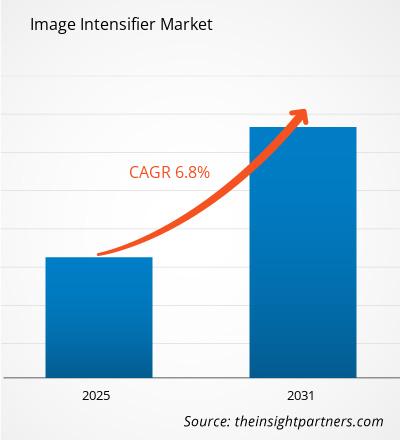
Segmentation Analysis
Application
Application is modeled at a 4.0–4.5% CAGR during 2026–2034. Demand varies materially by operating environment, with defense applications favoring lightweight, rugged, low-light systems and medical applications prioritizing real-time visualization. Cameras and scopes support surveillance and observation, while X-Ray Detectors benefit from fluoroscopy, interventional procedures, and equipment modernization.
- Cameras: Camera systems maintain broad relevance in surveillance, scientific imaging, and specialized inspection. Their strategic importance increases as compact image intensifiers are integrated into platforms requiring reliable low-light visualization and remote operation.
- Scopes: Scopes remain important for tactical observation and target identification, particularly where users require compact optics and direct viewing. Replacement demand increasingly favors lighter architectures with improved sensitivity and durability.
- Goggles: Goggles hold the leading application position because they combine portability with direct low-light observation. Defense procurement, policing, and surveillance requirements make this segment strategically important for system manufacturers.
- X-Ray Detectors: X-Ray Detectors serve medical and specialized inspection environments requiring dynamic imaging. Their importance is sustained by fluoroscopy and interventional workflows where real-time visualization remains operationally valuable.
Industry Vertical
Industry Vertical is modeled at a 3.8–4.3% CAGR during 2026–2034. Defense and Surveillance remains the principal demand base, while Medical provides recurring equipment replacement. Industrial adoption is more application-specific, with purchasing decisions determined by inspection requirements, operating conditions, and the value of enhanced low-light visibility.
- Medical: Medical adoption is concentrated in fluoroscopy, C-arms, and interventional imaging. Hospitals value established workflows, service continuity, and real-time visualization, supporting replacement demand where existing equipment remains economically viable.
- Defense and Surveillance: Defense and Surveillance represents the largest vertical because mission readiness requires dependable night vision. Procurement increasingly emphasizes interoperability, ruggedness, image quality, and lifecycle availability across allied systems.
- Industrial: Industrial users apply intensifiers selectively in inspection, research, and specialized monitoring. Adoption depends on whether low-light performance delivers measurable productivity or detection benefits compared with alternative digital sensors.
- Others: This category includes specialized applications outside the principal verticals, with demand shaped by scientific, aerospace, security, and customized imaging requirements.
Opportunity Snapshot
| Industry Vertical | Revenue Contribution (High/Medium/Low) | Trend Tag (MAX 2 words) | Adoption Stage |
| Medical | Medium | Fluoroscopy Renewal | Mature |
| Defense and Surveillance | High | Night Vision | Scaling |
| Industrial | Medium | Optical Inspection | Scaling |
| Others | Low | Scientific Imaging | Emerging |
Image Intensifier Market Growth Drivers and Impact Analysis
Rising defense modernization and night-vision procurement
Modernization of defense capabilities is enhancing the addressable demand for image intensification due to increased demand for continuous surveillance under low-light conditions. In terms of procurement, there is emphasis on lightweight goggles, increased service life, enhanced picture quality, and compatibility with thermal or digital systems. Of significance here is the defense spending in Europe, where NATO has indicated that the Allies of NATO and Canada have increased the total defense budget by almost 20% in 2025 from 2024. This creates an ideal procurement situation for those suppliers who have qualifying production capacity and existing relationships with militaries. The effect of increased procurement will not only be felt in complete goggles but will also help in the manufacture of tubes, optics, electronics, and testing equipment as well.
Replacement of legacy imaging equipment in medical workflows
Medical imaging creates a distinct demand mechanism because image intensifiers remain embedded in established fluoroscopy, C-arm, and interventional workflows. Instead, hospitals and imaging centers tend to consider replacement against existing equipment, clinical need, service agreements, and capital budgets when evaluating a decision for new technologies instead of evaluating new technology purely on its technical capabilities. This will favor companies which can assure mechanical compatibility and reliable output. On the other hand, flat panel detector technology still plays a role in technology decisions, hence efficiency of radiation dosage, quality of images, coverage of field, and economics of lifecycle become significant factors in the choice of technology. As such, suppliers of image intensifiers have to find ways of enhancing their performance while retaining integration benefits.
Expansion of compact imaging across surveillance and industrial use
Miniaturization in the Image Intensifier Market has expanded the field of potential application of intensified imaging technology. Smaller cameras, scopes, and wearable devices will be able to make use of low-light amplification, which cannot be performed by traditional imaging devices in certain operational conditions. Portability and persistence of monitoring are important for surveillance professionals, while industrial users will benefit from intensified imaging due to its ability to detect low-light signals and defects. The effects of intensified imaging on the market extend beyond military applications, since tube manufacturers can adjust their products to scientific, aerospace, and inspection uses. However, the deployment of intensified imaging technology depends on the cost-effectiveness of system implementation and competition from advanced digital sensors. Manufacturers that manage to miniaturize, lower power consumption, and simplify the integration process can increase the attractiveness of intensified imaging.
Image Intensifier Market Future Trends
Hybrid image intensification and sensor fusion
The Image Intensifier Market trends show that next-generation designs are predicted to merge the benefits of image enhancement together with thermal, digital, and augmented imagery. Instead of being solely dependent on one imaging modality, such systems will deliver complementary information through different illumination and environmental scenarios, enabling switching from night vision enhancement to thermal vision. It is important since the issue under discussion is very much relevant to the development of defense-related solutions, which require situational awareness to become an integral combination of multiple types of information collected using lightweight wearable devices. From the business perspective, it means a transition of the importance of tubes to a broader combination of optical and electronic systems. In addition, it means that suppliers capable of synchronizing, calibrating, powering, and ergonomically integrating these systems are likely to be more successful participants in next-generation designs.
Medical replacement platforms and specialized fluoroscopy
Medical equipment replacement creates an opportunity for suppliers to target installed systems where image intensifier technology remains economically and clinically suitable. Rather than competing solely on image quality, vendors can differentiate through mechanical compatibility, lower maintenance requirements, improved dose characteristics, and streamlined integration with existing C-arm or fluoroscopy platforms. Partnerships with equipment manufacturers can create recurring component demand, while regional service networks can reduce downtime concerns for hospitals. Emerging healthcare markets also provide selective opportunities where capital constraints favor established technologies over higher-cost alternatives. Suppliers should prioritize applications with sustained procedural volumes and clear lifecycle economics. Product strategies combining performance improvements with compatibility and serviceability are more likely to succeed than offerings positioned only around incremental technical specifications.
Image Intensifier Market Opportunities
Advanced tube manufacturing for European defense programs
European defense procurement provides an opportunity for suppliers to expand high-performance tube capacity while aligning production with regional strategic-autonomy objectives. The strongest commercial potential lies in systems requiring reliable low-light performance, compact form factors, and interoperability with NATO equipment. Suppliers can pursue this opportunity by investing in automated production controls, yield improvement, qualification laboratories, and regional assembly capabilities. Long-term framework agreements can improve capacity utilization and justify capital expenditure, while partnerships with night-vision system integrators can shorten qualification cycles. The opportunity also extends to aftermarket support because large installed fleets require replacement tubes, refurbishment, calibration, and service. Companies that combine tube technology with dependable European supply, certification support, and lifecycle services can capture value across both initial procurement and recurring sustainment programs.
Medical replacement platforms and specialized fluoroscopy
Medical equipment replacement creates an opportunity for suppliers to target installed systems where image intensifier technology remains economically and clinically suitable. Rather than competing solely on image quality, vendors can differentiate through mechanical compatibility, lower maintenance requirements, improved dose characteristics, and streamlined integration with existing C-arm or fluoroscopy platforms. Partnerships with equipment manufacturers can create recurring component demand, while regional service networks can reduce downtime concerns for hospitals. Emerging healthcare markets also provide selective opportunities where capital constraints favor established technologies over higher-cost alternatives. Suppliers should prioritize applications with sustained procedural volumes and clear lifecycle economics. Product strategies combining performance improvements with compatibility and serviceability are more likely to succeed than offerings positioned only around incremental technical specifications.
Recent Developments
- January 2026: Exosens signs its largest-ever contract for 5G image intensifier tubes with ACTinBlack, with more than 7,000 tubes ordered for European Special Forces night-vision systems. Deliveries are scheduled for 2027 and 2028, marking the largest single procurement of Exosens’ 5G tubes to date and demonstrating adoption of its latest high-performance night-vision technology.
- December 2025: THEON International Plc and Exosens extended their long-term image intensifier tube supply agreement by three years through 2030. The agreement provides for higher annual tube volumes, with THEON expecting to procure well over 400,000 tubes over five years to support rising night-vision demand across Europe, MENA, and APAC.
- September 2025: Exosens launched its new 5G image intensifier tube, introducing an advanced night-vision technology designed to improve observation performance, image clarity, and operational capability in low-light environments. The launch established the 5G tube as a new high-performance offering for demanding defense and night-vision applications.
Frequently Asked Questions

- Comprehensive Market Sizing and Forecast Analysis
- Detailed Segmentation Analysis
- In-Depth Market Dynamics Assessment
- Regional and Country-Level Insights
- Competitive Landscape and Company Benchmarking
- Strategic Business Intelligence
Recent Reports
Testimonials

The Insight Partners' SCADA System Market report is comprehensive, with valuable insights on current trends and future forecasts. The team was highly professional, responsive, and supportive throughout. We are very satisfied and highly recommend their services.
RAN KEDEM Partner, Reali Technologies LTDs
I requested a report on a very specific software market and the team produced the report in a few days. The information was very relevant and well presented. I then requested some changes and additions to the report. The team was again very responsive and I got the final report in less than a week.
JEAN-HERVE JENN Chairman, Future Analytica
We worked with The Insight Partners for an important market study and forecast. They gave us clear insights into opportunities and risks, which helped shape our plans. Their research was easy to use and based on solid data. It helped us make smart, confident decisions. We highly recommend them.
PIYUSH NAGPAL Sr. Vice President, High Beam Global
The Insight Partners delivered insightful, well-structured market research with strong domain expertise. Their team was professional and responsive throughout. The user-friendly website made accessing industry reports seamless. We highly recommend them for reliable, high-quality research services
YUKIHIKO ADACHI CEO, Deep Blue, LLC.
This is the first time I have purchased a market report from The Insight Partners.While I was unsure at first, I visited their web site and felt more comfortable to take the risk and purchase a market report.I am completely satisfied with the quality of the report and customer service. I had several questions and comments with the initial report, but after a couple of dialogs over email with their analyst I believe I have a report that I can use as input to our strategic planning process.Thank you so much for taking the extra time and making this a positive experience.I will definitely recommend your service to others and you will be my first call when we need further market data.
JOHN SUZUKI President and Chief Executive Officer, Board Director, BK Technologies
I wish to appreciate your support and the professionalism you displayed in the course of attending to my request for information regarding to infectious disease IVD market in Nigeria. I appreciate your patience, your guidance, and the fact that you were willing to offer a discount, which eventually made it possible for us to close a deal. I look forward to engaging The Insight Partners in the future, all thanks to the impression you have created in me as a result of this first encounter.
DR CHIJIOKE ONYIA MANAGING DIRECTOR, PineCrest Healthcare Ltd.Reason to Buy
- Informed Decision-Making
- Understanding Market Dynamics
- Competitive Analysis
- Identifying Emerging Markets
- Customer Insights
- Market Forecasts
- Risk Mitigation
- Boosting Operational Efficiency
- Strategic Planning
- Investment Justification
- Tracking Industry Innovations
- Aligning with Regulatory Trends





 Get Free Sample for