
Industrial Annunciator Market Size, Trends & Growth by 2034
Coverage: By Type (Conventional Annunciators and Dedicated Annunciators); End user (Process Industry and Discrete Industry), and Geography (North America, Europe, Asia Pacific, and South and Central America)
- Status : Data Released
- Report Code : TIPRE00010543
- Category : Electronics and Semiconductor
- No. of Pages : 150
- Available Report Formats :


- Last update date : September 18, 2026


2025 Market Size
US$ 490.46 Mn
Base year value
2034 Forecast
US$ 782.87 Mn
Projected by 2034
CAGR 2026-2034
5.33 %
Growth rate
Addressable Market
US$ 5,774.35 Mn
(2026-2034)
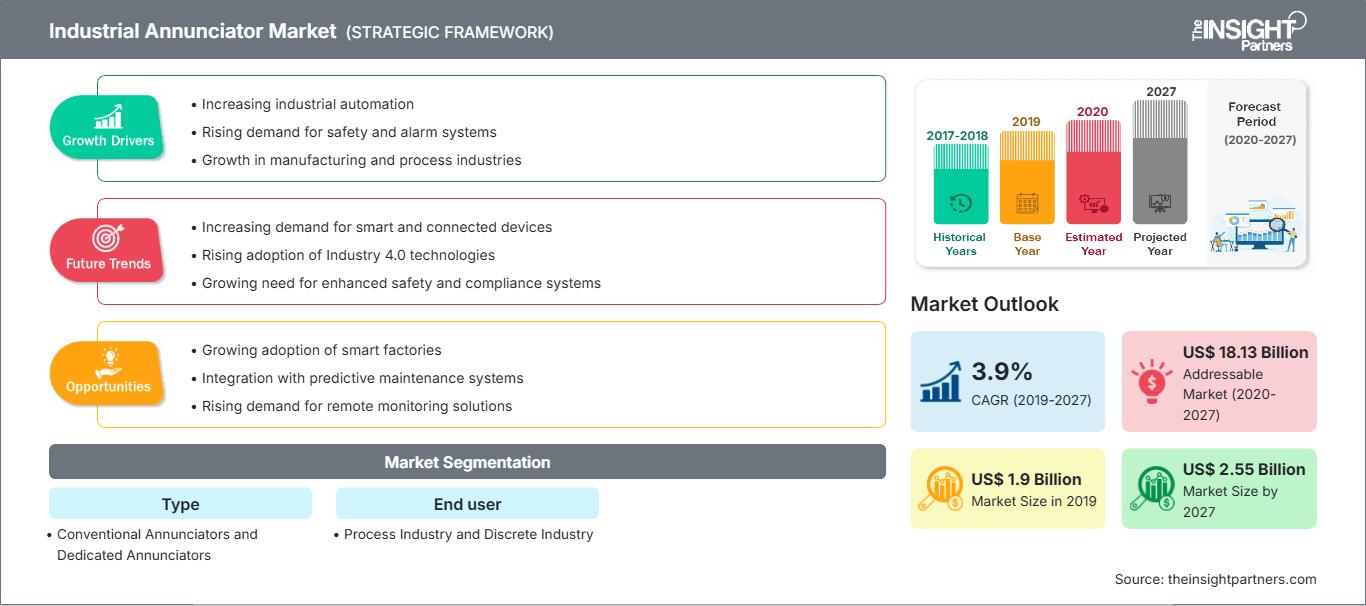
The Industrial Annunciator Market is expanding as industrial operators prioritize dependable alarm notification, equipment status visibility, and faster response to abnormal operating conditions. The market is valued at US$ 490.46 Million in 2025 and is projected to reach US$ 782.87 Million by 2034, advancing at a CAGR of 5.33% during 2026–2034. Demand is supported by process safety requirements, modernization of control rooms, and continued deployment of dedicated alarm systems.
North America is expected to maintain a substantial installed base, supported by refinery, chemical, power, and manufacturing applications. The Industrial Annunciator size outlook reflects replacement of legacy panels, tighter alarm-management practices, and investments in resilient industrial infrastructure. Expansion of automated facilities and modernization of aging electrical systems should support an estimated 4.8–5.5% CAGR through 2034.
Industrial Annunciator Market Assessment and Insights
- North America: North America is expected to account for 29–33% Industrial Annunciator Market share in 2025, supported by established process industries, replacement demand, and safety-oriented automation programs, with growth at a 4.8–5.5% CAGR between 2026–2034.
- US: The US is expected to represent 72–77% of North America's 2025 demand, with industrial modernization, energy infrastructure investment, and process safety requirements supporting a 4.9–5.6% CAGR.
- Europe: Europe is estimated at 24–28% share in 2025 and is projected to grow at 4.5–5.2% CAGR, led by Germany, the UK, France, Italy, and Spain, where industrial automation upgrades and functional-safety practices remain important.
- Asia Pacific: Asia Pacific is estimated at 31–35% share in 2025 and should record 6.1–6.9% CAGR through 2034, led by China, Japan, South Korea, and India as manufacturing capacity and automation penetration increase.
- Largest Segment: Conventional Annunciators hold an estimated 58–63% market share in 2025, with a 4.7–5.3% CAGR as replacement installations remain widespread across established plants.
- High Growth Segment: Dedicated Annunciators are estimated at 37–42% share in 2025 and should expand at 6.0–6.8% CAGR as application-specific monitoring gains traction.
- Key companies analyzed in detail: ABB Ltd, AMETEK Inc., Eaton Corporation plc, Ronan Engineering Company, Automation Displays Inc., Dwyer Instruments, Inc., NOTIFIER, Schweitzer Engineering Laboratories, Inc., Apex Automation Solutions, Omniflex.
Source: The Insight Partners' analysis based on proprietary research, government publications, company annual reports, investor presentations, industry databases, and expert interviews.
Alarms architecture in the industry is moving from individual visual indicators to notification systems that can be integrated and configured while coexisting with other systems such as the PLC, DCS, SCADA, and safety systems. Classic annunciators are still applicable due to the need for deterministic indication, local visibility, and simple maintenance of alarms systems. Industrial production sites have started incorporating LED screens, audibles, relays, interface cards, and programming of alarms. These developments are expanding the potential applicability of annunciation during brownfield upgrades.
During the forecasted period, investments in the Industrial Annunciator Market will be made in plants that have more need for high availability, remote diagnosis, and standardized alarm philosophies. Developing industrial economies will add demand as new process facilities start installing centralized monitoring systems. The regulatory requirements for functional safety, electrical reliability, and operator reaction will also favor alarms systems with capability of event priority indication without relying on complex software systems.
Industrial Annunciator Market Report Scope
| Report Attribute | Details |
|---|---|
| Market size in 2025 | US$ 490.46 Million |
| Market Size by 2034 | US$ 782.87 Million |
| Global CAGR (2026 - 2034) | 5.33% |
| Historical Data | 2021-2024 |
| Forecast period | 2026-2034 |
Industrial Annunciator Market Analysis
For industrial plants, it becomes critical to recognize abnormal conditions in motors, pumps, compressors, boilers, substation, production lines, and process equipment quickly. It means that alarm indication serves as an operational layer between field instrumentation and actions by operators. Growth of the Industrial Annunciator market will be driven by targets for plant availability, safety policies, maintenance regimes, and the cycle of replacements for old control panels.
The main drivers of demand in the Industrial Annunciator Market will come from those processes where one failure may stop production or expose operators to potential danger. Industries of processing usually need multi-point alarms with different priorities, whereas discrete manufacturing prefers equipment condition and production availability. Competing suppliers provide configurable input design, sturdy construction, indication, audio signaling, communication features, and compatibility with existing control systems. The role of local integrators is still very high since most applications need engineering modifications rather than standard implementations.
Competitive landscape in the Industrial Annunciator Market involves diversified automation manufacturers together with specialized Annunciator Manufacturers. ABB Ltd, Eaton Corporation plc, and AMETEK Inc. enjoy wider industrial technology mix, whereas Ronan Engineering Company, Automation Displays Inc., Dwyer Instruments, Inc., and Omniflex offer more specialized positioning. NOTIFIER and Schweitzer Engineering Laboratories, Inc. operate within the domain via adjacent Alarm & Protection and Monitoring offerings, whereas Apex Automation Solutions serves the applications-oriented Automation needs.
Growing investment into solutions that can provide for compatibility between the existing hardware and digital Monitoring. Thus, an Analysis of Industrial Annunciator will have to make a distinction between the need to build new systems and the need to replace the existing solutions. In addition, the positioning of a company will be influenced by the strength of distribution channels, engineering support, regional capabilities, and integration of Annunciator with PLC, DCS, SCADA, and Electrical Protection offerings.
● REPORT CUSTOMIZATION
Tailor This Report To Align With Your Specific Business Requirements
This report can be customized to align precisely with your business objectives, scope, and target markets. Customization options include tailored segmentation, geography, competitive analysis, and strategic insights to support informed decision-making.
Customize This Report →WHAT YOU CAN ADJUST
- ● Segmentations
- ● Geography
- ● Competitive Analysis
- ● Language Preferences
Industrial Annunciator Market: Strategic Insights
Regional Insights
North America Industrial Annunciator Market
North America is estimated to hold 29–33% Industrial Annunciator Market share in 2025 and is projected to grow at a 4.8–5.5% CAGR through 2034. The USA is still the primary demand generator, while Canada comes through with its contributions from energy, mining, utilities, and process industries. Renewal of older control panels and investments in robust industrial infrastructure can be counted on as a steady source of demand.
More and more industrial facilities need reliable local indication as well as automated central indication systems. Refineries, chemical plants, water management systems, food processing plants, and electricity generators keep their alarm equipment where instant visual indications are needed operationally. The demand is expected to remain highest in cases of modernizations when better indications are needed without changing the whole control system infrastructure.
U.S. Industrial Annunciator Market
The Industrial Annunciator Market report shows that the US is expected to represent 72–77% of North American demand in 2025 and grow at 4.9–5.6% CAGR. Its share reflects a large installed base spanning energy, chemicals, utilities, manufacturing, and commercial infrastructure. ABB Ltd, Eaton Corporation plc, AMETEK Inc., NOTIFIER, and other suppliers maintain relevant industrial automation, monitoring, protection, or alarm capabilities.
Application demand is concentrated in facilities where alarm visibility supports operational continuity and safety procedures. Modernization of electrical distribution, process control, water infrastructure, and manufacturing equipment should sustain replacement activity. Customers increasingly seek annunciators that coexist with PLC and SCADA systems while preserving hardwired indication for critical alarms, creating opportunities for hybrid architectures rather than complete replacement of conventional panels.
Europe Industrial Annunciator Market
Europe is estimated at 24–28% share in 2025 and should expand at 4.5–5.2% CAGR through 2034, with Germany serving as the leading national market. UK, Germany, France, Italy, and Spain collectively represent the principal demand centers because of their industrial bases and established automation ecosystems.
The Industrial Annunciator Market forecast shows that demand for alarms continues in the UK in utilities, process plants, and infrastructure where alarm indication is essential. Germany has sophisticated manufacturing as well as process automation and hence can contribute to replacement and integration programs. Opportunities for France exist in energy, chemicals, transport infrastructure, and manufacturing. In the case of Italy, it can benefit due to machinery and industrial production, whereas Spain can help due to utilities, food processing, chemicals, and infrastructure modernization.
APAC Industrial Annunciator Market
APAC is estimated at 31–35% share in 2025 and should grow at 6.1–6.9% CAGR, making it the fastest-growing major region. Demand is led by China, followed by Japan, South Korea, India, and Australia. Demand is driven by industrial growth, automation spending, and localization of production.
While China will see demand fueled by process and discrete manufacturing, Japan and South Korea will drive demand from sophisticated automation environments. India provides good prospects due to manufacturing, energy and infrastructure projects, whereas Australia can rely on mining and utility industries. Industrial strategy, plant upgrades, and investment in reliable electric infrastructure will drive demand for alarms.
Middle East & Africa Industrial Annunciator Market
Middle East and Africa demand is supported by oil and gas, utilities, mining, water infrastructure, and new industrial projects. Saudi Arabia is expected to lead regional demand, followed by the UAE and South Africa, with the remainder distributed across developing industrial markets.
The region should expand at a 5.3–6.1% CAGR as energy diversification and infrastructure programs create new monitoring requirements. Large process facilities require durable alarm indication under demanding operating conditions, while new industrial zones provide greenfield opportunities. Energy security, water infrastructure, and industrial localization should sustain adoption of annunciation systems alongside broader control and electrical automation investments.
Segmentation Analysis
Type
The Type segment is projected to grow at a 4.9–5.7% CAGR during 2026–2034. Industrial Annunciator scope remains broad because customers balance straightforward conventional indication with dedicated architectures designed for specialized alarm requirements. Selection depends on point count, response criticality, integration needs, maintenance philosophy, and the installed control platform.
- Conventional Annunciators: Conventional Annunciators remain the principal installed architecture because they provide familiar indication, straightforward troubleshooting, and compatibility with legacy relay and control-panel infrastructure across process and discrete facilities.
- Dedicated Annunciators: Dedicated Annunciators serve applications requiring purpose-built alarm presentation, configurable logic, and specialized interfaces, making them strategically relevant for critical equipment, electrical systems, and focused monitoring environments.
End user
The End user segment is expected to expand at a 5.5–6.2% CAGR during 2026–2034. Industrial Annunciator systems are selected according to process complexity, equipment criticality, safety requirements, and the degree of centralized automation. Process facilities generally require greater alarm density, whereas discrete facilities emphasize equipment-specific status visibility.
- Process Industry: Process Industry demand centers on continuous operations where alarms must identify deviations quickly across energy, chemicals, water, pharmaceuticals, and other facilities with high uptime and safety requirements.
- Discrete Industry: Discrete Industry adoption is associated with machinery, assembly, automotive, electronics, and engineered production lines where equipment status, fault identification, and production continuity influence annunciator configuration.
Opportunity Snapshot
| End User | Revenue Contribution | Trend Tag | Adoption Stage |
| Process Industry | High | Alarm Density | Mature |
| Discrete Industry | Medium | Line Monitoring | Scaling |
Industrial Annunciator Market Growth Drivers and Impact Analysis
Expansion of Industrial Automation and Brownfield Modernization
The upgrade of old control infrastructures is not always done by changing all the field devices and panels. The need for annunciators that are compatible with the old relays, PLCs, DCS systems, and new communication systems emerges. In brownfield projects, improvements are made incrementally since downtime of production facilities leads to losses. The use of a configurable annunciator would help to increase the visibility of alarms in an existing installation. The effect is most pronounced in industrialized areas where there is an extensive infrastructure that requires frequent replacements. Suppliers of annunciators who have the engineering information, compatibility, and lifecycle management capabilities will get projects that would otherwise be part of automation projects.
Increasing Focus on Operator Response and Alarm Visibility
It is increasingly recognized by industrial operators that alarm efficiency depends not only on detecting an incident but also on the clarity of its presentation to the operator. Improper presentation of alarm information may result in delayed action, lack of priority perception, and increased uncertainties in the face of abnormal situations. Annunciators serve as a specific visual and audio means of presentation of alarm information that can always be available even when there are communication problems in other supervisory control systems. Such a solution is especially important for process plants, utilities, substations, and factories. As far as the effect of the market is concerned, demand is created not only by installation but also by retrofitting operations for better operator information.
Growth of Critical Infrastructure and Electrification Projects
Expansion of power infrastructure, industrial electrification, water systems, and distributed energy assets creates additional locations where reliable alarm indication is required. Electrical rooms, substations, generation facilities, pumping stations, and industrial distribution systems can contain numerous conditions that require immediate recognition. Electrification also increases the operational importance of monitoring breakers, protection equipment, power-quality events, and equipment health. Annunciators can provide a localized indication layer that complements digital protection and supervisory systems. The effect is particularly relevant in projects where operators need simple, highly visible status information for critical assets. As infrastructure investment expands across emerging economies, suppliers with rugged products, configurable input arrangements, and local engineering support should be positioned to participate in both new installations and modernization programs.
Industrial Annunciator Market Future Trends
Integration of Edge Diagnostics With Local Alarm Indication
The Industrial Annunciator Market trends show that future systems are likely to combine deterministic local annunciation with edge-level diagnostics that interpret equipment conditions before presenting prioritized notifications. Instead of displaying every signal equally, intelligent architectures can use operating context, equipment state, and event history to distinguish actionable abnormalities from routine status changes. This approach can reduce unnecessary operator attention while retaining immediate local visibility for critical conditions. Over time, manufacturers may incorporate richer communication protocols, event logging, remote configuration, and cybersecurity controls without eliminating hardwired indication for high-priority alarms. Such architectures will be particularly relevant where plants operate mixed generations of equipment. The resulting Industrial Annunciator trends should favor modular platforms that permit customers to add analytics or connectivity without replacing the underlying alarm interface.
Modular Alarm Platforms for Multi-Generation Control Environments
A growing requirement will be the ability to connect annunciation equipment across different generations of industrial control systems. Plants frequently contain legacy relays, older PLCs, modern DCS platforms, networked sensors, and specialized protection devices within the same facility. Modular alarm platforms can address this complexity through interchangeable communication interfaces, configurable input cards, and scalable display arrangements. Future procurement decisions are likely to emphasize interoperability, maintainability, and long-term availability rather than display hardware alone. Vendors that support gradual migration can become strategic suppliers because customers can modernize individual sections of a plant while retaining functioning equipment elsewhere. This trend should strengthen demand for systems designed around open interfaces and clearly defined lifecycle support models.
Industrial Annunciator Market Opportunities
Retrofit Packages for Aging Industrial Control Panels
Suppliers can target large installed bases with retrofit packages that replace obsolete annunciator components while retaining existing field wiring wherever practical. A successful retrofit proposition should combine modern LED indication, configurable alarm logic, audible signaling, documentation, and compatibility assessment into a defined engineering package. This reduces project uncertainty for plant owners and shortens planned maintenance windows. Regional integrators can create additional value by surveying installed panels, identifying discontinued components, and developing replacement architectures before failures occur. Such services can generate recurring demand because industrial facilities frequently modernize equipment in stages rather than through comprehensive automation replacement. Companies that maintain strong aftermarket inventories and engineering capabilities can therefore build durable positions in maintenance-driven purchasing cycles.
Localized Solutions for Emerging Industrial Infrastructure
Emerging markets offer opportunities for suppliers that combine standardized hardware with local engineering, commissioning, and service support. New process plants, utilities, manufacturing clusters, and infrastructure projects often require dependable alarm systems but may operate with diverse automation architectures. Vendors can address this need by developing configurable product families that accommodate local panel standards, power conditions, communication requirements, and environmental specifications. Partnerships with system integrators can improve project access while reducing the need for direct field infrastructure in every country. India, Southeast Asia, the Middle East, and selected African markets are particularly relevant because industrial capacity is expanding alongside investments in energy, water, manufacturing, and transportation. A localized support model can therefore become as important as product specifications in competitive tenders.
Recent Developments
- January 2026: Potter Electric Signal Company, LLC introduced the GTSA-7, a 7-inch graphical touchscreen annunciator designed to modernize fire alarm monitoring. The system provides programmable soft keys, direct or remote connectivity, and compatibility with Potter fire alarm platforms, enabling centralized control and event monitoring through a graphical interface.
- June 2026: Russelectric introduced its ATS Remote Annunciator (RTS-RA), a monitoring accessory that consolidates data from up to eight automatic transfer switches into a single display. The system provides switch status, power data, alarm history, remote load testing, timer settings, and email notifications, with Ethernet connectivity supporting SCADA and building management system integration through OPC UA.
Frequently Asked Questions

- Comprehensive Market Sizing and Forecast Analysis
- Detailed Segmentation Analysis
- In-Depth Market Dynamics Assessment
- Regional and Country-Level Insights
- Competitive Landscape and Company Benchmarking
- Strategic Business Intelligence
Recent Reports
Testimonials

The Insight Partners' SCADA System Market report is comprehensive, with valuable insights on current trends and future forecasts. The team was highly professional, responsive, and supportive throughout. We are very satisfied and highly recommend their services.
RAN KEDEM Partner, Reali Technologies LTDs
I requested a report on a very specific software market and the team produced the report in a few days. The information was very relevant and well presented. I then requested some changes and additions to the report. The team was again very responsive and I got the final report in less than a week.
JEAN-HERVE JENN Chairman, Future Analytica
We worked with The Insight Partners for an important market study and forecast. They gave us clear insights into opportunities and risks, which helped shape our plans. Their research was easy to use and based on solid data. It helped us make smart, confident decisions. We highly recommend them.
PIYUSH NAGPAL Sr. Vice President, High Beam Global
The Insight Partners delivered insightful, well-structured market research with strong domain expertise. Their team was professional and responsive throughout. The user-friendly website made accessing industry reports seamless. We highly recommend them for reliable, high-quality research services
YUKIHIKO ADACHI CEO, Deep Blue, LLC.
This is the first time I have purchased a market report from The Insight Partners.While I was unsure at first, I visited their web site and felt more comfortable to take the risk and purchase a market report.I am completely satisfied with the quality of the report and customer service. I had several questions and comments with the initial report, but after a couple of dialogs over email with their analyst I believe I have a report that I can use as input to our strategic planning process.Thank you so much for taking the extra time and making this a positive experience.I will definitely recommend your service to others and you will be my first call when we need further market data.
JOHN SUZUKI President and Chief Executive Officer, Board Director, BK Technologies
I wish to appreciate your support and the professionalism you displayed in the course of attending to my request for information regarding to infectious disease IVD market in Nigeria. I appreciate your patience, your guidance, and the fact that you were willing to offer a discount, which eventually made it possible for us to close a deal. I look forward to engaging The Insight Partners in the future, all thanks to the impression you have created in me as a result of this first encounter.
DR CHIJIOKE ONYIA MANAGING DIRECTOR, PineCrest Healthcare Ltd.Reason to Buy
- Informed Decision-Making
- Understanding Market Dynamics
- Competitive Analysis
- Identifying Emerging Markets
- Customer Insights
- Market Forecasts
- Risk Mitigation
- Boosting Operational Efficiency
- Strategic Planning
- Investment Justification
- Tracking Industry Innovations
- Aligning with Regulatory Trends





 Get Free Sample for