
Industrial Multiprotocol Gateways Market Size, Trends & Demand by 2034
Coverage: by Application (Remote Monitoring, Product Optimization, Preventive Maintenance); End-user (Process Industries, Discrete Industries) , and Geography (North America, Europe, Asia Pacific, and South and Central America)
- Status : Data Released
- Report Code : TIPRE00010764
- Category : Electronics and Semiconductor
- No. of Pages : 150
- Available Report Formats :


- Last update date : September 18, 2026


2025 Market Size
US$ 433.9 Mn
Base year value
2034 Forecast
US$ 864.53 Mn
Projected by 2034
CAGR 2026-2034
7.96 %
Growth rate
Addressable Market
US$ 5,839.89 Mn
(2026-2034)
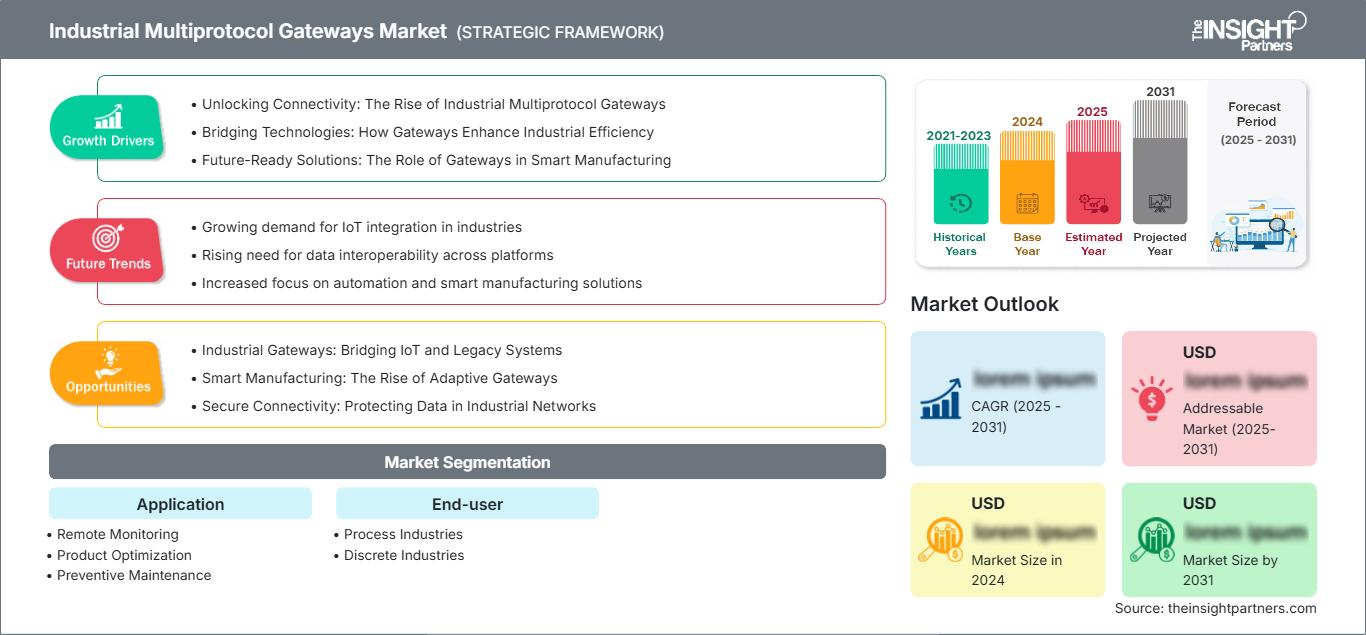
The Industrial Multiprotocol Gateways Market was valued at US$ 433.9 Million in 2025 and is projected to reach US$ 864.53 Million by 2034, registering a CAGR of 7.96% from 2026 to 2034. The market covers gateway platforms that connect heterogeneous industrial protocols, devices, controllers, and enterprise systems, enabling data exchange across legacy and modern operational technology environments.
Industrial Multiprotocol Gateways Market size in North America is supported by brownfield modernization, industrial cybersecurity requirements, and increasing integration between operational technology and enterprise platforms. A modelled regional CAGR range of 7.20%–8.40% reflects demand for protocol conversion, remote asset visibility, edge processing, and modernization of installed automation infrastructure across manufacturing, utilities, energy, and process industries.
Industrial Multiprotocol Gateways Market Assessment and Insights
- North America: North America is estimated to hold a 29–33% share in 2025 and is projected to grow at a CAGR of 7.20%–8.40% between 2026–2034, supported by brownfield modernization, cybersecurity, and IT/OT convergence.
- US: The US represents an estimated 78–82% of North America's 2025 market and is projected to grow at a CAGR of 7.30%–8.50%, driven by manufacturing modernization and distributed monitoring.
- Europe: Europe is estimated at 25–29% share in 2025 and is projected to grow at a CAGR of 7.00%–8.20%, with Germany, the UK, France, Italy, and Spain supported by automation upgrades and industrial digitalization.
- Asia Pacific: Asia Pacific is estimated at 27–31% share in 2025 and is projected to grow at a CAGR of 8.20%–9.40%, led by China, Japan, South Korea, India, and Australia through smart manufacturing and infrastructure investment.
- Largest Segment: Process Industries is estimated to account for a 54–58% market share in 2025 and is projected to grow at a CAGR of 7.40%–8.40%, supported by complex legacy automation estates.
- High Growth Segment: Preventive Maintenance is estimated to represent a 29–33% market share in 2025 and is projected to grow at a CAGR of 8.30%–9.30%, supported by asset-health monitoring.
- Key companies analyzed in detail: ABB, Advantech Co., Ltd., Atop Technologies, HMS Networks, Honeywell International Inc., Mindtree Limited, Moxa Inc., Multi-Tech Systems, Inc., SoftPLC Corporation, and Texas Instruments Incorporated.
Source: The Insight Partners' analysis based on proprietary research, government publications, company annual reports, investor presentations, industry databases, and expert interviews.
The Industrial Multiprotocol Gateways Market has evolved from mere protocol translation into advanced edge infrastructure that performs filtering, translation, encryption, and preprocessing of industrial data. The trend towards more sophisticated gateway architectures sees modern gateways adopting Ethernet, serial, fieldbus, MQTT, OPC UA, Modbus, and cloud connectivity all together. This development leads to decreased data silos and enables users to continue using legacy equipment along with implementing modern monitoring, management, and analytics capabilities.
The future is marked by brownfield digitization, cybersecurity in the industrial setting, and distributed computing. New applications in Southeast Asia, India, Eastern Europe, and the Middle East give rise to the need for flexible gateway architectures that allow connecting old equipment to new automation systems. The market moves in the direction of security, remote access, edge analytics, longevity, and easy-to-install gateways.
Industrial Multiprotocol Gateways Market Report Scope
| Report Attribute | Details |
|---|---|
| Market size in 2025 | US$ 433.9 Million |
| Market Size by 2034 | US$ 864.53 Million |
| Global CAGR (2026 - 2034) | 7.96% |
| Historical Data | 2021-2024 |
| Forecast period | 2026-2034 |
Industrial Multiprotocol Gateways Market Analysis
The development of the Industrial Multiprotocol Gateways Market is driven by the need to connect heterogeneous equipment without installing new working control system. This market consists of sensor and controller makers, gateway producers, automation solutions providers, systems integrators, cloud service providers, and industrial customers. The need to communicate with each other arises at the level of gateways among legacy serial devices, PLCs, SCADA systems, industrial Ethernet and cloud services.
There is a particular demand for this type of equipment in manufacturing companies where the upgrade of systems is performed on an incremental basis instead of full automation replacement. Process manufacturers usually have old and new pieces of equipment from different vendors, and therefore, protocol compatibility is crucial. Manufacturers of discrete products use gateways more and more often for gathering data from machines for their production tracking, quality control, and preventive maintenance analysis.
The Industrial Multiprotocol Gateways Market Report demonstrates the presence of the competitive environment comprised of automation vendors, industrial network companies, embedded computer manufacturers, and engineering service providers. Both ABB and Honeywell International Inc. rely on broad automation infrastructure, while Advantech Co., Ltd., HMS Networks, Moxa Inc., and Atop Technologies concentrate on communication and industrial networks. The semiconductor solutions provided by Texas Instruments Incorporated are important for embedded gateway design and edge computing.
It is not that much about hardware capacity; rather, it is about the protocol coverage, security, lifecycle services, and integration options. In this context, Mindtree Limited will have its share to play in the industrial digital transformation and integration, whereas Multi-Tech Systems, Inc. will operate in the area of connected devices and communications, and SoftPLC Corporation will focus on software-defined control systems. Hence, money is being invested in the platforms which consist of both hardware and software, as well as management and analytics.
● REPORT CUSTOMIZATION
Tailor This Report To Align With Your Specific Business Requirements
This report can be customized to align precisely with your business objectives, scope, and target markets. Customization options include tailored segmentation, geography, competitive analysis, and strategic insights to support informed decision-making.
Customize This Report →WHAT YOU CAN ADJUST
- ● Segmentations
- ● Geography
- ● Competitive Analysis
- ● Language Preferences
Industrial Multiprotocol Gateways Market: Strategic Insights
Regional Insights
North America Industrial Multiprotocol Gateways Market
North America accounts for an estimated 29-33% Industrial Multiprotocol Gateways Market share in 2025 and is expected to exhibit a CAGR of 7.20%-8.40% from 2025 to 2034. The US is the dominant country market, while Canada and Mexico participate in the growth via manufacturing, energy, mining, logistics, and infrastructure upgrades. Brownfield plants are still relevant since there is growing demand for network upgrades without the replacement of existing PLCs, controllers, sensors, and supervisory systems.
The region enjoys a developed automation ecosystem and high demand for remote monitoring, predictive asset management, and cybersecurity solutions. There is increasing demand from industrial facilities for gateways that can separate and secure exchange of OT and IT data. There is additional demand in utilities, oil and gas, food processing, and transportation sectors for reliable communications due to the presence of distributed assets. Systems integration in the region helps in implementing deployments through the configuration of protocols and edge computing in automation environments.
U.S. Industrial Multiprotocol Gateways Market
The US makes up a predicted 78-82% share of the North American 2025 market, with an expected CAGR growth rate of 7.30% - 8.50%. Modernization of manufacturing operations, digitization of utilities, automation of processes and distributed industrial systems drive the demand. Gateways become more commonly associated with remote monitoring and maintenance projects within existing aged infrastructure and automation ecosystems with multiple vendor equipment.
Companies like ABB, Honeywell International Inc., Advantech Co., Ltd., Moxa Inc., etc. possess necessary technologies for industrial automation and communication within the US market. Gateways find application in such areas as production optimization and preventative maintenance, where gateways become more commonly used as safe connections between the networks of PLC, SCADA systems, enterprise-level software, and cloud-based applications. Support of legacy interfaces is a key buying factor.
Europe Industrial Multiprotocol Gateways Market
The Europe region will hold a share of 25–29% in 2025 and has an anticipated CAGR of 7.00%–8.20%. Germany will be the largest regional market, followed by the UK, France, Italy, and Spain. The presence of industrial automation, energy efficiency initiatives, and investment in digital manufacturing drives gateway deployment in both process and discrete manufacturing.
The UK market is driven by modernization of manufacturing, utilities, transportation, and infrastructure. In recent years, industrial users are showing increasing interest in providing secure connectivity between legacy control systems and enterprise systems. Remote monitoring and lifecycle management are other driving factors in cases where the distributed nature of assets requires centralized visibility of gateway architectures that help in integration without heavy plant downtime are strategically important for operators handling old plants.
Germany will remain the leader in the European market due to its extensive manufacturing base, engineering expertise, and automation infrastructure. The French market is driven by the presence of aerospace, energy, chemicals, food processing industries, and industrial modernization. Italy and Spain contribute to the market with their machinery manufacturing, automotive, food, energy, and infrastructure industry applications.
APAC Industrial Multiprotocol Gateways Market
According to reports, APAC holds around 27-31% of the market in 2025 and is expected to grow with a CAGR of 8.20%-9.40%, with China being the key regional consumer. In APAC, Japan and South Korea provide growth avenues through advanced manufacturing whereas India and Australia offer potential in industrial automation, mining, and energy and infrastructure.
Industrial growth and investments in smart factories would drive the growth of gateways. China has an extensive manufacturing industry, Japan focuses on advanced automation technology, South Korea is known for its electronics and automotive production, India gains from industrial digitalization, and Australia has demand in mining and remote operations.
Middle East & Africa Industrial Multiprotocol Gateways Market
Middle East and Africa demand is concentrated in energy, utilities, infrastructure, manufacturing, and mining. Saudi Arabia and the UAE represent important Gulf markets, while South Africa provides a strong industrial and mining base. The region is projected to grow at a CAGR of 7.50%–8.70%, with Saudi Arabia leading regional investment activity.
Industrial diversification and infrastructure growth are leading to an increase in remote monitoring and automation connectivity. The Saudi projects in energy and industries need secure communication between distributed resources, while connected building, utility, and industrial systems have been used extensively by UAE projects. Rugged gateway requirements are supported by the South African mining industry, while the rest of MEA is project-oriented.
Segmentation Analysis
Application
The Application segment includes Remote Monitoring, Product Optimization, and Preventive Maintenance and is projected to grow at a CAGR of 7.80%–8.80% from 2026 to 2034. Demand is shifting toward applications that transform gateway connectivity into operational value. Remote monitoring establishes visibility, product optimization improves process performance, and preventive maintenance uses connected data to support earlier intervention and reduced unplanned downtime. Industrial Multiprotocol Gateways Market scope is therefore expanding from connectivity infrastructure toward data-enabled operational management.
- Remote Monitoring: Remote Monitoring provides centralized visibility across geographically distributed equipment, making it strategically important for utilities, energy, transportation, and industrial sites. Gateway platforms consolidate device data and enable operators to supervise assets without continuous physical presence.
- Product Optimization: Product Optimization uses machine and process data to identify operating conditions that affect throughput, quality, and resource consumption. Gateway connectivity enables production information to reach analytics and optimization platforms while preserving existing automation architecture.
- Preventive Maintenance: Preventive Maintenance connects asset condition data with maintenance workflows, supporting earlier identification of abnormal operating patterns. Its strategic importance increases where equipment failure creates significant downtime, safety exposure, production losses, or service interruptions.
End-user
The End-user segment in the Industrial Multiprotocol Gateways Market covers Process Industries and Discrete Industries and is projected to grow at a CAGR of 7.50%–8.50% from 2026 to 2034. Process industries typically operate complex, continuous assets with long lifecycles, while discrete manufacturers manage interconnected machines and production cells. Both groups require protocol conversion and data aggregation, but purchasing priorities differ according to production architecture, asset criticality, and modernization strategy.
- Process Industries: Process Industries remain a major demand center because refineries, chemicals, pharmaceuticals, food processing, utilities, and energy facilities frequently contain long-lived automation equipment. Gateways provide a practical route to connect legacy control environments with modern monitoring and analytics.
- Discrete Industries: Discrete Industries use gateways across automotive, electronics, machinery, and consumer-product manufacturing. Demand centers on machine connectivity, production visibility, quality monitoring, and integration between shop-floor controllers and manufacturing execution or enterprise systems.
Opportunity Snapshot
| End-user | Revenue Contribution | Trend Tag | Adoption Stage |
| Process Industries | High | Brownfield Retrofit | Mature |
| Discrete Industries | Medium | Smart Manufacturing | Scaling |
Industrial Multiprotocol Gateways Market Growth Drivers and Impact Analysis
Brownfield modernization is expanding demand for protocol interoperability
Industrial operators rarely replace complete automation estates at once because installed controllers, sensors, drives, and supervisory systems often remain operationally valuable. Multiprotocol gateways provide a lower-disruption route to modernization by translating between legacy interfaces and contemporary industrial networks. This approach reduces the need for costly equipment replacement while allowing data to reach analytics, cloud, and enterprise applications. The commercial impact is especially significant in process industries with long asset lifecycles. Suppliers that provide broad protocol support can address facilities containing equipment from multiple generations and vendors. Gateway deployment can therefore become an initial modernization step before wider automation investment, increasing the installed base of connected industrial assets and creating follow-on opportunities for software, cybersecurity, edge computing, and lifecycle services.
IT and OT convergence is increasing the need for secure data exchange
Industrial organizations increasingly connect operational systems with enterprise applications to improve visibility, planning, maintenance, and decision-making. This convergence creates new requirements for controlled data movement between production networks and higher-level information systems. Multiprotocol gateways can provide a defined interface for protocol translation, data filtering, authentication, and segmentation, reducing the need to expose legacy devices directly to broader networks. The impact is particularly relevant for facilities adopting cloud analytics or centralized monitoring while retaining established control systems. Cybersecurity is consequently becoming a product-selection criterion alongside protocol compatibility. Vendors capable of combining secure communications with manageable deployment and long lifecycle support can capture demand from customers seeking digital transformation without compromising operational resilience.
Remote asset visibility is strengthening gateway adoption across distributed operations
Remote monitoring is becoming more important as industrial organizations manage geographically dispersed plants, substations, pipelines, warehouses, water assets, and resource operations. Gateways aggregate information from local devices and transfer selected data to centralized systems, allowing organizations to monitor equipment without maintaining permanent on-site teams. This model can improve maintenance scheduling, reduce unnecessary site visits, and support faster response to abnormal conditions. Demand is particularly relevant where assets operate in difficult or remote environments. Industrial Multiprotocol Gateways Market growth consequently benefits from infrastructure operators seeking consistent communications across locations with different equipment generations. Suppliers can strengthen their positions by offering cellular, Ethernet, serial, and wireless connectivity options together with remote configuration and device-management capabilities.
Industrial Multiprotocol Gateways Market Future Trends
Edge intelligence will move gateway functions beyond protocol conversion
Industrial Multiprotocol Gateways Market trends are expected to shift toward gateways that perform local analytics before transmitting information to enterprise or cloud platforms. Edge processing can filter unnecessary data, identify abnormal conditions, calculate operational metrics, and reduce communication requirements. Future gateways are likely to include stronger processors, containerized applications, secure remote management, and support for machine-learning workloads. This evolution will allow industrial users to respond to operational events closer to the source while retaining centralized oversight. Vendors may increasingly offer application marketplaces and software-development environments that allow gateways to be customized for specific industrial workflows. As computing capabilities expand, the gateway will become a distributed intelligence node rather than a simple protocol translator.
Cybersecurity-by-design will become a core gateway specification
Future gateway procurement will increasingly emphasize secure boot, device identity, encrypted communications, role-based access, signed software, vulnerability management, and segmented network architectures. Industrial organizations are becoming more aware that gateways can represent a connection point between historically isolated operational systems and broader networks. Consequently, cybersecurity capabilities will increasingly be assessed during equipment selection rather than added after installation. Gateway vendors are likely to provide longer security-support periods, automated patching, centralized configuration, and clearer vulnerability-management processes. Compatibility with industrial cybersecurity frameworks will also influence procurement, particularly among critical infrastructure and regulated industries. These requirements can increase development costs but should also raise barriers to entry and favor suppliers with established industrial security expertise.
Industrial Multiprotocol Gateways Market Opportunities
Gateway-as-a-service can simplify multi-site industrial modernization
Industrial Multiprotocol Gateways Market Forecasts indicate an opportunity for suppliers to combine gateway hardware with recurring software and managed services. A gateway-as-a-service model could include remote configuration, firmware management, cybersecurity monitoring, connectivity supervision, and analytics subscriptions. Such an approach can reduce the technical burden on industrial customers operating many small or geographically distributed sites. Providers can standardize deployment templates while allowing protocol configurations to vary according to local equipment. The model is especially relevant to utilities, logistics, water infrastructure, energy, and multi-site manufacturing groups. Investors and technology providers can prioritize platforms with centralized management and predictable lifecycle costs, creating recurring revenue while improving consistency across installed gateway fleets.
Vertical-specific gateway platforms can unlock underserved industrial applications
A further opportunity exists in developing gateway solutions tailored to individual industrial environments rather than relying solely on horizontal platforms. Mining operations may prioritize rugged communications and remote diagnostics, while pharmaceutical facilities may require validated data handling and controlled connectivity. Food processing, utilities, energy, and transportation similarly have distinctive protocol, environmental, and compliance requirements. Vendors can package hardware, protocol libraries, cybersecurity controls, and application software around these specific workflows. Partnerships with systems integrators can accelerate deployment because integrators understand local automation architectures and commissioning requirements. A vertical strategy can also reduce customer configuration effort and improve time to value, strengthening differentiation in a market where basic protocol conversion is increasingly standardized.
Recent Developments
- August 2026: PUSR announced six new Industrial IoT products, covering Wi-Fi 6, LoRa gateways/modems, cellular IoT gateways, and multi-port serial servers. The products are designed to improve reliable wireless connectivity, edge intelligence, and multi-protocol communication for industrial automation, smart energy, warehousing, and connected devices.
- June 2026: MSA Safety launched the FieldServer Modbus IoT Gateway, enabling legacy Modbus equipment to connect with modern cloud and industrial systems. It supports remote monitoring and edge-to-cloud communication, allowing companies to modernize existing infrastructure without replacing their installed equipment.
- August 2026: STRATUM 9 introduced an industrial DECT NR+ gateway based on Nordic Semiconductor's nRF9151 SiP. The solution provides deterministic, low-latency private wireless connectivity for industrial automation and can replace cables where Wi-Fi is not reliable enough.
Frequently Asked Questions

- Comprehensive Market Sizing and Forecast Analysis
- Detailed Segmentation Analysis
- In-Depth Market Dynamics Assessment
- Regional and Country-Level Insights
- Competitive Landscape and Company Benchmarking
- Strategic Business Intelligence
Recent Reports
Testimonials

The Insight Partners' SCADA System Market report is comprehensive, with valuable insights on current trends and future forecasts. The team was highly professional, responsive, and supportive throughout. We are very satisfied and highly recommend their services.
RAN KEDEM Partner, Reali Technologies LTDs
I requested a report on a very specific software market and the team produced the report in a few days. The information was very relevant and well presented. I then requested some changes and additions to the report. The team was again very responsive and I got the final report in less than a week.
JEAN-HERVE JENN Chairman, Future Analytica
We worked with The Insight Partners for an important market study and forecast. They gave us clear insights into opportunities and risks, which helped shape our plans. Their research was easy to use and based on solid data. It helped us make smart, confident decisions. We highly recommend them.
PIYUSH NAGPAL Sr. Vice President, High Beam Global
The Insight Partners delivered insightful, well-structured market research with strong domain expertise. Their team was professional and responsive throughout. The user-friendly website made accessing industry reports seamless. We highly recommend them for reliable, high-quality research services
YUKIHIKO ADACHI CEO, Deep Blue, LLC.
This is the first time I have purchased a market report from The Insight Partners.While I was unsure at first, I visited their web site and felt more comfortable to take the risk and purchase a market report.I am completely satisfied with the quality of the report and customer service. I had several questions and comments with the initial report, but after a couple of dialogs over email with their analyst I believe I have a report that I can use as input to our strategic planning process.Thank you so much for taking the extra time and making this a positive experience.I will definitely recommend your service to others and you will be my first call when we need further market data.
JOHN SUZUKI President and Chief Executive Officer, Board Director, BK Technologies
I wish to appreciate your support and the professionalism you displayed in the course of attending to my request for information regarding to infectious disease IVD market in Nigeria. I appreciate your patience, your guidance, and the fact that you were willing to offer a discount, which eventually made it possible for us to close a deal. I look forward to engaging The Insight Partners in the future, all thanks to the impression you have created in me as a result of this first encounter.
DR CHIJIOKE ONYIA MANAGING DIRECTOR, PineCrest Healthcare Ltd.Reason to Buy
- Informed Decision-Making
- Understanding Market Dynamics
- Competitive Analysis
- Identifying Emerging Markets
- Customer Insights
- Market Forecasts
- Risk Mitigation
- Boosting Operational Efficiency
- Strategic Planning
- Investment Justification
- Tracking Industry Innovations
- Aligning with Regulatory Trends





 Get Free Sample for