
Industrial Robot Positioners Market Size, Trends & Demand by 2034
Coverage: By Type (Single-Axis Positioners, Dual-Axis Positioners, and Three-Axis Positioners), Application (Logistics, Assembly, Material Handling, and Others), and Geography
- Status : Data Released
- Report Code : TIPTE100001046
- Category : Electronics and Semiconductor
- No. of Pages : 150
- Available Report Formats :


- Last update date : September 21, 2026


2025 Market Size
US$ 787 Mn
Base year value
2034 Forecast
US$ 1,325.96 Mn
Projected by 2034
CAGR 2026-2034
5.97 %
Growth rate
Addressable Market
US$ 9,571.68 Mn
(2026-2034)
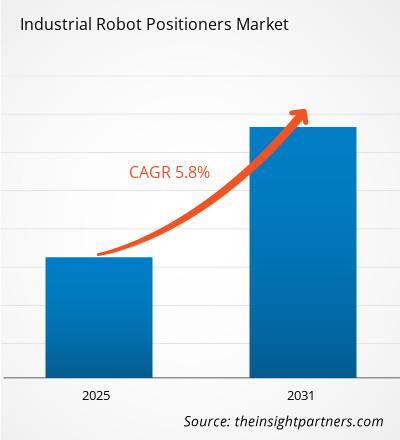
The Industrial Robot Positioners market is valued at US$ 787 Million in 2025 and is projected to reach US$ 1,325.96 Million by 2034, registering a CAGR of 5.97% from 2026 to 2034. Demand will be bolstered by increased automation in auto, fabrication, logistics, and materials handling applications. The Market will see continuous growth because of the need for precision in welding, faster rotation of workpieces, and better usage of robotic cells.
In North America, growth will come from reshoring trends, lack of skilled labor, and installation of flexible robotic cells. The Industrial Robot Positioners Market Size is forecast to increase at a projected 6.2–6.8% CAGR from 2026 to 2034, with demand coming from welding, manufacturing of heavy equipment, and automated materials handling.
Industrial Robot Positioners Market Assessment and Insights
- North America: North America is expected to account for a 27–31% share in 2025, expanding at a 6.2–6.8% CAGR between 2026–2034. Automotive automation, reshoring, aerospace production, and labor availability support demand for coordinated workpiece positioning.
- US: The US is estimated to represent 70–75% of North America’s 2025 share, growing at a 6.0–6.6% CAGR between 2026–2034, supported by factory modernization and robotic welding investments.
- Europe: Europe is projected to hold a 28–32% share in 2025, with a 5.6–6.2% CAGR between 2026–2034. Germany, Italy, France, Spain, and the UK remain important markets because of established automotive and industrial automation ecosystems.
- Asia Pacific: Asia Pacific is estimated at a 34–38% share in 2025, growing at a 6.5–7.1% CAGR between 2026–2034. China, Japan, South Korea, and India are leading demand through automotive, electronics, fabrication, and industrial automation investments.
- Largest Segment: Single-Axis Positioners are estimated to hold a 40–44% market share in 2025, growing at a 5.5–6.0% CAGR between 2026–2034, supported by welding and handling applications.
- High Growth Segment: Three-Axis Positioners are estimated at a 12–16% market share in 2025, expanding at a 6.8–7.5% CAGR between 2026–2034, driven by complex multi-axis workpiece manipulation.
- Key companies analyzed in detail: ABB, Comau, FANUC Corporation, KUKA Robotics, Yaskawa Electric Corporation, CLOOS Robotic Welding, Deuma, Drupe Engineering, Easom Automation Systems, and Hawk Technology.
Source: The Insight Partners' analysis based on proprietary research, government publications, company annual reports, investor presentations, industry databases, and expert interviews.
The technology base has moved on from mechanically operated fixtures towards positioners using servos, which are synchronized with the robot controller. Increasingly, modern systems use dynamic modeling, programmable motion, standardization of interfaces, and load sensing. Thus, the growth in the Industrial Robot Positioners Market is part of a general trend towards integrated robotic cells where the positioner motion plays a role in cycle time reduction, access to welds, fixture availability, and repeatability as opposed to being an auxiliary mechanical component.
The demand for future is predicted to increase beyond the traditional automotive welding shops. Countries in South East Asia, India, Eastern Europe, Mexico, and even some in the Middle East have begun to develop their automation capacities, but manufacturers want flexible robotic cells that can accommodate products with varying geometries. The considerations of energy efficiency, functional safety, predictive maintenance, and digital commissioning are emerging as important criteria in purchases, pushing suppliers to combine mechanical positioning systems with motion control software.
Industrial Robot Positioners Market Report Scope
| Report Attribute | Details |
|---|---|
| Market size in 2025 | US$ 787 Million |
| Market Size by 2034 | US$ 1,325.96 Million |
| Global CAGR (2026 - 2034) | 5.97% |
| Historical Data | 2021-2024 |
| Forecast period | 2026-2034 |
Industrial Robot Positioners Market Analysis
Automated manufacturing now demands precise manipulation of large or awkward work pieces for processes such as welding, assembly, inspection or handling by the robot. The Industrial Robot Positioners Market will thus derive advantage from this need as positioners increase the effective range of the robots without using more powerful and bulky robots. Key participants include positioners suppliers, robot makers, servo and drive makers, welding equipment manufacturers, system integrators, fixture makers and users. Manufacturing automobiles is a significant source of demand.
Supply factors that affect positioners include load capacity, axes design, precision of movements, rotation rate, compatibility of fixtures and type of integration. Standardized positioners ensure repeatable installations whereas custom-made positioners cater to oversized work pieces, asymmetric loads and welding systems. Suppliers are developing systems based on common control and communications systems thus favoring those capable of delivering the entire package including mechanical, drives, programming and safety systems.
The Industrial Robot Positioners Market Report is indicative of a market with a competitive structure where major robotic players and specialty engineering firms participate. ABB, FANUC Corporation, KUKA Robotics, and Yaskawa Electric Corporation have an advantage because of the existing bases of robots that allow them to offer positioner equipment along with other elements in automation cells. Comau utilizes its relations with the automotive industry whereas CLOOS Robotic Welding offers positioners dedicated to welding.
There is an increased focus on investment in flexible automation, software integration, and application-specific cells in addition to robot positioners. The differentiation is achieved via payload capacity, accuracy, small footprints, fast fixture changeovers, safety integration, and robot and positioner synchronization. The collaboration with system integrators continues to be essential because the customers often have a need for total automation cells such as welding and handling ones. The emerging competition encourages vendors to decrease installation time and preserve mechanical robustness and lifecycle.
● REPORT CUSTOMIZATION
Tailor This Report To Align With Your Specific Business Requirements
This report can be customized to align precisely with your business objectives, scope, and target markets. Customization options include tailored segmentation, geography, competitive analysis, and strategic insights to support informed decision-making.
Customize This Report →WHAT YOU CAN ADJUST
- ● Segmentations
- ● Geography
- ● Competitive Analysis
- ● Language Preferences
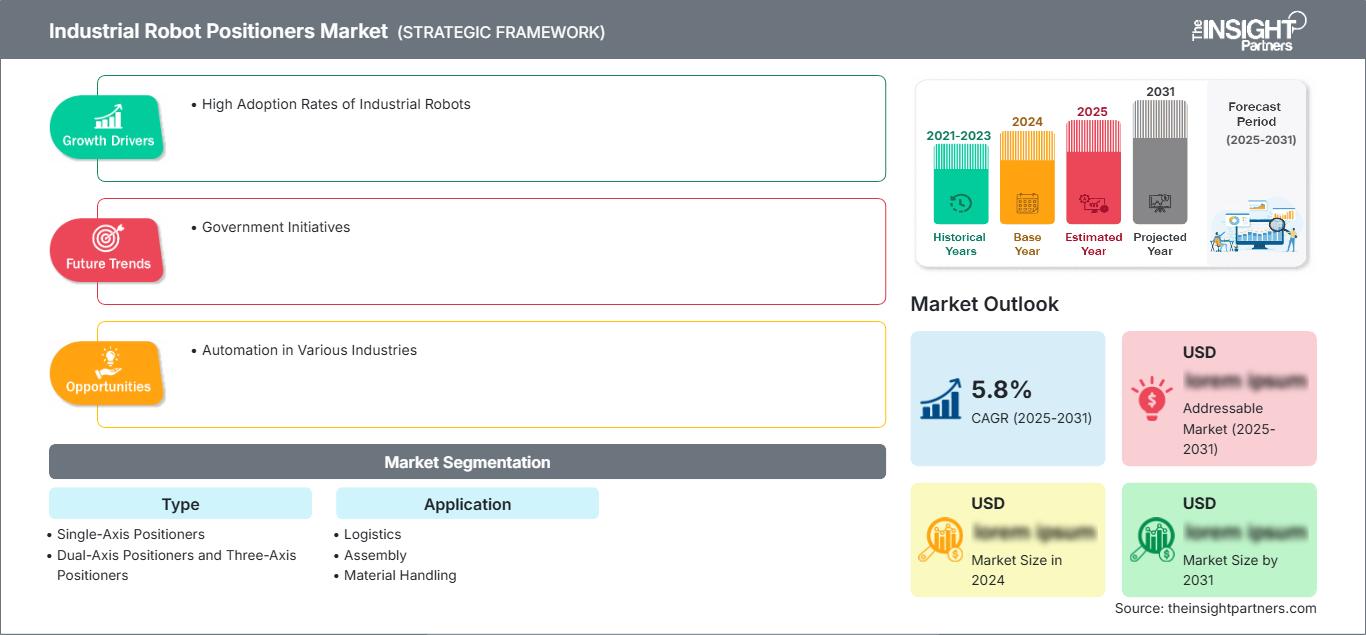
Industrial Robot Positioners Market: Strategic Insights
Regional Insights
North America Industrial Robot Positioners Market
North America constitutes an estimated 27-31% Industrial Robot Positioners market share in 2025, with the region's market forecasted to witness growth at a 6.2-6.8% CAGR over 2034. US dominates regional demand, driven by automotive manufacturing, aerospace manufacturing, heavy machinery, metal forming and initiatives aimed at lowering dependence on manual manufacturing. Positioners are increasingly specified as part of a robotic welding and handling cells.
Additional opportunities come from Canada and Mexico due to automotive and industrial supply chain investments. Companies prefer servo-based positioners which allow for multiple fixtures and varying workpiece geometries. Additional factors that impact regional demand include labor shortage and increased manufacturing efficiency. ABB, FANUC Corporation, KUKA Robotics, Comau, and Yaskawa Electric Corporation keep application relevance through their automation products.
U.S. Industrial Robot Positioners Market
The US is estimated to account for 70–75% of North America’s 2025 share and is projected to expand at a 6.0–6.6% CAGR through 2034. Automotive, aerospace, defense, machinery, and fabricated-metal producers are important users, particularly where welding cells require consistent orientation and repeatable positioning. Reshoring also supports investment in automated manufacturing equipment.
The companies that can be mentioned in relevance are ABB, FANUC Corporation, KUKA Robotics, Comau, and Yaskawa Electric Corporation. The current trend regarding the industry is the need to develop systems including robots, positioners, welders, sensors, and controllers. Two-station positioners that are capable of performing rapid rotation and fixture exchange are especially important for those facilities where high usage is required without adding workforce.
Europe Industrial Robot Positioners Market
Europe is forecast to occupy a market share of 28-32% in 2025 and will witness a CAGR of 5.6-6.2% till 2034. Germany leads the region, owing to automotive engineering and advanced industrial automation technologies. The other nations that contribute include the UK, France, Italy, and Spain via automotive, machinery, aerospace, metalworking, and industrial machinery manufacturing industries.
The UK has a focus on factory modernization and automation in flexible manufacturing. Germany benefits from robotic technology integration along with a wide supply chain. France has prospects in aerospace and automotive manufacturing, whereas Italy has prospects in machinery manufacturing and metal fabrication. Spain has prospects in automotive manufacturing and industrial components. Across Europe, energy efficiency, labor safety, flexible manufacturing, and digital factory programs drive the buying decisions for positioner systems.
APAC Industrial Robot Positioners Market
The share of APAC is forecasted to be between 34-38%, and the growth rate during 2025-2034 is anticipated to reach 6.5%-7.1%. The top four markets in APAC include China, Japan, South Korea, India, and Australia. These markets include automotive production, electronics manufacturing, metal fabrication, and machinery automation.
China possesses a huge manufacturing capacity along with automated manufacturing facilities, and Japan and South Korea focus on accuracy and efficiency. India is working on developing their demand in the automotive, infrastructure, and manufacturing segment. There are smaller opportunities in Australia, especially mining equipment and heavy fabrication. With the help of government-sponsored manufacturing programs, labor shortages, and smart factory developments, the use of coordinated robot positioners in APAC will be reinforced.
Middle East & Africa Industrial Robot Positioners Market
Middle East and Africa demand remains comparatively smaller but is developing at a 5.1–5.7% CAGR through 2034. Saudi Arabia and the UAE lead regional activity through industrial diversification, infrastructure development, and advanced manufacturing investments. South Africa remains important for automotive and metalworking applications, while the rest of MEA presents selective opportunities.
The use of positioners is especially important in cases where automation welding and material handling would lead to greater productivity in large fabricated structures and industrial equipment. Investment in the energy sector also means there is a demand for repetitive manufacturing of parts and assemblies. The regional customers are showing preference towards total automation cells which are locally integrated and have safety engineering capabilities.
Segmentation Analysis
Type
The Type segment in the Industrial Robot Positioners market is projected to expand at a 5.7–6.2% CAGR from 2026–2034. Single-axis systems remain widely applicable for straightforward rotational positioning, while dual-axis and three-axis configurations address increasingly complex workpieces. Selection depends on payload, required orientation, robot reach, cycle time, and fixture architecture. The segment's scope is therefore expanding alongside flexible robotic-cell design.
- Single-Axis Positioners: These systems provide straightforward rotational movement and remain widely used in welding, assembly, and handling cells. Their simpler architecture supports economical deployment, easier maintenance, and compatibility with standardized fixtures.
- Dual-Axis Positioners: Dual-axis equipment enables more flexible orientation of complex workpieces, improving robot accessibility and weld positioning. It is strategically important for automotive components, fabricated structures, and applications requiring multiple approach angles.
- Three-Axis Positioners: Three-axis systems provide advanced workpiece manipulation for geometrically complex components. Demand is concentrated in applications requiring synchronized positioning, improved accessibility, and greater flexibility across multi-operation robotic cells.
Application
The Application segment in the Industrial Robot Positioners market is expected to grow at a 6.0–6.6% CAGR during 2026–2034. Logistics, assembly, and material handling increasingly use robotic positioning to coordinate workpieces with automated processes. Growth depends on payload complexity, production volume, required accuracy, and integration with robotic arms, conveyors, welding systems, and automated inspection technologies.
- Logistics: Positioning equipment supports automated orientation and transfer of components within production environments. Demand is associated with flexible material-flow systems, pallet handling, automated storage interfaces, and robotic movement of irregular workpieces.
- Assembly: Assembly applications require repeatable component orientation and accurate access for fastening, joining, inspection, and installation. Positioners improve ergonomic conditions while allowing robots to reach multiple sides of complex assemblies.
- Material Handling: Material-handling applications use positioners to rotate, present, and transfer workpieces between manufacturing stages. Adoption is strongest where heavy or awkward components require controlled movement and consistent positioning.
IPC Type
The IPC Type segment in the Industrial Robot Positioners market is expected to register a 5.5–6.1% CAGR from 2026–2034 as industrial controllers increasingly coordinate robotic arms, positioners, sensors, safety devices, and production software. Panel, rack-mounted, box, embedded, and DIN rail configurations serve different automation architectures, with selection influenced by installation space, processing requirements, connectivity, and environmental conditions.
- Panel IPC: Panel IPC systems integrate computing and operator interfaces into compact industrial enclosures. They support centralized monitoring, visualization, and machine-control functions in positioner-intensive production cells.
- Rack Mount IPC: Rack-mounted IPCs suit centralized control environments requiring standardized installation and expandable computing resources. They are relevant for larger automation systems integrating several robotic cells and production-control applications.
- Box IPC: Box IPCs provide compact computing for distributed automation architectures. Their flexible mounting and industrial design make them suitable for robotic cells where space and environmental protection are important.
- Embedded IPC: Embedded IPCs support decentralized machine intelligence and real-time processing. They are strategically relevant for smart positioners, motion coordination, diagnostics, edge analytics, and connected manufacturing systems.
- DIN Rail IPC: DIN rail IPCs provide space-efficient industrial computing for control cabinets. Their standardized installation supports compact automation systems and facilitates integration with controllers, drives, networking, and safety components.
End Use Industry
The End Use Industry segment in the Industrial Robot Positioners market is projected to grow at a 5.8–6.4% CAGR during 2026–2034. Automotive remains a significant application base, while healthcare, aerospace and defense, semiconductor and electronics, energy and power, and oil and gas provide diversified opportunities. Each industry imposes different payload, cleanliness, accuracy, safety, and traceability requirements.
- Automotive: Automotive plants use positioners extensively for welding, body assembly, component handling, and flexible manufacturing. High production volumes favor synchronized equipment capable of supporting rapid cycle times and repeatable fixture changes.
- Healthcare: Healthcare manufacturing requires controlled positioning for equipment, devices, and specialized assemblies. Adoption is more selective, with emphasis on precision, traceability, clean production, and repeatable assembly operations.
- Aerospace and Defense: Aerospace and defense applications prioritize accuracy, large workpiece handling, controlled motion, and process repeatability. Positioners support fabrication and assembly of complex structures where accessibility and quality assurance are critical.
- Semiconductor and Electronics: Electronics applications emphasize precision, compact equipment, and controlled handling. Positioning solutions support assembly, inspection, testing, and material movement where small tolerances and reliable automation are required.
- Energy and Power: Energy applications involve large and heavy components, creating demand for robust positioners with high payload capacity. Equipment is used in fabrication, assembly, welding, and maintenance-oriented manufacturing environments.
- Oil and Gas: Oil and gas manufacturing uses positioners for heavy fabricated components, pipe-related assemblies, and equipment production. Reliability, load handling, safety, and operation in demanding industrial environments influence equipment selection.
Sales Channel
The Sales Channel segment in the Industrial Robot Positioners market is expected to grow at a 5.3–5.9% CAGR during 2026–2034. Offline channels remain dominant because industrial positioners require application engineering, sizing, commissioning, integration, and after-sales support. Online channels are gradually expanding for standardized components, replacement equipment, accessories, and smaller automation systems.
- Online: Online purchasing is gaining relevance for standardized products and replacement components. Digital catalogs simplify technical comparison, while customers increasingly use online channels for preliminary specification and procurement research.
- Offline: Offline channels remain essential for engineered systems requiring site assessment, payload calculations, robot synchronization, fixture design, installation, and commissioning. Integrator relationships strongly influence purchasing decisions for complex deployments.
Opportunity Snapshot
| Application | Revenue Contribution | Trend Tag | Adoption Stage |
|---|---|---|---|
| Logistics | Medium | Flexible Handling | Scaling |
| Assembly | High | Robotic Assembly | Mature |
| Material Handling | High | Heavy Handling | Scaling |
Industrial Robot Positioners Market Growth Drivers and Impact Analysis
Rising automation intensity in automotive and metal fabrication
Automobile and metalworking companies continue to implement robotic cells to achieve increased productivity, efficiency, and worker safety. Positioning systems make an immediate contribution to the effective workspace of the robot through the rotating or positioning of components at the right angle for processing. This increases the efficiency of the robot and helps with consistent processes such as welding or assembly. As manufacturing systems become more flexible, positioners are considered more often along with robots rather than as individual pieces of equipment in separate purchases. The effect is felt most strongly when dealing with volume production, where even small reductions in cycle time add up to increased production each year. The positioner vendors who offer integrated control systems, rapid fixture changeovers, and application engineering can benefit from this as well.
Growing need to address skilled-labor shortages through robotic cells
Manufacturers are under rising pressure to keep the production running even with the shortage of skilled personnel such as welders, machine operators, and automation technicians. Positioners assist robots in handling difficult to manipulate and move materials. This is especially relevant in cases where the manufacturing process involves welding, assembly, and material handling since human intervention might limit the efficiency of the process. The driver goes beyond labor replacement since the use of automatic positioning might increase the process reproducibility and minimize ergonomic risk. Standardization of the production process could also be easier to achieve in the case of several shifts since the use of positioners could help achieve consistent quality results. This creates an opportunity for system integrators to create packages involving robots, positioners, safety devices, sensors, and programming.
Expansion of flexible manufacturing and multi-product production cells
The development of shorter product cycles and more customized products is prompting manufacturers to adopt flexible robotic cells rather than dedicated production machines. Positioners help in this trend by helping robots to reach various angles of positioning of the workpiece and by providing interchangable fixtures. In such cases, a flexible cell will be able to handle multiple families of parts without any major mechanical changes. This trend has been especially useful for contract manufacturers, tier manufacturers, and those who serve diverse industrial customer segments. From the business perspective, there will be increased equipment utilization and better economic justification for automation even at moderate production volumes. Positioner manufacturers can gain competitive advantage by adopting modularity, programmability of motions, fixture interface capability, and quick reconfiguration capability.
Industrial Robot Positioners Market Future Trends
AI-assisted motion optimization and digital commissioning
Future positioner platforms are likely to incorporate increasingly sophisticated software for motion optimization, virtual commissioning, and production monitoring. AI-enabled systems could evaluate robot and positioner trajectories together, identifying collision risks, unnecessary movement, and opportunities to reduce cycle time before physical deployment. Digital twins will allow manufacturers to validate fixtures, payloads, and synchronized motion in simulated environments. The resulting workflow can shorten commissioning and improve engineering productivity, particularly for complex multi-axis cells. Industrial Robot Positioners Market trends are therefore expected to move toward software-defined motion coordination rather than purely mechanical differentiation. Suppliers with open programming environments and strong simulation capabilities will be positioned to support manufacturers operating multiple robotic cells with standardized digital engineering processes.
Modular positioner architectures for flexible production
Positioner designs are expected to become more modular as manufacturers demand equipment that can be adapted to changing products and production volumes. Future platforms may increasingly use standardized drive modules, interchangeable work plates, scalable axis configurations, and configurable safety systems. Such architectures can reduce engineering time while allowing manufacturers to increase payload or positioning capability without replacing the entire cell. Modular designs also support serviceability because individual components can be replaced or upgraded independently. This direction is particularly relevant for small and medium manufacturers seeking automation without committing to highly customized equipment. As modularity improves, suppliers can broaden their addressable customer base while system integrators gain greater freedom to configure automation cells according to payload, floor space, process sequence, and production requirements.
Industrial Robot Positioners Market Opportunities
Expansion into emerging manufacturing hubs
Manufacturing expansion in India, Southeast Asia, Mexico, Eastern Europe, and selected Middle Eastern economies creates opportunities for suppliers to establish local integration and service capabilities. Many new plants are adopting automation from the initial facility-design stage, allowing positioners to be specified as part of complete robotic cells. Vendors can capture this opportunity by partnering with regional system integrators, developing localized engineering support, and maintaining application-specific demonstration facilities. Industrial Robot Positioners Market Forecasts can support investment prioritization by comparing automation penetration, manufacturing output, labor availability, and capital expenditure patterns across target countries. Suppliers should prioritize industries with repetitive welding, heavy material handling, and multi-product assembly because these applications provide clear productivity justification for positioner deployment.
Aftermarket modernization and retrofit solutions
A substantial opportunity exists in upgrading installed robotic cells rather than replacing complete automation systems. Older positioners may remain mechanically serviceable while lacking modern servo drives, synchronized controls, safety functions, or digital diagnostics. Retrofit packages can extend equipment life while improving accuracy, connectivity, and productivity. Suppliers can develop standardized modernization kits covering drives, motors, controllers, encoders, safety devices, and communication interfaces. This approach can shorten customer investment cycles because the existing robot, fixture, and cell infrastructure may be retained. It also creates recurring revenue through maintenance, calibration, spare parts, and software support. Companies with large installed bases can use retrofit programs to deepen customer relationships and establish pathways toward eventual replacement with fully integrated next-generation positioner systems.
Recent Developments
- July 2026: ABB Ltd. announced a collaboration with NVIDIA focused on physical AI and published a related white paper addressing the transformation of industrial automation. The initiative builds on RobotStudio and AI-enabled simulation capabilities, reinforcing ABB’s strategy around intelligent robotics, digital engineering, and scalable automation across manufacturing applications.
- March 2026: KUKA Robotics unveiled its KUKA Automation Management Platform at NVIDIA GTC 2026. The platform is designed to connect robots, automation cells, digital twins, and software through an open architecture, supporting AI-driven orchestration and more flexible deployment across factories and warehouses.
- June 2025: Yaskawa Electric Corporation announced an investment of at least US$180 million and plans to create more than 700 jobs as part of a Wisconsin expansion and North American headquarters relocation. The investment also includes future robot manufacturing in Franklin, strengthening Yaskawa’s regional advanced-manufacturing footprint.
Frequently Asked Questions

- Comprehensive Market Sizing and Forecast Analysis
- Detailed Segmentation Analysis
- In-Depth Market Dynamics Assessment
- Regional and Country-Level Insights
- Competitive Landscape and Company Benchmarking
- Strategic Business Intelligence
Recent Reports
Testimonials

The Insight Partners' SCADA System Market report is comprehensive, with valuable insights on current trends and future forecasts. The team was highly professional, responsive, and supportive throughout. We are very satisfied and highly recommend their services.
RAN KEDEM Partner, Reali Technologies LTDs
I requested a report on a very specific software market and the team produced the report in a few days. The information was very relevant and well presented. I then requested some changes and additions to the report. The team was again very responsive and I got the final report in less than a week.
JEAN-HERVE JENN Chairman, Future Analytica
We worked with The Insight Partners for an important market study and forecast. They gave us clear insights into opportunities and risks, which helped shape our plans. Their research was easy to use and based on solid data. It helped us make smart, confident decisions. We highly recommend them.
PIYUSH NAGPAL Sr. Vice President, High Beam Global
The Insight Partners delivered insightful, well-structured market research with strong domain expertise. Their team was professional and responsive throughout. The user-friendly website made accessing industry reports seamless. We highly recommend them for reliable, high-quality research services
YUKIHIKO ADACHI CEO, Deep Blue, LLC.
This is the first time I have purchased a market report from The Insight Partners.While I was unsure at first, I visited their web site and felt more comfortable to take the risk and purchase a market report.I am completely satisfied with the quality of the report and customer service. I had several questions and comments with the initial report, but after a couple of dialogs over email with their analyst I believe I have a report that I can use as input to our strategic planning process.Thank you so much for taking the extra time and making this a positive experience.I will definitely recommend your service to others and you will be my first call when we need further market data.
JOHN SUZUKI President and Chief Executive Officer, Board Director, BK Technologies
I wish to appreciate your support and the professionalism you displayed in the course of attending to my request for information regarding to infectious disease IVD market in Nigeria. I appreciate your patience, your guidance, and the fact that you were willing to offer a discount, which eventually made it possible for us to close a deal. I look forward to engaging The Insight Partners in the future, all thanks to the impression you have created in me as a result of this first encounter.
DR CHIJIOKE ONYIA MANAGING DIRECTOR, PineCrest Healthcare Ltd.Reason to Buy
- Informed Decision-Making
- Understanding Market Dynamics
- Competitive Analysis
- Identifying Emerging Markets
- Customer Insights
- Market Forecasts
- Risk Mitigation
- Boosting Operational Efficiency
- Strategic Planning
- Investment Justification
- Tracking Industry Innovations
- Aligning with Regulatory Trends





 Get Free Sample for