
Investment Casting Market Growth, Demand & Size by 2034
Coverage: By Material (Aluminum, Steel, Nickel, Cobalt, Titanium); Process (Sodium Silicate Process and Silica Sol Process); Application (Aerospace and Defence, Automotive, Marine, Medical, Food, Oil and Gas, Power Generation, Industrial); and Geography (North America, Europe, Asia Pacific, and South and Central America)
- Status : Data Released
- Report Code : TIPRE00010183
- Category : Chemicals and Materials
- No. of Pages : 150
- Available Report Formats :


- Last update date : August 14, 2026


2025 Market Size
US$ 20.59 Bn
Base year value
2034 Forecast
US$ 33.52 Bn
Projected by 2034
CAGR 2026-2034
5.57 %
Growth rate
Addressable Market
US$ 245.38 Bn
(2026-2034)
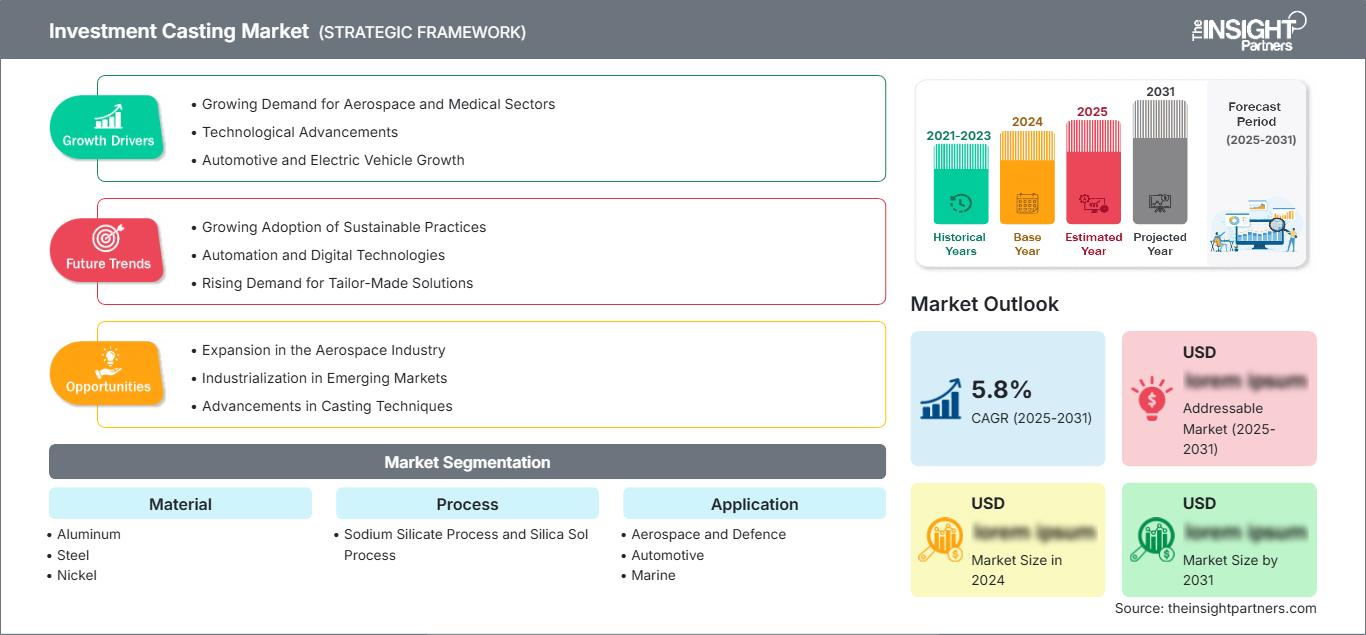
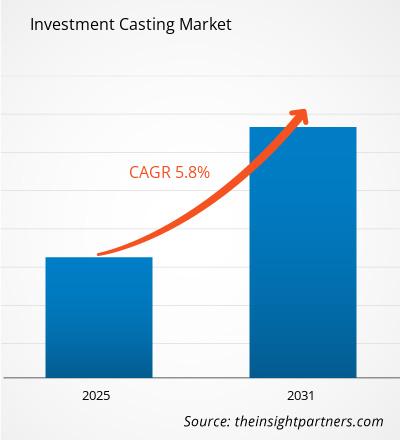
The investment casting market was valued at US$ 20.59 Billion in 2025 and is projected to reach US$ 33.52 Billion by 2034, registering a CAGR of 5.57% during 2026–2034. The market growth is influenced by rising demand for precision-engineered components across aerospace, automotive, medical, and industrial applications, where complex geometries, dimensional accuracy, and material efficiency are critical for advanced manufacturing requirements.
The investment casting market size is expanding across North America due to aerospace modernization programs, increased defense component manufacturing, and the adoption of lightweight metal components. The region is estimated to register a CAGR range of 5–6% between 2026 and 2034, supported by established foundry infrastructure, advanced manufacturing capabilities, and increasing demand for high-performance cast parts.
Investment Casting Market Assessment and Insights
- North America: The region accounted for an estimated 28–32% share in 2025 and is expected to grow at a CAGR range of 5–6% from 2026–2034. Aerospace, defense, and industrial machinery applications continue to support precision casting demand across the US and Canada.
- US: The country represented approximately 22–26% share in 2025 and is projected to expand at a CAGR range of 5–6% during 2026–2034. Strong aerospace manufacturing and defense supply chains drive adoption of investment cast components.
- Europe: The region held around 25–29% share in 2025 and is anticipated to achieve a CAGR range of 4–6% from 2026–2034. Germany, France, Italy, and the UK remain significant markets due to automotive, aerospace, and industrial engineering capabilities.
- Asia Pacific: The region captured approximately 30–34% share in 2025 and is expected to record a CAGR range of 6–7% between 2026–2034. China, Japan, South Korea, and India support regional expansion through manufacturing investments.
- Largest Segment: The aerospace and defense application segment held an estimated 30–34% market share in 2025 and is expected to grow at a CAGR range of 6–7% during 2026–2034 due to demand for lightweight precision components.
- High Growth Segment: The medical application segment accounted for approximately 8–12% market share in 2025 and is projected to expand at a CAGR range of 7–8% from 2026–2034 due to implant and surgical component requirements.
- Key companies analyzed in detail: Arconic Corporation, Anhui Yingliu Electromechanical Co., Ltd., ATI Inc., CIREX B.V., Investment & Precision Castings Ltd., Doncasters Group Ltd., Hitachi Metals, Ltd., Impro Precision Industries Limited, MetalTek International, Inc., Precision Castparts Corp., Zollern GmbH & Co. KG, Georg Fischer AG, Hitchiner Manufacturing Co., Inc., and other relevant industry participants.
Source: The Insight Partners' analysis based on proprietary research, government publications, company annual reports, investor presentations, industry databases, and expert interviews.
Investment casting technology has advanced with better wax pattern-making processes, ceramic shell technology, simulation software, and automated manufacturing equipment. The industry has progressed from traditional foundries to digitally-integrated production setups, allowing for better repeatability and decreased wastage of raw materials. Usage of nickel superalloys, titanium, and steel alloys has aided the growth of investment casting in harsh environments.
Future growth in the future will come from new manufacturing regions, especially the Asia Pacific and the Middle East, due to rising investments in the aerospace, energy, and industrial infrastructure sectors. The focus on efficient use of fuels, lighting components, and sustainable manufacturing processes is driving manufacturers to use investment casting technology.
Investment Casting Market Report Scope
| Report Attribute | Details |
|---|---|
| Market size in 2025 | US$ 20.59 Billion |
| Market Size by 2034 | US$ 33.52 Billion |
| Global CAGR (2026 - 2034) | 5.57% |
| Historical Data | 2021-2024 |
| Forecast period | 2026-2034 |
Investment Casting Market Analysis
The investment casting market growth is supported by increasing demand for complex metal components that require high dimensional accuracy and minimal post-processing. Aerospace manufacturers rely on precision cast parts for turbine blades, structural components, and engine systems, while automotive producers increasingly utilize lightweight cast components to improve vehicle efficiency. The ecosystem includes alloy suppliers, wax pattern manufacturers, foundries, machining providers, and end-use industries.
Supply chain integration has become increasingly important as manufacturers seek consistent quality, shorter production cycles, and cost optimization. Foundries are investing in automated inspection technologies, additive manufacturing-assisted pattern development, and advanced simulation platforms. These developments allow producers to manufacture intricate components while maintaining reliability standards required by aerospace, medical, and industrial customers, positively influencing the Investment Casting Market Share across key application sectors.
The investment casting market analysis indicates a competitive environment shaped by global foundries, specialized manufacturers, and vertically integrated metal processing companies. Companies such as Arconic Corporation, ATI Inc., Precision Castparts Corp., and Doncasters Group Ltd. focus on aerospace and industrial applications through advanced alloy capabilities and precision manufacturing expertise. Other players, including CIREX B.V., Zollern GmbH & Co. KG, and Hitchiner Manufacturing Co., Inc., strengthen their positions through specialized casting solutions.
Strategic investments are centered on capacity expansion, digital manufacturing adoption, and the development of advanced materials. Anhui Yingliu Electromechanical Co., Ltd., Impro Precision Industries Limited, MetalTek International, Inc., Georg Fischer AG, Hitachi Metals, Ltd., and Investment & Precision Castings Ltd. continue to address demand from industrial, automotive, and energy sectors through technology improvements and application diversification, as highlighted in the Investment Casting Market Report.
● REPORT CUSTOMIZATION
Tailor This Report To Align With Your Specific Business Requirements
This report can be customized to align precisely with your business objectives, scope, and target markets. Customization options include tailored segmentation, geography, competitive analysis, and strategic insights to support informed decision-making.
Customize This Report →WHAT YOU CAN ADJUST
- ● Segmentations
- ● Geography
- ● Competitive Analysis
- ● Language Preferences
Investment Casting Market: Strategic Insights
Regional Insights
North America Investment Casting Market
North America accounted for an estimated 28–32% share of the investment casting market in 2025 and is projected to expand at a CAGR range of 5–6% during 2026–2034. The area will benefit due to the presence of aerospace manufacturing networks, defense contracts, and industrial equipment manufacturing. The major contributing nation is the United States owing to its foundries and the need for manufactured components with high precision.
North American manufacturers have been using automation, digital quality inspection, and improved alloy manufacturing processes to enhance productivity. Aerospace engine parts, defense and medical devices continue to be among the major applications. More emphasis is being placed on local sourcing of parts and less reliance on imported parts, which in turn encourages the growth of foundries in the area, while Canada benefits by manufacturing aerospace and industrial equipment.
U.S. Investment Casting Market
The US investment casting market represented approximately 75–80% of the North American regional share in 2025 and is expected to register a CAGR range of 5–6% from 2026–2034. An aerospace and defense manufacturing ecosystem is an important factor that ensures sustained demand for high-complexity casting applications, such as turbine components, structures, and special engineering components.
The key players in the industry have established manufacturing plants in the country for the aerospace, automotive, and industrial customer segments. The use of more advanced manufacturing techniques, including computer-aided design integration and automated inspection processes, is boosting the accuracy of the manufacturing process.
Europe Investment Casting Market
Europe accounted for approximately 25–29% share of the investment casting market in 2025 and is forecast to grow at a CAGR range of 4–6% during 2026–2034. Germany still remains one of the leading countries because of its engineering base in automotive, manufacturing capability in aerospace, and industrial equipment. UK and France also have a large contribution in terms of aerospace and defense.
In Germany, there is a high demand for precision casting components for automotive, machinery, and energy equipment. In the UK, the market is supported by aerospace manufacturing capability and defense-related applications. In France, the aircraft manufacturing industry supports the demand. In Italy and Spain, adoption is growing because of the automotive manufacturing, industrial equipment production, and modernization of the manufacturing facilities.
APAC Investment Casting Market
APAC held an estimated 30–34% share of the market in 2025 and is anticipated to grow at a CAGR range of 6–7% between 2026–2034. China leads the regional market due to extensive manufacturing capacity, aerospace development, and industrial production. Japan, South Korea, India, and Australia contribute through automotive, aerospace, and energy applications, reinforcing key Investment Casting Market Trends across the region.
Industrial expansion, government manufacturing initiatives, and increasing investment in precision engineering are supporting regional growth. China’s aerospace and automotive sectors remain key demand centers, while India is developing advanced manufacturing capabilities through industrial localization programs. Japan and South Korea continue to adopt high-quality casting solutions for electronics, automotive, and aerospace applications.
Middle East & Africa Investment Casting Market
The Middle East & Africa market is estimated to represent approximately 5–8% share in 2025 and is expected to grow at a CAGR range of 5–6% during 2026–2034. Saudi Arabia leads regional demand through energy sector diversification and industrial development initiatives, while the UAE supports aerospace and advanced manufacturing activities, contributing to a positive Investment Casting Market Forecast across the region.
South Africa contributes through mining equipment, industrial manufacturing, and engineering applications. Growth across the Rest of the MEA region is influenced by infrastructure investments and increasing industrial capabilities. Energy sector modernization, aerospace development programs, and efforts to establish localized manufacturing ecosystems are expected to create additional opportunities for precision casting suppliers.
Segmentation Analysis
Material
The Material segment is expected to register a CAGR range of 5–6% during 2026–2034. Material selection remains a critical factor in investment casting as manufacturers balance mechanical strength, corrosion resistance, thermal performance, and weight requirements. Aluminum, steel, nickel, cobalt, and titanium alloys are increasingly selected based on application-specific performance requirements across aerospace, automotive, medical, and industrial sectors.
- Aluminum materials are widely adopted for lightweight components requiring corrosion resistance and efficient performance. Demand is supported by automotive lightweighting initiatives and aerospace applications where weight reduction contributes to improved operational efficiency and fuel performance.
- Steel materials maintain strong utilization in industrial equipment, automotive systems, and heavy-duty applications due to durability, strength, and cost advantages. Stainless and alloy steel variants support components exposed to demanding operating environments.
- Nickel materials are essential for high-temperature applications, particularly aerospace turbine components and energy equipment. Their ability to withstand thermal stress and oxidation makes nickel alloys strategically important for advanced engineering applications.
- Cobalt materials support specialized applications requiring wear resistance, thermal stability, and biocompatibility. These characteristics make cobalt-based alloys relevant for medical devices, aerospace components, and high-performance industrial parts.
- Titanium materials are gaining adoption due to high strength-to-weight ratios and corrosion resistance. Aerospace, medical implants, and defense applications increasingly utilize titanium investment cast components for performance-critical requirements.
Process
The Process segment is projected to achieve a CAGR range of 5–6% between 2026–2034. Investment casting processes continue evolving through improvements in ceramic shell formation, automation, and process monitoring. Manufacturers select processes based on component complexity, production volume, surface finish requirements, and cost considerations across different application industries.
- Sodium Silicate Process provides cost-effective casting solutions for applications requiring moderate precision and larger production volumes. The process remains relevant for industrial components where production efficiency and economical manufacturing are primary considerations.
- Silica Sol Process is preferred for high-precision components requiring superior surface finish and dimensional accuracy. Aerospace, medical, and advanced engineering industries increasingly adopt this process for complex components with stringent quality requirements.
Application
The Application segment is anticipated to record a CAGR range of 6–7% during 2026–2034. Increasing adoption across aerospace, automotive, medical, energy, and industrial sectors is driving demand for precision-engineered components. The segment benefits from requirements for complex geometries, reduced machining requirements, and improved material utilization.
- Aerospace and Defense applications represent a major demand area due to requirements for lightweight, durable, and heat-resistant components. Turbine blades, engine parts, and defense equipment components continue to support investment casting adoption.
- Automotive applications are expanding through demand for efficient vehicle systems, lightweight components, and advanced drivetrain technologies. Manufacturers utilize precision cast parts for performance improvement and manufacturing optimization.
- Marine applications use investment casting for corrosion-resistant components, propulsion systems, and specialized equipment. Marine manufacturers prioritize durable materials capable of operating under challenging environmental conditions.
- Medical applications are increasing due to demand for customized implants, surgical instruments, and precision medical devices. Investment casting enables the production of complex geometries required in advanced healthcare equipment.
- Food applications utilize investment casting for hygienic, corrosion-resistant components used in processing equipment. Stainless steel casting solutions support durability and compliance requirements within food manufacturing environments.
- Oil and Gas applications depend on investment cast components for valves, pumps, and flow-control systems. High-performance alloys help withstand pressure, temperature variations, and corrosive operating conditions.
- Power Generation applications require investment cast components for turbines, energy equipment, and high-temperature systems. Advanced alloys support reliability and operational efficiency in power infrastructure.
- Industrial applications include machinery, automation equipment, and engineering components. Manufacturers adopt investment casting to achieve complex designs, reduced assembly requirements, and improved component performance.
Opportunity Snapshot
| Application | Revenue Contribution (High/Medium/Low) | Trend Tag | Adoption Stage |
| Aerospace and Defence | High | Turbine Components | Mature |
| Automotive | High | Lightweight Parts | Scaling |
| Marine | Medium | Corrosion Systems | Mature |
| Medical | Medium | Custom Implants | Scaling |
| Food | Low | Hygienic Equipment | Mature |
| Oil and Gas | Medium | Valve Components | Mature |
| Power Generation | High | Energy Turbines | Scaling |
| Industrial | High | Precision Machinery | Mature |
Investment Casting Market Growth Drivers and Impact Analysis
Rising Demand for Lightweight Aerospace Components
Aerospace industry companies have been increasingly employing precision cast parts in order to make their planes lighter without compromising the performance of their structure. With investment casting, it has become possible to create complex engine and airframe parts made of advanced materials like nickel and titanium. According to the International Air Transport Association (IATA), future growth in aviation capacity will mean that there will be a need for improved airplane technologies. In efforts to produce fuel-efficient and low-emission aircraft, suppliers are making investments in advanced casting, automated inspections, and materials technology.
Expansion of Advanced Manufacturing Technologies
The use of computerized manufacturing equipment, computer simulation programs, and automated production systems has increased the accuracy of casting processes and decreased production waste. Foundries are using technology that allows for quicker design validation, better defect detection, and optimized material utilization. Such developments are especially crucial in industries with high standards of quality, such as aerospace, medical, and energy industries. Manufacturers are beginning to integrate their casting knowledge with the latest digital technology to increase production flexibility. This is also a way to solve problems with skilled workers while meeting increased production demands.
Increasing Adoption of High-Performance Alloys
Demand for high-performance alloys is on the rise, with end-use applications needing components that can operate in harsh environments involving high temperature, pressure, and corrosive conditions. Alloys containing nickel, cobalt, and titanium offer performance benefits in aerospace engine parts, medical devices, energy products, and other machinery. With the availability of alloy formulations tailored to meet particular needs, the durability of parts can be improved. Energy transition initiatives and upgrades of industrial facilities have also spurred demand for robust parts. Reliability and efficiency concerns are driving investments in advanced material technology amongst casting providers targeting high-value uses.
Investment Casting Market Future Trends
Integration of Artificial Intelligence in Casting Operations
AI and machine learning are likely to affect future casting processes through better control and inspection, as well as predictive maintenance. Companies are working on implementing AI-powered control systems that will help detect defects, optimize production parameters, and decrease the amount of material loss. Such technologies will contribute to improved results of the manufacturing process, especially for difficult aerospace and medical parts. With digital transformation, casting companies will be forced to spend more resources on creating smart factories. AI analysis, automation, and simulation will allow them to develop new productive approaches and meet customers’ needs more efficiently.
Growth of Sustainable Casting Practices
Sustainability is becoming an increasingly significant issue in the efforts by manufacturers to save energy, minimize waste, and reduce their impact on the environment. The future casting process is likely to include better recycling practices, energy-efficient machinery, and better utilization of materials. Manufacturers are also exploring production methods that help reduce wastage during the creation and finishing of the patterns. This trend is being driven by regulations as well as the sustainability objectives of the customers. Such initiatives will affect the investment choices and fast-track the adoption of sustainable production methods. Sustainable casting techniques will be a significant factor for suppliers in the aerospace, automotive, and industrial industries.
Investment Casting Market Opportunities
Expansion into Emerging Aerospace Manufacturing Hubs
Emerging aerospace manufacturing regions provide many opportunities for investment casting suppliers by way of collaboration and expansion of their capacities. Various countries in the Asia Pacific and the Middle East are making investments in building their aviation sector and their manufacturing capacity. Suppliers with knowledge of high-quality alloys and precision production technology will benefit from the growing demand for local component production. Collaboration with aircraft manufacturers, maintenance companies, and defense organizations will help gain access to the market. Investment Casting Outlooks show many future opportunities for these suppliers in the emerging economies as they develop their aerospace industries.
Development of Medical and Specialized Industrial Components
The growing demand for customized medical devices and specialized industrial equipment creates opportunities for manufacturers with advanced precision casting capabilities. Healthcare providers and equipment producers increasingly require components with complex geometries, biocompatible materials, and consistent quality standards. Similar requirements exist in industrial automation, energy, and high-performance machinery applications. Companies can expand their market presence by developing specialized solutions for niche applications and investing in certification capabilities. Growth opportunities are supported by increasing demand for customized engineering solutions and the need for reliable component suppliers across global manufacturing ecosystems.
Recent Developments
- July 2026: Thrust Capital Partners, a Canadian private equity firm dedicated to the aerospace & defense industry, announced that it has acquired Alphacasting Inc., a leading Quebec-based precision titanium and aluminium investment casting company primarily serving the aerospace & defense sectors.
- June 2026: DDM Systems, Inc, an advanced manufacturing company specializing in ceramic Additive Manufacturing for investment casting, based in Atlanta, Georgia, USA, announced the commercial launch of its Digital Foundry platform, a manufacturing approach designed to eliminate tooling from the investment casting process and deliver precision metal castings in days rather than months.
Frequently Asked Questions

- Comprehensive Market Sizing and Forecast Analysis
- Detailed Segmentation Analysis
- In-Depth Market Dynamics Assessment
- Regional and Country-Level Insights
- Competitive Landscape and Company Benchmarking
- Strategic Business Intelligence
Recent Reports
Testimonials

The Insight Partners provided valuable market intelligence that supported our global go-to-market strategy. Their team was professional, responsive, and attentive to our feedback, providing thoughtful analysis and helpful methodological clarifications throughout the project.
Junmo Kim Chief Financial Officer (CFO), Enertech Co., Ltd.
The Insight Partners' SCADA System Market report is comprehensive, with valuable insights on current trends and future forecasts. The team was highly professional, responsive, and supportive throughout. We are very satisfied and highly recommend their services.
RAN KEDEM Partner, Reali Technologies LTDs
I requested a report on a very specific software market and the team produced the report in a few days. The information was very relevant and well presented. I then requested some changes and additions to the report. The team was again very responsive and I got the final report in less than a week.
JEAN-HERVE JENN Chairman, Future Analytica
We worked with The Insight Partners for an important market study and forecast. They gave us clear insights into opportunities and risks, which helped shape our plans. Their research was easy to use and based on solid data. It helped us make smart, confident decisions. We highly recommend them.
PIYUSH NAGPAL Sr. Vice President, High Beam Global
The Insight Partners delivered insightful, well-structured market research with strong domain expertise. Their team was professional and responsive throughout. The user-friendly website made accessing industry reports seamless. We highly recommend them for reliable, high-quality research services
YUKIHIKO ADACHI CEO, Deep Blue, LLC.
This is the first time I have purchased a market report from The Insight Partners.While I was unsure at first, I visited their web site and felt more comfortable to take the risk and purchase a market report.I am completely satisfied with the quality of the report and customer service. I had several questions and comments with the initial report, but after a couple of dialogs over email with their analyst I believe I have a report that I can use as input to our strategic planning process.Thank you so much for taking the extra time and making this a positive experience.I will definitely recommend your service to others and you will be my first call when we need further market data.
JOHN SUZUKI President and Chief Executive Officer, Board Director, BK Technologies
I wish to appreciate your support and the professionalism you displayed in the course of attending to my request for information regarding to infectious disease IVD market in Nigeria. I appreciate your patience, your guidance, and the fact that you were willing to offer a discount, which eventually made it possible for us to close a deal. I look forward to engaging The Insight Partners in the future, all thanks to the impression you have created in me as a result of this first encounter.
DR CHIJIOKE ONYIA MANAGING DIRECTOR, PineCrest Healthcare Ltd.Reason to Buy
- Informed Decision-Making
- Understanding Market Dynamics
- Competitive Analysis
- Identifying Emerging Markets
- Customer Insights
- Market Forecasts
- Risk Mitigation
- Boosting Operational Efficiency
- Strategic Planning
- Investment Justification
- Tracking Industry Innovations
- Aligning with Regulatory Trends





 Get Free Sample for