
IP DECT Phones Market Demand, Size & Forecast by 2034
Coverage: by Component (Product, Services); Enterprise Size (Small and Medium Enterprises , Large Enterprises); Distribution Channel (B2B, B2C); End User (Residential, Commercial) , and Geography (North America, Europe, Asia Pacific, and South and Central America)
- Status : Data Released
- Report Code : TIPRE00011670
- Category : Electronics and Semiconductor
- No. of Pages : 150
- Available Report Formats :


- Last update date : September 21, 2026


2025 Market Size
US$ 6.49 Bn
Base year value
2034 Forecast
US$ 10.13 Bn
Projected by 2034
CAGR 2026-2034
5.07 %
Growth rate
Addressable Market
US$ 75.41 Bn
(2026-2034)
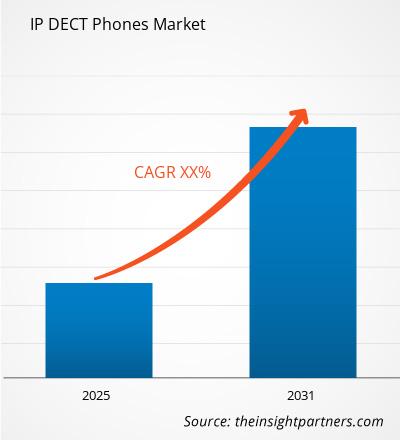
The global IP DECT Phones market was valued at US$ 6.49 billion in 2025 and is expected to reach US$ 10.13 billion by 2034; it is estimated to record a CAGR of 5.07% during 2026-2034.
IP DECT Phones Market Assessment and Insights
- North America: North America is expected to retain a leading position, representing a 38–40% share in 2025 and growing at a 4.8–5.2% CAGR between 2026–2034, supported by mature enterprise communications infrastructure.
- US: The US represents a 37–39% share of North American demand in 2025 and is projected to grow at a 4.6–5.0% CAGR between 2026–2034, led by healthcare and enterprise modernization.
- Europe: Europe accounts for a 29–31% share in 2025 and is projected to grow at a 4.0–4.6% CAGR between 2026–2034. Germany, the UK, and France remain leading markets, supported by established DECT adoption.
- Asia Pacific: Asia Pacific represents a 22–24% share in 2025 and is expected to expand at an 8.0–8.8% CAGR between 2026–2034, with China, Japan, India, and South Korea driving industrial deployment.
- Largest Segment: Product is the largest segment, holding a 70–75% market share in 2025 and expanding at a 4.5–5.2% CAGR during 2026–2034 as handset replacement remains central.
- High Growth Segment: Services account for a 25–30% market share in 2025 and are projected to grow at an 8.8–9.4% CAGR during 2026–2034, driven by managed deployments.
- Key companies analyzed in detail: ALE International, Ascom Holding AG, Avaya Inc., Cisco Systems, Inc., Gigaset Technologies GmbH, Grandstream Networks, Inc., Mitel Networks Corporation, NEC Corporation, Panasonic Corporation, Plantronics, Inc.
Source: The Insight Partners' analysis based on proprietary research, government publications, company annual reports, investor presentations, industry databases, and expert interviews.
The IP Dect Phones Market has transitioned from stand-alone cordless voice technology to IP-integrated mobile solutions with multi-cell design, SIP integration, remote provisioning, and UC compatibility. Manufacturing has come to focus on modular base stations, tough handsets, power efficiency, and software-managed products. In addition, supply chains need to cater to the needs associated with shorter product life cycles, regional certifications, parts availability, and local service support.
Further growth will most probably occur at the intersection of communications evolution and industrial automation, health care systems, logistics, and remote work environments. Current development trends in enterprise wireless include managed services, cloud provisioning, security, and hybrid connectivity. Clear regulations concerning spectrum utilization and enterprise wireless infrastructure will encourage adoption of the technology, while emerging markets may take advantage of easier implementation as the IP voice network is more readily available.
IP DECT Phones Market Report Scope
| Report Attribute | Details |
|---|---|
| Market size in 2025 | US$ 6.49 Billion |
| Market Size by 2034 | US$ 10.13 Billion |
| Global CAGR (2026 - 2034) | 5.07% |
| Historical Data | 2021-2024 |
| Forecast period | 2026-2034 |
IP DECT Phones Market Analysis
The demand side is motivated by firms who require secure mobile voice capabilities without interference and constraints, which may have been introduced by wireless communication technology in the past. Hospitals, storage facilities, hotels, retail outlets, manufacturing companies, and office buildings all require batteries with a long life span, roaming capabilities, and management from one point. The supply chain involves manufacturers of chips, devices, base stations, UC systems, telecommunications companies, distributors, and managed service providers.
Supply side developments are becoming more influenced by issues related to interoperability and flexibility in deployment. Suppliers have to be compatible with SIP environments, cloud services, multi-cell setups, remote provisioning, and maintain reliability of their hardware. Differentiation will be determined by audio quality, durability, security, batteries, and management systems. Service providers have the opportunity to increase value added by providing site surveys, installation, configuration, maintenance, firmware management, and other lifecycle services.
Competitive intensity is a function of the existence of established players in communications vendors and specialists in cordless enterprise mobility. Cisco Systems Inc. competes with its IP-DECT solution in cloud calling platforms while Avaya Inc., Mitel Networks Corp., NEC Corp., and ALE International have existing enterprise communications infrastructure. Ascom Holding AG highlights the need for challenging operational environments, while Gigaset Technologies GmbH highlights general professional and home DECT capability. Grandstream Networks, Inc. competes with scalable SIP-based systems.
Investments are increasingly going into software management tools, multi-cell scalability, rugged mobility, and vertical solutions. Panasonic Corporation and Plantronics, Inc. remain relevant through their communications offerings, while vendors are increasingly marketing devices as an endpoint to overall collaboration architecture. Differentiation is therefore increasingly becoming less about the device specifications and more about interoperability, lifecycle costs, deployment know-how, security, and cloud communications platforms.
● REPORT CUSTOMIZATION
Tailor This Report To Align With Your Specific Business Requirements
This report can be customized to align precisely with your business objectives, scope, and target markets. Customization options include tailored segmentation, geography, competitive analysis, and strategic insights to support informed decision-making.
Customize This Report →WHAT YOU CAN ADJUST
- ● Segmentations
- ● Geography
- ● Competitive Analysis
- ● Language Preferences
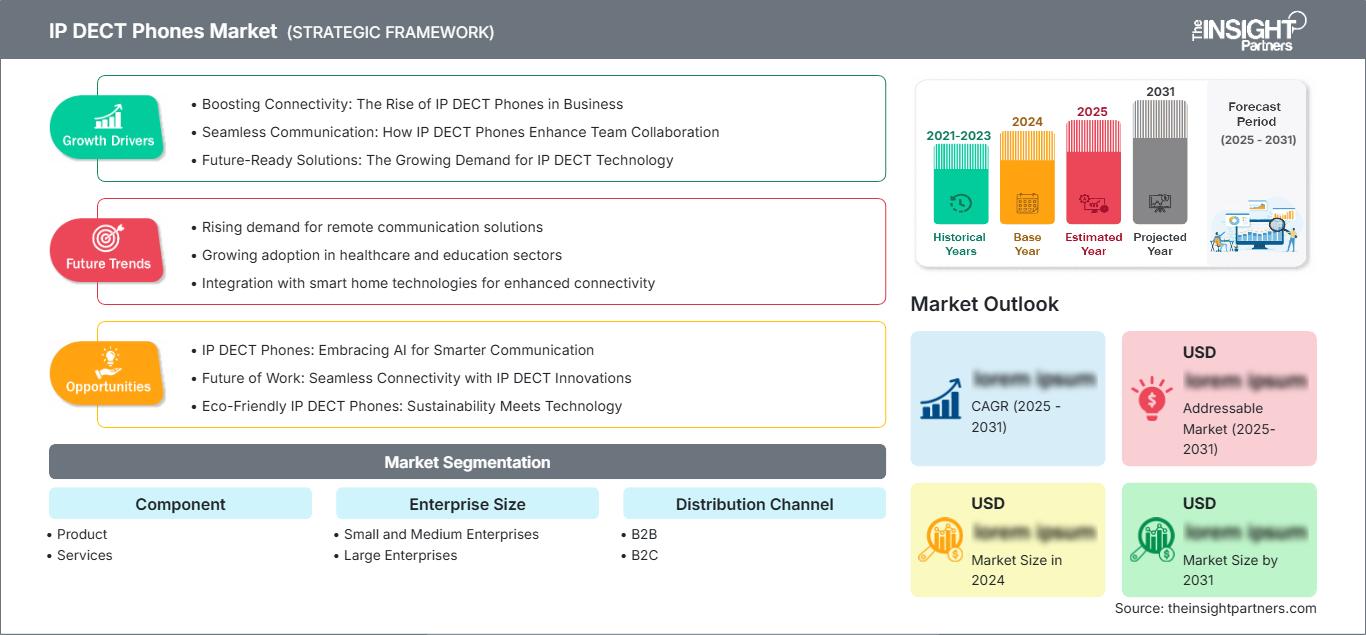
IP DECT Phones Market: Strategic Insights
Regional Insights
North America IP Dect Phones Market
The region of North America accounted for 38-40% of the IP Dect Phones Market share in 2025 and is forecasted to record a CAGR of 4.8-5.2% during the period up to 2034. North America is backed by its mature enterprise communications infrastructure, modernized healthcare, and system-integrator network. Applications are driven by hospitals, manufacturing plants, retail locations, hospitality, and large commercial campuses which require mobility and indoor coverage.
The US is the most significant market for North America, contributing to 37-39% of the demand with a forecasted growth rate of 4.6-5.0% CAGR. The contribution of Canada comes from the healthcare, logistics, and enterprise applications with recurring demand arising out of the need for replacements for legacy voice infrastructure. Cloud-based UC integration, ruggedized endpoints, and centralized provisioning are enhancing the value of the offering.
U.S. IP Dect Phones Market
The U.S. represents 37%-39% of the North American market in 2025 and has been expected to expand at a CAGR of 4.6%-5.0% through 2034. Significant healthcare facilities, retail outlets, manufacturing clusters, and hospitality firms are increasingly demanding reliable mobile voice connectivity. Cisco Systems, Inc., Avaya Inc., and other experienced communication solution providers provide for a significant existing installed base.
Trends within applications involve multi-cell capability, rugged devices, cloud calling, and device management systems. The healthcare and industrial segments have specific needs involving battery performance, roaming, and device resilience. Decisions regarding procurement take into account the cost throughout the product life cycle rather than just device acquisition.
Europe IP Dect Phones Market
Europe had a share of 29-31% in 2025 and is predicted to have a 4.0-4.6% CAGR through 2034. The key countries include Germany, followed by the UK and France that offer well-established DECT solutions for use in enterprise, residential, healthcare, retail and industrial sectors.
The UK keeps the demand due to hospitality, healthcare and business communication upgrade needs. Germany enjoys industrial and engineering activities. France includes enterprise upgrades and healthcare and governmental applications. Italy and Spain provide additional demand through hospitality and small business uses and residential IP telephony solutions. Energy savings, data security, compatibility and equipment availability become an issue for European consumers.
APAC IP Dect Phones Market
The APAC segment held a market share of 22–24% in 2025 and is expected to have a CAGR of 8.0-8.8% during 2025-2034. China is dominating the regional market in terms of demand, while Japan, South Korea, India, and Australia participate in terms of manufacturing, healthcare, logistics, hospitality, and digitization of enterprises.
The APAC region has captured a market share of 22–24% in 2025 and is anticipated to grow at a CAGR of 8.0–8.8% up to 2034. Leading the regional market is China, with Japan, South Korea, India, and Australia being the other countries driving demand via manufacturing industries, health care, logistics, hospitality, and digitization of enterprises. Modernization of industry and enterprise communication infrastructure has been aiding in adopting wireless voice communication systems, along with policies concerning smart facilities and digital connectivity that are boosting investments in wireless voice communication. The proliferation of smart factories, health care facilities, and digitized facilities is adding to the demand for wireless voice communication owing to the need for communication in large areas. Investments made in industrial automation and smart production environments in China and South Korea have been driving enterprises in upgrading their communication infrastructures, whereas in India, the growth of wireless communication technology can be seen in office buildings, health care facilities, warehouses, and hospitality sectors owing to the mobility and efficiency advantages.
Middle East & Africa IP Dect Phones Market
The Middle East & Africa region is forecast to witness an average growth rate of 5.5-6.2% in terms of demand over the forecast period until 2034, with Saudi Arabia being the most attractive market, followed by UAE and South Africa.
Hospitality, healthcare, logistics, and commercial infrastructure initiatives have been driving implementation, especially when there is a need for centralized mobility in large establishments. Modernization initiatives within the energy sector as well as large infrastructure developments are contributing towards increased investments in communication in the Gulf, while South Africa drives demand through its enterprise and industrial applications.
Segmentation Analysis
Component
Component segment in the IP Dect Phones Market demand remains hardware-led, although services are gaining importance as deployments become larger and more integrated. The segment is projected to expand at a 4.5–5.2% CAGR during 2026–2034. Product purchases remain essential for handset and base-station replacement, while professional and managed services increasingly influence deployment economics and lifecycle value.
- Product: Product remains the principal component because organizations require physical handsets, base stations, repeaters, chargers, and related infrastructure. Replacement cycles, ruggedization, improved audio, and IP interoperability sustain procurement across established deployments.
- Services: Services are strategically important as customers require planning, installation, configuration, remote provisioning, maintenance, and lifecycle management. Their importance rises with multi-site deployments where internal IT teams seek specialized wireless expertise.
Enterprise Size
Enterprise Size segment in the IP Dect Phones Market demand is projected to grow at a 4.8–6.8% CAGR during 2026–2034, reflecting different procurement priorities between smaller organizations and large enterprises. Scalable systems allow both groups to adopt IP-based mobility without requiring identical infrastructure strategies or deployment models.
- Small and Medium Enterprises: Small and Medium Enterprises favor cost-efficient single-cell and limited multi-cell systems that integrate with hosted voice platforms. Simple configuration and predictable operating costs remain important purchase criteria.
- Large Enterprises: Large Enterprises prioritize multi-site coverage, centralized administration, security, integration, and lifecycle support. Healthcare, manufacturing, retail, logistics, and hospitality applications create recurring demand for scalable wireless voice infrastructure.
Distribution Channel
Distribution Channel segment in the IP Dect Phones Market is expected to expand at a 4.8–9.5% CAGR during 2026–2034. Enterprise procurement remains concentrated in solution-oriented channels because deployments often require technical assessment and configuration, while consumer purchasing is increasingly supported by digital commerce and packaged IP telephony solutions.
- B2B: B2B remains strategically important because enterprise deployments require system design, integration, provisioning, and support. Direct sales, specialist distributors, and system integrators therefore retain influence over complex procurement decisions.
- B2C: B2C is expanding as home offices, residential users, and small work environments seek straightforward IP-enabled cordless systems. Online retail improves accessibility while packaged solutions reduce installation complexity for non-specialist buyers.
End User
End User segment in the IP Dect Phones Market demand is forecast to grow at a 5.0–9.6% CAGR during 2026–2034. Commercial organizations remain the principal source of specialized demand, while residential adoption benefits from home working, IP telephony availability, and continued consumer familiarity with cordless communication.
- Residential: Residential demand is supported by home offices, multi-user households, and replacement of traditional cordless systems with IP-connected alternatives. Ease of setup, voice quality, energy efficiency, and affordability shape purchasing decisions.
- Commercial: Commercial users require reliable mobility across workplaces, healthcare facilities, hotels, warehouses, retail stores, and industrial sites. Coverage, durability, battery life, interoperability, and centralized management are critical strategic considerations.
Opportunity Snapshot
| End User | Revenue Contribution (High/Medium/Low) | Trend Tag (MAX 2 words) | Adoption Stage (Emerging/Scaling/Mature) |
| Residential | Medium | Home Office | Scaling |
| Commercial | High | Mobile Workforce | Mature |
IP DECT Phones Market Growth Drivers and Impact Analysis
Cloud Migration Sustains Demand for IP-Compatible Wireless Endpoints
Migration from legacy PBX environments toward cloud and hosted communications is expanding the addressable role of IP-DECT endpoints. Organizations can modernize their voice architecture without abandoning cordless mobility in locations where smartphones or Wi-Fi handsets may be less suitable. The market impact is strongest among enterprises replacing aging telephony estates in phases, allowing endpoints to be integrated with existing SIP and unified communications infrastructure. Vendors that combine handset hardware with provisioning, monitoring, and support can increase customer lifetime value while reducing deployment friction. Cloud compatibility also lowers the technical barrier for smaller organizations because centralized platforms can reduce on-site administration. As a result, demand is shifting from isolated phone purchases toward integrated endpoint ecosystems that combine hardware, software, connectivity, and ongoing technical services.
Healthcare and Industrial Mobility Reinforce Specialized Device Demand
Healthcare, manufacturing, warehousing, and logistics environments create demand for wireless voice devices that can withstand continuous movement and operational stress. In hospitals, reliable roaming supports communication among clinical teams, while industrial facilities require durable endpoints that remain usable across production areas, storage zones, and restricted environments. These applications influence product specifications by increasing the importance of rugged construction, long battery endurance, clear audio, secure provisioning, and centralized administration. The commercial impact extends beyond handset volumes because specialized deployments typically require site surveys, coverage planning, installation, maintenance, and replacement programs. Vertical requirements also create opportunities for vendors to differentiate through accessories, alerting capabilities, and workflow integration. Consequently, the market can sustain higher-value deployments where communication reliability directly affects operational continuity, worker coordination, or service delivery.
Multi-Cell Architecture Expands Addressable Large-Facility Deployments
Multi-cell architecture is increasing the feasibility of wireless voice across large buildings and geographically distributed facilities. By linking multiple base stations, organizations can extend coverage while maintaining handset mobility and centralized management. This approach is particularly relevant to hotels, hospitals, warehouses, factories, retail networks, and large offices where users frequently move between operational zones. The market impact is reflected in larger deployment sizes and greater demand for professional installation, network planning, and lifecycle support. Multi-cell systems also create stronger vendor relationships because customers are less likely to change platforms after substantial infrastructure and configuration investments. As organizations consolidate communications technologies, scalable DECT architecture can become an endpoint layer within broader IP environments. This supports recurring hardware refreshes and service revenues while improving the economic case for enterprise-grade cordless communications.
IP DECT Phones Market Future Trends
Convergence of DECT, Cloud Management, and Intelligent Operations
Future platforms in the IP Dect Phones Market Trends are likely to combine DECT mobility with increasingly intelligent cloud management, allowing administrators to monitor device status, provision endpoints, manage firmware, and identify operational issues remotely. This development could reduce the cost of supporting geographically dispersed handset fleets while increasing visibility across large deployments. Predictive maintenance may become more relevant as vendors capture battery, connectivity, and device-health information. Integration with workflow systems could further position mobile endpoints as operational tools rather than simple voice devices. For buyers, the key consideration will be whether management platforms deliver measurable reductions in service visits, downtime, and administrative workload. Vendors able to combine dependable wireless performance with open interfaces and secure cloud controls should be better positioned to participate in enterprise communications modernization without relying exclusively on hardware differentiation.
Expansion Toward Hybrid Wireless and Connected Workplace Architectures
The next phase of development is likely to emphasize coexistence between DECT, Wi-Fi, private cellular networks, and other wireless technologies. Rather than replacing one technology with another, enterprises can allocate each connectivity layer according to coverage, latency, mobility, security, device density, and application requirements. This creates opportunities for hybrid handsets and gateways that support operational continuity across diverse environments. Manufacturing and logistics sites may combine specialized DECT voice with private wireless data networks, while healthcare organizations can preserve dedicated voice mobility alongside broader digital infrastructure. The resulting architecture may increase demand for interoperability testing, network design, and professional services. Vendors will therefore compete increasingly on ecosystem compatibility and deployment expertise, with standards support and software integration becoming more influential in purchasing decisions.
IP DECT Phones Market Opportunities
Managed Mobility Services for Multi-Site Enterprises
Managed mobility services represent an attractive investment opportunity because many enterprises lack the internal resources to survey, configure, monitor, and maintain extensive cordless voice estates. Providers can package deployment, device provisioning, firmware administration, battery replacement, troubleshooting, and lifecycle planning into recurring contracts. The IP Dect Phones Market Forecast is particularly relevant to healthcare groups, retail chains, logistics operators, hotel networks, and manufacturers with multiple facilities. Investors and vendors can target this space by developing cloud management tools, standardized deployment methodologies, and partner-led service models. Greater service attachment can also reduce dependence on one-time handset revenue and create stronger customer retention. Over time, managed mobility could become an important differentiator as enterprises evaluate communications infrastructure through total cost of ownership rather than initial equipment pricing alone.
Vertical Solutions for Healthcare, Hospitality, and Industrial Sites
Verticalized solutions offer another opportunity because specialized users evaluate communications equipment against operational workflows rather than generic voice requirements. Healthcare organizations may prioritize secure mobility, alerting, hygiene, and reliable coverage, while hotels emphasize staff coordination, roaming, durability, and guest-service responsiveness. Industrial customers can require rugged hardware, long battery endurance, and dependable communication across production and storage areas. Vendors can pursue higher-value opportunities by developing application partnerships, accessories, integration interfaces, and deployment templates tailored to these environments. Investors should assess suppliers with strong vertical expertise, channel relationships, and recurring service capabilities. Such positioning can reduce direct price competition and support expansion from handset sales into infrastructure, software, integration, and managed support.
Recent Developments
- April 2025: DINSTAR launched its new G-Series IP phones for modern enterprise communication. The range is designed for professional office environments, combining clear audio with enterprise-focused features and an updated design. The series aims to improve workplace collaboration and communication efficiency.
- November 2024: Grandstream launched new DECT and carrier-grade IP phones, including the ruggedized DP735 cordless DECT phone. The company also introduced the GRP2610(P) and GRP2611G desktop IP phones with two- and three-line configurations. The new devices target business, enterprise and high-volume communication deployments.
- September 2024: Gigaset expanded its professional communications portfolio with three new IP desktop phones. The devices range from a compact all-rounder to a Wi-Fi-connected premium model featuring a 5-inch color LCD display. The phones were scheduled for launch across European markets in early 2025, strengthening Gigaset’s one-stop professional communications offering.
Frequently Asked Questions

- Comprehensive Market Sizing and Forecast Analysis
- Detailed Segmentation Analysis
- In-Depth Market Dynamics Assessment
- Regional and Country-Level Insights
- Competitive Landscape and Company Benchmarking
- Strategic Business Intelligence
Recent Reports
Testimonials

The Insight Partners' SCADA System Market report is comprehensive, with valuable insights on current trends and future forecasts. The team was highly professional, responsive, and supportive throughout. We are very satisfied and highly recommend their services.
RAN KEDEM Partner, Reali Technologies LTDs
I requested a report on a very specific software market and the team produced the report in a few days. The information was very relevant and well presented. I then requested some changes and additions to the report. The team was again very responsive and I got the final report in less than a week.
JEAN-HERVE JENN Chairman, Future Analytica
We worked with The Insight Partners for an important market study and forecast. They gave us clear insights into opportunities and risks, which helped shape our plans. Their research was easy to use and based on solid data. It helped us make smart, confident decisions. We highly recommend them.
PIYUSH NAGPAL Sr. Vice President, High Beam Global
The Insight Partners delivered insightful, well-structured market research with strong domain expertise. Their team was professional and responsive throughout. The user-friendly website made accessing industry reports seamless. We highly recommend them for reliable, high-quality research services
YUKIHIKO ADACHI CEO, Deep Blue, LLC.
This is the first time I have purchased a market report from The Insight Partners.While I was unsure at first, I visited their web site and felt more comfortable to take the risk and purchase a market report.I am completely satisfied with the quality of the report and customer service. I had several questions and comments with the initial report, but after a couple of dialogs over email with their analyst I believe I have a report that I can use as input to our strategic planning process.Thank you so much for taking the extra time and making this a positive experience.I will definitely recommend your service to others and you will be my first call when we need further market data.
JOHN SUZUKI President and Chief Executive Officer, Board Director, BK Technologies
I wish to appreciate your support and the professionalism you displayed in the course of attending to my request for information regarding to infectious disease IVD market in Nigeria. I appreciate your patience, your guidance, and the fact that you were willing to offer a discount, which eventually made it possible for us to close a deal. I look forward to engaging The Insight Partners in the future, all thanks to the impression you have created in me as a result of this first encounter.
DR CHIJIOKE ONYIA MANAGING DIRECTOR, PineCrest Healthcare Ltd.Reason to Buy
- Informed Decision-Making
- Understanding Market Dynamics
- Competitive Analysis
- Identifying Emerging Markets
- Customer Insights
- Market Forecasts
- Risk Mitigation
- Boosting Operational Efficiency
- Strategic Planning
- Investment Justification
- Tracking Industry Innovations
- Aligning with Regulatory Trends





 Get Free Sample for