
Laser Marking Machine Market Share, Size & Demand by 2034
Coverage: by Type (CO2 Laser, Fiber Laser, Green Laser, UV Laser, YAG Laser); Application (Automotive, Aerospace, Medical, Packaging, Others) , and Geography (North America, Europe, Asia Pacific, and South and Central America)
- Status : Data Released
- Report Code : TIPRE00011496
- Category : Electronics and Semiconductor
- No. of Pages : 150
- Available Report Formats :


- Last update date : September 28, 2026


2025 Market Size
US$ 3.8 Bn
Base year value
2034 Forecast
US$ 7.06 Bn
Projected by 2034
CAGR 2026-2034
7.13 %
Growth rate
Addressable Market
US$ 49.03 Bn
(2026-2034)
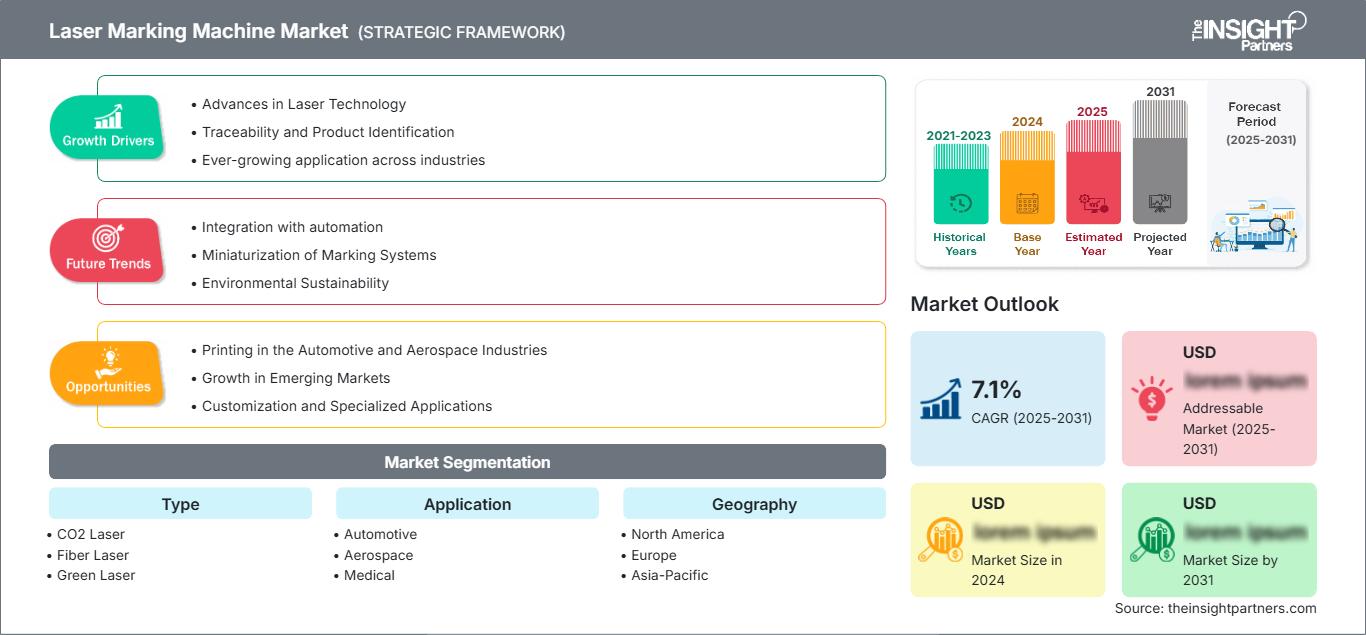
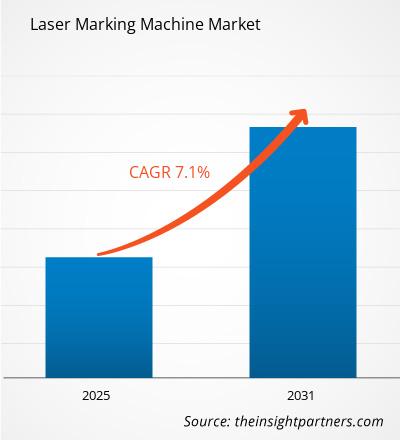
The global Laser Marking Machine market was valued at US$ 3.8 billion in 2025 and is expected to reach US$ 7.06 billion by 2034; it is estimated to record a CAGR of 7.13% during 2026-2034.
Laser Marking Machine Market Assessment and Insights
- North America: The region represented 25–29% Laser Marking Machine Market share in 2025 and is expected to grow at 8.6–9.2% CAGR during 2026–2034, supported by regulated traceability, production reshoring, and automated part identification.
- US: The country generated 78–82% of North American revenue in 2025 and is projected to record 8.7–9.3% CAGR through 2034.
- Europe: Europe held 22–26% in 2025 and should expand at 7.5–8.1% CAGR, led by Germany, the UK, France, Italy, and Spain.
- Asia Pacific: Asia Pacific accounted for 37–41% in 2025 and is forecast to grow at 8.8–9.4% CAGR, with China, Japan, South Korea, and India leading adoption.
- Largest Segment: Fiber laser captured 42–46% market share in 2025 and is expected to grow at 8.3–8.9% CAGR through 2034.
- High Growth Segment: Medical applications held 12–16% share in 2025 and are forecast to expand at 9.2–9.8% CAGR during 2026–2034.
- Key companies analyzed in detail: Epilog Corporation, Han's Laser Technology Industry Group Co., Ltd., LaserStar Technologies Corporation, Markolaser GmbH, MECCO Partners, LLC, Sahajanand Laser Technology Limited, Telesis Technologies, Inc., Trotec Laser GmbH, TYKMA Electrox, Inc., and Videojet Technologies, Inc.
Source: The Insight Partners' analysis based on proprietary research, government publications, company annual reports, investor presentations, industry databases, and expert interviews.
Laser marking advanced from stand-alone engraving machines to networked production assets, with programmable sources, galvo scanning, cameras, extraction and line-control software all included. Fiber machines established themselves in metal marking applications thanks to low-maintenance solid-state sources and production-rate Data Matrix coding. UV and green wavelengths expanded the range of substrates possible, due to reduced heat effects, with CO2 remaining important for paper, glass, films and organic substrates. Suppliers began offering integrated enclosures, rotary mechanisms, robotics and validation support along with the laser source itself.
According to Laser Marking Machine Market Forecast, future investments will be made in electronics and electric vehicle supply chain in Asia and reshoring efforts in North America and traceability efforts in Europe. The demand for permanent marking is expected to come from medical UDI and aerospace maintenance applications whereas increasing labor costs will make it necessary to have automatic loading and inspection systems. Customers will look for modular systems that can accommodate new substrates, codes, and production recipes without making a full system upgrade.
Laser Marking Machine Market Report Scope
| Report Attribute | Details |
|---|---|
| Market size in 2025 | US$ 3.8 Billion |
| Market Size by 2034 | US$ 7.06 Billion |
| Global CAGR (2026 - 2034) | 7.13% |
| Historical Data | 2021-2024 |
| Forecast period | 2026-2034 |
Laser Marking Machine Market Analysis
Requirements of permanent marking of automotive parts, reusable medical devices, aerospace parts and packaged goods create the demand for Laser Marking Machines. The demand is supported by a value chain consisting of laser suppliers, motion control suppliers, marking machine suppliers, distributors, exhaust suppliers, integrators and software providers. End-users analyze the complete value chain system and give greater priority to integration features and applications than to output watts.
The supply will be impacted by the wavelength and power class requirement. The Fiber Lasers have the advantage of low cost of ownership as well as the existing supply chain for industrial lasers, while UV and Green Lasers require additional optical components as well as better cooling features. The delivery time is also impacted by scanners, safety enclosure, cameras, automation components. The end-users manage risks by means of application test, sample marking, maintenance contract and dual sourcing of critical components such as windows and filters.
The analysis of the laser marking machine market shows competition between large-scale industrial systems and application-oriented systems. Han’s Laser Technology Industry Group Co., Ltd. and Sahajanand Laser Technology Limited concentrate on mass production and automation, while Epilog Corporation and Trotec Laser GmbH concentrate on flexible production environment. Videojet Technologies, Inc. has the competitive advantage thanks to its packaging line capability, while Telesis Technologies, Inc., TYKMA Electrox, Inc., MECCO Partners, LLC, LaserStar Technologies Corporation and Markolaser GmbH have competitive advantage thanks to their traceability applications.
Nowadays investments are being made in vision-assisted mounting, robotics, remote monitoring and recipe management. Strategic positioning becomes dependent on proving code readability, substrate robustness and uptime of the line in customer's environment. The vendors with application laboratories in the regions have an opportunity to shorten the qualification process, and software integration helps to obtain the recurring value via monitoring and support. The acquisition and partnership become the most valuable option for the regional integrators with relationships but no proprietary laser systems.
● REPORT CUSTOMIZATION
Tailor This Report To Align With Your Specific Business Requirements
This report can be customized to align precisely with your business objectives, scope, and target markets. Customization options include tailored segmentation, geography, competitive analysis, and strategic insights to support informed decision-making.
Customize This Report →WHAT YOU CAN ADJUST
- ● Segmentations
- ● Geography
- ● Competitive Analysis
- ● Language Preferences
Laser Marking Machine Market: Strategic Insights
Regional Insights
North America Laser Marking Machine Market
The Laser Marking Machine Market share in North America was 25–29% in 2025, with modeled CAGR of 8.6–9.2% through 2034. Adoption is prompted by traceability needs, return of premium manufacturing, and automation of mixed-model lines. Automotive parts suppliers have been adopting fiber laser systems for serializing their metal parts, while packagers deploy CO2 or UV laser technology together with vision inspection systems for marking permanent codes on high-speed lines. Medical devices makers remain one of the major validation-sensitive customers.
Procurement trends turn into bias towards enclosed systems, small heads for marking, and software for manufacturing execution systems. The significant existing installed base in the area creates retrofitting needs for camera systems, extraction, and controls apart from new machines. Aerospace and medical industries in Canada are complemented by automotive and electronics manufacturing clusters of Mexico to create adoption on the other side of the border. Fast support, documentation of certifications, and testing of applications can prove more important than machine costs due to production lines and legibility of codes.
U.S. Laser Marking Machine Market
The US represented 78–82% of North American revenue in 2025 and is expected to advance at 8.7–9.3% CAGR. The demand is wide-ranging, from automobile manufacturers, aerospace suppliers, medical-device makers, contract packagers, and electronics assembly. The FDA mandate on permanent UDI marking for qualifying reusable, reprocessed devices requires traceability and material compatibility to be the major purchasing considerations. Fiber lasers have come to rule metallic serialization, while UV light sources are becoming more significant for heat-sensitive plastics and recyclable packaging designs.
Local representation by Epilog Corporation, LaserStar Technologies Corporation, MECCO Partners, LLC, Telesis Technologies, Inc., TYKMA Electrox, Inc., and Videojet Technologies, Inc. provides additional strength in applications expertise and retrofit solutions. The end-users prefer solutions which can transfer serial information to enterprise databases and check markings instantly. Aerospace maintenance has been found to support durable part identification: some industry facts suggest limited new-aircraft production and increased maintenance operations.
Europe Laser Marking Machine Market
Europe accounted for 22–26% of 2025 revenue and is forecast to expand at 7.5–8.1% CAGR. Germany excels in machinery, automotive, electronics, and medical products manufacturing, and the UK offers aerospace, life science, and specialized engineering solutions. The German automation environment enables the implementation of integrated laser marking cells, and flexible systems along with service capabilities are highly valued by UK end users in the selection process for smaller runs with premium products. France unites aerospace, cosmetics packaging, and medical devices applications; Italy's machinery and luxury goods manufacturing enable high-precision engraving and serialization, while Spain adds automotive and food packaging needs to the list.
In all the above-mentioned countries, the adoption of the technology depends on circular packaging design, product passports, and plant digitalization initiatives. Proximity to the customer is valuable for Trotec Laser GmbH and integrators specializing in the above applications, yet the suppliers should deal with different languages and standards and varying purchasing cycles.
APAC Laser Marking Machine Market
Asia Pacific held 37–41% in 2025 and is projected to grow at 8.8–9.4% CAGR. China excels in equipment manufacturing, electronics, batteries, and automotives; Japan and South Korea provide high-precision components and semiconductors; India is scaling up industrial automation; and Australia has a niche in mining, medical, and fabrication sectors.
Policy of industrial support for domestic electronics, EVs, and advanced manufacturing speeds up implementation. Customers vary from export-driven factories needing codes to small workshops using smaller systems. Pricing advantages drive volumes, whereas premium applications are in micron-sized marks, vision integration, and multi-location software management.
Middle East & Africa Laser Marking Machine Market
Middle East and Africa is modeled to expand at 6.8–7.4% CAGR. Saudi Arabia leads through industrial localisation, energy equipment, and packaging investment; the UAE supports logistics, aerospace maintenance, and diversified manufacturing; South Africa contributes automotive, medical, and general engineering demand.
Projects favour robust systems suited to dust, heat, and distributed service conditions. Rest-of-region demand is selective and often integrator-led. Energy infrastructure creates applications for permanent asset identification, while expanding packaged-goods production supports CO2 and UV installations where consumable reduction and code permanence justify investment.
Segmentation Analysis
Type
The type segment is projected to expand at 7.8–8.4% CAGR during 2026–2034. Laser Marking Machine Market scope across source technologies is determined by wavelength, substrate absorption, cycle time, thermal tolerance, and required contrast. Fiber systems lead metal applications, CO2 addresses organic and packaging materials, and shorter-wavelength UV and green sources extend precision processing. YAG remains relevant in installed systems and specialised industrial environments where proven processes outweigh platform modernisation.
- CO2 Laser: CO2 systems retain strategic importance in paper, cardboard, glass, wood, coatings, and selected plastics, especially where broad marking fields and high-speed packaging-line integration determine productivity.
- Fiber Laser: Fiber lasers hold 42–46% share in 2025 and combine fine beam quality, efficient metal absorption, limited maintenance, and compact heads for automotive, tools, electronics, and serialized components.
- Green Laser: Green wavelengths support reflective metals, electronic components, and sensitive materials where improved absorption or reduced heat input enables cleaner marks than conventional infrared processing.
- UV Laser: UV platforms serve medical polymers, films, cosmetics, pharmaceuticals, and recyclable packaging by creating high-contrast codes with limited thermal damage, although source cost and optical complexity remain higher.
- YAG Laser: YAG equipment maintains demand in established metal-marking workflows, repair environments, and facilities with validated legacy recipes, but faces replacement pressure from efficient fiber sources.
Application
The application segment is forecast to grow at 8.0–8.6% CAGR during 2026–2034. Selection depends on mark permanence, regulatory exposure, production speed, component value, and substrate risk. Automotive remains volume-intensive, aerospace and medical demand validation, and packaging prioritises high-speed variable coding. Medical applications represent the high-growth segment at 9.2–9.8% CAGR with 12–16% share in 2025, reflecting direct-part identification and stringent readability requirements.
- Automotive: Automotive suppliers require permanent codes on powertrain, battery, chassis, and safety components. Integration with robotic handling and plant databases makes fiber marking a core traceability investment.
- Aerospace: Aerospace demand centres on durable, legible identification for high-value components and maintenance records, with process qualification and avoidance of material damage taking priority over maximum throughput.
- Medical: Medical-device producers value corrosion-resistant, sterilisation-tolerant UDI marks on reusable instruments and implants, supporting UV, ultrafine fiber, and validated vision inspection workflows.
- Packaging: Packaging applications use CO2, fiber, and UV systems for lot, date, barcode, and promotional coding, reducing consumables while addressing films, cartons, bottles, and metal containers.
Opportunity Snapshot
| Application | Revenue Contribution | Trend Tag | Adoption Stage |
| Automotive | High | Battery Traceability | Mature |
| Aerospace | Medium | Part Serialization | Scaling |
| Medical | Medium | UDI Compliance | Scaling |
| Packaging | High | Dynamic Coding | Mature |
| Others | Low | Flexible Engraving | Emerging |
Laser Marking Machine Market Growth Drivers and Impact Analysis
Persistent Traceability and Compliance Requirements
There is a growing demand for readable labels from industries that are under strict regulations and those where safety is of utmost importance. According to 21 CFR 801.45, a device which needs to be reprocessed prior to being put to use should bear a permanent label in its UDI. Likewise, in the automobile and aviation industry, it becomes necessary to have a link between parts and their batch number, suppliers, and inspection information. Lasers overcome this challenge without having to use any labeling that can get easily lost or any ink that may wear away. Commercially speaking, the scope of use of lasers is not limited to machine sale but also includes testing, qualifying, verification, database incorporation, and maintenance.
Automation of High-Mix Manufacturing Lines
Instead of stand-alone marking machines, companies are now using marking stations that are interconnected with robots, cameras, programmable controllers and manufacturing execution systems. The benefit of using such a system is that the machine can automatically detect the part, choose the recipe, give it a serial number, inspect the markings, and reject the component without requiring any input from the operator. Using such a system is particularly beneficial in a situation where there are many different components in the high-mix production because mistakes during changeover can result in waste and traceability issues. Laser marking systems become more compact and flexible, and therefore can easily be fitted into small plants.
Expansion of Advanced Materials and Electrified Products
The use of electric cars, batteries, power electronics, medical polymers, and light-weighted assemblies for aerospace is leading to the introduction of substrates which need careful management of energy. Fiber lasers can be used to label metals which have been used in manufacturing cells, housing, connectors, and busbars, while UV and green wavelengths can be used on heat-sensitive plastics, reflective substrates, coated films, and miniaturized electronics. With increasingly dense product designs, labels have to fit in small areas without affecting legibility. The change in materials creates new opportunities for companies with wide-wavelength capability and laboratories that can establish processing windows for new materials. This results in increased revenue generation through capacity additions as well as replacement of existing technology.
Laser Marking Machine Market Future Trends
Closed-Loop Vision and Adaptive Process Control
Trends in Laser Marking Machine Markets would change from post-marking inspection to closed-loop marking cells. A camera system would be able to determine the orientation of the part, alignment of artwork, quality grade of code, and trigger parameter changes or part rejection. Machine learning might play a role in anomaly detection, though the use would depend on explainable controls and defined thresholds in regulated markets. In terms of commercial success, the market would reward vendors who could deliver optics, software, data management and services together, and not just provide a light source.
Wavelength Diversification for Sustainable Packaging
The Laser Marking Machine Market trends show that packaging redesign toward mono-material structures and reduced inks will increase demand for wavelengths that create contrast without weakening thin films or containers. UV systems can mark sensitive polymers, while CO2 remains efficient for cartons, labels, and selected flexible materials. Future platforms will combine wider processing windows with automated focus adjustment to accommodate curved surfaces and frequent product changeovers. Suppliers will need substrate databases developed jointly with resin, film, and packaging-converting partners. Successful solutions will prove both readability and recyclability compatibility, allowing brand owners to reduce coding consumables while maintaining line speed and regulatory information.
Laser Marking Machine Market Opportunities
Application Laboratories for Mid-Market Manufacturers
Many mid-sized manufacturers understand the traceability case but lack internal laser expertise. Vendors can convert this gap into growth by operating regional application laboratories that test customer parts, select wavelengths, optimise recipes, and produce validation evidence before purchase. A packaged offer combining sample marking, fixture design, extraction assessment, operator training, and financing can shorten decision cycles. The strongest targets are contract manufacturers serving medical, automotive, and electronics customers, because one flexible system can support multiple programs. Suppliers should measure conversion rates from sample requests to equipment orders and attach service agreements that preserve parameters when substrates, coatings, or production volumes change.
Retrofit Software and Vision for the Installed Base
The installed base creates an opportunity beyond new-machine sales. Many lasers remain mechanically serviceable but lack modern cameras, secure recipe handling, network connectivity, or code verification. Suppliers and integrators can offer staged retrofit packages that add these capabilities without disrupting validated laser processes. Priority accounts include multi-plant manufacturers seeking common reporting and remote support across mixed equipment fleets. Commercial models may combine hardware upgrades with annual software, calibration, and cybersecurity services. Success requires open interfaces and disciplined qualification, because poorly executed retrofits can compromise safety or compliance. Vendors should start with repeatable kits for high-volume platforms and expand through certified integration partners.
Recent Developments
- September 2025: Videojet Technologies, Inc. presented the 7920 UV, 3350 CO2, and 7440 fiber laser systems at PACK EXPO Las Vegas, demonstrating permanent 2D coding on curved metal, heat-sensitive plastic, flexible packaging, and tight production layouts through multiple OEM integrations.
- June 2026: Americhem has launched a new Laser Marking Solutions platform designed to help manufacturers produce durable, high-contrast and machine-readable markings directly on polymer components. The new portfolio combines masterbatches and engineered compounds developed to improve the interaction between polymer materials and laser marking systems. The technology is aimed at industries where permanent identification, traceability and regulatory compliance are becoming increasingly important.
- December 2024: Videojet Technologies, Inc. introduced the 7920 UV laser marking system with SmartFocus, multi-level surface marking, automatic focal adjustment, compact beam delivery, remote service, and a five-year source warranty. The system targets consumer goods, parts marking, pharmaceuticals, and mono-material packaging.
Frequently Asked Questions

- Comprehensive Market Sizing and Forecast Analysis
- Detailed Segmentation Analysis
- In-Depth Market Dynamics Assessment
- Regional and Country-Level Insights
- Competitive Landscape and Company Benchmarking
- Strategic Business Intelligence
Recent Reports
Testimonials

The Insight Partners provided valuable market intelligence that supported our global go-to-market strategy. Their team was professional, responsive, and attentive to our feedback, providing thoughtful analysis and helpful methodological clarifications throughout the project.
Junmo Kim Chief Financial Officer (CFO), Enertech Co., Ltd.
The Insight Partners' SCADA System Market report is comprehensive, with valuable insights on current trends and future forecasts. The team was highly professional, responsive, and supportive throughout. We are very satisfied and highly recommend their services.
RAN KEDEM Partner, Reali Technologies LTDs
I requested a report on a very specific software market and the team produced the report in a few days. The information was very relevant and well presented. I then requested some changes and additions to the report. The team was again very responsive and I got the final report in less than a week.
JEAN-HERVE JENN Chairman, Future Analytica
We worked with The Insight Partners for an important market study and forecast. They gave us clear insights into opportunities and risks, which helped shape our plans. Their research was easy to use and based on solid data. It helped us make smart, confident decisions. We highly recommend them.
PIYUSH NAGPAL Sr. Vice President, High Beam Global
The Insight Partners delivered insightful, well-structured market research with strong domain expertise. Their team was professional and responsive throughout. The user-friendly website made accessing industry reports seamless. We highly recommend them for reliable, high-quality research services
YUKIHIKO ADACHI CEO, Deep Blue, LLC.
This is the first time I have purchased a market report from The Insight Partners.While I was unsure at first, I visited their web site and felt more comfortable to take the risk and purchase a market report.I am completely satisfied with the quality of the report and customer service. I had several questions and comments with the initial report, but after a couple of dialogs over email with their analyst I believe I have a report that I can use as input to our strategic planning process.Thank you so much for taking the extra time and making this a positive experience.I will definitely recommend your service to others and you will be my first call when we need further market data.
JOHN SUZUKI President and Chief Executive Officer, Board Director, BK Technologies
I wish to appreciate your support and the professionalism you displayed in the course of attending to my request for information regarding to infectious disease IVD market in Nigeria. I appreciate your patience, your guidance, and the fact that you were willing to offer a discount, which eventually made it possible for us to close a deal. I look forward to engaging The Insight Partners in the future, all thanks to the impression you have created in me as a result of this first encounter.
DR CHIJIOKE ONYIA MANAGING DIRECTOR, PineCrest Healthcare Ltd.Reason to Buy
- Informed Decision-Making
- Understanding Market Dynamics
- Competitive Analysis
- Identifying Emerging Markets
- Customer Insights
- Market Forecasts
- Risk Mitigation
- Boosting Operational Efficiency
- Strategic Planning
- Investment Justification
- Tracking Industry Innovations
- Aligning with Regulatory Trends





 Get Free Sample for