
Lead Type Capacitors Market Demand, Size & Forecast by 2034
Coverage: By Type (Aluminum Electrolytic Capacitors, Ceramic Capacitors, Others); Application (Consumer Electronics, Automotive, Industrial Machinery, Defence, Others) , and Geography (North America, Europe, Asia Pacific, and South and Central America)
- Status : Data Released
- Report Code : TIPRE00018385
- Category : Electronics and Semiconductor
- No. of Pages : 150
- Available Report Formats :


- Last update date : September 28, 2026


2025 Market Size
US$ 667.5 Mn
Base year value
2034 Forecast
US$ 1,047.33 Mn
Projected by 2034
CAGR 2026-2034
5.13 %
Growth rate
Addressable Market
US$ 7,779.36 Mn
(2026-2034)
Lead Type Capacitors Market is valued at US$ 667.5 Million in 2025 and is projected to reach US$ 1,047.33 Million by 2034, expanding at a CAGR of 5.13% during 2026–2034. Demand is shaped by the continuing need for compact, reliable capacitance in electronic assemblies, particularly where board-space constraints, thermal exposure, ripple-current handling, and long operating life influence component selection across automotive, industrial, consumer, and defense applications.
North America presents a structurally attractive environment, with the Lead Type Capacitors Market size supported by automotive electrification, data-center power infrastructure, industrial automation, and defense electronics. Its estimated CAGR of 5.4–6.1% through 2034 reflects replacement demand and increasing requirements for high-temperature, high-reliability components. Domestic manufacturing initiatives and resilient electronics supply chains further support localized component qualification and procurement.
Lead Type Capacitors Market Assessment and Insights
- North America: North America is expected to hold a 22–26% share in 2025 and grow at a CAGR of 5.4–6.1% between 2026–2034, supported by automotive electronics, industrial controls, defense systems, and localized electronics production.
- US: The US accounts for 72–76% of North America's 2025 demand, with a 15–18% global share of 2025 revenue and a CAGR of 5.5–6.2% during 2026–2034.
- Europe: Europe is estimated at a 19–23% share in 2025, growing at 4.8–5.6% CAGR through 2034, with Germany, France, Italy, and the UK benefiting from automotive electronics and industrial equipment demand.
- Asia Pacific: Asia Pacific represents a 43–48% share in 2025 and is projected to expand at a 5.6–6.5% CAGR, led by China, Japan, South Korea, Taiwan, and India through dense electronics manufacturing ecosystems.
- Largest Segment: Ceramic Capacitors represent a 54–59% market share in 2025, supported by miniaturization requirements and broad circuit applications, with a 5.4–6.1% CAGR through 2034.
- High Growth Segment: Automotive is the high-growth application, representing a 24–28% market share in 2025 and expanding at a 6.1–7.0% CAGR as vehicle electronics increase.
- Key companies analyzed in detail: 600 Group PLC, Coherent Corp., Epilog Laser, Gravotech Marking, Han's Laser Technology Industry Group Co., Ltd., Jenoptik AG, LaserStar Technologies Corporation, MECCO Inc., Novanta Inc., TRUMPF GmbH + Co. KG, Dongguan Win Shine Electronic Co., Ltd., Jiangxi Liansheng Electronic Co., Ltd., Lelon Electronics Corp., Murata Manufacturing Co., Ltd., NICHICON CORPORATION, Nippon Chemi-Con Corporation, Panasonic Corporation, Rubycon Corporation, SMK China, Taiwan Chinsan Electronic Group.
Source: The Insight Partners' analysis based on proprietary research, government publications, company annual reports, investor presentations, industry databases, and expert interviews.
The Lead Type Capacitors Market has progressed from traditional through-hole capacitors to smaller units with better capacitance density, less equivalent series resistance, greater endurance capability, and enhanced environmental reliability. Traditional aluminum electrolytic units continue to be significant for bulk energy storage and ripple current suppression, while ceramic technologies benefit from small sizes and consistent performance at high frequencies. The manufacturing of capacitors has seen greater emphasis on automation of winding, electrodes, dielectrics, inspection, and electrical tolerance.
Future developments will see a strong connection between component design and vehicle electrification, power conversion, communications, and computing technologies. Priorities will shift toward temperature resistant materials, automated testing, localization of manufacturing, and qualification according to application. Regulations related to electrical safety, material content, and traceability will increase the supplier discipline, while growth of the electronics manufacturing base in Asia and North America will provide opportunities for specialty component manufacturers.
Lead Type Capacitors Market Report Scope
| Report Attribute | Details |
|---|---|
| Market size in 2025 | US$ 667.5 Million |
| Market Size by 2034 | US$ 1,047.33 Million |
| Global CAGR (2026 - 2034) | 5.13% |
| Historical Data | 2021-2024 |
| Forecast period | 2026-2034 |
Lead Type Capacitors Market Analysis
Demand growth has been strongly linked to the expansion of Lead Type Capacitors Market in terms of power supply, motor control, automotive electronic control unit, consumer applications, and industrial equipment. The industry value chain includes dielectric and foil makers, capacitors makers, lead and terminals makers, distributors, contract manufacturers, original equipment manufacturers, and test labs. Automotive and industrial customers have longer qualification processes, resulting in switching costs when a component becomes qualified.
The supply situation is contingent upon aluminum foils, ceramic dielectric materials, conductive materials, electrolytes, terminals, resin systems, and packaging materials. Companies must, therefore, compete not only on electrical properties but also on availability of materials. Asia Pacific continues to be the main manufacturing base due to its integration in electronics supply chain, whereas North American and European customers are increasingly focusing on dual sourcing and regional qualification of alternatives.
Lead Type Capacitors Market Report reveals that there is an apparent differentiation among the competition that ranges from volume players, component makers, and diversified electronics companies. Murata Manufacturing Co., Ltd., NICHICON CORPORATION, Nippon Chemi-Con Corporation, Panasonic Corporation, Rubycon Corporation, Lelon Electronics Corp., and Taiwan Chinsan Electronic Group compete through product variety, manufacturing capabilities, engineering support, and reliability. The smaller companies usually focus on particular capacitor value, package type, temperature range, or customer need.
Investment strategies in the industry are increasingly geared towards increased capacitance density, small package sizes, automotive applications, and automation in manufacturing process. Panasonic is investing in high temperature aluminum and polymer technologies, whereas Murata continues to innovate in ceramic miniaturization and automotive reliability. On the other hand, Rubycon focuses on high ripple aluminum and polymer products. The competitive environment therefore suggests a strategy focused on material innovation, manufacturing capability, qualification services, and delivery reliability.
● REPORT CUSTOMIZATION
Tailor This Report To Align With Your Specific Business Requirements
This report can be customized to align precisely with your business objectives, scope, and target markets. Customization options include tailored segmentation, geography, competitive analysis, and strategic insights to support informed decision-making.
Customize This Report →WHAT YOU CAN ADJUST
- ● Segmentations
- ● Geography
- ● Competitive Analysis
- ● Language Preferences
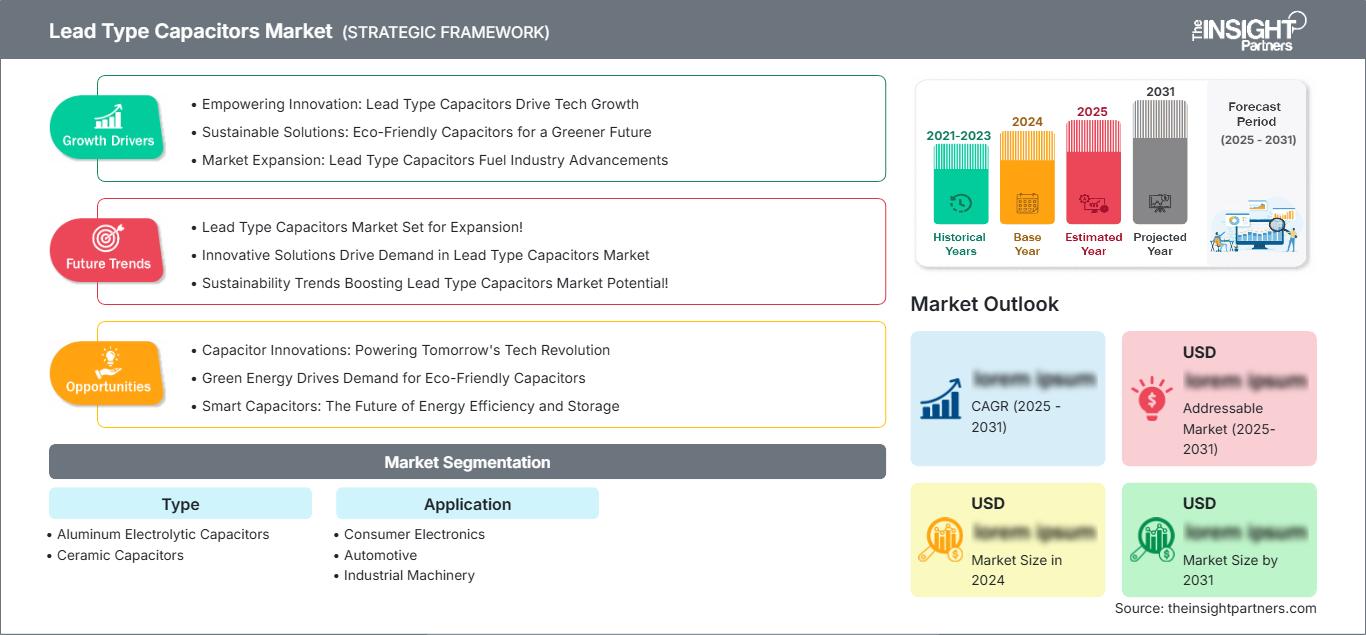
Lead Type Capacitors Market: Strategic Insights
Regional Insights
North America Lead Type Capacitors Market
North America, expected to capture 22-26% of Lead Type Capacitors Market Share by 2025, has demands that originate from US and are backed up by Canada and Mexico. CAGR growth rate in the region is estimated at 5.4-6.1% till 2034. Diversified demands are provided by the following sectors: automotive electronics, aerospace applications, industrial automation, medical devices, and power infrastructure of data centers. Reshoring and supply chain resilience programs contribute to the development of supplier relations and qualification of various suppliers.
Buyers in the US have demands that constitute 72-76% of regional demands; Mexico supplies automotive and electronic assemblies. More and more demands include extended temperature operation, impedance control, high endurance, and miniature size. Demands of defense customers create strong demands for high reliability, and industrial investments create recurring demands for power conversion and control equipment. The procurement environment in the region supports manufacturers who can prove their quality systems and applications engineering, reliable logistics and qualification.
U.S. Lead Type Capacitors Market
The US comprises 72–76% of the total North America's Lead Type Capacitors Market of 2025, estimated to record 5.5-6.2% CAGR up to 2034. The demand pattern is scattered among automotive, aerospace, defense, industrial machinery, medical electronics, communications, and computing systems. The local system makers assess the component availability in addition to its electrical performance capability, which becomes highly significant for some critical assemblies.
Murata Manufacturing Co., Ltd., Panasonic Corporation, NICHICON CORPORATION, Nippon Chemi-Con Corporation, and Rubycon Corporation have a range of products catering to their customers in US electronics market. The applications for power stabilization, filtering, energy buffering, and noise suppression are essential. The needs from the automotive electrification include smaller and temperature resistant components, and industrial automation provides robust through-hole and leaded devices. The qualification discipline stays comparatively high for some safety-sensitive or long-lived components.
Europe Lead Type Capacitors Market
Europe is estimated to hold a 19–23% share of the Lead Type Capacitors Market in 2025 and is expected to expand at a 4.8–5.6% CAGR through 2034. Germany is the leading country, followed by the UK, France, Italy, and Spain. Automotive engineering, industrial automation, energy systems, and electronics manufacturing provide the principal demand base.
There are advantages for the UK market in relation to aerospace, defense, industrial controls, and electronic components manufacturing. Germany has the greatest automotive and industrial equipment exposure and generates constant demand for quality parts. France enjoys support in terms of aerospace, transportation, energy, and defense electronics. Italy and Spain provide additional demand with machinery, automotive parts, renewable energy equipment, and consumer electronics manufacturing. Europeans buyers give more importance to traceability, environment regulations, long-term performance, and secure supply chain.
APAC Lead Type Capacitors Market
APAC represents 43–48% of the Lead Type Capacitors Market in 2025 and is expected to expand at a 5.6–6.5% CAGR. China is the leading country, with Japan, South Korea, India, and Australia contributing through electronics, automotive, industrial, and infrastructure applications.
Advantageous to China are its extensive manufacturing capabilities in electronics, to Japan are its advanced parts manufacturing and automotive systems, to South Korea are its electronics and mobility, to India is its growing manufacturing capabilities, and to Australia is its industrial infrastructure. Electronics localization and electric mobility are supported through regional policies, which will strengthen demand further.
Middle East & Africa Lead Type Capacitors Market
However, the demands of Middle East and Africa are smaller but more diversified with Saudi Arabia and UAE being key investors in the Gulf region and South Africa being a key industrial player in Africa. The region is expected to grow at a CAGR of 4.2%-5.0% until 2034 due to improvements in power infrastructure and industrialization.
The industrial diversification of Saudi Arabia and logistics, energy, and advanced infrastructure in UAE help the regions in demand growth. South Africa promotes mining, manufacturing, and power generation. The remaining MEA market is driven by telecommunications, utilities, transportation, and industrial equipment. Energy transition and infrastructure development offer chances for the use of capacitors in power conversion and equipment stabilization.
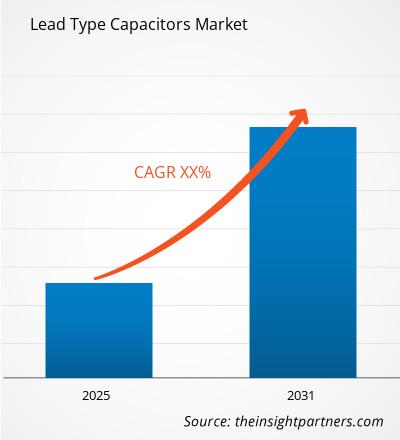
Segmentation Analysis
Type
Type segmentation distinguishes Aluminum Electrolytic Capacitors and Ceramic Capacitors according to electrical behavior, capacitance density, frequency response, temperature tolerance, and application requirements. Ceramic Capacitors retain a broad design advantage in compact electronic circuits, while aluminum electrolytic devices remain important where higher capacitance and ripple-current handling are required. The Type segment is estimated to grow at a 5.2–6.0% CAGR during 2026–2034. The Lead Type Capacitors Market scope increasingly reflects application-specific trade-offs between size, endurance, voltage, and cost.
- Aluminum Electrolytic Capacitors: These devices remain important for power-supply filtering, energy buffering, and ripple-current management. Demand is strongest where comparatively high capacitance, controlled cost, and established manufacturing processes outweigh ultra-miniaturization.
- Ceramic Capacitors: Ceramic designs support compact assemblies, high-frequency filtering, and demanding automotive electronics. Their strong dimensional efficiency makes them strategically important as electronic control functions become more densely integrated.
Application
Application segmentation covers Consumer Electronics, Automotive, Industrial Machinery, and Defence, reflecting differences in reliability, qualification, operating environment, and purchasing cycles. Automotive and defense customers generally require tighter validation, while consumer electronics emphasizes cost, volume, and compactness. Industrial applications balance endurance and reliability with total equipment cost. Application demand is estimated to expand at a 5.5–6.3% CAGR during 2026–2034 as electronics penetration increases across mechanical and electrical systems.
- Consumer Electronics: Portable devices, household electronics, computing equipment, and power adapters require compact capacitance and dependable filtering, with purchasing decisions strongly influenced by component footprint, availability, and manufacturing economics.
- Automotive: Vehicle electronics require components capable of handling vibration, temperature variation, electrical transients, and long service periods. Electrification and advanced electronic functions increase the importance of application-qualified capacitor designs.
- Industrial Machinery: Factory automation, drives, controls, instrumentation, and power supplies create recurring demand for robust components that support equipment uptime, electrical filtering, and predictable maintenance requirements.
- Defence: Defense electronics prioritize environmental robustness, traceability, long operational life, and stringent qualification. Procurement cycles can be lengthy, but approved components may remain embedded in platforms for extended production and service periods.
Opportunity Snapshot
| Application | Revenue Contribution | Trend Tag | Adoption Stage |
|---|---|---|---|
| Consumer Electronics | High | Miniaturized Power | Mature |
| Automotive | High | Vehicle Electrification | Scaling |
| Industrial Machinery | Medium | Smart Automation | Scaling |
| Defence | Medium | Mission Electronics | Mature |
Lead Type Capacitors Market Growth Drivers and Impact Analysis
Vehicle Electrification and Rising Electronic Content
With the growth of electrification comes an expansion in the amount of control, sensing, communications, and safety circuits contained within cars. According to the International Energy Agency, there were more than 20 million electric car sales in 2025 where electric cars comprised one quarter of all new car sales. The impact of this structure change means that the total addressable market need for capacitors shrinks less and less as smaller and smaller and more reliable devices become necessary for power conversion and control modules. Those companies able to qualify components in automotive applications have a clear path towards value-added capacitor designs and long-term relationships with customers.
Miniaturization of Power and Control Electronics
The trend toward the incorporation of increased levels of functionality within limited space on the board makes the value of smaller and more effective capacitors with high capacitance and consistent electrical properties even more important. The above-mentioned need becomes quite evident in automotive control modules, industrial control units, communication equipment, and consumer electronics. Smaller components allow for shrinking board sizes, optimizing thermal designs, and increasing functional density; however, miniaturization makes these parts more vulnerable to issues related to the dielectric performance, temperature, vibrations, and production variation. As a result, there is the need for suppliers to improve their materials' formulae and electrode efficiency, while keeping the process yield acceptable. The business aspect here is a shift towards differentiated products instead of pure commoditization of purchases.
Industrial Automation and Infrastructure Modernization
Factory automation, power electronics, transportation systems, communications infrastructure, and distributed energy equipment require capacitors for filtering, voltage stabilization, control circuits, and energy buffering. As industrial assets become more electronically controlled, component reliability increasingly affects equipment availability and maintenance costs. This favors capacitors with predictable lifetime characteristics and consistent electrical performance across operating conditions. Infrastructure modernization also creates demand beyond traditional machinery because power conversion equipment is increasingly deployed in charging systems, energy management, and digital infrastructure. For suppliers, the market impact is a broader customer base with varying qualification requirements. Industrial buyers often prioritize lifecycle reliability, technical documentation, and replacement availability, creating opportunities for manufacturers that maintain long-running product families and provide engineering support throughout equipment development, production, and aftermarket servicing.
Lead Type Capacitors Market Future Trends
Application-Specific High-Reliability Architectures
Future Lead Type Capacitors Market trends will increasingly center on application-specific component architectures rather than universal product families. Automotive, defense, industrial, and high-performance computing customers will seek combinations of capacitance, voltage, temperature endurance, vibration resistance, and footprint tailored to particular circuit environments. Digital simulation and accelerated reliability testing should shorten development cycles while increasing confidence in component behavior. Manufacturers are likely to maintain broader variant libraries around common platforms, allowing engineers to select optimized electrical characteristics without redesigning surrounding assemblies. Procurement teams may also evaluate component lifecycle commitments earlier during platform development, particularly for products expected to remain in production for many years. This approach can increase design-in value for suppliers while raising technical barriers to entry for manufacturers without strong application engineering capabilities.
Integrated Qualification and Traceability Systems
Digital quality systems are likely to become more deeply integrated with component manufacturing, qualification, logistics, and customer documentation. Automated inspection, production data capture, statistical process monitoring, and serialized traceability can improve consistency while helping manufacturers identify process deviations earlier. Customers in regulated or safety-sensitive industries may increasingly request digital certificates, material information, production histories, and standardized reliability evidence. This development could shift supplier evaluation away from price and toward measurable process capability. It may also support predictive maintenance by linking component specifications with equipment operating conditions and replacement records. Manufacturers investing in connected quality infrastructure can improve yield, accelerate customer approvals, and manage geographically distributed production more effectively. Over time, traceability may become a routine procurement requirement for strategically important electronic components.
Lead Type Capacitors Market Opportunities
Localized Production and Dual-Sourcing Programs
Manufacturers and distributors can pursue opportunities created by customers seeking more resilient component supply chains. Establishing regional inventory, qualifying secondary manufacturing sources, and developing standardized cross-reference products can reduce exposure to transportation disruptions and production concentration. The opportunity is particularly relevant for automotive and industrial customers whose qualification processes make sudden supplier replacement difficult. Lead Type Capacitors Market Forecasts indicate that suppliers combining local technical support with stable global production could strengthen their position with multinational buyers. Investments should prioritize products with established qualification pathways, repeat industrial demand, and manageable customization requirements. Partnerships with contract manufacturers and electronics distributors can further improve market access without requiring immediate construction of full-scale local production facilities, allowing suppliers to test demand before committing substantial capital.
High-Temperature and High-Reliability Component Platforms
A second opportunity lies in developing capacitor platforms for demanding environments where conventional components face limitations. Automotive power electronics, industrial drives, defense equipment, and infrastructure systems can require operation under elevated temperature, vibration, electrical stress, or long service intervals. Investment in improved dielectric materials, electrolyte stability, terminal structures, and automated inspection can create differentiated products with stronger qualification barriers. Suppliers should align development programs with customer design cycles rather than relying solely on catalog expansion. Collaboration with system manufacturers can reveal circuit-level requirements earlier and improve the probability of successful qualification. Products designed around shared mechanical dimensions and multiple electrical ratings could also simplify manufacturing while offering customers greater flexibility. Such platforms provide a route toward higher-value applications without depending exclusively on volume growth.
Recent Developments
- August 2026: Murata Manufacturing introduced a new 100Vdc/10μF lead-type multilayer ceramic capacitor (MLCC), claimed to be the world’s smallest in volume and height for its voltage and capacitance rating. Designed for emerging 48V power systems in automotive, consumer and industrial applications, the new RCE and RDE series devices double the rated voltage compared with Murata’s existing 50Vdc/10μF product while increasing maximum capacitance from 4.7μF to 10μF for its 100Vdc lead-type MLCCs.
- August 2026: Tema ETFs launched the Tema MLCC & PowerSemi ETF (PSOX), the first exchange-traded fund focused specifically on multi-layer ceramic capacitors (MLCCs) and power semiconductors, targeting companies positioned to benefit from rising power demands in AI infrastructure. The fund provides exposure to global suppliers across Japan, Taiwan and South Korea, with holdings including Murata Manufacturing, Taiyo Yuden
Frequently Asked Questions

- Comprehensive Market Sizing and Forecast Analysis
- Detailed Segmentation Analysis
- In-Depth Market Dynamics Assessment
- Regional and Country-Level Insights
- Competitive Landscape and Company Benchmarking
- Strategic Business Intelligence
Recent Reports
Testimonials

The Insight Partners provided valuable market intelligence that supported our global go-to-market strategy. Their team was professional, responsive, and attentive to our feedback, providing thoughtful analysis and helpful methodological clarifications throughout the project.
Junmo Kim Chief Financial Officer (CFO), Enertech Co., Ltd.
The Insight Partners' SCADA System Market report is comprehensive, with valuable insights on current trends and future forecasts. The team was highly professional, responsive, and supportive throughout. We are very satisfied and highly recommend their services.
RAN KEDEM Partner, Reali Technologies LTDs
I requested a report on a very specific software market and the team produced the report in a few days. The information was very relevant and well presented. I then requested some changes and additions to the report. The team was again very responsive and I got the final report in less than a week.
JEAN-HERVE JENN Chairman, Future Analytica
We worked with The Insight Partners for an important market study and forecast. They gave us clear insights into opportunities and risks, which helped shape our plans. Their research was easy to use and based on solid data. It helped us make smart, confident decisions. We highly recommend them.
PIYUSH NAGPAL Sr. Vice President, High Beam Global
The Insight Partners delivered insightful, well-structured market research with strong domain expertise. Their team was professional and responsive throughout. The user-friendly website made accessing industry reports seamless. We highly recommend them for reliable, high-quality research services
YUKIHIKO ADACHI CEO, Deep Blue, LLC.
This is the first time I have purchased a market report from The Insight Partners.While I was unsure at first, I visited their web site and felt more comfortable to take the risk and purchase a market report.I am completely satisfied with the quality of the report and customer service. I had several questions and comments with the initial report, but after a couple of dialogs over email with their analyst I believe I have a report that I can use as input to our strategic planning process.Thank you so much for taking the extra time and making this a positive experience.I will definitely recommend your service to others and you will be my first call when we need further market data.
JOHN SUZUKI President and Chief Executive Officer, Board Director, BK Technologies
I wish to appreciate your support and the professionalism you displayed in the course of attending to my request for information regarding to infectious disease IVD market in Nigeria. I appreciate your patience, your guidance, and the fact that you were willing to offer a discount, which eventually made it possible for us to close a deal. I look forward to engaging The Insight Partners in the future, all thanks to the impression you have created in me as a result of this first encounter.
DR CHIJIOKE ONYIA MANAGING DIRECTOR, PineCrest Healthcare Ltd.Reason to Buy
- Informed Decision-Making
- Understanding Market Dynamics
- Competitive Analysis
- Identifying Emerging Markets
- Customer Insights
- Market Forecasts
- Risk Mitigation
- Boosting Operational Efficiency
- Strategic Planning
- Investment Justification
- Tracking Industry Innovations
- Aligning with Regulatory Trends





 Get Free Sample for