
Man-Portable Communication Systems Market Demand, Trends & Forecast by 2034
Coverage: by Platform (Land, Airborne, Naval); Application (Software Defined Radios (SDR), SATCOM, Encryption, Smartphones, Homeland Security, Commercial) , and Geography (North America, Europe, Asia Pacific, and South and Central America)
- Status : Data Released
- Report Code : TIPRE00012235
- Category : Electronics and Semiconductor
- No. of Pages : 150
- Available Report Formats :


- Last update date : October 13, 2026


2025 Market Size
US$ 44.76 Bn
Base year value
2034 Forecast
US$ 52.48 Bn
Projected by 2034
CAGR 2026-2034
2.01 %
Growth rate
Addressable Market
US$ 445.57 Bn
(2026-2034)
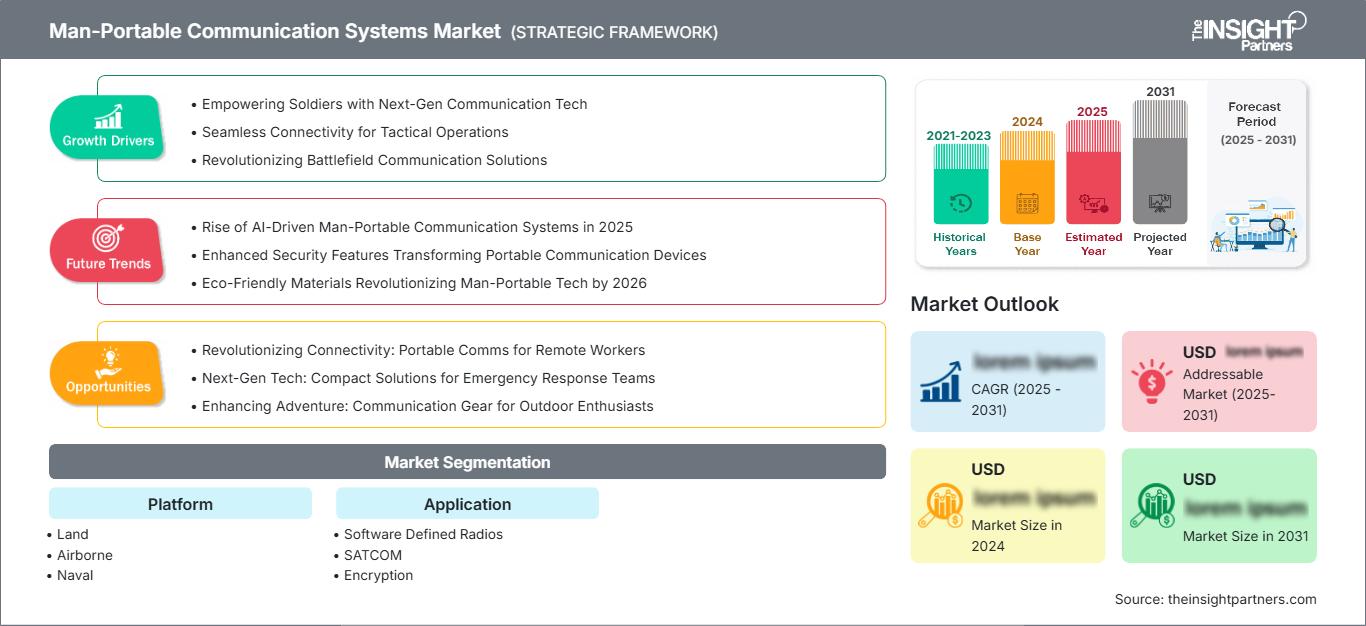
The Man-Portable Communication Systems Market is valued at US$ 44.76 Billion in 2025 and is projected to reach US$ 52.48 Billion by 2034, expanding at a CAGR of 2.01% during 2026–2034. The market reflects sustained demand for secure, resilient, and mobile communications across defense, homeland security, and commercial missions, with platform modernization increasingly emphasizing interoperability, software programmability, spectrum resilience, and reduced size, weight, and power requirements.
Man-Portable Communication Systems Market size in North America is supported by continued defense-network modernization, resilient tactical communications procurement, and rising requirements for interoperable command-and-control architectures. The regional outlook indicates a CAGR of approximately 2.20–2.60% through 2034, supported by investment in software-defined radios, protected SATCOM, encryption, and communications systems capable of operating under contested electromagnetic conditions.
Man-Portable Communication Systems Market Assessment and Insights
- North America: North America remains a leading regional market, supported by military modernization and resilient networking programs. Its 2025 share is estimated at 34–38%, with growth projected at a 2.20–2.60% CAGR between 2026–2034.
- US: The US represents the dominant North American market, supported by tactical-network modernization and procurement of resilient radios. Its 2025 share of North America is estimated at 78–82%, expanding at a 2.30–2.70% CAGR between 2026–2034.
- Europe: Europe benefits from NATO interoperability, sovereign communications programs, and defense digitization. Its 2025 share is estimated at 26–30%, growing at a 1.70–2.10% CAGR between 2026–2034, led by the UK, Germany, France, Italy, and Spain.
- Asia Pacific: Asia Pacific is supported by military modernization, border-security requirements, and indigenous defense manufacturing. The region represents an estimated 22–26% share in 2025 and is expected to grow at a 2.40–2.80% CAGR between 2026–2034, led by China, Japan, South Korea, and India.
- Largest Segment: Land platforms represent the largest segment, with an estimated 52–56% market share in 2025 and a 2.10–2.50% CAGR between 2026–2034, reflecting extensive soldier-level deployment.
- High Growth Segment: Software Defined Radios constitute the high-growth application segment, accounting for approximately 24–28% market share in 2025 and expanding at a 3.20–3.60% CAGR between 2026–2034.
- Key companies analyzed in detail: ASELSAN Elektronik Sanayi ve Ticaret A.Ş.; BAE Systems plc; Cobham Limited; Codan Limited; L3Harris Technologies, Inc.; Leonardo S.p.a.; RTX Corporation; Saab AB; Thales S.A.; Viasat, Inc.; Rohde & Schwarz GmbH & Co. KG; Elbit Systems Ltd.
Source: The Insight Partners' analysis based on proprietary research, government publications, company annual reports, investor presentations, industry databases, and expert interviews.
The evolution of Man-Portable Communication Systems Market has shifted from voice-centric portable radios toward software-defined, multi-band, network-enabled architectures supporting voice, data, video, and situational awareness. Modern systems increasingly integrate MANET capabilities, cryptographic modules, SATCOM interfaces, and programmable waveforms. Production dynamics have also changed as defense suppliers prioritize modular architectures, commercial semiconductor availability, miniaturized RF components, and software upgrades that extend equipment life without requiring complete hardware replacement.
Future expansion of the Man-Portable Communication Systems Market share is expected to involve emerging defense markets across Asia Pacific, Eastern Europe, and the Middle East, where force modernization and indigenous production policies are strengthening procurement pipelines. Regulatory and alliance requirements are also encouraging interoperability with NATO and other multinational communication standards. Investment is increasingly directed toward anti-jam capability, resilient satellite links, cybersecurity, electromagnetic-spectrum management, and architectures that can connect dismounted personnel with airborne, naval, and land-based command networks.
Man-Portable Communication Systems Market Report Scope
| Report Attribute | Details |
|---|---|
| Market size in 2025 | US$ 44.76 Billion |
| Market Size by 2034 | US$ 52.48 Billion |
| Global CAGR (2026 - 2034) | 2.01% |
| Historical Data | 2021-2024 |
| Forecast period | 2026-2034 |
Man-Portable Communication Systems Market Analysis
Man-Portable Communication Systems Market growth is driven by military forces seeking communications that remain functional during electronic warfare, infrastructure disruption, and rapidly changing operational conditions. It includes RF semiconductor companies, antenna and battery makers, radio producers, cryptographers, satellite companies, software developers, system integrators, and defense departments. Hence, demand is driven not only by equipment replacement cycles but also by command-and-control modernization efforts.
In terms of supplies, vendors increasingly compete based on their SWaP capabilities, interoperability, cybersecurity features, flexibility of waveforms, and lifecycle services. The procurement cycle remains affected by qualification, encryption certification, sovereign security needs, and the integration of new products into existing systems. Such an environment allows for the success of vendors that offer modular architecture, while the shortage of components and defense-grade electronics increases costs and delays.
Man-Portable Communication Systems Market analysis indicates a competitive structure combining diversified defense contractors with specialist communications companies. Integrated tactical networks, secure radios, and mission systems are L3Harris Technologies, BAE Systems, Thales S.A., Saab AB, Leonardo S.p.a., and RTX Corporation’s competition, whereas SATCOM, RF, and unique communications systems make the competition of Viasat, Inc., Cobham Limited, Codan Limited, and Rohde & Schwarz GmbH & Co. KG.
In investment trends, software-oriented designs, open architecture, and scalable product lines become crucial. ASELSAN Elektronik Sanayi ve Ticaret A.Ş. and Elbit Systems Ltd. enhance their position in regional and sovereign defense markets with the help of indigenous communications systems, while Western competitors focus on interoperability with allied networks. Thus, strategic competitive advantages are based on secure connectivity, flexibility of waveforms, network robustness, compliance with export regulations, and integration of communications in all operational environments.
● REPORT CUSTOMIZATION
Tailor This Report To Align With Your Specific Business Requirements
This report can be customized to align precisely with your business objectives, scope, and target markets. Customization options include tailored segmentation, geography, competitive analysis, and strategic insights to support informed decision-making.
Customize This Report →WHAT YOU CAN ADJUST
- ● Segmentations
- ● Geography
- ● Competitive Analysis
- ● Language Preferences
Man-Portable Communication Systems Market: Strategic Insights
Regional Insights
North America Man-Portable Communication Systems Market
North America accounted for an estimated 34–38% share of the Man-Portable Communication Systems Market report in 2025, with a projected CAGR of 2.20–2.60% through 2034. There are many opportunities related to defense modernization, tactical network digitization, and resilient communication in contested electromagnetic environments. Programs for the procurement of systems in the US serve as the main catalysts of regional demands, whereas modernization efforts in Canada provide the need for interoperable radios, encrypted data links, and deployable communication.
There are growing regional trends toward software-defined systems, multi-domain communication, encryption, and reduction of SWaP. Procurement is trending towards solutions that will enable dismounted soldiers to communicate with command centers, unmanned vehicles, airplanes, and even satellites. With a strong defense industrial base, existing test facilities, and requirements for interoperability, the region serves as a good opportunity for advanced vendors. Additionally, customers in North America are paying increasing attention to lifecycle updates of software and modularity of equipment.
U.S. Man-Portable Communication Systems Market
The US represents approximately 78–82% of North America's 2025 share, with a projected 2.30–2.70% CAGR. Key procurement focuses are robust tactical networking, software-defined radios, secure waveforms, and communications that are capable of enabling joint all-domain operations. Market drivers include established vendors and large-scale modernization efforts within the armed forces.
Current application areas are focused more on high-throughput man-pack radios, MANET communications, encryption, and interoperability in land, airborne, and space communication systems. Key vendors with significant presence across this segment include L3Harris Technologies, Inc., BAE Systems plc, RTX Corporation, and Viasat, Inc. Other vendors cater to specific needs for RF, encryption, and tactical network applications.
Europe Man-Portable Communication Systems Market
Europe represented an estimated 26–30% share in 2025, with a 1.70–2.10% CAGR through 2034. The factors of demand include NATO interoperability, national rearmament, communications security, and initiatives within the defense industries of Europe. The German market should remain strong, while contributions from the UK, France, Italy, and Spain will be made through modernization and multinational projects.
In the UK, secure tactical communications, expeditionary network communications, and interoperability with NATO partners will continue to be important. In Germany, the development of digital land forces and secure communications, along with fostering domestic industry, will be key. France remains focused on sovereign defense and integrated command networks. Italy and Spain will focus on communications modernization for land and joint operations. European procurements increasingly focus on modular radios, anti-jamming, encryption, and interoperable waveforms.
APAC Man-Portable Communication Systems Market
APAC represented approximately 22–26% share in 2025, with a projected 2.40–2.80% CAGR. China continues to be a prominent market player; on the other hand, Japan, South Korea, India, and Australia are boosting investment in secure tactical communication systems. Industrial localization programs and defense manufacturing policies facilitate the development of supply in the region.
The demand for secure tactical communication systems is driven by such factors as border protection, maritime disputes, military modernization, and communication infrastructure resilience. Indigenous manufacturing programs in India and South Korea, interoperability and networking programs in Japan and Australia, and comprehensive capabilities in military communications in China drive the market development in the region.
Middle East & Africa Man-Portable Communication Systems Market
The Middle East & Africa is projected to expand at a 1.90–2.30% CAGR, supported by defense modernization, infrastructure protection, and communications requirements associated with geographically dispersed operations. Saudi Arabia is a leading market, with the UAE and South Africa contributing through defense procurement and industrial development.
Saudi Arabia and the UAE are investing in advanced defense communications and digital command networks, while South Africa supports regional requirements through established aerospace and defense capabilities. The rest of MEA demand is linked to border protection, critical infrastructure, energy facilities, and expeditionary security. Energy-sector communications and infrastructure resilience further encourage demand for secure, mobile, and reliable systems that can operate beyond fixed communication networks.
Segmentation Analysis
Platform
Platform segmentation defines how portable communication technologies are configured for operational environments. Man-Portable Communication Systems Market scope increasingly favors modular designs that can transition between tactical roles while maintaining secure connectivity. Platform is projected to expand at a 2.10–2.50% CAGR between 2026–2034, supported by multi-domain interoperability, mobility, and modernization of field communications.
- Land: Land platforms remain the principal demand base because dismounted personnel require portable communications for voice, data, command coordination, and situational awareness across infrastructure-limited environments.
- Airborne: Airborne systems support aircraft and unmanned platforms requiring compact, secure, high-performance connectivity, particularly where SWaP constraints and interoperability with tactical networks influence procurement decisions.
- Naval: Naval applications emphasize secure ship-to-shore, fleet, and expeditionary connectivity, with demand shaped by maritime interoperability, SATCOM integration, anti-jam performance, and distributed operations.
Application
Application segmentation reflects the transition from standalone voice radios toward integrated digital communication ecosystems. Application is projected to grow at a 2.20–2.60% CAGR between 2026–2034, with software-defined architectures enabling adaptable waveforms, networking, encryption, and connectivity across mission environments.
- Software Defined Radios: Software-defined radios provide programmable architectures that accommodate evolving waveforms, network standards, and mission requirements, making them strategically important for long equipment lifecycles.
- SATCOM: SATCOM supports beyond-line-of-sight communications where terrestrial infrastructure is unavailable, enabling distributed forces to maintain connectivity across remote and geographically separated operational areas.
- Encryption: Encryption technologies protect voice, data, and network traffic from interception, making secure cryptographic capabilities essential for defense, homeland security, and sensitive commercial communications.
- Smartphones: Ruggedized and secure smartphones extend tactical information access, enabling messaging, mapping, situational awareness, and application-based collaboration alongside dedicated radio networks.
- Homeland Security: Homeland security applications address emergency response, border protection, public safety, and critical infrastructure communications requiring resilient connectivity across complex operational environments.
- Commercial: Commercial applications include utilities, transportation, energy, remote industrial operations, and other sectors requiring dependable mobile communications where conventional cellular networks provide insufficient coverage.
Opportunity Snapshot
| Application | Revenue Contribution | Trend Tag | Adoption Stage |
| Software Defined Radios | High | Adaptive Waveforms | Scaling |
| SATCOM | High | Protected Connectivity | Scaling |
| Encryption | High | Zero Trust | Mature |
| Smartphones | Medium | Tactical Mobility | Scaling |
| Homeland Security | Medium | Mission Networking | Scaling |
| Commercial | Low | Remote Connectivity | Emerging |
Man-Portable Communication Systems Market Growth Drivers and Impact Analysis
Resilient Communications Requirements in Contested Electromagnetic Environments
The proliferation of electronic warfare technologies increases the importance of communications systems that are resistant to jamming, interference, interception, and degraded infrastructures. This driver impacts the procurement specification as the focus moves from the mere distance of transmission and voice quality to anti-jam waveforms, network adaptability, frequency agility, encryption, and low probability of intercept features. The impact for the suppliers is that resilience allows differentiation based on software and signal processing capabilities in addition to the hardware components. The defense entities also start considering radios as part of the larger communication networks and not separate devices. The consequence of this trend in procurement preference is systems that are interoperable and are able to automatically choose communication channels and sustain the command links amid disturbances.
Defense Modernization and Multi-Domain Command Networks
Modern defense technologies are more focused on connecting soldiers, vehicles, aircraft, unmanned systems, satellites, and command posts into integrated networks of operations. As a result, there is an increased need for portable solutions that will help transfer voice, data, imagery, and situation-awareness information instead of using classical radio communication only. These trends have already affected the market through the need for increased throughput, interoperable waveforms, MANET capability, and gateway solutions. There is a growing need for portables to be able to operate as a network node in larger command systems, pushing manufacturers to produce modular solutions with open interfaces and software-upgradeable solutions. In this way, the addressable value chain extends beyond radio manufacturing to network management, cybersecurity, integration, and lifecycle services. The trend creates the need for more compact and lightweight solutions since dismounted soldiers need to carry both communication and mission-related solutions.
Growing Need for Secure Communications Beyond Fixed Infrastructure
There is a need for reliable communication in cases when cellular or fixed communication networks are not present, damaged, congested, or strategically unsuitable. These needs can be addressed through the use of man-portable solutions that provide independent communication capability through radio, mesh, or satellite means of communication. The impact of the market opportunity is not limited to the military since there is an increasing number of companies that require reliable communication during power outage situations or in isolated regions. The suppliers will be able to widen the scope of the application of their products by designing rugged terminals that are capable of working under a variety of communication standards and network types.
Man-Portable Communication Systems Market Future Trends
AI-Assisted Spectrum Management and Adaptive Communications
Man-Portable Communication Systems Market trends are increasingly moving toward AI-assisted spectrum awareness, automated waveform selection, and adaptive network management. Radio devices of the future are anticipated to adapt to changes in electromagnetic environments and choose communication parameters automatically without significant manual interaction. This feature could contribute to the resilience of communication systems in cases where interference or jamming of the traditional channel is experienced due to spectrum congestion. Moreover, an AI-powered system may also analyze sensor data, network conditions, and mission requirements to choose the best available route for the transmission of a message. With advancements in processing, all of these features will be able to come nearer to the tactical edge, thereby minimizing reliance on remote infrastructure.
Convergence of Terrestrial, Cellular, and Satellite Networks
Architecture of the future is expected to integrate tactical radios, private cellular networks, 5G, SATCOM, and mesh networks through orchestration layers. Rather than relying on a single channel, there would be the ability for users to switch from one bearer to another depending on its security, bandwidth, availability, and mission. In such a scenario, it is expected that suppliers will develop gateways and software to abstract the different networks in a similar operational domain. Portable devices could be converted into connectivity nodes instead of just being radios in such an architecture. These types of architectures will provide more continuity of operations in harsh environments while minimizing the challenges associated with operating different communication systems. It will require standards-based interfaces and cybersecurity controls in addition to network management interoperability solutions.
Man-Portable Communication Systems Market Opportunities
Indigenous Communications Programs in Emerging Defense Markets
Man-Portable Communication Systems Market Forecasts indicate opportunities for suppliers that establish local production, technology partnerships, and integration capabilities in countries pursuing communications sovereignty. India, South Korea, selected Middle Eastern economies, and other emerging defense markets are strengthening domestic electronics and defense ecosystems, creating demand for technology transfer and localized manufacturing. Vendors can capture these opportunities by offering modular platforms that support local encryption requirements, indigenous waveforms, and national command architectures. Partnerships with domestic system integrators can also reduce procurement barriers and improve long-term sustainment. The opportunity extends beyond hardware because training, software maintenance, cybersecurity certification, and lifecycle support can generate recurring revenue. Suppliers with adaptable product families are positioned to address differing national standards while retaining common core architectures, thereby improving production efficiency and reducing development requirements for country-specific variants.
Commercialization of Rugged Secure Connectivity Platforms
An additional opportunity exists in adapting defense-grade communication technologies for commercial sectors that operate in remote, hazardous, or infrastructure-constrained environments. Energy, mining, maritime transport, disaster response, logistics, and utilities can benefit from portable connectivity that combines radio, cellular, and satellite paths with encryption and network management. Vendors can develop commercial variants with simplified interfaces and scalable security configurations while retaining ruggedized hardware and multi-network capabilities. This approach can diversify revenue beyond defense procurement cycles and create larger production volumes for selected components. Commercial deployments may also provide valuable operating data that informs product refinement without changing core military configurations. As enterprises increasingly depend on digital field operations, secure portable communications can become an enabling layer for remote monitoring, workforce coordination, emergency response, and continuity planning where conventional public networks cannot consistently meet operational requirements.
Frequently Asked Questions

- Comprehensive Market Sizing and Forecast Analysis
- Detailed Segmentation Analysis
- In-Depth Market Dynamics Assessment
- Regional and Country-Level Insights
- Competitive Landscape and Company Benchmarking
- Strategic Business Intelligence
Recent Reports
Testimonials

The Insight Partners provided valuable market intelligence that supported our global go-to-market strategy. Their team was professional, responsive, and attentive to our feedback, providing thoughtful analysis and helpful methodological clarifications throughout the project.
Junmo Kim Chief Financial Officer (CFO), Enertech Co., Ltd.
The Insight Partners' SCADA System Market report is comprehensive, with valuable insights on current trends and future forecasts. The team was highly professional, responsive, and supportive throughout. We are very satisfied and highly recommend their services.
RAN KEDEM Partner, Reali Technologies LTDs
I requested a report on a very specific software market and the team produced the report in a few days. The information was very relevant and well presented. I then requested some changes and additions to the report. The team was again very responsive and I got the final report in less than a week.
JEAN-HERVE JENN Chairman, Future Analytica
We worked with The Insight Partners for an important market study and forecast. They gave us clear insights into opportunities and risks, which helped shape our plans. Their research was easy to use and based on solid data. It helped us make smart, confident decisions. We highly recommend them.
PIYUSH NAGPAL Sr. Vice President, High Beam Global
The Insight Partners delivered insightful, well-structured market research with strong domain expertise. Their team was professional and responsive throughout. The user-friendly website made accessing industry reports seamless. We highly recommend them for reliable, high-quality research services
YUKIHIKO ADACHI CEO, Deep Blue, LLC.
This is the first time I have purchased a market report from The Insight Partners.While I was unsure at first, I visited their web site and felt more comfortable to take the risk and purchase a market report.I am completely satisfied with the quality of the report and customer service. I had several questions and comments with the initial report, but after a couple of dialogs over email with their analyst I believe I have a report that I can use as input to our strategic planning process.Thank you so much for taking the extra time and making this a positive experience.I will definitely recommend your service to others and you will be my first call when we need further market data.
JOHN SUZUKI President and Chief Executive Officer, Board Director, BK Technologies
I wish to appreciate your support and the professionalism you displayed in the course of attending to my request for information regarding to infectious disease IVD market in Nigeria. I appreciate your patience, your guidance, and the fact that you were willing to offer a discount, which eventually made it possible for us to close a deal. I look forward to engaging The Insight Partners in the future, all thanks to the impression you have created in me as a result of this first encounter.
DR CHIJIOKE ONYIA MANAGING DIRECTOR, PineCrest Healthcare Ltd.Reason to Buy
- Informed Decision-Making
- Understanding Market Dynamics
- Competitive Analysis
- Identifying Emerging Markets
- Customer Insights
- Market Forecasts
- Risk Mitigation
- Boosting Operational Efficiency
- Strategic Planning
- Investment Justification
- Tracking Industry Innovations
- Aligning with Regulatory Trends





 Get Free Sample for