
Material Handling Robotics Market Share, Growth & Forecast by 2034
Coverage: by Type (Transportation Handling Robots, Positioning, Unit Load Formation Robots, Storage, Identification, Control Robots); End User (Automotive, Chemical, Electrical and Electronics, Industrial Machinery, Food and Beverage, Others) , and Geography (North America, Europe, Asia Pacific, and South and Central America)
- Status : Data Released
- Report Code : TIPRE00007841
- Category : Electronics and Semiconductor
- No. of Pages : 150
- Available Report Formats :


- Last update date : September 30, 2026


2025 Market Size
US$ 26.43 Bn
Base year value
2034 Forecast
US$ 69.26 Bn
Projected by 2034
CAGR 2026-2034
11.30 %
Growth rate
Addressable Market
US$ 421.97 Bn
(2026-2034)
Global adoption of automated logistics and manufacturing solutions is reshaping industrial operations worldwide. The Material Handling Robotics Market was valued at US$ 26.43 Billion in 2025 and is projected to reach US$ 69.26 Billion by 2034, expanding at a CAGR of 11.30% between 2026 and 2034. This growth trajectory reflects rising automation investments across automotive, electronics, and food processing industries, as manufacturers prioritize efficiency, safety, and precision in increasingly complex production and warehousing environments.
North America continues to anchor advanced automation deployment, with the region's Material Handling Robotics Market size supported by strong reshoring momentum and labor shortages across warehousing and manufacturing sectors. Estimated to expand at a CAGR between 10.5% and 11.5% from 2026 to 2034, the region benefits from dense automotive production hubs, e-commerce fulfillment expansion, and early adoption of autonomous mobile robots integrated with warehouse management systems.
Material Handling Robotics Market Assessment and Insights
- North America held an estimated 21–24% Material Handling Robotics Market share in 2025 and is projected to grow at a CAGR of 10.7–11.5% between 2026 and 2034, driven by reshoring, labor shortages, and warehouse automation investments.
- US accounted for approximately 83–86% of North America's share in 2025, supported by automotive and e-commerce fulfillment automation, with a CAGR of 10.6–11.4% through 2034.
- Europe represented 24–27% of the market in 2025, expanding at a CAGR of 10.5–11.2% between 2026 and 2034, led by Germany and the United Kingdom amid strong automotive and industrial machinery automation demand.
- Asia Pacific dominated with 41–45% share in 2025 and is set to grow at a CAGR of 11.8–12.6% through 2034, led by China, Japan, and South Korea, reflecting dense electronics manufacturing and government-backed automation programs.
- Largest Segment: Transportation Handling Robots led with a 26–29% share in 2025, growing at a CAGR of 10.8–11.4% between 2026 and 2034, owing to widespread deployment across automotive and warehousing.
- High Growth Segment: Identification robots hold a 12–15% share in 2025, expanding at a CAGR of 12.0–12.8% through 2034, fueled by rising AI-based vision and tracking adoption.
- Key companies analyzed in detail: ABB Ltd., Comau S.p.A., DENSO Corporation, EFORT Intelligent Equipment Co., Ltd., Estun Automation Co., Ltd., FANUC Corporation, Hyundai Robotics, Kawasaki Heavy Industries, Ltd., KUKA AG (Midea Group), and Mitsubishi Electric Corporation.
Source: The Insight Partners' analysis based on proprietary research, government publications, company annual reports, investor presentations, industry databases, and expert interviews.
Automation technology has come a long way as manufacturers adopt flexible, sensor-based robotic systems rather than fixed path conveyors systems that can be used to move varying loads. Automation technology was first used in moving materials in repetitive tasks such as palletizing in automotive assembly lines. In today's systems, automated production has been enhanced by the adoption of cloud technologies, machine vision systems, and AI-based path-planning. Manufacturers are also adopting modular designs that allow for flexibility and rapid reconfigurability across different products. These changes are contributing positively to the Material Handling Robotics market.
In the coming years, investments in robotic systems will go beyond traditional manufacturing bases to emerging markets like Southeast Asia and Latin America that are establishing industrial capabilities. Governments are offering financial incentives and safety laws that encourage use of automated robots for material handling rather than manual methods. There is an increase in investments in startups that offer robotic solutions in warehouses, combined with falling costs of sensors and processors.
Material Handling Robotics Market Report Scope
| Report Attribute | Details |
|---|---|
| Market size in 2025 | US$ 26.43 Billion |
| Market Size by 2034 | US$ 69.26 Billion |
| Global CAGR (2026 - 2034) | 11.30% |
| Historical Data | 2021-2024 |
| Forecast period | 2026-2034 |
Material Handling Robotics Market Analysis
Market growth in Material Handling Robotics will be driven by increased e-commerce volumes, labor price inflation, and the demand for consistent throughput on warehouse and manufacturing floors. Manufacturers of automobiles and electronic devices are increasingly using robots for repetitive lifting, sorting, and transportation activities, thereby ensuring reduced work-related injuries while also ensuring quicker cycle times. In matured markets where there is pressure on wage increases, manufacturers have no choice but to turn to robotics as an alternative for manual material handling especially in environments demanding high precision manufacturing process.
Value chain includes the manufacture of robot arm and controller, integration houses, and end users who require customized automation systems. The supply chain of components such as reducers, servo motors, and sensors is limited to just a few suppliers while integrators ensure that robots and their controllers are customized according to the production layout.
The competitive intensity in the Material Handling Robotics Market analysis involves a blend of existing players in the industrial robot industry and specialized automation providers. Amongst others, ABB Ltd., FANUC Corporation, and KUKA AG (Midea Group) have a comprehensive portfolio covering transportation, palletizing, and storage robots, whereas DENSO Corporation and Mitsubishi Electric Corporation benefit from their strong relationships with customers in the automotive and electronics manufacturing industries. The companies such as Comau S.p.A. and Kawasaki Heavy Industries, Ltd. have been extending their range of collaborative and heavy-duty robots.
Other competitors such as Chinese and Korean companies including EFORT Intelligent Equipment Co., Ltd., Estun Automation Co., Ltd., and Hyundai Robotics are winning market share through cost-effective offerings and speedy regional service networks. More investments are being made by companies in vision systems using AI technology and other innovations such as autonomous navigation and modularity of robots.
● REPORT CUSTOMIZATION
Tailor This Report To Align With Your Specific Business Requirements
This report can be customized to align precisely with your business objectives, scope, and target markets. Customization options include tailored segmentation, geography, competitive analysis, and strategic insights to support informed decision-making.
Customize This Report →WHAT YOU CAN ADJUST
- ● Segmentations
- ● Geography
- ● Competitive Analysis
- ● Language Preferences
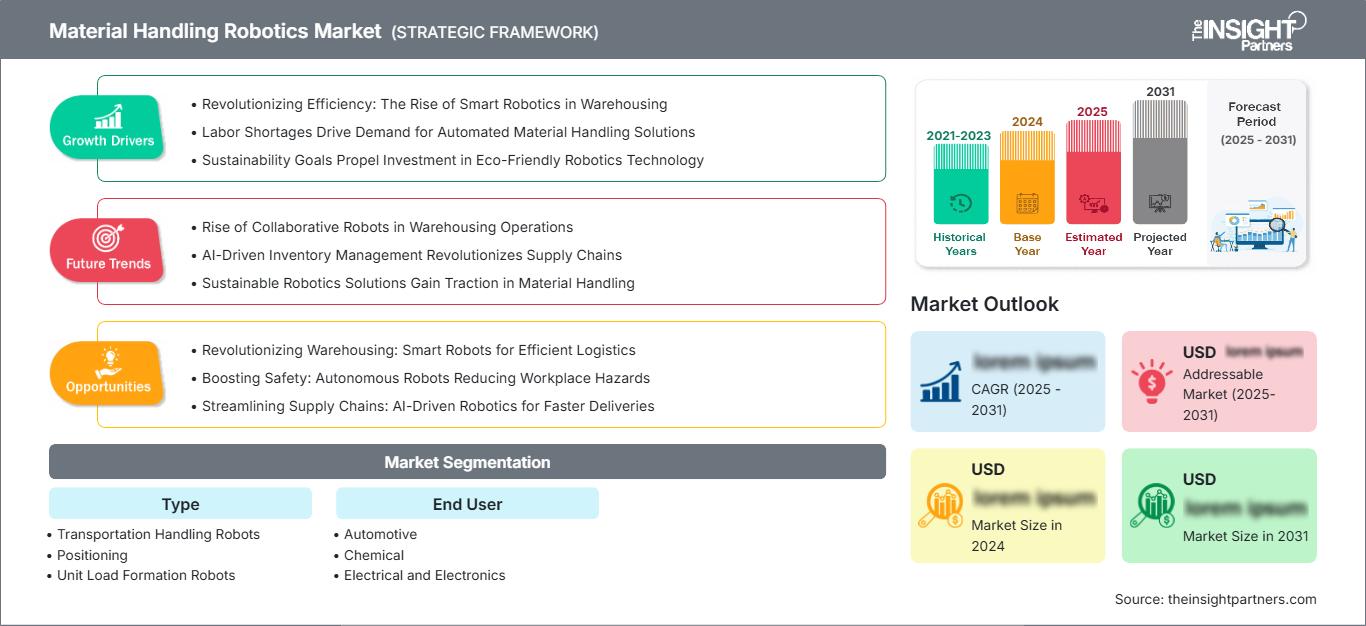
Material Handling Robotics Market: Strategic Insights
Regional Insights
North America Material Handling Robotics Market
North America had a share of the worth 21-24% in 2025, making it the third-biggest region in terms of market contribution behind Asia Pacific and Europe. The growth has been facilitated by advancements in the automotive industry, aerospace components handling, and fast-growing e-commerce order fulfillment systems. Ongoing labor shortages in logistics and warehousing operations have sped up the use of robotics for tasks such as repetitive lifting, palletizing, and transportation that were done using manual labor before.
North America is expected to grow with a CAGR of 10.7%-11.5% during 2026-2034 due to reshoring trends, government support, and investments in autonomous mobile robots. In addition, Canada and Mexico contribute to the growth through growing automotive and electronics assembling operations by implementing robotic transportation and storage solutions for meeting nearshoring needs.
U.S. Material Handling Robotics Market
The United States contributed to approximately 83–86% of North America's material handling robots revenue in 2025 because of the presence of the majority of the country's automobile assembly units, aerospace industry and large fulfillment centers. Robot makers, such as ABB Ltd., FANUC Corporation, and KUKA AG (Midea Group) have strong sales and after-sales service network in the Midwest and southeastern automotive manufacturing plants, which facilitates the deployment and maintenance of robots in the highly productive environment.
Autonomous mobile robots are seen as emerging application in third-party logistics sector, whereas cobots are being increasingly used for machine tending in electronics and industrial machines factories. The U.S. market is forecasted to experience growth of 10.6–11.4% during 2026-2034 on account of investments in warehouse automation, stringent workplace safety rules, and increasing production of semiconductors and batteries domestically.
Europe Material Handling Robotics Market
Europe held an estimated share of 24–27% in the Material Handling Robotics Market in 2025 and occupied the second position in the regional markets after Asia Pacific. The growth is expected to continue during the period 2026-2034 at a CAGR of 10.5–11.2%, which will be fueled by strict regulations for workplace safety, higher automobile production, and continued investment in Industry 4.0-based smart factories in Western and Central Europe.
Germany is the leading country of Europe's Market owing to the country's strong automotive and industrial machinery industries. KUKA AG (Midea Group), an indigenous company in Germany, adds to the list of players in the country besides the strong network of integrators and increased use of autonomous mobile robots in logistics.
The United Kingdom is one of the fast-growing countries in this market on account of the investment in warehouses automation in the fields of e-commerce and food distribution. Labor issues that emerged due to Brexit have boosted the implementation rate in logistics companies, whereas the interest in collaborative robots keeps adding to deployment rates in small manufacturing facilities. France, Italy, and Spain are also contributing steadily to the market with a focus on aerospace and automotive handling.
APAC Material Handling Robotics Market
Asia Pacific led the Material Handling Robotics Market with an estimated 41–45% share in 2025, driven by dense electronics and automotive manufacturing bases across China, Japan, and South Korea. China remains the leading contributor, supported by large-scale factory automation programs and domestic robot manufacturing capacity expansion under national industrial upgrading policies.
The region is projected to grow at a CAGR of 11.8–12.6% between 2026 and 2034, with India and Australia emerging as fast-adopting markets amid expanding electronics assembly and mining-linked logistics automation, supported by government-backed initiatives strengthening regional supply chains.
Middle East & Africa Material Handling Robotics Market
The Middle East and Africa remain an emerging contributor, led by the United Arab Emirates and Saudi Arabia, where diversification away from oil-based economies is driving investment in logistics parks, food processing, and industrial manufacturing zones requiring automated transportation and storage systems.
The region is expected to expand at a CAGR of 11.0–11.8% between 2026 and 2034, with South Africa and the broader Rest of MEA gradually adopting automation within mining-linked and food processing facilities, supported by infrastructure modernization and free-zone manufacturing incentives.
Segmentation Analysis
Type
Type segmentation defines the Material Handling Robotics Market scope, encompassing transportation, positioning, unit load formation, storage, identification, and control robots. This segment is projected to grow at a CAGR of 10.9–11.6% between 2026 and 2034, driven by rising demand for flexible, multi-function robotic systems across automotive, electronics, and food processing environments.
- Transportation Handling Robots: Widely deployed for moving materials between production stages, these robots dominate automotive and warehousing applications, offering high reliability for repetitive point-to-point transport across large-scale facilities.
- Positioning: These robots ensure precise placement and alignment of components during assembly, playing a critical role in automotive and electronics manufacturing where tolerance accuracy directly affects product quality.
- Unit Load Formation Robots: Used for palletizing and depalletizing operations, these robots consolidate products into stable loads for storage and transport, supporting efficient warehouse space utilization.
- Storage: Storage robots manage automated retrieval and placement of goods within racking systems, improving inventory accuracy and space efficiency across high-density distribution centers.
- Identification: These robots integrate vision and sensor-based systems to identify, sort, and track items across production and logistics operations, enabling accurate inventory management.
- Control Robots: Serving as the coordination layer, control robots manage task sequencing and communication across robotic fleets, ensuring synchronized operations within complex, multi-robot environments.
End User
End User industries shaping the market include automotive, chemical, electrical and electronics, industrial machinery, and food and beverage sectors, each with distinct automation priorities. This segment is projected to grow at a CAGR of 11.1–11.8% between 2026 and 2034, as manufacturers increasingly adopt robotic transportation, storage, and identification systems to improve throughput and consistency.
- Automotive: The largest end-user segment, automotive manufacturing relies heavily on robotic transportation and positioning systems for assembly line material movement, driven by high production volumes.
- Chemical: Chemical manufacturers deploy robots for handling hazardous materials safely, reducing worker exposure risks while ensuring precise dosing and transport of sensitive substances.
- Electrical and Electronics: This sector demands high-precision robots for delicate component handling and identification, supporting rapid production cycles in semiconductor and consumer electronics assembly.
- Industrial Machinery: Heavy machinery manufacturers utilize robots for transporting and positioning large components, improving workplace safety and reducing cycle times across fabrication stages.
- Food and Beverage: Growing hygiene and traceability requirements drive robotic adoption for sorting and storage, minimizing contamination risks while supporting high-speed, temperature-sensitive lines.
Opportunity Snapshot
| End User | Revenue Contribution | Trend Tag | Adoption Stage |
|---|---|---|---|
| Automotive | High | Assembly Automation | Mature |
| Chemical | Medium | Hazardous Handling | Scaling |
| Electrical and Electronics | High | Precision Sorting | Scaling |
| Industrial Machinery | Medium | Heavy Component Handling | Scaling |
| Food and Beverage | Medium | Hygienic Packaging | Emerging |
Material Handling Robotics Market Growth Drivers and Impact Analysis
Rising E-Commerce and Warehouse Automation Demand
The rapid expansion of global e-commerce business is leading to shortages in workforce capabilities of the warehouses, forcing logistics service providers to automate the transportation, storage, and order fulfillment processes through robotics. The same day and next-day delivery demands high speed of movement of materials, which is difficult to maintain through manpower when the system is operating at peak loads. Autonomous mobile robots and automated storage and retrieval systems are being used to increase efficiency without having a proportional increase in workforce. This particular factor has gained significance in North America and select regions in Asia Pacific due to the fast growing area of fulfillment centers square footage.
Labor Shortages and Rising Workplace Safety Standards
There is a continuous shortage of manual material handling workers in manufacturing and logistics operations in developed countries due to an aging workforce and lack of inclination towards such physically exhausting occupations. This problem is solved through robotics, which can perform lifting, moving, and sorting activities repeatedly without posing the same health risks as humans do when they perform such actions. North American and European regulatory authorities have raised standards of safety at workplaces, and as a result, companies have started automating their material handling operations to avoid liabilities. This trend is not limited to large firms, as mid-size manufacturers consider robots necessary for consistent production.
Expansion of Electronics and Battery Manufacturing Capacity
Rapid expansion of semiconductor, battery, and consumer electronics manufacturing capacity is generating substantial demand for precision material handling robots capable of managing delicate, high-value components. New fabrication and assembly plants across the United States, South Korea, Japan, and parts of Europe require robots for accurate positioning, identification, and transport of components with minimal contamination risk. This capacity expansion, driven partly by supply chain diversification away from concentrated manufacturing regions, is creating recurring demand for robotic integration in newly constructed facilities. As production volumes scale, manufacturers increasingly prioritize robotic systems that combine speed, precision, and traceability.
Material Handling Robotics Market Future Trends
AI-Driven Autonomous Navigation and Fleet Coordination
Emerging Material Handling Robotics Market trends point toward greater reliance on AI-driven navigation systems that allow robots to operate without fixed infrastructure such as magnetic strips or guide markers. Visual simultaneous localization and mapping is enabling robots to adapt dynamically to changing warehouse and factory layouts. Fleet management software is increasingly coordinating multiple robot types, including transportation, storage, and identification units, within unified digital platforms. As facilities scale operations, this shift toward intelligent, self-coordinating robotic fleets is expected to reduce commissioning time and improve adaptability across evolving production and distribution environments.
Convergence of Robotics with Digital Twin and Simulation Platforms
Manufacturers are increasingly adopting digital twin technology to simulate robotic material handling workflows before physical deployment, reducing implementation risk and downtime. This convergence allows engineers to test throughput scenarios, collision risks, and layout changes virtually, shortening commissioning timelines for new production lines. Cloud-based simulation platforms are also enabling remote monitoring and predictive maintenance, allowing operators to anticipate component wear before failures disrupt operations. As digital twin adoption expands beyond large enterprises, mid-sized manufacturers are expected to gain access to more affordable simulation tools, further accelerating robotic integration.
Material Handling Robotics Market Opportunities
Expansion into Mid-Sized Manufacturing and Emerging Economies
Material Handling Robotics Market Forecasts indicate substantial untapped potential among mid-sized manufacturers that have historically lacked capital access for automation. Declining hardware costs and modular, easier-to-deploy robotic platforms are lowering adoption barriers for smaller production facilities across Southeast Asia, Eastern Europe, and Latin America. Equipment financing models, including robotics-as-a-service arrangements, are enabling manufacturers to adopt automation without significant upfront capital expenditure. This opens opportunities for robot manufacturers and integrators to develop simplified, cost-effective solutions tailored to smaller production volumes. As regional manufacturing bases expand, companies that establish early service networks stand to capture disproportionate share of this emerging demand.
Integration of Robotics with Warehouse Management and ERP Systems
Deeper integration between robotic material handling systems and enterprise resource planning or warehouse management software presents a significant opportunity for solution providers. Seamless data exchange allows real-time inventory visibility, predictive replenishment, and coordinated task allocation across human and robotic workers. Companies that develop open, interoperable software architectures compatible with multiple robot brands and existing enterprise systems are positioned to capture demand from facilities operating mixed automation fleets. This opportunity extends to third-party logistics providers seeking unified visibility across multi-client warehouse operations, where integrated robotics can materially improve order accuracy.
Frequently Asked Questions

- Comprehensive Market Sizing and Forecast Analysis
- Detailed Segmentation Analysis
- In-Depth Market Dynamics Assessment
- Regional and Country-Level Insights
- Competitive Landscape and Company Benchmarking
- Strategic Business Intelligence
Recent Reports
Testimonials

The Insight Partners provided valuable market intelligence that supported our global go-to-market strategy. Their team was professional, responsive, and attentive to our feedback, providing thoughtful analysis and helpful methodological clarifications throughout the project.
Junmo Kim Chief Financial Officer (CFO), Enertech Co., Ltd.
The Insight Partners' SCADA System Market report is comprehensive, with valuable insights on current trends and future forecasts. The team was highly professional, responsive, and supportive throughout. We are very satisfied and highly recommend their services.
RAN KEDEM Partner, Reali Technologies LTDs
I requested a report on a very specific software market and the team produced the report in a few days. The information was very relevant and well presented. I then requested some changes and additions to the report. The team was again very responsive and I got the final report in less than a week.
JEAN-HERVE JENN Chairman, Future Analytica
We worked with The Insight Partners for an important market study and forecast. They gave us clear insights into opportunities and risks, which helped shape our plans. Their research was easy to use and based on solid data. It helped us make smart, confident decisions. We highly recommend them.
PIYUSH NAGPAL Sr. Vice President, High Beam Global
The Insight Partners delivered insightful, well-structured market research with strong domain expertise. Their team was professional and responsive throughout. The user-friendly website made accessing industry reports seamless. We highly recommend them for reliable, high-quality research services
YUKIHIKO ADACHI CEO, Deep Blue, LLC.
This is the first time I have purchased a market report from The Insight Partners.While I was unsure at first, I visited their web site and felt more comfortable to take the risk and purchase a market report.I am completely satisfied with the quality of the report and customer service. I had several questions and comments with the initial report, but after a couple of dialogs over email with their analyst I believe I have a report that I can use as input to our strategic planning process.Thank you so much for taking the extra time and making this a positive experience.I will definitely recommend your service to others and you will be my first call when we need further market data.
JOHN SUZUKI President and Chief Executive Officer, Board Director, BK Technologies
I wish to appreciate your support and the professionalism you displayed in the course of attending to my request for information regarding to infectious disease IVD market in Nigeria. I appreciate your patience, your guidance, and the fact that you were willing to offer a discount, which eventually made it possible for us to close a deal. I look forward to engaging The Insight Partners in the future, all thanks to the impression you have created in me as a result of this first encounter.
DR CHIJIOKE ONYIA MANAGING DIRECTOR, PineCrest Healthcare Ltd.Reason to Buy
- Informed Decision-Making
- Understanding Market Dynamics
- Competitive Analysis
- Identifying Emerging Markets
- Customer Insights
- Market Forecasts
- Risk Mitigation
- Boosting Operational Efficiency
- Strategic Planning
- Investment Justification
- Tracking Industry Innovations
- Aligning with Regulatory Trends





 Get Free Sample for