
Memristor Market Size, Trends & Demand by 2034
Coverage: by Type (Molecular and Ionic Thin film Memristors, Spin and Magnetic Based Memristors); Application (Digital Memory, Logic Circuits, Neuromorphic Systems, Analog Electronics, Others); Industry Vertical (IT and Telecommunication, Automotive, Consumer Electronics, Healthcare, Industrial, Others), and Geography (North America, Europe, Asia Pacific, and South and Central America)
- Status : Data Released
- Report Code : TIPRE00003614
- Category : Electronics and Semiconductor
- No. of Pages : 150
- Available Report Formats :


- Last update date : October 13, 2026


2025 Market Size
US$ 513.12 Mn
Base year value
2034 Forecast
US$ 2,216.88 Mn
Projected by 2034
CAGR 2026-2034
20.07 %
Growth rate
Addressable Market
US$ 12,852.93 Mn
(2026-2034)
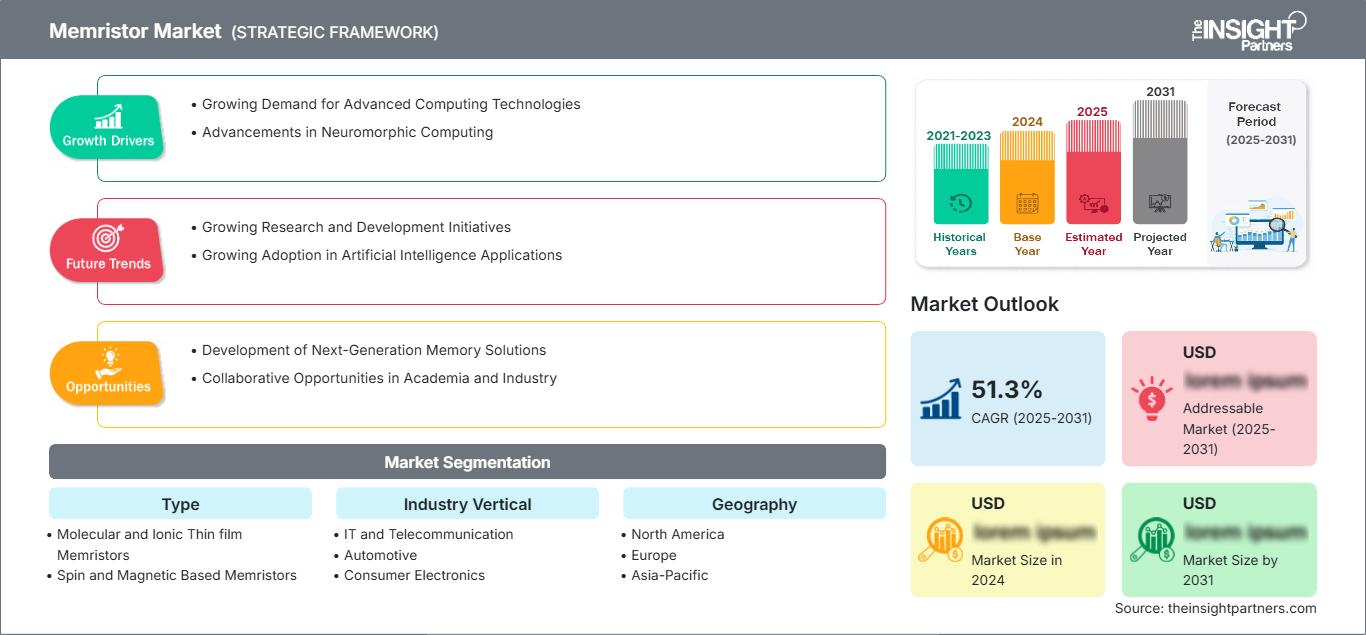
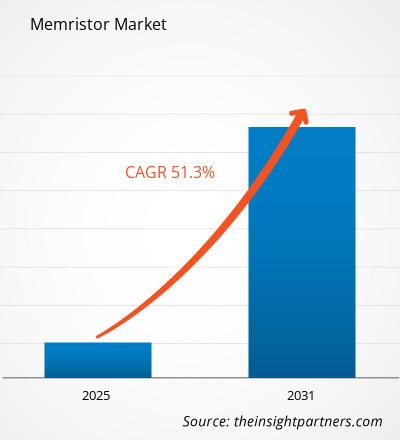
The Memristor Market is valued at US$ 513.12 Million in 2025 and is projected to reach US$ 2,216.88 Million by 2034, expanding at a CAGR of 20.07% from 2026 to 2034. Growth is being shaped by increasing interest in non-volatile computing architectures, neuromorphic processing, and memory-centric AI acceleration. The technology's ability to combine storage and computation is also supporting research into lower-latency and energy-conscious semiconductor architectures across several electronics applications.
North America is positioned for sustained expansion in the Memristor Market size, supported by semiconductor research capabilities, AI infrastructure investment, and growing experimentation with compute-in-memory architectures. The regional trajectory is also influenced by demand for specialized memory technologies in data centers, edge computing, defense electronics, and advanced automotive systems, where lower data movement and power consumption can improve system-level efficiency.
Memristor Market Assessment and Insights
- North America: The region is expected to hold a 34–38% share in 2025 and expand at a 19–22% CAGR between 2026 – 2034, supported by AI hardware research, semiconductor innovation, and early adoption of in-memory computing.
- US: The US is estimated to represent 29–33% of global revenue in 2025, growing at a 19–22% CAGR between 2026 – 2034, supported by advanced computing and semiconductor R&D.
- Europe: Europe is projected to account for a 16–20% share in 2025 and grow at a 17–20% CAGR between 2026 – 2034, with Germany, the UK, France, and Italy supporting research-led adoption.
- Asia Pacific: Asia Pacific is estimated at a 29–33% share in 2025 and is expected to expand at a 22–25% CAGR between 2026 – 2034, led by China, Japan, and South Korea.
- Largest Segment: Molecular and Ionic Thin film Memristors are estimated to command a 58–63% market share in 2025, with a 19–22% CAGR from 2026–2034, reflecting broader material and fabrication research.
- High Growth Segment: Spin and Magnetic Based Memristors are estimated at a 37–42% market share in 2025, advancing at a 22–25% CAGR from 2026–2034 as spintronic architectures mature.
- Key companies analyzed in detail: Fujitsu Limited; Hewlett Packard Enterprise Company; Intel Corporation; Knowm Inc.; Micron Technology, Inc.; Panasonic Holdings Corporation; Rambus Inc.; Samsung Electronics Co., Ltd.; SanDisk Corporation; SK hynix Inc.
Source: The Insight Partners' analysis based on proprietary research, government publications, company annual reports, investor presentations, industry databases, and expert interviews.
In terms of the technological environment, development has moved from lab demonstrations of resistive switching to structures of the device tailored to be integrated with standard semiconductor processes. The focus is shifting towards multilevel states, endurance, retention, analog computing, and suitability for use in crossbar configurations. This is affecting manufacturing processes since the success of memristive devices will depend on the combined efforts of all the above-listed aspects.
Looking ahead, commercialization is likely to broaden through pilot deployments and specialized accelerators before reaching higher-volume applications. Emerging opportunities within the Memristor Market share are particularly relevant in Asia Pacific manufacturing centers and North American AI ecosystems, while European programs emphasize energy efficiency and advanced semiconductor research. Regulatory support for domestic semiconductor capacity and strategic supply chains can encourage investment in fabrication, packaging, materials, and design capabilities.
Memristor Market Report Scope
| Report Attribute | Details |
|---|---|
| Market size in 2025 | US$ 513.12 Million |
| Market Size by 2034 | US$ 2,216.88 Million |
| Global CAGR (2026 - 2034) | 20.07% |
| Historical Data | 2021-2024 |
| Forecast period | 2026-2034 |
Memristor Market Analysis
Demand is becoming more associated with the need for efficient processing of AI workloads, where transferring the weights from the memory to the processor introduces latency and overhead in terms of energy. Memristive arrays will be able to overcome this challenge by enabling computing close to where the data is stored. The ecosystem, thus, comprises material suppliers, device engineers, wafer fabrication plants, memory manufacturers, accelerators, software providers, and system integrators.
Supply dynamics within the Memristor Market report remain technology-sensitive because different architectures require different materials and process flows. Molecular and ionic structures may be able to draw on existing research into resistive switching, but magnetic structures will need closer integration with magnetic materials, device physics, sensors, and control circuitry. Wafer-level fabrication readiness, design kits, test methodology, and reliable characterization continue to influence scalability.
Competitive position is becoming more about the ability to link the devices with computing architectures. Fujitsu Limited, Intel Corporation, Micron Technology, Inc., Samsung Electronics Co., Ltd., and SK hynix Inc. are organizations that have a lot of semiconductor device engineering expertise, while Hewlett Packard Enterprise Company has historical knowledge of memristive computing. Knowm Inc. brings specific expertise in neuromorphic device research, while Rambus Inc. offers memory and interfacing expertise.
Strategic investment in the Memristor Market forecast is shifting toward architectures that can demonstrate measurable system benefits rather than device performance alone. Panasonic Holdings Corporation and SanDisk Corporation broaden the competitive context through established electronics and storage capabilities. Companies are also evaluating partnerships, university research, advanced packaging, and application-specific accelerators because commercialization requires coordinated progress across memory cells, CMOS integration, algorithms, and system software.
● REPORT CUSTOMIZATION
Tailor This Report To Align With Your Specific Business Requirements
This report can be customized to align precisely with your business objectives, scope, and target markets. Customization options include tailored segmentation, geography, competitive analysis, and strategic insights to support informed decision-making.
Customize This Report →WHAT YOU CAN ADJUST
- ● Segmentations
- ● Geography
- ● Competitive Analysis
- ● Language Preferences
Memristor Market: Strategic Insights
Regional Insights
North America Memristor Market
North America is estimated to represent a 34–38% share of the Memristor Market in 2025, with regional expansion expected at a 19–22% CAGR through 2034. The US dominates regional demand due to the presence of the highest number of AI developers, semiconductor design engineers, research institutions, hyperscale computing systems, and defense electronics projects. Canada contributes expertise related to academic knowledge and photonics.
The regional ecosystem is developing towards the areas of compute-in-memory prototyping, edge AI, neuromorphic systems, and innovative non-volatile memory. This demand is fueled by the need to enhance computational efficiency due to the scaling of AI applications. Universities, semiconductor companies, and technology programs supported by the government are helping develop prototypes, while semiconductor incentives from domestic sources are encouraging investments in fabrication and packaging capability. High-value commercialization efforts will dominate North America.
U.S. Memristor Market
The U.S. represents approximately 76–86% of North America's 2025 Memristor Market share and is expected to grow at a 19–22% CAGR through 2034. Its placement has been influenced by considerable semiconductor innovation, AI hardware, defense electronics, and computing investments. Organizations operating in the space include Fujitsu Limited, Hewlett Packard Enterprise Company, Intel Corporation, Micron Technology, Inc., and Knowm Inc.
Development efforts are becoming more oriented towards neuromorphic computing, AI inference, edge computing, and memory-focused architectures. Government-led programs related to semiconductors and the need for domestic technology supply chains can help with pilot manufacturing and advanced packaging. The industry can also leverage connections that exist between universities, national labs, start-ups, and semiconductor companies. The commercialization path will initially be through custom computing systems before entering mainstream memory products.
Europe Memristor Market
Europe is estimated to hold a 16–20% of the Memristor Market share in 2025 and is projected to expand at a 17–20% CAGR through 2034. It can be expected that Germany will continue its leadership in the region owing to automotive electronics, automation industries, semiconductors R&D and advanced manufacturing capabilities. In addition to that, the UK and France also offer contributions via university research and AI-related technological development.
Research in neuromorphic engineering, advanced materials, and semiconductor design remains high in the UK, thereby offering pathways towards prototyping and commercialization of the research in universities. Application of low-power embedded computing, sensing, and adaptive electronics will be offered in Germany due to its strong automotive and industrial sectors. Furthermore, France, Italy, and Spain have complementary activities in the form of research organizations, industrial automation, aerospace, and electronics development.
APAC Memristor Market
APAC is estimated at a 29–33% share of the Memristor Market in 2025 and is forecast to grow at a 22–25% CAGR, making it the fastest-expanding major region. China, Japan, South Korea, India, and Australia contribute through semiconductor manufacturing, AI research, consumer electronics, and industrial digitization.
China and South Korea provide strong manufacturing ecosystems, while Japan contributes advanced materials and electronics research. India is developing semiconductor capacity and AI infrastructure, and Australia adds research capabilities. South Korea is expected to remain a leading regional country because of its memory manufacturing base and investment in advanced computing. Industrial policy, semiconductor localization, and AI adoption are reinforcing regional demand for emerging memory architectures.
Middle East & Africa Memristor Market
The Middle East and Africa Memristor Market is expected to remain a developing market, expanding at a 15–18% CAGR through 2034. Saudi Arabia and the UAE are building digital infrastructure and AI capabilities, while South Africa provides a comparatively established electronics and research ecosystem. The rest of MEA remains earlier-stage.
Saudi Arabia and the UAE are relevant to future demand because large-scale data infrastructure and AI programs can create requirements for efficient computing hardware. South Africa supports research and industrial electronics applications, while other MEA markets remain influenced by infrastructure availability and technology-import economics. Energy efficiency is strategically relevant because data-intensive computing can increase power requirements, encouraging interest in architectures that reduce data movement and improve processing efficiency.
Segmentation Analysis
Type
The Type segment includes Molecular and Ionic Thin Film Memristors and Spin and Magnetic Based Memristors, reflecting key Memristor Market trends across emerging memory architectures. The segment is expected to grow at a 19–23% CAGR from 2026–2034, supported by continued development of non-volatile switching, multilevel storage, neuromorphic processing, and material integration.
- Molecular and Ionic Thin film Memristors: These devices retain a strong position because ionic movement and thin-film structures support resistive switching research across multiple material systems. Their flexibility makes them strategically important for experimental memory arrays and neuromorphic architectures.
- Spin and Magnetic Based Memristors: These architectures benefit from interest in spintronic computing and non-volatile operation. Their strategic value lies in combining memory characteristics with magnetic-state control, creating opportunities for high-speed and energy-conscious computing designs.
Industry Vertical
Industry Vertical segmentation within the Memristor Market includes IT and Telecommunication, Automotive, Consumer Electronics, Healthcare, Industrial, and Others. The segment is expected to expand at a 20–24% CAGR from 2026–2034, as organizations explore memory-centric processing across increasingly data-intensive systems.
- IT and Telecommunication: Demand centers on AI infrastructure, edge processing, networking, and data-intensive workloads. Memristive architectures can support lower data movement and efficient inference, strengthening their strategic relevance for specialized computing.
- Automotive: Vehicle electronics increasingly require localized AI, sensing, and real-time decision-making. Non-volatile and low-power memory architectures can support advanced driver assistance, intelligent sensing, and future software-defined vehicle platforms.
- Consumer Electronics: Smartphones, wearables, smart appliances, and personal computing devices require efficient processing within constrained power envelopes. Memristive technologies can provide opportunities for compact memory-compute integration and adaptive AI functions.
- Healthcare: Medical equipment increasingly processes imaging, monitoring, and diagnostic information locally. Emerging memory architectures can support low-power edge analytics, especially where continuous sensing and rapid inference are important.
- Industrial: Industrial automation, robotics, machine vision, and predictive systems create demand for localized computation. Memristors can support adaptive processing architectures that reduce data transfers between sensors, memory, and processing units.
Opportunity Snapshot
| Industry Vertical | Revenue Contribution | Trend Tag | Adoption Stage |
| IT and Telecommunication | High | Edge AI | Scaling |
| Automotive | Medium | Vehicle AI | Emerging |
| Consumer Electronics | High | Smart Devices | Scaling |
| Healthcare | Medium | Edge Diagnostics | Emerging |
| Industrial | High | Machine Vision | Scaling |
| Others | Low | Specialized Compute | Emerging |
Memristor Market Growth Drivers and Impact Analysis
AI inference is increasing demand for memory-centric computing
Workload trends in AI are bringing to the fore the energy and latency overheads associated with shuttling model parameters to and fro from the memory subsystem to compute units. Memristor crossbar technology provides an approach to perform matrix computations near stored data, making it applicable for inference engines where efficiency throughputs per watt are important. This factor is driving changes in the focus for investments from memory density to architectures capable of performing both storage, computation, and analog processing. This has a pronounced effect on edge AI, neuromorphic computing, and acceleration markets, where thermal and power limitations restrict traditional architectures. With the increasing distribution of AI models, the commercial potential of localized inferencing is expected to increase further, driving the exploration of memristor architectures.
Semiconductor scaling is encouraging alternative memory architectures
The traditional technique of scaling semiconductors becomes more complicated in order to enhance performance, density, energy efficiency, and cost. Memristive devices offer a different approach to solving those problems, as the switching process of such devices can be achieved via materials and architectures without the need to scale transistors. Thus, it is possible to integrate such devices into three-dimensional architecture, develop embedded non-volatile memory, and design compute-in-memory devices. This problem concerns all manufacturers of semiconductors because the success in using the memristive technology would increase the need for new capabilities in terms of deposition, patterning, characterization, and packaging processes. Variability and endurance are critical challenges; however, with better process control, it is possible to decrease these problems step-by-step.
Energy efficiency is strengthening interest in edge processing
The increase in connected sensors, systems, automobiles, and smart devices is causing more information to be processed at the edges of data center networks. Moving raw information from a remote processor takes up network bandwidth and energy, whereas processing in a local environment depends on efficient use of memory and computing resources. Memristors can assist in localized computing by minimizing the frequent shifting between memory and compute resources. This factor can shape the application of memristors in robotics, industrial sensing, automotive sensing, medical instruments, and telecommunication networking. The most promising areas may arise from tasks that are repetitive in nature, focused on inference tasks, and have low latency constraints. The commercial success of these technologies will depend on their ability to ensure reliability, ease of software integration, and sufficient accuracy.
Memristor Market Future Trends
Memristive arrays will move toward application-specific AI accelerators
Further advancements will be geared towards application-specific accelerators that integrate memristive crossbar arrays with conventional digital logic, analog interfaces, and onboard control. Instead of using CPUs/GPUs exclusively, these architectures can carry out specific matrix operations while allowing the CPU/GPU to carry out heavy computing tasks. This dual structure can lower the risks associated with the commercialization of this technology since manufacturers will be able to maintain their existing software and interface. This is particularly pertinent to edge AI, industry vision, autonomous electronics, and smart sensors. Focus will shift to calibration, error handling, precision control, and compilation. With time, better integration of hardware properties and neural network algorithms can increase the predictability of memristive accelerator usage.
Materials engineering will broaden the technology base
The research field is anticipated to expand into new two-dimensional materials, magnetic materials, molecular layers, and designed interfaces from the traditional oxide systems. Such an expansion would enhance switching performance, thermal stability, endurance, retention, and multilevel capabilities of such memory elements, but would bring its own set of issues specific to each of those material systems. New advanced materials may also be required to enable operation under extreme conditions or very high densities when traditional structures would not suffice. Interface engineering will become more prominent since switching performance is largely defined by electrode interactions, defects, diffusion, and nanostructure of the material.
Memristor Market Opportunities
Specialized edge AI platforms can accelerate commercialization
Companies developing edge AI hardware can use memristive architectures to target workloads where energy efficiency and response time matter more than general-purpose flexibility. Potential applications include machine vision, robotics, industrial monitoring, intelligent cameras, automotive sensing, and connected medical equipment. Investment opportunities are strongest where a defined workload permits optimization of array dimensions, precision, memory hierarchy, and software tools. Vendors can reduce commercialization risk by combining memristive accelerators with conventional processors rather than requiring complete architectural replacement. Strategic partnerships among device manufacturers, AI chip designers, software developers, and equipment makers can also accelerate qualification. Market participants should prioritize applications with measurable power or latency benefits and established purchasing requirements, creating clearer pathways from prototype demonstrations to commercial systems.
Advanced semiconductor partnerships can strengthen manufacturing readiness
A major opportunity exists in partnerships connecting materials developers, memory manufacturers, foundries, packaging specialists, and system companies. Memristor commercialization requires consistent device behavior across wafers, predictable fabrication yields, reliable endurance, and integration with CMOS circuitry. Partnerships can distribute development risk while allowing specialists to focus on materials, process modules, circuit design, algorithms, or packaging. Investment can also target metrology and testing infrastructure because reliable characterization is essential for qualifying emerging memory technologies. Organizations with existing semiconductor production capabilities may have an advantage when adapting memristive devices to embedded memory or accelerator applications. Over the forecast period, the most valuable partnerships are likely to be those that demonstrate repeatable system-level performance rather than laboratory-scale device metrics alone.
Frequently Asked Questions

- Comprehensive Market Sizing and Forecast Analysis
- Detailed Segmentation Analysis
- In-Depth Market Dynamics Assessment
- Regional and Country-Level Insights
- Competitive Landscape and Company Benchmarking
- Strategic Business Intelligence
Recent Reports
Testimonials

The Insight Partners provided valuable market intelligence that supported our global go-to-market strategy. Their team was professional, responsive, and attentive to our feedback, providing thoughtful analysis and helpful methodological clarifications throughout the project.
Junmo Kim Chief Financial Officer (CFO), Enertech Co., Ltd.
The Insight Partners' SCADA System Market report is comprehensive, with valuable insights on current trends and future forecasts. The team was highly professional, responsive, and supportive throughout. We are very satisfied and highly recommend their services.
RAN KEDEM Partner, Reali Technologies LTDs
I requested a report on a very specific software market and the team produced the report in a few days. The information was very relevant and well presented. I then requested some changes and additions to the report. The team was again very responsive and I got the final report in less than a week.
JEAN-HERVE JENN Chairman, Future Analytica
We worked with The Insight Partners for an important market study and forecast. They gave us clear insights into opportunities and risks, which helped shape our plans. Their research was easy to use and based on solid data. It helped us make smart, confident decisions. We highly recommend them.
PIYUSH NAGPAL Sr. Vice President, High Beam Global
The Insight Partners delivered insightful, well-structured market research with strong domain expertise. Their team was professional and responsive throughout. The user-friendly website made accessing industry reports seamless. We highly recommend them for reliable, high-quality research services
YUKIHIKO ADACHI CEO, Deep Blue, LLC.
This is the first time I have purchased a market report from The Insight Partners.While I was unsure at first, I visited their web site and felt more comfortable to take the risk and purchase a market report.I am completely satisfied with the quality of the report and customer service. I had several questions and comments with the initial report, but after a couple of dialogs over email with their analyst I believe I have a report that I can use as input to our strategic planning process.Thank you so much for taking the extra time and making this a positive experience.I will definitely recommend your service to others and you will be my first call when we need further market data.
JOHN SUZUKI President and Chief Executive Officer, Board Director, BK Technologies
I wish to appreciate your support and the professionalism you displayed in the course of attending to my request for information regarding to infectious disease IVD market in Nigeria. I appreciate your patience, your guidance, and the fact that you were willing to offer a discount, which eventually made it possible for us to close a deal. I look forward to engaging The Insight Partners in the future, all thanks to the impression you have created in me as a result of this first encounter.
DR CHIJIOKE ONYIA MANAGING DIRECTOR, PineCrest Healthcare Ltd.Reason to Buy
- Informed Decision-Making
- Understanding Market Dynamics
- Competitive Analysis
- Identifying Emerging Markets
- Customer Insights
- Market Forecasts
- Risk Mitigation
- Boosting Operational Efficiency
- Strategic Planning
- Investment Justification
- Tracking Industry Innovations
- Aligning with Regulatory Trends





 Get Free Sample for