
Mobile Generator Market Demand, Trends & Forecast by 2034
Coverage: by Fuel Type (Diesel Generators, Gaseous Generators); Power Range (8 to 20, 21 to 90, 91 to 370, 371 to 500); End-User (Industrial, Construction, Disaster Relief, Oil Field, Military, Municipal Fleets, Others) , and Geography (North America, Europe, Asia Pacific, and South and Central America)
- Status : Data Released
- Report Code : TIPRE00004358
- Category : Electronics and Semiconductor
- No. of Pages : 150
- Available Report Formats :


- Last update date : October 13, 2026


2025 Market Size
US$ 1.78 Bn
Base year value
2034 Forecast
US$ 2.36 Bn
Projected by 2034
CAGR 2026-2034
3.59 %
Growth rate
Addressable Market
US$ 19.19 Bn
(2026-2034)
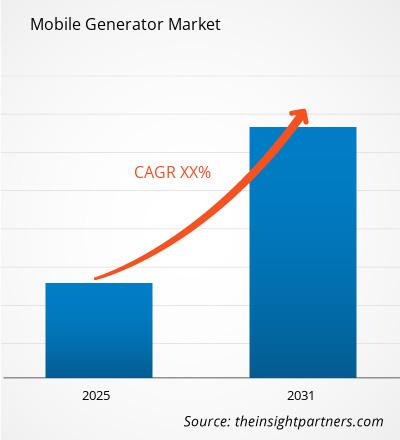
The Mobile Generator Market sustained demand for portable backup power solutions continues to define the market, valued at US$ 1.78 Billion in 2025 and projected to reach US$ 2.36 Billion by 2034, expanding at a CAGR of 3.59% between 2026 and 2034. Construction, disaster relief, and oil field operations increasingly rely on diesel and gaseous mobile generator units for temporary and emergency power supply across varied end-use environments.
North America is estimated to grow at a CAGR of 3.3-3.8% through 2034, reflecting the mobile generator market size expansion driven by rising extreme weather event frequency requiring emergency backup power deployment and sustained construction sector activity. Growing municipal fleet electrification support infrastructure further reinforces steady regional demand across public safety applications.
Mobile Generator Market Assessment and Insights
- North America: The region holds an estimated 32-35% share in 2025, growing at a CAGR of 3.3-3.8% between 2026-2034, supported by disaster relief preparedness, construction activity, and municipal fleet backup power infrastructure investment.
- US: The United States represents the majority of regional demand in 2025, expanding at a CAGR of 3.2-3.7% through 2034, driven by extreme weather resilience and construction sector generator rental demand.
- Europe: Europe accounts for roughly 22-25% share in 2025 and is projected to grow at a CAGR of 3.4-3.9% through 2034, led by Germany, the UK, and France through construction and industrial standby power needs.
- Asia Pacific: Asia Pacific holds an estimated 26-30% share in 2025, expanding at a CAGR of 3.9-4.4% between 2026-2034, led by China, India, and Japan through infrastructure construction and disaster relief preparedness programs.
- Largest Segment: The Diesel Generators segment holds the largest share at 68-72% in 2025, growing at a CAGR of 3.3-3.8% through 2034, favored for reliability and extended runtime across industrial applications.
- High Growth Segment: The Gaseous Generators segment registers the fastest growth at a CAGR of 4.8-5.3% through 2034, propelled by tightening emissions regulations favoring cleaner-burning fuel alternatives across construction and municipal fleets.
- Key companies analyzed in detail: Atlas Copco AB, Briggs & Stratton, LLC, Caterpillar Inc., Cummins Inc., Doosan Portable Power, FG Wilson (Engineering) Limited, Genei Industries, Inc., Generac Power Systems, Inc., Kohler Co., WINCO, Inc., Multiquip Inc.
Source: The Insight Partners' analysis based on proprietary research, government publications, company annual reports, investor presentations, industry databases, and expert interviews.
The mobile generator market has evolved through incremental engineering improvements, moving from bulky, fuel-inefficient units toward compact, higher-output diesel and gaseous generator platforms engineered for extended runtime and reduced maintenance intervals. Sound-damping and exhaust systems have become more advanced as a result of increasingly stringent regional environmental regulations. Manufacturing activities have seen the introduction of modular assembly techniques that make it easier to customize according to power range and fuel type needs for different end-users in construction, industrial, and emergency response sectors.
The future holds increased rental fleet penetration in Southeast Asia and Latin America regions, where infrastructure projects are being developed. Favorable tailwinds in the form of new emissions regulations by agencies responsible for environmental regulation compliance will increase the need for cleaner gaseous generators. Hybrids consisting of batteries and conventional fuel generators are predicted to experience increased adoption in construction and municipal fleets over the forecast period.
Mobile Generator Market Report Scope
| Report Attribute | Details |
|---|---|
| Market size in 2025 | US$ 1.78 Billion |
| Market Size by 2034 | US$ 2.36 Billion |
| Global CAGR (2026 - 2034) | 3.59% |
| Historical Data | 2021-2024 |
| Forecast period | 2026-2034 |
Mobile Generator Market Analysis
Market growth is mainly attributed to the increasing demand for temporary and emergency backup power at construction sites, relief disaster camps, and oil field drilling rigs, where a stable electricity supply from the power grid is not available. Value chain includes the manufacture of engines, generators production, and regional rental fleets and services, with demand associated with construction project schedules, frequency of severe weather, and military and municipal purchases.
Supply factors include sourcing of engine parts and availability of technologies that enable emissions compliance, along with management of rental fleet capacity in regional distribution systems. Manufacturers of power generators are localizing service and maintenance operations near major demand centers in order to minimize delays in delivering products to disaster relief and construction clients.
Competitive analysis identifies the presence of a number of well-known engine and generator producers having extensive rental and servicing operations. Caterpillar Inc. and Cummins Inc. operate with vast product lines ranging from diesel generators to gas-powered ones, whereas Atlas Copco AB and Doosan Portable Power use integrated compressor and generator technology to cater to the rental market needs of construction and industrial sectors.
Generac Power Systems, Inc. and Kohler Co. keep on developing their offerings for residential and municipal markets as far as standby generators are concerned, whereas such companies as Briggs & Stratton, LLC, FG Wilson (Engineering) Limited, Genei Industries, Inc., and WINCO, Inc. offer custom solutions in terms of power ranges and distribution agreements with oil field and military procurement agencies.
● REPORT CUSTOMIZATION
Tailor This Report To Align With Your Specific Business Requirements
This report can be customized to align precisely with your business objectives, scope, and target markets. Customization options include tailored segmentation, geography, competitive analysis, and strategic insights to support informed decision-making.
Customize This Report →WHAT YOU CAN ADJUST
- ● Segmentations
- ● Geography
- ● Competitive Analysis
- ● Language Preferences
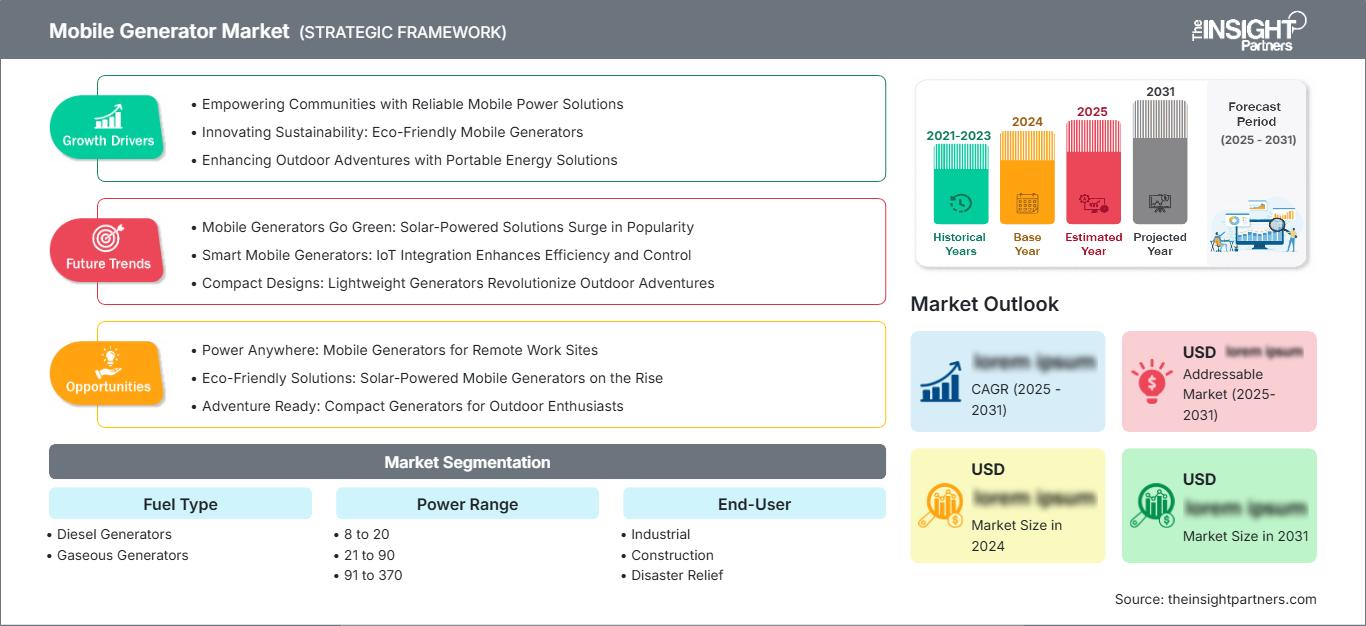
Mobile Generator Market: Strategic Insights
Regional Insights
North America Mobile Generator Market
North America holds an estimated 32-35% share of the global market in 2025, expanding at a CAGR of 3.3-3.8% through 2034. Growth is fueled by increasing instances of extreme weather conditions that would require backup power solutions, together with continued development within the construction industry, ensuring the constant need for generator rentals.
Key structural factors consist of an aging fleet of infrastructure in cities that requires upgrading of its backup power solutions, along with growing exploration of oil fields in certain regions, necessitating portable power solutions. Canada provides steady demand from its remote industrial and mining projects, while Mexico grows its manufacturing sector with the help of the nearshoring trend, thus creating additional regional demand.
U.S. Mobile Generator Market
The United States accounts for an estimated 76-80% share of the North American mobile generator market in 2025, growing at a CAGR of 3.2-3.7% through 2034. Constantly growing construction and increasing investments in disaster relief preparations keep providing the base for the demand for diesel and gas mobile generators.
Generac Power Systems, Inc. and Cummins Inc. operate large-scale domestic manufacturing and services, ensuring fast delivery and installation of the equipment in case of emergencies. The trend in the application is the growing popularity of gaseous generators in the municipal fleets because of the strict environmental regulations, whereas construction and oil fields choose diesel generators.
Europe Mobile Generator Market
Europe commands an estimated 22-25% share of the global market in 2025, growing at a CAGR of 3.4-3.9% through 2034, with Germany identified as the leading contributor given its extensive construction and industrial machinery sectors requiring reliable standby and mobile power solutions.
Germany represents the region's largest market, driven by construction and industrial equipment demand for portable diesel generators. The UK contributes through disaster relief preparedness and municipal infrastructure upgrades, while France, Italy, and Spain register steady demand from construction and renewable energy installation projects requiring reliable mobile power solutions across expanding regional infrastructure development initiatives.
APAC Mobile Generator Market
Asia Pacific leads the global market with an estimated 26-30% of the Mobile Generator Market share in 2025, expanding at the fastest regional CAGR of 3.9-4.4% through 2034. China leads, given its extensive infrastructure construction base, followed by India, Japan, South Korea, and Australia.
Industrial policy support for infrastructure development, particularly across China and India, alongside expanding disaster relief preparedness programs following recurring natural disaster events, continues driving demand for portable diesel and gaseous generators across construction and emergency response applications region-wide.
Middle East & Africa Mobile Generator Market
The Middle East & Africa mobile generator market is projected to grow at a CAGR of 3.1-3.6% through 2034, with Saudi Arabia leading regional demand through infrastructure diversification projects requiring reliable mobile power solutions across construction and oil field installations.
The UAE contributes through construction and smart infrastructure projects, while South Africa and the Rest of MEA register gradual uptake tied to grid reliability challenges and mining sector expansion requiring dependable portable power solutions across remote industrial installations.
Segmentation Analysis
Fuel Type
The Fuel Type segment, comprising Diesel Generators and Gaseous Generators, registers a combined CAGR of 3.6-4.1% between 2026 and 2034. Diesel units continue dominating industrial and oil field applications requiring extended runtime, while gaseous generators gain preference across municipal and construction fleets responding to tightening regional emissions standards and cleaner-burning fuel requirements.
- Diesel Generators: Diesel generators remain preferred for industrial, oil field, and military applications requiring extended runtime and higher power output, valued for fuel efficiency and proven reliability under demanding conditions.
- Gaseous Generators: Gaseous generators gain traction across municipal and construction fleets, favored for lower emissions profiles and quieter operation suited to urban and regulated environmental compliance requirements.
Power Range
The Power Range segment, spanning 8 to 20, 21 to 90, 91 to 370, and 371 to 500 kilowatt categories, grows at a CAGR of 3.5-4.0% through 2034. This mobile generator market scope reflects diverse application requirements, with mid-range units gaining share as construction and industrial customers increasingly standardize around flexible, moderate-capacity power solutions for varied project scales.
- 8 to 20: This range serves small construction sites and residential backup applications, valued for portability and adequate power output for light-duty equipment and temporary facility power needs.
- 21 to 90: This range dominates mid-scale construction and commercial applications, offering balanced power output suited to equipment operation and temporary facility electrification requirements across project sites.
- 91 to 370: This range serves industrial and oil field applications requiring substantial power capacity, supporting heavy machinery operation and extended-duration project power requirements across demanding environments.
- 371 to 500: This range serves large-scale industrial, military, and disaster relief applications requiring maximum power output, supporting critical infrastructure restoration and extensive equipment operation simultaneously.
End-User
The End-User segment, covering Industrial, Construction, Disaster Relief, Oil Field, Military, and Municipal Fleets, expands at a CAGR of 3.7-4.2% between 2026 and 2034. Construction and industrial applications maintain dominant share given consistent project-based demand, while disaster relief and municipal fleet segments grow steadily through expanding emergency preparedness investment and public infrastructure modernization programs.
- Industrial: Industrial facilities utilize mobile generators for backup power during grid outages and temporary power needs during facility expansion or maintenance activities requiring uninterrupted operational continuity.
- Construction: Construction sites represent a dominant application, requiring portable generators for equipment operation and temporary facility power throughout project development phases lacking permanent grid connections.
- Disaster Relief: Disaster relief organizations depend on mobile generators for rapid emergency power restoration following natural disasters, prioritizing reliability and rapid deployment capability during critical response periods.
- Oil Field: Oil field operations require robust mobile generators for remote power supply supporting extraction equipment and facility operations in locations lacking consistent grid infrastructure access.
- Military: Military applications demand ruggedized mobile generators for field operations and tactical power requirements, prioritizing durability and reliable performance under extreme operational conditions.
- Municipal Fleets: Municipal fleets increasingly integrate mobile generators for emergency response readiness and public infrastructure backup power, driven by expanding disaster preparedness budget allocations across local governments.
Opportunity Snapshot
| End-User | Revenue Contribution | Trend Tag | Adoption Stage |
| Industrial | High | Facility Backup | Mature |
| Construction | High | Site Power | Mature |
| Disaster Relief | Medium | Emergency Response | Scaling |
| Oil Field | Medium | Remote Extraction | Mature |
| Military | Medium | Tactical Deployment | Mature |
| Municipal Fleets | Medium | Public Infrastructure | Scaling |
Mobile Generator Market Growth Drivers and Impact Analysis
Rising Extreme Weather Frequency Driving Emergency Power Demand
With an increase in the occurrence and severity of weather-related catastrophes like hurricanes, forest fires, and severe winter weather events, the need for mobile generators that can quickly be dispatched during power failure situations is rising greatly. The trend for disaster relief organizations and city authorities to keep a set of generator vehicles to restore power quickly after natural disasters damaging critical facilities is on the rise. In regions experiencing repeated severe weather conditions, utility grid exposure and vulnerability lead to the need to invest in backup power systems. Insurance companies' information helps cities in budget planning for disaster preparation, thus indirectly aiding in decision-making for generator acquisition. With the continuing impact of climate variability on grid stability in different regions, the demand for mobile diesel and gaseous generators is expected to continue to rise.
Sustained Construction Sector Activity Supporting Equipment Power Demand
On-going activities within the various sectors that include construction projects, commercial and infrastructure development, continue to create a constant demand for generators capable of providing power to equipment and facilities during various phases of the projects before they are linked up to the permanent power supply source. Construction companies increasingly turn to leasing generators to help save costs and increase their flexibility without committing funds towards such equipment. This trend is favorable to mid-sized generators that can meet the power requirements for various construction projects. Increased investments into infrastructure across both developed and developing economies continue to create additional demand for generator leasing and purchases. Suppliers who provide a wide range of power generation options can tap into this increased demand base.
Tightening Emissions Regulations Accelerating Gaseous Generator Adoption
As a result of increasingly rigorous regional emissions regulations for mobile power equipment, there is an increased uptake of gaseous generators whose combustion is cleaner when contrasted with their diesel counterparts. For example, municipal fleet operators and construction contractors working in regulated urban areas feel increasing pressure to comply, hence prompting them to migrate to equipment whose power output is more environmentally friendly. Such regulatory pressures are common among regions that already have in place a compliance framework for air quality regulations, limiting the use of diesel equipment in certain zones. Failure to comply leads to delays and penalties. Thus, due to increasingly stringent environmental regulations worldwide and in select developing countries, the demand for gaseous generators in these applications will continue to grow significantly.
Mobile Generator Market Future Trends
Integration of Hybrid Battery Systems within Mobile Generator Configurations
Manufacturers are increasingly incorporating battery storage integration within mobile generator configurations, reflecting broader mobile generator market trends toward hybrid power solutions, balancing fuel efficiency and emissions reduction. This capability enables generators to operate in battery-supported modes during lower-demand periods, reducing fuel consumption and extending maintenance intervals. As construction and municipal fleet operators prioritize sustainability alongside operational reliability, demand for hybrid-configured units compatible with variable load requirements is expected to increase. This trend is particularly relevant for disaster relief and remote industrial applications requiring extended operational periods, positioning hybrid generators as a differentiated product category among manufacturers targeting environmentally conscious institutional and municipal customers globally.
Expansion of Remote Monitoring and Predictive Maintenance Capabilities
A shift towards the use of generators fitted with remote monitoring technology will revolutionize the manufacturing process, since the fuel level, run time, and maintenance requirements can all be monitored without visiting the location. The connectivity is helping to minimize downtime of equipment in cases such as disaster recovery and oil field work, where machine breakdowns have major repercussions. There is an increasing tendency among manufacturers to create generator platforms that incorporate telematics in order to schedule maintenance according to machine performance. This trend will continue in the future as more rental fleet operators and municipal authorities focus on suppliers who provide fleet management and lower cost of ownership in different applications.
Mobile Generator Market Opportunities
Expansion of Rental Fleet Infrastructure Across Emerging Construction Markets
Growing infrastructure construction activity across emerging Southeast Asian, Latin American, and African economies presents a significant opportunity for generator manufacturers and rental companies establishing localized fleet infrastructure. Regional construction contractors increasingly seek flexible rental arrangements offering equipment access without substantial capital investment requirements. Companies investing in regional service centers and technical support networks can strengthen market penetration within these growing economies. This opportunity extends to establishing maintenance and parts distribution operations closer to demand centers, reducing response times and operational costs. Mobile generator market forecasts indicate sustained investment interest in emerging market rental infrastructure will continue strengthening through 2034 as global manufacturers rebalance distribution networks to serve expanding construction and industrial demand strategically.
Development of Specialized Configurations for Renewable Energy Transition Support
Expanding renewable energy installation projects present a substantial opportunity for mobile generator manufacturers developing specialized configurations supporting temporary power during solar and wind farm construction phases, lacking permanent grid connections. Companies investing in product development targeting renewable energy contractor requirements can differentiate through application-specific power range and fuel efficiency optimization. This opportunity extends to hybrid generator configurations supporting battery storage installation and commissioning activities requiring temporary backup power. Manufacturers prioritizing renewable energy sector engagement, supported by dedicated sales resources targeting this expanding contractor segment, are positioned to capture incremental growth as global renewable energy infrastructure investment continues accelerating across both developed and emerging regional markets.
Frequently Asked Questions

- Comprehensive Market Sizing and Forecast Analysis
- Detailed Segmentation Analysis
- In-Depth Market Dynamics Assessment
- Regional and Country-Level Insights
- Competitive Landscape and Company Benchmarking
- Strategic Business Intelligence
Recent Reports
Testimonials

The Insight Partners provided valuable market intelligence that supported our global go-to-market strategy. Their team was professional, responsive, and attentive to our feedback, providing thoughtful analysis and helpful methodological clarifications throughout the project.
Junmo Kim Chief Financial Officer (CFO), Enertech Co., Ltd.
The Insight Partners' SCADA System Market report is comprehensive, with valuable insights on current trends and future forecasts. The team was highly professional, responsive, and supportive throughout. We are very satisfied and highly recommend their services.
RAN KEDEM Partner, Reali Technologies LTDs
I requested a report on a very specific software market and the team produced the report in a few days. The information was very relevant and well presented. I then requested some changes and additions to the report. The team was again very responsive and I got the final report in less than a week.
JEAN-HERVE JENN Chairman, Future Analytica
We worked with The Insight Partners for an important market study and forecast. They gave us clear insights into opportunities and risks, which helped shape our plans. Their research was easy to use and based on solid data. It helped us make smart, confident decisions. We highly recommend them.
PIYUSH NAGPAL Sr. Vice President, High Beam Global
The Insight Partners delivered insightful, well-structured market research with strong domain expertise. Their team was professional and responsive throughout. The user-friendly website made accessing industry reports seamless. We highly recommend them for reliable, high-quality research services
YUKIHIKO ADACHI CEO, Deep Blue, LLC.
This is the first time I have purchased a market report from The Insight Partners.While I was unsure at first, I visited their web site and felt more comfortable to take the risk and purchase a market report.I am completely satisfied with the quality of the report and customer service. I had several questions and comments with the initial report, but after a couple of dialogs over email with their analyst I believe I have a report that I can use as input to our strategic planning process.Thank you so much for taking the extra time and making this a positive experience.I will definitely recommend your service to others and you will be my first call when we need further market data.
JOHN SUZUKI President and Chief Executive Officer, Board Director, BK Technologies
I wish to appreciate your support and the professionalism you displayed in the course of attending to my request for information regarding to infectious disease IVD market in Nigeria. I appreciate your patience, your guidance, and the fact that you were willing to offer a discount, which eventually made it possible for us to close a deal. I look forward to engaging The Insight Partners in the future, all thanks to the impression you have created in me as a result of this first encounter.
DR CHIJIOKE ONYIA MANAGING DIRECTOR, PineCrest Healthcare Ltd.Reason to Buy
- Informed Decision-Making
- Understanding Market Dynamics
- Competitive Analysis
- Identifying Emerging Markets
- Customer Insights
- Market Forecasts
- Risk Mitigation
- Boosting Operational Efficiency
- Strategic Planning
- Investment Justification
- Tracking Industry Innovations
- Aligning with Regulatory Trends





 Get Free Sample for