
Residential Routers Market Trends, Size & Growth by 2034
Coverage: By Connectivity (Wired, Wireless); Standard (802.11b/g/n, 802.11ac, 802.11ax) , and Geography (North America, Europe, Asia Pacific, and South and Central America)
- Status : Data Released
- Report Code : TIPRE00017561
- Category : Electronics and Semiconductor
- No. of Pages : 150
- Available Report Formats :


- Last update date : September 17, 2026


2025 Market Size
US$ 12.81 Bn
Base year value
2034 Forecast
US$ 23.63 Bn
Projected by 2034
CAGR 2026-2034
7.04 %
Growth rate
Addressable Market
US$ 164.51 Bn
(2026-2034)
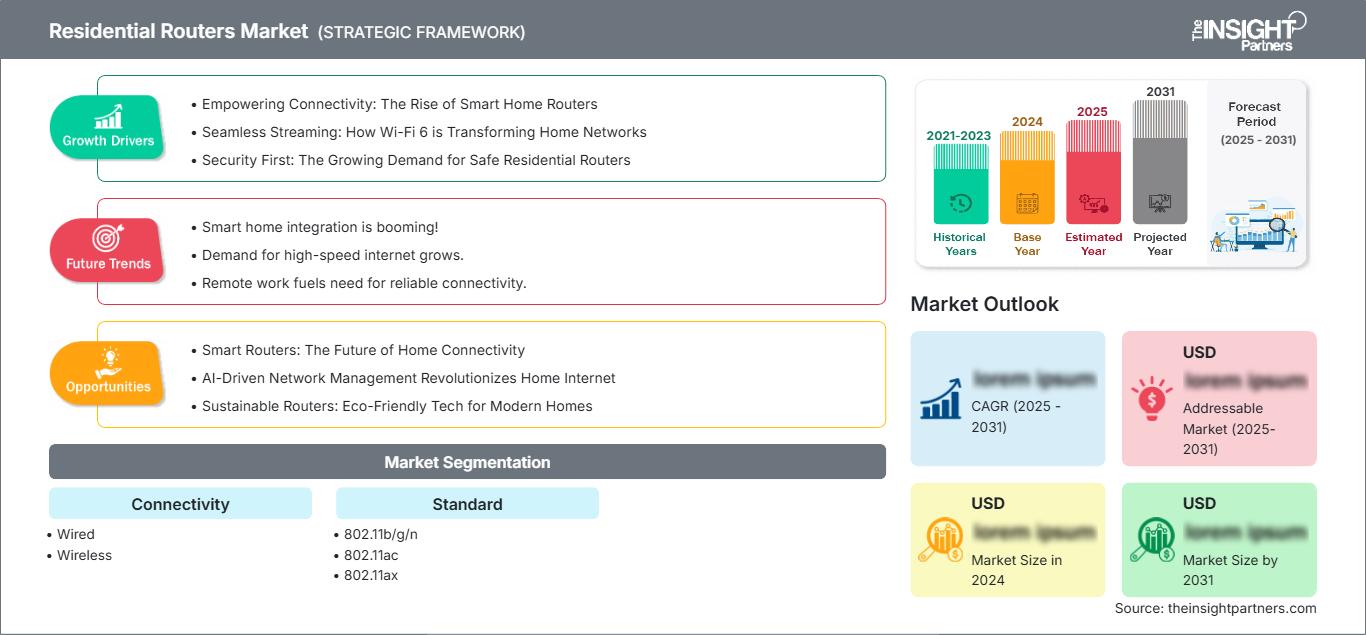
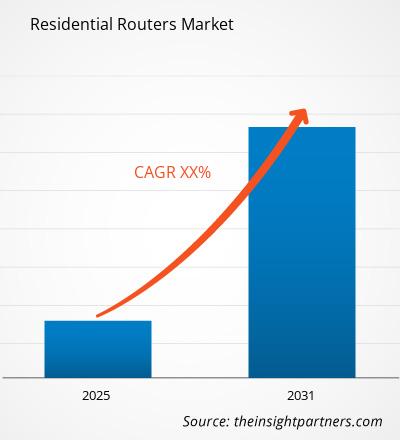
The residential routers market is positioned at US$ 12.81 Billion in 2025 and is projected to reach US$ 23.63 Billion by 2034, registering a CAGR of 7.04% during 2026–2034. Expansion is supported by higher household broadband speeds, increasing connected-device density, and migration toward advanced wireless standards that improve capacity, latency, security, and whole-home coverage for increasingly data-intensive residential environments.
North America remains a structurally attractive geography, with the residential routers market size supported by widespread gigabit broadband, high connected-device penetration, and replacement demand for higher-capacity equipment. The region is expected to register a 6.70–7.20% CAGR between 2026 and 2034, as fiber upgrades, multi-gigabit plans, Wi-Fi 7 adoption, and cybersecurity requirements encourage households to replace legacy equipment.
Residential Routers Market Assessment and Insights
- North America: North America is expected to account for a 29–33% share in 2025 and expand at a 6.70–7.20% CAGR between 2026–2034, supported by gigabit broadband upgrades, device density, and replacement cycles.
- US: The US represents a 72–76% share of North America in 2025 and is projected to grow at a 6.80–7.30% CAGR between 2026–2034, led by fiber and multi-gigabit broadband.
- Europe: Europe is estimated to hold a 25–29% share in 2025 and grow at a 6.30–6.90% CAGR between 2026–2034, with Germany, the UK, France, Italy, and Spain supporting demand through fiber deployment and connected-home adoption.
- Asia Pacific: Asia Pacific is projected to hold a 29–33% share in 2025 and register an 8.00–8.60% CAGR between 2026–2034, with China, Japan, South Korea, and India benefiting from expanding broadband infrastructure.
- Largest Segment: Wireless connectivity holds an 82–86% market share in 2025 and is expected to expand at a 7.60–8.00% CAGR during 2026–2034, reflecting dominant household Wi-Fi usage.
- High Growth Segment: 802.11ax is estimated at a 38–42% market share in 2025 and is projected to grow at a 10.20–10.80% CAGR during 2026–2034, supported by efficient multi-device networking.
- Key companies analyzed in detail: ASUSTeK Computer Inc., D-Link Corporation, Google LLC, Linksys, NETGEAR, Inc., Nokia Solutions and Networks Oy, Synology Inc., TP-Link Systems Inc., TRENDnet, Inc., and Xiaomi Corporation.
Source: The Insight Partners' analysis based on proprietary research, government publications, company annual reports, investor presentations, industry databases, and expert interviews.
The residential routers market has evolved from basic gateway equipment toward intelligent, high-capacity home networking platforms. Product differentiation is becoming increasingly focused on Wi-Fi 6, Wi-Fi 7, mesh technology, multi-gigabit Ethernet, automatic channel management, parental controls, and built-in cybersecurity. The production process has become characterized by highly integrated chipsets as well as software-defined functionalities, thus enabling vendors to provide premium gaming, smart homes, and broadband lines using a common hardware platform.
Future growth will increasingly be characterized by upgrades to broadband technologies outside the established developed countries. In January 2026, the Indian government adopted lower-6 GHz regulations, thus encouraging the adoption of Wi-Fi 7, while the fiber build-outs and spectrum harmonization in Europe make the case even stronger for high-capacity home networks. Suppliers are hence investing in radio frequency technology, processing power, security firmware, cloud management services, and local production.
Residential Routers Market Report Scope
| Report Attribute | Details |
|---|---|
| Market size in 2025 | US$ 12.81 Billion |
| Market Size by 2034 | US$ 23.63 Billion |
| Global CAGR (2026 - 2034) | 7.04% |
| Historical Data | 2021-2024 |
| Forecast period | 2026-2034 |
Residential Routers Market Analysis
Demand in the market growth cycle is closely linked to broadband speed, connected-device density, streaming, gaming, remote work, smart-home equipment, and cloud applications. The ecosystem is made up of chipset vendors, original equipment manufacturers, ISPs, retailers, installers, software providers, and end-users. Given the increasing adoption of fixed broadband at gigabit and multi-gigabit speeds, the router performance bottleneck shifts to throughput capability, which was once just a convenience factor.
Supply factors are driven by semiconductor availability, radio frequency chips, memory, antennas, Ethernet controllers, and software. Increasingly, vendors rely on a common platform across various segments, and new revenues from mesh networks and managed gateways can be expected. Component standardization may reduce manufacturing complexity, yet regional certifications, spectrum regulations, security considerations, and supply chain localization are key factors for the availability and launch dates of products.
Competitive positioning in market analysis increasingly depends on technology cadence, software experience, brand trust, and channel reach. ASUSTeK Computer Inc. emphasizes performance-oriented networking, while D-Link Corporation and TRENDnet, Inc. maintain broad networking portfolios. NETGEAR, Inc. competes strongly in premium and performance categories, whereas TP-Link Systems Inc. combines extensive consumer coverage with aggressive Wi-Fi 7 expansion.
Google LLC and Linksys are focused on easy management and ecosystem integration, whereas Xiaomi Corporation takes advantage of its larger ecosystem of smart devices. Nokia Solutions and Networks Oy engages itself strongly in home connectivity from a service provider perspective, whereas Synology Inc. makes its name through software-based network management. The current investment focus is on Wi-Fi 7, mesh technology improvement, network management with artificial intelligence, cybersecurity, and faster Ethernet, resulting in a division between hardware-based and software-based solutions.
● REPORT CUSTOMIZATION
Tailor This Report To Align With Your Specific Business Requirements
This report can be customized to align precisely with your business objectives, scope, and target markets. Customization options include tailored segmentation, geography, competitive analysis, and strategic insights to support informed decision-making.
Customize This Report →WHAT YOU CAN ADJUST
- ● Segmentations
- ● Geography
- ● Competitive Analysis
- ● Language Preferences
Residential Routers Market: Strategic Insights
Regional Insights
North America residential routers market
North America is estimated to represent a 29–33% share of the global residential routers market in 2025 and is expected to expand at a 6.70–7.20% CAGR through 2034. While the US accounts for regional demand, the participation of Canada lies in fiber installation, broadband enhancement in cities, and the upgrade of older gateways. With high internet usage among households, there is room for repeated cycles of router replacement.
Multi-gigabit broadband installation, connected home usage, and cybersecurity consciousness are factors that affect regional demand as well. With the need for reliable coverage in more than one room in the house, there are possibilities for mesh and Wi-Fi 7 technology. Service providers continue to play significant roles in distribution as they can coincide gateway upgrades with broadband subscription changes.
U.S. residential routers market
The US represents approximately 72–76% of the North American residential routers market demand in 2025, while its market is projected to grow at a 6.80–7.30% CAGR through 2034. In fact, fiber, cable, and fixed-wireless broadband services now offer increased speed options that set up the need for effective networking hardware at home. Online gaming, video streaming, remote working, and connected devices further boost the replacement cycle.
Among ASUSTeK Computer Inc., Google LLC, Linksys, NETGEAR, Inc., and TP-Link Systems Inc. are major players in terms of consumer awareness, while Nokia Solutions and Networks Oy is involved in the space through connectivity solutions for the service providers. In terms of applications, full wireless coverage of the home, multiple device control, parental control, IoT isolation, and secure remote access gain priority.
Europe residential routers market
Europe is expected to account for a 25–29% of the residential routers market share in 2025 and register a 6.30–6.90% CAGR through 2034. Germany is a leading national market, supported by broadband modernization and high household connectivity. The UK, France, Italy, and Spain also contribute substantially, with fiber deployment improving the performance requirements placed on residential routers.
The UK is progressing rapidly in full-fiber availability, with Ofcom reporting 24.9 million residential premises covered in January 2026. Germany remains important because broadband modernization and dense urban housing create demand for reliable whole-home connectivity. France and Spain benefit from extensive fiber networks, while Italy continues upgrading fixed broadband. Europe’s harmonized 6-GHz environment supports advanced wireless products and encourages migration toward higher-capacity equipment.
APAC residential routers market
APAC is projected to hold a 29–33% share of the residential routers market in 2025 and grow at an 8.00–8.60% CAGR through 2034. China leads the regional opportunity, followed by Japan, South Korea, India, and Australia. Expanding broadband, smart-home adoption, and rising digital consumption support equipment upgrades across residential settings.
China benefits from scale and domestic networking ecosystems, while Japan and South Korea maintain advanced broadband environments. India combines rapid internet adoption with emerging Wi-Fi 7 availability, supported by lower-6-GHz regulation. Australia continues expanding high-speed fixed connectivity. Industrial policy, localized manufacturing, and spectrum liberalization should support APAC demand, making the region a key source of incremental unit growth.
Middle East & Africa residential routers market
The Middle East and Africa residential routers market demand is developing from a smaller base, with Saudi Arabia and the UAE leading premium connectivity adoption and South Africa representing a significant African market. The region is expected to expand at a 7.20–7.80% CAGR through 2034, supported by broadband modernization and smart-city investment.
Saudi Arabia benefits from digital infrastructure programs, while the UAE emphasizes high-speed connectivity and smart-home applications. South Africa is supported by fixed broadband and fiber expansion, whereas the rest of MEA presents opportunities through fixed wireless access and improving urban connectivity. Infrastructure investment, rising digital services usage, and household device proliferation will increasingly favor higher-capacity wireless equipment.
Segmentation Analysis
Connectivity
The Connectivity segment is expected to grow at a 7.40–7.90% CAGR during 2026–2034. Residential demand is increasingly concentrated around wireless access because households require flexible coverage across smartphones, televisions, computers, cameras, appliances, and gaming devices. Wired connectivity remains strategically relevant for backhaul, gaming, storage, and high-throughput fixed devices, supporting hybrid network architectures, according to the Residential Routers Market forecast.
- Wired: Wired connectivity remains strategically important for high-throughput devices, mesh backhaul, gaming systems, storage, and smart-home hubs where stable low-latency communication is prioritized over installation flexibility.
- Wireless: Wireless connectivity maintains the dominant position because smartphones, televisions, laptops, wearables, cameras, and smart appliances depend on flexible whole-home access without dedicated physical cabling.
Standard
The Standard segment is forecast to expand at a 6.80–7.30% CAGR during 2026–2034. Demand is moving from legacy 802.11b/g/n products toward higher-efficiency standards as broadband speeds and connected-device counts increase. Product portfolios increasingly use newer standards to differentiate premium offerings while retaining lower-cost equipment for price-sensitive households and basic connectivity requirements, reflecting key Residential Routers Market trends.
- 802.11b/g/n: Legacy standards remain relevant in installed networks and low-cost devices, particularly where replacement cycles are longer, although their role is gradually narrowing as households demand higher throughput and capacity.
- 802.11ac: 802.11ac continues serving mainstream households requiring dependable dual-band performance, particularly where broadband speeds are moderate and users do not yet require advanced multi-device efficiency.
- 802.11ax: 802.11ax benefits from improved capacity, efficiency, and congestion management, making it strategically important for dense connected homes and providing a practical bridge toward Wi-Fi 7 adoption.
Opportunity Snapshot
| Standard | Revenue Contribution (High/Medium/Low) | Trend Tag | Adoption Stage |
| 802.11b/g/n | Low | Legacy Refresh | Mature |
| 802.11ac | Medium | Dual-Band | Mature |
| 802.11ax | High | Wi-Fi 6 | Scaling |
Residential Routers Market Growth Drivers and Impact Analysis
Expansion of Gigabit and Multi-Gigabit Broadband
Increased speed of fixed broadband is leading to higher performance needs for home networking devices. OECD statistics indicate that the proportion of gigabit offers in OECD markets has risen from 3% of fixed broadband subscriptions in 2019 to 19% in 2024, signifying an evolution towards higher speed connections. With more customers choosing faster options, older routers become limiting factors, preventing them from exploiting bandwidth. This opens up chances for replacing them with Wi-Fi 6, Wi-Fi 7, multi-gigabit Ethernet, and mesh networking products. ISPs can facilitate the process by including appropriate gateways with faster broadband packages. The consequent upgrade cycle provides higher ASPs for producers and motivates them to develop better-performing chipsets and traffic management software.
Rising Connected-Device Density in Residential Environments
It is now common for households to use smartphones, TVs, laptops, tablets, cameras, appliances, sensors, and gaming systems at once. This shifts the purchase consideration from the maximum theoretical rate to capacity, reliability, latency, and effective allocation of resources. Newer generations of WiFi, such as WiFi 6, account for dense device environments by using advanced techniques such as OFDMA and improved scheduling, as well as efficient spectrum usage. Another way that makes it easier to cover large or multi-floor apartments is the mesh technology. This means that the market consequence will be an increasing gap between low-end and high-capacity routers.
Cybersecurity and Network Management Becoming Purchase Criteria
Home routers have become security gateways rather than connectivity equipment. Multiple endpoints, such as connected cameras, appliances, computers, and phones need to be authenticated, segmented, managed, and secured from any malicious traffic. More and more regulatory issues have come into play, evidenced by the recent FCC decision in the United States in March 2026 for consumer router approvals that are produced abroad. In this environment, the strategic importance of a security approach to software updating, supply chain integrity, vulnerability management, and compliance becomes crucial. Vendors should differentiate themselves by offering security controls, guest networks, IoT isolation, parental management, and automatic threat detection.
Residential Routers Market Future Trends
AI-Assisted Home Network Optimization
In terms of the evolution of routing technology in the future, there will be more implementation of artificial intelligence that will help in analyzing network conditions and configuring the routers without human input. Future devices will not need humans to choose channels or fix issues related to congestion because the technology will detect interference and prioritize devices based on traffic and coverage issues. The future devices will distribute resources for work, gaming, media streaming, and IoT devices, and recommend moving routers or installing mesh routers based on needs. In situations where local computation is needed for sensitive information, it can be done locally within the house, without sending out information.
Transition Toward Reliability-Centric Wireless Architecture
Innovations within wireless technology are slowly making a transition from focusing on maximizing data throughput to providing consistent performance in the presence of interference, congestion, and mobility. Innovation in the form of the development of Wi-Fi 8 is aligned with this transition in the sense that the focus will now be on reliability, access point coordination, low latency, and multi-client support. The implication of this for home networking is that future routers will monitor connection performance continuously as opposed to simply reporting the highest possible theoretical throughput performance. Coordination among multiple access points can help with coverage and handoff problems among different nodes, especially in large households. In the long run, router evaluation will increasingly take into account reliability measures like latency and connection performance.
Residential Routers Market Opportunities
Localized Manufacturing and Regional Product Configuration
The residential routers forecasts increasingly favor suppliers capable of aligning manufacturing, certification, spectrum configuration, and product software with regional requirements. TP-Link’s 2026 localization of Wi-Fi 7 production in India illustrates how spectrum liberalization can intersect with manufacturing strategy. Similar opportunities exist in other high-growth markets where governments encourage domestic electronics production or secure technology supply chains. Manufacturers can establish regional assembly, testing, firmware teams, and supplier relationships to shorten delivery cycles and reduce regulatory friction. Localization can also enable market-specific configurations for frequency bands, power limits, language support, and operator requirements. Strategic investment in these capabilities may improve resilience while allowing companies to respond faster to changes in broadband infrastructure and wireless policy.
Premium Mesh and Multi-Gigabit Residential Ecosystems
Premium households increasingly require seamless connectivity across large floor areas, multiple users, smart-home devices, gaming equipment, and high-bandwidth entertainment. This creates an opportunity to combine routers, mesh nodes, multi-gigabit switches, security software, and device-management applications into integrated platforms. Suppliers can pursue recurring software revenue through advanced parental controls, security subscriptions, diagnostics, and cloud-based network management, while maintaining hardware differentiation through Wi-Fi 7 and higher-speed Ethernet. The opportunity is particularly relevant where fiber upgrades are occurring faster than household networking replacement. Companies that establish interoperability across routers, access points, and smart-home devices can increase customer retention and create stronger ecosystem effects without depending exclusively on periodic hardware upgrades.
Frequently Asked Questions

- Comprehensive Market Sizing and Forecast Analysis
- Detailed Segmentation Analysis
- In-Depth Market Dynamics Assessment
- Regional and Country-Level Insights
- Competitive Landscape and Company Benchmarking
- Strategic Business Intelligence
Recent Reports
Testimonials

The Insight Partners provided valuable market intelligence that supported our global go-to-market strategy. Their team was professional, responsive, and attentive to our feedback, providing thoughtful analysis and helpful methodological clarifications throughout the project.
Junmo Kim Chief Financial Officer (CFO), Enertech Co., Ltd.
The Insight Partners' SCADA System Market report is comprehensive, with valuable insights on current trends and future forecasts. The team was highly professional, responsive, and supportive throughout. We are very satisfied and highly recommend their services.
RAN KEDEM Partner, Reali Technologies LTDs
I requested a report on a very specific software market and the team produced the report in a few days. The information was very relevant and well presented. I then requested some changes and additions to the report. The team was again very responsive and I got the final report in less than a week.
JEAN-HERVE JENN Chairman, Future Analytica
We worked with The Insight Partners for an important market study and forecast. They gave us clear insights into opportunities and risks, which helped shape our plans. Their research was easy to use and based on solid data. It helped us make smart, confident decisions. We highly recommend them.
PIYUSH NAGPAL Sr. Vice President, High Beam Global
The Insight Partners delivered insightful, well-structured market research with strong domain expertise. Their team was professional and responsive throughout. The user-friendly website made accessing industry reports seamless. We highly recommend them for reliable, high-quality research services
YUKIHIKO ADACHI CEO, Deep Blue, LLC.
This is the first time I have purchased a market report from The Insight Partners.While I was unsure at first, I visited their web site and felt more comfortable to take the risk and purchase a market report.I am completely satisfied with the quality of the report and customer service. I had several questions and comments with the initial report, but after a couple of dialogs over email with their analyst I believe I have a report that I can use as input to our strategic planning process.Thank you so much for taking the extra time and making this a positive experience.I will definitely recommend your service to others and you will be my first call when we need further market data.
JOHN SUZUKI President and Chief Executive Officer, Board Director, BK Technologies
I wish to appreciate your support and the professionalism you displayed in the course of attending to my request for information regarding to infectious disease IVD market in Nigeria. I appreciate your patience, your guidance, and the fact that you were willing to offer a discount, which eventually made it possible for us to close a deal. I look forward to engaging The Insight Partners in the future, all thanks to the impression you have created in me as a result of this first encounter.
DR CHIJIOKE ONYIA MANAGING DIRECTOR, PineCrest Healthcare Ltd.Reason to Buy
- Informed Decision-Making
- Understanding Market Dynamics
- Competitive Analysis
- Identifying Emerging Markets
- Customer Insights
- Market Forecasts
- Risk Mitigation
- Boosting Operational Efficiency
- Strategic Planning
- Investment Justification
- Tracking Industry Innovations
- Aligning with Regulatory Trends





 Get Free Sample for