
RF-over-Fiber Market Share, Growth & Forecast by 2034
Coverage: by Component (Optical Cables, Optical Amplifiers, Transceivers, Optical Switches, Antennas, Others); Frequency Band (L, S, C, X, KU, KA); Application (Telecommunications, Radar, Navigation, Broadcast, Broadband); End-use (Civil, Military) , and Geography (North America, Europe, Asia Pacific, and South and Central America)
- Status : Data Released
- Report Code : TIPRE00006227
- Category : Electronics and Semiconductor
- No. of Pages : 150
- Available Report Formats :


- Last update date : September 15, 2026


2025 Market Size
US$ 643.85 Mn
Base year value
2034 Forecast
US$ 1,025. Mn
Projected by 2034
CAGR 2026-2034
5.98 %
Growth rate
Addressable Market
US$ 7,834.64 Mn
(2026-2034)
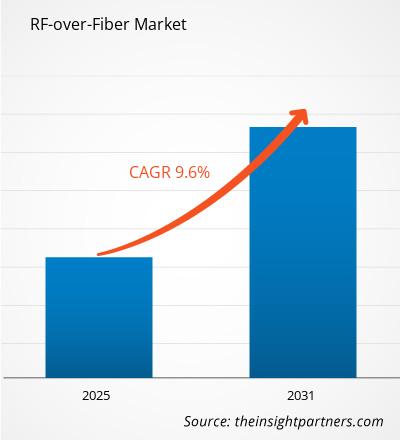
The rf-over-fiber market is positioned for sustained expansion as optical transport increasingly supports high-frequency wireless, radar, navigation, and secure communications architectures. The market is valued at US$ 643.85 Million in 2025 and is projected to reach US$ 1025.00 Million by 2034, reflecting a CAGR of 5.98% from 2026 to 2034. Its development is supported by demand for low-loss signal distribution, electromagnetic interference immunity, lighter interconnects, and geographically separated antenna and processing infrastructure.
North America remains a strategically important geography, with the rf-over-fiber market size expected to expand at an estimated 5.6–6.2% CAGR between 2026 and 2034. Aerospace and defense modernization, radar infrastructure replacement, satellite communications, and fiber-based telecommunications upgrades provide structural support. The region also benefits from established RF engineering capabilities, defense procurement programs, and a mature ecosystem of optical component and microwave technology suppliers.
RF-over-Fiber Market Assessment and Insights
- North America: North America is expected to retain a leading position, representing a 37–39% share in 2025 and growing at a 5.6–6.2% CAGR between 2026–2034, supported by defense electronics, radar modernization, satellite communications, and telecom infrastructure.
- US: The US accounts for 55–59% of North America's 2025 market, expanding at a 5.5–6.1% CAGR between 2026–2034, with aerospace, defense, radar, and secure communications applications sustaining demand.
- Europe: Europe represents a 20–22% share in 2025, growing at a 5.1–5.7% CAGR between 2026–2034. Germany, the UK, France, Italy, and Spain contribute through aerospace, defense, satellite, transportation, and telecommunications programs.
- Asia Pacific: Asia Pacific holds a 25–27% share in 2025 and is projected to grow at a 6.4–7.0% CAGR between 2026–2034, led by China, Japan, South Korea, and India through telecommunications expansion, electronics manufacturing, and defense modernization.
- Largest Segment: Optical Cables represent a 30–35% market share in 2025, with a 6.1–6.7% CAGR from 2026–2034, reflecting their central role in low-loss RF signal transport.
- High Growth Segment: Radar is estimated at a 20–24% market share in 2025, with a 7.0–7.6% CAGR from 2026–2034, driven by electronically steered systems, surveillance, and defense applications.
- Key companies analyzed in detail: APIC Corporation, EMCORE Corporation, ETL Systems Ltd, Finisar Corporation, Foxcom, Glenair, HUBER+SUHNER, Optical Zonu Corp, SEIKOH GIKEN Co., Ltd., and ViaLite.
Source: The Insight Partners' analysis based on proprietary research, government publications, company annual reports, investor presentations, industry databases, and expert interviews.
The rf-over-fiber market has evolved from specialized point-to-point signal extension toward integrated RF distribution architectures. Optical transmitters, optical receivers, optical amplifiers, and photonic packages have become more effective in terms of dynamic range, phase stability, bandwidth, and environmental resistance. Mass production focuses on small modules, durable units, and specific designs for radars, satellites, broadcasting, and wireless systems. The immunity of fiber optic cables to electromagnetic interference proves especially useful in cases of attenuation, grounding, and susceptibility of long copper cables.
Future developments are expected to spread to defense laboratories, satellite earth stations, telecommunication facilities, and distributed antenna systems. Manufacturing in Asia can help with the availability of components, but investments in North America and Europe are to be targeted at secure communications and aerospace systems. Increased focus of regulatory policies on spectrum efficiency and communication resiliency will favor optical transport architectures requiring transfer of RF signals without altering their properties or adding interference.
RF-over-Fiber Market Report Scope
| Report Attribute | Details |
|---|---|
| Market size in 2025 | US$ 643.85 Million |
| Market Size by 2034 | US$ 1,025. Million |
| Global CAGR (2026 - 2034) | 5.98% |
| Historical Data | 2021-2024 |
| Forecast period | 2026-2034 |
RF-over-Fiber Market Analysis
The rf-over-fiber market growth is being shaped by the need to transport analog RF signals across distances where coaxial infrastructure becomes heavy, lossy, or vulnerable to electromagnetic interference. Ecosystem encompasses lasers, photodiodes, optical transmitters and receivers, amplifiers, fiber assemblies, antennas, RF connectors, monitoring tools, and system integration providers. The market is driven by requirements such as signal integrity, distance, lightweight characteristics, and flexibility of antenna positioning.
Increasingly, the market favors suppliers that can integrate photonics with RF engineering, packaging, and monitoring technologies. The defense industry tends to have rugged and thermally stable parts, while the telecommunication and broadcasting industries have more scalable and serviceable components. Hence, there are different buying criteria and the market is not price-driven. Component suppliers compete on noise figure, spurious-free dynamic range, linearity, phase stability, bandwidth, packaging, and lifecycle.
The rf-over-fiber market analysis indicates a fragmented competitive environment comprising specialized RF photonics companies and broader optical technology suppliers. APIC Corporation, EMCORE Corporation, ETL Systems Ltd, Foxcom, Optical Zonu Corp, and ViaLite address different combinations of RF transport, satellite, wireless, and defense requirements. HUBER+SUHNER combines RF-over-fiber technology with broader photonic and interconnect capabilities, strengthening its position in aerospace and laboratory environments.
Investment is increasingly directed toward higher-frequency capability, miniaturization, network monitoring, ruggedization, and application-specific modules. Finisar Corporation contributes optical communications expertise, while Glenair and SEIKOH GIKEN Co., Ltd. bring complementary connectivity and photonics capabilities. Strategic positioning increasingly depends on qualification credentials, customization, supply reliability, and integration into larger RF systems rather than standalone component specifications.
● REPORT CUSTOMIZATION
Tailor This Report To Align With Your Specific Business Requirements
This report can be customized to align precisely with your business objectives, scope, and target markets. Customization options include tailored segmentation, geography, competitive analysis, and strategic insights to support informed decision-making.
Customize This Report →WHAT YOU CAN ADJUST
- ● Segmentations
- ● Geography
- ● Competitive Analysis
- ● Language Preferences
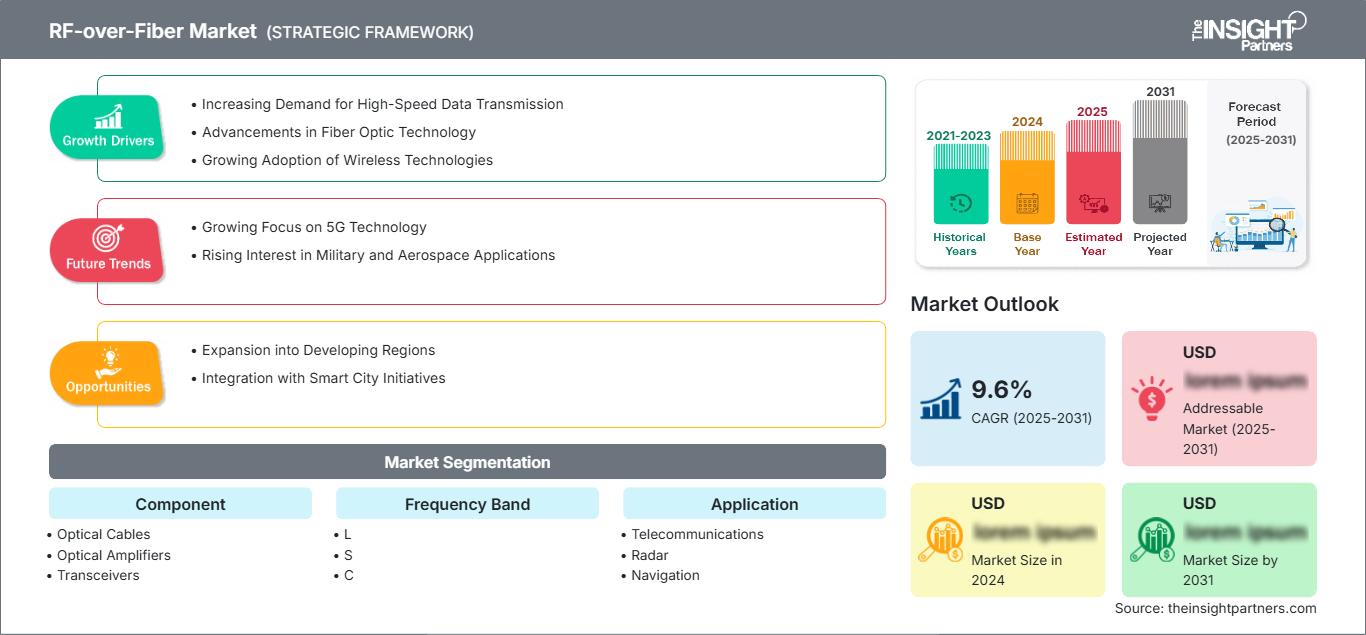
RF-over-Fiber Market: Strategic Insights
Regional Insights
North America rf-over-fiber market
North America commands a 37–39% of the rf-over-fiber market share in 2025 and is expected to expand at a 5.6–6.2% CAGR through 2034. The US accounts for most regional demand, supported by defense electronics, radar modernization, satellite communications, secure wireless networks, and advanced testing infrastructure. Canada contributes through aerospace, telecommunications, and research applications, while Mexico provides a smaller electronics and communications manufacturing base.
The focus of regional procurement on electromagnetic interference-resistant signal channels, lighter-weight cables, remote antenna interface, and ruggedized optics cannot be ignored. The technical requirements that arise from radar facilities, electronic warfare systems, military communications, and satellite ground station systems are important examples. Civil applications include the fiber optics-intensive wireless infrastructure as well as specialized broadcasting networks. This makes it possible for North America to continue being a leader in the field.
U.S. rf-over-fiber Market
The US represents approximately 55–59% of North America's 2025 rf-over-fiber market share and is projected to grow at a 5.5–6.1% CAGR through 2034. Demand is concentrated in aerospace and defense, satellite communications, radar, electronic warfare, telecommunications, and specialized test environments. Companies including EMCORE Corporation, Foxcom, Optical Zonu Corp, and ViaLite participate in applications requiring optical RF transport and signal remoting.
Application trends are moving toward distributed antennas, phased-array radar, secure communications, UAV connectivity, and remote instrumentation. Federal investment in radar and air-traffic infrastructure also creates opportunities for fiber-based signal distribution. The modernization of US aviation infrastructure includes significant replacement of legacy telecommunications systems with fiber technologies, reinforcing the broader infrastructure environment for optical connectivity. Procurement priorities remain focused on reliability, security, environmental tolerance, and interoperability.
Europe rf-over-fiber Market
Europe is estimated to hold a 20–22% share of the rf-over-fiber market in 2025, with a 5.1–5.7% CAGR through 2034. The UK is an important market because of defense electronics, radar, satellite communications, and telecommunications engineering. Germany supports demand through industrial electronics, automotive testing, aerospace, and advanced communications infrastructure. France, Italy, and Spain contribute through defense modernization, aerospace manufacturing, transportation, and telecom applications. The UK and Germany remain leading national contributors.
European adoption is supported by the need for secure, lightweight, and EMI-resistant connectivity in aircraft, spacecraft, laboratories, and critical infrastructure. Defense spending and modernization programs provide additional demand for RF distribution, radar testing, and electronic warfare systems. The region's established optical manufacturing base and emphasis on high-reliability engineering favor suppliers offering customized and qualified solutions. Demand should remain particularly resilient in aerospace and defense applications.
APAC rf-over-fiber Market
APAC holds a 25–27% share of the rf-over-fiber market in 2025 and is forecast to grow at a 6.4–7.0% CAGR through 2034, making it the fastest-growing major region. China is at the top of regional demand, trailed by Japan, South Korea, India, and Australia. Telecom infrastructure build-outs, electronics manufacturing, radar systems, and satellite systems enable adoption in these regions.
Government-driven digital infrastructure and defense modernization drive the addressable market opportunity. Japan and South Korea focus on communication electronics, and India is in the process of developing its own aerospace and defense industry. Opportunities exist in defense, satellite, and remote communications for Australia. The strong manufacturing capabilities of the region can be leveraged to manufacture components efficiently, making optical RF solutions attractive from an economic perspective.
Middle East & Africa rf-over-fiber Market
The Middle East and Africa rf-over-fiber market region is expected to expand at a 5.8–6.4% CAGR through 2034, with Saudi Arabia and the UAE leading regional demand. Investment in secure communications, smart infrastructure, satellite connectivity, airport systems, and defense electronics supports optical RF adoption, while South Africa contributes through telecommunications and research infrastructure.
Saudi Arabia's infrastructure diversification and UAE's aerospace and communications investments provide important demand centers. South Africa remains relevant for advanced telecommunications and scientific applications. The rest of MEA presents selective opportunities around remote connectivity, energy infrastructure, defense surveillance, and transportation. Adoption is generally project-driven, with procurement favoring ruggedized solutions capable of operating across demanding environmental conditions and long physical distances.
Segmentation Analysis
Component
The Component segment is projected to grow at a 6.1–6.7% CAGR from 2026–2034. System performance depends on coordinated optical and RF components, creating demand for higher linearity, lower noise, improved thermal stability, and compact packaging. Integrated assemblies are increasingly preferred where installation space and maintenance requirements are constrained. The RF-over-fiber market is benefiting from growing demand for high-performance signal transmission solutions that combine the advantages of optical fiber infrastructure with advanced RF communication capabilities.
- Optical Cables: Core infrastructure for low-loss RF transport, optical cables remain strategically important where long-distance connectivity, EMI immunity, low weight, and installation flexibility outweigh conventional coaxial approaches.
- Optical Amplifiers: Amplifiers extend optical link reach and compensate for transmission losses, supporting applications requiring long-distance distribution, multiple optical paths, and stable signal levels.
- Transceivers: Transceivers convert RF and optical signals while determining link performance, making bandwidth, linearity, dynamic range, and environmental stability important purchasing criteria.
- Optical Switches: Optical switches enable flexible routing and reconfiguration, particularly valuable in laboratories, test systems, distributed architectures, and facilities requiring rapid changes between signal paths.
- Antennas: Antennas provide the RF interface between transported signals and wireless environments, with integration requirements varying across radar, communications, navigation, and broadcast applications.
Frequency Band
The Frequency Band segment is expected to register a 5.7–6.3% CAGR from 2026–2034. RFoF architectures must maintain signal fidelity across increasingly diverse spectrum requirements, with higher-frequency applications demanding stronger phase control, lower distortion, and specialized optical conversion components. The RF-over-fiber market is increasingly supported by demand for reliable transmission across a broad range of frequency bands in telecommunications, aerospace, defense, satellite communications, and broadband network applications.
- L: L-band applications support navigation, satellite communications, and selected radar systems, creating demand for stable signal distribution and long-distance antenna remoting.
- S: S-band demand is associated with radar, communications, and satellite applications where reliable RF transport and controlled signal loss are essential.
- C: C-band benefits from telecommunications, satellite, and wireless infrastructure requirements, particularly where distributed RF signals must reach remote antenna locations.
- X: X-band is strategically relevant to radar, defense, and sensing systems, requiring precise transport characteristics and robust performance in demanding environments.
- KU: Ku-band supports satellite communications and high-capacity links, increasing requirements for frequency stability, low noise, and compact optical transport systems.
- KA: Ka-band applications benefit from very high bandwidth potential in satellite and advanced communications, creating demand for specialized high-frequency photonic components.
Application
The Application segment is forecast to grow at a 6.2–6.8% CAGR from 2026–2034. Radar and navigation provide technically demanding use cases, while telecommunications and broadband broaden volume opportunities. Broadcast applications continue to use optical transport where centralized equipment must be separated from antennas or remote facilities.
- Telecommunications: Operators use optical RF transport to extend wireless coverage, connect remote antennas, and support distributed architectures where coaxial losses constrain deployment flexibility.
- Radar: Radar systems require precise signal transport for sensing, tracking, testing, and phased-array architectures, making RFoF valuable for remote antenna and instrumentation configurations.
- Navigation: Navigation systems require stable RF distribution for positioning and timing infrastructure, particularly where antenna separation and electromagnetic isolation are important.
- Broadcast: Broadcast operators use fiber-based RF transport to connect studios, transmitters, antennas, and remote facilities while preserving signal integrity over longer distances.
- Broadband: Broadband applications benefit from optical distribution for wireless and access infrastructure, where centralized processing and remote radio locations improve network design flexibility.
End-use
The End-use segment is estimated to expand at a 5.8–6.4% CAGR from 2026–2034. Civil applications provide volume through telecommunications, broadcast, navigation, and infrastructure, while military requirements generate higher specification demand for secure, rugged, and EMI-resistant architectures.
- Civil: Civil deployments span telecommunications, broadcast, broadband, navigation, research, and infrastructure applications, with procurement emphasizing reliability, scalability, maintainability, and installation efficiency.
- Military: Military systems prioritize secure communications, radar, electronic warfare, surveillance, and aerospace connectivity, where fiber's low weight and EMI immunity can improve system resilience.
Opportunity Snapshot
| Application | Revenue Contribution | Trend Tag | Adoption Stage |
| Telecommunications | High | Wireless Fronthaul | Scaling |
| Radar | High | Phased Arrays | Scaling |
| Navigation | Medium | Signal Timing | Scaling |
| Broadcast | Medium | Remote Transmission | Mature |
| Broadband | Medium | Fiber Backhaul | Scaling |
RF-over-Fiber Market Growth Drivers and Impact Analysis
Increasing deployment of distributed antenna and remote radio architectures
With telecommunications and specialty wireless applications, processing is moving further away from the antenna location. The effect on RF transmission through fiber is increased by the fact that it allows RF signal characteristics to be maintained through fiber, but also decreases copper-based signal attenuation and electromagnetic interference issues. The greatest effect will be seen in large facilities, campus environments, transport settings, and specialty wireless applications where antennas need to be separated from processing equipment. Another benefit of fiber is that routing is easier when multiple RF connections would have required extensive coaxial cable installation. In pursuit of coverage flexibility, vendors who can provide low noise/high linearity solutions with remote monitoring capabilities will realize more system value.
Defense modernization and increasing electronic warfare complexity
The modern defense platforms are seeing integration of radar, electronic warfare, communications, surveillance, and navigation in confined spaces. RF-over-fiber technology offers the ability to keep the antennas separate from sensitive electronics while minimizing electromagnetic interference and reducing the weight of cables. The effect is seen from aircraft and ships to radar ranges on the ground and unmanned systems. Modularity is becoming increasingly important in defense procurement due to the changing frequency and mission configurations for systems. The fiber optic solution is capable of satisfying these demands while providing long-distance transmission capability. With the radar and electronic warfare architecture becoming increasingly distributed, vendors with rugged packaging and high dynamic range and phase stability will be able to serve the higher value programs.
Expansion of satellite communications and high-frequency ground infrastructure
Satellite communications depend on dependable links among antennas, RF hardware, signal processing units, and ground segments. With satellites becoming diverse in their orbits and frequencies, there is a need for versatile architectures that will be able to deal with the evolving signal paths and geographic locations of equipment. RFoF helps in minimizing physical restrictions that come with long coaxial cables and provides for centralized signal processing with RF interfaces close to the antenna. Commercial implications of this technology are most applicable to teleports, satellite integrators, defense ground stations, and research centers. Satellite applications at higher frequencies make the role of phase stability and low noise optical conversion more important.
RF-over-Fiber Market Future Trends
Software-managed optical RF infrastructure
The rf-over-fiber market trends are moving toward software-managed infrastructure in which optical links, gain settings, alarms, and signal paths can be monitored remotely. There is an increasing need for visibility within distributed equipment due to the fact that physical access to remote antennas might be too expensive or complex. It is quite possible that future solutions will include more advanced telemetry capabilities, secure management protocols, automated diagnostics, and centralization of configuration. Such development would mean that RFoF will move towards becoming more like managed network infrastructure than a passive medium. Companies that can provide optical equipment along with monitoring software would be able to achieve better visibility and lower maintenance costs.
Higher-frequency photonic integration for advanced RF systems
There is an expectation that future systems will give more priority to photonic integration because, as radar systems, satellite systems, and wireless communication systems advance into broadband, the frequency band in which they operate will be increased. Integrated optical sources, modulators, detectors, and RF interfaces may not only make these systems smaller, but also more consistent within multi-channel systems. The architecture may therefore enable dense phased arrays, advanced satellite payloads, high-frequency test setups, and distributed sensor systems. Photonic integration may also provide the chance for thermal management, calibration, and phase-control capabilities to be integrated into optical modules. There will therefore be competition among suppliers based on the performance of the whole link rather than that of individual components.
RF-over-Fiber Market Opportunities
Localized manufacturing for defense and aerospace supply chains
The rf-over-fiber market forecasts indicate an opportunity for suppliers to establish localized manufacturing, qualification, and service capabilities in major defense markets. Governments and prime contractors increasingly seek resilient supply chains for components used in communications, radar, navigation, and electronic warfare systems. Local production can reduce lead times, simplify qualification management, and improve responsiveness to customized requirements. Investors can target companies with established photonics expertise and expand their capabilities into ruggedized RF transport assemblies. The strongest opportunities are likely to involve high-reliability products rather than commodity optical components, because defense programs place greater emphasis on environmental performance and lifecycle support. Strategic partnerships with system integrators can further accelerate qualification and recurring program participation.
Integrated RFoF platforms for test and measurement facilities
A second opportunity lies in integrated platforms serving laboratories, radar ranges, satellite test centers, and telecommunications validation facilities. These environments require flexible signal routing, repeatable configurations, precise timing, and remote operation. An integrated offering combining optical transport, switching, amplification, monitoring, and delay functions can reduce the need for multiple standalone instruments. Investment should focus on modular architectures that accommodate changing frequency requirements without complete system replacement. Research institutions and advanced engineering centers can become important early adopters because they often require experimental flexibility before commercial deployment. Suppliers that develop configurable platforms with standardized control interfaces can build recurring demand through upgrades, additional channels, and expanded frequency coverage.
Frequently Asked Questions

- Comprehensive Market Sizing and Forecast Analysis
- Detailed Segmentation Analysis
- In-Depth Market Dynamics Assessment
- Regional and Country-Level Insights
- Competitive Landscape and Company Benchmarking
- Strategic Business Intelligence
Recent Reports
Testimonials

The Insight Partners' SCADA System Market report is comprehensive, with valuable insights on current trends and future forecasts. The team was highly professional, responsive, and supportive throughout. We are very satisfied and highly recommend their services.
RAN KEDEM Partner, Reali Technologies LTDs
I requested a report on a very specific software market and the team produced the report in a few days. The information was very relevant and well presented. I then requested some changes and additions to the report. The team was again very responsive and I got the final report in less than a week.
JEAN-HERVE JENN Chairman, Future Analytica
We worked with The Insight Partners for an important market study and forecast. They gave us clear insights into opportunities and risks, which helped shape our plans. Their research was easy to use and based on solid data. It helped us make smart, confident decisions. We highly recommend them.
PIYUSH NAGPAL Sr. Vice President, High Beam Global
The Insight Partners delivered insightful, well-structured market research with strong domain expertise. Their team was professional and responsive throughout. The user-friendly website made accessing industry reports seamless. We highly recommend them for reliable, high-quality research services
YUKIHIKO ADACHI CEO, Deep Blue, LLC.
This is the first time I have purchased a market report from The Insight Partners.While I was unsure at first, I visited their web site and felt more comfortable to take the risk and purchase a market report.I am completely satisfied with the quality of the report and customer service. I had several questions and comments with the initial report, but after a couple of dialogs over email with their analyst I believe I have a report that I can use as input to our strategic planning process.Thank you so much for taking the extra time and making this a positive experience.I will definitely recommend your service to others and you will be my first call when we need further market data.
JOHN SUZUKI President and Chief Executive Officer, Board Director, BK Technologies
I wish to appreciate your support and the professionalism you displayed in the course of attending to my request for information regarding to infectious disease IVD market in Nigeria. I appreciate your patience, your guidance, and the fact that you were willing to offer a discount, which eventually made it possible for us to close a deal. I look forward to engaging The Insight Partners in the future, all thanks to the impression you have created in me as a result of this first encounter.
DR CHIJIOKE ONYIA MANAGING DIRECTOR, PineCrest Healthcare Ltd.Reason to Buy
- Informed Decision-Making
- Understanding Market Dynamics
- Competitive Analysis
- Identifying Emerging Markets
- Customer Insights
- Market Forecasts
- Risk Mitigation
- Boosting Operational Efficiency
- Strategic Planning
- Investment Justification
- Tracking Industry Innovations
- Aligning with Regulatory Trends





 Get Free Sample for