
RFID in Retail Market Share, Growth & Demand by 2034
Coverage: by Product (Tags, Readers, Software); Frequency (Low, High, Ultra-High, Others); End User (Apparel and Fashion, Electronics, Grocery and Food Retail, Pharmacy and Healthcare Retail, others); , and Geography (North America, Europe, Asia Pacific, and South and Central America)
- Status : Data Released
- Report Code : TIPRE00005275
- Category : Electronics and Semiconductor
- No. of Pages : 150
- Available Report Formats :


- Last update date : September 10, 2026


2025 Market Size
US$ 10.22 Bn
Base year value
2034 Forecast
US$ 16.42 Bn
Projected by 2034
CAGR 2026-2034
6.10 %
Growth rate
Addressable Market
US$ 125.12 Bn
(2026-2034)
The RFID in retail market is expanding as retailers move from periodic stock counting toward item-level inventory visibility, automated replenishment, omnichannel fulfillment, and loss prevention. The market is valued at US$ 10.22 Billion in 2025 and is projected to reach US$ 16.42 Billion by 2034, registering a CAGR of 6.10% from 2026 to 2034. Adoption is increasingly linked with store digitization, supply chain traceability, checkout automation, and more accurate product availability.
North America remains a structurally important market in the RFID in Retail Market Size, supported by established RFID infrastructure, large omnichannel retail networks, and continued investment in inventory intelligence. The regional market is estimated to advance at a 5.8–6.5% CAGR between 2026 and 2034. Increasing use of RFID for apparel replenishment, self-checkout, shrink mitigation, and real-time stock visibility should sustain deployments across major retailers.
RFID in Retail Market Assessment and Insights
- North America: The region is estimated to hold a 31–35% share in 2025 and grow at a 5.8–6.5% CAGR between 2026–2034, supported by mature retail technology ecosystems and broad omnichannel adoption.
- US: The US represents approximately 78–82% of North America's 2025 share, with growth of 5.7–6.4% CAGR between 2026–2034, driven by large-format retail digitization.
- Europe: Europe accounts for a 25–29% share in 2025 and is expected to expand at a 5.6–6.2% CAGR between 2026–2034, led by Germany, the UK, France, Italy, and Spain.
- Asia Pacific: Asia Pacific represents approximately 27–31% share in 2025 and is projected to register 6.6–7.4% CAGR between 2026–2034, with China, Japan, South Korea, and India supporting adoption.
- Largest Segment: Hardware holds an estimated 48–53% market share in 2025, expanding at a 5.6–6.2% CAGR from 2026–2034, reflecting sustained reader, antenna, and tag infrastructure requirements.
- High Growth Segment: Software records an estimated 20–24% market share in 2025, with a 7.0–8.0% CAGR from 2026–2034, supported by analytics, inventory orchestration, and integration requirements.
- Key companies analyzed in detail: Alien Technology, LLC; Applied Wireless, Inc.; ASSA ABLOY Global Solutions; Avery Dennison Corporation; Checkpoint Systems; GAO RFID inc.; Honeywell International Inc.; NXP Semiconductors; Smartrac N.V.; Zebra Technologies Corp.
Source: The Insight Partners' analysis based on proprietary research, government publications, company annual reports, investor presentations, industry databases, and expert interviews.
The evolution of RFID in the retail market has shifted from isolated identification projects toward connected inventory ecosystems. UHF systems, compact readers, improved tag sensitivity, cloud software, and mobile RFID devices have reduced operational friction. The move from associating item-level identification with enterprise resource planning to warehouse management systems, point of sale and e-commerce has increased RFID applications to groceries, healthcare retailing, electronics and logistics-intensive stores.
Future expansion will see more involvement with developing retail economies where chain organizations have digital supply chains that require investments. The manufacture of tags locally, better economics of readers and interoperable software can bring down the barriers to entry. The regulatory push towards traceability, authentication, circular economy and transparency in the supply chain can also spur investment.
RFID in Retail Market Report Scope
| Report Attribute | Details |
|---|---|
| Market size in 2025 | US$ 10.22 Billion |
| Market Size by 2034 | US$ 16.42 Billion |
| Global CAGR (2026 - 2034) | 6.10% |
| Historical Data | 2021-2024 |
| Forecast period | 2026-2034 |
RFID in Retail Market Analysis
Retailers are using RFID to address persistent inventory inaccuracies, which directly influence replenishment, availability, markdowns, and omnichannel fulfillment. The GS1 ecosystem indicates that EPC/RFID can raise store inventory accuracy from roughly 70% toward 95% or higher in relevant applications. Consequently, RFID in retail market is increasingly connected to measurable operating outcomes rather than technology replacement alone. The value chain spans tag and inlay manufacturers, readers, antennas, printers, middleware providers, systems integrators, cloud platforms, and retail software vendors.
Supply dynamics are influenced by tag-chip availability, reader semiconductor components, antenna engineering, printing capacity, and deployment services in the RFID in Retail Market Report. Interoperability with already present barcode and POS systems is common among large retailers, making standardization approaches such as GS1 Gen2 necessary. This creates an environment in which vendors of RFID equipment compete on read speed, size, ruggedness, integration, and deployment costs, whereas vendors of software solutions do so on analytics and workflow management.
However, competitive positioning is increasingly shifting to full retail workflows and not just hardware. For instance, Avery Dennison brings together material identification and digital products, Zebra Technologies brings RFID into mobile computing, printing, scanning, and frontline software, NXP Semiconductors bolsters the semiconductor level through advances in RAIN RFID technology, and Honeywell International Inc. meets automation and data capture needs.
Investments are also flowing into platforms, collaborations, and application-based solutions. While Checkpoint Systems focuses on loss prevention and visibility of retail inventories, ASSA ABLOY Global Solutions introduces RFID technology into access control and security-based settings. Alien Technology, LLC, GAO RFID inc., and Applied Wireless, Inc. cater to specific identification needs, while Smartrac N.V. and Avery Dennison continue to matter to the tag and inlay domain.
● REPORT CUSTOMIZATION
Tailor This Report To Align With Your Specific Business Requirements
This report can be customized to align precisely with your business objectives, scope, and target markets. Customization options include tailored segmentation, geography, competitive analysis, and strategic insights to support informed decision-making.
Customize This Report →WHAT YOU CAN ADJUST
- ● Segmentations
- ● Geography
- ● Competitive Analysis
- ● Language Preferences
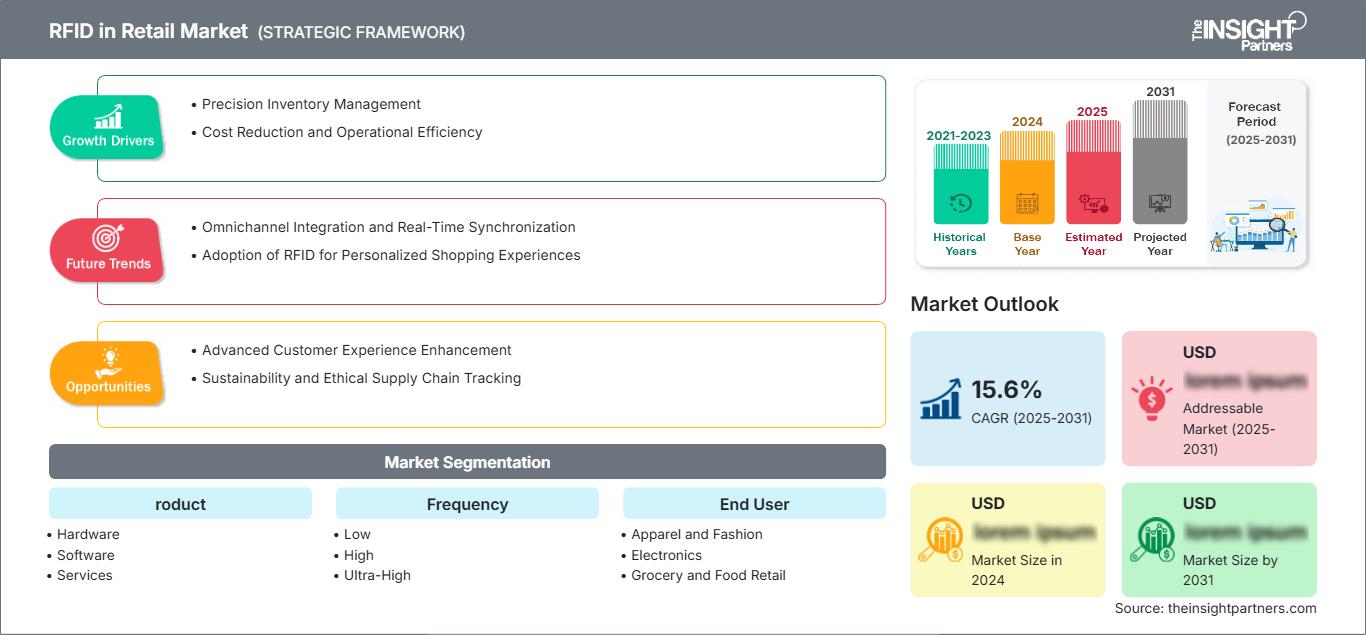
RFID in Retail Market: Strategic Insights
Regional Insights
North America RFID in retail market
North America is estimated at 31–35% of the RFID in retail market share in 2025, with a regional CAGR of 5.8–6.5% through 2034. The US dominates regional demand because large retailers have established RFID programs across apparel, footwear, general merchandise, and distribution operations. Canada contributes through grocery modernization, warehouse automation, and omnichannel fulfillment investments.
Regional adoption is also supported by strong systems integration capabilities and mature cloud retail platforms. Retailers increasingly connect RFID data with mobile workforce applications, automated replenishment, loss prevention, and e-commerce availability. Investment priorities are moving toward software-enabled deployments that can convert item-level reads into operational decisions, rather than expanding reader infrastructure without corresponding workflow integration.
U.S. RFID in retail Market
The US represents approximately 78–82% of North America's 2025 RFID in retail market share and is projected to grow at 5.7–6.4% CAGR through 2034. Major apparel and general merchandise retailers use RFID for inventory accuracy, cycle counting, ship-from-store, click-and-collect, and item locating. Zebra Technologies Corp., Honeywell International Inc., Avery Dennison Corporation, and Checkpoint Systems maintain relevant market positions.
Retail application priorities are broadening beyond apparel. Grocery operators are assessing RFID for fresh products, expiration visibility, and inventory control, while electronics retailers can use item-level identification for high-value products. Increased labor costs also strengthen the case for mobile and automated counting. The US therefore, remains a key testing ground for RFID-enabled store automation and integrated loss-prevention workflows.
Europe RFID in retail Market
Europe represents approximately 25–29% share of the RFID in retail market in 2025 and is expected to expand at 5.6–6.2% CAGR through 2034. Germany is the largest market due to the high development of production-retail connections and automated solutions. The UK is second because of well-developed omnichannel solutions and existing RFID technology. France, Italy, and Spain make their contributions through fashion, luxury, grocery, and specialty retail industry improvements and thus provide Europe with a diversified demand base.
In Germany, RFID technologies have been adopted with a focus on supply chain accuracy and integration into warehouses and industrial traceability. In the UK, there is a strong demand from apparel and omnichannel retailers who need fast inventory verification and availability in stores. In France and Italy, fashion and luxury solutions play an important role due to product authenticity.
APAC RFID in retail Market
APAC accounts for approximately 27–31% share of the RFID in retail market in 2025 and is expected to achieve 6.6–7.4% CAGR through 2034. China takes the lead in regional deployments, followed by Japan, South Korea, India, and Australia. Adoption is being fueled by manufacturing integration, organized retail development, e-commerce fulfillment, and government-enabled digitalization.
China capitalizes on its robust manufacturing ecosystems for electronics and retail, while Japan focuses on automation and precision. India is working on local production and deployment capabilities for RFID, including retail supply chain solutions. South Korea helps connected stores and electronics retail, while Australia focuses on the geographic distribution of inventories.
Middle East & Africa RFID in retail Market
The Middle East and Africa RFID in retail market represents a smaller but developing opportunity, with demand led by the UAE, Saudi Arabia, and South Africa. The region is estimated to grow at 5.2–6.0% CAGR through 2034, supported by modern retail infrastructure, logistics investment, and smart-city programs. The UAE remains the leading regional market for technology-intensive retail deployments.
The transformation of Saudi Arabia’s retail sector and logistics development provides opportunities for item-level tracking, whereas the UAE focuses more on automated stores, luxury retailing, and omnichannel solutions. South Africa offers the most promising sub-Saharan market foundation in the grocery and apparel sectors. The rest of the MEA region has fragmented demand, which depends on organized retail penetration, infrastructure preparedness, and cost of implementation.
Segmentation Analysis
Product
Product segmentation comprises Hardware, Software, and Services in the RFID in Retail Market Trends. Hardware remains foundational because RFID deployments require tags, readers, antennas, printers, and related infrastructure. Software is expanding faster as retailers seek analytics, inventory orchestration, and enterprise integration. The segment is expected to register a 5.6–6.4% CAGR from 2026–2034, with value gradually shifting toward integrated solutions and recurring software services.
- Hardware: Hardware remains the principal deployment layer, supporting identification, reading, encoding, and communication. Demand is strongest where retailers require dense store coverage, warehouse visibility, mobile scanning, and reliable item-level inventory capture.
- Software: Software enables RFID event processing, inventory analytics, exception management, and integration with retail platforms. Its strategic importance rises as retailers seek centralized visibility across stores, warehouses, ecommerce channels, and distribution networks.
- Services: Services include consulting, deployment, integration, maintenance, and managed support. Demand is concentrated among retailers requiring customized architecture, process redesign, system integration, and operational training before large-scale deployment.
Frequency
Frequency includes Low, High, Ultra-High, and Others. Ultra-High Frequency remains central to retail inventory applications because its operating characteristics support longer read distances and rapid identification of multiple tagged products. The segment is forecast to grow at a 5.9–6.6% CAGR from 2026–2034, while frequency selection remains application-specific.
- Low: Low-frequency systems suit specialized identification environments where short-range communication and tolerance to certain materials are important. Retail applications remain selective, generally involving controlled identification rather than high-volume inventory counting.
- High: High-frequency RFID supports proximity-oriented applications and selected customer-interaction use cases. Its characteristics can complement authentication, access, loyalty, and product engagement where read distance requirements are limited.
- Ultra-High: Ultra-high-frequency technology dominates item-level retail inventory because it supports rapid multi-tag reading across stores, stockrooms, distribution centers, and receiving areas. Its scalability makes it strategically important for omnichannel retail.
End User
End User segmentation covers Apparel and Fashion, Electronics, Grocery and Food Retail, Pharmacy and Healthcare Retail, and others. Apparel and fashion remains the leading application environment because item-level tagging aligns naturally with SKU-level inventory management. The segment is projected to expand at a 6.0–6.7% CAGR from 2026–2034, while grocery and healthcare offer significant application diversification.
- Apparel and Fashion: Apparel remains the strongest RFID user because product-level identification improves size and color availability, cycle counting, replenishment, fulfillment, and store inventory accuracy across high-SKU environments.
- Electronics: Electronics retailers use RFID for high-value product visibility, receiving, shelf availability, and loss prevention. Integration with point-of-sale and warehouse systems strengthens operational control over expensive inventory.
- Grocery and Food Retail: Grocery adoption is expanding toward fresh categories, expiration management, automated receiving, and waste reduction. RFID becomes more valuable where product perishability and frequent inventory movements create accuracy challenges.
- Pharmacy and Healthcare Retail: Pharmacy and healthcare retail can use RFID for product identification, stock control, expiration monitoring, and traceability. Adoption is supported by the need for accurate inventory records and controlled handling.
Opportunity Snapshot
| End User | Revenue Contribution (High/Medium/Low) | Trend Tag | Adoption Stage |
| Apparel and Fashion | High | SKU Visibility | Mature |
| Electronics | Medium | Asset Tracking | Scaling |
| Grocery and Food Retail | Medium | Fresh Traceability | Scaling |
| Pharmacy and Healthcare Retail | Medium | Expiry Control | Emerging |
RFID in Retail Market Growth Drivers and Impact Analysis
Item-level inventory accuracy is becoming an operating requirement
Accurate inventory has become more of a revenue and service performance concern for retailers than an internal concern. From the GS1 research findings, it has been established that EPC/RFID technology can increase the inventory accuracy level from around 70% to at least 95% or above in suitable store environments. Increased accuracy translates into increased online availability, better inventory replenishment decision-making, click-and-collect accuracy, and exception management. The effect is important because retailers can use their improved store performance in terms of inventory accuracy to justify the need for RFID rather than justifying the technology because of its advanced nature. The effect will be felt especially in apparel, footwear, and general merchandise, where many types are available.
Omnichannel fulfillment is increasing the value of real-time inventory
Increased utilization of “buy online, pickup in-store,” “ship from store,” and distributed fulfillment makes it increasingly necessary for retailers to have precise item location data in order to improve their bottom line. The traditional barcode process requires manual scans, whereas RFID provides faster multi-item visibility. Item-level identification is used by retailers in order to find out if an item is present in the store, the location of an item, and whether it can be allocated to an order. Exception management at a store level is also possible because of the differences identified between system data and actual inventory levels. With the growing integration of e-commerce and physical stores, RFID becomes the key source of data and not only a tool for inventory counting.
Retail loss prevention is moving toward data-driven identification
Shrink is still an operational reality, which means that retailers will have an incentive to couple RFID with surveillance, exception analysis, and frontline processes. Identification at the item level can add additional data on movement, discrepancies, and inventory events, especially when coupled with data from the point of sale. While RFID alone cannot replace existing loss prevention technology systems, it can enhance the quality and timeliness of inventory alerts. This will allow retailers to focus investigations, detect anomalies, and reconcile differences between receiving, selling, returns, and actual counting. It will be particularly effective when dealing with valuable and fast-moving items. Given increased attention to intelligent stores, it will mean that the use of RFID technology needs to move beyond just inventory into operational and loss prevention decision-making.
RFID in Retail Market Future Trends
RFID data will become an input for retail artificial intelligence
Adoption at the next level would mean that RFID events are treated like operational event data and not just inventory data points. Retailers can take tag reads along with point of sales, workforce data, computer vision, electronic shelf labels, and e-commerce demand. The AI system will be able to detect anomalies in inventory movement, forecast inventory replenishment requirements, conduct cycle counts, and suggest merchandise placement. The future need for the software architecture that can process large amounts of event data will increase in order to be compatible with current retail platforms. Privacy and security controls will have increasing importance as item-level data becomes more integrated. In the long run, competitive advantage would no longer be just about reader performance but would depend on how good the data analytics and workflow automation capabilities are.
RFID-enabled product identities will support circular retail models
RFID is set to play a role in the development of new product traceability systems where resale, repairs, rentals, recycling, authentication, and lifecycle management come into play. Digital IDs for products can link the physical merchandise with data that accompanies an object through several business stages. In retail and brand environments, this can enable product authenticity checking, returns management, product history, and other aspects. Sustainability programs can add to the interest in such products, since there will be a need for accurate information on the materials, ownership and lifecycle. The potential goes beyond the simple inventory process, especially in fashion, luxury, electronics and consumer durable products.
RFID in Retail Market Opportunities
Local manufacturing and regional RFID ecosystems
In countries where there is significant growth in the adoption of RFID programs by retailers but where tag, inlay, and hardware imports remain essential, local manufacturing provides a unique advantage. Local manufacturing enables faster delivery, easier customization, and better alignment with particular application needs. One such example is India, where Avery Dennison will be setting up its first RFID inlay and label manufacturing plant in 2025. Companies can use their experience in the localization process to set up regional engineering, converting, and integrating services. Investors must look at markets where organized retail and manufacturing systems exist in conjunction, since these markets have potential for both demand and export-led manufacturing.
Integrated RFID platforms for specialized retail categories
A second opportunity lies in category-specific platforms that combine identification hardware, software, analytics, and workflow services. Generic RFID deployments can require significant integration effort, particularly in grocery, healthcare retail, electronics, and luxury environments where product characteristics and operational processes differ. Vendors can create stronger value propositions by packaging readers, tags, middleware, dashboards, APIs, and predefined workflows around specific operational problems. The RFID in retail market forecasts indicate that retailers will increasingly evaluate solutions according to deployment speed, interoperability, measurable operating impact, and scalability rather than hardware specifications alone. Companies able to simplify implementation while preserving standards compatibility can address mid-sized retailers that historically viewed RFID as too complex or expensive for broad deployment.
Frequently Asked Questions

- Comprehensive Market Sizing and Forecast Analysis
- Detailed Segmentation Analysis
- In-Depth Market Dynamics Assessment
- Regional and Country-Level Insights
- Competitive Landscape and Company Benchmarking
- Strategic Business Intelligence
Recent Reports
Testimonials

The Insight Partners' SCADA System Market report is comprehensive, with valuable insights on current trends and future forecasts. The team was highly professional, responsive, and supportive throughout. We are very satisfied and highly recommend their services.
RAN KEDEM Partner, Reali Technologies LTDs
I requested a report on a very specific software market and the team produced the report in a few days. The information was very relevant and well presented. I then requested some changes and additions to the report. The team was again very responsive and I got the final report in less than a week.
JEAN-HERVE JENN Chairman, Future Analytica
We worked with The Insight Partners for an important market study and forecast. They gave us clear insights into opportunities and risks, which helped shape our plans. Their research was easy to use and based on solid data. It helped us make smart, confident decisions. We highly recommend them.
PIYUSH NAGPAL Sr. Vice President, High Beam Global
The Insight Partners delivered insightful, well-structured market research with strong domain expertise. Their team was professional and responsive throughout. The user-friendly website made accessing industry reports seamless. We highly recommend them for reliable, high-quality research services
YUKIHIKO ADACHI CEO, Deep Blue, LLC.
This is the first time I have purchased a market report from The Insight Partners.While I was unsure at first, I visited their web site and felt more comfortable to take the risk and purchase a market report.I am completely satisfied with the quality of the report and customer service. I had several questions and comments with the initial report, but after a couple of dialogs over email with their analyst I believe I have a report that I can use as input to our strategic planning process.Thank you so much for taking the extra time and making this a positive experience.I will definitely recommend your service to others and you will be my first call when we need further market data.
JOHN SUZUKI President and Chief Executive Officer, Board Director, BK Technologies
I wish to appreciate your support and the professionalism you displayed in the course of attending to my request for information regarding to infectious disease IVD market in Nigeria. I appreciate your patience, your guidance, and the fact that you were willing to offer a discount, which eventually made it possible for us to close a deal. I look forward to engaging The Insight Partners in the future, all thanks to the impression you have created in me as a result of this first encounter.
DR CHIJIOKE ONYIA MANAGING DIRECTOR, PineCrest Healthcare Ltd.Reason to Buy
- Informed Decision-Making
- Understanding Market Dynamics
- Competitive Analysis
- Identifying Emerging Markets
- Customer Insights
- Market Forecasts
- Risk Mitigation
- Boosting Operational Efficiency
- Strategic Planning
- Investment Justification
- Tracking Industry Innovations
- Aligning with Regulatory Trends





 Get Free Sample for