
RFID Reader Market Size, Demand & Growth by 2034
Coverage: by Product Type (Handheld RFID Readers and Fixed RFID Readers); Frequency (Low Frequency (125 kHz - 134 kHz), High Frequency (13.56 MHz), and Ultra-high Frequency (860 MHz to 960 MHz)); and Industry Vertical (Apparel & Retail, Pharmaceutical & Healthcare, Transportation & Logistics, Industrial Manufacturing, Automotive, and Others), and Geography (North America, Europe, Asia Pacific, and South and Central America)
- Status : Data Released
- Report Code : TIPRE00003153
- Category : Electronics and Semiconductor
- No. of Pages : 150
- Available Report Formats :


- Last update date : September 16, 2026


2025 Market Size
US$ 7.17 Bn
Base year value
2034 Forecast
US$ 16.07 Bn
Projected by 2034
CAGR 2026-2034
9.37 %
Growth rate
Addressable Market
US$ 103.71 Bn
(2026-2034)
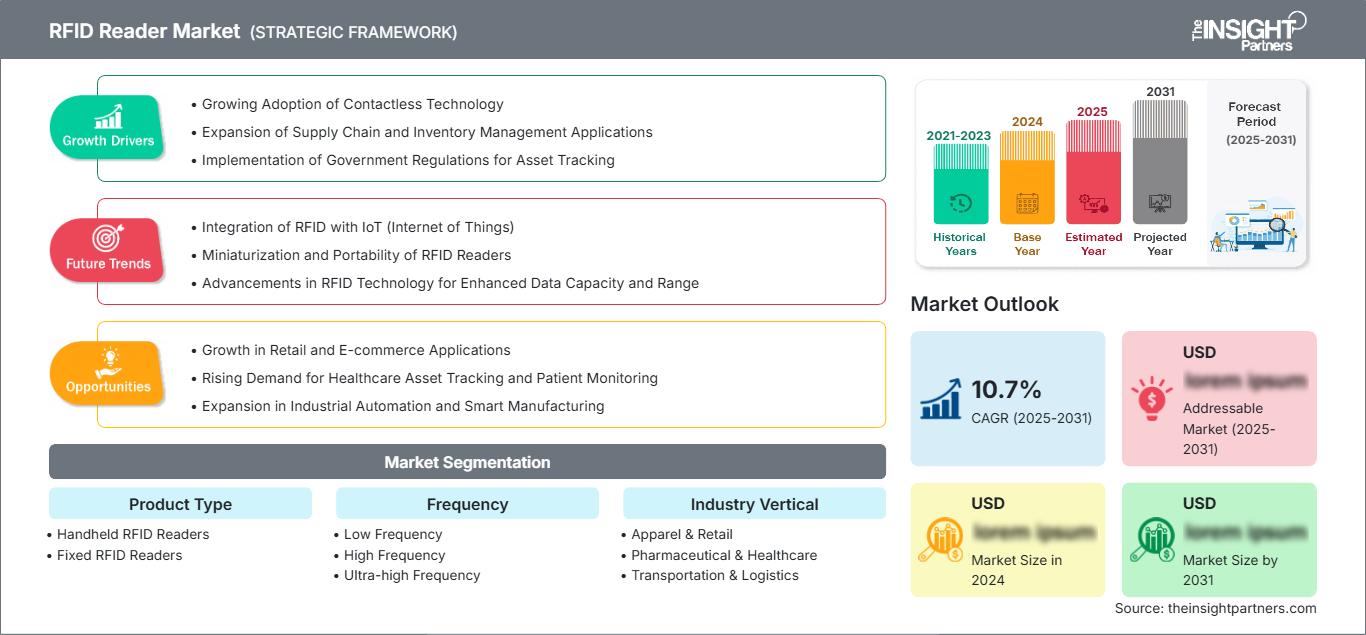
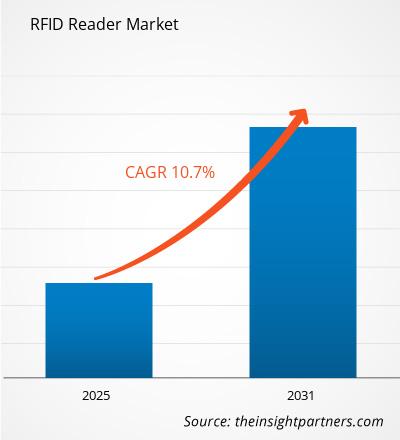
The RFID reader market is positioned at the intersection of automatic identification, connected operations, and industrial traceability. The market size is US$ 7.17 Billion in 2025 and is projected to reach US$ 16.07 Billion by 2034, registering a CAGR of 9.37% during 2026–2034. Expansion is supported by increasing use of RFID for inventory visibility, asset tracking, warehouse automation, manufacturing execution, healthcare identification, and transportation workflows.
North America remains a structurally important adoption center as enterprises prioritize real-time inventory intelligence, labor productivity, and automated identification. The RFID reader market size is expected to expand at an estimated CAGR of 8.8–9.8% between 2026–2034. Retail modernization, warehouse automation, healthcare asset tracking, and established RFID infrastructure provide a comparatively mature foundation for incremental deployments.
RFID Reader Market Assessment and Insights
- North America: North America is expected to account for a 30–34% share in 2025 and grow at a CAGR of 8.8–9.8% between 2026–2034, supported by retail automation, logistics visibility, healthcare asset management, and established enterprise RFID deployments.
- US: The US is estimated to represent 72–76% of North America's 2025 revenue, with a CAGR of 8.9–9.9% between 2026–2034 as retailers, logistics operators, and manufacturers automate identification.
- Europe: Europe is projected to hold a 22–26% share in 2025 and expand at a CAGR of 8.2–9.2%, led by Germany, the UK, France, Italy, and Spain through traceability, manufacturing digitization, and circular-economy initiatives.
- Asia Pacific: Asia Pacific is estimated at a 26–30% share in 2025 and is expected to grow at 10.2–11.2% CAGR, with China, Japan, South Korea, and India benefiting from manufacturing automation and expanding logistics infrastructure.
- Largest Segment: Fixed RFID Readers represent the largest segment, with a 58–62% market share in 2025 and a CAGR of 9.1–10.1%, reflecting continuous deployment across warehouses, production lines, and retail portals.
- High Growth Segment: Handheld RFID Readers are the high-growth segment, holding a 38–42% market share in 2025 and advancing at a CAGR of 10.0–11.0% as mobile inventory and asset workflows expand.
- Key companies analyzed in detail: Alien Technology, LLC; Applied Wireless IDentifications Group, Inc. (AWID); CIPHERLAB Co., Ltd.; Datalogic S.p.A.; GAO RFID, Inc.; Honeywell International Inc.; Impinj, Inc.; Invengo Technology Pte. Ltd.; Xerox Corporation; Zebra Technologies Corporation.
Source: The Insight Partners' analysis based on proprietary research, government publications, company annual reports, investor presentations, industry databases, and expert interviews.
Technology advances have moved RFID readers from standalone identification machines to connected edge devices that allow the use of barcode scanners, mobile computers, cloud applications, and analysis capabilities. In addition, fixed RFID readers increasingly incorporate automatic portals and conveyer technology, while handheld readers offer RFID with wireless capabilities. Priorities in production will include modular design, increased read reliability, and software-defined RFID for different industrial settings.
Future growth will depend on developing economies in manufacturing, healthcare networks, package delivery, and automated distribution centers. The focus on product tracking and digital product data as a regulatory requirement might add more weight to RFID from the business perspective. In addition, investments will shift towards edge devices that provide richer data processing capabilities without having to rely on central systems.
RFID Reader Market Report Scope
| Report Attribute | Details |
|---|---|
| Market size in 2025 | US$ 7.17 Billion |
| Market Size by 2034 | US$ 16.07 Billion |
| Global CAGR (2026 - 2034) | 9.37% |
| Historical Data | 2021-2024 |
| Forecast period | 2026-2034 |
RFID Reader Market Analysis
Demand for the RFID reader market growth is being shaped by the need to identify multiple tagged objects without individual line-of-sight scanning. The readers will be used by retailers for stock-taking and replenishment, by logistics companies for package and pallet tracking, and by manufacturing facilities for tracking work-in-progress. It involves players ranging from reader manufacturers to antenna manufacturers to IC suppliers, systems integrators, software developers, and enterprise clients, resulting in continuous needs for infrastructure integration.
Supply factors are gradually placing greater value on suppliers who can integrate RF capability and software solutions. UHF readers have become dominant in many long-range enterprise applications, whereas HF and LF readers still make sense for proximity-oriented environments. Application-oriented purchasing is also increasingly becoming the case, with portal, embedded, rugged handheld, and industrial fixed readers catering to different operational circumstances.
Competitive positioning is becoming increasingly platform-oriented in the RFID Reader Market Report. Impinj, Zebra Technologies Corporation, Honeywell International Inc., Datalogic S.p.A., and CIPHERLAB Co., Ltd. address different combinations of reader hardware, mobile computing, enterprise software, and identification workflows. Alien Technology, LLC and GAO RFID, Inc. offer unique RFID technologies, while Applied Wireless IDentifications Group, Inc. (AWID) concentrates on identification infrastructures. Xerox Corporation and Invengo Technology Pte. Ltd. increase competition.
Investment trends now focus more on reader intelligence, connectivity and integration rather than the raw performance of the hardware. Companies are marketing their products through applications such as warehouse automation, retail inventory accuracy, manufacturing traceability and health care processes. Gen2X innovation, edge computing and interference management can add value to the reader product. Partnership strategies with software companies and systems integrators become important due to the fact that customers measure RFID infrastructures by their process efficiency rather than device performance.
● REPORT CUSTOMIZATION
Tailor This Report To Align With Your Specific Business Requirements
This report can be customized to align precisely with your business objectives, scope, and target markets. Customization options include tailored segmentation, geography, competitive analysis, and strategic insights to support informed decision-making.
Customize This Report →WHAT YOU CAN ADJUST
- ● Segmentations
- ● Geography
- ● Competitive Analysis
- ● Language Preferences
RFID Reader Market: Strategic Insights
Regional Insights
North America RFID reader market
North America is estimated to hold a 30–34% of the RFID reader market share in 2025 and register an 8.8–9.8% CAGR through 2034. The area has an advantage because of advanced warehouse automation technology, big retail players, pharmaceutical track and trace, and extensive adoption of enterprise asset management systems. The US is still the main provider of RFID technologies, and Canada helps with the adoption of such systems in logistics, healthcare, and industrial sectors.
RFID and replenishment/omnichannel systems are one of the major drivers of retail inventory precision. Logistics providers install stationary RFID readers on docks, portal checkpoints, and conveyors, whereas manufacturing companies use RFID readers to track work in process. Systems integrators and the availability of durable handheld RFID scanners are additional drivers of adoption.
U.S. RFID reader Market
The US represents approximately 72–76% of North America's 2025 RFID reader market revenue and is expected to expand at an 8.9–9.9% CAGR. Large retailers, third-party logistics providers, manufacturers, hospitals, and distribution centers are major users. Zebra Technologies Corporation, Honeywell International Inc., Impinj, Inc., and other suppliers maintain significant application exposure across enterprise identification workflows.
Application development increasingly emphasizes fixed readers for automated warehouse gates and handheld readers for cycle counting, exception management, and asset verification. Retailers are also integrating RFID data with inventory-management software to support omnichannel fulfillment. Manufacturing adoption is expanding as plants seek greater traceability across components and finished goods, while healthcare organizations use RFID to monitor equipment and improve location visibility.
Europe RFID reader Market
Europe is estimated to account for a 22–26% share of the RFID reader market in 2025, with an 8.2–9.2% CAGR through 2034. Germany leads regional adoption, followed by the UK and France, while Italy and Spain contribute through retail, manufacturing, logistics, and healthcare deployments. Traceability requirements and sustainability initiatives support long-term investment.
The UK maintains strong demand from retail and logistics organizations seeking inventory visibility and automated fulfillment. Germany benefits from industrial automation and advanced manufacturing ecosystems, supporting fixed reader installations across production and distribution. France, Italy, and Spain are expanding RFID use in apparel, retail, transport, and pharmaceutical operations, with adoption increasingly connected to digital supply-chain initiatives.
APAC RFID reader Market
APAC is estimated to hold a 26–30% share of the RFID reader market in 2025 and grow at a 10.2–11.2% CAGR. China leads regional adoption, followed by Japan, South Korea, India, and Australia. Industrial automation, expanding e-commerce logistics, electronics manufacturing, and government-supported digitalization are strengthening demand for connected identification systems.
China benefits from large manufacturing and logistics ecosystems, while Japan and South Korea emphasize precision manufacturing and automated material handling. India is expanding warehouse and retail digitization, and Australia supports adoption through logistics and resource-related operations. Regional demand is increasingly shifting toward fixed readers integrated with automated facilities and handheld systems supporting mobile workers.
Middle East & Africa RFID reader Market
The Middle East and Africa RFID reader market represents a smaller but expanding opportunity, with Saudi Arabia, the UAE, and South Africa serving as major adoption centers. The region is expected to register a 7.5–8.5% CAGR through 2034, supported by logistics infrastructure, retail modernization, healthcare digitization, and smart-industry programs.
Saudi Arabia and the UAE are investing in automated logistics and digitally enabled infrastructure, while South Africa remains a key industrial and retail market. Energy, transport, and distribution projects create opportunities for asset identification and tracking. The Rest of MEA is expected to adopt selectively as infrastructure modernization improves and enterprises prioritize operational visibility.
Segmentation Analysis
Product Type
Product Type adoption is differentiated by mobility, read environment, integration requirements, and deployment economics in the RFID Reader Market Trends. Fixed RFID Readers remain central to automated portals and production infrastructure, while handheld systems support flexible field operations. The segment is expected to expand at a 9.2–10.2% CAGR between 2026–2034. Reader selection increasingly depends on workflow architecture, read density, connectivity, and integration with enterprise systems.
- Handheld RFID Readers: Mobile devices support cycle counting, asset verification, receiving, and exception handling. Their portability enables operators to move between locations while capturing RFID data alongside barcode and enterprise application information.
- Fixed RFID Readers: Fixed systems provide continuous identification at portals, conveyors, dock doors, production stations, and controlled zones, making them strategically important for automated workflows requiring consistent read performance.
- Others: Embedded and specialized configurations address applications requiring customized form factors, integration constraints, or dedicated identification functions within equipment and operational environments.
Frequency
Frequency selection determines read distance, tag compatibility, interference tolerance, and application suitability. Ultra-high frequency solutions dominate many enterprise tracking environments because they support longer read ranges and rapid multi-tag identification. The frequency segment is projected to grow at an 8.9–9.9% CAGR through 2034. HF and LF remain important where proximity, security, or specialized operating conditions outweigh long-range identification.
- Low Frequency: LF systems are suited to short-range identification environments where robust operation around challenging materials and controlled read distances are important.
- High Frequency: HF supports proximity-oriented applications, enabling reliable identification in controlled environments such as access, authentication, and specialized healthcare workflows.
- Ultra-high Frequency: UHF provides longer read ranges and multi-tag capability, supporting retail inventory, warehouse portals, logistics tracking, manufacturing visibility, and automated material movement.
- Others: Specialized frequency configurations address selected regional, industrial, or application-specific requirements where conventional LF, HF, or UHF deployment characteristics are insufficient.
Industry Vertical
Industry Vertical demand reflects the growing need for machine-readable visibility across physical assets and inventory. The segment is forecast to expand at a 9.5–10.5% CAGR through 2034. Retail and logistics remain important application centers, while manufacturing, healthcare, and automotive deployments increasingly connect reader data with execution and asset-management platforms. The RFID reader market scope is therefore broadening beyond identification toward operational intelligence.
- Apparel & Retail: Retailers use RFID for inventory accuracy, replenishment, omnichannel fulfillment, loss prevention, and faster stock verification across stores and distribution facilities.
- Pharmaceutical & Healthcare: Healthcare organizations deploy RFID to improve equipment visibility, inventory control, medication handling, and traceability where accurate identification can support workflow reliability.
- Transportation & Logistics: Logistics operators use readers for parcel, pallet, container, and asset identification, improving movement visibility across warehouses, hubs, yards, and distribution networks.
- Industrial Manufacturing: Manufacturers integrate readers into production and material-handling processes to identify components, monitor work-in-process, and connect physical movements with manufacturing systems.
- Automotive: Automotive operations use RFID for component traceability, sequencing, returnable containers, and production-line visibility across complex manufacturing environments.
- Others: Additional sectors use RFID where automated identification can reduce manual data capture, improve asset visibility, or strengthen process control.
Opportunity Snapshot
| Industry Vertical | Revenue Contribution (High/Medium/Low) | Trend Tag (MAX 2 words) | Adoption Stage |
| Apparel & Retail | High | Inventory Accuracy | Mature |
| Pharmaceutical & Healthcare | Medium | Asset Tracking | Scaling |
| Transportation & Logistics | High | Parcel Visibility | Scaling |
| Industrial Manufacturing | High | Process Traceability | Scaling |
| Automotive | Medium | Parts Tracking | Scaling |
| Others | Low | Asset Identification | Emerging |
RFID Reader Market Growth Drivers and Impact Analysis
Automated inventory visibility is increasing reader deployment intensity
The move for retailers and logistics firms is from periodic to continuous visibility of stock, using more reader touch points in areas such as receipt, warehousing, picking, shipping, and returns. While fixed readers will be used to automate identification at entry points, handheld readers take care of exception handling and mobile verification. This model turns identification into a networked solution through a shift in procurement from equipment acquisition to an identification network approach. The operational benefits will mainly accrue in situations where volumes are high and there are repeated costs of manual scanning. With the connection of the reader data to the warehouse management and ERP systems, RFID technology becomes a means of structured operational information, not just identification.
Warehouse automation is expanding the addressable identification environment
The need for reliable inputs is critical in automated storage and retrieval systems, conveyors, sorting devices, and robots used for material handling. RFID readers offer another option or supplement to visual systems where issues related to line-of-sight could affect the performance of barcode operations. With the rising level of automation in distribution centers, readers are being installed at strategic locations within the facilities and incorporated into the warehouse execution systems. It results in the need for readers that can perform in environments with a large number of tags, variable speeds, electromagnetic interference, and constant operation. The commercial implications are not limited to the hardware itself since the use of readers normally entails antennas, middleware, integration, and maintenance.
Traceability requirements are strengthening identification infrastructure investment
For manufacturers, healthcare organizations, and logistics organizations, there is an increasing need for traceability of where the items, components, or goods have been shipped. RFID technologies can generate automated logs of events when readers are installed at certain checkpoints in the process flow. This is important for quality management, recall preparedness, inventory management, and chain-of-custody requirements. Impact on procurement will be to have readers that can produce credible time-stamped information and can integrate with the organization’s databases. For manufacturing industries, this could be used in tracking the genealogy of components and work-in-progress goods. For the healthcare industry, this will help improve the visibility of the equipment and inventory. In logistics organizations, it will minimize manual verification of identification.
RFID Reader Market Future Trends
Readers will increasingly operate as intelligent edge identification nodes
There will be much greater use of edge processing in future reader designs, allowing devices to sort out tag events and prioritize before communicating data to corporate systems. This may decrease network traffic and increase the speed of reaction in dense environments. Artificial intelligence may be used to discriminate relevant readings from irrelevant noise and detect abnormal movement patterns. Integration with camera systems, barcodes, sensors and industrial controllers will allow for multimodal ID systems rather than just standalone RFID systems. Software configuration will make it simpler to tailor the reader function to workflow requirements without changing hardware. With increased use of edge computing in warehouse and factory environments, purchasers will begin to look at processor performance, security, APIs, and remote fleet management capabilities, along with antenna and radio capabilities.
RFID infrastructure will converge with digital supply-chain platforms
The next step in adoption will see greater integration between reader-based events, digital twins, inventory solutions, transportation networks, and analytics software. Rather than using identification as an isolated process, firms will be able to leverage event streams to enrich the identification of asset movement. Such integration could lead to predictive replenishment, automated exception handling, condition monitoring, and enhanced provenance. Given how interoperability becomes more critical when RFID is combined with IoT, machine vision, and barcode technologies, readers that offer such capabilities are expected to play a more strategically important role. Eventually, decisions about infrastructure will be increasingly influenced by the quality of the information provided by the reader ecosystem rather than the simple read range.
RFID Reader Market Opportunities
Expansion of RFID-enabled manufacturing corridors
Manufacturing ecosystems in India, Southeast Asia, Mexico, Eastern Europe, and selected Middle Eastern economies provide opportunities for reader suppliers to establish scalable identification infrastructure. New facilities can incorporate RFID at the design stage rather than retrofitting legacy systems, allowing fixed readers to be integrated directly with conveyors, production stations, warehouse gates, and quality checkpoints. Vendors can target these markets through local integrators, modular product portfolios, and application-specific software partnerships. The strongest opportunities are likely to arise where automotive, electronics, industrial machinery, and contract manufacturing clusters are expanding simultaneously. Suppliers that provide interoperability with existing manufacturing execution systems and support regional deployment requirements can reduce implementation friction and participate in multi-site modernization programs.
Integration-led solutions for traceability and compliance
The RFID reader market forecasts indicate an opportunity for suppliers that move beyond hardware sales toward integrated traceability solutions. Customers increasingly need reader infrastructure connected with enterprise resource planning, warehouse management, manufacturing execution, and analytics platforms. Vendors can therefore develop packaged solutions combining readers, antennas, middleware, deployment services, and application programming interfaces. Healthcare, pharmaceuticals, food logistics, and industrial manufacturing offer particularly relevant use cases because traceability has direct operational and compliance implications. Investment can also focus on managed reader fleets, remote diagnostics, cybersecurity, and lifecycle services. Such models create recurring revenue opportunities while helping customers standardize deployments across multiple facilities. Strategic differentiation will depend on implementation expertise, data integration, and measurable workflow outcomes.
Frequently Asked Questions

- Comprehensive Market Sizing and Forecast Analysis
- Detailed Segmentation Analysis
- In-Depth Market Dynamics Assessment
- Regional and Country-Level Insights
- Competitive Landscape and Company Benchmarking
- Strategic Business Intelligence
Recent Reports
Testimonials

The Insight Partners' SCADA System Market report is comprehensive, with valuable insights on current trends and future forecasts. The team was highly professional, responsive, and supportive throughout. We are very satisfied and highly recommend their services.
RAN KEDEM Partner, Reali Technologies LTDs
I requested a report on a very specific software market and the team produced the report in a few days. The information was very relevant and well presented. I then requested some changes and additions to the report. The team was again very responsive and I got the final report in less than a week.
JEAN-HERVE JENN Chairman, Future Analytica
We worked with The Insight Partners for an important market study and forecast. They gave us clear insights into opportunities and risks, which helped shape our plans. Their research was easy to use and based on solid data. It helped us make smart, confident decisions. We highly recommend them.
PIYUSH NAGPAL Sr. Vice President, High Beam Global
The Insight Partners delivered insightful, well-structured market research with strong domain expertise. Their team was professional and responsive throughout. The user-friendly website made accessing industry reports seamless. We highly recommend them for reliable, high-quality research services
YUKIHIKO ADACHI CEO, Deep Blue, LLC.
This is the first time I have purchased a market report from The Insight Partners.While I was unsure at first, I visited their web site and felt more comfortable to take the risk and purchase a market report.I am completely satisfied with the quality of the report and customer service. I had several questions and comments with the initial report, but after a couple of dialogs over email with their analyst I believe I have a report that I can use as input to our strategic planning process.Thank you so much for taking the extra time and making this a positive experience.I will definitely recommend your service to others and you will be my first call when we need further market data.
JOHN SUZUKI President and Chief Executive Officer, Board Director, BK Technologies
I wish to appreciate your support and the professionalism you displayed in the course of attending to my request for information regarding to infectious disease IVD market in Nigeria. I appreciate your patience, your guidance, and the fact that you were willing to offer a discount, which eventually made it possible for us to close a deal. I look forward to engaging The Insight Partners in the future, all thanks to the impression you have created in me as a result of this first encounter.
DR CHIJIOKE ONYIA MANAGING DIRECTOR, PineCrest Healthcare Ltd.Reason to Buy
- Informed Decision-Making
- Understanding Market Dynamics
- Competitive Analysis
- Identifying Emerging Markets
- Customer Insights
- Market Forecasts
- Risk Mitigation
- Boosting Operational Efficiency
- Strategic Planning
- Investment Justification
- Tracking Industry Innovations
- Aligning with Regulatory Trends





 Get Free Sample for