
Robot Operating System Market Growth, Demand & Size by 2034
Coverage: by Robot Type (SCARA Robots, Articulated Robots, Collaborative Robots, Cartesian Robots, Parallel Robots, Others); End-use Industry (Automotive, Electrical and Electronics, Food and Beverages, Healthcare, Metal and Machinery, Others) , and Geography (North America, Europe, Asia Pacific, and South and Central America)
- Status : Data Released
- Report Code : TIPRE00006781
- Category : Electronics and Semiconductor
- No. of Pages : 150
- Available Report Formats :


- Last update date : September 07, 2026


2025 Market Size
US$ 742.11 Mn
Base year value
2034 Forecast
US$ 1,703.04 Mn
Projected by 2034
CAGR 2026-2034
9.67 %
Growth rate
Addressable Market
US$ 10,899.67 Mn
(2026-2034)
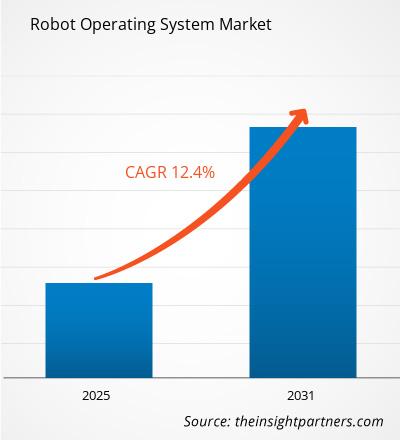
The global Robot Operating System market was valued at US$ 742.11 million in 2025 and is expected to reach US$ 1703.04 million by 2034; it is estimated to record a CAGR of 9.67% during 2026-2034.
Robot Operating System Market Assessment and Insights
- North America: The region is estimated to hold a 28–32% share in 2025 and expand at a CAGR of 10.2–11.1% between 2026–2034, supported by automation investment, software development capabilities, and industrial robotics deployment.
- US: The US is estimated to represent 78–83% of North American revenue in 2025 and grow at a CAGR of 10.3–11.2% between 2026–2034, led by manufacturing automation and AI-enabled robotics.
- Europe: Europe is estimated to account for 23–27% share in 2025 and grow at a CAGR of 9.7–10.6% between 2026–2034, with Germany, France, Italy, and the UK supporting industrial software adoption.
- Asia Pacific: Asia Pacific is estimated to command 34–38% share in 2025 and expand at a CAGR of 11.5–12.5% between 2026–2034, led by China, Japan, South Korea, and India.
- Largest Segment: Articulated Robots are estimated to hold a 31–35% market share in 2025 and expand at a CAGR of 10.4–11.3% during 2026–2034, reflecting broad industrial deployment.
- High Growth Segment: Collaborative Robots are estimated to hold a 15–19% market share in 2025 and record a CAGR of 12.2–13.3% during 2026–2034, supported by flexible automation.
- Key companies analyzed in detail: ABB Ltd.; Clearpath Robotics; DENSO Corporation; FANUC Corporation; KUKA AG; Microsoft Corporation; Omron Corporation; Rethink Robotics GmbH; Universal Robots; Yaskawa Electric Corporation.
Source: The Insight Partners' analysis based on proprietary research, government publications, company annual reports, investor presentations, industry databases, and expert interviews.
The technology foundation has been transformed from research-based robot middleware to architectures that facilitate distributed computing, embedded controllers, simulation, perception, navigation, and multi-robot collaboration. The shift to ROS 2 is a manifestation of how the technology foundation has changed with the use of distributed data communication systems, lifecycle management, better security capabilities, and real-time processing. Production dynamics have involved proprietary robot controllers together with software interfaces, thereby enabling the hardware differentiation of manufacturing companies and software interoperability.
Future investments will be inclined towards AI-driven autonomy, simulation-to-real conversion, edge computing, and standardized interfaces. Emerging robotics ecosystems in India, Southeast Asia, and selected Middle Eastern nations will widen adoption as industrial automation expands past the conventional automotive application. Functional safety, cybersecurity, data governance, and human-robot collaboration will be the subject of regulatory attention and thus impact deployment architecture, especially when software is used to control safety-relevant physical systems.
Robot Operating System Market Report Scope
| Report Attribute | Details |
|---|---|
| Market size in 2025 | US$ 742.11 Million |
| Market Size by 2034 | US$ 1,703.04 Million |
| Global CAGR (2026 - 2034) | 9.67% |
| Historical Data | 2021-2024 |
| Forecast period | 2026-2034 |
Robot Operating System Market Analysis
The robot operating system market growth is being supported by demand for reusable software components that reduce development time across increasingly heterogeneous robotic platforms. There is an ecosystem involving robot Original Equipment Manufacturers (OEMs), parts suppliers, systems integrators, universities, and cloud service providers, where middleware allows linking sensors, actuators, simulation tools, perception modules, planners, and applications. As a consequence of that, the new value chain reduces the differentiation factor on the hardware level and places it on the software integration and development tooling side.
The supply chain is getting increasingly modular as companies make available APIs, drivers, simulation suites, and middleware. There are ROS 2 distributions with defined release cycles (e.g. Humble and Jazzy), ros2_control, and MoveIt providing a hardware abstraction layer and motion planning capabilities. For instance, Clearpath Robotics provides ROS 2 support for multiple mobile robots. That means that the same software architecture can be used on different hardware setups.
The robot operating system market analysis indicates a competitive structure combining established robot manufacturers, automation companies, software providers, and specialist robotics developers. ABB Ltd., FANUC Corporation, KUKA AG, Omron Corporation, and Yaskawa Electric Corporation offer deep installation bases and capabilities for industrial integration. Meanwhile, Clearpath Robotics and Rethink Robotics GmbH offer software-based, collaborative models of development, and Microsoft Corporation offers cloud, AI, simulation, and development infrastructure.
The positioning of companies is gradually shifting from dominance of interfaces to the replacement of software stacks. The shift of FANUC Corporation towards open ROS 2 drivers is a good example, as well as the continuous expansion of ROS 2 compatibility by Clearpath Robotics. Investments are therefore going into AI middleware, simulation, digital twins, hardware abstractions, and fleet management. Companies that will be able to marry open development and reliable industrial performance will be capable of capturing software value while preserving the control architecture of controllers.
● REPORT CUSTOMIZATION
Tailor This Report To Align With Your Specific Business Requirements
This report can be customized to align precisely with your business objectives, scope, and target markets. Customization options include tailored segmentation, geography, competitive analysis, and strategic insights to support informed decision-making.
Customize This Report →WHAT YOU CAN ADJUST
- ● Segmentations
- ● Geography
- ● Competitive Analysis
- ● Language Preferences
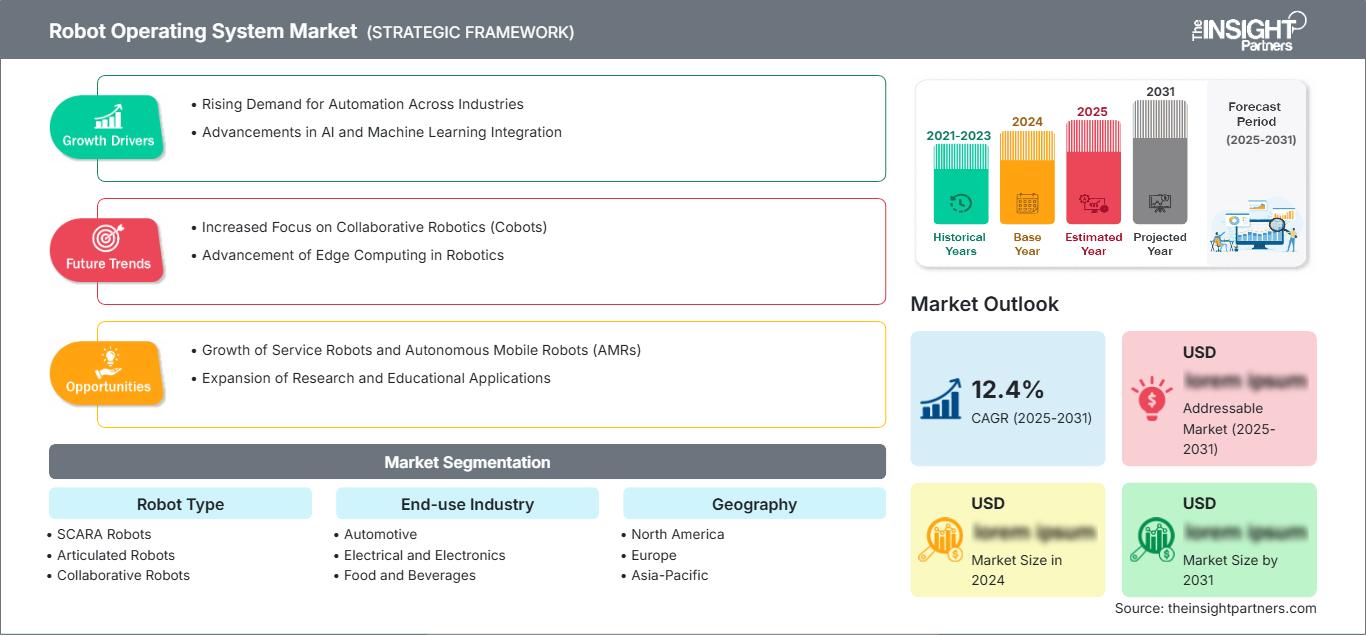
Robot Operating System Market: Strategic Insights
Regional Insights
North America robot operating system market
North America is estimated to represent 28–32% of the robot operating system market share in 2025, with the region projected to expand at a CAGR of 10.2–11.1% through 2034. The United States drives regional implementation due to the integration of industrial robots with machine vision, AI inference, autonomous material handling, and connected production systems. Canada makes its contribution through research organizations, the development of mobile robotics, and automation implementations in certain sectors.
Demand in the region is driven by reshoring efforts and the necessity of improving manufacturing productivity without adding more labor. Some key application areas are automotive, electronics, logistics, aerospace, and warehousing. Microsoft Corporation and Clearpath Robotics add value to the software environment, while ABB Ltd., FANUC Corporation, KUKA AG, Omron Corporation, Universal Robots, and Yaskawa Electric Corporation drive industrial commercialization. The presence of a highly developed computing environment, robotics research, and an integrators’ network will enable high software adoption.
U.S. robot operating system Market
The U.S. is estimated to account for 78–83% of the North American robot operating system market revenue in 2025 and is modeled to grow at a CAGR of 10.3–11.2% during 2026–2034. Adoption is concentrated in automotive, electronics, aerospace, logistics, and advanced manufacturing, where developers require interoperable perception, navigation, and manipulation frameworks.
The application mix is expanding from fixed robotic workcells toward mobile manipulators and collaborative systems. Clearpath Robotics has continued supporting ROS 2 on platforms including Husky, Jackal, Ridgeback, and Dingo, while Microsoft Corporation contributes software infrastructure relevant to simulation and AI-enabled automation. FANUC Corporation, ABB Ltd., KUKA AG, and Universal Robots provide industrial hardware environments in which open middleware can increasingly complement proprietary control systems.
Europe robot operating system Market
Europe is estimated to hold a 23–27% share of the robot operating system market in 2025 and is projected to grow at a CAGR of 9.7–10.6% through 2034. Germany is the leading national market, followed by the UK, France, Italy, and Spain. Automotive engineering, machinery, logistics, and industrial automation provide the principal demand base.
Germany benefits from a dense concentration of robot manufacturers, automation suppliers, research institutes, and automotive producers. The country's engineering ecosystem supports ROS 2 experimentation alongside proprietary industrial platforms, with KUKA AG providing a major local robotics presence. Demand is increasingly linked to flexible manufacturing, digital twins, and software-defined automation.
The UK, France, Italy, and Spain collectively broaden adoption through aerospace, automotive, food processing, logistics, and research applications. Italy's machinery ecosystem and France's industrial automation programs provide opportunities for middleware integration, while Spain's automotive and logistics activities support deployment. Europe therefore combines established industrial robotics with emerging software-led development models.
APAC robot operating system Market
APAC is estimated to represent 34–38% share of the robot operating system market in 2025 and expand at a CAGR of 11.5–12.5%, making it the leading regional growth engine. China remains the largest market, supported by industrial automation, while Japan, South Korea, India, and Australia expand adoption through manufacturing modernization and robotics research.
China's scale in industrial robotics, Japan's established automation base, South Korea's electronics manufacturing, India's digital manufacturing initiatives, and Australia's mining automation collectively support demand. Policies promoting smart factories and advanced manufacturing strengthen software requirements, while ROS 2 enables developers to combine local hardware with globally available software components.
Middle East & Africa robot operating system Market
The Middle East and Africa robot operating system market adoption remains smaller but is expanding as Saudi Arabia and the UAE invest in smart infrastructure, logistics, manufacturing, and autonomous systems. South Africa provides an industrial base, while the rest of MEA offers opportunities in warehousing, energy, mining, and specialized automation.
The region is modeled to expand at a CAGR of 9.0–10.0% through 2034, with the UAE positioned among the leading early adopters. Robotics software can support geographically distributed operations where autonomous inspection, material handling, and remote supervision reduce operating constraints.
Segmentation Analysis
Robot Type
The Robot Operating System Market Report indicates that the Robot Type segment is projected to expand at a CAGR of 10.5–11.5% during 2026–2034. Demand is shaped by differences in payload, workspace, precision, human interaction, and application complexity. Open middleware is particularly valuable where customers combine robot hardware with third-party sensors, AI models, simulation platforms, and customized application logic.
- SCARA Robots: High-speed assembly and pick-and-place applications make SCARA platforms important for electronics and precision manufacturing, where software integration must coordinate motion, vision, conveyors, and inspection systems.
- Articulated Robots: Broad payload and reach configurations support welding, handling, assembly, painting, and machine tending, creating a large installed base for interoperable software and advanced motion planning.
- Collaborative Robots: Human-facing deployment encourages flexible programming, perception integration, and rapid application changes, increasing the importance of middleware that connects safety functions with higher-level autonomy.
- Cartesian Robots: Structured linear motion remains relevant for material handling, machining, and assembly, with software requirements centered on deterministic coordination, trajectory control, and integration with production equipment.
- Parallel Robots: High-speed sorting, packaging, and inspection applications create demand for tightly synchronized vision and motion pipelines, particularly where throughput and precise end-effector control are critical.
End-use Industry
The Robot Operating System Market Forecast estimates that the End-use Industry segment is projected to grow at a CAGR of 10.8–11.8% during 2026–2034. Automotive remains an important deployment environment, but software adoption is broadening into electronics, food processing, healthcare, machinery, and other sectors as robots become more adaptable and data-driven.
- Automotive: High robot density and complex production cells create strong requirements for simulation, coordinated motion, machine vision, quality inspection, and software interoperability across manufacturing stages.
- Electrical and Electronics: Short product cycles and precision requirements encourage flexible robot programming, vision integration, traceability, and rapid reconfiguration for increasingly diversified production lines.
- Food and Beverages: Hygiene constraints, packaging variability, and high throughput create demand for reliable perception, motion planning, and flexible automation in processing and secondary packaging.
- Healthcare: Research, laboratory automation, rehabilitation, logistics, and surgical support require modular software architectures capable of integrating specialized sensors, manipulation functions, and stringent operational controls.
- Metal and Machinery: Welding, machine tending, inspection, grinding, and material handling applications benefit from reusable software components that reduce integration effort across varied equipment configurations.
Opportunity Snapshot
| End-use | Revenue Contribution (High/Medium/Low) | Trend Tag | Adoption Stage |
| Automotive | High | Smart Factories | Mature |
| Electrical and Electronics | High | Precision Automation | Scaling |
| Food and Beverages | Medium | Vision Handling | Scaling |
| Healthcare | Medium | Robot Assist | Emerging |
| Metal and Machinery | Medium | Machine Tending | Scaling |
| Others | Low | Service Robotics | Emerging |
Robot Operating System Market Growth Drivers and Impact Analysis
Expansion of AI-enabled autonomous robotics
With the advent of AI, the software of robots is evolving from performing set tasks to decision-making with the help of the perception of the environment. Machine learning algorithms are able to analyze sensory and vision input, while planning algorithms select actions according to the ever-changing environment. The need for such middleware that can link AI inference, sensor input, navigation, manipulation, and hardware actuation without redeveloping the whole software stack becomes more significant. The effect is most noticeable in mobile robotics, logistics, inspection, and adaptive manufacturing. One can also reuse generic components for various robot architectures, thus reducing time for experiments. With the shift of AI processing loads to edge computing or centralized infrastructure, there is an increasing demand for standardization of communications, monitoring, and resource allocation within software architectures.
Need for interoperable multi-vendor robotic systems
Manufacturers today often find themselves working with diverse automation systems, including robots, conveyors, cameras, sensors, PLCs, autonomous mobile systems, and other legacy controllers from different vendors. As a result, interoperability becomes not just a preferred but also a sensible choice for investments. Middleware can offer standard interfaces that will help application programmers control equipment without needing to reprogram the core functionality on each new hardware platform. This point is especially crucial for system integrators who have to build custom cells at different locations of their customers. The market implications of this trend go far beyond the license costs for robot software, affecting such aspects as engineering, simulation, driver programming, testing, cybersecurity, and lifecycle support.
Growth of simulation and digital engineering workflows
Simulation is becoming central to robotics development because physical testing is costly, time-consuming, and difficult to scale. Developers can use virtual environments to validate navigation, manipulation, collision avoidance, sensor configurations, and production sequences before deploying software on physical robots. This approach supports parallel development by allowing software teams to work independently of hardware availability. The market impact is particularly relevant for complex robotic cells, mobile fleets, and AI training workflows requiring large numbers of simulated scenarios. Digital twins also allow manufacturers to evaluate layout changes, throughput assumptions, and maintenance interventions before making physical modifications. Integration between simulation tools and middleware further increases software reuse. Consequently, demand is shifting toward development ecosystems that connect simulation, data generation, testing, deployment, monitoring, and physical robot operation.
Robot Operating System Market Future Trends
ROS 2 as a bridge between open robotics and Physical AI
The robot operating system market trends are increasingly centered on using ROS 2 as an integration layer for Physical AI rather than treating middleware solely as a robotics development toolkit. Future architectures are likely to connect foundation models, vision-language-action systems, simulation environments, and conventional motion-control frameworks through modular interfaces. This approach can allow high-level AI systems to generate tasks while deterministic controllers execute safety-critical motion. Open drivers and standardized control frameworks should become more important as robot manufacturers seek access to external AI ecosystems without abandoning proprietary hardware. Cloud-edge collaboration will also expand, particularly where computationally intensive models are unsuitable for onboard processors. The resulting architecture will emphasize observability, version management, model validation, cybersecurity, and controlled deployment pipelines across robot fleets.
Convergence of robotics middleware with industrial software stacks
A second future direction is closer integration between robotics middleware and industrial automation platforms, manufacturing execution systems, digital twins, and enterprise data services. Instead of operating as an isolated software layer, robotics middleware will increasingly exchange information with production scheduling, quality management, asset monitoring, and maintenance systems. This convergence can improve resource utilization because robot tasks can respond to production priorities rather than fixed sequences. It may also support predictive maintenance by combining robot telemetry with equipment condition data. Greater integration will require deterministic communication, identity management, safety segmentation, and robust cybersecurity controls. Vendors that provide reliable connectors between open robotics frameworks and established industrial systems should therefore gain strategic importance. This development will gradually move robotics software procurement from engineering teams toward broader automation and operations stakeholders.
Robot Operating System Market Opportunities
Software platforms for heterogeneous robot fleets
The robot operating system market scope is expanding toward fleet-level software capable of managing robots from multiple manufacturers and coordinating different operating environments. Investors and technology providers can target middleware services that unify navigation, task allocation, diagnostics, telemetry, and software updates across heterogeneous fleets. Such platforms are relevant to warehouses, factories, hospitals, campuses, and logistics operations where customers may acquire robots incrementally rather than from one supplier. The commercial opportunity extends into deployment management, cybersecurity, analytics, simulation, and remote support. A platform strategy can also create recurring revenue through software subscriptions and lifecycle services. The strongest opportunities are likely to emerge where customers need interoperability but lack internal teams capable of maintaining multiple proprietary interfaces, making vendor-neutral orchestration a practical operational requirement.
AI-ready development environments for industrial robotics
robot operating system Forecasts indicate increasing investment opportunities in development environments that combine simulation, synthetic data, AI model testing, hardware abstraction, and deployment management. Vendors can build differentiated offerings around validated reference architectures for specific industrial tasks such as bin picking, inspection, welding, machine tending, and autonomous transport. This specialization can reduce the engineering burden associated with adapting generic AI models to physical systems. Partnerships among robot OEMs, semiconductor companies, cloud providers, and integrators can further accelerate commercialization by combining compute resources with validated hardware interfaces. Investors should evaluate platforms according to developer adoption, hardware compatibility, simulation capabilities, safety mechanisms, and recurring software economics rather than robot unit shipments alone. The opportunity is strongest where software can be reused across multiple robot configurations and customer sites.
Frequently Asked Questions

- Comprehensive Market Sizing and Forecast Analysis
- Detailed Segmentation Analysis
- In-Depth Market Dynamics Assessment
- Regional and Country-Level Insights
- Competitive Landscape and Company Benchmarking
- Strategic Business Intelligence
Recent Reports
Testimonials

The Insight Partners provided valuable market intelligence that supported our global go-to-market strategy. Their team was professional, responsive, and attentive to our feedback, providing thoughtful analysis and helpful methodological clarifications throughout the project.
Junmo Kim Chief Financial Officer (CFO), Enertech Co., Ltd.
The Insight Partners' SCADA System Market report is comprehensive, with valuable insights on current trends and future forecasts. The team was highly professional, responsive, and supportive throughout. We are very satisfied and highly recommend their services.
RAN KEDEM Partner, Reali Technologies LTDs
I requested a report on a very specific software market and the team produced the report in a few days. The information was very relevant and well presented. I then requested some changes and additions to the report. The team was again very responsive and I got the final report in less than a week.
JEAN-HERVE JENN Chairman, Future Analytica
We worked with The Insight Partners for an important market study and forecast. They gave us clear insights into opportunities and risks, which helped shape our plans. Their research was easy to use and based on solid data. It helped us make smart, confident decisions. We highly recommend them.
PIYUSH NAGPAL Sr. Vice President, High Beam Global
The Insight Partners delivered insightful, well-structured market research with strong domain expertise. Their team was professional and responsive throughout. The user-friendly website made accessing industry reports seamless. We highly recommend them for reliable, high-quality research services
YUKIHIKO ADACHI CEO, Deep Blue, LLC.
This is the first time I have purchased a market report from The Insight Partners.While I was unsure at first, I visited their web site and felt more comfortable to take the risk and purchase a market report.I am completely satisfied with the quality of the report and customer service. I had several questions and comments with the initial report, but after a couple of dialogs over email with their analyst I believe I have a report that I can use as input to our strategic planning process.Thank you so much for taking the extra time and making this a positive experience.I will definitely recommend your service to others and you will be my first call when we need further market data.
JOHN SUZUKI President and Chief Executive Officer, Board Director, BK Technologies
I wish to appreciate your support and the professionalism you displayed in the course of attending to my request for information regarding to infectious disease IVD market in Nigeria. I appreciate your patience, your guidance, and the fact that you were willing to offer a discount, which eventually made it possible for us to close a deal. I look forward to engaging The Insight Partners in the future, all thanks to the impression you have created in me as a result of this first encounter.
DR CHIJIOKE ONYIA MANAGING DIRECTOR, PineCrest Healthcare Ltd.Reason to Buy
- Informed Decision-Making
- Understanding Market Dynamics
- Competitive Analysis
- Identifying Emerging Markets
- Customer Insights
- Market Forecasts
- Risk Mitigation
- Boosting Operational Efficiency
- Strategic Planning
- Investment Justification
- Tracking Industry Innovations
- Aligning with Regulatory Trends





 Get Free Sample for