
Rolled Steel Motor Market Trends, Growth and Size - 2034
Coverage: By Phase (Single Phase, Three Phase); Power (0 kW - 7.5 kW, 7.5 kW - 15.5kW, 15.5 kW - 29.5 kW, Above 29.5 kW;); Industry (Food and Beverages, HVAC, Marine, Mining, Pulp and Paper, Rubber and Plastics, Others), and Geography (North America, Europe, Asia Pacific, and South and Central America)
- Status : Data Released
- Report Code : TIPRE00019018
- Category : Electronics and Semiconductor
- No. of Pages : 150
- Available Report Formats :


- Last update date : September 08, 2026


2025 Market Size
US$ 19.78 Bn
Base year value
2034 Forecast
US$ 29.53 Bn
Projected by 2034
CAGR 2026-2034
4.55 %
Growth rate
Addressable Market
US$ 223.85 Bn
(2026-2034)
The global Rolled Steel Motor market was valued at US$ 19.78 billion in 2025 and is expected to reach US$ 29.53 billion by 2034; it is estimated to record a CAGR of 4.55% during 2026-2034.
Rolled Steel Motor Market Assessment and Insights
- North America: The region is estimated to hold a 24–28% share in 2025, with the market growing at a 4.6–5.0% CAGR between 2026–2034. Industrial replacement cycles and efficiency upgrades support stable demand.
- US: The US is estimated to represent 65–69% of North America's 2025 demand, expanding at a 4.7–5.1% CAGR between 2026–2034, supported by manufacturing investment and HVAC modernization.
- Europe: Europe is estimated at a 27–31% share in 2025 and a 4.2–4.7% CAGR between 2026–2034. Germany, Italy, France, and the UK lead demand through automation, process industries, and energy-efficiency programs.
- Asia Pacific: Asia Pacific is estimated at a 34–38% share in 2025 and a 5.1–5.6% CAGR between 2026–2034. China, Japan, India, and South Korea benefit from expanding industrial capacity and motor-efficiency initiatives.
- Largest Segment: Three Phase motors are estimated to hold a 66–70% market share in 2025, growing at a 4.7–5.1% CAGR through 2034 as industrial loads favor balanced power delivery.
- High Growth Segment: 15.5 kW - 29.5 kW motors are estimated at a 21–25% market share in 2025, with a 5.3–5.8% CAGR as medium-power equipment demand broadens.
- Key companies analyzed in detail: ABB Ltd., Brook Crompton, Elektrim Motors, Nidec Motor Corporation, Regal Rexnord Corporation, Rockwell Automation, Inc., Siemens AG, TECO-Westinghouse Motor Company, Toshiba Corporation, WEG.
Source: The Insight Partners' analysis based on proprietary research, government publications, company annual reports, investor presentations, industry databases, and expert interviews.
The trend of production is moving towards efficient platforms, better insulation, better electromagnetic construction, and VFD compatibility. The rolled-steel frame is still applicable as standard fabrication provides robust housing and cost-effective production. Digital monitoring also plays an important role as buyers tend to look at the entire life cycle of energy usage, maintainability, heat management, and automated processes.
For the next ten years, investment should focus on efficient motors, regional production, and custom-built motors. South and Southeast Asia could expand the demand by incorporating automation in factories, food processing units, and infrastructure works. Regulations on efficiency and decarbonization goals would help the inefficient motors get replaced, whereas local sourcing would help promote regional manufacturing.
Rolled Steel Motor Market Report Scope
| Report Attribute | Details |
|---|---|
| Market size in 2025 | US$ 19.78 Billion |
| Market Size by 2034 | US$ 29.53 Billion |
| Global CAGR (2026 - 2034) | 4.55% |
| Historical Data | 2021-2024 |
| Forecast period | 2026-2034 |
Rolled Steel Motor Market Analysis
Industrial demand is supported by dependable rotary power across pumps, fans, compressors, conveyors, mixers, and processing lines. The market growth depends on equipment utilization, plant expansion, replacement schedules, and electricity-cost management. The value chain spans electrical steel and copper suppliers, frame and rotor manufacturers, winding operations, bearing and insulation providers, drive integrators, distributors, system builders, and end users.
Within the rolled steel motor market, supply dynamics emphasize standardized platforms configurable for voltage, enclosure, mounting, duty cycle, and variable-speed operation. Broad production footprints can improve component sourcing and delivery times, while regional suppliers compete through customization and service responsiveness. Procurement increasingly considers the total cost of ownership, particularly where motors operate continuously and efficiency differences affect annual electricity consumption.
For the rolled steel motor market analysis, competition spans multinational motor specialists, automation companies, and regional manufacturers. ABB Ltd. merges motors with drives and automation, whereas Nidec Motor Corporation and WEG focus on broad product lines. Siemens AG, Rockwell Automation Inc., Toshiba Corp. and Regal Rexnord Corp. are competing via integrated solutions. Brook Crompton, Elektrim Motors, and TECO-Westinghouse Motor Company offer application-based solutions.
Efficiency, production flexibility, diagnostics, and regional sourcing resilience are the drivers of investments. The strategic positioning is shifting from the single sale of motors to bundled drives and controls, and even monitoring and services. It may help in improving retention since the choice of a motor becomes tied to the performance of the facility rather than to the mere replacement.
● REPORT CUSTOMIZATION
Tailor This Report To Align With Your Specific Business Requirements
This report can be customized to align precisely with your business objectives, scope, and target markets. Customization options include tailored segmentation, geography, competitive analysis, and strategic insights to support informed decision-making.
Customize This Report →WHAT YOU CAN ADJUST
- ● Segmentations
- ● Geography
- ● Competitive Analysis
- ● Language Preferences
Rolled Steel Motor Market: Strategic Insights
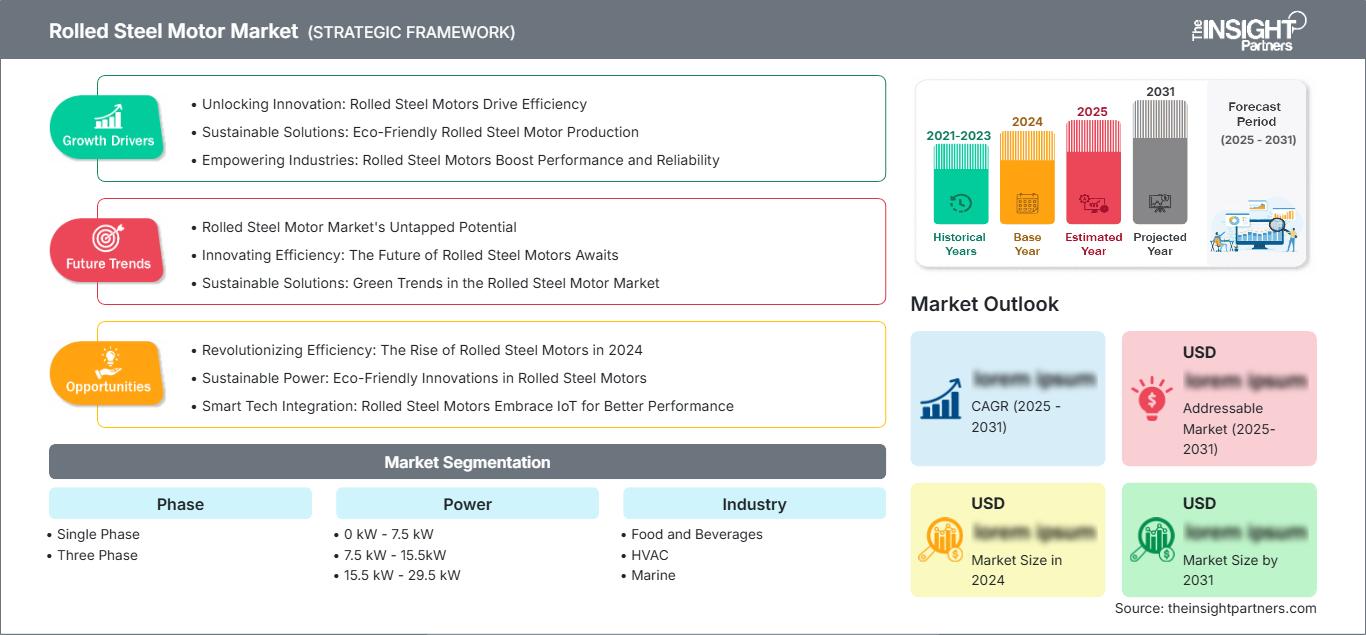
Regional Insights
North America rolled steel motor market
Within the rolled steel motor market, North America is estimated to account for a 24–28% 2025 rolled steel motor market share, with a 4.6–5.0% CAGR through 2034. U.S. dominance in regional consumption is assured by manufacturing reshoring, automated warehousing, HVAC upgrading, food processing, and mining equipment. In Canada, additional consumption will come from mining, pulp and paper, and process industry applications that require dependable medium power motor drive systems. Procurement trends in the region now focus on efficiency considerations, VFD compatibility, and local service support.
The importance of replacement demand arises from the fact that installed motors in industrial facilities can run for extended periods of time under difficult loads. Efficiency considerations, predictive maintenance practices, and VFD compatibility are now becoming more significant requirements. Manufacturing expansion in Mexico and additional cross-border supply chain activity associated with automotive and industrial production will boost demand.
U.S. rolled steel motor Market
The United States represents an estimated 65–69% of North American demand in 2025 and is expected to expand at a 4.7–5.1% CAGR through 2034. Application demand is spread across HVAC applications, food and beverage, mining, materials handling, water systems, and general manufacturing. Industrial motor abilities of ABB Ltd., Rockwell Automation, Inc., Nidec Motor Corporation, Siemens AG, Regal Rexnord Corporation, and WEG can be considered applicable. Distribution channels and aftermarket engineering play an important role because of the lead time, sizing, and availability that define replacement choices.
Industrial motor demand due to manufacturing investments and replacement is strengthened by efficiency and VFD ability. Data centers and logistics facilities indirectly influence the motor market requirements via cooling, pumping, conveying, and auxiliaries. The buyer considers service availability and lead times, and therefore, distribution channels and aftermarket engineering play a critical role.
Europe rolled steel motor Market
Europe is estimated to hold a 27–31% share in 2025 and is projected to grow at a 4.2–4.7% CAGR through 2034. Germany is the leading national market, followed by Italy, France, the UK, and Spain, reflecting strong manufacturing and process-industry bases.
Germany features a strong automation and machinery environment, enabling demand for motors in the areas of assembly line applications, pumps, conveyors, and process equipment. Energy efficiency considerations and industrial decarbonization trends drive the need to replace old units with higher-efficiency equipment and electronic drives. Export of machinery provides additional demand cycles.
The UK, France, Italy, and Spain represent a diversified demand landscape for HVAC, food processing, pulp and paper, marine, and industrial machinery markets. Southern Europe manufacturing and infrastructure investments will enable incremental demand, while energy cost-consciousness will foster demand for efficient motor solutions. Proximity of service and engineering expertise will keep suppliers well-positioned.
APAC rolled steel motor Market
APAC holds an estimated 34–38% share in 2025 and is expected to grow at a 5.1–5.6% CAGR through 2034. China leads regional demand, followed by Japan, South Korea, India, and Australia. Manufacturing expansion, industrial automation, mining, food processing, and infrastructure are central demand drivers.
Industrial efficiency and domestic-manufacturing policies support investment in modern motor systems. India and China provide volume opportunities, while Japan and South Korea favor advanced, reliable solutions. Australia contributes through mining and infrastructure, making medium-power motors relevant across resource-intensive operations.
Middle East & Africa rolled steel motor Market
The Middle East and Africa demand is smaller but strategically relevant across oil and gas support services, water infrastructure, mining, construction, and industrial facilities. Saudi Arabia leads regional demand, followed by the UAE and South Africa, while the rest of MEA remains project-driven.
A modeled 4.0–4.5% CAGR through 2034 reflects infrastructure development, industrial diversification, and replacement demand. Saudi Arabia and the UAE are investing in non-oil industries and utilities, while South African mining supports rugged applications. Energy availability, high temperatures, dust exposure, and serviceability influence specifications.
Segmentation Analysis
Phase
In the rolled steel motor market, the Phase segment is expected to define the market scope to grow at a 4.7–5.1% CAGR during 2026–2034. Three-phase configurations remain dominant for industrial machinery because they provide efficient power transmission, smoother torque, and suitability for continuous-duty loads. Single-phase units retain importance in smaller equipment and facilities where three-phase infrastructure is unavailable.
- Single Phase: Used in smaller pumps, fans, compressors, and auxiliary equipment, single-phase motors benefit from simple electrical installation and broad availability. Their role remains concentrated in low-power applications.
- Three Phase: Preferred for industrial production and continuous-duty equipment because balanced power delivery supports efficiency, reliability, and scalable integration with drives and automation systems.
Power
The Power segment is projected to expand at a 4.8–5.4% CAGR during 2026–2034. Demand varies with equipment duty, torque requirements, and plant scale. Medium-power categories benefit from broad use across pumps, conveyors, HVAC systems, compressors, and processing machinery, while higher ratings serve heavier industrial loads.
- 0 kW - 7.5 kW: Supports distributed low-power machinery, fans, pumps, conveyors, and auxiliary systems where compact construction, availability, and straightforward replacement are priorities.
- 7.5 kW - 15.5kW: Serves mid-sized industrial equipment and HVAC applications, balancing output capability with manageable installation requirements and broad compatibility with standard industrial controls.
- 15.5 kW - 29.5 kW: Provides a strong fit for medium-duty pumps, compressors, conveyors, and process equipment, making this range strategically important for industrial modernization projects.
- Above 29.5 kW: Targets demanding applications requiring higher torque and continuous operation, including mining, marine, pulp and paper, and large process machinery.
Industry
The Industry segment is expected to register a 4.9–5.3% CAGR during 2026–2034. Application diversity reduces dependence on any single end market. Food and beverages and HVAC emphasize reliability and hygiene-related operating requirements, while mining, marine, pulp and paper, and rubber and plastics prioritize ruggedness, continuous duty, and process stability.
- Food and Beverages: Motor demand follows processing, packaging, conveying, refrigeration, and utility equipment, with buyers emphasizing reliable operation, cleanable designs, and maintenance accessibility.
- HVAC: Pumps, fans, cooling systems, and air-handling equipment create recurring motor requirements, while variable-speed control increases the value of efficient motors matched to changing loads.
- Marine: Propulsion auxiliaries, pumps, ventilation, and onboard machinery require robust motor systems capable of handling vibration, moisture, and demanding operating environments.
- Mining: Conveyors, crushers, pumps, fans, and material-handling systems require durable motors with high reliability and serviceability under abrasive, dusty, and heavy-load conditions.
- Pulp and Paper: Continuous production lines depend on reliable motors for pumps, rollers, fans, and process machinery, making thermal performance and maintenance planning important purchasing criteria.
- Rubber and Plastics: Extrusion, molding, mixing, cooling, and conveying equipment use motors across varied duty profiles, encouraging demand for controllable and dependable industrial drive systems.
Opportunity Snapshot
| Industry | Revenue Contribution (High/Medium/Low) | Trend Tag | Adoption Stage |
| Food and Beverages | High | Process Automation | Scaling |
| HVAC | High | VFD Integration | Mature |
| Marine | Medium | Auxiliary Drives | Scaling |
| Mining | High | Heavy Duty | Mature |
| Pulp and Paper | Medium | Mill Automation | Mature |
| Rubber and Plastics | Medium | Smart Drives | Scaling |
Rolled Steel Motor Market Growth Drivers and Impact Analysis
Industrial energy-efficiency requirements
Consumption of industrial electricity leads to the efficiency of motors becoming a real operating cost factor with regard to pumps, fans, compressors, and conveyors. There is an effort to promote the purchase of motors based on their efficiency through IEC efficiency classifications and minimum efficiency legislation in countries. As such, manufacturers are making more efforts to design more efficient motors that are coolable, have better magnetic circuit designs, and operate well with VFDs.
Manufacturing automation and equipment modernization
Automation in factories leads to an increase in controlled motor inventory and also results in increased demands on torque consistency, speed control, uptime, and diagnostics. Production lines tie motors up with drives, controls, sensors, and supervision software systems, thereby preferring solutions that are compatible with the control systems architecture. This will be especially felt in industries such as food processing, packaging, plastics, material handling, and discrete manufacturing, where downtime impacts business.
Industrial capacity expansion in emerging manufacturing centers
New plants and projects in Asia, the Middle East, and Latin America increase the number of installed pumps, fans, compressors, conveyors, and process equipment units. New projects generate both the first-time and replacement demand for equipment. Original Equipment Manufacturers have volume potential while distributors have recurring service needs. Local manufacturing initiatives may lead to local production of equipment and services. Medium power motors have specific significance due to a broad range of applications.
Rolled Steel Motor Market Future Trends
Digital condition monitoring becomes a standard specification
The rolled steel motor market trends increasingly point toward future motor procurement incorporating embedded sensing, connected drives, and software-assisted maintenance workflows. Motor operators in industry will no longer view motors in isolation but will use temperature, vibration, current, and load data to spot abnormalities prior to failure. This approach will help minimize unexpected downtime and optimize maintenance planning, particularly in continuous process operations in which one failed motor can bring an entire assembly line to a standstill. Future suppliers will compete on diagnostics, interoperability, cyber-security, and analytics, not just on efficiency.
Regionalized manufacturing and application-specific motor platforms
Supply chains will likely trend towards regionalization due to the lead time certainty, local service provision, and robustness in case of interruptions in transport and trade. The motor industry may cope with this challenge by developing similar electrical and mechanical designs but customizing the frame design, cooling, housing, bearings, and mounting systems for local uses. This strategy facilitates economies of scale without losing application specificity. India, Southeast Asia, Mexico, and the Middle East can benefit from more assembly and services operations as industrial capacity increases.
Rolled Steel Motor Market Opportunities
Medium-power modernization programs
The rolled steel motor market forecasts support investment in standardized product families optimized for pumps, compressors, conveyors, HVAC equipment, and processing machinery, then paired with drives and monitoring services. A focused modernization program can target plants with aging motors and inconsistent maintenance records, using energy audits to identify replacement candidates. Distributors can strengthen the proposition through stocked configurations, rapid replacement, commissioning support, and spare-parts planning. Manufacturers that combine efficiency, modularity, and application documentation can improve conversion rates while limiting engineering costs. The opportunity is strongest where industrial customers seek predictable operating expenses and faster maintenance turnaround.
Service-led expansion in emerging industrial clusters
Investors and suppliers can build defensible positions by pairing motor distribution with localized repair, testing, commissioning, and condition-monitoring services. Emerging manufacturing clusters often experience shortages of specialized technical support even when hardware is readily available. Establishing service centers near food-processing zones, mining regions, industrial parks, and infrastructure corridors can reduce downtime and create recurring revenue beyond initial equipment sales. Suppliers can use standardized motor platforms to manage inventory while tailoring service packages to local duty conditions. The opportunity is particularly relevant in markets where industrial customers value rapid response and lifecycle support.
Frequently Asked Questions

- Comprehensive Market Sizing and Forecast Analysis
- Detailed Segmentation Analysis
- In-Depth Market Dynamics Assessment
- Regional and Country-Level Insights
- Competitive Landscape and Company Benchmarking
- Strategic Business Intelligence
Recent Reports
Testimonials

The Insight Partners provided valuable market intelligence that supported our global go-to-market strategy. Their team was professional, responsive, and attentive to our feedback, providing thoughtful analysis and helpful methodological clarifications throughout the project.
Junmo Kim Chief Financial Officer (CFO), Enertech Co., Ltd.
The Insight Partners' SCADA System Market report is comprehensive, with valuable insights on current trends and future forecasts. The team was highly professional, responsive, and supportive throughout. We are very satisfied and highly recommend their services.
RAN KEDEM Partner, Reali Technologies LTDs
I requested a report on a very specific software market and the team produced the report in a few days. The information was very relevant and well presented. I then requested some changes and additions to the report. The team was again very responsive and I got the final report in less than a week.
JEAN-HERVE JENN Chairman, Future Analytica
We worked with The Insight Partners for an important market study and forecast. They gave us clear insights into opportunities and risks, which helped shape our plans. Their research was easy to use and based on solid data. It helped us make smart, confident decisions. We highly recommend them.
PIYUSH NAGPAL Sr. Vice President, High Beam Global
The Insight Partners delivered insightful, well-structured market research with strong domain expertise. Their team was professional and responsive throughout. The user-friendly website made accessing industry reports seamless. We highly recommend them for reliable, high-quality research services
YUKIHIKO ADACHI CEO, Deep Blue, LLC.
This is the first time I have purchased a market report from The Insight Partners.While I was unsure at first, I visited their web site and felt more comfortable to take the risk and purchase a market report.I am completely satisfied with the quality of the report and customer service. I had several questions and comments with the initial report, but after a couple of dialogs over email with their analyst I believe I have a report that I can use as input to our strategic planning process.Thank you so much for taking the extra time and making this a positive experience.I will definitely recommend your service to others and you will be my first call when we need further market data.
JOHN SUZUKI President and Chief Executive Officer, Board Director, BK Technologies
I wish to appreciate your support and the professionalism you displayed in the course of attending to my request for information regarding to infectious disease IVD market in Nigeria. I appreciate your patience, your guidance, and the fact that you were willing to offer a discount, which eventually made it possible for us to close a deal. I look forward to engaging The Insight Partners in the future, all thanks to the impression you have created in me as a result of this first encounter.
DR CHIJIOKE ONYIA MANAGING DIRECTOR, PineCrest Healthcare Ltd.Reason to Buy
- Informed Decision-Making
- Understanding Market Dynamics
- Competitive Analysis
- Identifying Emerging Markets
- Customer Insights
- Market Forecasts
- Risk Mitigation
- Boosting Operational Efficiency
- Strategic Planning
- Investment Justification
- Tracking Industry Innovations
- Aligning with Regulatory Trends





 Get Free Sample for