
Rotary Uninterruptible Power Supply Market Share, Demand & Growth by 2034
Coverage: By Type (Single-phase, Three-phase); Application (Data center, Medical, Industry, Retail, Others) , and Geography (North America, Europe, Asia Pacific, and South and Central America)
- Status : Data Released
- Report Code : TIPRE00020660
- Category : Electronics and Semiconductor
- No. of Pages : 150
- Available Report Formats :


- Last update date : September 18, 2026


2025 Market Size
US$ 839.11 Mn
Base year value
2034 Forecast
US$ 1,873.32 Mn
Projected by 2034
CAGR 2026-2034
9.33 %
Growth rate
Addressable Market
US$ 12,111.97 Mn
(2026-2034)
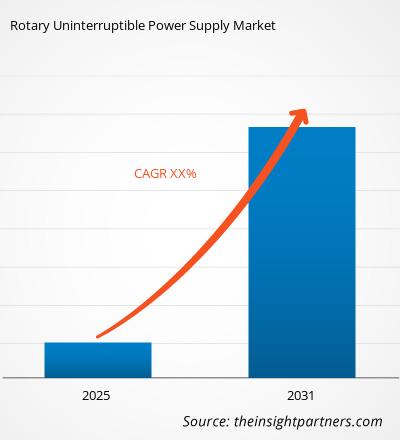
The rotary uninterruptible power supply market was valued at US$ 839.11 Million in 2025 and is projected to reach US$ 1873.32 Million by 2034, expanding at a CAGR of 9.33% during 2026–2034. Growth is supported by rising requirements for continuous power across critical infrastructure, particularly data centers and industrial facilities. Increasing power-density requirements, grid instability, and the need to protect high-value digital infrastructure are strengthening demand for resilient power-protection architectures.
North America remains an important market because of its extensive data-center infrastructure and continued investment in high-availability electrical systems. Demand is supported by hyperscale and colocation expansion, modernization of industrial facilities, and requirements for resilient power during grid disturbances. The Rotary Uninterruptible Power Supply Market size is reinforced by demand for high-power protection solutions with reduced reliance on electrochemical batteries, supporting adoption across large critical-load installations.
Rotary Uninterruptible Power Supply Market Assessment and Insights
- North America: North America is estimated to hold a 27–31% share in 2025 and is projected to grow at a 8.7–9.5% CAGR between 2026–2034, supported by hyperscale data-center construction, critical infrastructure modernization, and high power-density requirements.
- US: The US represents approximately 82–86% of North American demand in 2025, growing at a 8.8–9.6% CAGR between 2026–2034, driven by data-center investment and industrial electrification.
- Europe: Europe is estimated to account for a 25–29% share in 2025 and expand at a 8.9–9.7% CAGR between 2026–2034, with Germany, the UK, France, Italy, and Spain representing major markets.
- Asia Pacific: Asia Pacific is estimated to represent a 30–34% share in 2025 and grow at a 10.0–10.8% CAGR between 2026–2034, led by China, Japan, South Korea, India, and Australia.
- Largest Segment: Three-phase systems are estimated to hold a 72–76% market share in 2025, expanding at a 9.6–10.4% CAGR between 2026–2034 as critical facilities require higher-capacity protection.
- High Growth Segment: Data center applications are estimated to hold a 48–52% market share in 2025, growing at a 10.2–11.0% CAGR between 2026–2034 amid AI-driven infrastructure investment.
- Key companies analyzed in detail: Active Power Solutions Ltd, Eaton Corporation plc, Emerson Electric Co., Falcon Electric, Inc., GE Vernova Inc., Para Systems, Inc., S&C Electric Company, Schneider Electric SE, Tripp Lite, and Piller Power Systems GmbH.
Source: The Insight Partners' analysis based on proprietary research, government publications, company annual reports, investor presentations, industry databases, and expert interviews.
The trend within technology is moving away from legacy backup solutions to more highly scalable solutions focused on availability, efficiency, footprint, and lifecycle costs. Rotary energy storage systems combine mechanical storage of electrical energy with power conditioning devices and may be designed for heavy critical loads. As data center rack density grows, there will be a higher need for power systems that can handle rapidly fluctuating loads without compromising voltage and frequency stability.
Within the forecast period, funding should be allocated towards high-density computing centers, manufacturing facilities, healthcare facilities, and digitally-dependent businesses. The grid constraints, together with increasing concentrations of critical loads, are contributing to this trend. The Rotary Uninterruptible Power Supply Market report highlights increasing supplier focus on remote monitoring, predictive maintenance, modular deployment, and integration with facility energy-management platforms.
Rotary Uninterruptible Power Supply Market Report Scope
| Report Attribute | Details |
|---|---|
| Market size in 2025 | US$ 839.11 Million |
| Market Size by 2034 | US$ 1,873.32 Million |
| Global CAGR (2026 - 2034) | 9.33% |
| Historical Data | 2021-2024 |
| Forecast period | 2026-2034 |
Rotary Uninterruptible Power Supply Market Analysis
Demand is strongly connected to the expansion of facilities, where even brief power disturbances can create disproportionate financial or operational consequences. Data centers, hospitals, industrial automation facilities, and critical commercial operations require continuity and power-quality control. The ecosystem includes UPS manufacturers, flywheel and generator suppliers, electrical-component producers, system integrators, engineering contractors, distributors, maintenance providers, and facility operators.
The rotary uninterruptible power supply market growth is influenced by both new installations and the replacement of aging critical-power infrastructure. Supply dynamics depend on rotating machinery, generators, power electronics, control systems, bearings, flywheels, switchgear, and monitoring components. Larger projects generally require engineering customization, commissioning, redundancy planning, and long-term maintenance agreements, creating a service-intensive value chain beyond initial equipment sales.
Competition combines established electrical-equipment companies with specialized rotary power suppliers. Eaton Corporation plc and Schneider Electric SE benefit from broad critical-power portfolios and relationships with data-center customers, while Emerson Electric Co. and GE Vernova Inc. contribute extensive industrial power expertise. Active Power Solutions Ltd and Piller Power Systems GmbH provide specialized rotary and flywheel capabilities. S&C Electric Company, Falcon Electric, Inc., Para Systems, Inc., and Tripp Lite strengthen competition across specialized and complementary power-protection applications.
Investment priorities are increasingly moving toward systems capable of supporting AI-related load variability, higher facility power density, and digital monitoring. Schneider Electric has developed a high-density UPS architecture for AI infrastructure, while Eaton has expanded its critical-power and data-center manufacturing capabilities. The rotary uninterruptible power supply market analysis, therefore, indicates increasing emphasis on integration, lifecycle service, availability engineering, and compatibility with increasingly dynamic electrical loads.
● REPORT CUSTOMIZATION
Tailor This Report To Align With Your Specific Business Requirements
This report can be customized to align precisely with your business objectives, scope, and target markets. Customization options include tailored segmentation, geography, competitive analysis, and strategic insights to support informed decision-making.
Customize This Report →WHAT YOU CAN ADJUST
- ● Segmentations
- ● Geography
- ● Competitive Analysis
- ● Language Preferences
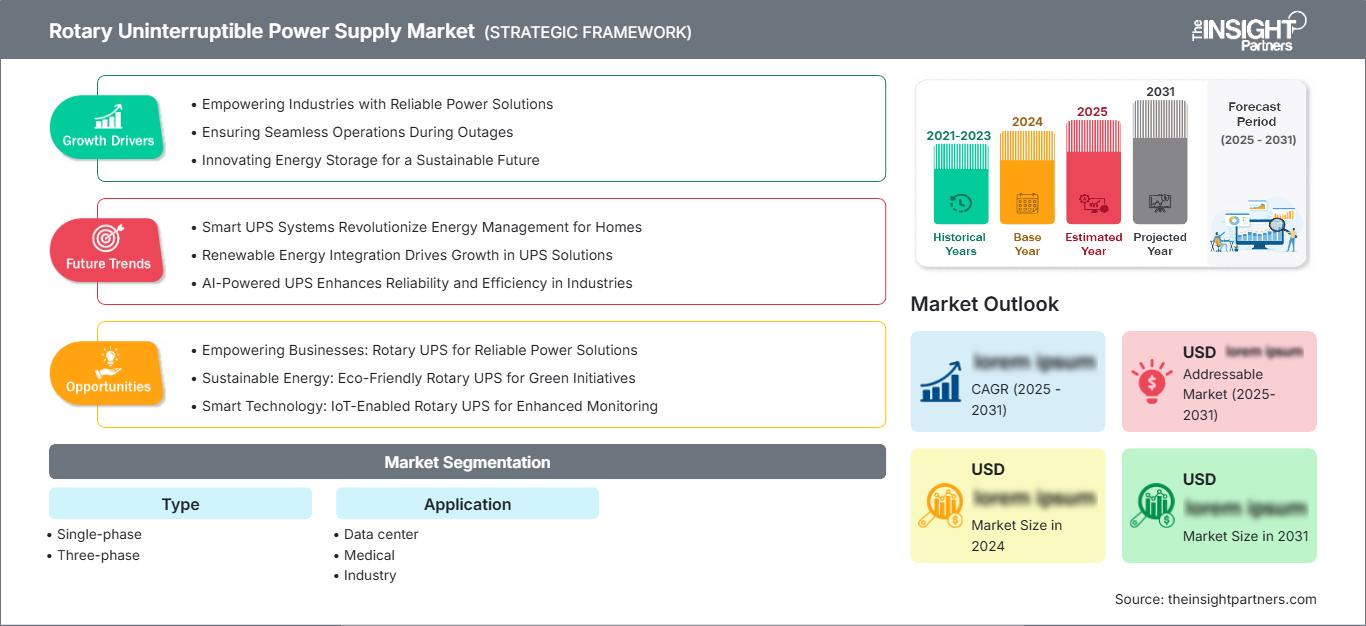
Rotary Uninterruptible Power Supply Market: Strategic Insights
Regional Insights
North America Rotary Uninterruptible Power Supply Market
North America is estimated to account for a 27–31% of the Rotary Uninterruptible Power Supply Market share in 2025 and is projected to grow at a 8.7–9.5% CAGR between 2026–2034. The region benefits from extensive hyperscale and colocation data-center investment, industrial automation, healthcare infrastructure, and mature critical-power distribution. The US remains the principal regional market because of its concentration of large data centers and technology-intensive facilities.
Growing electricity demand from AI infrastructure is increasing attention on power availability, grid constraints, and high-density electrical architectures. Rotary systems can become relevant where operators seek high-power protection and reduced dependence on battery-heavy configurations. Canada contributes through data centers, healthcare, telecommunications, and industrial facilities, while the replacement of aging critical-power equipment creates an additional recurring demand stream.
U.S. Rotary Uninterruptible Power Supply Market
The US represents approximately 82–86% of North American Rotary Uninterruptible Power Supply Market demand in 2025 and is projected to grow at a 8.8–9.6% CAGR between 2026–2034. Data centers remain the leading application, followed by industrial facilities, healthcare, and commercial infrastructure. The installed base of critical electrical equipment also creates replacement and modernization opportunities.
Eaton Corporation plc, Schneider Electric SE, Emerson Electric Co., and specialized suppliers serve different portions of the power-protection ecosystem. AI-driven data-center expansion is increasing requirements for resilient systems capable of handling rapidly changing loads. This is encouraging investment in higher-density UPS architectures, advanced controls, power-quality monitoring, and integrated electrical infrastructure.
Europe Rotary Uninterruptible Power Supply Market
Europe is estimated to hold a 25–29% share of the Rotary Uninterruptible Power Supply Market in 2025 and is expected to grow at a 8.9–9.7% CAGR between 2026–2034. Germany is a leading market, supported by industrial automation and data-center investment. The UK remains important because of its large-scale digital infrastructure and financial services, while France, Italy, and Spain provide additional demand from industrial, healthcare, and commercial facilities.
Germany combines a large industrial base with a growing demand for reliable power infrastructure. The UK has strong requirements for data centers, telecommunications, and digitally intensive businesses. France benefits from industrial and technology investment, while Italy and Spain provide opportunities through manufacturing, healthcare, commercial facilities, and expanding digital infrastructure. European demand is also influenced by energy-efficiency requirements and grid modernization.
APAC Rotary Uninterruptible Power Supply Market
APAC is estimated to represent a 30–34% share in 2025 and is projected to expand at a 10.0–10.8% CAGR between 2026–2034. China leads regional demand, followed by Japan, South Korea, India, and Australia. Data-center construction, semiconductor manufacturing, industrial automation, and digital infrastructure are strengthening requirements for reliable power.
China benefits from large-scale manufacturing and digital infrastructure investment. Japan and South Korea emphasize high reliability across technology-intensive facilities, while India is expanding data-center and industrial capacity. Australia contributes through data centers, mining, and infrastructure. Policy support for digitalization and industrial modernization further improves the long-term adoption environment.
Middle East & Africa Rotary Uninterruptible Power Supply Market
The Middle East and Africa demand is projected to grow at a 8.1–8.9% CAGR between 2026–2034. Saudi Arabia and the UAE are important markets because of data-center development, infrastructure programs, and economic diversification. South Africa provides demand from financial services, telecommunications, healthcare, and industrial facilities.
Energy-intensive infrastructure and grid reliability remain central considerations across the region. Large digital projects increasingly require resilient power architectures, while industrial and commercial modernization creates additional opportunities. The Rest of MEA remains fragmented, with adoption influenced by project financing, electricity reliability, local service availability, and the development of digital infrastructure.
Segmentation Analysis
Type
Three-phase architecture is expected to remain dominant, with the segment projected to grow at a 9.6–10.4% CAGR between 2026–2034. Higher-capacity critical facilities generally require three-phase distribution because it supports larger loads and efficient electrical integration. Single-phase systems remain relevant for smaller installations, specialized equipment, and lower-capacity critical applications.
- Single-phase: Single-phase systems serve smaller critical loads and specialized installations where electrical demand does not justify three-phase architecture. Their relevance remains strongest across compact facilities and selected commercial or medical equipment.
- Three-phase: Three-phase systems address high-capacity applications requiring balanced electrical distribution, scalability, redundancy, and integration with facility-level power infrastructure. Data centers and industrial facilities represent important demand centers.
Application
Data-center applications are projected to expand at a 10.2–11.0% CAGR between 2026–2034, reflecting rapid digital infrastructure investment and increasing electrical demand from AI workloads. Medical, industrial, and retail facilities provide diversified demand where power interruption can affect safety, production, inventory, or business continuity.
- Data center: Data centers require continuous, high-quality power to protect computing equipment and maintain service availability. Increasing rack density and AI workloads are strengthening requirements for resilient, high-capacity UPS architectures.
- Medical: Hospitals and medical facilities require dependable power for diagnostic equipment, operating environments, communications, and critical support systems. Reliability and maintenance continuity are major purchasing considerations.
- Industry: Industrial facilities use UPS systems to protect automation, process-control equipment, robotics, and sensitive electrical loads. Avoiding production interruptions can make resilient power infrastructure economically important.
- Retail: Retail applications include distribution centers, stores, payment systems, refrigeration, and communications infrastructure. Adoption is influenced by business-continuity requirements and the increasing digitalization of retail operations.
Opportunity Snapshot
| Application | Revenue Contribution | Trend Tag | Adoption Stage |
| Data center | High | AI Load Density | Scaling |
| Medical | Medium | Critical Care | Mature |
| Industry | Medium | Process Continuity | Mature |
| Retail | Low | Digital Continuity | Emerging |
Rotary Uninterruptible Power Supply Market Growth Drivers and Impact Analysis
AI Data Centers Increasing High-Capacity Power Protection Requirements
The AI infrastructure is creating changes in the electrical behavior of the data center in terms of increased rack power density as well as rapid load fluctuations. The resulting challenges include increased challenges for UPS systems, power distribution systems, switchgear, and power quality control systems. According to industry insights, the infrastructure connected with AI is pushing the operators towards denser power systems along with more complex electrical architecture. Vertiv has identified the demand for UPS systems that are able to handle fast load fluctuations created by AI. At the same time, Schneider Electric is offering high-density UPS solutions for AI and big electrical loads.
Grid Constraints Strengthening Demand for Resilient Critical Power
Electricity availability is emerging as a strategic challenge for big digital and industrial projects, making the need for reliable power infrastructure on-site even more important. Data center planners are starting to consider aspects such as grid availability, timeframes for connecting to the grid, grid power quality, and backup strategy before constructing their facilities. Eaton highlighted accelerated orders for Electrical Americas in 2025 and attributed part of this growth to data centers, but the company's investments have increased capacity for producing power infrastructure components. This creates a demand for UPS systems that are able to keep the load safe in the event of any disruption and complement the power infrastructure of the facility.
Lifecycle Economics Favoring High-Reliability Power Architectures
More critical facilities now consider the lifecycle economics of the power-protection equipment as opposed to merely the purchase price. Factors such as maintenance considerations, power efficiency, physical size, reliability, ease of component replacements, and vulnerability to downtime impact the lifecycle economics. In some cases, rotary technology may prove more appealing for certain high-power applications due to its design, which may mitigate the need for large battery banks and high-power ride-through. Active Power claims that its flywheel UPS systems are installed in data centers and positions itself based on efficiency, sustainability, and lifecycle economics.
Rotary Uninterruptible Power Supply Market Future Trends
Integration of UPS Systems With Intelligent Energy Management
The rotary uninterruptible power supply market trends are moving toward greater integration between backup power equipment, facility controls, and digital energy-management systems. Future deployments are likely to use continuous monitoring of operating conditions, power quality, thermal behavior, and equipment health to identify abnormal conditions before failures occur. Integration with facility-management platforms can also improve coordination between UPS equipment, generators, switchgear, cooling, and distributed energy resources. Eaton is already developing grid-interactive UPS capabilities and digital tools intended to improve data-center energy management. This trajectory should shift procurement from standalone equipment toward connected critical-power architectures, increasing the importance of software compatibility, cybersecurity, remote diagnostics, and service capabilities.
Higher Power Density and Compact Critical-Power Architectures
Future installations are likely to consider power density as an important aspect, considering the limitations in terms of land, electrical rooms, and construction time of data centers. The Galaxy VXL from Schneider Electric is an example of where the industry is headed with its modular and scalable approach to deliver a power-dense solution for AI and data centers, capable of delivering 1.25 MW of power in a compact form factor. In such a scenario, it will be essential for rotary systems providers to prove that their technology can be integrated into tight layouts and, at the same time, ensure availability and maintainability.
Rotary Uninterruptible Power Supply Market Opportunities
AI-Ready Critical Power Infrastructure
The rotary uninterruptible power supply market forecasts indicate an attractive opportunity around AI-ready data-center infrastructure because accelerated computing is increasing both power density and electrical-load variability. Equipment suppliers can target hyperscale, colocation, and enterprise facilities by developing high-capacity systems compatible with modern switchgear, generators, cooling, and monitoring platforms. Partnerships with data-center developers and engineering firms can improve early specification access, where UPS architecture is often determined during facility design. Suppliers can also differentiate through commissioning support, predictive maintenance, and long-term service agreements. Schneider Electric's collaboration with data-center developers and its expansion of high-density power solutions demonstrate the commercial importance of securing infrastructure capacity ahead of new AI facilities.
Emerging-Market Data Center and Industrial Projects
Emerging markets provide opportunities for suppliers that can combine resilient equipment with localized engineering, service, and financing capabilities. India, Southeast Asia, the Middle East, and selected African markets are expanding digital infrastructure and industrial capacity, creating new requirements for dependable electrical systems. Suppliers can pursue modular project architectures that reduce installation complexity and enable phased capacity expansion. Local partnerships with electrical contractors, distributors, and facility operators can improve technical support and reduce procurement barriers. The opportunity is particularly relevant where grid reliability varies across locations and customers require power continuity without building oversized infrastructure. Equipment providers with established maintenance networks can use service capability as a differentiator alongside efficiency, footprint, and reliability.
Frequently Asked Questions

- Comprehensive Market Sizing and Forecast Analysis
- Detailed Segmentation Analysis
- In-Depth Market Dynamics Assessment
- Regional and Country-Level Insights
- Competitive Landscape and Company Benchmarking
- Strategic Business Intelligence
Recent Reports
Testimonials

The Insight Partners' SCADA System Market report is comprehensive, with valuable insights on current trends and future forecasts. The team was highly professional, responsive, and supportive throughout. We are very satisfied and highly recommend their services.
RAN KEDEM Partner, Reali Technologies LTDs
I requested a report on a very specific software market and the team produced the report in a few days. The information was very relevant and well presented. I then requested some changes and additions to the report. The team was again very responsive and I got the final report in less than a week.
JEAN-HERVE JENN Chairman, Future Analytica
We worked with The Insight Partners for an important market study and forecast. They gave us clear insights into opportunities and risks, which helped shape our plans. Their research was easy to use and based on solid data. It helped us make smart, confident decisions. We highly recommend them.
PIYUSH NAGPAL Sr. Vice President, High Beam Global
The Insight Partners delivered insightful, well-structured market research with strong domain expertise. Their team was professional and responsive throughout. The user-friendly website made accessing industry reports seamless. We highly recommend them for reliable, high-quality research services
YUKIHIKO ADACHI CEO, Deep Blue, LLC.
This is the first time I have purchased a market report from The Insight Partners.While I was unsure at first, I visited their web site and felt more comfortable to take the risk and purchase a market report.I am completely satisfied with the quality of the report and customer service. I had several questions and comments with the initial report, but after a couple of dialogs over email with their analyst I believe I have a report that I can use as input to our strategic planning process.Thank you so much for taking the extra time and making this a positive experience.I will definitely recommend your service to others and you will be my first call when we need further market data.
JOHN SUZUKI President and Chief Executive Officer, Board Director, BK Technologies
I wish to appreciate your support and the professionalism you displayed in the course of attending to my request for information regarding to infectious disease IVD market in Nigeria. I appreciate your patience, your guidance, and the fact that you were willing to offer a discount, which eventually made it possible for us to close a deal. I look forward to engaging The Insight Partners in the future, all thanks to the impression you have created in me as a result of this first encounter.
DR CHIJIOKE ONYIA MANAGING DIRECTOR, PineCrest Healthcare Ltd.Reason to Buy
- Informed Decision-Making
- Understanding Market Dynamics
- Competitive Analysis
- Identifying Emerging Markets
- Customer Insights
- Market Forecasts
- Risk Mitigation
- Boosting Operational Efficiency
- Strategic Planning
- Investment Justification
- Tracking Industry Innovations
- Aligning with Regulatory Trends





 Get Free Sample for