
SATCOM Equipment Market Share, Growth & Forecast by 2034
Coverage: By Component (Transponders, Transceivers, Converters, Amplifiers, Space Antennas, Others); Satellite Type (CubeSat, Small, Medium, Large); Application (Earth Observation and Remote Sensing, Communication, Navigation, Scientific Research and Exploration, Others); End User (Commercial, Military) , and Geography (North America, Europe, Asia Pacific, and South and Central America)
- Status : Data Released
- Report Code : TIPRE00006118
- Category : Electronics and Semiconductor
- No. of Pages : 150
- Available Report Formats :


- Last update date : September 21, 2026


2025 Market Size
US$ 46.25 Bn
Base year value
2034 Forecast
US$ 248.58 Bn
Projected by 2034
CAGR 2026-2034
20.55 %
Growth rate
Addressable Market
US$ 1,187.41 Bn
(2026-2034)
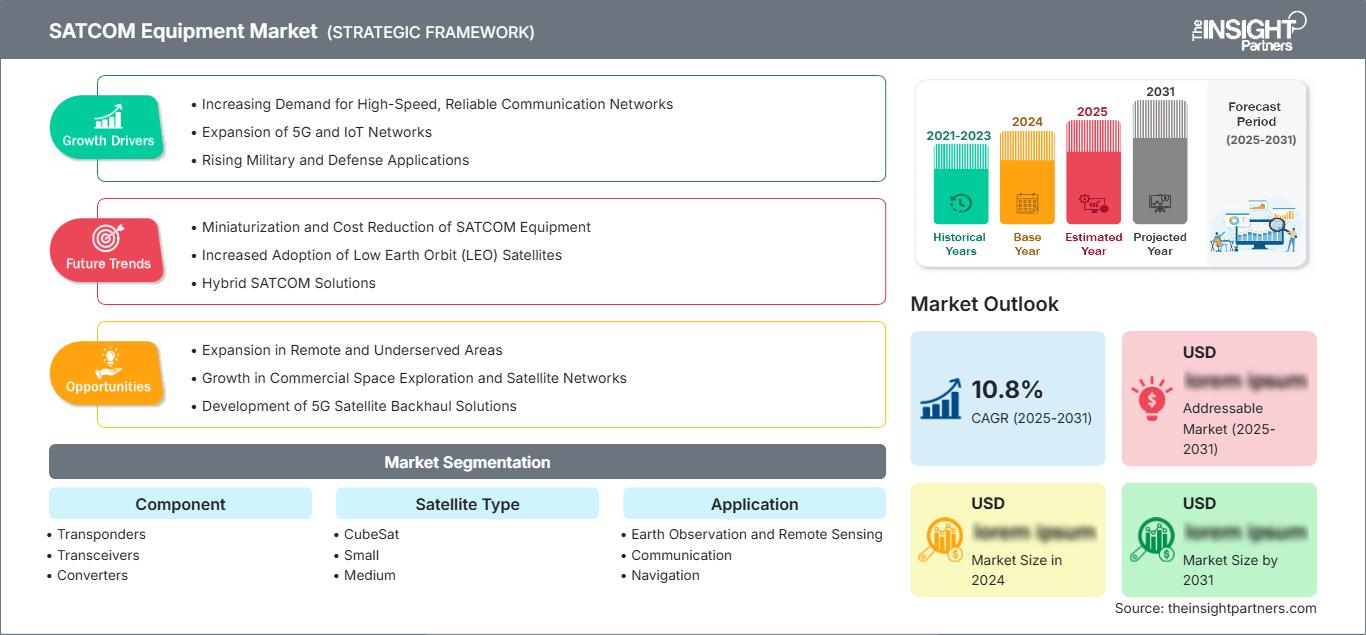
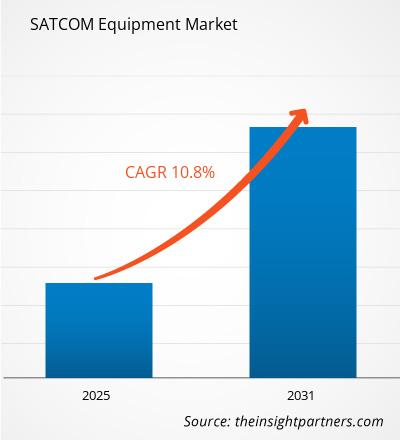
The satcom equipment market was valued at US$ 46.25 Billion in 2025 and is projected to reach US$ 248.58 Billion by 2034, growing at a CAGR of 20.55% during 2026–2034. Growth is driven by multi-orbit connectivity, secure communications, high-throughput payloads, and rising demand for reliable broadband, direct-to-device services, and resilient mission networks across commercial and military users.
North America remains central to satcom equipment market size expansion as defense modernization, aviation connectivity, emergency communications, and commercial satellite broadband programs are accelerating terminal, antenna, transceiver, amplifier, and ground infrastructure upgrades. The region is estimated to hold 36–39% share in 2025 and grow at a CAGR of 19.2–20.1% during 2026–2034, supported by advanced procurement and strong space manufacturing capacity.
SATCOM Equipment Market Assessment and Insights
- North America holds 36–39% share in 2025 and is growing at a CAGR of 19.2–20.1% between 2026–2034, supported by defense SATCOM, airborne connectivity, and ground network modernization.
- US accounts for 82–86% of North America in 2025 and is growing at a CAGR of 19.5–20.4% during 2026–2034 due to military and commercial constellation investments.
- Europe holds 22–25% share in 2025 and is growing at a CAGR of 18.4–19.3% during 2026–2034, led by the UK, Germany, France, Italy, and Spain.
- Asia Pacific represents 26–29% share in 2025 and is growing at a CAGR of 21.6–22.8% during 2026–2034, with China, India, Japan, South Korea, and Australia supporting demand.
- Largest Segment: communication applications hold 48–52% market share in 2025 and are growing at a CAGR of 20.8–21.6% during 2026–2034.
- High Growth Segment: CubeSat and small satellite platforms hold 24–28% market share in 2025 and are growing at a CAGR of 23.5–25.0% during 2026–2034.
- Key companies analyzed in detail: Airbus S.A.S., Ball Aerospace, Cobham Limited, General Dynamics Mission Systems, Inc., Honeywell International Inc., L3Harris Technologies, Inc., MDA Space Ltd., Mitsubishi Electric Corporation, NEC Corporation, and RUAG International Holding AG.
Source: The Insight Partners' analysis based on proprietary research, government publications, company annual reports, investor presentations, industry databases, and expert interviews.
The industry has developed from individual satellite terminals to a system of a multi-orbital communication ecosystem. Equipment development is focused on software-defined payloads, phased-array antennas, compact converters, improved power efficiency, and compatibility of satellites in GEO, MEO, and LEO orbits. SIA noted 4,434 satellites were launched in 2025, along with a rise in revenue of ground network and GNSS equipment, supporting the hardware pull effect due to high density and satellite services.
Funding will keep shifting to resilient tactical networks, aviation broadband, maritime communications, and government-sponsored secure communication systems. New space initiatives in the Asia Pacific and the Middle East region are expanding the target customer base, while North America and Europe pay attention to mission assurance and protected bandwidth. The suppliers providing space-qualified products, production capabilities, cybersecurity solutions, and field service will be able to thrive.
SATCOM Equipment Market Report Scope
| Report Attribute | Details |
|---|---|
| Market size in 2025 | US$ 46.25 Billion |
| Market Size by 2034 | US$ 248.58 Billion |
| Global CAGR (2026 - 2034) | 20.55% |
| Historical Data | 2021-2024 |
| Forecast period | 2026-2034 |
SATCOM Equipment Market Analysis
The satcom equipment market growth is supported by broadband expansion, defense modernization, remote asset monitoring, disaster recovery, and growing reliance on satellite connectivity where terrestrial networks are limited. Requirements include payload electronics, transponders, transceivers, converters, amplifiers, terminals, satellite antennas, and terrestrial gateways. Service providers need more throughput, lower latency, and connectivity among orbital tiers, with equipment capabilities directly impacting service performance.
The supply chain encompasses satellite builders, radio frequency component makers, terminal makers, constellations for launches, defense organizations, telcos, and system integrators. Supply dynamics depend on radiation-tolerant electronics, gallium nitride amplifiers, antenna production capabilities, and spectrum management. Reliability, certification, compatibility with secure waveforms, maintenance over time, and network management cloud integration are key procurement considerations.
satcom equipment market analysis shows a competitive landscape anchored by Airbus S.A.S., Ball Aerospace, Cobham Limited, General Dynamics Mission Systems, Inc., Honeywell International Inc., L3Harris Technologies, Inc., MDA Space Ltd., Mitsubishi Electric Corporation, NEC Corporation, and RUAG International Holding AG. These companies compete through payload design, secure communication terminals, air and land platforms, deployable antennas, and mission-specific electronics.
Strategic positioning is shifting toward multi-domain connectivity. L3Harris Technologies, Inc. is emphasizing resilient hybrid networks, Honeywell International Inc. is expanding aviation SATCOM systems, and Airbus S.A.S. is advancing secure satellite programs. General Dynamics Mission Systems, Inc. supports rugged SATCOM-on-the-move antennas, while MDA Space Ltd., Mitsubishi Electric Corporation, NEC Corporation, and RUAG International Holding AG strengthen national space and payload supply chains.
● REPORT CUSTOMIZATION
Tailor This Report To Align With Your Specific Business Requirements
This report can be customized to align precisely with your business objectives, scope, and target markets. Customization options include tailored segmentation, geography, competitive analysis, and strategic insights to support informed decision-making.
Customize This Report →WHAT YOU CAN ADJUST
- ● Segmentations
- ● Geography
- ● Competitive Analysis
- ● Language Preferences
SATCOM Equipment Market: Strategic Insights
Regional Insights
North America satcom equipment market
North America accounts for 36–39% satcom equipment market share in 2025 and is forecast to grow at a CAGR of 19.2–20.1% during 2026–2034. Defense modernization, commercial broadband, aviation connectivity, and emergency communications are creating demand for rugged terminals, high-gain antennas, secure modems, and ground infrastructure. The U.S. satellite manufacturing base and launch ecosystem further support regional equipment procurement.
Government buyers prioritize encrypted, anti-jam, and interoperable systems, while commercial operators need scalable equipment for LEO and multi-orbit service models. The region benefits from strong participation by L3Harris Technologies, Inc., General Dynamics Mission Systems, Inc., Honeywell International Inc., and Ball Aerospace. Replacement demand is also rising as legacy ground stations and fixed terminals are upgraded to handle higher throughput and software-defined network control.
U.S. satcom equipment Market
The U.S. represents 82–86% of North America in 2025 and is growing at a CAGR of 19.5–20.4% through 2034. Military communications, space-based surveillance, airborne command systems, and satellite broadband are major demand centers. Department of Defense programs continue to require resilient beyond-line-of-sight connectivity across air, land, sea, cyber, and space operations.
Company presence is deep, with L3Harris Technologies, Inc., General Dynamics Mission Systems, Inc., Honeywell International Inc., and Ball Aerospace supporting terminals, secure communications, payloads, and aerospace subsystems. Application trends are moving toward software-defined radios, modular terminal architectures, multi-network aviation systems, and SATCOM-on-the-move capability that enables continuous command, control, intelligence, and broadband services in contested or remote environments.
Europe satcom equipment Market
Europe holds 22–25% share in 2025 and is expected to grow at a CAGR of 18.4–19.3% during 2026–2034. The UK supports protected communications and satellite services, Germany drives military satellite contracts and advanced payload engineering, while France contributes through Airbus S.A.S. and national space capabilities. Italy and Spain add demand through defense, maritime, and institutional connectivity programs.
European buyers emphasize sovereignty, secure communications, and interoperability with NATO missions. Airbus S.A.S., Cobham Limited, and RUAG International Holding AG provide important regional capability across satellite systems, antennas, and aerospace hardware. France and Germany remain leading centers for secure satellite infrastructure, while Spain and Italy support institutional and commercial programs that require terminals, converters, amplifiers, and ground equipment.
APAC satcom equipment Market
APAC accounts for 26–29% share in 2025 and is forecast to grow at a CAGR of 21.6–22.8% between 2026–2034. China excels at large-scale manufacture and launch of satellites, while India develops its communication, navigation, and remote sensing applications. High-reliability electronics and military communication needs are addressed by Japan and South Korea, while Australia bolsters regional connectivity and space situational awareness.
The need is driven by rural broadband, maritime domain awareness, disaster management, border security, and sovereign space endeavors. Local governments are regionalizing their satellite supply chain and promoting the development of indigenous equipment. Mitsubishi Electric Corporation and NEC Corporation are among the leading Japanese vendors, while India and South Korea offer new business prospects for converters, transceivers, amplifiers, antennas, and small satellite communication subsystems.
Middle East & Africa satcom equipment Market
The Middle East and Africa are projected to grow at a CAGR of 18.7–19.8% during 2026–2034. Both Saudi Arabia and the UAE dominate the demand by virtue of their national space policies, military communication, smart cities, and infrastructure surveillance. South Africa meets the regional demands in earth observation, broadcast, and enterprise connectivity, whereas the rest of MEA relies on satellite connectivity to support underdeveloped areas.
Oil fields, marine paths, mining resources, and border activities generate enduring demands for stationary terminals, mobile terminals, and secure communication. The UAE is rising as a regional center for satellite operations and space investments, whereas Saudi Arabia’s infrastructure initiative drives communications resiliency. Import dependence becomes critical for adoption through vendor relationships, regional service centers, and training initiatives.
Segmentation Analysis
Component
Component demand within the satcom equipment market scope is growing at a CAGR of 19.8–21.0% during 2026–2034. Component selection is increasingly defined by power efficiency, bandwidth, digital control, space qualification, and integration with phased arrays or software-defined payloads. Higher satellite density is raising demand for repeatable, compact, and reliable RF chains across space and ground systems.
- Transponders remain essential for relaying communication signals, especially in GEO and high-capacity payloads where frequency translation, channelization, and reliability directly affect service continuity.
- Transceivers support two-way signal transmission in terminals, satellites, and tactical systems, making them critical for compact equipment architectures and mobile broadband applications.
- Converters are needed for frequency conversion across uplink and downlink paths, supporting interoperability across L, S, C, X, Ku, and Ka band systems.
- Amplifiers are gaining importance as higher data rates and smaller antennas require efficient power delivery, thermal control, and rugged performance in demanding operating environments.
- Space Antennas are strategically important because beamforming, high gain, and multi-band capability influence coverage, capacity, and service flexibility across orbit classes.
Satellite Type
Satellite Type demand is growing at a CAGR of 20.9–22.4% during 2026–2034. CubeSat and small satellite adoption is reshaping equipment design around miniaturization, modularity, and lower production cost, while medium and large satellites continue to require advanced payload reliability, higher capacity, and longer mission life for strategic communications.
- CubeSat platforms create demand for miniaturized transceivers, low-power amplifiers, and compact antennas suited to short development cycles and constellation-based missions.
- Small satellites support communications, remote sensing, and IoT missions where scalable production and modular equipment reduce deployment cost and accelerate constellation refresh.
- Medium satellites balance capacity and mission flexibility, supporting communications and navigation payloads that require reliable RF chains and more capable onboard processing.
- Large satellites remain important for high-capacity GEO communications, military payloads, and long-life missions requiring robust transponders, antennas, amplifiers, and thermal management.
Application
Application demand is growing at a CAGR of 20.4–21.7% during 2026–2034. Communication is the largest use case, but navigation, earth observation, and exploration are creating wider equipment requirements. The growth profile reflects rising demand for secure broadband, disaster response, remote sensing data links, and real-time positioning support.
- Earth Observation and Remote Sensing require high-reliability downlink equipment, onboard data handling, and ground antennas to support imaging, climate monitoring, agriculture, and disaster assessment.
- Communication dominates demand because broadband, tactical networks, aviation, maritime, backhaul, and direct-to-device services require continuous investment in payload and terminal equipment.
- Navigation uses specialized payload electronics, timing systems, and ground monitoring infrastructure to maintain signal accuracy, resilience, and coverage for commercial and government users.
- Scientific Research and Exploration relies on deep-space communication, telemetry, tracking, and command equipment where reliability, signal sensitivity, and mission-specific customization are critical.
End User
End User demand is growing at a CAGR of 20.0–21.3% during 2026–2034. Commercial buyers focus on service coverage, bandwidth economics, and scalable gateways, while military users prioritize secure, anti-jam, mobile, and resilient communications. Both groups are increasingly adopting multi-orbit architectures that require adaptable equipment and network control.
- Commercial demand is supported by broadband operators, aviation connectivity, maritime services, telecom backhaul, enterprise networks, and emerging direct-to-device business models.
- Military demand reflects secure command, intelligence, surveillance, reconnaissance, protected communications, and field mobility requirements across contested and remote mission environments.
Opportunity Snapshot
| Application | Revenue Contribution | Trend Tag | Adoption Stage |
| Earth Observation and Remote Sensing | Medium | Data Downlink | Scaling |
| Communication | High | Hybrid SATCOM | Mature |
| Navigation | Medium | Timing Resilience | Scaling |
| Scientific Research and Exploration | Low | Deep Space | Emerging |
SATCOM Equipment Market Growth Drivers and Impact Analysis
Expansion of Multi-Orbit Broadband Networks
LEO, MEO, and GEO constellations are being integrated in order to provide better coverage, reduced latency, and improved service continuity. With the integration, there is a higher need for electronically steerable antennas, multiband terminals, agile frequency conversion, amplification, and network-aware transceivers. The effect can be observed in aviation, maritime communications, remote enterprise communication, and defense mobility. The rising number of broadband subscribers and increasing satellite launches are driving the demand for equipment not only in payload manufacturing but also in user terminals and gateways.
Defense Need for Resilient Communications
The military is increasing its investment in secure SATCOM due to the need for encrypted satellite communications in contested environment situations for command, control, surveillance, and coordination for strikes. SATCOM equipment should be able to facilitate encryption, anti-jamming, low probability of interception, and interoperability with tactical networks. The need for such capabilities increases the demand for rugged terminals, portable antennas, SATCOM on the move systems, and software-defined radios. There may be lengthy procurement cycles, but the contract sizes are large and upgrade opportunities abound.
Growth in Remote Monitoring and Critical Infrastructure Connectivity
Connectivity is required by energy companies, miners, ships, disaster relief teams, and the government in places where terrestrial networks are either not available or are insecure. Satellite devices can help monitor assets, conduct diagnostics remotely, send out distress calls and ensure that services remain uninterrupted. This driver drives up the demand for devices by commercial players beyond broadcasting and military organizations. Buyers want lightweight, energy-efficient terminals that are easy to integrate with the IoT infrastructure.
SATCOM Equipment Market Future Trends
Software-Defined and Reconfigurable Payloads
The satcom equipment market trends will increasingly favor software-defined payloads that can reallocate capacity, adjust coverage, and support new services after launch. Operators will require satellites that continue to have commercial utility even as their traffic patterns, frequency bands, and defensive considerations evolve. This is likely to increase demand for digital processing systems, reprogrammable transponders, electronically-steered antennas, and programmable radio frequency systems. Manufacturers that can provide reliable hardware along with reprogrammable software will be more poised as these constellations become adaptive networks.
Direct-to-Device and Hybrid Terrestrial Integration
The future development of equipment will be guided by connectivity to devices directly and integration of satellite and terrestrial networks. Service providers, satellite operators, and governments are looking into developing solutions that enable communication from ordinary devices in emergency situations or out of a cellular coverage area. This would mean a need for equipment that can support interoperable connectivity based on standards. The potential is not limited to consumers’ messaging applications.
SATCOM Equipment Market Opportunities
Protected Military Terminal Modernization
The satcom equipment market forecasts point to a major opportunity in replacing legacy military terminals with smaller, more resilient, and software-defined systems. The defense customer requirements demand equipment that ensures multi-orbit capability, secure waveforms, rapid deployment, and enhanced cyber resilience. The vendors may target their products to land platforms, airplanes, maritime vessels, and command centers through modular terminal family approaches. The best projects will be those that ensure longevity, security certification, interoperability, and upgrades that reduce sustainment risks.
Localized Space Manufacturing and Ground Infrastructure
Space capabilities require countries to develop their own capability to have payload electronics, antennas, gateways, test equipment, and integration services. This presents a chance for suppliers globally to develop strategic relationships, technology transfer models, and regional assembly capability. Programs in the Asia Pacific region and the Middle East are particularly appealing as governments desire indigenous capability but require internationally proven capability. Suppliers that can offer training, documentation, and lifecycle maintenance will gain more than suppliers of parts.
Frequently Asked Questions

- Comprehensive Market Sizing and Forecast Analysis
- Detailed Segmentation Analysis
- In-Depth Market Dynamics Assessment
- Regional and Country-Level Insights
- Competitive Landscape and Company Benchmarking
- Strategic Business Intelligence
Recent Reports
Testimonials

The Insight Partners' SCADA System Market report is comprehensive, with valuable insights on current trends and future forecasts. The team was highly professional, responsive, and supportive throughout. We are very satisfied and highly recommend their services.
RAN KEDEM Partner, Reali Technologies LTDs
I requested a report on a very specific software market and the team produced the report in a few days. The information was very relevant and well presented. I then requested some changes and additions to the report. The team was again very responsive and I got the final report in less than a week.
JEAN-HERVE JENN Chairman, Future Analytica
We worked with The Insight Partners for an important market study and forecast. They gave us clear insights into opportunities and risks, which helped shape our plans. Their research was easy to use and based on solid data. It helped us make smart, confident decisions. We highly recommend them.
PIYUSH NAGPAL Sr. Vice President, High Beam Global
The Insight Partners delivered insightful, well-structured market research with strong domain expertise. Their team was professional and responsive throughout. The user-friendly website made accessing industry reports seamless. We highly recommend them for reliable, high-quality research services
YUKIHIKO ADACHI CEO, Deep Blue, LLC.
This is the first time I have purchased a market report from The Insight Partners.While I was unsure at first, I visited their web site and felt more comfortable to take the risk and purchase a market report.I am completely satisfied with the quality of the report and customer service. I had several questions and comments with the initial report, but after a couple of dialogs over email with their analyst I believe I have a report that I can use as input to our strategic planning process.Thank you so much for taking the extra time and making this a positive experience.I will definitely recommend your service to others and you will be my first call when we need further market data.
JOHN SUZUKI President and Chief Executive Officer, Board Director, BK Technologies
I wish to appreciate your support and the professionalism you displayed in the course of attending to my request for information regarding to infectious disease IVD market in Nigeria. I appreciate your patience, your guidance, and the fact that you were willing to offer a discount, which eventually made it possible for us to close a deal. I look forward to engaging The Insight Partners in the future, all thanks to the impression you have created in me as a result of this first encounter.
DR CHIJIOKE ONYIA MANAGING DIRECTOR, PineCrest Healthcare Ltd.Reason to Buy
- Informed Decision-Making
- Understanding Market Dynamics
- Competitive Analysis
- Identifying Emerging Markets
- Customer Insights
- Market Forecasts
- Risk Mitigation
- Boosting Operational Efficiency
- Strategic Planning
- Investment Justification
- Tracking Industry Innovations
- Aligning with Regulatory Trends





 Get Free Sample for