
Shore Power Market Share, Growth & Demand by 2034
Coverage: by Component (Switchgear, Transformer, Frequency Converter, Cables and Accessories, Others); Connection (Retrofit, New Installation); Installation (Shipside, Shoreside) , and Geography (North America, Europe, Asia Pacific, and South and Central America)
- Status : Data Released
- Report Code : TIPRE00009077
- Category : Electronics and Semiconductor
- No. of Pages : 150
- Available Report Formats :


- Last update date : July 15, 2026


2025 Market Size
US$ 2.51 Bn
Base year value
2034 Forecast
US$ 5.83 Bn
Projected by 2034
CAGR 2026-2034
9.82 %
Growth rate
Addressable Market
US$ 37.15 Bn
(2026-2034)
The Shore Power Market size is expected to increase from US$ 2.51 Billion in 2025 to US$ 5.83 Billion in 2034, achieving a CAGR of 9.82%. This growth is aided by the push towards electrification of ports, the decrease in the emissions from ships, and the investment made in grid-powered berths. The demand for shore power market is expanding to other types of berths including cruise berths, container berths, Ro-Ro berths, naval berths, and multipurpose berths.
In North America, the rate of adoption of the shore power market is predicted to occur at an estimated 8.8-9.6% CAGR as ports try to align their air quality goals with those of the vessels. The size of the market will be influenced by California’s at-berth emissions regulations, funding from the government for the modernization of ports, investments made in cruise terminals, and container gateways.
Shore Power Market Assessment and Insights
- North America accounted for 27–30% share in 2025 and is growing at an 8.8–9.6% CAGR during 2026–2034, led by berth electrification, port grant funding, cruise operations, and stricter local air-quality rules.
- US represented 78–82% of North America in 2025 and is expanding at an 8.9–9.7% CAGR, supported by West Coast and Gulf port upgrades.
- Europe held 25–28% share in 2025 and is advancing at a 9.0–9.8% CAGR through 2026–2034, with Germany, the UK, France, Italy, Spain, and Nordic countries leading deployment under Fit for 55 and port decarbonization plans.
- Asia Pacific captured 34–38% share in 2025 and is growing at a 10.4–11.3% CAGR during 2026–2034, driven by China, Japan, South Korea, India, and Australia upgrading container, ferry, and cruise terminals.
- Largest Segment New Installation held 62–66% market share in 2025 and is growing at a 9.3–10.1% CAGR as greenfield berths adopt integrated electrical systems.
- High Growth Segment Retrofit accounted for 34–38% market share in 2025 and is expanding at a 10.6–11.5% CAGR as existing ships and terminals prepare for compliance deadlines.
- Key companies analyzed in detail: Blueday Technology AS, Cavotec SA, Cochran Marine LLC, Danfoss A/S, ESL Power Systems, Inc., General Electric Company, igus Inc., Schneider Electric SE, Siemens AG, VINCI Energies S.A.
Source: The Insight Partners' analysis based on proprietary research, government publications, company annual reports, investor presentations, industry databases, and expert interviews.
The introduction of technology has changed from one-off cruise-berth installations to the incorporation of port-wide power supply networks using medium voltage switchgear, transformers, frequency conversions, automated cable management, and control technologies. Current production trends favor the use of modular assemblies, retrofits in containers, and standard interfaces that meet IEC 80005 compatibility due to reduced installation period requirements by vessel owners and non-disruptive solutions for cargo handling by terminal operators. Technology suppliers will compete on the basis of reliability, smaller size, remote monitoring, and maintenance.
Market growth will be influenced by port clusters emerging in Asia, the Middle East, and Latin America, whereby funding of ports infrastructure is becoming increasingly dependent on cleaner logistics routes. In Europe and North America, market regulations are driving investments while shipping lines will ensure ship-side compatibility in order to prevent berth access issues. The market will gain from utility partnerships, renewable energy purchases, and multiple berths projects that convert compliance costs to operational savings.
Shore Power Market Report Scope
| Report Attribute | Details |
|---|---|
| Market size in 2025 | US$ 2.51 Billion |
| Market Size by 2034 | US$ 5.83 Billion |
| Global CAGR (2026 - 2034) | 9.82% |
| Historical Data | 2021-2024 |
| Forecast period | 2026-2034 |
Shore Power Market Analysis
Growth will be bolstered by regulations regarding emissions, port congestion mitigation, and pressures from cargo owners to cut down Scope 3 logistic emissions. The vessel owners are able to turn off auxiliary power engines when berthing, thus reducing emissions of local nitrogen oxide, sulfur oxide, particulates, and noise. The demand for shore power solutions is highest in places where cruise ships, container ships, and ferries stay in port for sufficient periods of time to make connections economically viable.
Port authorities, terminal operators, utilities, engineering firms, equipment manufacturers, ship owners, and classification societies are some of the key participants in the value chain. Dynamics of supply continue to be project-driven due to wide variation in the berth configuration, voltage levels, frequencies, and ship types.
Shore Power Market analysis reveals a highly competitive market with differentiation among electrification consortia and niche players in marine connections. Siemens AG, Schneider Electric SE, General Electric Company, and Danfoss A/S have offerings of electrical grid, conversion, and automation solutions, whereas Cavotec SA, Blueday Technology AS, Cochran Marine LLC, ESL Power Systems, Inc., igus Inc., and VINCI Energies S.A. enhance project execution capabilities and marine connectivity solutions.
In terms of investment considerations, there is a shift from singular demonstration projects to multiberth electrification projects. Strategic positioning requires safety compliance, service coverage, and integration capability of shore and ship-side solutions. Suppliers having modular solutions and retrofit solutions will be better positioned to meet the needs of ports with phased mandate compliance and uncertain vessel traffic.
● REPORT CUSTOMIZATION
Tailor This Report To Align With Your Specific Business Requirements
This report can be customized to align precisely with your business objectives, scope, and target markets. Customization options include tailored segmentation, geography, competitive analysis, and strategic insights to support informed decision-making.
Customize This Report →WHAT YOU CAN ADJUST
- ● Segmentations
- ● Geography
- ● Competitive Analysis
- ● Language Preferences
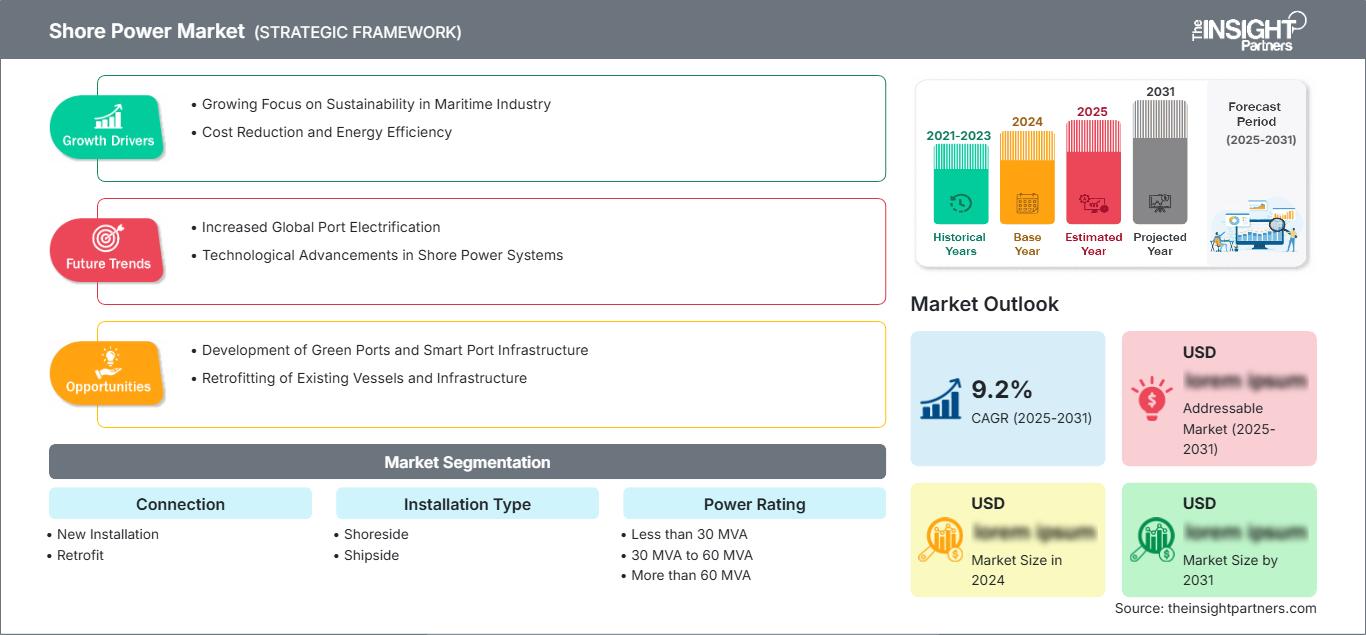
Shore Power Market: Strategic Insights
Regional Insights
North America Shore Power Market
North America held 27–30% share in 2025 and is projected to grow at an 8.8–9.6% CAGR through 2034. The Shore Power Market share is supported by California’s at-berth rules, U.S. port grant programs, Canadian cruise terminal electrification, and utility participation in grid upgrades.
Container gateways, ferry terminals, and cruise ports are the principal demand centers. West Coast projects set technical benchmarks, while Gulf and East Coast ports are increasingly evaluating high-voltage systems for containerized trade, offshore energy support, and passenger operations.
U.S. Shore Power Market
The U.S. held 78-82% share of North America in 2025 and is projected to grow at an 8.9-9.7% CAGR. The demand is primarily driven by California, Washington, New York, Florida, Texas, and Georgia wherein there is increasing pressure on cruise, container, and ferry berths emissions.
Presence of players is higher in system integration, cable management, switchgear, and grid automation. Application is moving from purely cruise terminal connection to terminal network where berths can optimize their capacity as well as reduce the use of diesel engines while loading/unloading passengers/freight.
Europe Shore Power Market
Europe accounted for 25–28% share in 2025 and is advancing at a 9.0–9.8% CAGR, with Germany as a leading country because of Hamburg, Kiel, and other North Sea and Baltic investments. EU rules requiring onshore power supply at major ports are accelerating procurement.
The UK is focusing on cruise, ferry, and container terminals where grid access and harbor air quality are strategic concerns. Germany combines public funding with utility coordination, while France, Italy, and Spain are prioritizing Mediterranean cruise calls, logistics hubs, and port-city emission reduction programs.
APAC Shore Power Market
The share of APAC was 34–38% in 2025 and is expected to increase at a CAGR of 10.4–11.3%. China continues to be the top country since there are large clusters of seaports which are integrating their shore power facilities for container, bulk, and passenger ships.
Japan and South Korea have coordinated their shipbuilding, ferry services, and port decarbonization initiatives, whereas India and Australia are progressing from the feasibility studies to specific improvements.
Middle East & Africa Shore Power Market
Middle East & Africa is projected to grow at an 8.1–8.9% CAGR, led by the UAE because of logistics hub investment, cruise tourism, and smart port initiatives. Saudi Arabia is linking port modernization with industrial diversification and cleaner energy planning.
South Africa and the rest of MEA remain earlier-stage markets, where grid constraints and capital prioritization slow rollout. However, LNG, container, cruise, and free-zone developments create selective opportunities for medium-voltage systems at strategic terminals.
Segmentation Analysis
Connection
Connection is expected to record a 9.8–10.6% CAGR during 2026–2034 as ports and vessel owners balance new berth readiness with retrofit compliance. The Shore Power Market scope under this segment covers both infrastructure built into new terminals and packages installed on existing vessels or quay assets, making interoperability and installation timing critical.
- New Installation remains the largest sub-segment because greenfield terminals can integrate transformers, switchgear, cable routing, and safety systems during construction, reducing retrofit complexity and supporting standardized berth electrification.
- Retrofit is strategically important as existing ships and berths prepare for compliance. Demand is strongest where vessel downtime must be minimized through containerized equipment and modular cable management.
Installation Type
Installation Type is projected to grow at a 9.4–10.2% CAGR during 2026–2034. Shoreside projects dominate capital spending because ports must provide grid access, conversion, and connection equipment, while shipside systems determine vessel eligibility and connection speed. Coordinated deployment is essential to avoid stranded infrastructure.
- Shoreside installations anchor port electrification programs by combining substations, frequency converters, cable handling, and safety controls. Demand is linked to berth utilization, grid capacity, and public funding.
- Shipside installations are gaining importance as shipowners prepare fleets for mandatory connection windows. Retrofit practicality, onboard space, and vessel trading routes influence investment timing.
Power Rating
Power Rating is expected to expand at a 9.6–10.4% CAGR during 2026–2034 as vessel size, hotel loads, reefer demand, and berth function determine capacity needs. Medium and higher ratings are gaining relevance because ports are designing flexible systems that can serve different ship classes without repeated civil works.
- Less than 3 MVA serves ferries, small passenger vessels, workboats, and selected inland or coastal terminals where grid connection requirements are moderate and installation economics are sensitive.
- 3 MVA to 6 MVA addresses many container, Ro-Ro, and multipurpose berths, providing a practical balance between capital cost, operational flexibility, and compatibility with common vessel loads.
- More than 6 MVA is strategically important for cruise ships, mega-container vessels, and high-load terminals where hotel services, reefer plugs, and climate-control demand raise connection capacity needs.
Component
Component is projected to grow at a 9.5–10.3% CAGR during 2026–2034 as ports specify equipment that can manage voltage transformation, frequency differences, safety interlocks, and harsh marine environments. Reliability, compact design, lifecycle service, and compliance with international standards are central purchasing criteria.
- Transformers remain essential for voltage matching between utility supply and vessel systems. Demand is supported by multi-berth projects requiring resilient, efficient, and serviceable electrical architecture.
- Frequency Converters are critical where shore grid frequency differs from vessel requirements, making them central to global interoperability, connection quality, and high-value cruise or container applications.
Opportunity Snapshot
| Connection | Revenue Contribution | Trend Tag | Adoption Stage |
| New Installation | High | Green Berths | Scaling |
| Retrofit | Medium | Fleet Readiness | Emerging |
Shore Power Market Growth Drivers and Impact Analysis
Port emission mandates convert pilots into capital programs
Regulatory pressures represent the most direct motivation since ports and vessel operators need to show tangible reductions in their at-berth emissions. Regulations in California and Europe have made connections at shores a mandatory process rather than an optional one, which is driven by the need for sustainability. This will result in a shift in purchasing decisions as ports will develop plans for multiple berth installations, utility companies will assess substations and load curves, while shipping lines will develop interfaces on board even before route regulations take effect.
Grid-connected berths improve port energy economics
Economic logic is becoming better understood as power purchase, power purchase from renewables, and berth planning become a part of port strategy. In cases where ships plug into shore power sources, the tariff system may be implemented that covers the cost of the infrastructure construction and simultaneously helps to enhance the environmental performance of the locality. Increased usage of shore power for cruise, ferry, and container ships will result in a better payback rate than the one that could be obtained by a single unit.
Shipside retrofits accelerate compliance readiness
Ships are being equipped with the equipment at the shipyard because the process of electrification of the berth has little to no value if the ship cannot be easily connected to the berth. The trend towards retrofitting is growing in terms of container ships, cruise ships, ferries, and Ro-Ro shipping fleet that travels on routes with predictable port calls. Standardization and modularity in solutions reduce engineering effort, down-time, and risks associated with the implementation of the required changes. This trend broadens the addressable market from capital projects in ports to maintenance throughout the trade route.
Shore Power Market Future Trends
Modular shore systems move into container terminals
The Shore Power Market trends will increasingly favor modular, portable, and compact solutions intended for use in busy container terminals. The presence of fixed infrastructure can get in the way of crane activities, cargo handling, and vessel repositioning, which is why ports have begun looking at cable management and flexible connectivity options that allow for mobility. The trend makes it possible to phase in implementation, simplify civil engineering work, and adapt berth capacity to the availability of the vessel.
Port electrification converges with renewable power management
Systems going forward will not only be considered within their context as an ecosystem but rather will be included as part of the larger port energy ecosystem instead of as stand-alone power systems. Ports may find that the coming together of shore power, solar power, battery technology, cargo handling equipment electrification, and vehicle charging will require load management and scheduling, which requires a more proactive approach through software integration. This results in a more strategic approach to shore connection infrastructure, which manages emissions, energy costs, and resilience from one platform.
Shore Power Market Opportunities
Multi-berth electrification programs create bundled contracts
Transition of port authorities from single pilot berths to multiple electric berths provides potential business for those suppliers who can provide engineering and equipment that is repeatable in nature along with long term service. According to the forecasts in the Shore Power Market Forecasts, bundled projects are likely to get funded as the cost of strengthening the grid infrastructure gets distributed with each call made by the vessels. Design-build-maintain models can be targeted by the contractors, whereas the equipment makers can ensure platform specifications.
Shipside packages open aftermarket service revenue
Retrofit programs for vessels have the potential to be a sustainable aftermarket due to the needs for surveying, adapting design, installation, testing, crew training, and regular maintenance. Service providers can generate income by providing onboard packages of services tailored to specific vessel types and navigation zones. Shipping companies like those upgrades that can be installed either during the period of drydocking or even while being in operation without considerable downtime.
Recent Developments
- February 2026: JNPA (Jawaharlal Nehru Port Authority) has issued an EPC tender for the installation of Shore Power at the GTI Container Terminal, amounting to ₹83.57 crore that comes along with a five-year maintenance period as well. This project has been developed as an initiative taken by the Indian nation during its maritime decarbonization transition phase.
- January 2026: ABB has signed contracts with Rotterdam Shore Power (RSP), a joint venture by the Port of Rotterdam and Eneco, an international energy company headquartered in the Netherlands, to engineer and construct shore power systems comprising multiple installations for the Port of Rotterdam. The combined shore power systems are expected to be the largest in the world to date based on total capacity, over 100 megavolt-amperes (MVA). The installations will help to significantly reduce emissions in the Port of Rotterdam and support compliance with the FuelEU Maritime Regulation. The legislation will require all container and passenger ships above 5,000 gross tonnage to use onshore power supply or equivalent zero-emission technology in EU ports starting from 1 January 2030
- October 2025: Cavotec has concluded two more contracts amounting to EUR 9.35 million with one of the biggest container shipping firms in the world. These two contracts are related to shore power systems that will be used both on the new and existing container ships. One contract valued at EUR 5.55 million entails the installation of Cavotec's shore power systems on many existing ships. The projects will be done while the ships are sailing in the area between Asia, the US, and Europe. The deliveries will start from now and will end by the end of 2026.
Frequently Asked Questions

- Comprehensive Market Sizing and Forecast Analysis
- Detailed Segmentation Analysis
- In-Depth Market Dynamics Assessment
- Regional and Country-Level Insights
- Competitive Landscape and Company Benchmarking
- Strategic Business Intelligence
Recent Reports
Testimonials

The Insight Partners' SCADA System Market report is comprehensive, with valuable insights on current trends and future forecasts. The team was highly professional, responsive, and supportive throughout. We are very satisfied and highly recommend their services.
RAN KEDEM Partner, Reali Technologies LTDs
I requested a report on a very specific software market and the team produced the report in a few days. The information was very relevant and well presented. I then requested some changes and additions to the report. The team was again very responsive and I got the final report in less than a week.
JEAN-HERVE JENN Chairman, Future Analytica
We worked with The Insight Partners for an important market study and forecast. They gave us clear insights into opportunities and risks, which helped shape our plans. Their research was easy to use and based on solid data. It helped us make smart, confident decisions. We highly recommend them.
PIYUSH NAGPAL Sr. Vice President, High Beam Global
The Insight Partners delivered insightful, well-structured market research with strong domain expertise. Their team was professional and responsive throughout. The user-friendly website made accessing industry reports seamless. We highly recommend them for reliable, high-quality research services
YUKIHIKO ADACHI CEO, Deep Blue, LLC.
This is the first time I have purchased a market report from The Insight Partners.While I was unsure at first, I visited their web site and felt more comfortable to take the risk and purchase a market report.I am completely satisfied with the quality of the report and customer service. I had several questions and comments with the initial report, but after a couple of dialogs over email with their analyst I believe I have a report that I can use as input to our strategic planning process.Thank you so much for taking the extra time and making this a positive experience.I will definitely recommend your service to others and you will be my first call when we need further market data.
JOHN SUZUKI President and Chief Executive Officer, Board Director, BK Technologies
I wish to appreciate your support and the professionalism you displayed in the course of attending to my request for information regarding to infectious disease IVD market in Nigeria. I appreciate your patience, your guidance, and the fact that you were willing to offer a discount, which eventually made it possible for us to close a deal. I look forward to engaging The Insight Partners in the future, all thanks to the impression you have created in me as a result of this first encounter.
DR CHIJIOKE ONYIA MANAGING DIRECTOR, PineCrest Healthcare Ltd.Reason to Buy
- Informed Decision-Making
- Understanding Market Dynamics
- Competitive Analysis
- Identifying Emerging Markets
- Customer Insights
- Market Forecasts
- Risk Mitigation
- Boosting Operational Efficiency
- Strategic Planning
- Investment Justification
- Tracking Industry Innovations
- Aligning with Regulatory Trends





 Get Free Sample for