
SLAM Technology Market Size, Trends & Demand by 2034
Coverage: by Type (EKF SLAM, Fast SLAM, Graph-Based SLAM, Others); Product (Mechanical LiDAR, Solid-State LiDAR); Installation (Airborne, Ground-Based); Application (Robotics, UAV, AR/VR, Automotive, Others) , and Geography (North America, Europe, Asia Pacific, and South and Central America)
- Status : Data Released
- Report Code : TIPRE00009540
- Category : Electronics and Semiconductor
- No. of Pages : 150
- Available Report Formats :


- Last update date : July 27, 2026


2025 Market Size
US$ 448.61 Mn
Base year value
2034 Forecast
US$ 10,960.26 Mn
Projected by 2034
CAGR 2026-2034
42.63 %
Growth rate
Addressable Market
US$ 35,164.96 Mn
(2026-2034)
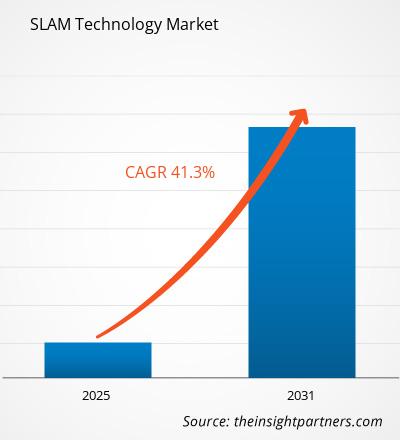
The Slam Technology Market size was valued at US$ 448.61 Million in 2025 and is forecasted to achieve US$ 10,960.26 Million by 2034; it is forecasted to grow with a CAGR of 42.63% between 2026 and 2034. Key factors behind the growth include autonomy of robotic systems, LiDAR-based mapping, UAV navigation, AR/VR spatial anchoring, and automotive perception systems that rely on constant localization in GPS-challenging conditions.
In North America, adoption is anticipated to progress with a projected CAGR of 40–44%, owing to the development of robot automation in warehouses, military robotization experiments, and enterprise AR deployments. The key factors behind the Slam Technology Market size include investments in autonomous mobile robots, industrial digital twins, and mapping tools which reduce reliance on the existing infrastructure while ensuring better navigation performance.
SLAM Technology Market Assessment and Insights
- North America held 38–42% of the Slam Technology Market share in 2025 and is growing at a CAGR range of 40–44% during 2026–2034, led by robotics pilots, autonomous logistics, and AR platforms.
- US represented 78–82% of North America in 2025 and is growing at a CAGR range of 40–44% during 2026–2034.
- Europe accounted for 22–26% share in 2025 and is growing at a CAGR range of 38–42% during 2026–2034, with Germany, the UK, and France leading industrial uptake.
- Asia Pacific held 25–29% share in 2025 and is growing at a CAGR range of 44–48% during 2026–2034, supported by China, Japan, South Korea, and India.
- Largest Segment Robotics held 34–38% market share in 2025 and is growing at a CAGR range of 41–45% during 2026–2034.
- High Growth Segment UAV held 17–21% market share in 2025 and is growing at a CAGR range of 46–50% during 2026–2034.
- Key companies analyzed in detail: Aethon, Inc.; Clearpath Robotics Inc.; Dibotics SAS; GeoSLAM Ltd.; GESTALT Robotics GmbH; Google LLC; KUKA AG; Morpho, Inc.; NavVis GmbH; Wikitude GmbH.
Source: The Insight Partners' analysis based on proprietary research, government publications, company annual reports, investor presentations, industry databases, and expert interviews.
The Slam Technology Market has evolved from localization algorithms for research purposes to perception stacks that integrate sensors such as LIDAR, camera, IMU, and edge processing coupled with cloud-based map management. The production trends are changing due to the small sizes of the sensors and reduced computational costs, allowing SLAM functionalities in small mobile robots, handheld scanners, drones, and AR technology. The vendors have started distinguishing themselves through software efficiency, map durability, integration in fleets, and deployment services, rather than individual hardware specifications.
The forward movement in the market is going to be strong in those regions where automation and digital infrastructure investments converge with safety concerns and labor efficiency concerns. North America and Asia Pacific regions will continue to be preferred markets for the commercialization of the product, while the Europe region will capitalize on the smart manufacturing and construction industry.
SLAM Technology Market Report Scope
| Report Attribute | Details |
|---|---|
| Market size in 2025 | US$ 448.61 Million |
| Market Size by 2034 | US$ 10,960.26 Million |
| Global CAGR (2026 - 2034) | 42.63% |
| Historical Data | 2021-2024 |
| Forecast period | 2026-2034 |
SLAM Technology Market Analysis
SLAM Technology Market growth is fueled by the necessity of localization of devices without GPS, built-in beacons, or static map information. There is an increasing demand in warehouses, hospitals, mines, construction sites, and urban infrastructure projects in which the robots and scanning devices have to function in changing environments. LiDAR SLAM is highly relevant as research conducted in 2025 pays special attention to lightweight solutions, sensor fusion, multi-robotic systems, and deep learning as key development directions.
The ecosystem consists of algorithm developers, robotics manufacturers, LiDAR providers, software developers, cloud services, and system integrators. The supply landscape is getting better as solid-state LiDAR, GPUs, and open navigation algorithms minimize the barriers for implementation. However, the customers will assess the cost according to mapping quality, drift correction capabilities, impact on battery, cybersecurity issues, and capability to create persistent maps during several operational cycles.
The Slam Technology Market Report reveals a highly fragmented market yet one with strategic activity. GeoSLAM Ltd. and NavVis GmbH have products oriented towards reality capture, Clearpath Robotics Inc. and KUKA AG are engaged in integrating navigation intelligence with AMRs, Google LLC contributes via spatial computing and mapping software and GESTALT Robotics GmbH through perception driven industrial automation. Such an environment favors collaboration between hardware vendors and software vendors.
There is a shift towards investable autonomy and not just lab-level performance. Customers prefer those vendors who are able to integrate localization, obstacle detection, fleet management, and workflow integration. There is relevance for Aethon, Inc. in healthcare logistics, Dibotics SAS in 3D perception, Morpho, Inc. in Japan-specific technology ecosystems and Wikitude GmbH in AR spatial anchoring. Competition is thus defined by application-specificity, sensor agnosticism and field level repeatability.
● REPORT CUSTOMIZATION
Tailor This Report To Align With Your Specific Business Requirements
This report can be customized to align precisely with your business objectives, scope, and target markets. Customization options include tailored segmentation, geography, competitive analysis, and strategic insights to support informed decision-making.
Customize This Report →WHAT YOU CAN ADJUST
- ● Segmentations
- ● Geography
- ● Competitive Analysis
- ● Language Preferences
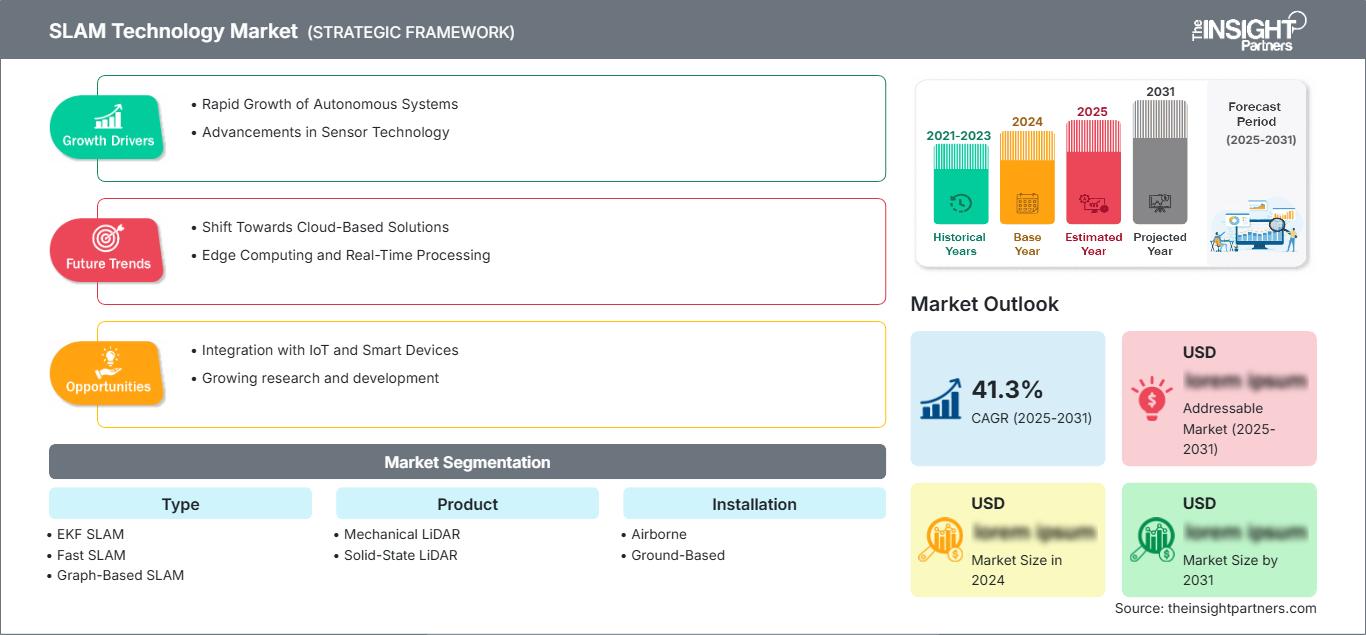
SLAM Technology Market: Strategic Insights
Regional Insights
North America Slam Technology Market
North America represented 38–42% share in 2025 and is projected to grow at a CAGR range of 40–44% during 2026–2034. The Slam Technology Market share is supported by large-scale warehouse automation, defense robotics, autonomous vehicle software, and AR developer ecosystems. Regional demand also reflects strong robotics research networks and investment in industrial digital twins.
Procurement is increasingly linked to measurable navigation reliability, worker safety, and integration with existing enterprise systems. Companies using autonomous mobile robots prioritize SLAM stacks that minimize route downtime and reduce infrastructure retrofits. The region also benefits from high cloud adoption, strong semiconductor access, and customer willingness to pilot advanced mapping solutions in logistics, healthcare, construction, and public safety operations.
U.S. Slam Technology Market
In 2025, the U.S. held 78-82% of the North American market and will witness growth at a CAGR of 40-44% between 2026 and 2034. The drivers will be associated with autonomous material handling, robot testing for last-mile delivery services, defense upgrades, and AR applications where stable spatial references are required. The enterprise customers focus on cybersecurity, real-time processing, and support for deployment.
The company strength lies within robotics platforms, cloud maps, and industrial automation solutions. Google LLC offers ecosystem solutions for AR and maps, Clearpath Robotics Inc. provides autonomous platforms for research purposes, and Aethon, Inc. is focused on hospitals logistics. Other use cases in the U.S. include inspection drones, smart factories, fulfillment centers, and simulations for autonomy validation.
Europe Slam Technology Market
Europe accounted for 22–26% market share in 2025 and will continue to grow at a CAGR rate of 38–42% between 2026 and 2034 owing to the dominance of Germany. Demand in the United Kingdom is observed in the fields of construction scans, railway inspections, and digital twins. Germany is leading in industrial robots, automobile plants, and factory intralogistics, where SLAM helps in flexible automation and material handling.
Smart infrastructure, energy asset inspection, and manufacturing modernization from France, Italy, and Spain help to bolster Europe's market. Generally, the customers in the region tend to demand conformity with safety norms, data protection policies, and traceability of the system. NavVis GmbH, GeoSLAM Ltd., KUKA AG, and GESTALT Robotics GmbH help the European market in this regard.
APAC Slam Technology Market
APAC held a market share between 25-29% in 2025, expected to grow at a CAGR of 44-48% by 2034 led by China. Automation & robotics technology in factories are driven by Japan and South Korea. In addition, India & Australia contribute due to demands for logistics, mining, infrastructure, and drone-based inspections. Smart manufacturing policy support is fast-tracking implementation.
Advantages of scale in the region include electronics value chains, LiDAR manufacturing capabilities, and faster commercialization of autonomous systems. The customers have adopted SLAM to enhance facility performance efficiency, minimize reliance on navigation markers, and facilitate their digital transformation efforts. Morpho, Inc. and its regional partners stand to gain from the robotics foundation of Japan and demands for precise spatial intelligence.
Middle East & Africa Slam Technology Market
MEA and Africa are projected to expand within a 36%-40% CAGR range from 2026 to 2034, with UAE and Saudi Arabia driving growth. The factors responsible include smart cities, inspection of assets in oil and gas industries, construction digitalization, and infrastructure mapping with security requirements. South Africa is a contributor through mining, utilities, and industrial maintenance sectors.
The implementation trend will remain project-driven but not standardized, however, with valuable infrastructures, there are good cases to apply mobile mapping and UAV navigation technologies. Rest of MEA will have needs for ports, airports, energy corridors, and big-scale public projects. The vendors should be ready for tough environmental conditions and long procurement processes.
Segmentation Analysis
Type
Type is expected to grow at a CAGR range of 41–45% during 2026–2034 as users select algorithms according to sensor cost, environment complexity, and accuracy tolerance. The Slam Technology Market scope within type is widening because graph optimization, probabilistic filtering, and particle-based methods increasingly support indoor robots, outdoor UAVs, and mixed-reality mapping.
- EKF SLAM remains relevant where predictable environments and moderate computing resources favor probabilistic filtering, particularly in compact robots, academic platforms, and cost-sensitive systems requiring interpretable localization updates.
- Fast SLAM supports scenarios requiring particle filters and landmark-based mapping, making it useful in mobile robots that need flexible localization under uncertainty without extremely dense environmental representation.
- Graph-Based SLAM is strategically important for high-accuracy mapping, loop closure, and multi-session localization, especially in LiDAR-based robotics, autonomous vehicles, and large-scale facility mapping.
Product
Product is projected to grow at a CAGR range of 40–44% during 2026–2034 as LiDAR architectures shift toward lower cost, smaller form factors, and better energy efficiency. Mechanical systems retain strength in accuracy-demanding use cases, while solid-state products improve scalability for consumer, automotive, and compact industrial applications.
- Mechanical LiDAR holds a strong position in surveying, autonomous vehicle testing, and industrial mapping because rotating systems provide broad field-of-view coverage and proven performance in complex environments.
- Solid-State LiDAR is gaining strategic importance as compact robots, drones, and automotive platforms demand durable, lower-maintenance sensors suitable for volume deployment and embedded perception stacks.
Installation
Installation is estimated to grow at a CAGR range of 42–46% during 2026–2034 as aerial and ground platforms address different navigation constraints. Ground-based deployments dominate structured indoor workflows, while airborne installation is expanding for inspection, emergency response, mining, and infrastructure mapping where GPS is unreliable or unavailable.
- Airborne installations are important for UAV inspection, indoor flight, underground mapping, and emergency response, where compact sensors and rapid mapping improve mission safety and spatial coverage.
- Ground-Based systems remain the adoption base for mobile robots, handheld scanners, and autonomous vehicles because they offer stable payload capacity, repeatable routes, and easier enterprise integration.
Application
Application is expected to grow at a CAGR range of 43–47% during 2026–2034 as SLAM becomes embedded across robotics, UAVs, AR/VR, and vehicles. Robotics remains the largest application because material handling, healthcare delivery, inspection, and service robots require safe autonomy in changing environments without extensive facility retrofits.
- Robotics leads adoption as autonomous mobile robots, service robots, and inspection platforms rely on SLAM for route planning, obstacle avoidance, and persistent facility maps.
- UAV demand is increasing in mining, infrastructure inspection, emergency response, and indoor mapping, where aerial systems need localization in GPS-denied or signal-degraded environments.
- AR/VR uses SLAM to align virtual content with physical spaces, supporting training, industrial guidance, gaming, remote assistance, and spatial computing experiences.
- Automotive applications focus on localization, parking automation, test fleets, and advanced driver assistance, where sensor fusion improves environmental understanding and redundancy.
Opportunity Snapshot
| Application | Revenue Contribution | Trend Tag | Adoption Stage |
| Robotics | High | Fleet Autonomy | Scaling |
| UAV | Medium | Indoor Flight | Scaling |
| AR/VR | Medium | Spatial Anchors | Scaling |
| Automotive | Medium | Sensor Fusion | Emerging |
| Others | Low | Asset Mapping | Emerging |
SLAM Technology Market Growth Drivers and Impact Analysis
Autonomous Mobile Robots Enter Core Operations
Factories, hospitals, warehouses, and campuses are moving autonomous mobile robots from pilots into operational workflows. This raises demand for SLAM because robots must navigate people, carts, pallets, lifts, and temporary obstacles without fixed magnetic tape or extensive markers. The impact is strongest where labor availability is constrained and facilities change frequently. SLAM-enabled robots can reduce route commissioning effort, support continuous remapping, and improve uptime by adapting to layout changes. As more buyers evaluate fleet-level productivity, vendors that combine localization, safety sensing, task allocation, and analytics will capture larger budgets than providers offering isolated navigation modules.
LiDAR and Edge Computing Costs Improve Deployability
Declining sensor size, improved solid-state LiDAR durability, and more efficient edge processors are making SLAM practical across smaller robots, drones, handheld scanners, and AR devices. Earlier deployments often required expensive payloads and specialist tuning, but integrated modules now support faster commissioning and broader use cases. The real-world impact is a wider customer base, including small facilities, contractors, public agencies, and field service teams. Lower deployment friction also supports recurring software revenue through mapping updates, cloud collaboration, and fleet optimization. Suppliers that maintain accuracy while lowering power consumption will be better positioned for high-volume applications.
Digital Twin Programs Require Rapid Reality Capture
Construction, utilities, manufacturing, and public infrastructure teams increasingly need updated spatial records for maintenance, safety, renovation, and remote collaboration. SLAM-based scanners shorten capture time because operators can map indoor and outdoor areas while moving naturally, without relying only on tripod scanning. This improves project economics when facilities are large, congested, or difficult to shut down. The impact extends beyond surveying into asset management, compliance documentation, and simulation. Vendors that connect mobile mapping data with BIM, GIS, and enterprise asset systems can convert one-time scanning projects into recurring information workflows.
SLAM Technology Market Future Trends
Persistent Multi-Session Mapping Becomes Standard
Slam Technology Market trends will increasingly center on persistent maps that allow robots, drones, and AR devices to localize against previously captured environments rather than rebuilding maps every session. This shift improves long-term autonomy because facilities, roads, and construction sites can maintain usable spatial memory across operators and devices. Future systems will combine cloud map repositories, edge localization, and semantic labels that identify doors, racks, hazards, and work zones. The result will be more reliable fleet coordination, faster onboarding of new devices, and stronger value for customers managing multiple dynamic sites.
Semantic SLAM Adds Context to Navigation
Future SLAM systems will not only estimate position and build geometry; they will interpret what objects and spaces mean operationally. By combining LiDAR, vision, AI models, and enterprise metadata, platforms can distinguish temporary obstacles from permanent assets and route robots around safety-critical zones. This will support higher autonomy in warehouses, hospitals, airports, mines, and factories. As semantic understanding improves, SLAM will become part of decision intelligence rather than a background navigation layer, enabling better task planning, automated inspection, and exception handling across complex environments.
SLAM Technology Market Opportunities
Warehouse Fleet Modernization
Distribution centers present a strong investment opportunity because operators want flexible automation without redesigning entire facilities. Slam Technology Market Forecasts indicate that application-level value will concentrate where robots can handle transport, picking support, replenishment, and returns in layouts that change by season. Vendors should prioritize fleet orchestration, low-drift localization, safety certification, and integration with warehouse management systems. Opportunity size will depend on proving payback through labor redeployment, throughput gains, and reduced route engineering. Partnerships with automation integrators can shorten sales cycles and expand repeat deployments across multi-site logistics networks.
Infrastructure Inspection and Emergency Mapping
UAV and handheld SLAM systems create opportunities in bridges, tunnels, mines, power assets, refineries, and disaster response locations where GPS access is weak or conditions are unsafe. Buyers need fast situational awareness, accurate maps, and evidence-grade records for maintenance or response decisions. Vendors can differentiate by ruggedizing hardware, simplifying operator training, and connecting outputs to GIS, BIM, and emergency command systems. Service-based models may expand adoption because public agencies and asset owners often prefer outcome-based mapping over equipment ownership, especially for intermittent inspection missions.
Recent Developments
- June 2026: ABB autonomous forklift technology is moving deeper into factory intralogistics with the launch of the new Flexley Stack F712, an AI-powered autonomous mobile robot designed for pallet transport, warehouse storage and high-density material handling. ABB Robotics has expanded its Autonomous Mobile Robotics portfolio with the launch of the Flexley Stack F712, completing what the company describes as a full interoperable ecosystem across all major Visual SLAM AMR types. The new Flexley Stack F712 brings ABB Robotics’ AI-powered Visual SLAM technology to autonomous forklifts, allowing customers to combine forklifts, tugs and movers on a common navigation, fleet management and software platform.
- February 2026: Emesent chose Geo Week 2026 in Denver, USA, to launch the Emesent GX1. As an integrated, highly accurate all-in-one mobile scanning system combining simultaneous localization and mapping (SLAM), Lidar, real-time kinematic (RTK) georeferencing, cameras and software, the product marks a significant breakthrough for the autonomous mapping technology company.
- April 2023: ABB Robotics unveiled its Visual SLAM technology designed to help autonomous mobile robots better navigate their surroundings. The Zürich, Switzerland-based company said Visual SLAM combines AI and 3D vision technologies to guarantee a superior performance in comparison to other guidance techniques for AMRs. Offering significant advantages over other forms of navigation such as magnetic tape, QR codes, and traditional 2D SLAM that require additional infrastructure to function, Visual SLAM AMRs are being embraced by companies to handle an expanding range of production and distribution tasks, the company said.
Frequently Asked Questions

- Comprehensive Market Sizing and Forecast Analysis
- Detailed Segmentation Analysis
- In-Depth Market Dynamics Assessment
- Regional and Country-Level Insights
- Competitive Landscape and Company Benchmarking
- Strategic Business Intelligence
Recent Reports
Testimonials

The Insight Partners provided valuable market intelligence that supported our global go-to-market strategy. Their team was professional, responsive, and attentive to our feedback, providing thoughtful analysis and helpful methodological clarifications throughout the project.
Junmo Kim Chief Financial Officer (CFO), Enertech Co., Ltd.
The Insight Partners' SCADA System Market report is comprehensive, with valuable insights on current trends and future forecasts. The team was highly professional, responsive, and supportive throughout. We are very satisfied and highly recommend their services.
RAN KEDEM Partner, Reali Technologies LTDs
I requested a report on a very specific software market and the team produced the report in a few days. The information was very relevant and well presented. I then requested some changes and additions to the report. The team was again very responsive and I got the final report in less than a week.
JEAN-HERVE JENN Chairman, Future Analytica
We worked with The Insight Partners for an important market study and forecast. They gave us clear insights into opportunities and risks, which helped shape our plans. Their research was easy to use and based on solid data. It helped us make smart, confident decisions. We highly recommend them.
PIYUSH NAGPAL Sr. Vice President, High Beam Global
The Insight Partners delivered insightful, well-structured market research with strong domain expertise. Their team was professional and responsive throughout. The user-friendly website made accessing industry reports seamless. We highly recommend them for reliable, high-quality research services
YUKIHIKO ADACHI CEO, Deep Blue, LLC.
This is the first time I have purchased a market report from The Insight Partners.While I was unsure at first, I visited their web site and felt more comfortable to take the risk and purchase a market report.I am completely satisfied with the quality of the report and customer service. I had several questions and comments with the initial report, but after a couple of dialogs over email with their analyst I believe I have a report that I can use as input to our strategic planning process.Thank you so much for taking the extra time and making this a positive experience.I will definitely recommend your service to others and you will be my first call when we need further market data.
JOHN SUZUKI President and Chief Executive Officer, Board Director, BK Technologies
I wish to appreciate your support and the professionalism you displayed in the course of attending to my request for information regarding to infectious disease IVD market in Nigeria. I appreciate your patience, your guidance, and the fact that you were willing to offer a discount, which eventually made it possible for us to close a deal. I look forward to engaging The Insight Partners in the future, all thanks to the impression you have created in me as a result of this first encounter.
DR CHIJIOKE ONYIA MANAGING DIRECTOR, PineCrest Healthcare Ltd.Reason to Buy
- Informed Decision-Making
- Understanding Market Dynamics
- Competitive Analysis
- Identifying Emerging Markets
- Customer Insights
- Market Forecasts
- Risk Mitigation
- Boosting Operational Efficiency
- Strategic Planning
- Investment Justification
- Tracking Industry Innovations
- Aligning with Regulatory Trends





 Get Free Sample for